Skip to content
recaplica

    One moment: security check

    Cloudflare wants to make sure you're not a robot. Tick the box below and your search will continue on its own.

    IT
    recaplica What Is Neoclassicism? The Movement in Art and Literature
    © 2026 Recaplica · recaplica.com — All rights reserved
    Home › Literature

    What Is Neoclassicism? The Movement in Art and Literature

    By Recaplica Newsroom · Updated on September 28, 2026

    What to print

    Page numbers appear when printing with default margins.

    Slides

    Choose a cut

    Flash10 slidesThe essential thread, to present in classFull15 slidesEvery chapter and the deeper detail

    Both come with speaker notes.

    Telegram channel
    recaplica Clear in 30 seconds, yours in 10 minutes.
    In 30 seconds Key points Figures Deep dive Slides Myths Mind map Quiz Flashcards FAQ

    In 30 seconds quick read

    Neoclassicism is the artistic and literary movement that, starting around 1750, brought back the balance and restraint of Greek and Roman art as a reaction against the ornate excess of Rococo. The German scholar Johann Joachim Winckelmann set out its principles in 1755 and expanded them in 1764, while the excavations at Herculaneum and Pompeii gave artists direct models of antiquity to study. In painting, clean drawing defines the work of David and Ingres; in sculpture, composed forms define Canova and Thorvaldsen; in architecture, temple forms define Schinkel's buildings; in literature, the English tradition runs through Dryden, Pope, Swift, and Johnson. Preromanticism grows in that same span of time, bringing its own attention to feeling and melancholy.

    Key Points

    • The movement takes shape around 1750 as a reaction against Rococo, driven forward by the excavations at Herculaneum and Pompeii.
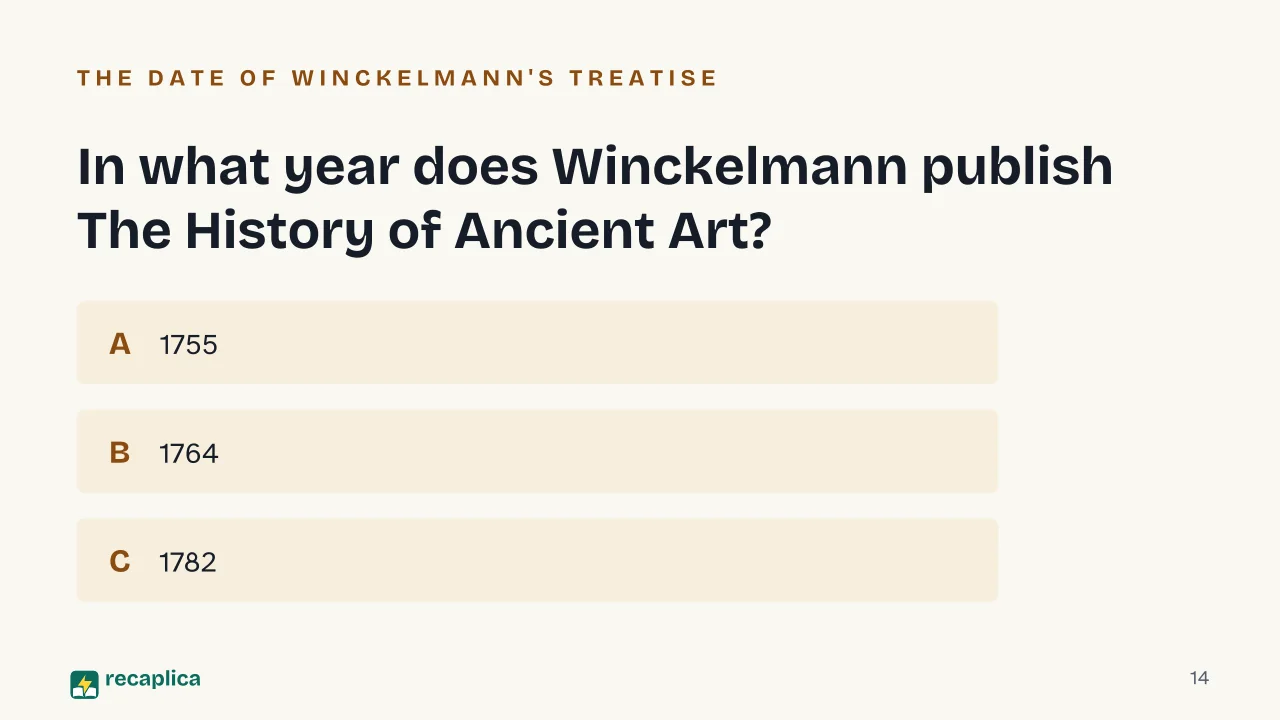
    • Winckelmann publishes Thoughts on the Imitation of Greek Works in 1755 and The History of Ancient Art in 1764, laying out Neoclassical theory.
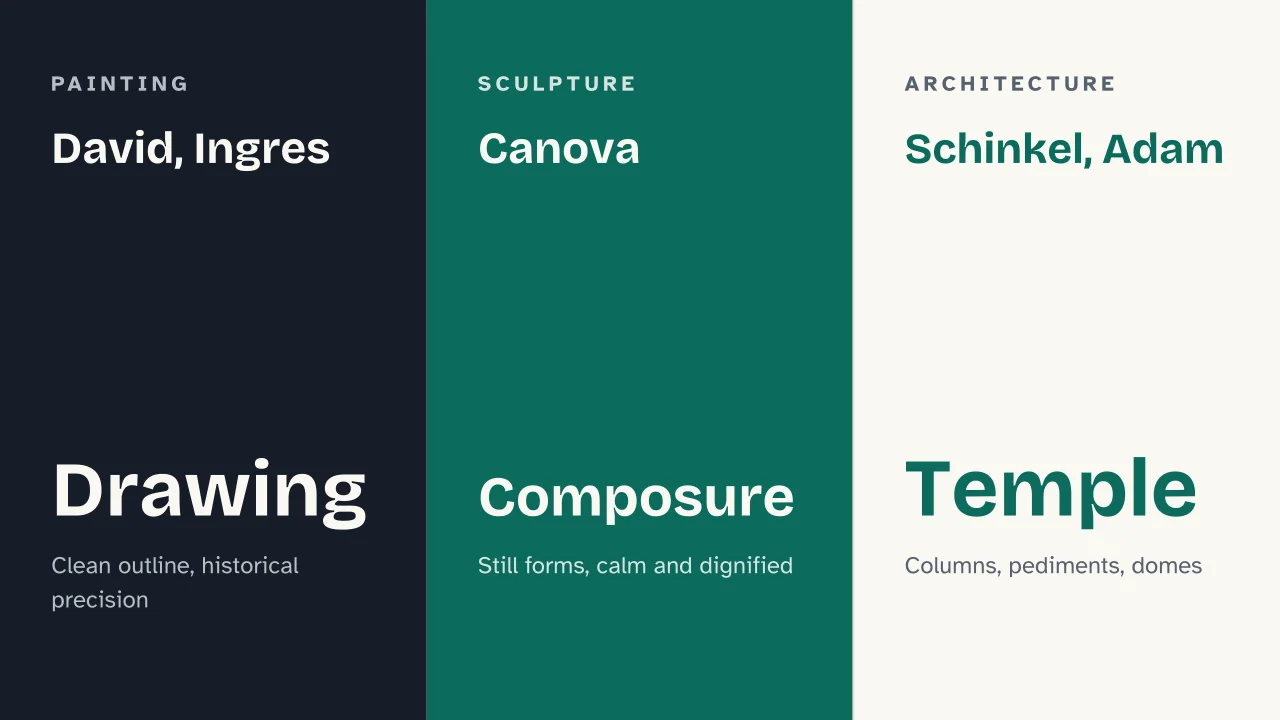
    • Painting is defined by David and Ingres and their clean drawn line; sculpture by the composed forms of Canova and Thorvaldsen; architecture by temple forms and columns, as in Schinkel's work.
    • In literature, the English tradition runs through the Restoration Age, the Augustan Age, and the Age of Johnson, with Dryden, Pope, Swift, and Johnson.
    • Preromanticism emerges in the same decades as Neoclassicism, and the two sensibilities coexist in the second half of the eighteenth century.

    Key figures

    • 1755 Winckelmann publishes Thoughts on the Imitation of Greek Works, the movement's first theoretical text Source: Treccani, Storia della civiltà europea
    • 1764 Winckelmann publishes The History of Ancient Art, the book that establishes Neoclassical theory Source: Treccani, Storia della civiltà europea
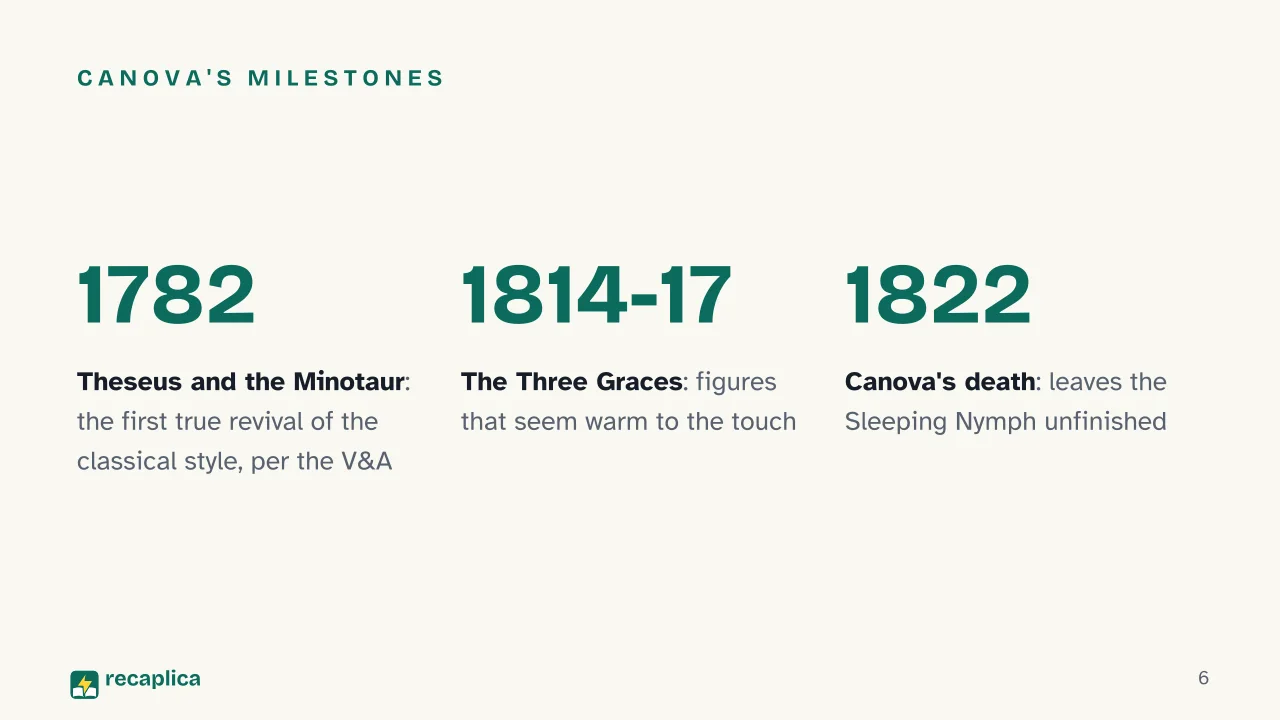
    • 1782 Antonio Canova carves Theseus and the Minotaur, described as the first true revival of the classical style Source: Victoria and Albert Museum

    Deep Dive

    An ideal born from the rejection of Rococo

    According to Tate, Neoclassicism is “a particularly pure form of classicism that emerged from about 1750”: a form of classicism that, unlike the Renaissance revival of antiquity nearly three centuries earlier (see the Renaissance for a comparison of the two), takes hold in the middle of the eighteenth century. TheArtStory places the movement’s origin “in opposition to the overly decorative and gaudy styles of Rococo and Baroque”: painters, sculptors, and architects set aside scrollwork, gilding, and movement in favor of a plainer visual language.

    The archaeological excavations of the time give this shift a concrete push. Treccani recounts how, across Rome, Tivoli, Herculaneum, and Pompeii, temples, statues, and pottery came back to light: direct models that artists could study and imitate, rather than reconstructing antiquity from texts alone.

    Winckelmann’s aesthetic

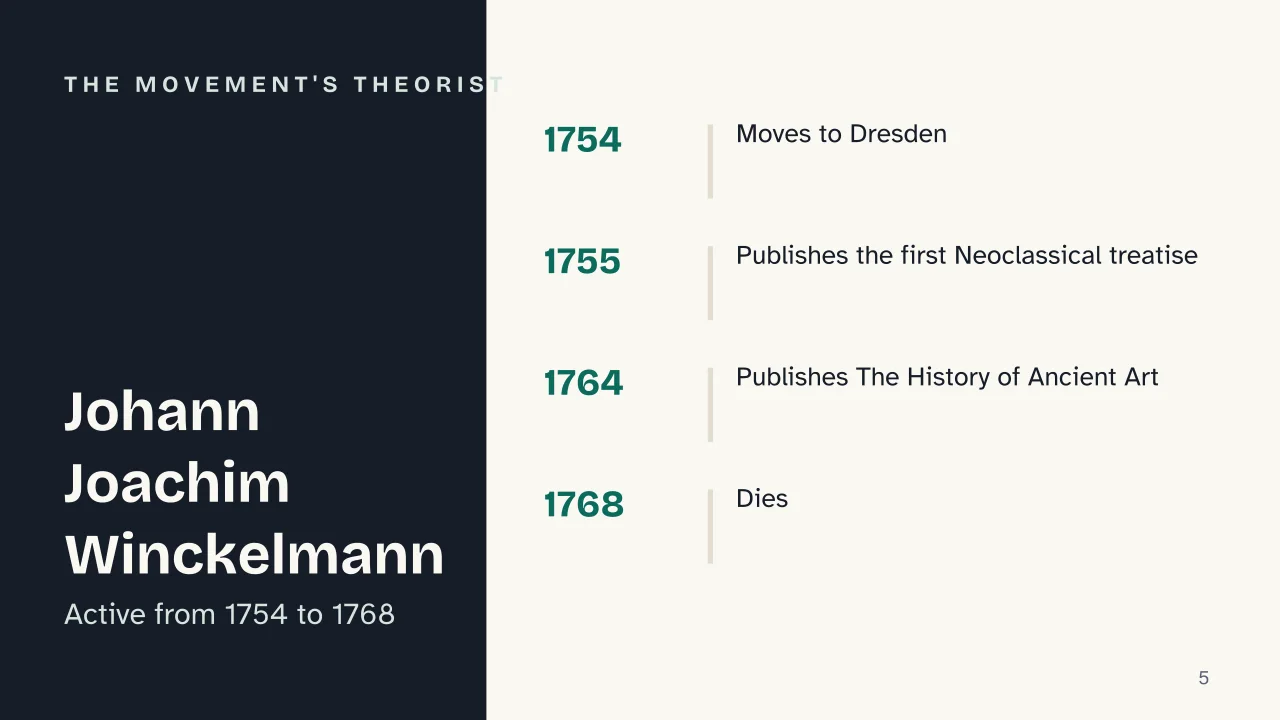
    The theoretical groundwork for the movement is largely the work of the German scholar Johann Joachim Winckelmann, who, according to Treccani, “affirms the need for a clear, rational art, grounded in the imitation of the ancients.” Winckelmann moves to Dresden in 1754; in 1755 he publishes Thoughts on the Imitation of Greek Works and settles in Rome, where he gains access to the city’s ancient collections and travels to Naples to visit the excavations at Herculaneum and Pompeii; in 1764 he publishes The History of Ancient Art. He dies in 1768.

    It is in these writings that the movement’s most recognizable phrase appears: for Winckelmann, Greek art possesses “noble simplicity and quiet grandeur” (in the German original, “edle Einfalt und stille Grösse”). For him, “the only way for us to become great, and if possible inimitable, is by imitating the ancients.”

    Painting, sculpture, architecture

    Across the visual arts, Neoclassicism takes on different traits depending on the medium. Treccani describes painting as dominated by “the complete triumph of outline, meaning drawing,” with “scrupulous historical precision” in reconstructing ancient settings and costume: its central figure is Jacques-Louis David, whose pupil Jean-Auguste-Dominique Ingres carries the style forward.

    Sculpture, by contrast, is built on “Greek eurythmy” and “Olympian serenity,” with figures “still, calm, and dignified in bearing.” Treccani calls Antonio Canova “the founder of Neoclassical sculpture, not only in Italy but beyond it”: the Victoria and Albert Museum dates his Theseus and the Minotaur to 1782, calling it the first true revival of the classical style, and The Three Graces to 1814-17, where Canova is described as “re-creating the sense of living flesh” in marble. His last work, Sleeping Nymph, remained unfinished at his death in 1822. In architecture, the language is drawn from ancient temples: colonnaded porticoes, triangular pediments, and domes, as in Karl Friedrich Schinkel’s buildings in Berlin and the work of the Adam brothers in Britain.

    Practical example: a painting that recounts a Roman historical episode with still figures, clean outlines, and a limited, decisive palette is likely a Neoclassical work; the same subject rendered in soft, blended brushwork and bright colors would instead belong to the Rococo taste the movement rejected.

    Neoclassical literature, between England and Italy

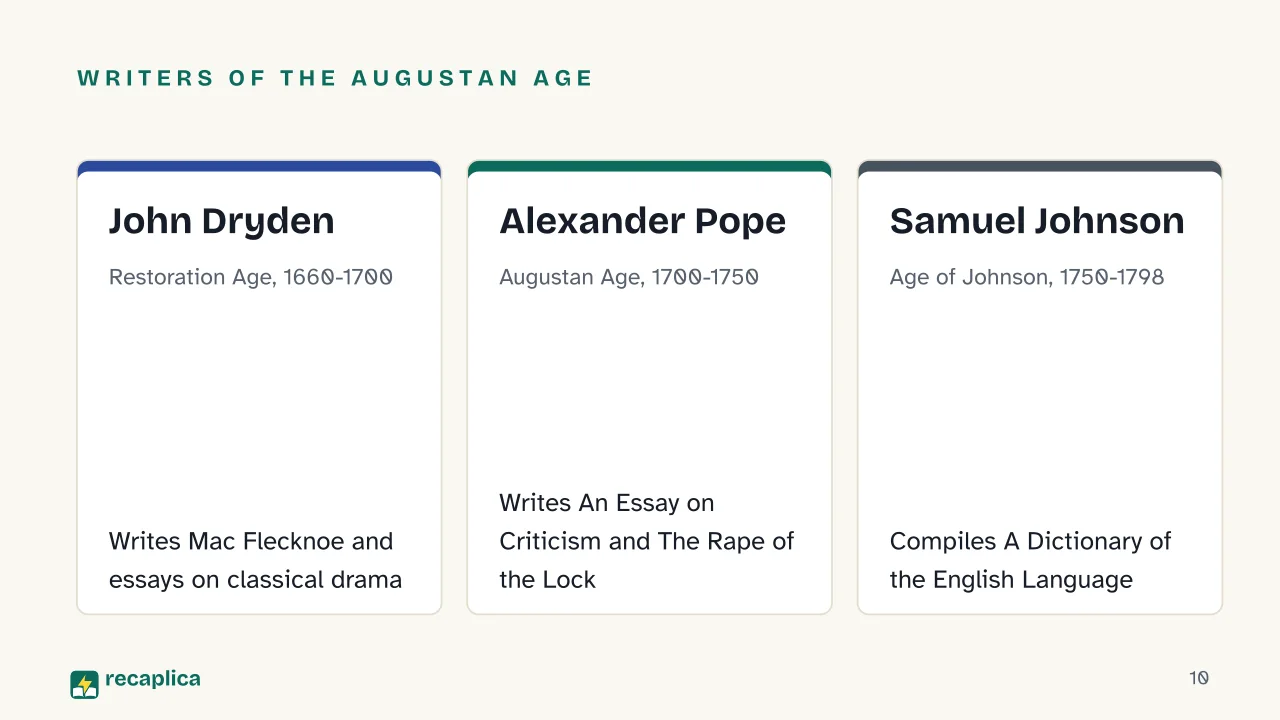
    The literary side of Neoclassicism is best documented in the English tradition. Encyclopedia.com defines it as “a resurgence of classical taste and sensibility,” resting on a view of human nature as “dualistic, flawed, and needing to be curbed by reason and decorum,” with stylistic traits built on “balanced antithesis, symmetry, restraint, and order.” The same source periodizes the movement in England from 1660, the year of the Stuart Restoration, through 1798, when Wordsworth publishes the Lyrical Ballads: three phases, the Restoration Age (1660-1700) of John Dryden, the Augustan Age (1700-1750) of Alexander Pope and Jonathan Swift, and the Age of Johnson (1750-1798) of Samuel Johnson.

    In Italy, literary Neoclassicism has its own voice in Giuseppe Parini, an Enlightenment poet who shares its restraint and formal discipline; Ugo Foscolo also passes partly through this current.

    Neoclassicism and Preromanticism, two sensibilities in the same century

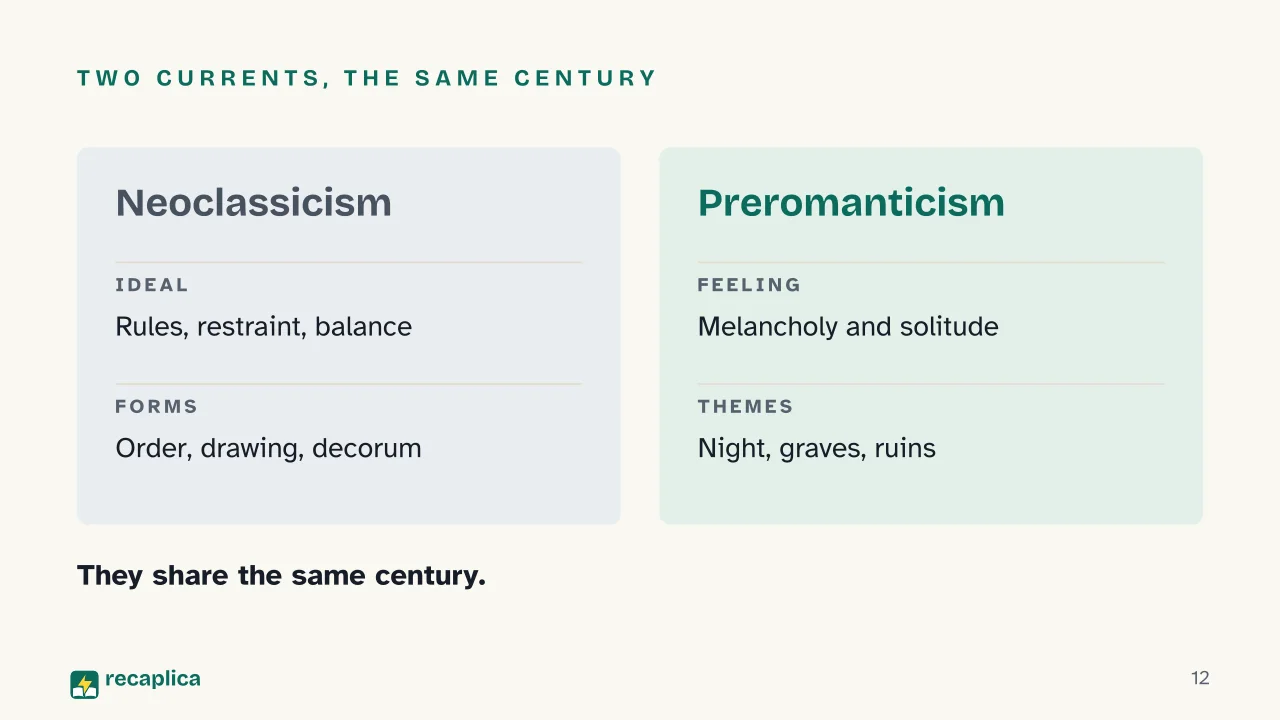
    The two currents do not follow one another: they emerge and grow within the same span of time. The Italian Wikipedia entry on Preromanticism places the phenomenon “in the final decades of the eighteenth century,” the same period in which Neoclassicism takes hold, describing it as a reaction to the “gradual suppression” of human instinct, feeling, and passion in favor of “pathos and melancholy” and “the pursuit of solitude.”

    NeoclassicismPreromanticism
    IdealBalance, restraint, orderFeeling, melancholy, instinct
    ModelGreek and Roman artNature and interiority
    ExamplesCanova, David, WinckelmannGray, Macpherson, Rousseau

    The clearest case of this overlap, in Italy, is Foscolo: Of the Sepulchres joins classical structure and restraint with a devoted, sentimental treatment of memory and affection.

    Slide deck

    Slides ready to download and make your own in PowerPoint or Google Slides, with speaker notes. Pick the Flash cut or the Full one.
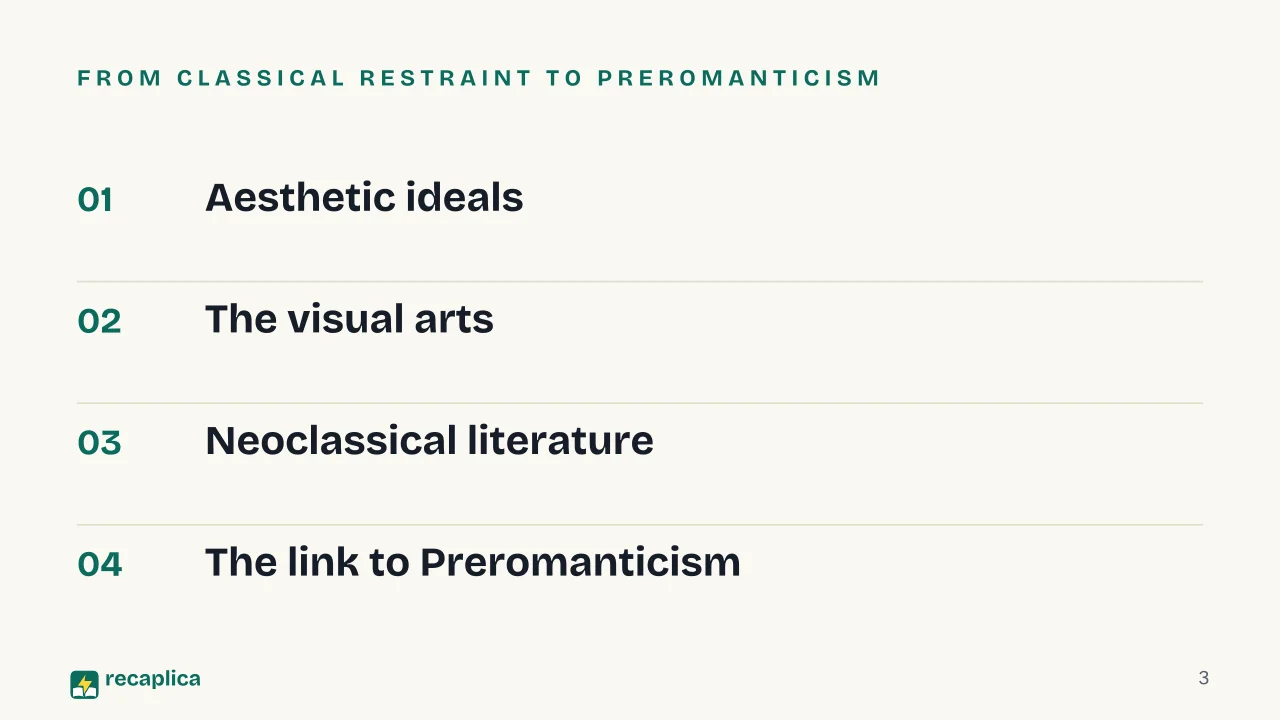
    Slide 1 of the presentation on What Is Neoclassicism? The Movement in Art and Literature: NeoclassicismSlide 2 of the presentation on What Is Neoclassicism? The Movement in Art and Literature: Why did classical restraint come back into fashion in the late eighteenth century, after decades of Rococo splendor?Slide 3 of the presentation on What Is Neoclassicism? The Movement in Art and Literature: From classical restraint to PreromanticismSlide 4 of the presentation on What Is Neoclassicism? The Movement in Art and Literature: Chapter 01: Aesthetic idealsSlide 5 of the presentation on What Is Neoclassicism? The Movement in Art and Literature: The movement's theoristSlide 6 of the presentation on What Is Neoclassicism? The Movement in Art and Literature: Canova's milestonesSlide 7 of the presentation on What Is Neoclassicism? The Movement in Art and Literature: Chapter 02: The visual artsSlide 8 of the presentation on What Is Neoclassicism? The Movement in Art and Literature: David, Ingres · Canova · Schinkel, AdamSlide 9 of the presentation on What Is Neoclassicism? The Movement in Art and Literature: Chapter 03: Neoclassical literatureSlide 10 of the presentation on What Is Neoclassicism? The Movement in Art and Literature: Writers of the Augustan Age: John Dryden, Alexander Pope, Samuel JohnsonSlide 11 of the presentation on What Is Neoclassicism? The Movement in Art and Literature: Chapter 04: The link to PreromanticismSlide 12 of the presentation on What Is Neoclassicism? The Movement in Art and Literature: Two currents, the same centurySlide 13 of the presentation on What Is Neoclassicism? The Movement in Art and Literature: Neoclassicism is not just columns and temples.Slide 14 of the presentation on What Is Neoclassicism? The Movement in Art and Literature: In what year does Winckelmann publish The History of Ancient Art?Slide 15 of the presentation on What Is Neoclassicism? The Movement in Art and Literature: The full Recap on Recaplica
    Flash10 slidesThe essential thread, to present in classFull15 slidesEvery chapter and the deeper detail

    Common myths

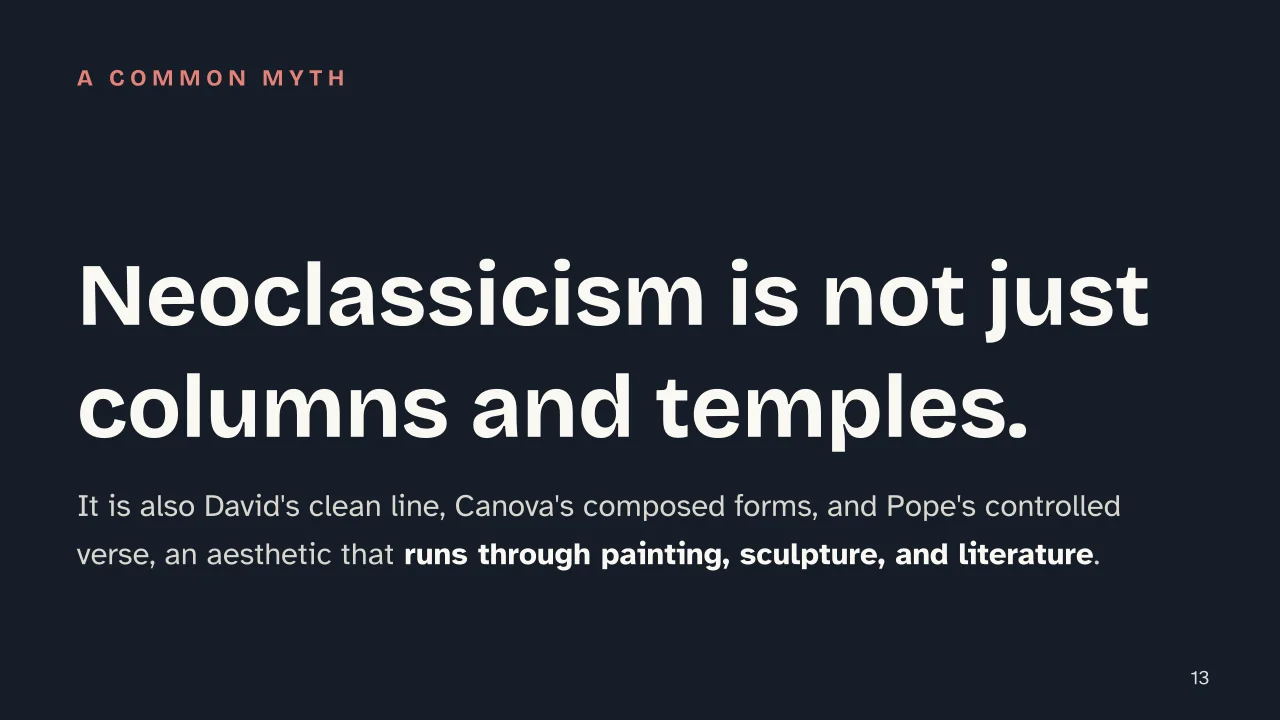
    • ✗ Myth Neoclassicism is just columns and temples.

      ✓ Reality Treccani describes distinct traits across the arts: a drawn, linear style in painting, composed forms in Canova's sculpture, and temple forms only in architecture. Reducing the movement to buildings misses two of its three visual arts.

    • ✗ Myth Winckelmann, the movement's theorist, was Italian.

      ✓ Reality Winckelmann was German. He moved to Dresden in 1754 and then to Rome in 1755, where he wrote his major works on ancient art (Treccani, Storia della civiltà europea).

    • ✗ Myth Preromanticism began only after Neoclassicism had run its course.

      ✓ Reality The Italian Wikipedia entry on Preromanticism places it in the final decades of the eighteenth century, the same span in which Neoclassicism flourishes. What changes is the sensibility toward the past and toward feeling.

    Mind map

    Drag the background to move around and the nodes to reposition them; use − and + to collapse and expand branches.
    Customize
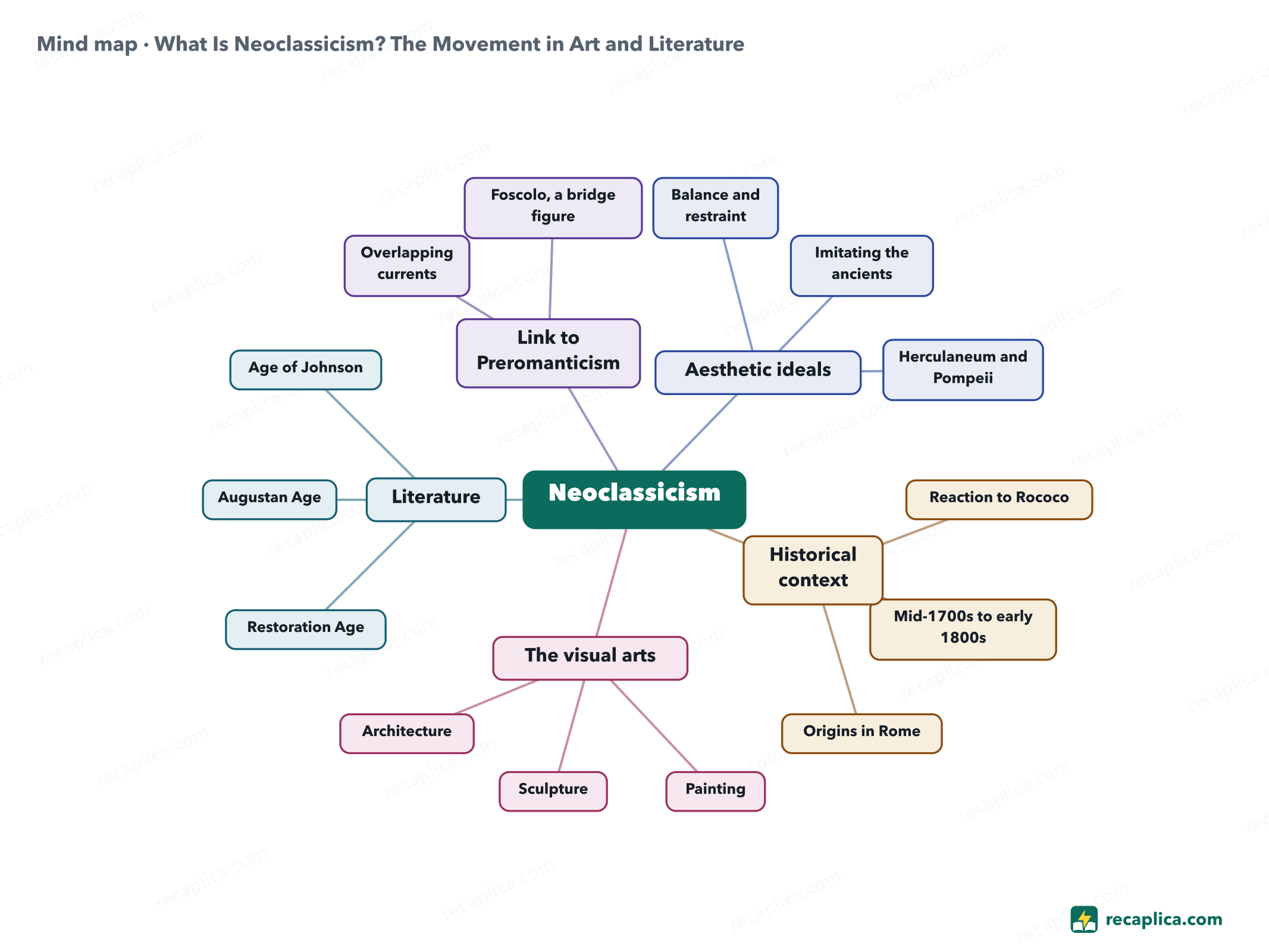
    Mind map: What Is Neoclassicism? The Movement in Art and Literature
    • Neoclassicism
      • Aesthetic ideals Winckelmann's rational imitation of the ancients
        • Balance and restraint The classical ideal of composure
        • Imitating the ancients The only path to greatness, for Winckelmann
        • Herculaneum and Pompeii Direct models for artists to study
      • Historical context A reaction to Rococo in the mid-eighteenth century
        • Reaction to Rococo
        • Mid-1700s to early 1800s
        • Origins in Rome
      • The visual arts
        • Painting David and Ingres, clean line and drawing
        • Sculpture Canova and Thorvaldsen, composed forms
        • Architecture Schinkel and the Adam brothers, temples and columns
      • Literature
        • Restoration Age Dryden, from 1660
        • Augustan Age Pope and Swift, to 1750
        • Age of Johnson Samuel Johnson, to 1798
      • Link to Preromanticism
        • Overlapping currents Same century, different sensibilities
        • Foscolo, a bridge figure Of the Sepulchres joins classical order with feeling

    Quiz: test yourself

    Answer the questions to check what you have learned: you get instant feedback and a short explanation.

    Grade 0/10 0/5
    1 Who first set out the principles of Neoclassicism?

    According to Treccani, the German archaeologist Winckelmann put the movement's principles into writing in 1755, before painters and sculptors applied them in their own work.

    2 Which phrase of Winckelmann's sums up the Neoclassical ideal?

    This is how Winckelmann describes Greek art in Thoughts on the Imitation of Greek Works, and it became the aesthetic manifesto of Neoclassicism (Treccani, Storia della civiltà europea).

    3 Which excavations fueled the Neoclassical taste for antiquity?

    Treccani notes that discoveries in Rome, Tivoli, Herculaneum, and Pompeii brought temples, statues, and pottery back to light, giving Neoclassical artists direct models to study.

    4 What trait defines Neoclassical painting, according to Treccani?

    The Treccani entry on Neoclassical art describes a "complete triumph of outline, meaning drawing," set against the soft brushwork of Baroque painting.

    5 According to the sources, how do Neoclassicism and Preromanticism relate to each other?

    The Italian Wikipedia entry on Preromanticism places it in the same final decades of the eighteenth century in which Neoclassicism takes hold; the two sensibilities coexist in that same span of time.

    Answers: 1-A · 2-A · 3-A · 4-A · 5-A

    Flashcards

    Tap the card to flip it and check whether you remember the answer, then move to the next one.

    1 / 6

    Explain it in your own words

    The ultimate test: if you can explain it in simple words, you've truly understood it. Write your explanation, then compare it with the Recap.

    Your explanation is saved only on this device.

    Neoclassicism is the artistic and literary movement that, starting around 1750, brought back the balance and restraint of Greek and Roman art as a reaction against the ornate excess of Rococo. The German scholar Johann Joachim Winckelmann set out its principles in 1755 and expanded them in 1764, while the excavations at Herculaneum and Pompeii gave artists direct models of antiquity to study. In painting, clean drawing defines the work of David and Ingres; in sculpture, composed forms define Canova and Thorvaldsen; in architecture, temple forms define Schinkel's buildings; in literature, the English tradition runs through Dryden, Pope, Swift, and Johnson. Preromanticism grows in that same span of time, bringing its own attention to feeling and melancholy.

    Frequently asked questions

    What is neoclassicism?

    It is the artistic and literary movement that, starting around 1750, revived the ideals of balance and restraint found in Greek and Roman art, as a reaction against the ornate excess of Rococo (Tate, Treccani).

    What is the difference between neoclassicism and romanticism?

    Neoclassicism and its contemporary current, Preromanticism, pull in different directions within the same late eighteenth century. Neoclassicism seeks order, restraint, and the imitation of the ancients, while Preromanticism explores melancholy, solitude, and feeling, as seen in Foscolo, a writer caught between both sensibilities.

    Who are the main neoclassical artists?

    In painting, Jacques-Louis David and Jean-Auguste-Dominique Ingres; in sculpture, Antonio Canova and Bertel Thorvaldsen; in architecture, Karl Friedrich Schinkel and the Adam brothers (Treccani, Enciclopedia dei ragazzi).

    Where does the phrase "noble simplicity and quiet grandeur" come from?

    It is Winckelmann's description of Greek art in Thoughts on the Imitation of Greek Works, published in 1755, and it became the aesthetic ideal of Neoclassicism (Treccani).

    What are the characteristics of neoclassical art?

    A clean, dominant outline and historical precision in painting, composed and serene forms in sculpture, and temple forms, columns, and domes in architecture (Treccani, Arte neoclassica).

    Sources

    • Treccani, Neoclassicismo (Enciclopedia dei ragazzi)
    • Treccani, Il neoclassicismo di Winckelmann (Storia della civiltà europea)
    • Treccani, Arte neoclassica (Enciclopedia Italiana)
    • Treccani, Preromanticismo (Enciclopedia)
    • Tate, Neoclassicism (art term)
    • TheArtStory, Neoclassicism Movement Overview
    • Encyclopedia.com, Neoclassicism (Dictionary of Literary Terms)
    • Wikipedia (IT), Preromanticismo
    • Victoria and Albert Museum, Antonio Canova, an introduction

    Every Recap goes through an independent review before publication.

    Every evening, the day's new Recaps on our Telegram channel. Join the channel →

    Keep learning

    • Literature Zeno's Conscience (Confessions of Zeno): Summary and Analysis Zeno's Conscience is the novel Italo Svevo published in 1923, the third and last of his major novels after A Life (1892) and As a Man Grows Older (1898). The book takes the shape of a memoir that Zeno Cosini writes at his psychoanalyst's urging, working through his life not in chronological order but chapter by chapter, each one built around a separate theme: smoking, his father's death, his marriage to Augusta, an affair with his lover Carla, and a business partnership with his brother-in-law Guido Speier. Zeno's account can't be taken at face value, since it passes through his own subjective memory and self-deceptions he never intended. Svevo paid to publish the book himself, and it barely sold in Italy at first; it found an audience only years later, after his friend James Joyce brought it to the attention of two French critics. Read the Recap →
    • Literature Cesare Beccaria: Life and Ideas in On Crimes and Punishments Cesare Beccaria was born in Milan in 1738 and died in the same city in 1794. In 1764 he anonymously published On Crimes and Punishments, a short treatise written within the Academy of Fists, the Milanese circle led by the Verri brothers. The book argues that punishment should be proportionate to the harm a crime does to the public good, that its purpose is to prevent further offenses, and it condemns judicial torture and the death penalty. Within a few years it was translated into French and English, and it found readers such as Catherine II of Russia, John Adams and Thomas Jefferson. Read the Recap →
    • Literature Giuseppe Parini: Life, The Day, and the Satire of the Nobility Giuseppe Parini was born in Bosisio in 1729, became a priest without a real calling in 1754, and taught eloquence in Milan at the Scuole Palatine. His major work, The Day, tells in unrhymed verse the story of one day in the life of a Milanese nobleman, the «giovin signore», from waking to sleep, using the solemn style of epic poetry to expose how empty that day really is. Alongside the poem he wrote the Odes, developed over nearly forty years, and the Dialogue on Nobility, a direct attack on the privileges of birth. Close to, but never fully aligned with, Pietro Verri's Enlightenment circle at the Caffè, he left behind a model of committed poetry that Foscolo and Manzoni would each take up in their own way. Read the Recap →

    recaplica

    Clear in 30 seconds, yours in 10 minutes.

    Recaps Mind maps Request a Recap Telegram channel Mind map maker Our method About Privacy & cookies Legal notes & terms of use

    © 2026 Recaplica · A project by Curi S.r.l. — VAT IT05472000750

    Statistics, only if you say so

    To learn which Recaps help most we would use Google Analytics, with aggregate, anonymous data. It starts only with your OK, and you can change your mind anytime. Privacy policy