|
recaplica
Giacomo Leopardi: Life, Works and the Idea of Cosmic Pessimism | |||||||||||||||||||||
| © 2026 Recaplica · recaplica.com — All rights reserved | |||||||||||||||||||||
Giacomo Leopardi: Life, Works and the Idea of Cosmic PessimismWhat to print Page numbers appear when printing with default margins. SlidesChoose a cut Flash10 slidesThe essential thread, to present in classFull17 slidesEvery chapter and the deeper detailBoth come with speaker notes. In 30 seconds quick readGiacomo Leopardi was an Italian poet, philosopher, and philologist, born in Recanati in 1798 and dead in Naples in 1837. As a boy he spent years teaching himself Greek and Hebrew in his father's library, and later blamed that grueling self-study for his first health troubles. His best-known works are the Canti, the collection of poems that includes The Infinite and La ginestra, the Operette morali, a set of philosophical dialogues in prose, and the Zibaldone di pensieri, a vast diary of reflections that stayed private until after his death. In his thought, human unhappiness moves from an early explanation rooted in history and society to a more radical conviction, cosmic pessimism: suffering as a law of nature that touches every living being, in every age. Key Points
Key figures
Deep DiveA childhood in his father’s libraryGiacomo Leopardi was born on June 29, 1798, in Recanati, the first of seven children of Count Monaldo Leopardi and Marchioness Adelaide Antici; among his siblings, sources name Carlo, Paolina, and Luigi. His family entrusted his education to ecclesiastical tutors, including G. Torres, V. Diotallevi, and, from 1807, S. Sanchini: by 1812 his father Monaldo himself recognized that his son had already exhausted what those teachers could offer him. From that point on, Giacomo threw himself into self-directed study in his father’s library, teaching himself Greek and Hebrew. It was such a total commitment that he later called it his “mad and most desperate study,” and blamed it himself, not a medical judgment, for making his own physical appearance “miserable” and for wearing down a young man’s health. The 1819 crisis and the “philosophical conversion”In 1819 Leopardi was struck by a severe eye condition that stopped him from reading: a suffering he described as “far darker” than anything before, one that pushed him to reflect deeply on his own condition. Leopardi himself locates the start of his philosophical reflection in that year, a shift he called his “philosophical conversion.” That same year he also tried to run away from Recanati; the attempt was discovered and came to nothing. Away from Recanati, between disappointment and happinessBetween 1822 and 1837 Leopardi left Recanati several times, in stays of very different length and fortune.
In Pisa, in particular, Leopardi described the city as “a mix of a big city and a small one… so romantic that I’ve never seen its like,” and made friends there with G. Rosini and G. Carmignani. In Florence he mixed with intellectuals such as G. Vieusseux, G. Capponi, G. Montani, N. Tommaseo, and Alessandro Manzoni; in 1831 he was named Recanati’s representative to the assembly of Bologna’s provisional government, an appointment made pointless almost immediately by the return of Austrian rule. Among the most important relationships of his life were the one with Pietro Giordani, a frequent correspondent between 1817 and 1821 whom Leopardi called the “perfect writer of Italy,” and the one with Antonio Ranieri, whom he met in 1828 through his friend A. Poerio: Ranieri became his inseparable companion in his final years, stayed at his side until his death, and wrote a memoir about him in 1880. From 1831 Leopardi also fell, without being loved back, for the Florentine countess Fanny Targioni Tozzetti, who inspired what’s known as the Aspasia cycle. The poetic works, from his early idylls to La ginestraHis first notable odes, To Italy and On the Monument to Dante — in which Leopardi pays tribute to Dante, the poet of the Divine Comedy — came out in Bologna in 1824, amid a patriotic mood that anticipated by decades the movement that would lead to Italian unification. In 1825 he composed his idylls, later folded into the Canti, including The Infinite (1819), Memories (1816), and, most likely, To the Moon (1819). The Canti were first published in Florence in 1831 and kept growing in the years that followed with poems such as To Silvia (1828), The Remembrances (1829), The Calm After the Storm (1829), Saturday in the Village (1829), and Night Song of a Wandering Shepherd of Asia (1829-1830). The so-called Aspasia cycle, meanwhile, gathers The Dominant Thought, Love and Death, Consalvo, To Himself, and Aspasia, most likely composed between 1831 and 1834. His last great poetic season arrives in 1836, with La ginestra, or The Flower of the Desert, and The Setting of the Moon. The Zibaldone, the Operette morali, and the other prose worksAlongside his poetry, Leopardi produced an equally vast body of philosophical and scholarly prose: the Philosophical Dissertations (1811-1812), a History of Astronomy from Its Origins to 1811 (1813), and an Essay on the Popular Errors of the Ancients (1815). He also translated Horace’s Odes in the early 1810s and Epictetus’s Manual between November and December 1825, and worked, without finishing it, on a translation of Plato. His longest and most private text is the Zibaldone di pensieri, the philosophical and literary diary he kept from July-August 1817 until 1832, later bound into volumes: 4,526 autograph pages, numbered by his own hand. In 1827 the publisher Stella brought out the Operette morali instead, a collection of philosophical dialogues that includes the Dialogue Between Nature and an Icelander and the Dialogue Between Torquato Tasso and His Familiar Spirit. These were followed by an Italian anthology of prose (1827) and one of poetry (1828), the Pensieri, 111 aphorisms written in the 1830s, and the Paralipomeni della Batracomiomachia, a mock-heroic poem in eight cantos composed between 1831 and 1836. Historical pessimism and cosmic pessimism, the distinction that mattersLeopardi’s philosophical thought unfolds in two clearly distinct phases — the same distinction any serious student is expected to know. In his early civic odes, such as To Italy, On the Monument to Dante, and To Angelo Mai, unhappiness is read as an effect of historical circumstances: reason overtaking imagination as civilization advances, and human beings organizing into societies in ways that curb individual freedom and spontaneity. This is what’s called historical pessimism, a reading that Leopardi himself, at first, traced back to the influence of eighteenth- century thinkers. Between 1823 and 1828, though, Leopardi pushes his thinking to its furthest consequences: human unhappiness is no longer the product of circumstances tied to this or that individual, but “a law of nature, from which no man, in any age, indeed no being, can escape.” This is what scholars call cosmic pessimism. With the great idylls, from 1828 onward, this pessimism “takes on its true poetic face,” what’s described as cosmic pity.
Nature as a stepmother, and the theory of pleasureAt the root of it all, for Leopardi, lies what scholars call the theory of pleasure: human beings “seek nothing but their own happiness,” and this amor sui is “the one driving force of life.” The trouble is that nature doesn’t share that goal: it isn’t concerned with the happiness of individuals, only with its own self-preservation, for which births are just as necessary as deaths. The conclusion he draws is stark: “life is nothing but a slower or faster process of dying,” and so nothing but “a useless misery.” This indifferent nature, in one of Leopardi’s own verses quoted by the Treccani dictionary under the entry “matrigna” (stepmother), is described as a force that toward mortal beings is “a mother in giving birth, and a stepmother in will”: a mother in bringing life into the world, but a stepmother, hostile and cruel, in how she governs it afterward. In the Operette morali, drafted mostly in 1824 with additions in 1825, 1827, and 1832, Leopardi also takes up the theme of boredom, the flip side of this same condition: a need, never satisfied, for an existence free from inertia and from the emptiness that runs through everyday life. Health, final years, and a medical hypothesis to treat with cautionLeopardi struggled with frail health throughout his life, something he himself partly attributed to his excessive studying as a young man in his father’s library. It’s a subject that’s also been revisited from a medical angle over the years: a study published in 2017 in the Journal of Clinical Rheumatology raises the possibility — to be read strictly as a retrospective hypothesis, not a confirmed diagnosis — that Leopardi had juvenile ankylosing spondylitis, a condition that, on this reading, may have contributed to his spinal curvature and to the health troubles that followed him to the end. As a hypothesis put forward nearly two centuries after the fact, it should be taken as one possible lens on his life, not as a clinical record. Leopardi died in Naples on June 14, 1837, beside his friend Antonio Ranieri, who remained loyal to him to the last. Legacy, manuscripts, and Casa LeopardiLeopardi’s autograph manuscripts were officially handed over to the National Library of Naples on May 19, 1907, at the end of a long legal dispute and a period of temporary custody, from 1897 to 1907, entrusted to a ministerial commission. In 2023 the entire corpus was digitized, with over 15,000 high-resolution reproductions put online: from the Canti to the Zibaldone, along with prose works, speeches, prefaces, translations, fragments, notes, and correspondence. On July 1, 1937, marking the centenary of the poet’s death, the National Center for Leopardi Studies was founded in Recanati; since 2002 it has been a private institution with a specialized library of roughly 30,000 items and photographs of every Leopardi manuscript held in Florence and Naples, and since 1962 it has organized an international conference on Leopardi studies, usually every four years. Its headquarters stand beside Palazzo Leopardi, in a building from which a path climbs to the top of the Hill of Infinity, the hill made famous by the poem of the same name. Palazzo Leopardi itself, in Recanati, is partly a house museum: the entire first floor, where Giacomo educated himself, holds his father Monaldo’s library and is the only part of the building open to visitors year-round, since the rest still serves as the family’s home. A restoration completed on March 21, 2020, opened further rooms of the palace to visitors: the piano nobile, the rooms Giacomo shared with his siblings as a boy, an art gallery, and the poet’s own bedroom, its window facing the moon and stars; the garden that inspired The Remembrances is also part of the visit. The route is called “Where I Lived as a Child.” Like Giovanni Pascoli and Luigi Pirandello, Leopardi remains one of the Italian authors most studied in school. Since 2023, anyone can consult online the entire autograph corpus digitized by the National Library of Naples, over 15,000 reproductions running from the Canti to the Zibaldone. Slide deckSlides ready to download and make your own in PowerPoint or Google Slides, with speaker notes. Pick the Flash cut or the Full one.     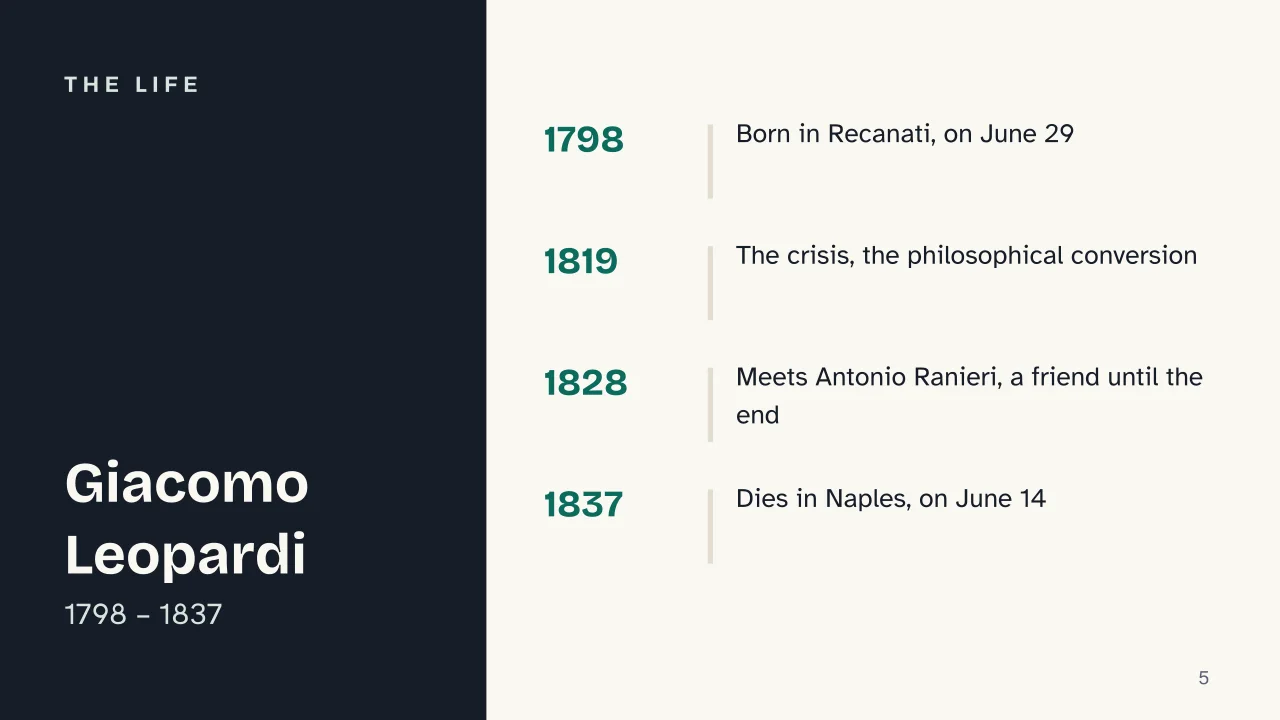 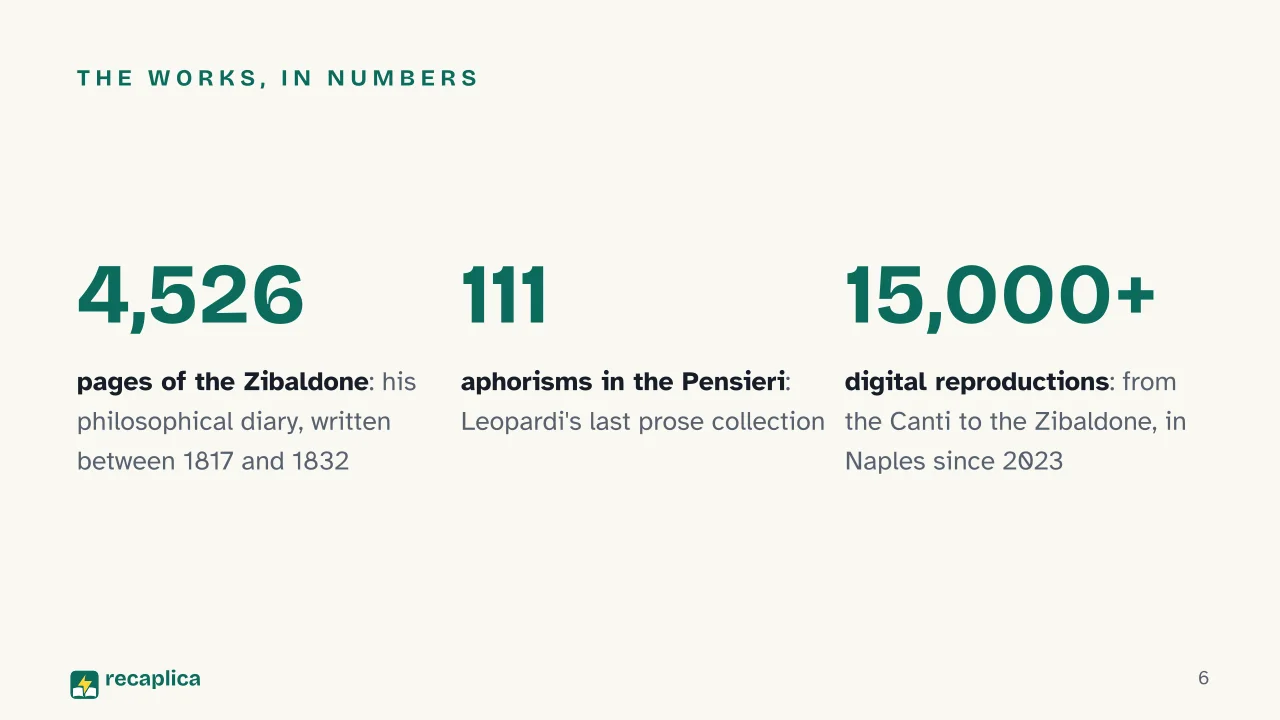  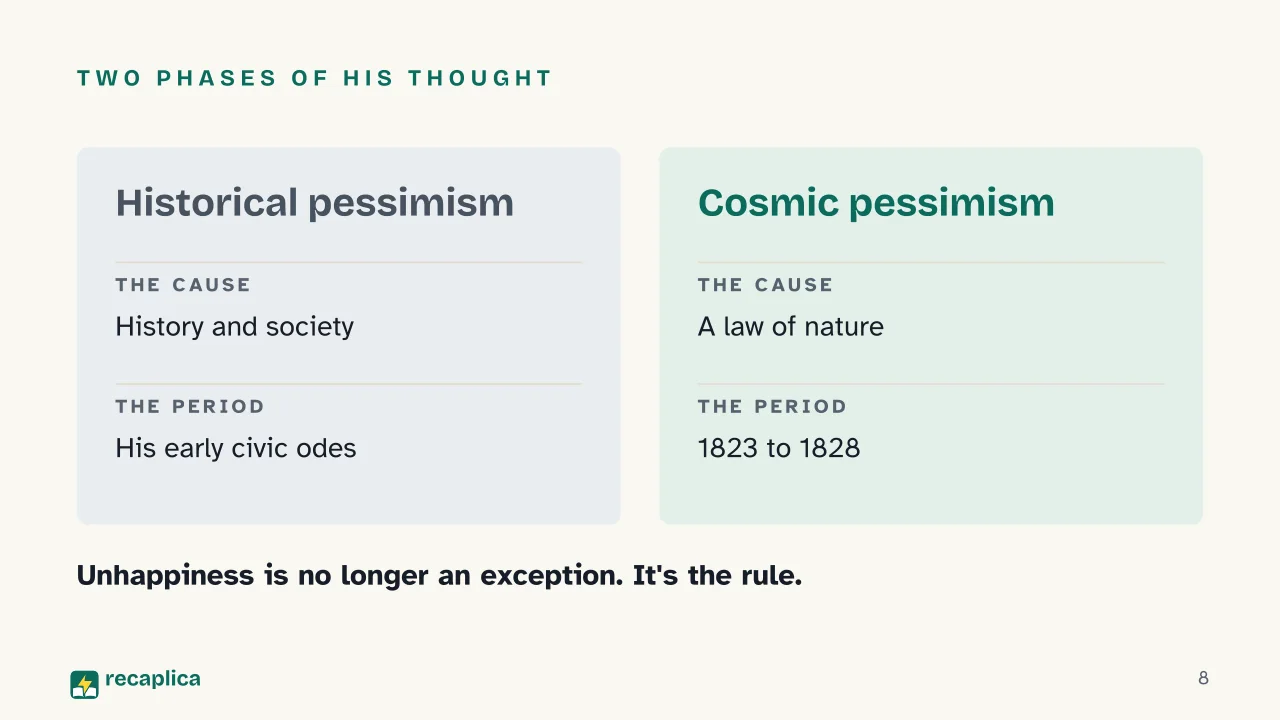   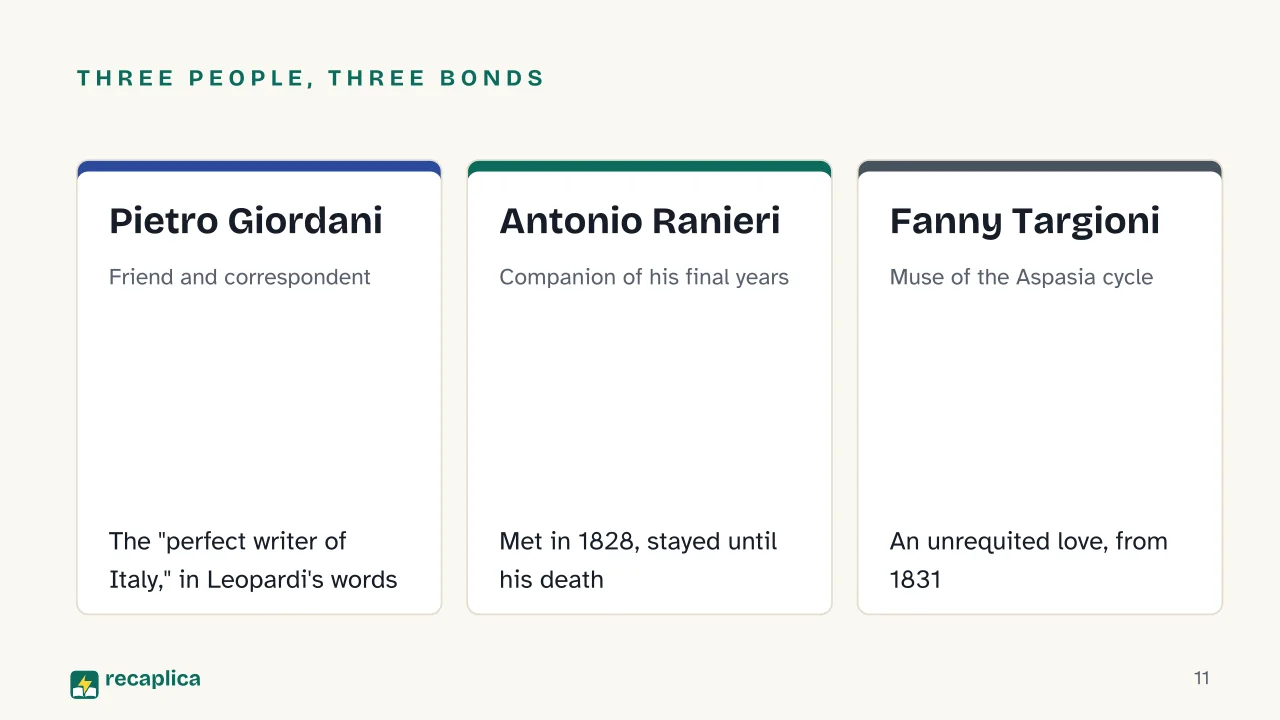 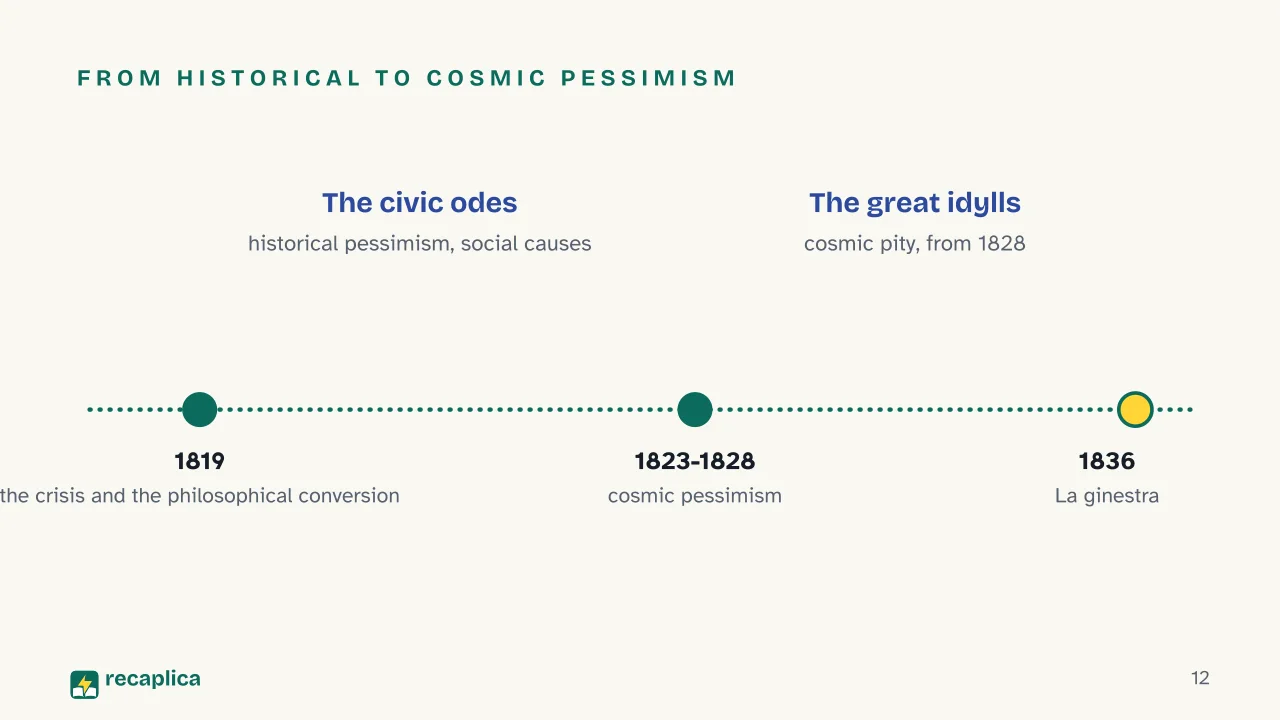  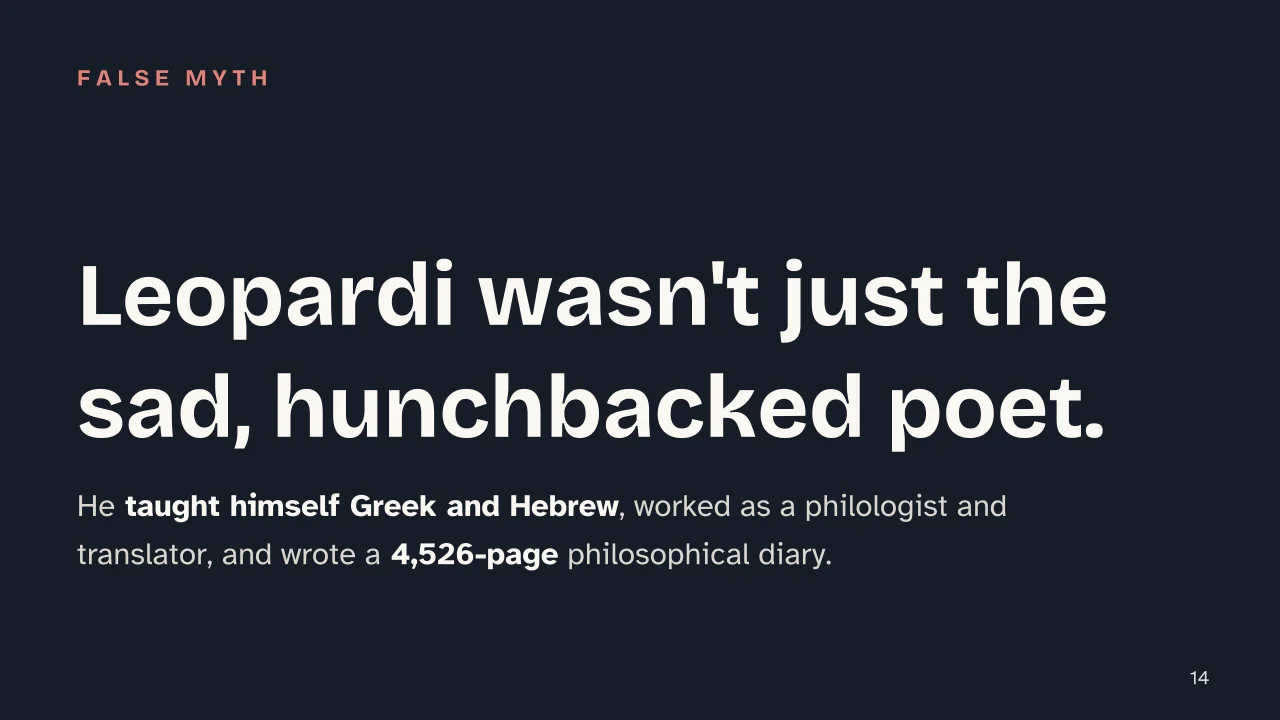 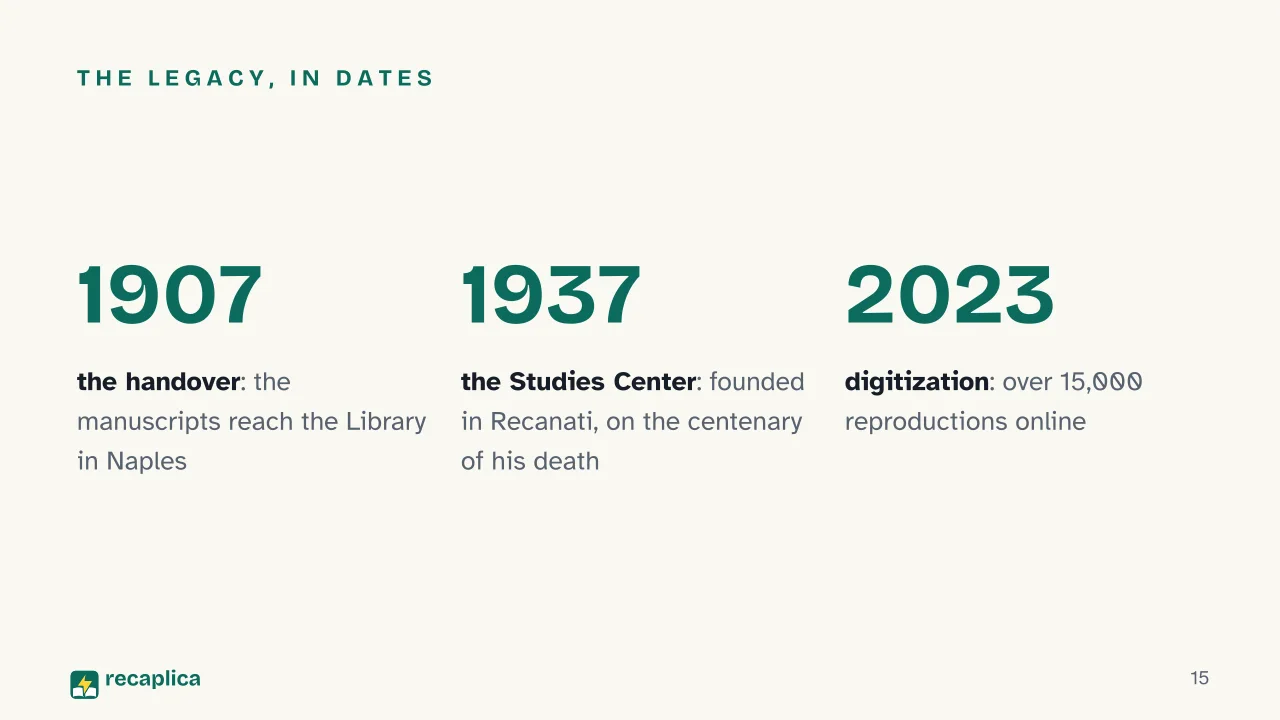 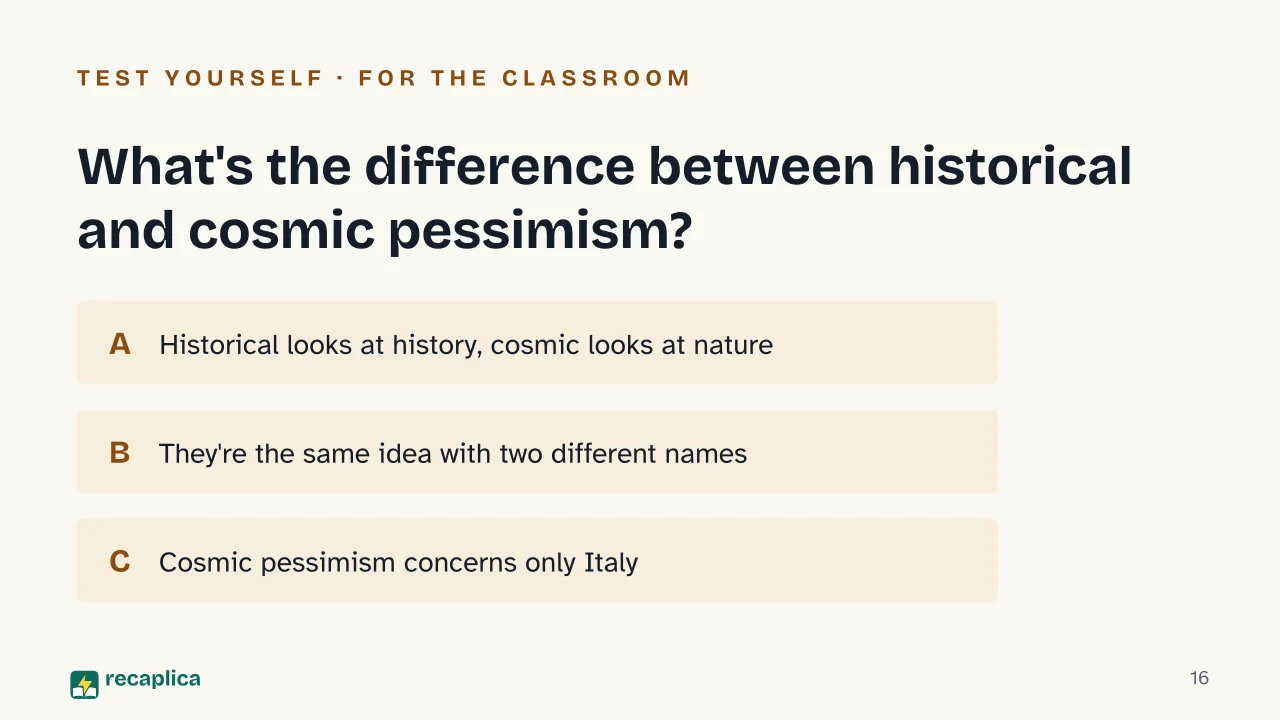  Common myths
Mind mapDrag the background to move around and the nodes to reposition them; use − and + to collapse and expand branches. 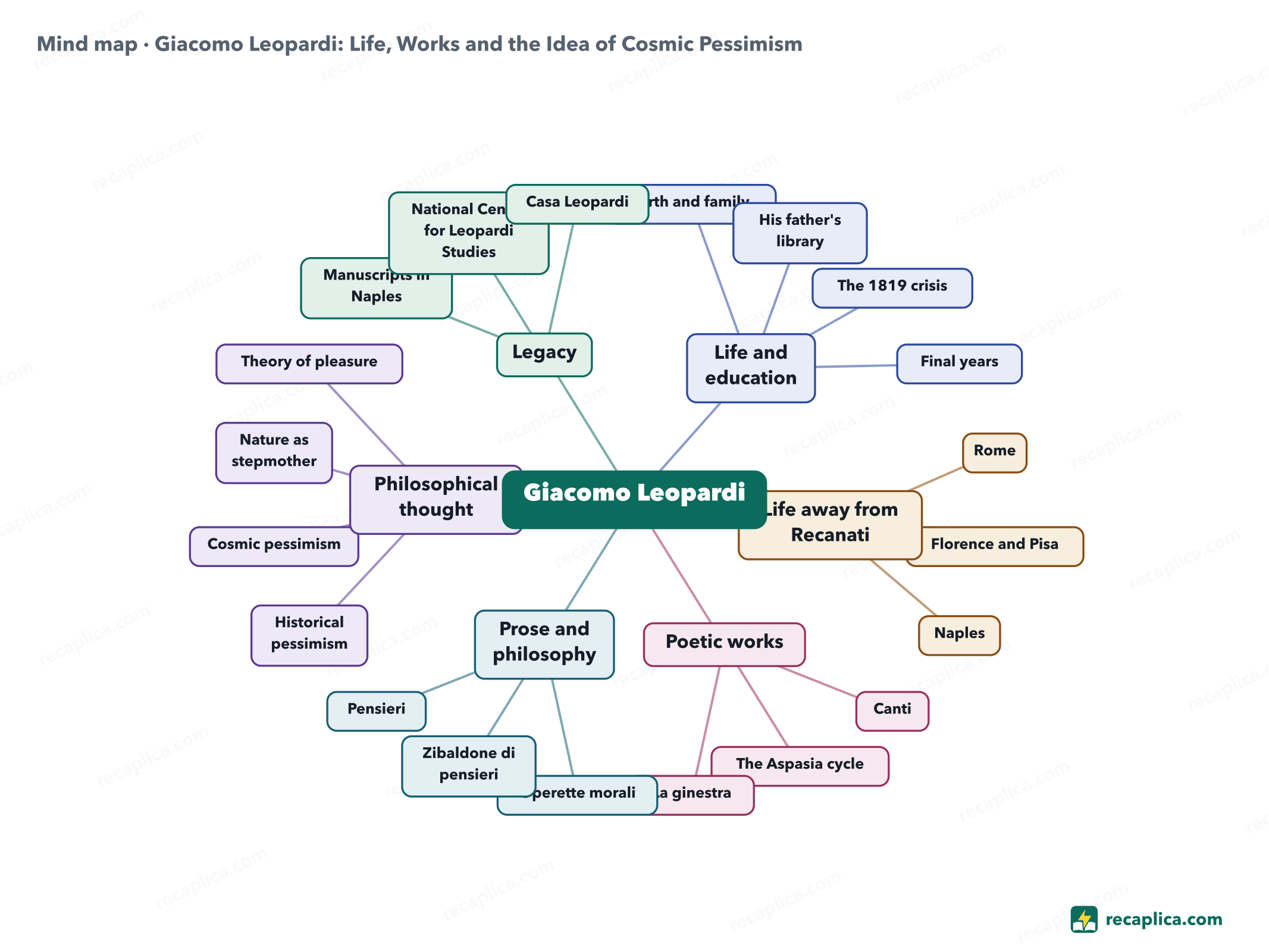
Quiz: test yourselfAnswer the questions to check what you have learned: you get instant feedback and a short explanation. Grade 0/10 0/5
FlashcardsTap the card to flip it and check whether you remember the answer, then move to the next one. 1 / 8 Explain it in your own wordsThe ultimate test: if you can explain it in simple words, you've truly understood it. Write your explanation, then compare it with the Recap. Your explanation is saved only on this device.
Frequently asked questionsWhy is Leopardi considered a pessimist poet?Because in his philosophy human unhappiness isn't an accident but a structural condition. In his early civic odes he explains it through historical and social causes (historical pessimism); between 1823 and 1828 he reaches a more radical position, cosmic pessimism, in which suffering is a law of nature affecting every living being, in every age. What does "nature as a stepmother" mean in Leopardi?It's the idea that nature isn't concerned with the happiness of individual beings, only with its own self-preservation, for which births and deaths are equally necessary. The word "stepmother," which in ordinary usage names a hostile or cruel figure, appears in one of Leopardi's own verses to describe this nature that's indifferent to human fate. What are Giacomo Leopardi's main works?In poetry, the Canti, which include The Infinite, To Silvia, and La ginestra; in philosophical prose, the Operette morali, dialogues such as the Dialogue Between Nature and an Icelander, and the Zibaldone di pensieri, his private diary of reflections, left unpublished until after his death. Where are Leopardi's manuscripts held today?At the National Library of Naples, where they were officially handed over on May 19, 1907, after a long legal dispute. Since 2023 they've also been digitized, with over 15,000 reproductions online of the entire autograph corpus, from the Canti to the Zibaldone. Is it true that Leopardi's curved spine came from a specific disease?His frail health and the curvature of his spine are well documented, but the exact cause remains a hypothesis. A study published in 2017 in the Journal of Clinical Rheumatology proposes, retrospectively, a possible case of juvenile ankylosing spondylitis — a medical hypothesis, not a confirmed diagnosis, put forward nearly two centuries later based on the available biographical record. Every Recap goes through an independent review before publication. |