Skip to content
recaplica

    One moment: security check

    Cloudflare wants to make sure you're not a robot. Tick the box below and your search will continue on its own.

    IT
    recaplica Of the Sepulchres: Foscolo's Poem on Tombs, Memory and Civic Life
    © 2026 Recaplica · recaplica.com — All rights reserved
    Home › Literature

    Of the Sepulchres: Foscolo's Poem on Tombs, Memory and Civic Life

    By Recaplica Newsroom · Updated on September 17, 2026

    What to print

    Page numbers appear when printing with default margins.

    Slides

    Choose a cut

    Flash10 slidesThe essential thread, to present in classFull14 slidesEvery chapter and the deeper detail

    Both come with speaker notes.

    Telegram channel
    recaplica Clear in 30 seconds, yours in 10 minutes.
    In 30 seconds Key points Deep dive Slides Myths Mind map Quiz Flashcards FAQ

    In 30 seconds quick read

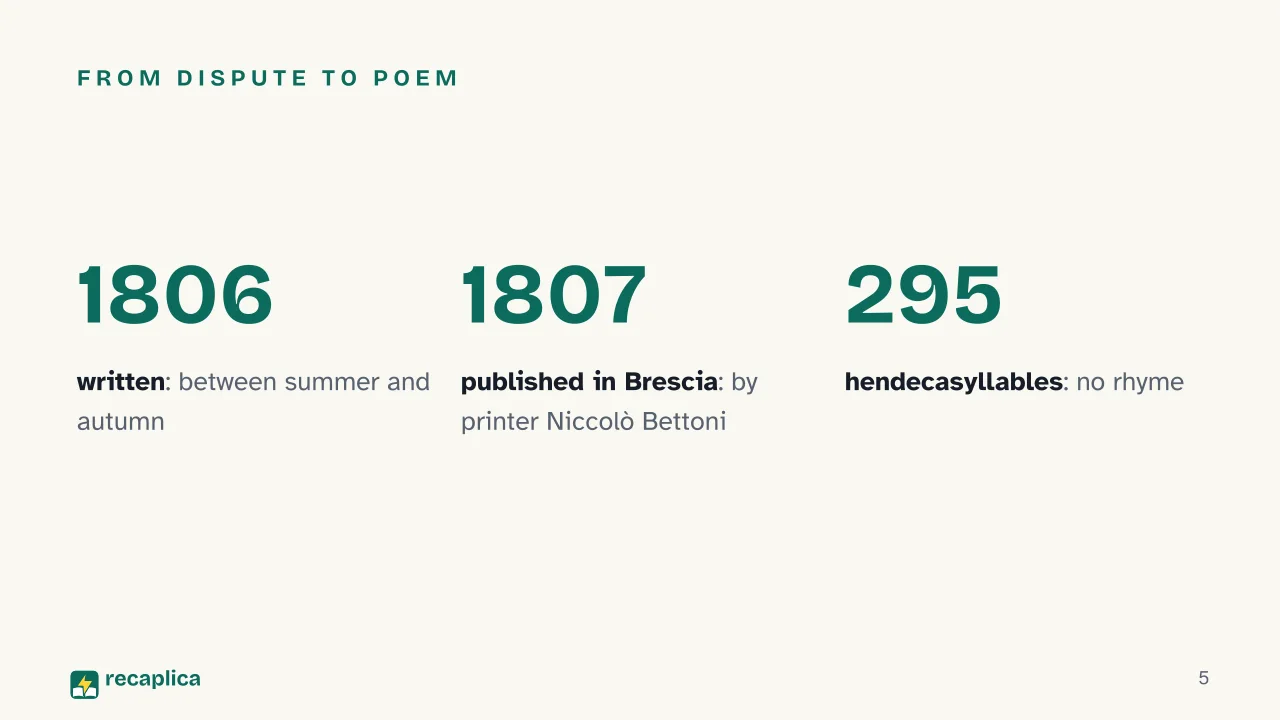
    Of the Sepulchres is a poem by Ugo Foscolo, written between the summer and autumn of 1806 and published in Brescia in 1807. It grew out of a conversation in the literary salon of Isabella Teotochi Albrizzi about the Edict of Saint-Cloud, the Napoleonic law that regulated burials, and it is dedicated to the poet Ippolito Pindemonte. Across 295 unrhymed hendecasyllables, Foscolo starts from a materialist view of death and arrives at the civic value of tombs, above all the tombs of famous Italians buried in Santa Croce in Florence, which keep a people's memory alive. Treccani calls it the highest point Foscolo ever reached as a poet.

    Key Points

    • Foscolo writes Of the Sepulchres between the summer and autumn of 1806, after a conversation in Isabella Teotochi Albrizzi's salon about the Edict of Saint-Cloud; the poem is published in Brescia in 1807.
    • It runs to 295 unrhymed hendecasyllables, dedicated to the poet Ippolito Pindemonte.
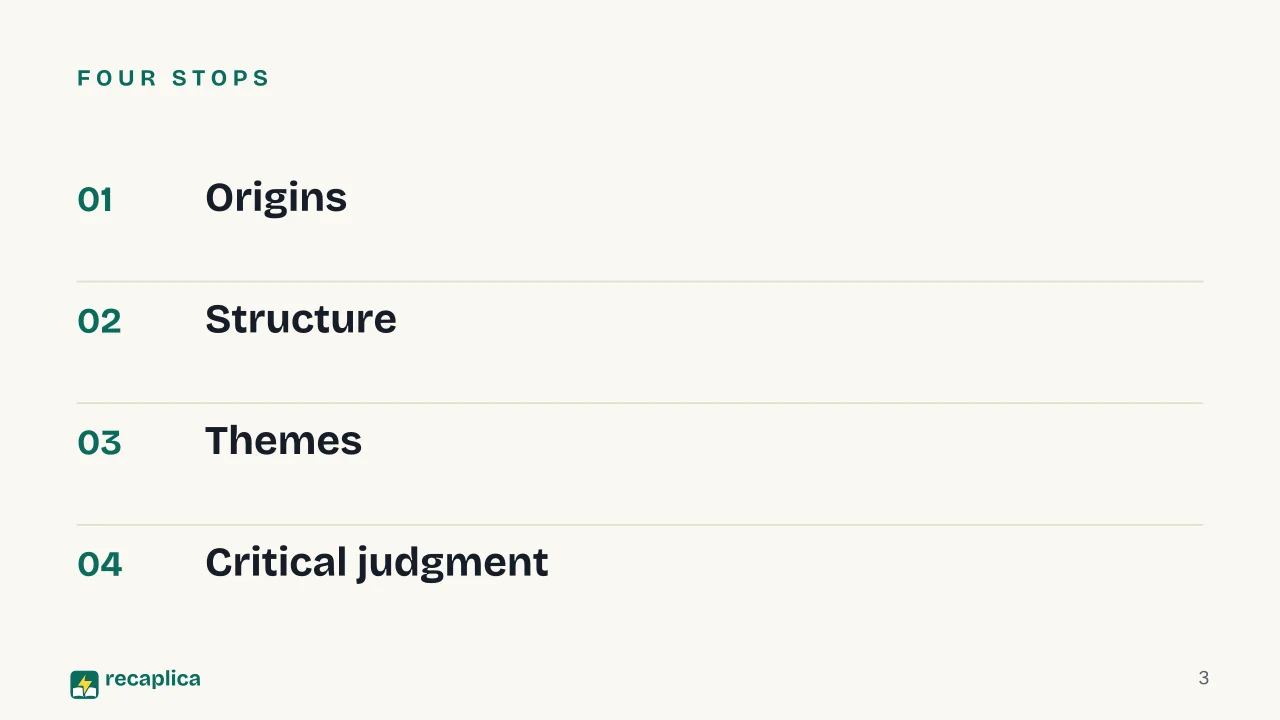
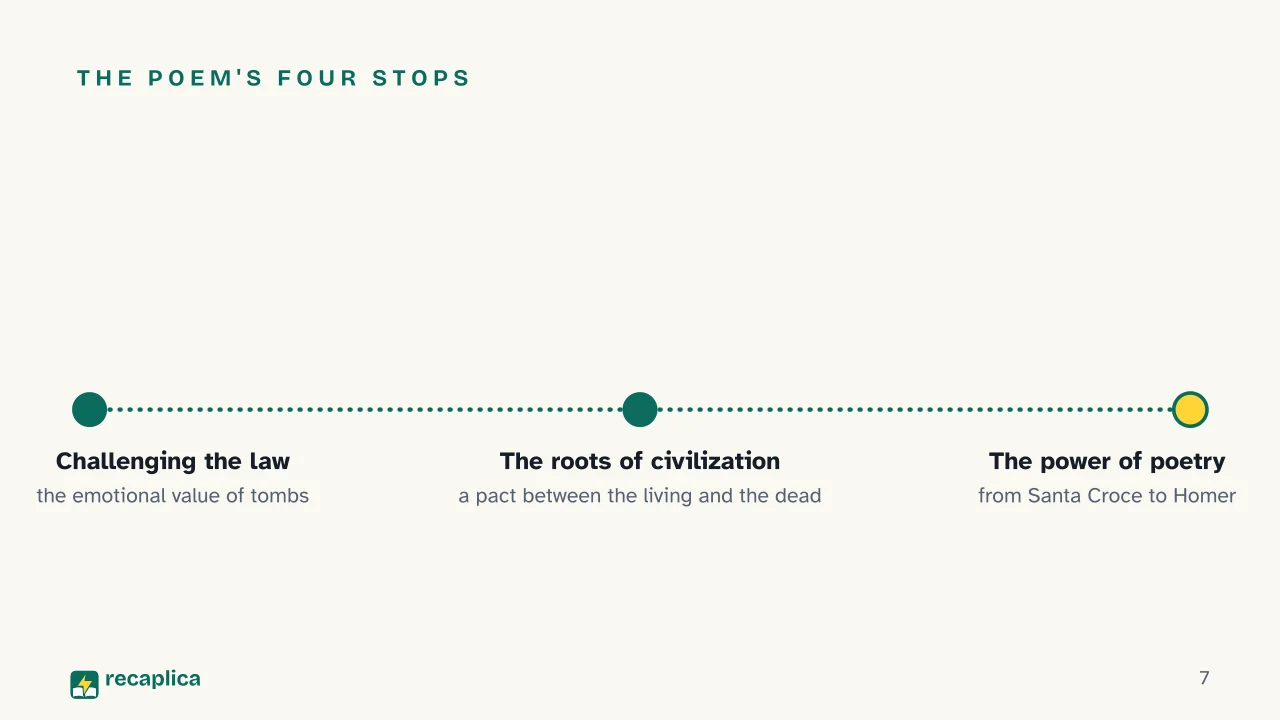
    • The text unfolds in four movements: from a challenge to the burial law and the emotional value of tombs, to the roots of civilization, to the civic weight of the illustrious tombs at Santa Croce, and finally to the role of poetry against oblivion.
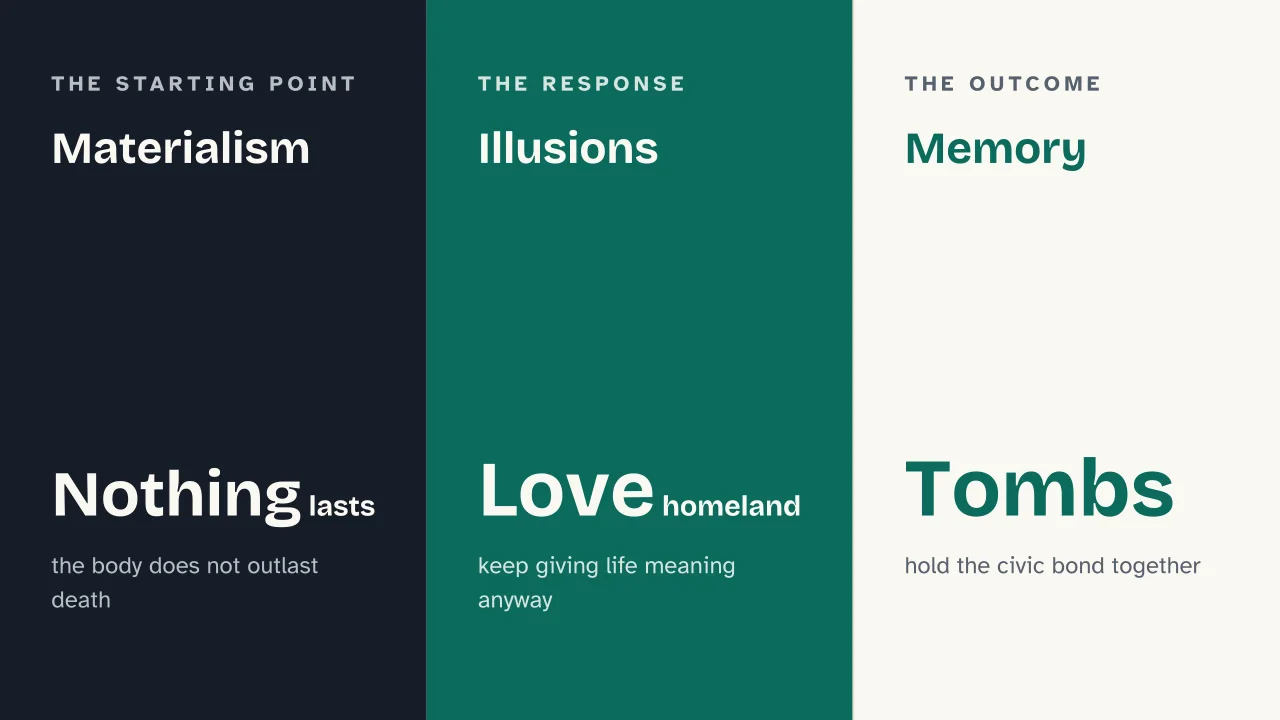
    • At the core of the poem is the idea that even within a materialist view of death, certain illusions keep giving life meaning: love, homeland, shared memory.
    • Treccani ranks the poem as the summit of Foscolo's entire body of poetry, his single greatest achievement.
    • The closing parallel with Homer ties it together: just as the tombs of Trojan heroes inspired the Greek poet's song, the tombs of Machiavelli, Michelangelo, Galileo and Alfieri at Santa Croce preserve the memory of a nation.

    Deep Dive

    Origins: from the Edict of Saint-Cloud to a Venetian salon

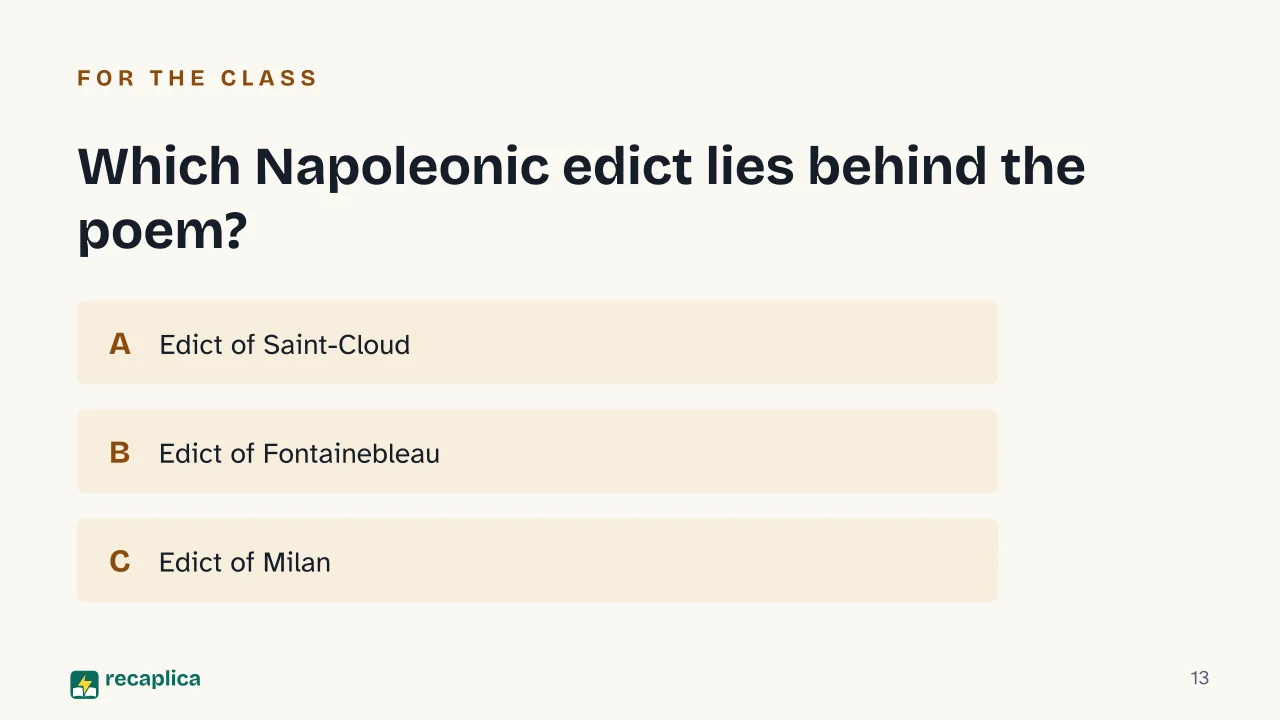
    Foscolo wrote Of the Sepulchres between the summer and autumn of 1806; the poem reached print in Brescia the following year, 1807, from the presses of Niccolò Bettoni. It began with a specific event: a conversation in the literary salon of Isabella Teotochi Albrizzi, where the talk turned to the Edict of Saint-Cloud, the law with which Napoleon regulated burials in June 1804 and which was extended to the Kingdom of Italy in 1806. The edict required cemeteries outside city walls and identical headstones for everyone, erasing the old distinction between an ordinary citizen’s grave and the tomb of a famous man.

    The poem grew out of that concrete dispute, dedicated to the Veronese poet Ippolito Pindemonte, who had taken part in the same salon conversation. The historical trigger and the poem’s civic meaning stay on separate but connected tracks: the law was the occasion, the reflection on shared memory is what Foscolo built from it.

    Readers of Ugo Foscolo: Life, Exile, and Major Works already know the biographical backdrop to these years: the exile, the teaching post at the University of Pavia, the work as translator and polemicist.

    Structure: the four parts of Of the Sepulchres

    The text, 295 unrhymed hendecasyllables, unfolds in four movements. In the first, Foscolo challenges the burial law and turns the argument on its head: tombs are not for the dead, who cannot know they exist, but for the living, because they keep an emotional bond with people who are gone. The second movement moves from private affection to the foundations of society: honoring the dead, Foscolo argues, is one of the origins of civilization itself, marking the shift from primitive scattering to a community held together by laws and shared feeling.

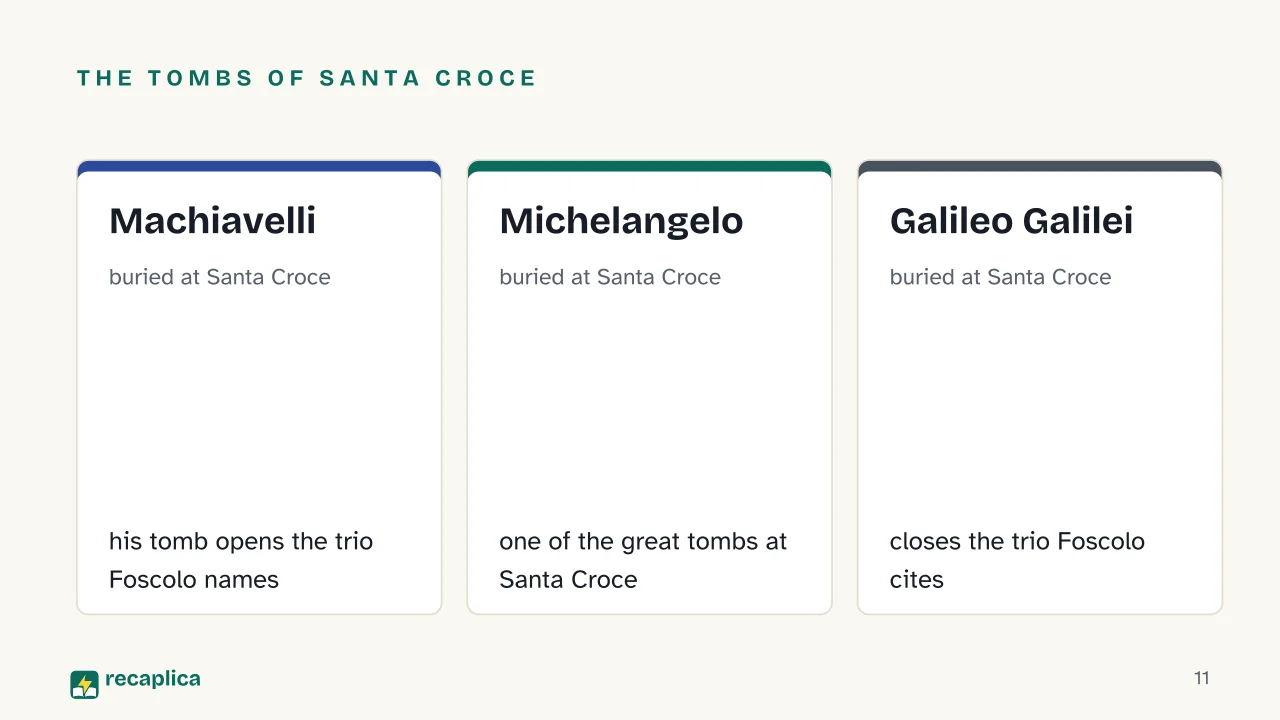
    The third part widens into the civic and historical value of tombs: Foscolo points to the basilica of Santa Croce in Florence, resting place of Niccolò Machiavelli, Michelangelo, Galileo Galilei and Vittorio Alfieri. Visiting those tombs, in his view, means walking through Italian cultural history by way of the people who made it. The fourth and final movement turns to poetry itself: verse, more than a gravestone, keeps memory alive once tombs are worn away by time or destroyed by war.

    Practical example: when Foscolo writes that everything is swallowed by forgetting — “involve tutte cose l’oblio nella sua notte” — the very next lines already point to poetry as the force that resists that darkness, able to keep a name alive long after the stone over a grave has crumbled.

    Themes: materialism, illusion and civic memory

    According to Treccani, the poem rests on a materialist outlook paired with a pessimistic mood: time wears down and transforms everything in the universe, and biological death leaves no way out. From this starting point, illusions still stay alive for Foscolo — love, homeland, the “corrispondenza d’amorosi sensi” between the living and the dead — and they give shared meaning to existence even without a rational basis. Tombs, in this light, become the thread that ties the living to the dead and past centuries to the ones still to come.

    That tension between materialism and the need for meaning brings Foscolo close to a later writer, Giacomo Leopardi: Life, Works and the Idea of Cosmic Pessimism, though the two poets land in different places: Leopardi denies almost every form of consolation, while Foscolo finds his in shared memory and in the civic reach of poetry.

    Santa Croce and the parallel with Homer

    Beyond naming tombs in Florence, the third section of the poem introduces the idea that poetry has a civic and political function, capable of holding a nation together through the names of its great figures. In the fourth part Foscolo pushes that idea to its peak with the Homeric parallel: just as the tombs of the Trojan heroes, Ajax and Hector among them, inspired Homer’s song, the tombs of illustrious Italians can inspire the poets who come after them. Homer becomes the emblem of a poetry that carries an entire people’s history forward, and the poem closes by claiming the same role for early nineteenth-century Italian letters.

    Readers of The Last Letters of Jacopo Ortis: Plot and Themes of Foscolo’s Novel will recognize some of the same threads already at work in the novel: homeland, the weight of memory, a reckoning with death. In Of the Sepulchres, though, Foscolo trades the novel’s intimate, despairing register for a more public, oratorical one.

    Why Of the Sepulchres is considered Foscolo’s masterpiece

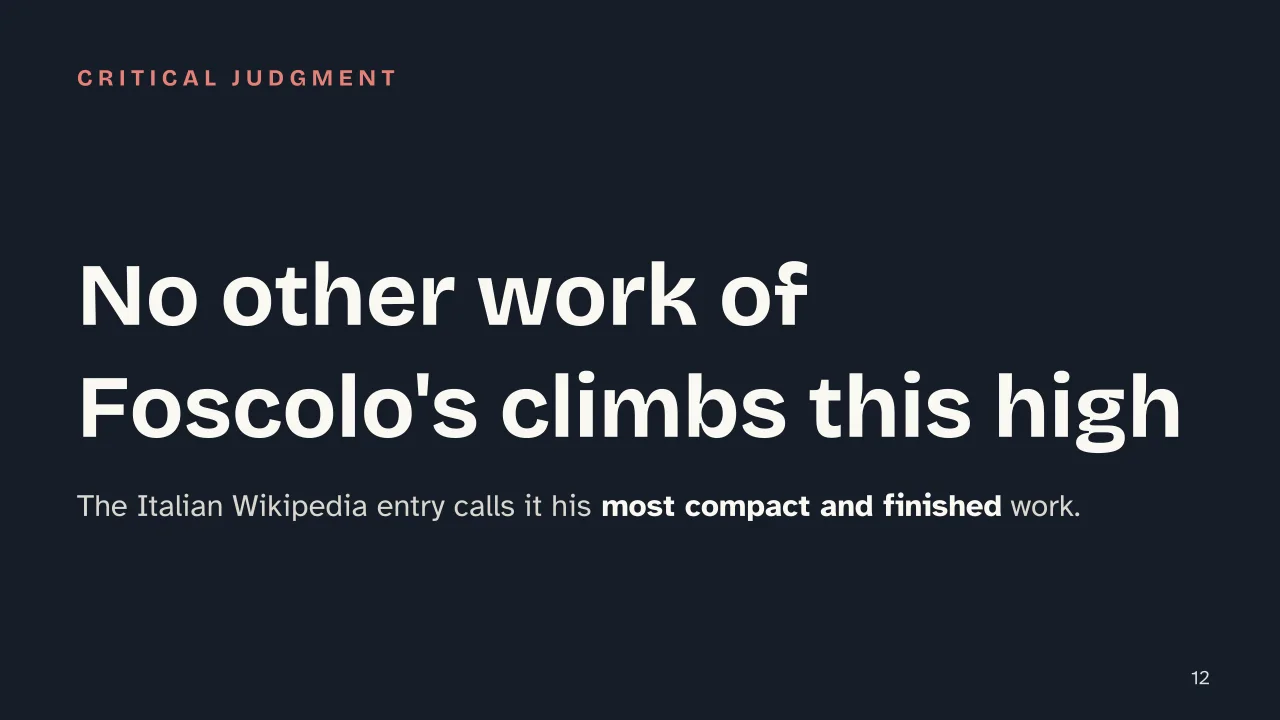
    The Italian Wikipedia entry calls Of the Sepulchres Foscolo’s most compact and finished work; Treccani goes further: it ranks the poem the highest point reached across Foscolo’s entire poetic output, beyond his lyric poetry alone. Part of that judgment rests on the poem’s stylistic balance: classicist in form and in its references, Homer, mythology, civic oratory, yet already carrying traits Romantic poets would soon prize, from attention to individual feeling and personal memory to a new kind of meditation on death.

    A useful comparison is Dante’s Divine Comedy: the structure of the journey, summarized, another work that tackles collective memory through a long poetic journey: where Dante builds an entire afterlife to pass judgment on human history, Foscolo works within 295 lines on a single subject, tombs, to reach a similar conclusion: for Foscolo too, verse is what keeps a tomb’s memory alive over time.

    Slide deck

    Slides ready to download and make your own in PowerPoint or Google Slides, with speaker notes. Pick the Flash cut or the Full one.
    Slide 1 of the presentation on Of the Sepulchres: Of the SepulchresSlide 2 of the presentation on Of the Sepulchres: Why would a poet fight back against a burial law?Slide 3 of the presentation on Of the Sepulchres: Four stopsSlide 4 of the presentation on Of the Sepulchres: Chapter 01: OriginsSlide 5 of the presentation on Of the Sepulchres: From dispute to poemSlide 6 of the presentation on Of the Sepulchres: Chapter 02: StructureSlide 7 of the presentation on Of the Sepulchres: The poem's four stopsSlide 8 of the presentation on Of the Sepulchres: Chapter 03: ThemesSlide 9 of the presentation on Of the Sepulchres: Materialism · Illusions · MemorySlide 10 of the presentation on Of the Sepulchres: Chapter 04: Critical judgmentSlide 11 of the presentation on Of the Sepulchres: The tombs of Santa Croce: Machiavelli, Michelangelo, Galileo GalileiSlide 12 of the presentation on Of the Sepulchres: No other work of Foscolo's climbs this highSlide 13 of the presentation on Of the Sepulchres: Which Napoleonic edict lies behind the poem?Slide 14 of the presentation on Of the Sepulchres: The full Recap
    Flash10 slidesThe essential thread, to present in classFull14 slidesEvery chapter and the deeper detail

    Common myths

    • ✗ Myth Some readers treat Of the Sepulchres as a gloomy meditation on death and nothing else

      ✓ Reality Death is only the starting point. The poem's real subject is civic life: Foscolo argues that remembering great men binds generations together and gives a shared meaning to a people's history.

    • ✗ Myth The poem is sometimes described as pure poetic invention, detached from the events of Foscolo's own time

      ✓ Reality It was triggered by an actual legal dispute. The Edict of Saint-Cloud, extended to the Kingdom of Italy in 1806, was debated by Foscolo and other intellectuals in Isabella Teotochi Albrizzi's salon before he put a single verse on paper.

    • ✗ Myth Because it is called a carme, readers sometimes assume the poem rhymes, like a classical ode

      ✓ Reality It is written in 295 unrhymed hendecasyllables. Foscolo chose blank verse because it suited the meditative, oratorical tone he was after.

    Mind map

    Drag the background to move around and the nodes to reposition them; use − and + to collapse and expand branches.
    Customize
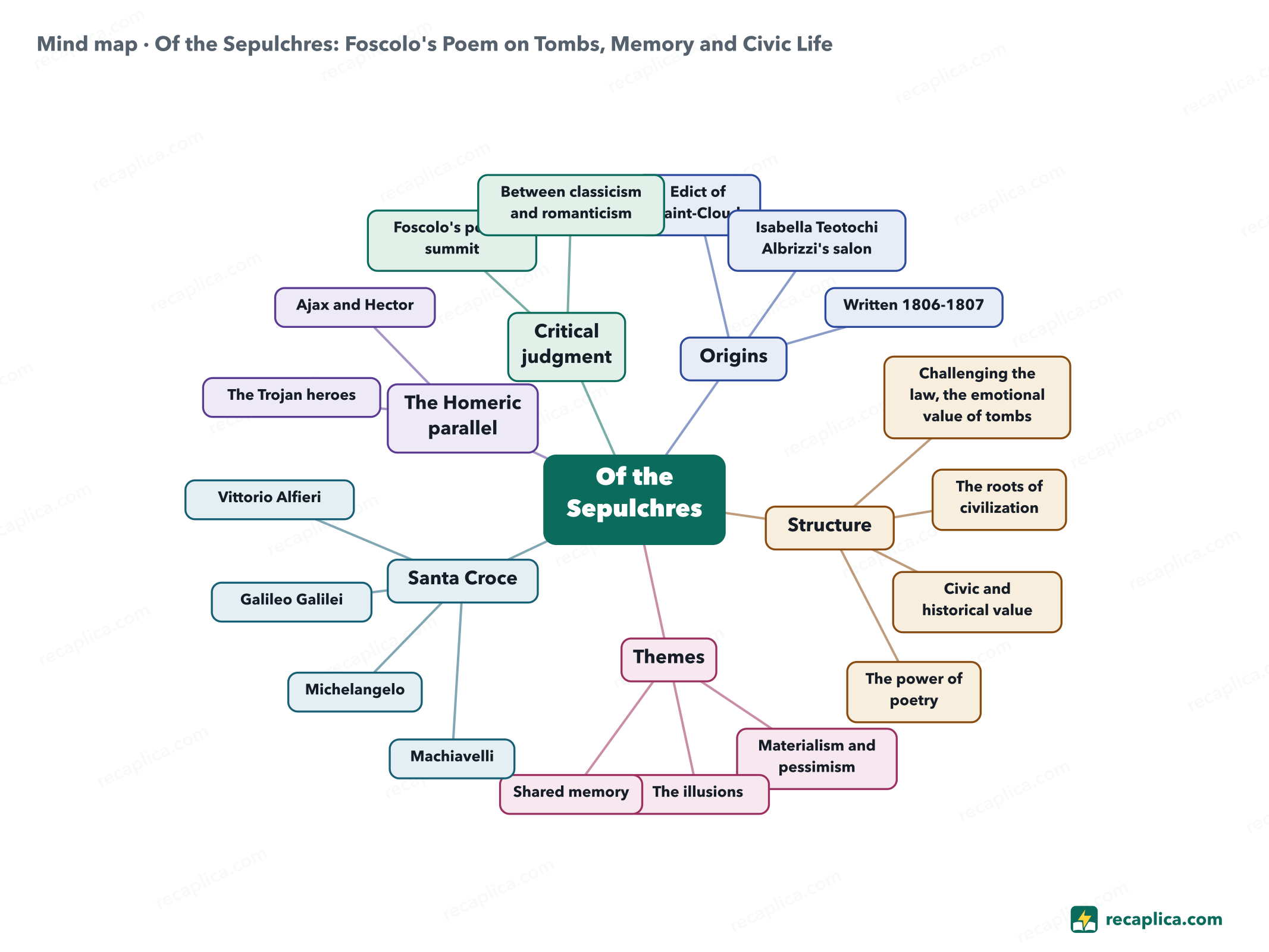
    Mind map: Of the Sepulchres: Foscolo's Poem on Tombs, Memory and Civic Life
    • Of the Sepulchres
      • Origins
        • Edict of Saint-Cloud Napoleonic burial law of 1804, extended to the Kingdom of Italy in 1806
        • Isabella Teotochi Albrizzi's salon where the debate that sparked the poem took place
        • Written 1806-1807 composed between summer and autumn 1806, published in Brescia in 1807
      • Structure
        • Challenging the law, the emotional value of tombs
        • The roots of civilization
        • Civic and historical value
        • The power of poetry
      • Themes
        • Materialism and pessimism
        • The illusions love, homeland, memory
        • Shared memory
      • Santa Croce
        • Machiavelli
        • Michelangelo
        • Galileo Galilei
        • Vittorio Alfieri
      • The Homeric parallel
        • The Trojan heroes
        • Ajax and Hector
      • Critical judgment
        • Foscolo's poetic summit according to Treccani
        • Between classicism and romanticism

    Quiz: test yourself

    Answer the questions to check what you have learned: you get instant feedback and a short explanation.

    Grade 0/10 0/5
    1 In what year was Of the Sepulchres published?

    Foscolo wrote the poem between the summer and autumn of 1806, but it reached print in Brescia, from the presses of Niccolò Bettoni, in 1807.

    2 Who is Of the Sepulchres dedicated to?

    The dedication goes to the Veronese poet Ippolito Pindemonte, who took part in the same salon conversation that gave Foscolo the idea for the poem.

    3 Which Napoleonic edict lies behind the debate that inspired the poem?

    The Edict of Saint-Cloud, issued by Napoleon in June 1804 and extended to the Kingdom of Italy in 1806, regulated burials and required cemeteries outside city walls with identical headstones.

    4 Of the Sepulchres is written in rhymed octaves.

    The poem is made of 295 unrhymed hendecasyllables; it follows no rhyme scheme at all, let alone octaves.

    5 Which illustrious tombs at Santa Croce, in Florence, does Foscolo cite in the poem?

    Foscolo names the tombs of Niccolò Machiavelli, Michelangelo, Galileo Galilei and Vittorio Alfieri, all housed in the basilica of Santa Croce.

    Answers: 1-B · 2-B · 3-A · 4-B · 5-B

    Flashcards

    Tap the card to flip it and check whether you remember the answer, then move to the next one.

    1 / 8

    Explain it in your own words

    The ultimate test: if you can explain it in simple words, you've truly understood it. Write your explanation, then compare it with the Recap.

    Your explanation is saved only on this device.

    Of the Sepulchres is a poem by Ugo Foscolo, written between the summer and autumn of 1806 and published in Brescia in 1807. It grew out of a conversation in the literary salon of Isabella Teotochi Albrizzi about the Edict of Saint-Cloud, the Napoleonic law that regulated burials, and it is dedicated to the poet Ippolito Pindemonte. Across 295 unrhymed hendecasyllables, Foscolo starts from a materialist view of death and arrives at the civic value of tombs, above all the tombs of famous Italians buried in Santa Croce in Florence, which keep a people's memory alive. Treccani calls it the highest point Foscolo ever reached as a poet.

    Frequently asked questions

    What is Of the Sepulchres by Ugo Foscolo?

    It is a poem of 295 unrhymed hendecasyllables that Ugo Foscolo wrote between 1806 and 1807, dedicated to Ippolito Pindemonte: it opens with a dispute over burial law and closes on the civic meaning of memory.

    Why did Ugo Foscolo write Of the Sepulchres?

    The idea came from a conversation in Isabella Teotochi Albrizzi's salon about the Edict of Saint-Cloud, the 1804 Napoleonic law that regulated burials and was extended to the Kingdom of Italy in 1806.

    How many lines does Of the Sepulchres have?

    295 unrhymed hendecasyllables, arranged in four thematic sections.

    What is the central theme of Of the Sepulchres?

    The civic value of tombs: Foscolo argues that remembering great men, such as those buried at Santa Croce in Florence, holds together the memory of an entire people.

    Why is Of the Sepulchres considered Foscolo's masterpiece?

    Treccani calls it the highest point of his entire poetic output, praising the balance it strikes between classicist form and themes that anticipate Romanticism.

    Sources

    • Dei sepolcri – Wikipedia
    • FOSCOLO, Ugo – Treccani, Enciclopedia Italiana
    • Analisi e commento al Dei sepolcri di Ugo Foscolo – Studenti.it

    Every Recap goes through an independent review before publication.

    Every evening, the day's new Recaps on our Telegram channel. Join the channel →

    Keep learning

    • Literature Carlo Goldoni: The Playwright Who Rewrote Italian Comedy Carlo Goldoni was born in Venice in 1707 and died in Paris in 1793, after training as a lawyer in Padua and practicing law in Venice. Before him, Italian comic theater relied mostly on commedia dell'arte: unscripted scenarios and fixed stock characters such as Harlequin. Goldoni moved the genre toward fully written plays with characters drawn from real life instead of stereotypes, a shift that begins with "La donna di garbo" ("The Woman of Good Sense") and spreads through his work in the 1750s. The change happened gradually: some transitional plays kept only three or four fully scripted scenes per act, with the rest still improvised. Read the Recap →
    • Literature Torquato Tasso: The Poet Behind Jerusalem Delivered Torquato Tasso was born in Sorrento in 1544 and died in Rome in 1595, having spent most of his adult life at the Este court in Ferrara. His masterwork is Jerusalem Delivered, a twenty-canto poem about the First Crusade and the fall of Jerusalem, published in its final form in 1581 after more than two decades of work. The story follows Godfrey of Bouillon as he leads the Christian army, but it keeps breaking away into private tales of love and duty: the knight Tancred, the sorceress Armida, the paladin Rinaldo. In 1593 Tasso issued a stricter revision titled Jerusalem Conquered, which never won over readers the way the original did. Read the Recap →
    • Literature Orlando Furioso: Plot, Characters and Summary Orlando Furioso is the chivalric romance that Ludovico Ariosto first publishes in 1516 and brings to its final shape in 1532, in forty-six cantos. It follows knights and ladies at the court of Charlemagne, and centers on the paladin Orlando, who loses his mind for love of Angelica — the source of the poem's title. Ariosto writes in ottava rima, the eight-line stanza typical of Italian narrative poetry, and takes as his starting point the unfinished Orlando Innamorato by Matteo Maria Boiardo. Read the Recap →

    recaplica

    Clear in 30 seconds, yours in 10 minutes.

    Recaps Mind maps Request a Recap Telegram channel Mind map maker Our method About Privacy & cookies Legal notes & terms of use

    © 2026 Recaplica · A project by Curi S.r.l. — VAT IT05472000750

    Statistics, only if you say so

    To learn which Recaps help most we would use Google Analytics, with aggregate, anonymous data. It starts only with your OK, and you can change your mind anytime. Privacy policy