|
recaplica
Kierkegaard: Philosophy of Existence Summary |
| © 2026 Recaplica · recaplica.com — All rights reserved |
Kierkegaard: Philosophy of Existence SummaryWhat to print Page numbers appear when printing with default margins. SlidesChoose a cut Flash10 slidesThe essential thread, to present in classFull16 slidesEvery chapter and the deeper detailBoth come with speaker notes. In 30 seconds quick readSøren Kierkegaard was a Danish philosopher who lived from 1813 to 1855, often called the father of existentialism. At the core of his thought sits the concrete existence of the single individual, with their choices and their freedom, set against Hegel's ambition to explain the whole of reality through one complete philosophical system. Kierkegaard distinguishes three ways of living, the aesthetic, the ethical and the religious, and describes anxiety as the dizziness that comes with the freedom to choose. Between 1843 and 1849 he published, often under different pseudonyms, the works that remain the core of his philosophical legacy. Key Points
Deep DiveWho was Søren KierkegaardSøren Kierkegaard was born on 5 May 1813 in Copenhagen, into a well-off family. His father, Michael Kierkegaard, was a successful merchant but also a man prone to melancholy, and he passed on to his son a deep sense of guilt that stayed with him for life. In 1840 Kierkegaard got engaged to Regine Olsen, then eighteen; the following year he broke off the engagement, convinced his own temperament made him unfit for marriage, rather than reveal to her a personal secret he considered incompatible with married life. Shortly before his death he used the newspaper Fædrelandet to launch a public, pointed attack on the Danish state church — a challenge to established religious authority that, under very different circumstances, echoes the one Martin Luther raised centuries earlier with the Protestant Reformation. He died in Copenhagen on 11 November 1855, a few weeks after being hospitalized, at age 42. His output falls into two strands. One is signed under different pseudonyms: Victor Eremita, Johannes de Silentio, Johannes Climacus, Vigilius Haufniensis, Anti-Climacus. The other is signed with his own name, such as Works of Love, published in 1847. The pseudonyms are not a literary quirk: each voice argues its own point of view, often in tension with the others, and Kierkegaard uses irony and satire to carry an argument forward without speaking in the first person. Kierkegaard’s target: Hegel’s systemIn a common reading, the refusal to build a philosophical system makes Kierkegaard a radical opponent of Hegel. The pseudonym Johannes Climacus pushes the objection to its limit: only God could build a complete system of existence, not a human being who exists in time and cannot view their own life from a point outside it. It is a modern version of an older question, the one about what makes an individual real in front of a universal category that Aristotle and Plato had already approached in opposite ways. To see what Kierkegaard rejects, it helps to see where he starts. Hegel proposes a method, dialectic, that in theory can reveal the whole of reality as a single rational process. Kierkegaard mainly targets the starting ambition behind a project like that: the same drive to close existence inside a finished system also underlies Spinoza’s single substance, built from a geometric order meant to explain everything. For Kierkegaard that order stays outside the person who exists and chooses, and no system can choose in their place.
The three spheres of existenceA common reading of Kierkegaard’s thought distinguishes three spheres, or stages, of existence. The aesthetic sphere is built around immediate pleasure and asks nothing lasting of the person. The ethical sphere brings in duty and commitment: a person ties themselves to a job, a relationship, a promise, and answers for it over time. The religious sphere, for Kierkegaard, calls for the inwardness of a believer: genuine faith is a personal, passionate claim, one that demands more than simply knowing facts. There is no sharp line between one sphere and the next. Between the aesthetic and the ethical lies a zone crossed by irony. Between the ethical and the religious, a zone crossed by humor. The pseudonym Johannes Climacus sums up the move toward the religious sphere with two provocative formulas, “truth is subjectivity” and “subjectivity is untruth”: religious truth is claimed first-hand, with a passion no outside check could supply. For Kierkegaard, faith begins at the exact point where reason stops. Anxiety in KierkegaardIn The Concept of Anxiety, signed under the pseudonym Vigilius Haufniensis, Kierkegaard describes anxiety, in German Angst, as the dizziness of freedom. It appears when the spirit has to hold body and soul together at the moment of choosing. The same work also calls it an ambivalent feeling, both attraction and repulsion, that anticipates the pleasure of freedom together with the weight of the responsibility freedom brings. It is the natural response to a life lived with intellectual independence, taking on responsibility for one’s own choices. The major works, in briefBetween 1843 and 1849 Kierkegaard published, in quick succession, the works that remain the core of his thought. Either/Or, edited by the fictional Victor Eremita, sets the aesthetic and ethical ways of life side by side. Fear and Trembling, signed Johannes de Silentio, draws on the biblical story of Abraham to question the relationship between faith and ethics. The Concept of Anxiety, signed Vigilius Haufniensis, develops the theme of the previous section. The Sickness unto Death, signed Anti-Climacus, treats despair as a condition of the spirit. To these can be added Philosophical Fragments and the Concluding Unscientific Postscript, both signed Johannes Climacus, and Repetition, signed Constantin Constantius, published already in 1843. Each of these works deserves a reading of its own; here they remain an introduction, a starting point. The legacy of an uncomfortable thinkerKierkegaard’s thought influences the phenomenological and existentialist tradition of the 20th century, from Heidegger to Sartre, from Jaspers to Marcel and Levinas. He becomes a major intellectual figure mostly after the First World War, when he is rediscovered across Europe. The label “first existentialist” has followed him ever since, but the Stanford Encyclopedia of Philosophy flags a caution: applied to a thinker for whom faith remains the destination, it risks misleading readers who tie existentialism mainly to atheist thinkers like Sartre. Slide deckSlides ready to download and make your own in PowerPoint or Google Slides, with speaker notes. Pick the Flash cut or the Full one.   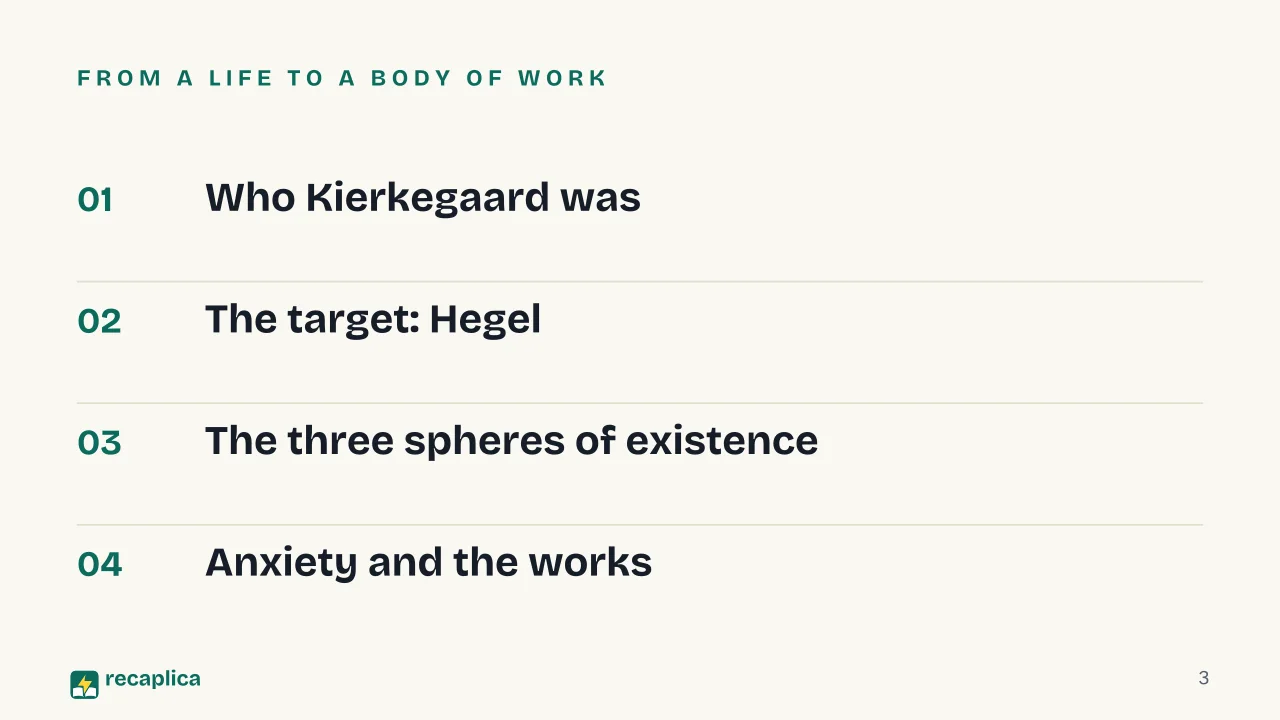  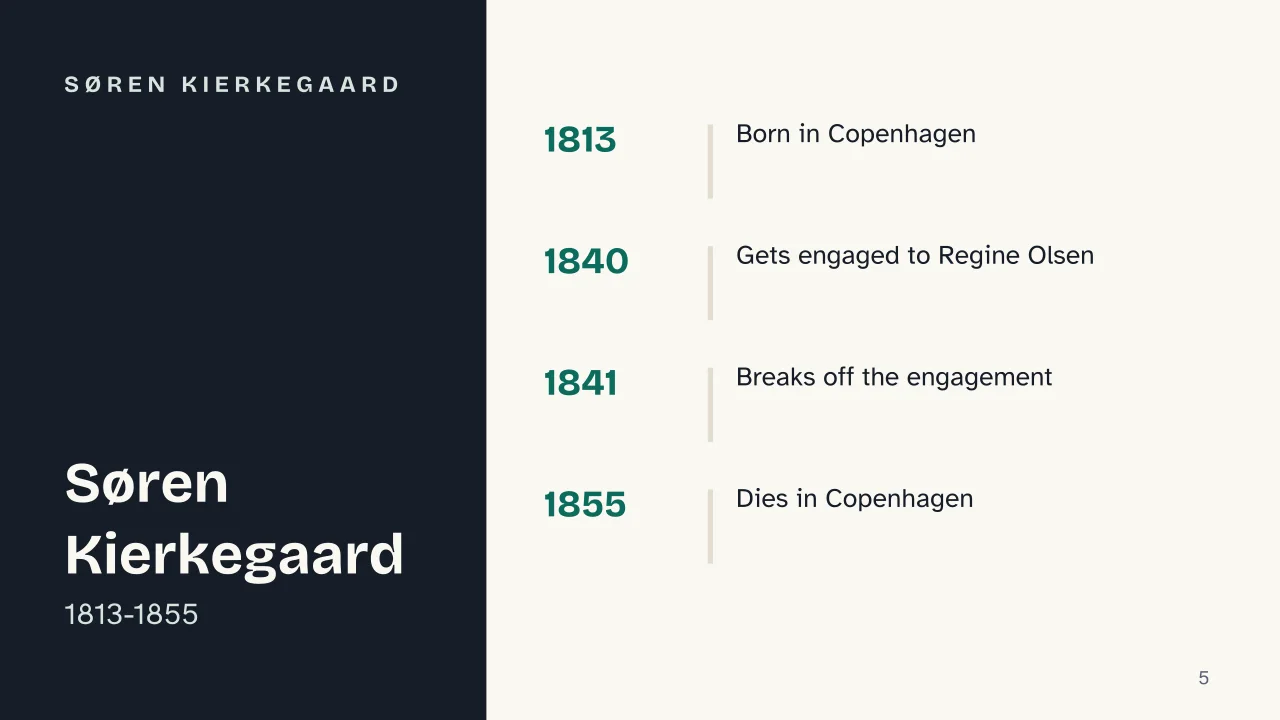  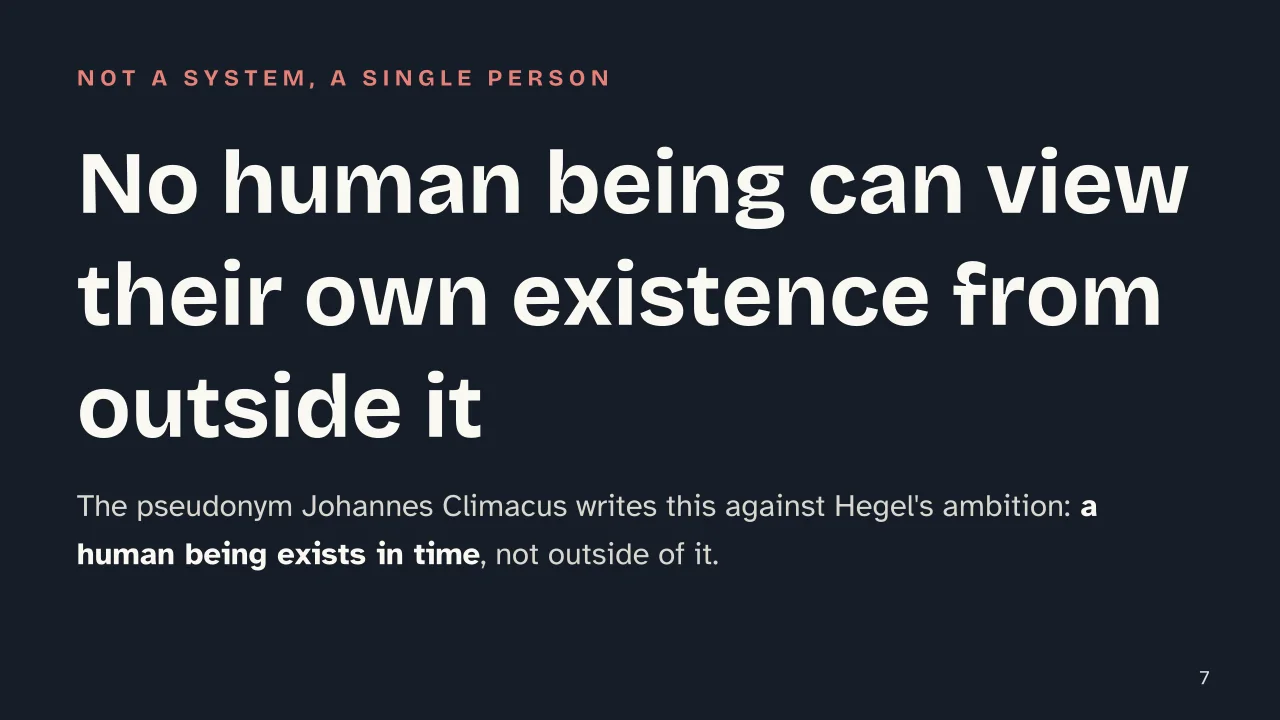   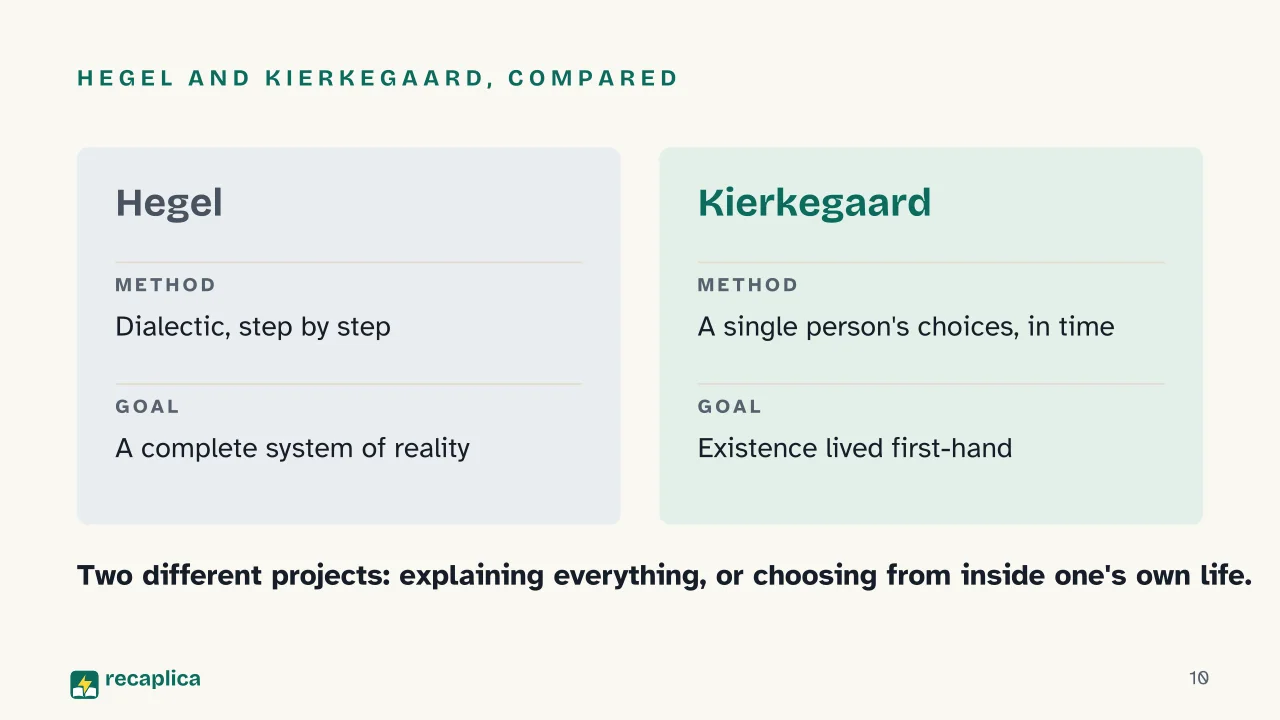  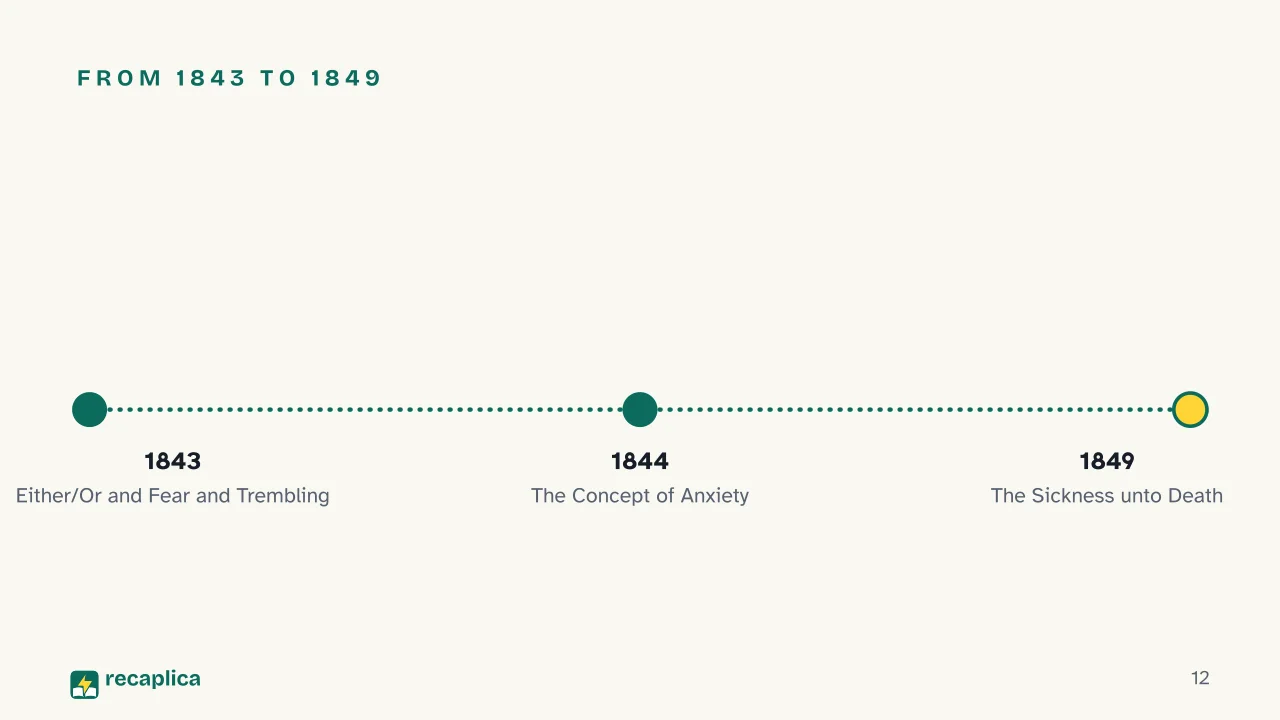 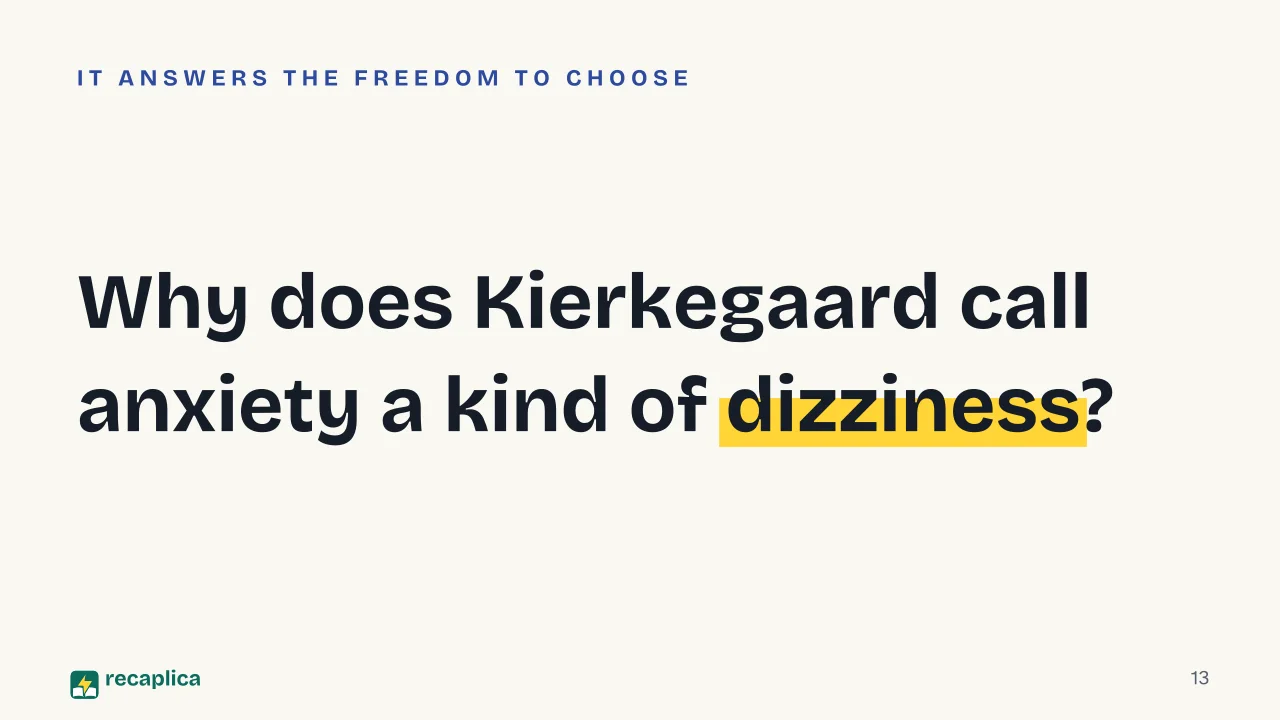 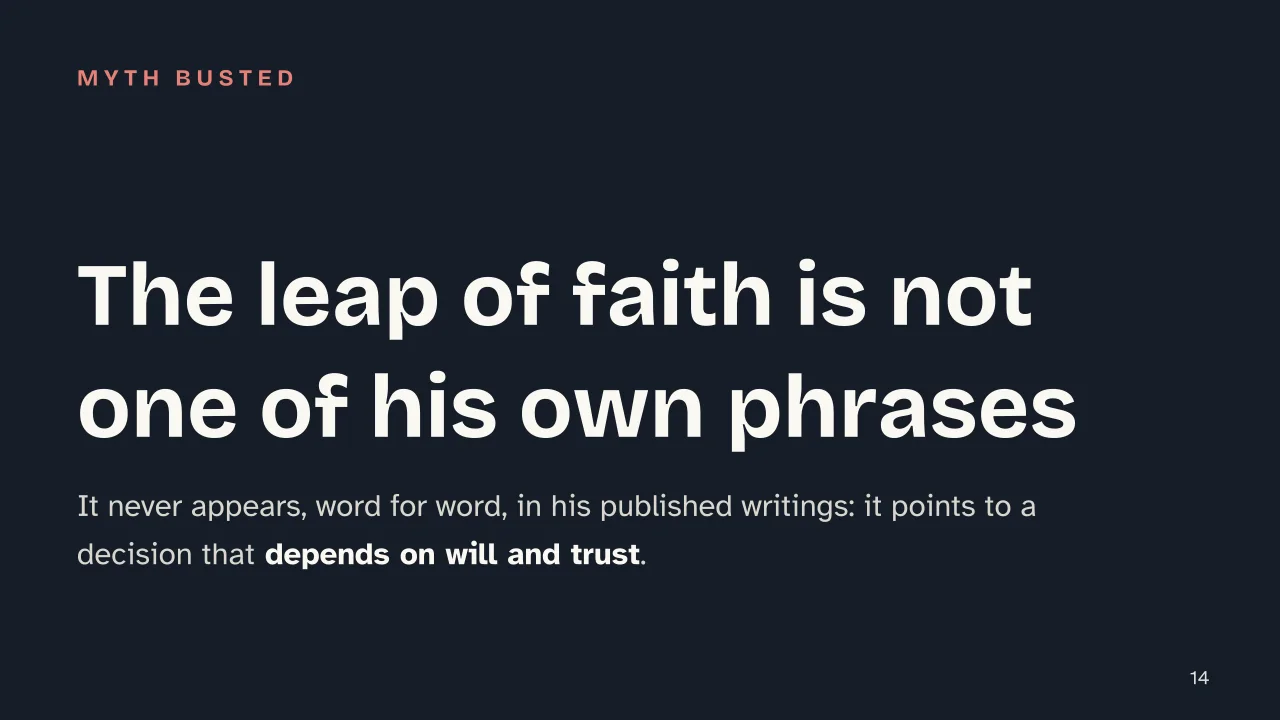 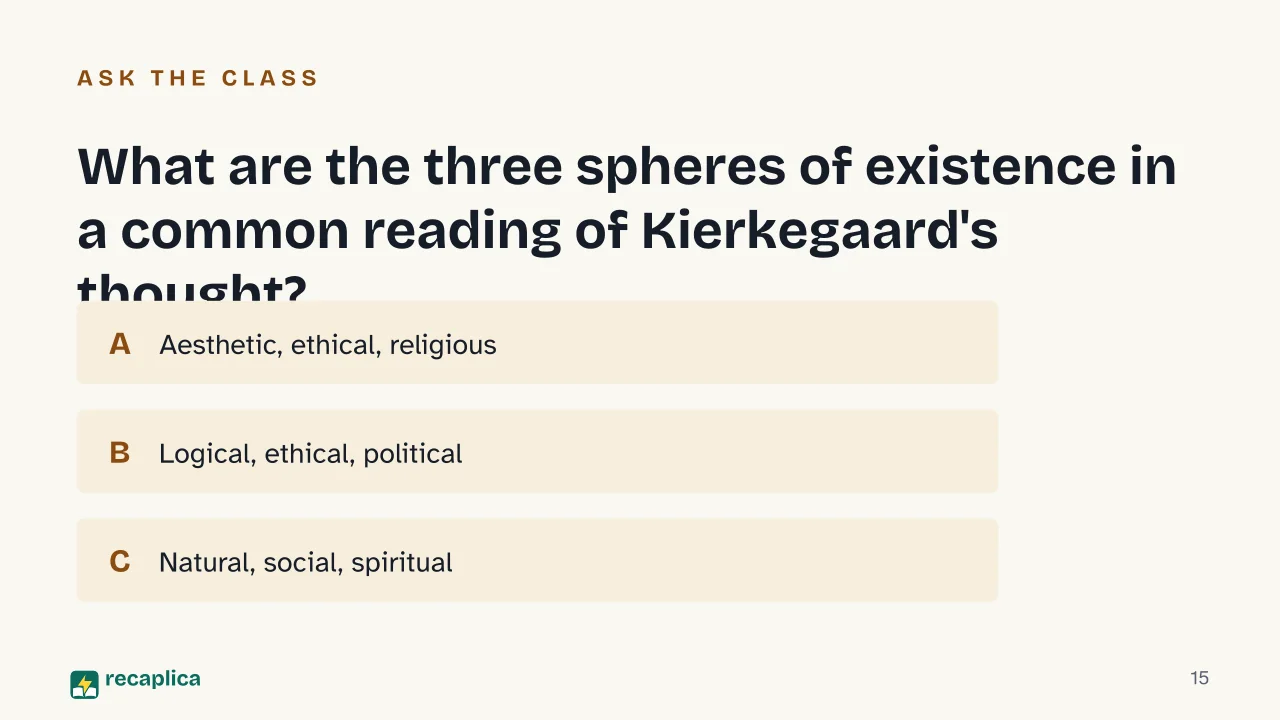  Common myths
Mind mapDrag the background to move around and the nodes to reposition them; use − and + to collapse and expand branches. 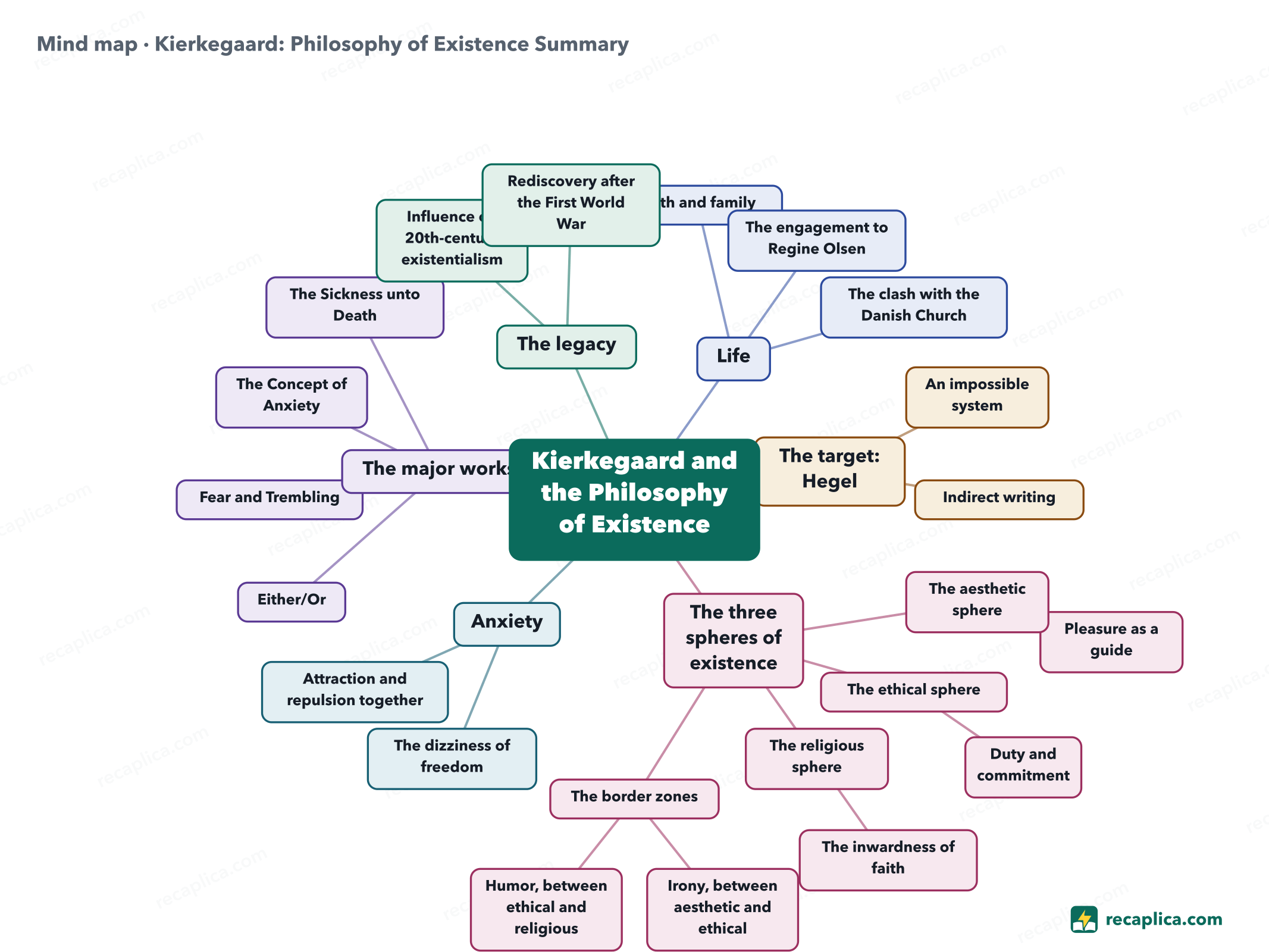
Quiz: test yourselfAnswer the questions to check what you have learned: you get instant feedback and a short explanation. Grade 0/10 0/5
FlashcardsTap the card to flip it and check whether you remember the answer, then move to the next one. 1 / 7 Explain it in your own wordsThe ultimate test: if you can explain it in simple words, you've truly understood it. Write your explanation, then compare it with the Recap. Your explanation is saved only on this device.
Frequently asked questionsWho was Søren Kierkegaard?A Danish philosopher who lived from 1813 to 1855, often called the father of existentialism for his work on choice, freedom and the faith of the single individual. What is Kierkegaard's philosophy of existence?A way of reading human life that starts from a single person's own choices and freedom, rather than from an abstract philosophical system. Kierkegaard built it largely against Hegel, whose dialectic claimed to explain reality as a whole. Why is Kierkegaard called a philosopher of existentialism?Because his thought centers on one person's own choices and freedom, instead of an abstract philosophical system. The label needs care, though, since it can confuse readers who link existentialism to atheist thinkers like Sartre, while for Kierkegaard religious faith stays central. What is anxiety according to Kierkegaard?It is described as the dizziness of freedom, which arises at the moment of choice, when body and soul must stay joined. Other readings define it as an ambivalent feeling, attraction and repulsion together. What are Kierkegaard's main works?Between 1843 and 1849 he published, under different pseudonyms, Either/Or, Fear and Trembling, The Concept of Anxiety and The Sickness unto Death; in 1847 he published Works of Love under his own name. Every Recap goes through an independent review before publication. |