Skip to content
recaplica

    One moment: security check

    Cloudflare wants to make sure you're not a robot. Tick the box below and your search will continue on its own.

    IT
    recaplica Martin Luther and the Protestant Reformation: A Summary
    © 2026 Recaplica · recaplica.com — All rights reserved
    Home › History

    Martin Luther and the Protestant Reformation: A Summary

    By Recaplica Newsroom · Updated on September 24, 2026

    What to print

    Page numbers appear when printing with default margins.

    Slides

    Choose a cut

    Flash10 slidesThe essential thread, to present in classFull14 slidesEvery chapter and the deeper detail

    Both come with speaker notes.

    Telegram channel
    recaplica Clear in 30 seconds, yours in 10 minutes.
    In 30 seconds Key points Figures Deep dive Slides Myths Mind map Quiz Flashcards FAQ

    In 30 seconds quick read

    Martin Luther was a German Augustinian monk who, according to tradition, nailed 95 theses against the sale of indulgences to the door of the Castle Church in Wittenberg in 1517. The act opened a religious process that lasted decades, later known as the Protestant Reformation, which led to Luther's excommunication and to a new Christian doctrine that took hold mainly in Germany and in the Scandinavian and Baltic countries. The clash with Emperor Charles V only ended in 1555 with the Peace of Augsburg, which split the territory of the Empire between Catholics and Lutherans.

    Key Points

    • Martin Luther was born in Eisleben in 1483 and joined the Order of Augustinian Hermits.
    • In 1517 he nailed, according to tradition, 95 theses against the sale of indulgences to the door of the Castle Church in Wittenberg.
    • The printing press helped the theses spread across Germany as early as 1518.
    • In 1521 he was excommunicated by Pope Leo X and, at the Diet of Worms, declared an outlaw and heretic by Emperor Charles V.
    • Luther kept only two of the seven Catholic sacraments, baptism and the Eucharist.
    • The 1555 Peace of Augsburg sealed the religious division of the Empire between Catholics and Protestants.

    Key figures

    • October 31, 1517 The conventional starting date of the Protestant Reformation, the day Luther is said to have nailed the 95 theses to the door of the Castle Church in Wittenberg. Source: Treccani
    • 1521 Year of Luther's excommunication by Pope Leo X and of the Diet of Worms, which declared him an outlaw and a heretic. Source: History.com
    • 1555 Year of the Peace of Augsburg, which split the territory of the Empire between Catholics and Lutherans under the principle cuius regio, eius religio. Source: Treccani

    Deep Dive

    Who Martin Luther Was

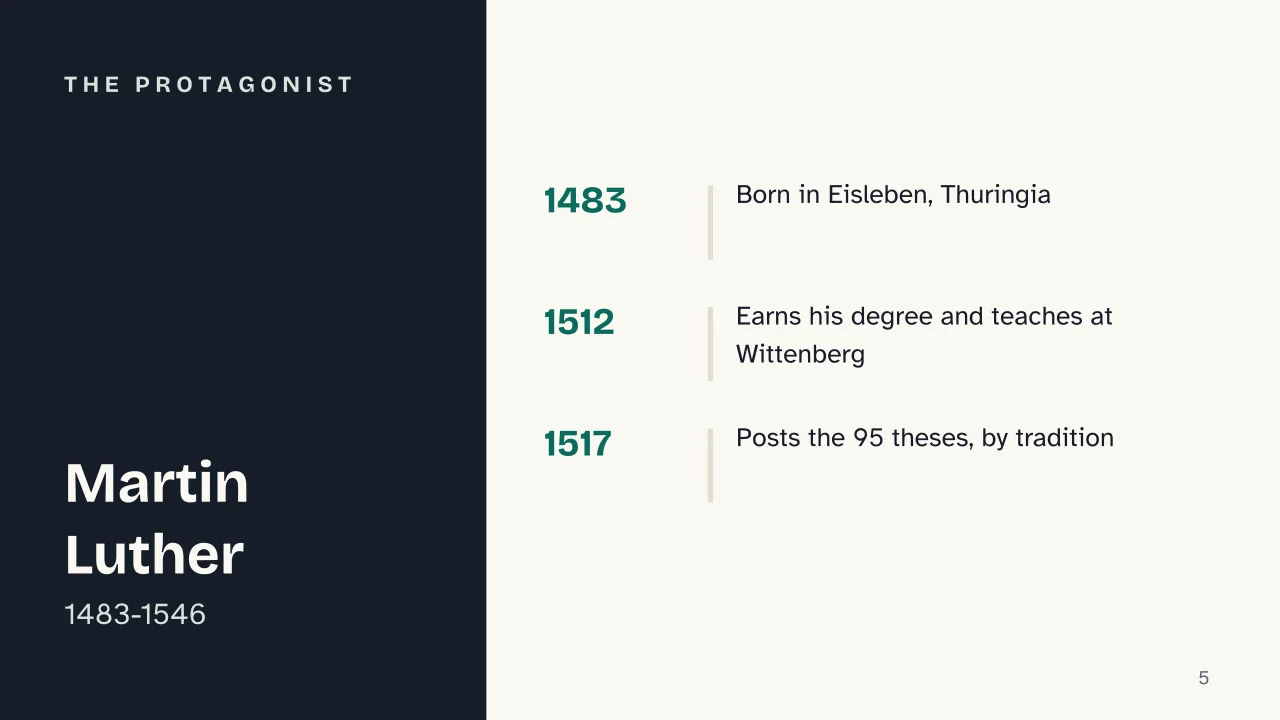
    Martin Luther was born in Eisleben, Thuringia, in 1483 and joined the Order of Augustinian Hermits. He earned a degree in biblical studies in 1512 and from then on taught Scripture for the rest of his life at the newly founded University of Wittenberg, the German town that would become the center of the religious process later called the Protestant Reformation.

    As with many figures who lived five centuries ago, not everything told about Luther is documented the same way: some episodes, as we’ll see, are handed down as tradition rather than proven by a document from the period. For a look at the period that preceded the Reformation, see the Recap on the Middle Ages, the age in which the Catholic Church consolidated the authority Luther would later challenge.

    The 95 Theses Against Indulgences

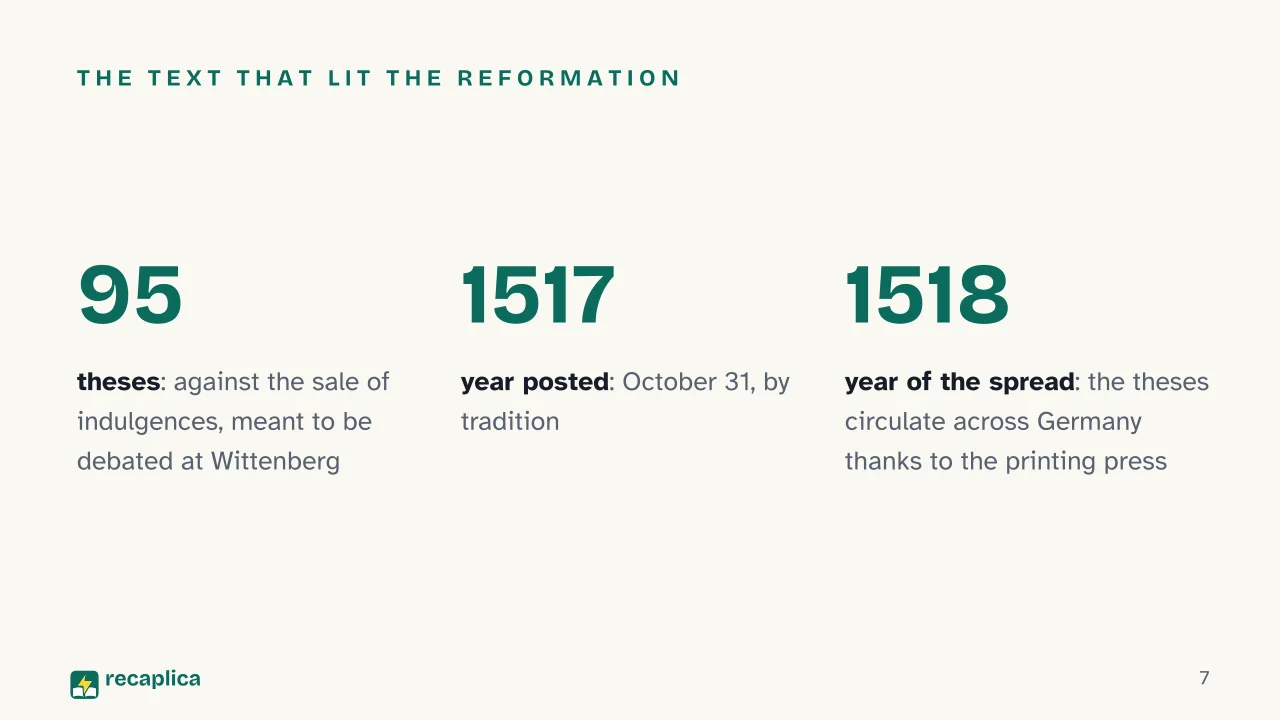
    At the heart of the story are the 95 theses, a text in which Luther challenged the practice of indulgences: payments the Church requested to reduce time in purgatory. The document, meant according to the original text to be “debated at Wittenberg,” is known to history as the Disputation on the Power and Efficacy of Indulgences.

    The conventional starting date of the Protestant Reformation is October 31, 1517, the day Luther is said to have nailed the 95 theses to the door of the Castle Church in Wittenberg. It’s an important date, but it should be taken for what it is: both Treccani and History.com use cautious language (“would have posted,” “legend has it”) to flag that the posting itself is a handed-down tradition, not something documented by a source from the time.

    What is certain is how fast the text spread: thanks to the printing press, invented roughly a century earlier, the 95 theses circulated across Germany as early as 1518, just a year after they were written.

    Practical example: if you’re studying for a history test, try lining up on your own the four key dates of the Reformation — 1517, 1521, 1530, 1555 — and for each one write in a single line what changed. It’s the same exercise the concept map further down asks for.

    The Break with Rome

    The consequences of the 95 theses arrived within a few years. In 1521 Pope Leo X formally excommunicated Luther from the Catholic Church. That same year, at the Diet of Worms, Holy Roman Emperor Charles V issued the famous Edict of Worms, declaring Luther an outlaw and a heretic. Papal excommunication follows a procedure that, in different forms, remains part of the Catholic Church’s canon law: to see how that institution’s top office works, see the Recap on the Papal Conclave.

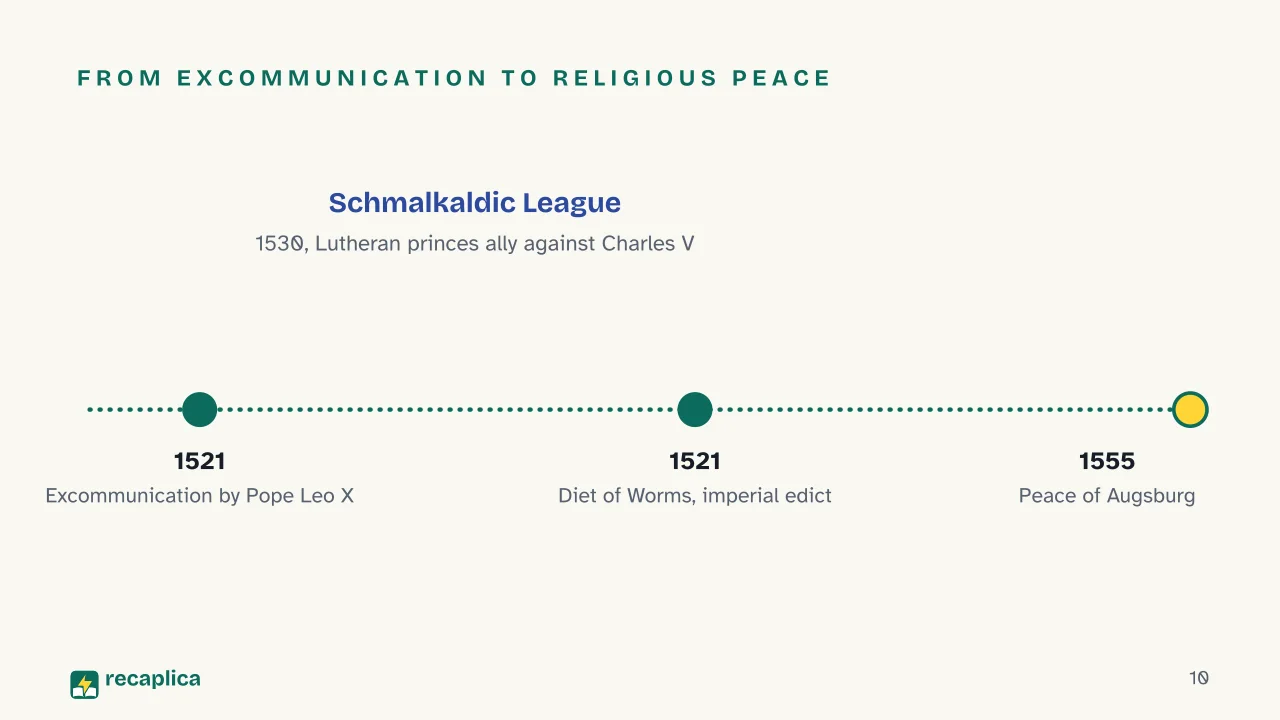
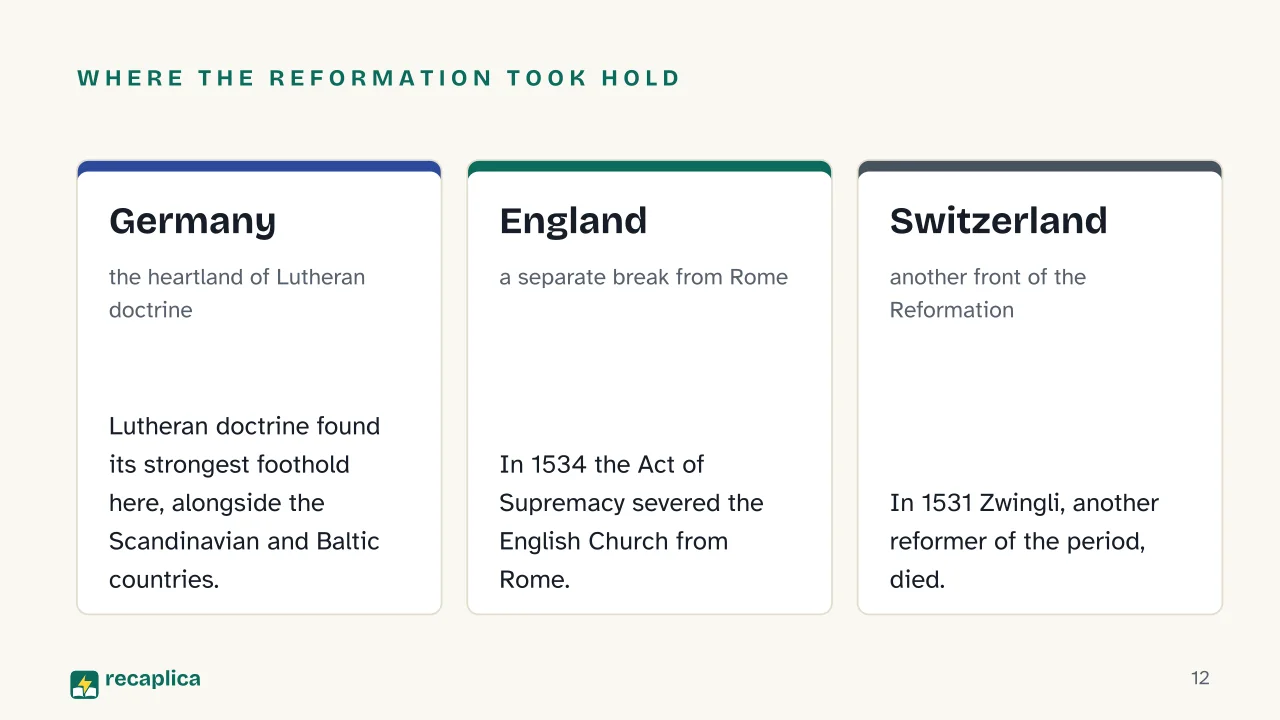
    Despite the condemnation, Lutheran doctrine put down roots mainly in German lands and across the Scandinavian and Baltic region. The political and religious clash between the German princes who had embraced it and the emperor dragged on for decades: after the diets of Speyer (1529) and Augsburg (1530), the Lutheran princes joined forces in the Schmalkaldic League (1530) and fought Charles V until the 1555 Peace of Augsburg. That agreement sealed the division between Catholics and Protestants in the Empire under the principle cuius regio, eius religio, which required subjects to follow the religion of their own prince, whether Catholic or Lutheran.

    YearEvent
    1483Luther born in Eisleben
    1512Degree and professorship at Wittenberg
    1517The 95 theses against indulgences
    1518The theses spread across Germany
    1521Excommunication and the Diet of Worms
    1529-1530Diets of Speyer and Augsburg, Schmalkaldic League
    1546Luther dies
    1555Peace of Augsburg

    What Survived of Catholic Doctrine

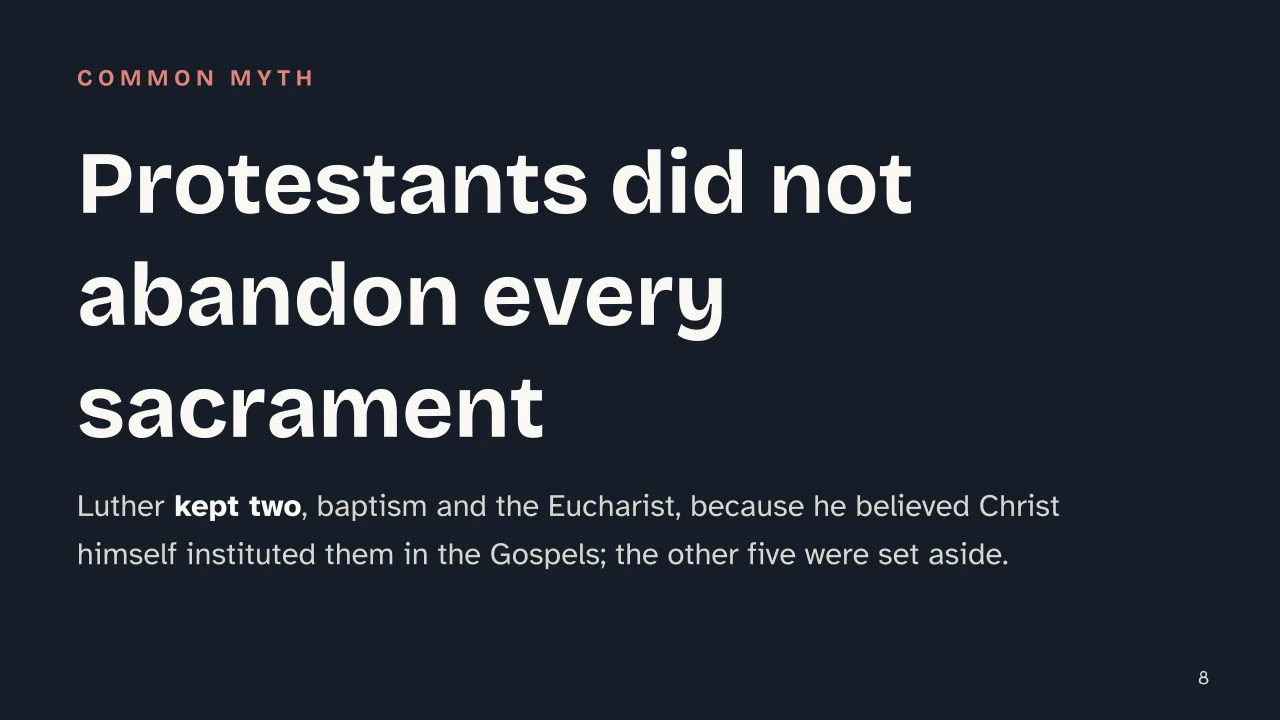
    One of the least understood parts of the story concerns the sacraments. Luther did not reject all of them: he kept two, baptism and the Eucharist (the Lord’s Supper), because he believed they were the only ones instituted directly by Christ in the Gospels. He attacked monastic vows, pilgrimages, and works of merit instead, calling them “man-made” substitutes for the divine word of forgiveness. Lutheran doctrine radically changed the Church’s authority and the number of recognized sacraments, yet it did not start from zero: much of the earlier Christian framework remained in place.

    The period in which Luther worked overlaps with the Renaissance, the same stretch of time in which art, science, and culture were being transformed in Italy: the Protestant Reformation was, in a sense, the religious counterpart of that wave of change that swept across sixteenth-century Europe.

    Slide deck

    Slides ready to download and make your own in PowerPoint or Google Slides, with speaker notes. Pick the Flash cut or the Full one.
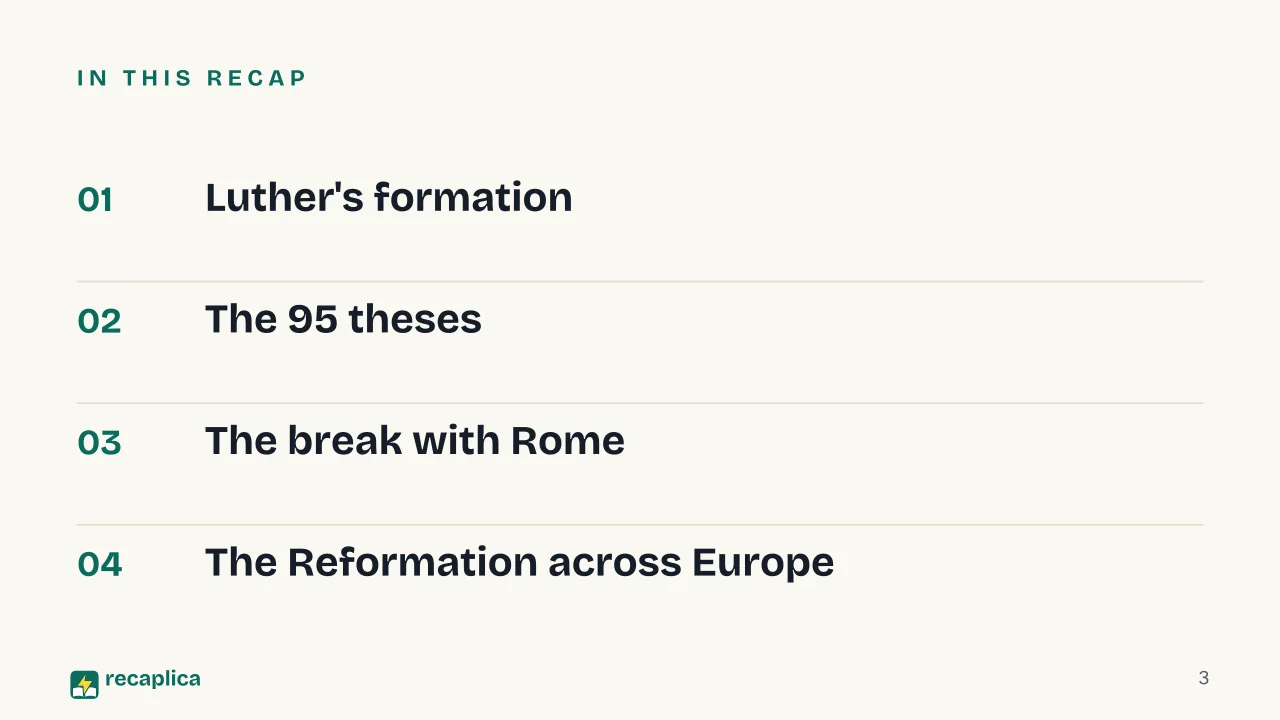
    Slide 1 of the presentation on Martin Luther and the Protestant Reformation: Martin Luther and the Protestant ReformationSlide 2 of the presentation on Martin Luther and the Protestant Reformation: How does one monk end up changing the religious history of a continent?Slide 3 of the presentation on Martin Luther and the Protestant Reformation: In this RecapSlide 4 of the presentation on Martin Luther and the Protestant Reformation: Chapter 01: Luther's formationSlide 5 of the presentation on Martin Luther and the Protestant Reformation: The protagonistSlide 6 of the presentation on Martin Luther and the Protestant Reformation: Chapter 02: The 95 thesesSlide 7 of the presentation on Martin Luther and the Protestant Reformation: The text that lit the ReformationSlide 8 of the presentation on Martin Luther and the Protestant Reformation: Protestants did not abandon every sacramentSlide 9 of the presentation on Martin Luther and the Protestant Reformation: Chapter 03: The break with RomeSlide 10 of the presentation on Martin Luther and the Protestant Reformation: From excommunication to religious peaceSlide 11 of the presentation on Martin Luther and the Protestant Reformation: Chapter 04: The Reformation across EuropeSlide 12 of the presentation on Martin Luther and the Protestant Reformation: Where the Reformation took hold: Germany, England, SwitzerlandSlide 13 of the presentation on Martin Luther and the Protestant Reformation: What were Luther's 95 theses directed against?Slide 14 of the presentation on Martin Luther and the Protestant Reformation: The Recap continues on the site
    Flash10 slidesThe essential thread, to present in classFull14 slidesEvery chapter and the deeper detail

    Common myths

    • ✗ Myth The nailing of the 95 theses to the Wittenberg church door is a fact documented with certainty.

      ✓ Reality It is a handed-down tradition, not an episode proven by a document from the time: Treccani writes that Luther "would have posted" the theses, and History.com uses the phrase "legend has it".

    • ✗ Myth Protestants abandoned every sacrament of the Catholic Church.

      ✓ Reality Luther kept two, baptism and the Eucharist (the Lord's Supper), because he believed Christ himself instituted them in the Gospels; the other five were set aside along with monastic vows and pilgrimages.

    • ✗ Myth The 95 theses spread across Europe on their own as soon as they were written.

      ✓ Reality Their rapid circulation across Germany in 1518 was made possible by the printing press, invented roughly a century earlier: without that technology, the text would have stayed local for much longer.

    Mind map

    Drag the background to move around and the nodes to reposition them; use − and + to collapse and expand branches.
    Customize
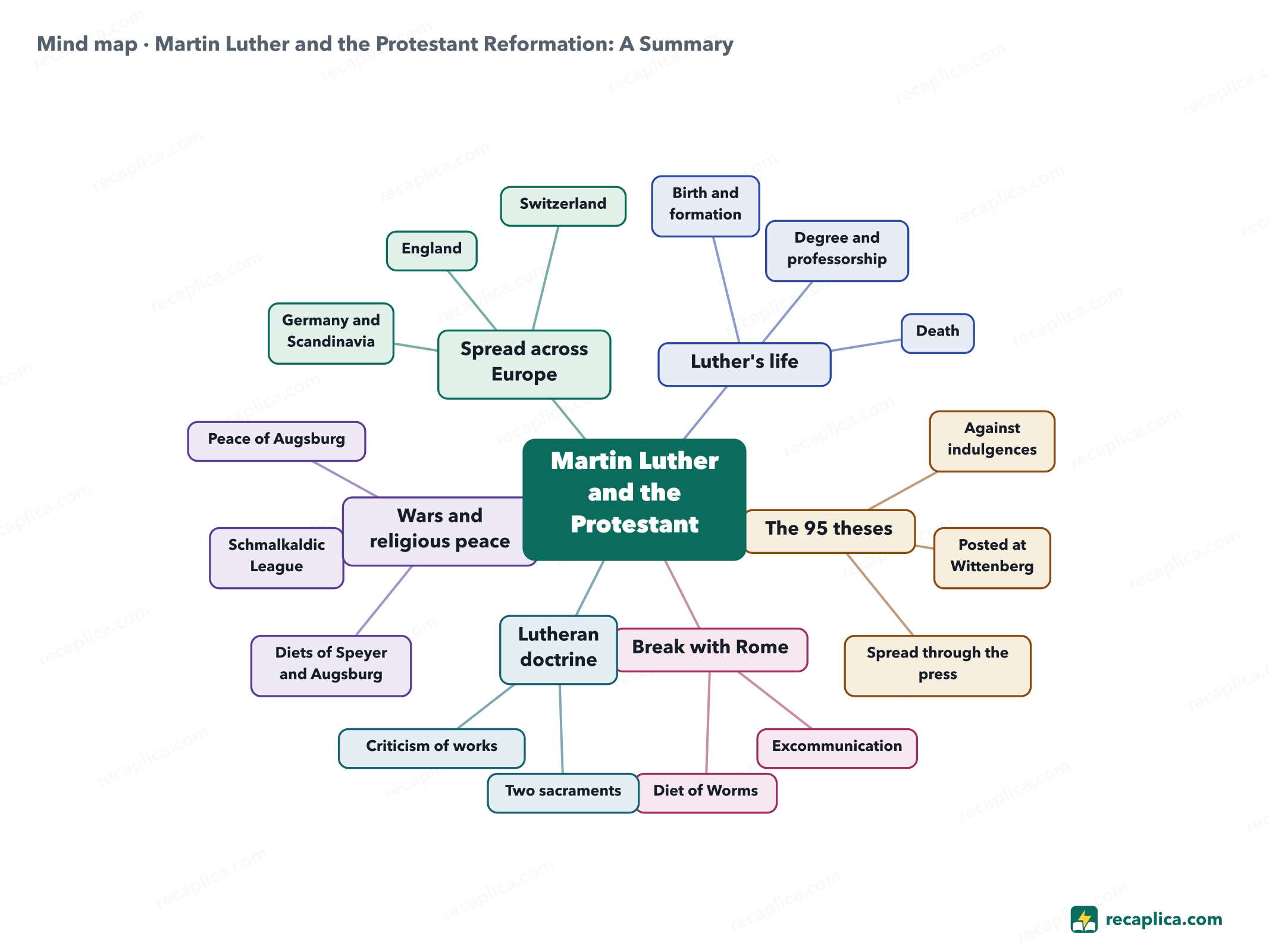
    Mind map: Martin Luther and the Protestant Reformation: A Summary
    • Martin Luther and the Protestant Reformation
      • Luther's life
        • Birth and formation Eisleben, 1483, Order of Augustinian Hermits
        • Degree and professorship 1512, University of Wittenberg
        • Death 1546
      • The 95 theses
        • Against indulgences payments to reduce time in purgatory
        • Posted at Wittenberg October 31, 1517, by tradition
        • Spread through the press across Germany as early as 1518
      • Break with Rome
        • Excommunication 1521, Pope Leo X
        • Diet of Worms 1521, imperial edict of Charles V
      • Lutheran doctrine
        • Two sacraments baptism and the Eucharist, not seven
        • Criticism of works monastic vows and pilgrimages as human substitutes
      • Wars and religious peace
        • Diets of Speyer and Augsburg 1529-1530
        • Schmalkaldic League 1530, alliance against Charles V
        • Peace of Augsburg 1555, cuius regio eius religio
      • Spread across Europe
        • Germany and Scandinavia the region where Lutheran doctrine found its strongest following
        • England Act of Supremacy, 1534
        • Switzerland another front of the Reformation, with Zwingli's death in 1531

    Quiz: test yourself

    Answer the questions to check what you have learned: you get instant feedback and a short explanation.

    Grade 0/10 0/5
    1 In what year did Martin Luther, according to tradition, nail his 95 theses to the door of the Castle Church in Wittenberg?

    October 31, 1517 is the conventional date, handed down as a tradition rather than proven by a document from the time.

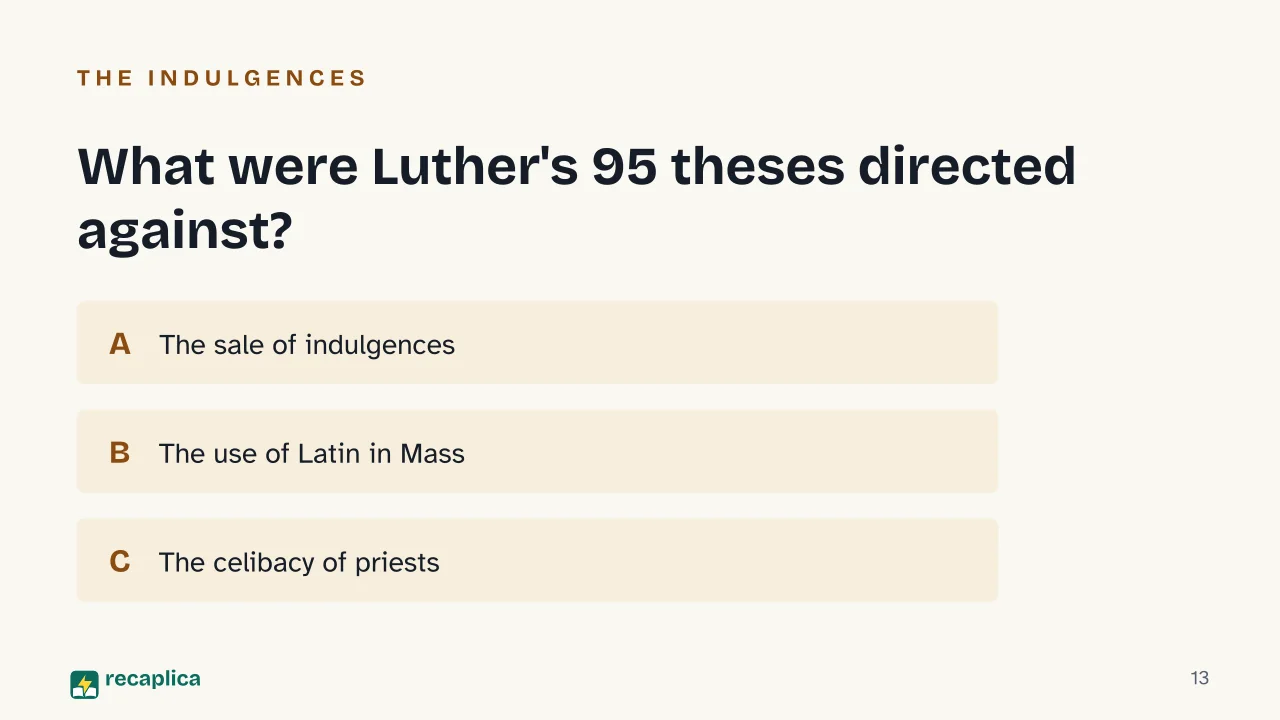
    2 What were Luther's 95 theses directed against?

    Indulgences were payments the Church requested to reduce time in purgatory: Luther challenged them in a text meant to be debated at Wittenberg.

    3 How many sacraments did Martin Luther recognize, compared with the Catholic Church's seven?

    Luther kept only the sacraments he believed Christ himself instituted in the Gospels: baptism and the Eucharist (the Lord's Supper).

    4 True or false: the 1555 Peace of Augsburg settled the Empire's religious divide under the principle "cuius regio, eius religio".

    The principle required subjects to follow the religion of their own prince, Catholic or Lutheran, closing the conflict that had opened at the diets of Speyer and Augsburg.

    5 What helped Luther's theses spread quickly across Germany as early as 1518?

    The printing press, invented roughly a century earlier, let the theses circulate across Germany within a year.

    Answers: 1-B · 2-A · 3-B · 4-A · 5-A

    Flashcards

    Tap the card to flip it and check whether you remember the answer, then move to the next one.

    1 / 7

    Explain it in your own words

    The ultimate test: if you can explain it in simple words, you've truly understood it. Write your explanation, then compare it with the Recap.

    Your explanation is saved only on this device.

    Martin Luther was a German Augustinian monk who, according to tradition, nailed 95 theses against the sale of indulgences to the door of the Castle Church in Wittenberg in 1517. The act opened a religious process that lasted decades, later known as the Protestant Reformation, which led to Luther's excommunication and to a new Christian doctrine that took hold mainly in Germany and in the Scandinavian and Baltic countries. The clash with Emperor Charles V only ended in 1555 with the Peace of Augsburg, which split the territory of the Empire between Catholics and Lutherans.

    Frequently asked questions

    How exactly are Martin Luther and the Protestant Reformation connected?

    Martin Luther is the person who started the process: in 1517 he challenged the sale of indulgences with his 95 theses. The Protestant Reformation is the name later given to the whole religious movement that grew out of that act, which took hold mainly in Germany and in the Scandinavian and Baltic countries over the following decades.

    Who was Martin Luther?

    A German Augustinian monk, born in Eisleben in 1483, who earned a degree in biblical studies in 1512 and taught Scripture at the newly founded University of Wittenberg. He died in 1546.

    What are Luther's 95 theses?

    A text meant to be debated at Wittenberg, in which Luther challenged the sale of indulgences; tradition holds that he nailed them to the door of the Castle Church in Wittenberg on October 31, 1517.

    Did Protestants abandon all the Catholic sacraments?

    No. Luther kept two, baptism and the Eucharist, because he believed Christ himself instituted them in the Gospels; the other five Catholic sacraments were set aside along with monastic vows, pilgrimages, and works of merit.

    Sources

    • Treccani, «Riforma protestante»
    • Treccani, «Lutero e il luteranesimo» (Enciclopedia dei ragazzi)
    • History.com, «Martin Luther posts 95 theses»
    • World History Encyclopedia, «Protestant Reformation»
    • New World Encyclopedia, «Martin Luther»
    • Chiesa Evangelica Luterana in Italia, «Le 95 tesi di Lutero»

    Every Recap goes through an independent review before publication.

    Every evening, the day's new Recaps on our Telegram channel. Join the channel →

    Keep learning

    • History Capetian Dynasty: Who Were the Kings Who Built Medieval France The Capetian dynasty ruled France from 987 to 1328, starting when an assembly of nobles elected Hugh Capet king. At first his real power covered a tiny territory, roughly 1,000 square kilometers between Paris and Orléans: the rest of the kingdom belonged to powerful feudal lords. Over the next two centuries the Capetian kings grew the Crown's holdings through alliances, marriages and war, culminating in Philip II Augustus's victory at Bouvines in 1214. Louis IX brought the dynasty to its religious and institutional peak, while Philip IV the Fair clashed openly with the papacy. When the direct line died out in 1328, the throne passed to the Valois, a branch of the same family. Read the Recap →
    • History Italian City-State: What It Was, How It Began, and How It Changed The Italian city-state was the form of self-government with which, starting in the late 11th century, many cities in northern and central Italy ran their own affairs, pulling free of direct control by bishops and feudal lords. It began as a government of consuls elected by an assembly of heads of household, then shifted to a foreign official called the podestà, and from the mid-13th century saw the institutions of the popolo take shape alongside it, organized by guild and led by the captain of the people. Through the 13th and 14th centuries, conflict between leading families and the popolo wore this balance down and opened the way to city lordships, the signorie. Venice followed a different path from the start, with an elected doge and its own system of councils. Read the Recap →
    • History Manorialism: what it is and how the early medieval manor worked Manorialism was how large landed estates were organised in Carolingian Europe between the 8th and 9th centuries. The manor (or curtis) split into two parts: the demesne, farmed directly for the lord, and tenant land worked by peasant families in exchange for dues. Labour obligations, known as corvée, tied the two halves together. Historians now trace this model back to the Roman-era great estates. It is an economic system, distinct from feudalism, which is a political relationship between a lord and a vassal. Read the Recap →

    recaplica

    Clear in 30 seconds, yours in 10 minutes.

    Recaps Mind maps Request a Recap Telegram channel Mind map maker Our method About Privacy & cookies Legal notes & terms of use

    © 2026 Recaplica · A project by Curi S.r.l. — VAT IT05472000750

    Statistics, only if you say so

    To learn which Recaps help most we would use Google Analytics, with aggregate, anonymous data. It starts only with your OK, and you can change your mind anytime. Privacy policy