|
recaplica
Fear and Trembling by Kierkegaard: Summary and Meaning |
| © 2026 Recaplica · recaplica.com — All rights reserved |
Fear and Trembling by Kierkegaard: Summary and MeaningWhat to print Page numbers appear when printing with default margins. SlidesChoose a cut Flash10 slidesThe essential thread, to present in classFull14 slidesEvery chapter and the deeper detailBoth come with speaker notes. In 30 seconds quick readFear and Trembling is a book Søren Kierkegaard published in 1843 under the pen name Johannes de Silentio. It returns to the story in Genesis where God asks Abraham to sacrifice his son Isaac, and asks what it would really mean to obey such a command. The book names Abraham's act a 'teleological suspension of the ethical': he sets himself as an exception to a universal duty. A tragic hero stays inside that duty and can always explain the reason for the deed; Abraham acts in a direct relation to God and has no shared language left to explain himself in. The book is the limit case of the religious sphere already introduced in the Recap on Kierkegaard and the philosophy of existence. Key Points
Deep DiveIn 1843 Søren Kierkegaard published a short book signed with a pen name, Johannes de Silentio, that takes a very old story and turns it into an open philosophical problem, never quite settled on the pages that follow. The story is Genesis 22: God asks Abraham to sacrifice Isaac, the son he had waited years for. Abraham sets out without telling anyone what he is doing, not even Isaac, who asks along the way where the lamb for the sacrifice is. Johannes de Silentio stops exactly on that silence and turns it over at length, without ever reaching an explanation that resolves it. The pen name is not a detail. In the text the writer states plainly that he is no philosopher at all. He presents himself instead as a voice that watches Abraham’s act from outside, and admits he could not repeat it himself. “John of Silence” is also a reading instruction: the writer makes no claim to explain Abraham’s faith, only to show how it stays beyond reach for anyone who looks at it from a certain distance. The tragic hero, inside shared rulesTo show what makes Abraham a special case, Johannes de Silentio sets him against a more familiar figure, the tragic hero. A tragic hero can also do a terrible thing, but he stays inside the ethics his community shares: he can tell why he did it, and whoever listens, however pained, understands. It is the same universal ethics that Aristotle describes in the Nicomachean Ethics as a virtue practiced together with others, inside norms everyone recognizes. Abraham has no such way out. The ethical principle at stake is simple: a man must not kill his own innocent son. If Abraham broke it out of calculation or whim, he would remain a murderer, and no faith changes that verdict. Johannes de Silentio calls Abraham’s move a “teleological suspension of the ethical”: the act by which Abraham sets that universal norm aside for a higher end, God’s direct command. The norm still holds for everyone else, but for him, in that moment, it yields to something beyond it.
The knight of faithJohannes de Silentio also sets Abraham apart from another figure, the “knight of infinite resignation,” who gives up what he loves and stops there, moving on with a calm and steady gait, at peace with the loss. Abraham goes further: he makes a double movement. He gives up Isaac, accepting to lose him for good, and at the same time believes, by faith, that he will get him back already in this life. It is not a consolation added after the fact: it is a concrete expectation, here, not only in eternity. That is why the source presses a point that is easy to miss: the true measure of Abraham’s faith does not lie only in his readiness to sacrifice Isaac. It lies in the hope, just as real, of getting him back. An Abraham willing only to lose would already be a tragic hero, or little more. The knight of faith is the one who holds together two things that seem to rule each other out. Faith and reason, a riddle that stays openJohannes de Silentio makes clear that the “absurd” he writes about is not a mere surprise or an unlikely event. It is something reason, by its own nature, cannot sort into a category or resolve: not a problem still waiting for the right answer, but a paradox logic never reaches. Seen from outside, Johannes de Silentio himself writes, Abraham’s faith looks absurd, and no argument makes it reasonable to an outside observer’s eyes. This clash between faith and universal reason is nothing new in the history of thought: even a thinker like the one behind Hellenistic Judaism, who tried to bring Greek philosophy into dialogue with a biblical text, ran into points where the two languages do not translate into each other cleanly. Kierkegaard, unlike that attempt at reconciliation, leaves the knot exposed: he offers no synthesis, and lets the reader stay with the question. The Recap on Kierkegaard introduces the three spheres in which he sorts ways of being in the world, aesthetic, ethical, religious, and recalls Judge William from Either/Or as the voice of shared ethics. Fear and Trembling pushes that same ethics to its limit: Abraham is the case where the religious sphere stops being a quiet stage and becomes a leap no rule covers. Slide deckSlides ready to download and make your own in PowerPoint or Google Slides, with speaker notes. Pick the Flash cut or the Full one.   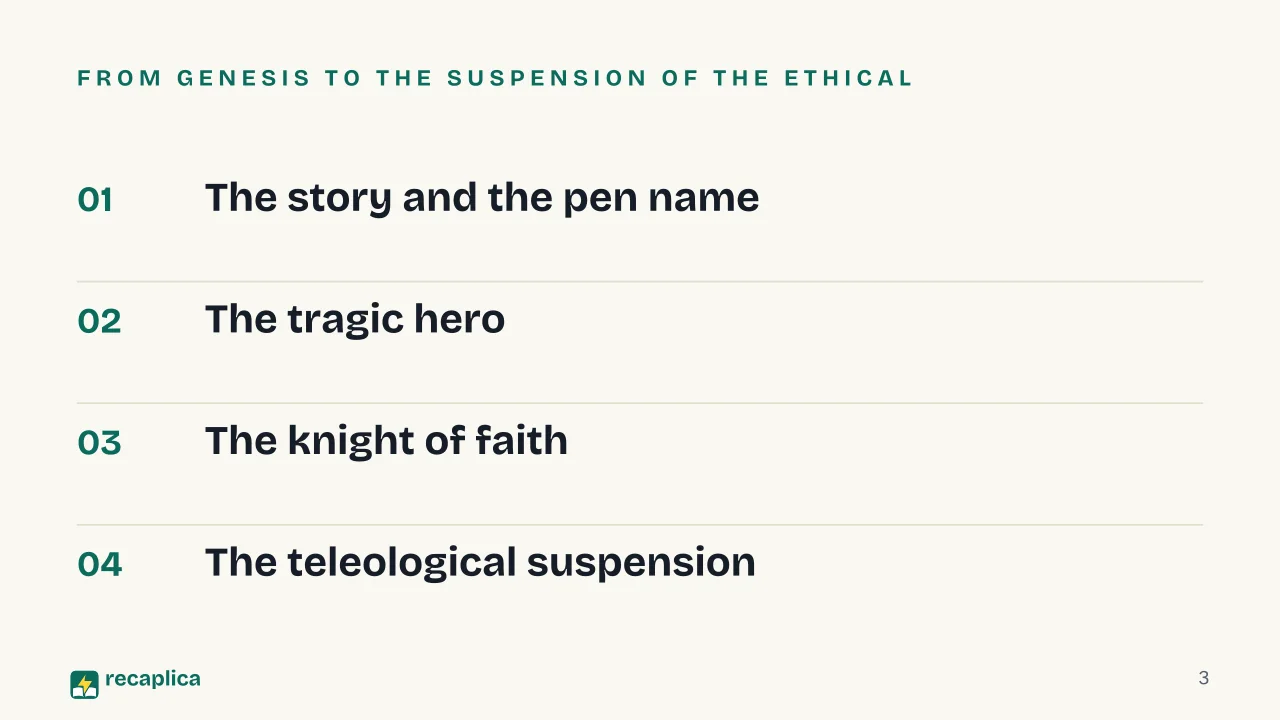  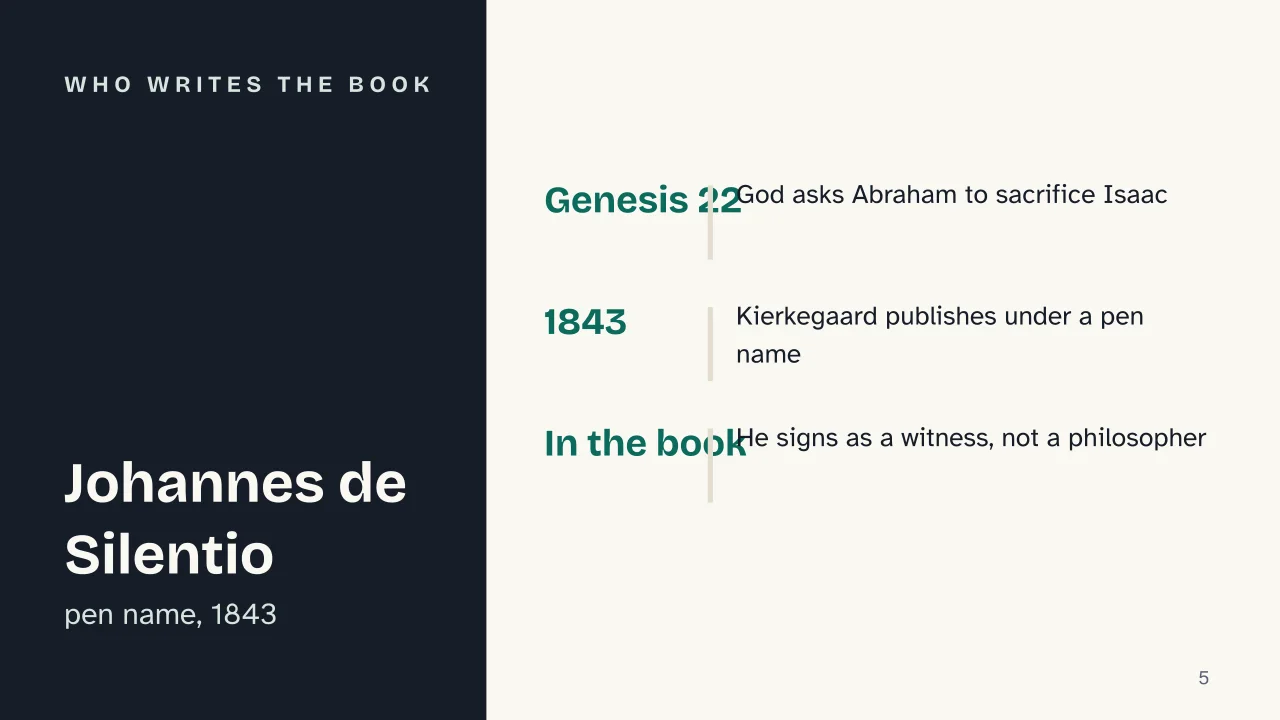  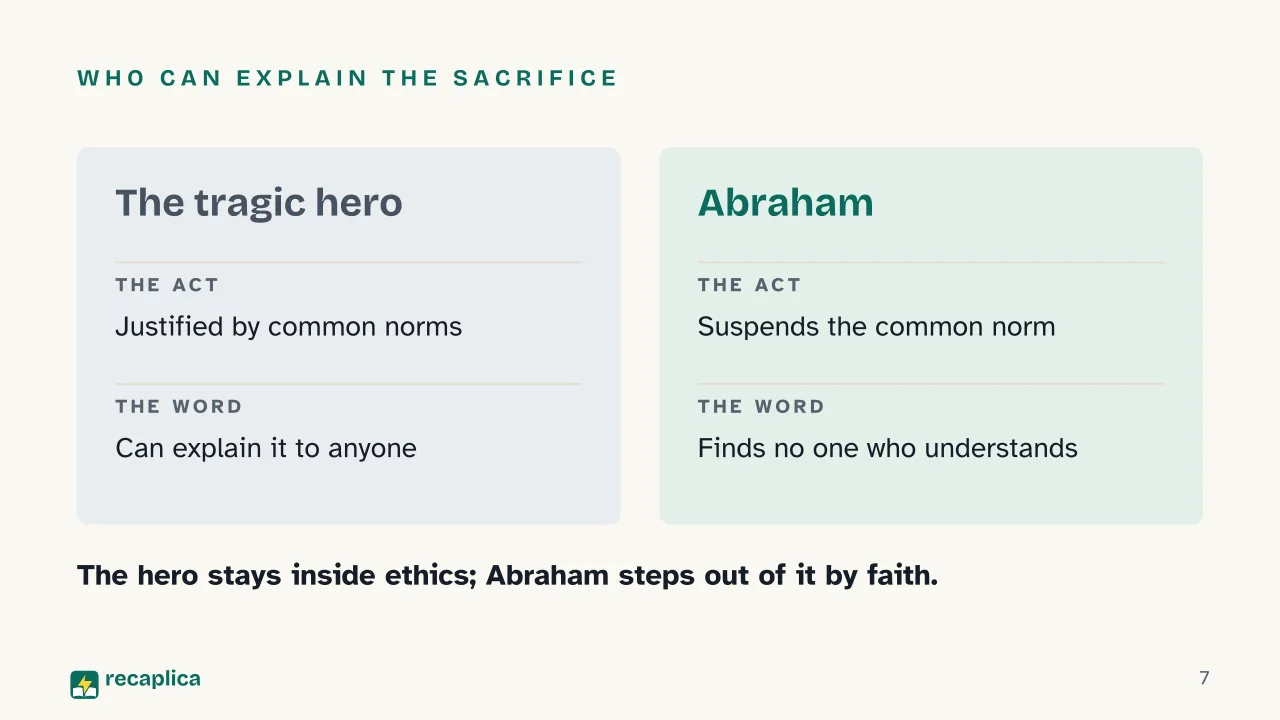  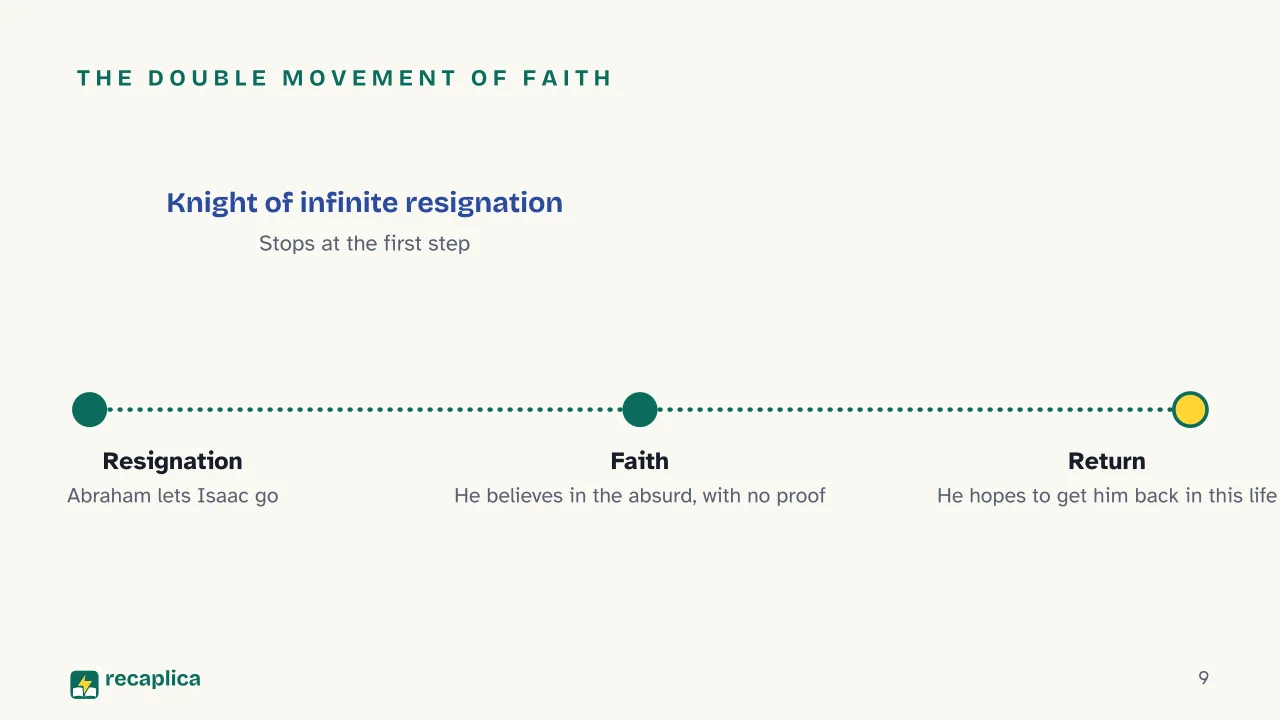  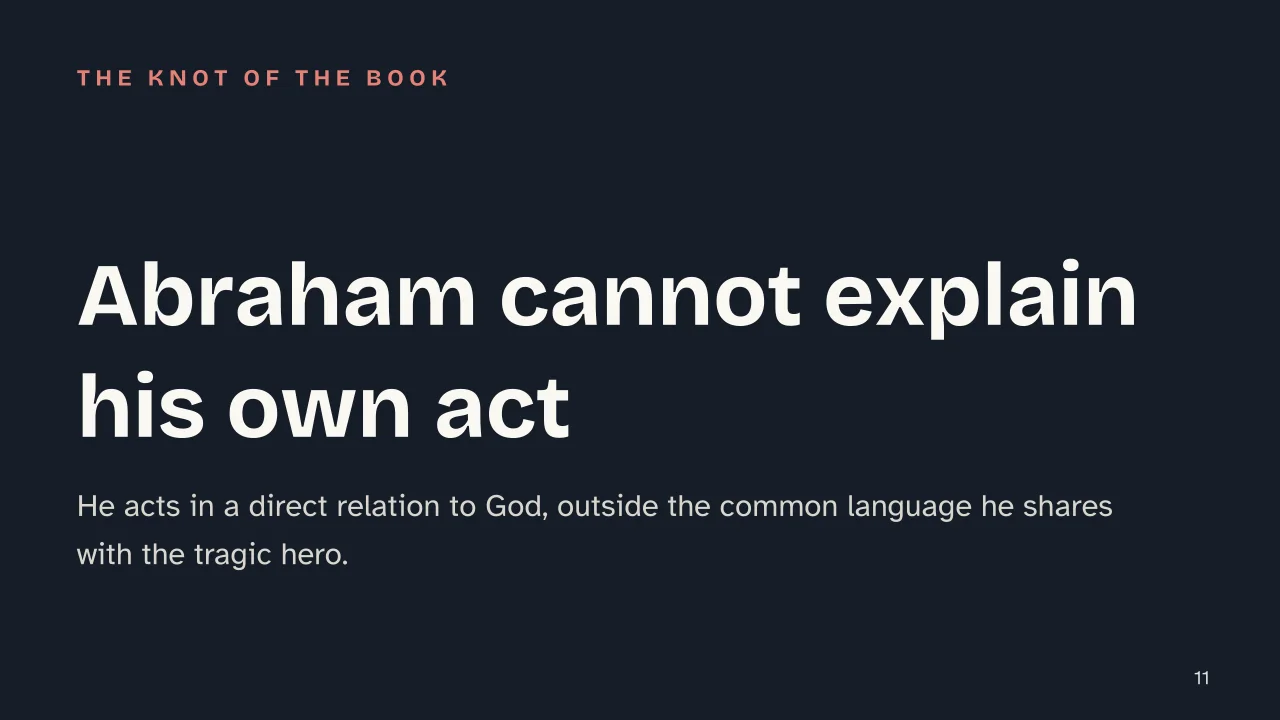 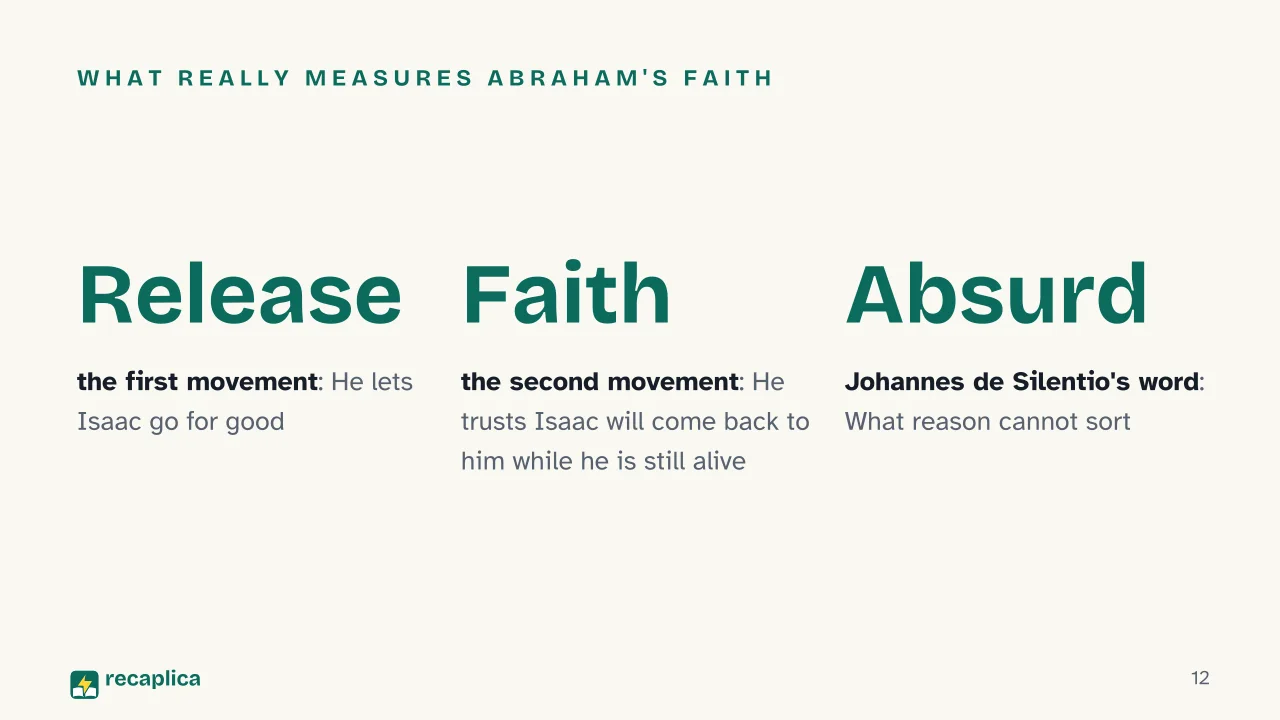 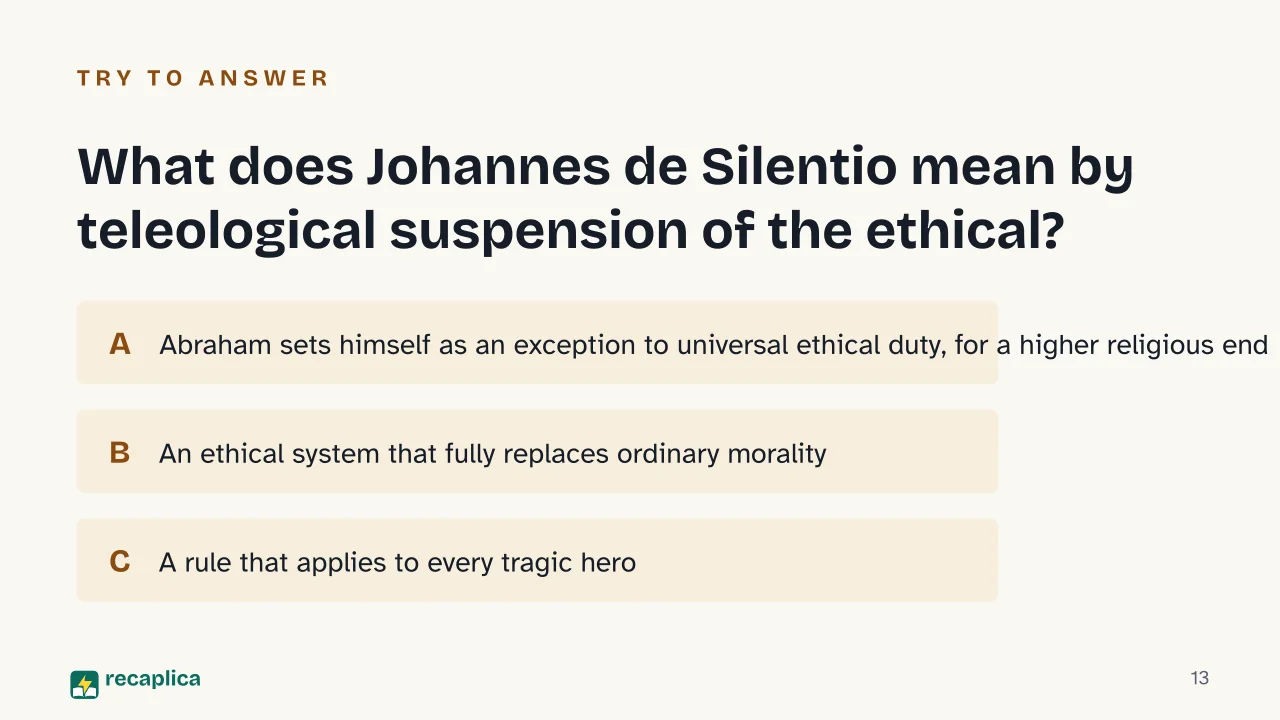  Common myths
Mind mapDrag the background to move around and the nodes to reposition them; use − and + to collapse and expand branches. 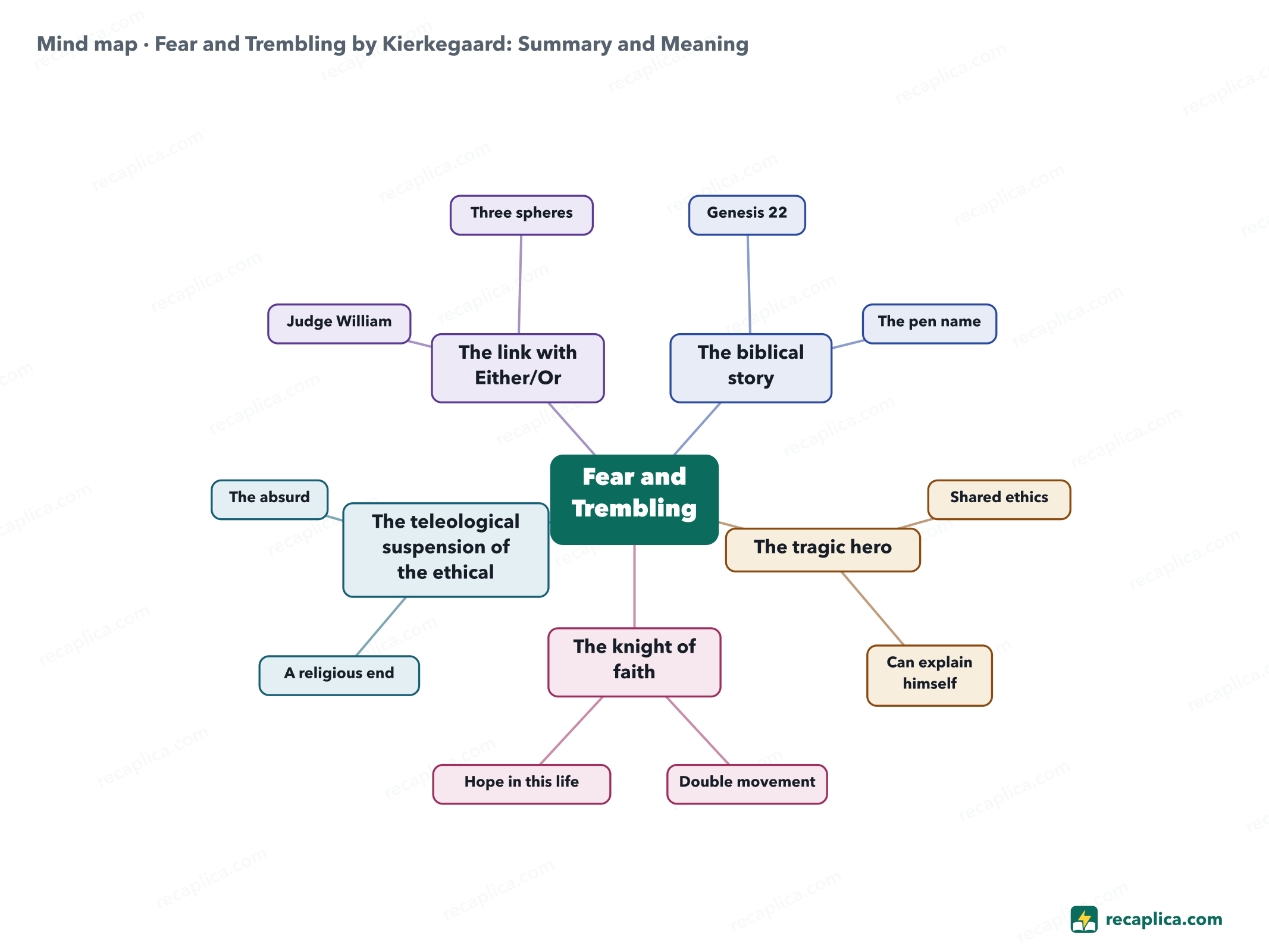
Quiz: test yourselfAnswer the questions to check what you have learned: you get instant feedback and a short explanation. Grade 0/10 0/5
FlashcardsTap the card to flip it and check whether you remember the answer, then move to the next one. 1 / 7 Explain it in your own wordsThe ultimate test: if you can explain it in simple words, you've truly understood it. Write your explanation, then compare it with the Recap. Your explanation is saved only on this device.
Frequently asked questionsWhat is Fear and Trembling by Søren Kierkegaard about?It is a book published in 1843 under the pen name Johannes de Silentio that returns to the story of Abraham and Isaac in Genesis 22, to ask what Abraham's silent obedience to God actually means. Does Fear and Trembling tell readers to obey any religious command without question?No. The book gives no instruction to follow: it describes the paradox of Abraham's faith and how hard it is, for an outside observer, to tell it apart from an absurd act. Who is Johannes de Silentio?He is the pen name under which Kierkegaard published Fear and Trembling in 1843. In the text he presents himself as an outside voice who watches Abraham and admits he could not repeat the deed himself. What is the difference between the tragic hero and the knight of faith?A tragic hero stays inside shared ethics and can always justify his sacrifice in public; the knight of faith, like Abraham, acts in a direct relation to God and finds no common language to explain himself. Every Recap goes through an independent review before publication. |