|
recaplica
The Sickness Unto Death: Kierkegaard's Concept of Despair | ||||||||||
| © 2026 Recaplica · recaplica.com — All rights reserved | ||||||||||
The Sickness Unto Death: Kierkegaard's Concept of DespairWhat to print Page numbers appear when printing with default margins. SlidesChoose a cut Flash10 slidesThe essential thread, to present in classFull16 slidesEvery chapter and the deeper detailBoth come with speaker notes. In 30 seconds quick readKierkegaard calls The Sickness Unto Death a work of «psychology» and signs it in 1849 under the pseudonym Anti-Climacus. The Stanford Encyclopedia of Philosophy treats it as the clearest statement of his view of the self. For Anti-Climacus, the self exists only in relating to itself: it is a relation, an ongoing activity the self keeps performing on itself. Despair sets in when that relation breaks down, and the book traces several forms of it, from a person who never suspects they have an eternal self to one who openly defies their own condition. The self stops being sick only by resting on God. Key Points
Deep DiveA work of «psychology»Kierkegaard presents The Sickness Unto Death, on its own title page, as a work of «psychology». He publishes it in 1849 under the pseudonym Anti-Climacus. The Stanford Encyclopedia of Philosophy notes that his idea of what a self is takes shape here more clearly than anywhere else in his writing. The Internet Encyclopedia of Philosophy places it in Kierkegaard’s «second authorship», alongside Works of Love, published in 1847, and Practice in Christianity, from 1850. The pseudonym’s name is not an accident. Anti-Climacus is built as the counterpart to another of Kierkegaard’s pseudonyms, Johannes Climacus. For the Internet Encyclopedia of Philosophy, the book’s two central concepts are despair and the self. What the self is, for Anti-ClimacusAnti-Climacus opens the work with this definition: the self is a relation that relates to itself. He is quick to flag a point easy to miss: the self is not the relation as such, but the fact that the relation relates to itself. It only takes a moment to see why: being made of body and soul, of the finite and the infinite, is only half the story. The other half is how that mixture relates to itself. Anti-Climacus goes on to define the self as a conscious synthesis of the infinite and the finite, whose task, becoming itself, can only be carried out through a relation to God. The question of what makes an individual truly themselves, rather than just a particular case of a wider category, runs through the history of Western philosophy, from Aristotle and Plato onward, before Kierkegaard recast it as an inward relation.
Despair as a sickness of the spiritAnti-Climacus explicitly defines despair as a sickness of the spirit, of the self. The title of the book comes from this definition. He calls the condition «the sickness unto death» for a precise reason: it describes a continuous dying that keeps renewing itself without ever reaching an end. The torment of despair, for Anti-Climacus, lies precisely in not being able to die: the end of physical life does not settle it. To convey how widespread the condition is, the Stanford Encyclopedia of Philosophy cites an image of Anti-Climacus’s: most people live in a house of several floors, and choose to stay in the basement, away from their own higher spiritual dimension. The forms of despairThe Internet Encyclopedia of Philosophy identifies several forms of despair in the book. A table helps compare them.
Someone unaware of their own despair, for Anti-Climacus, is also the furthest from recognizing themselves as spirit. In the despair of possibility, by contrast, a person loses touch with necessity: for Anti-Climacus, necessity alone, without possibility, suffocates the spirit, while possibility serves it like oxygen. Once despair becomes aware of why it refuses to be itself, it takes the form of defiance.
Why the self needs GodFor Anti-Climacus, the human self cannot relate to itself in isolation: it always does so by relating to another. For the self to be well, free of the despair this sickness names, that other has to be God. Anti-Climacus goes as far as writing that someone without God has no self either: it is the most extreme form of despair, willing to be oneself apart from God. This grounding outside the self sets Anti-Climacus’s proposal apart from other philosophical answers to the question of how to live well. Kant’s categorical imperative, for instance, places the origin of the moral law in each individual’s own reason, not in a personal relation to a divinity. A healthy self, for Anti-Climacus, is «grounded transparently» in the power that posited it: a demand for self-knowledge that echoes, from entirely different premises, Socrates’s call to know oneself before being able to say anything true about oneself. Slide deckSlides ready to download and make your own in PowerPoint or Google Slides, with speaker notes. Pick the Flash cut or the Full one.  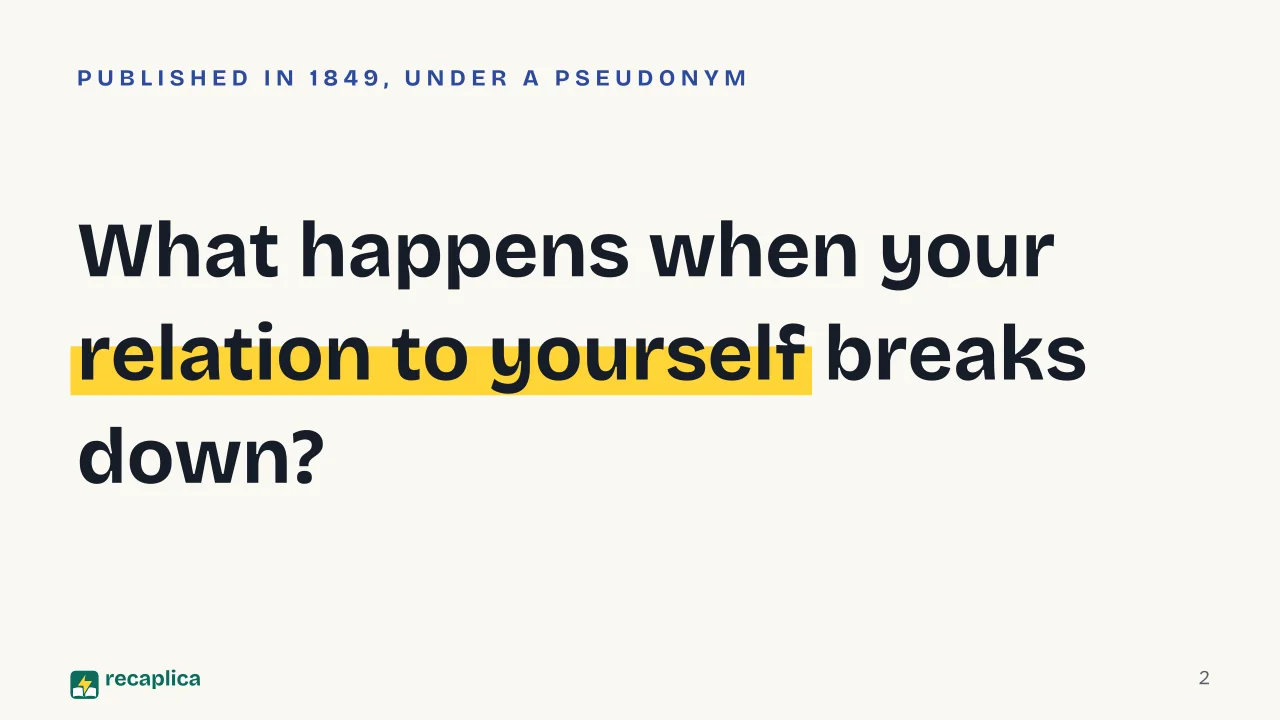 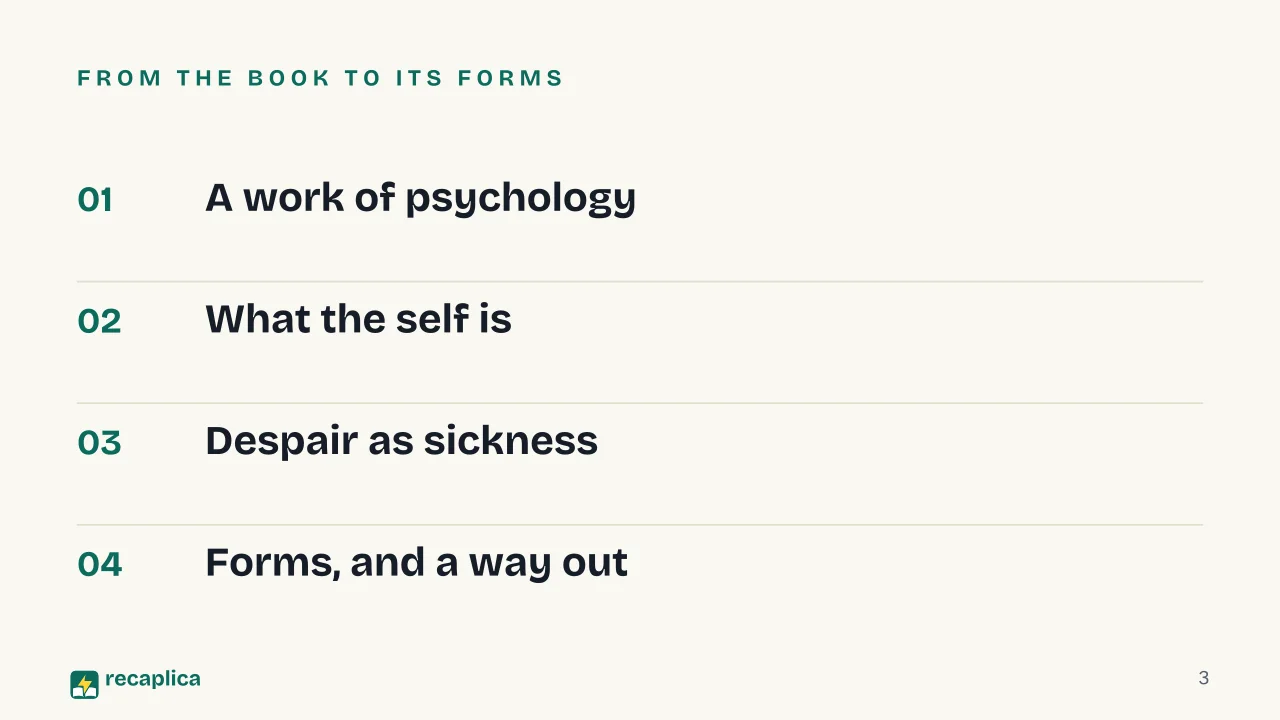  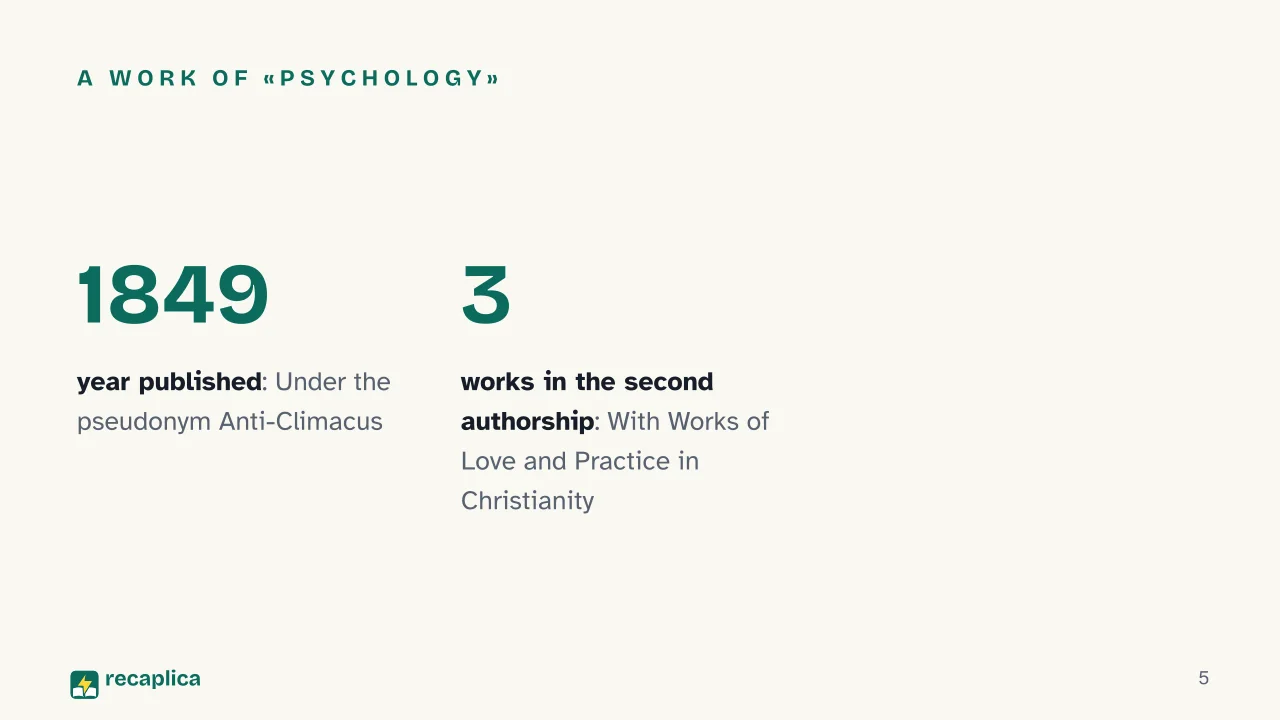  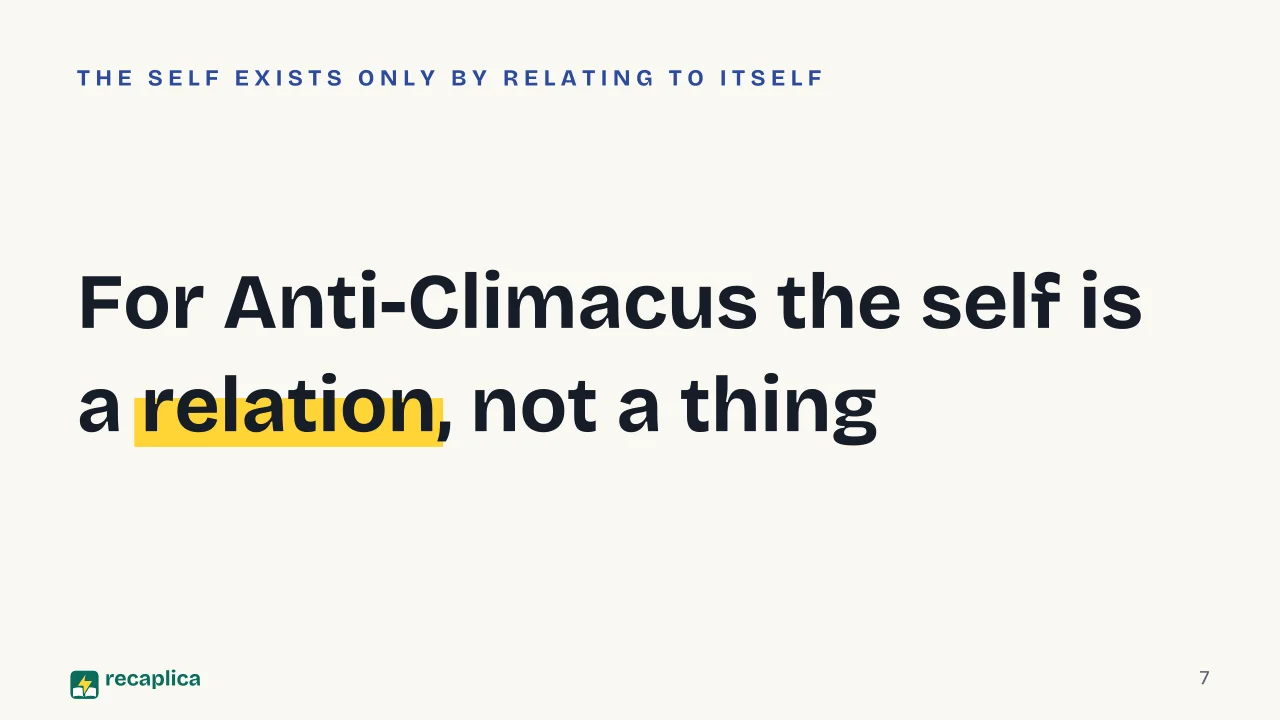 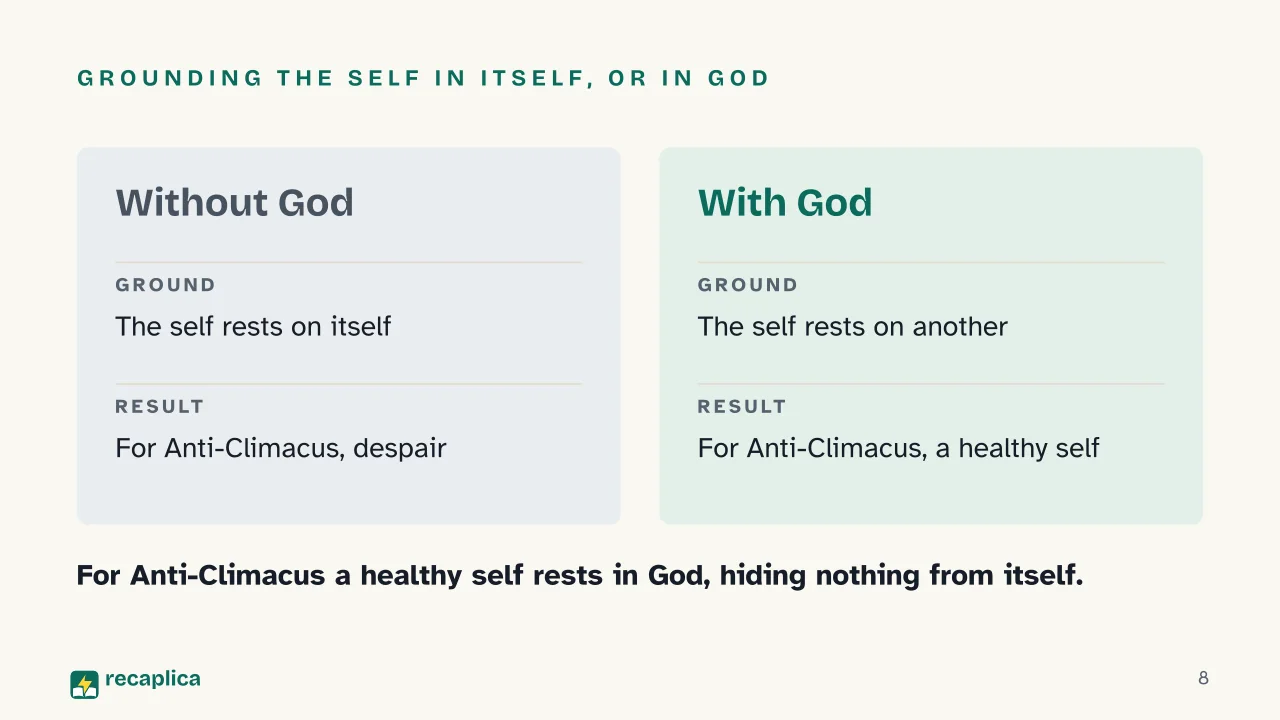  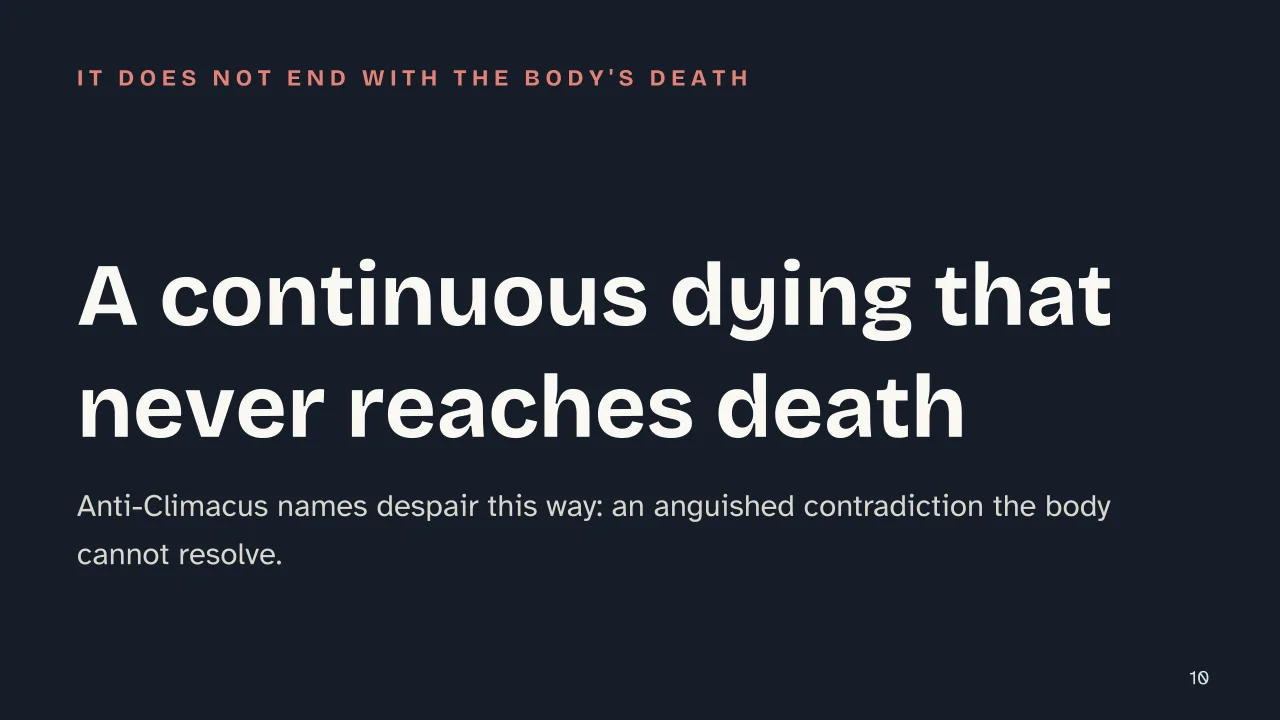  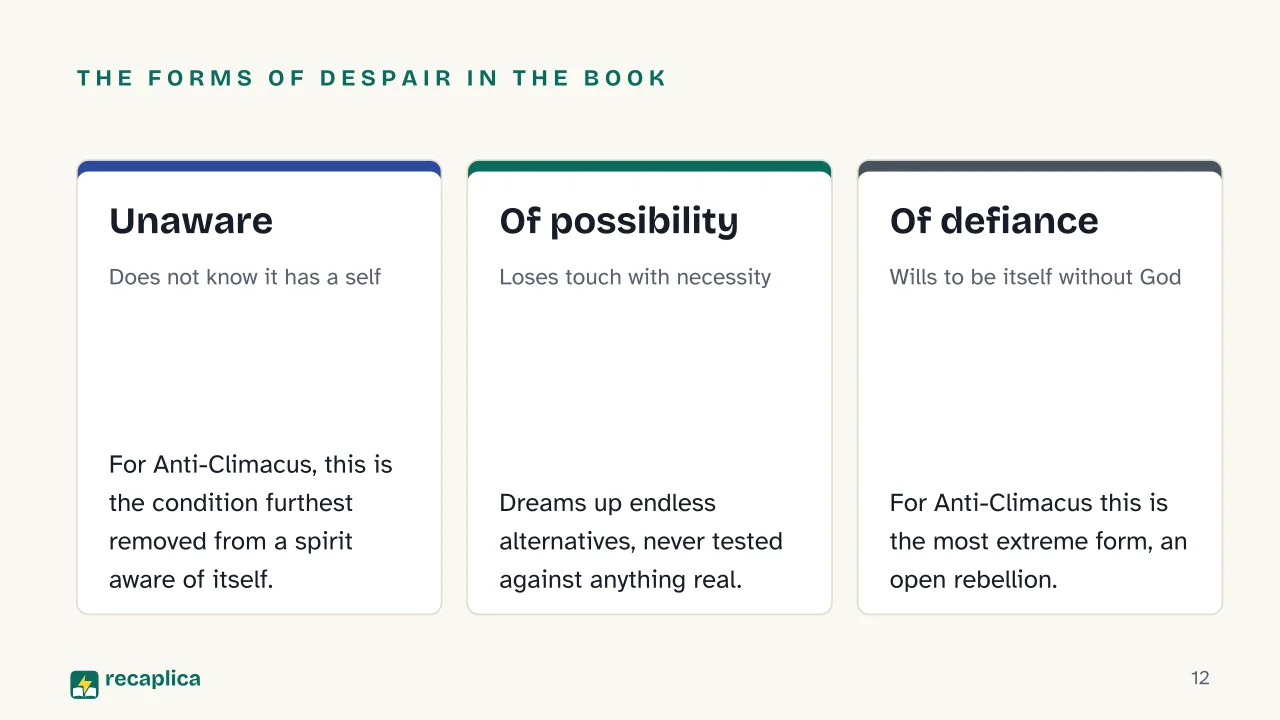     Common myths
Mind mapDrag the background to move around and the nodes to reposition them; use − and + to collapse and expand branches. 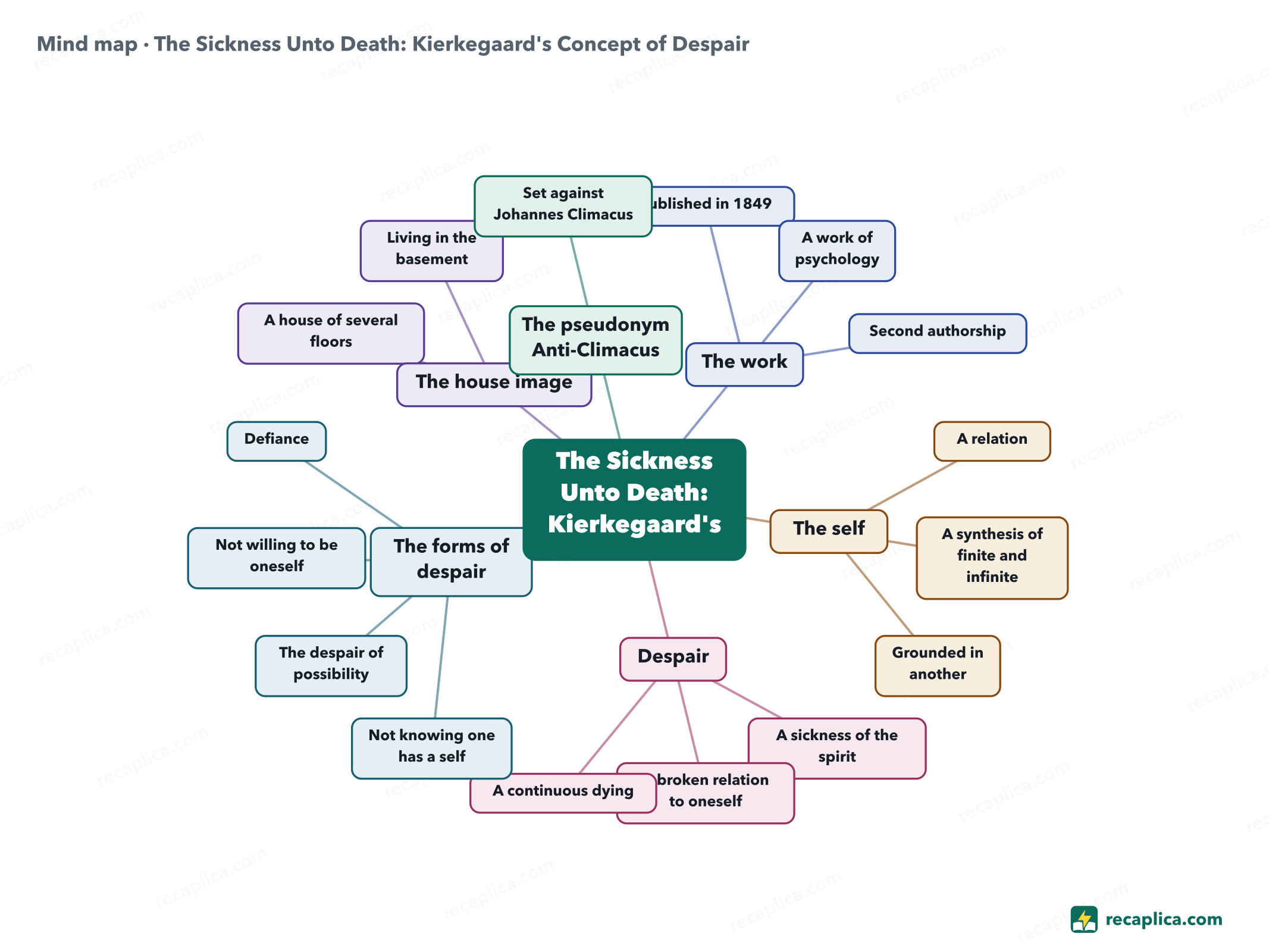
Quiz: test yourselfAnswer the questions to check what you have learned: you get instant feedback and a short explanation. Grade 0/10 0/5
FlashcardsTap the card to flip it and check whether you remember the answer, then move to the next one. 1 / 8 Explain it in your own wordsThe ultimate test: if you can explain it in simple words, you've truly understood it. Write your explanation, then compare it with the Recap. Your explanation is saved only on this device.
Frequently asked questionsWhat is despair, for Kierkegaard?In The Sickness Unto Death, signed by Anti-Climacus, despair is the name the spirit takes when the bond between the self and itself breaks: not a simple mood that passes. Who is Anti-Climacus?The fictional name under which Kierkegaard signs the work, built on purpose as the reverse of an earlier pseudonym of his, Johannes Climacus. Why is the work called «the sickness unto death» if despair does not cause death?Because for Anti-Climacus despair is a torment that keeps renewing itself: it resembles a dying that never reaches an actual death. What forms of despair does the book describe?Among others, Anti-Climacus describes someone unaware of having a self, someone who loses touch with reality in the «despair of possibility», and someone who openly defies their own condition by willing to be themselves without resting on God. What does it take, for Anti-Climacus, not to be in despair?Anti-Climacus asks for a self that rests, clearly, on the power that brought it into being: for him that support has one name, God. Every Recap goes through an independent review before publication. |