|
recaplica
Either/Or by Kierkegaard: Summary of the Aesthetic and the Ethical Life |
| © 2026 Recaplica · recaplica.com — All rights reserved |
Either/Or by Kierkegaard: Summary of the Aesthetic and the Ethical LifeWhat to print Page numbers appear when printing with default margins. SlidesChoose a cut Flash10 slidesThe essential thread, to present in classFull15 slidesEvery chapter and the deeper detailBoth come with speaker notes. In 30 seconds quick readSøren Kierkegaard published Either/Or in 1843, having started it in Berlin. The Danish title, «Enten-Eller. Et Livs-Fragment», means «Either/Or. A Fragment of Life», and no author's name appears on the title page: the book comes to the reader as edited by a pseudonym, Victor Eremita. The first volume belongs to a young man known only by the letter «A», who organises his days around not being bored; the second consists of two very long letters that a judge, Judge William, addresses to him. The alternative in the title is about which sphere a person lives in, the aesthetic one or the ethical one, and not about good and evil. Key Points
Key figures
Deep DiveA book that arrives without its author’s nameEither/Or appeared in Copenhagen in 1843. Kierkegaard had begun writing it soon after reaching Berlin, and he treated that book as the real start of his philosophical work. The Danish title is «Enten-Eller. Et Livs-Fragment», which in English reads as «Either/Or. A Fragment of Life». Kierkegaard does not appear on the title page. The work is credited to an editor, Victor Eremita, a pseudonym whose Latin meaning is «victorious hermit»: within the fiction of the book, the papers of both volumes passed through his hands. The first volume: «A» and the aesthetic lifeThe first volume collects the writings of a young man whose name is never given, marked only by the letter «A». The pieces vary a great deal in tone, turning at moments to despair, and all of them circle the way he looks at existence. The Internet Encyclopedia of Philosophy describes «A» as an existential type shaped on German Romantic aestheticism: an ironic, urbane figure whose chief concern is to avoid boredom and to remain a detached spectator of the sensuous pleasures of life. The same entry calls him a reflective aesthete lost in sheer possibility, and the volume builds towards The Seducer’s Diary.
The second volume: Judge William’s lettersHalfway through the book the voice changes. A judge takes over, Judge William, whom some translations call Assessor William, and he writes two very long letters addressed to «A» himself. His method is indirect persuasion, working to bring the recipient round to seeing something for himself. That something is that despair arises from the aesthetic life itself, and that an authentic self stays out of reach for anyone who remains inside that sphere alone. William also defends transparency and openness in communication as marks of the ethical life, and on marriage he offers a precise argument: ethical love does not shut aesthetic love out, and can hold it within itself. What gets chosen in the «either/or» of the titleThe title announces a stark alternative, and the temptation is to read it as a moral dilemma. The choice staged in the book, though, lies between two ways of existing, the aesthetic and the ethical. A moral dilemma asks which action to take; here what is in question is the sphere a person lives in, and with it the fact that a choice has to be made at all, and that it falls to the one making it. A reader who comes to Either/Or after studying Kant’s categorical imperative finds ground quite unlike that of a universal moral law: nobody in this book hands over a rule to apply to cases. Moving from the aesthetic sphere to the ethical one is the knot that returns throughout Søren Kierkegaard’s philosophy of existence, and it is also why the Danish writer is so often called «the father of existentialism», besides being remembered as a sharp critic of Hegel and Hegelianism. Regine Olsen, a presence without a nameKierkegaard became engaged to Regine Olsen on 10 September 1840: she was eighteen. On 12 October 1841 he broke the engagement off, convinced that his calling lay not in marriage but in his own path as a writer and thinker. Either/Or arrived a little over a year later, and the clash between open possibility and a commitment taken up runs through both volumes. The Søren Kierkegaard Research Centre at the University of Copenhagen adds a qualification worth keeping in mind: Regine’s name appears in none of his books, and her presence is reflected in the love conflicts told more than once in the pseudonymous writings, Either/Or among them. Reading the book as an account of that episode therefore goes further than the source says. The connection the source grants is a poetic one. How loudly it landed, and where it still carriesOn publication Either/Or had an immediate and strong impact on readers in Copenhagen, recognised at once as a significant literary event. Kierkegaard’s thought went on to shape the phenomenological and existentialist traditions in ways that are widely acknowledged, and the theme of the choices that define a life became material for fiction: a century later it turns up, handled with other tools, in the fiction of existential unease by Alberto Moravia. Slide deckSlides ready to download and make your own in PowerPoint or Google Slides, with speaker notes. Pick the Flash cut or the Full one.     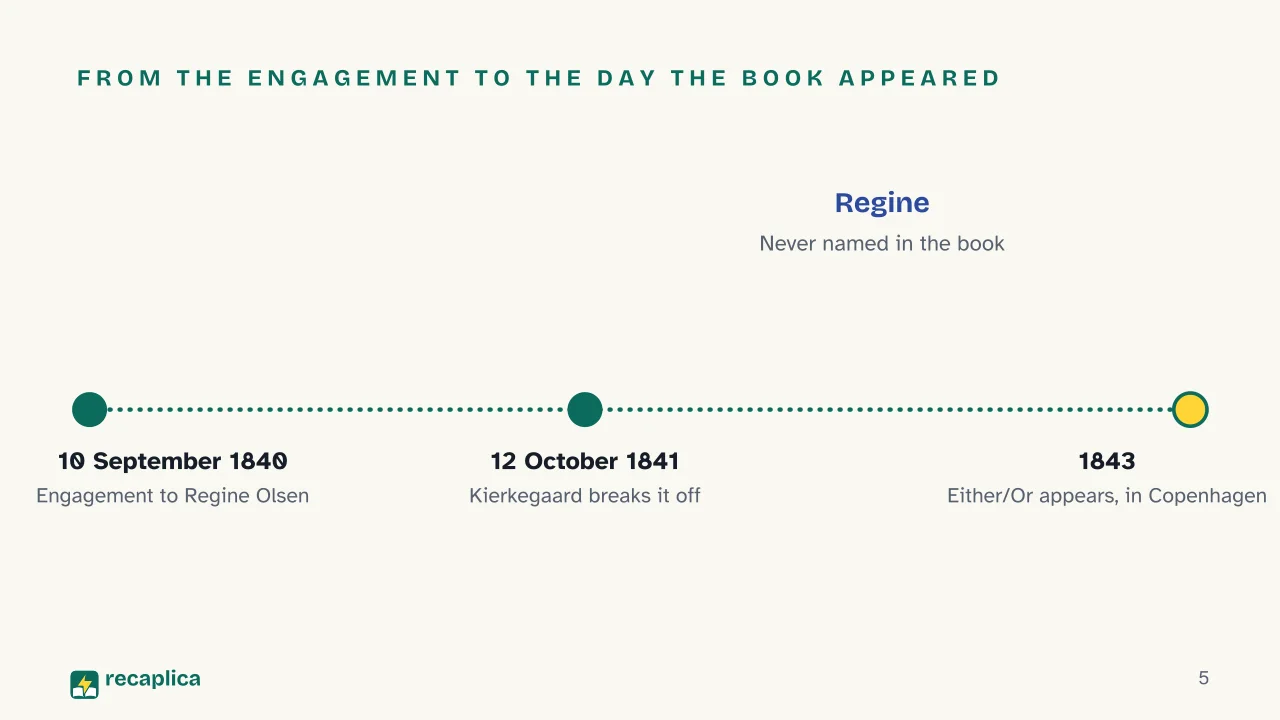  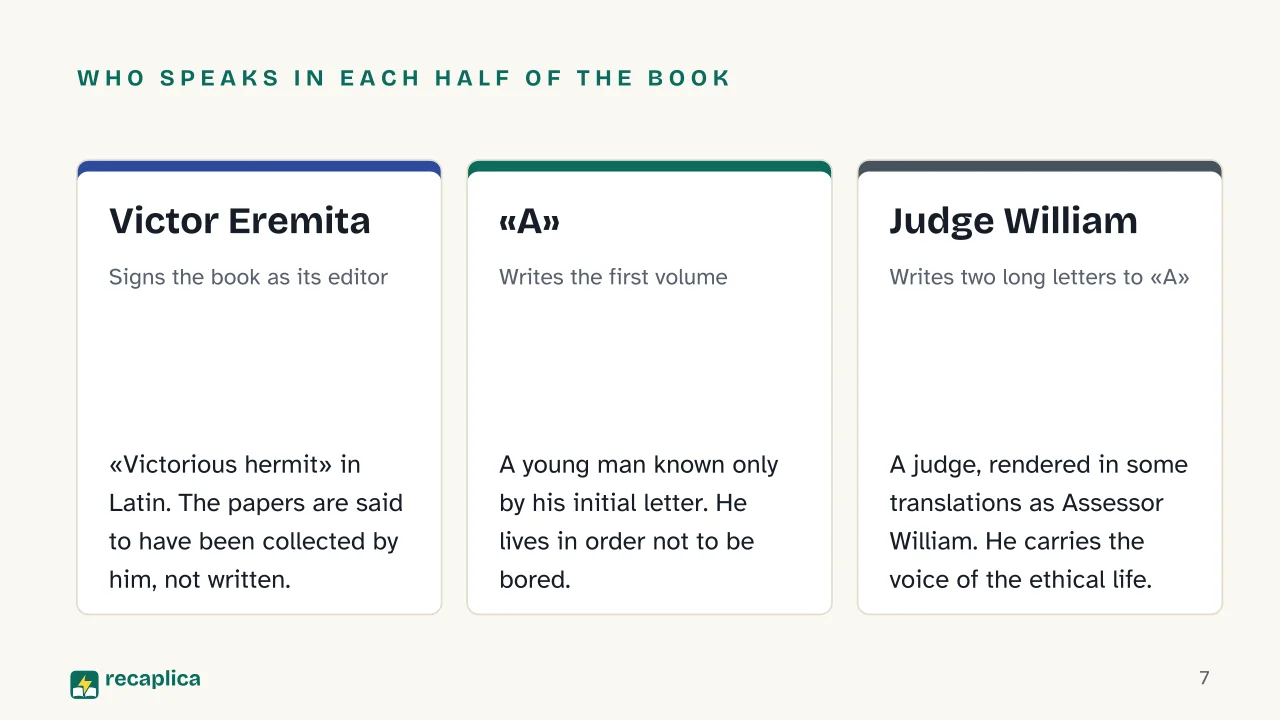  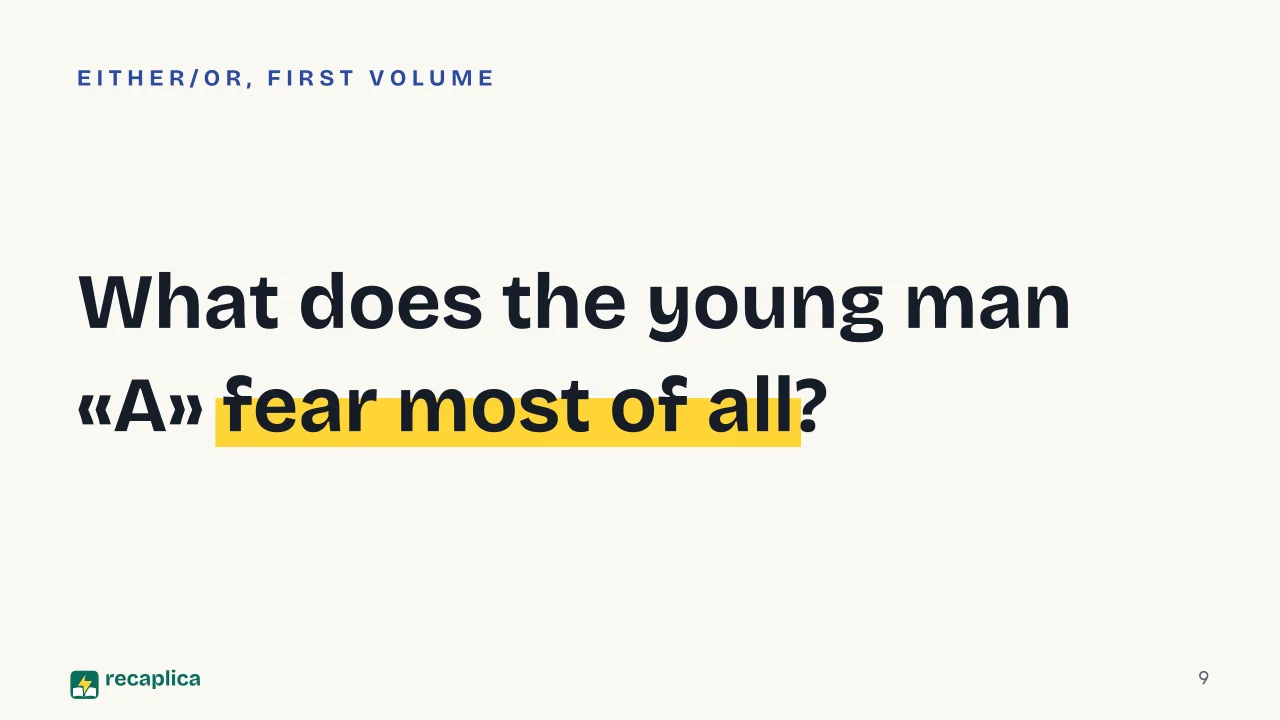  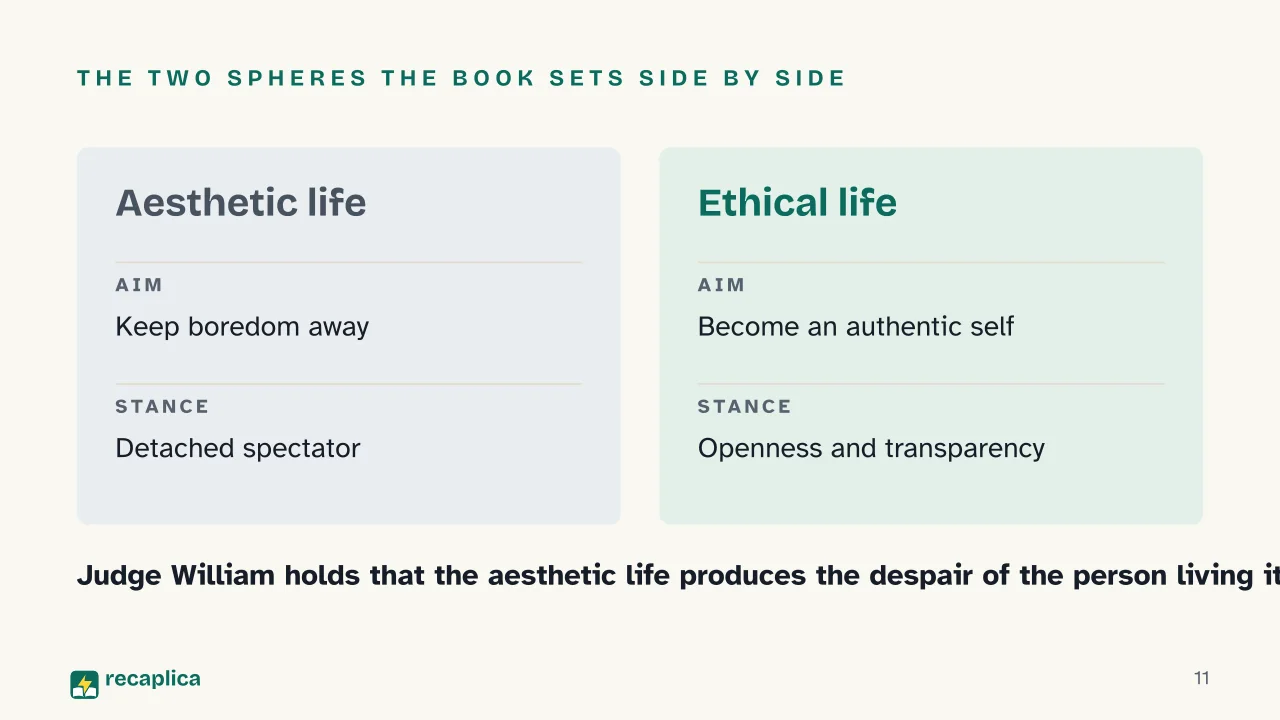 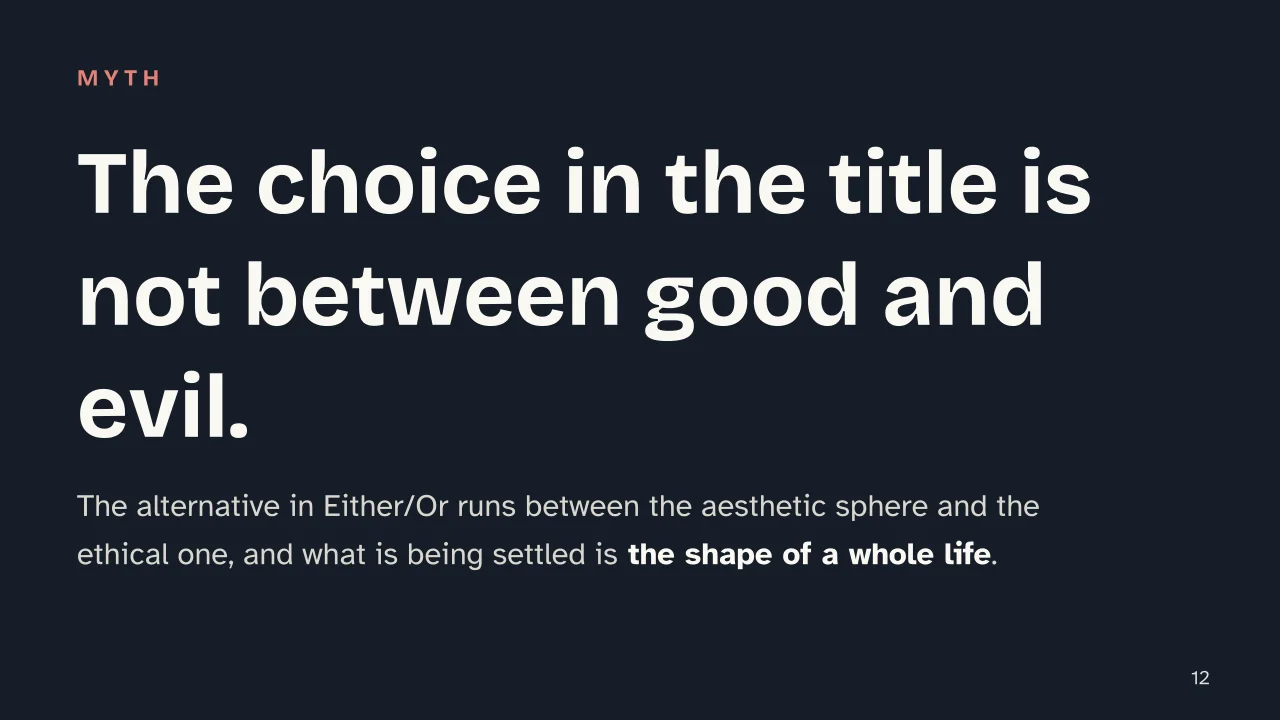 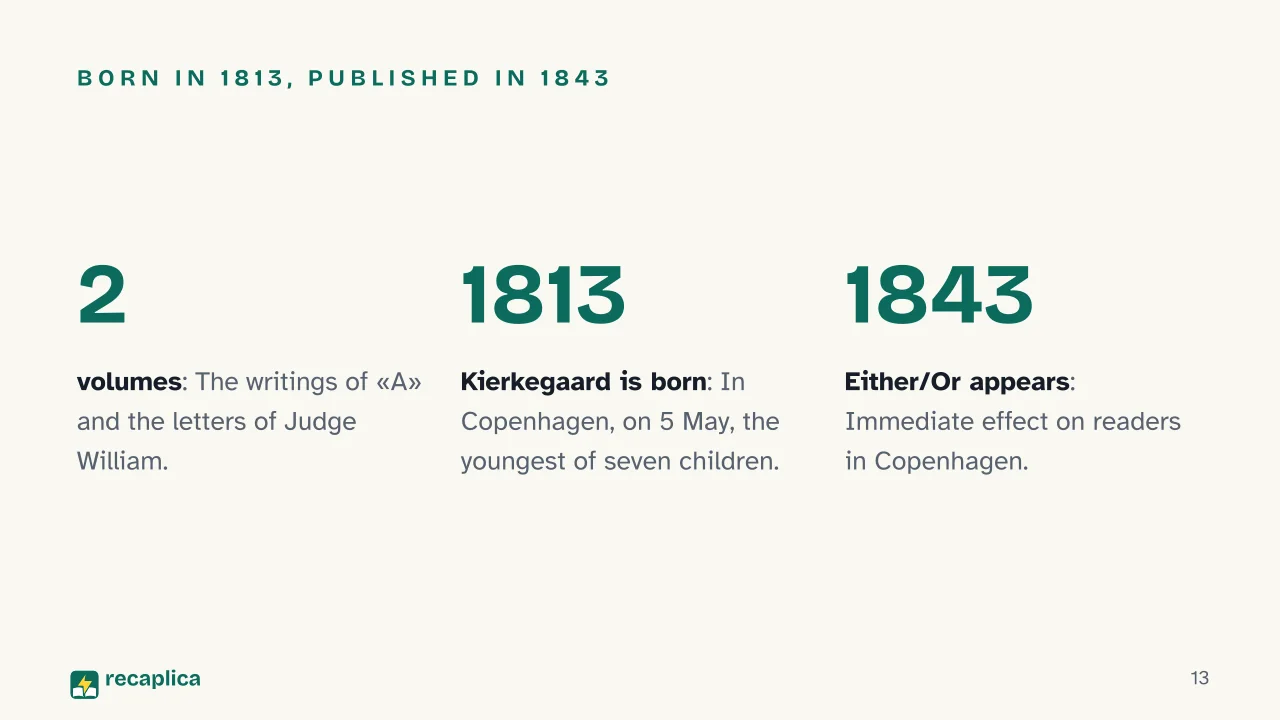 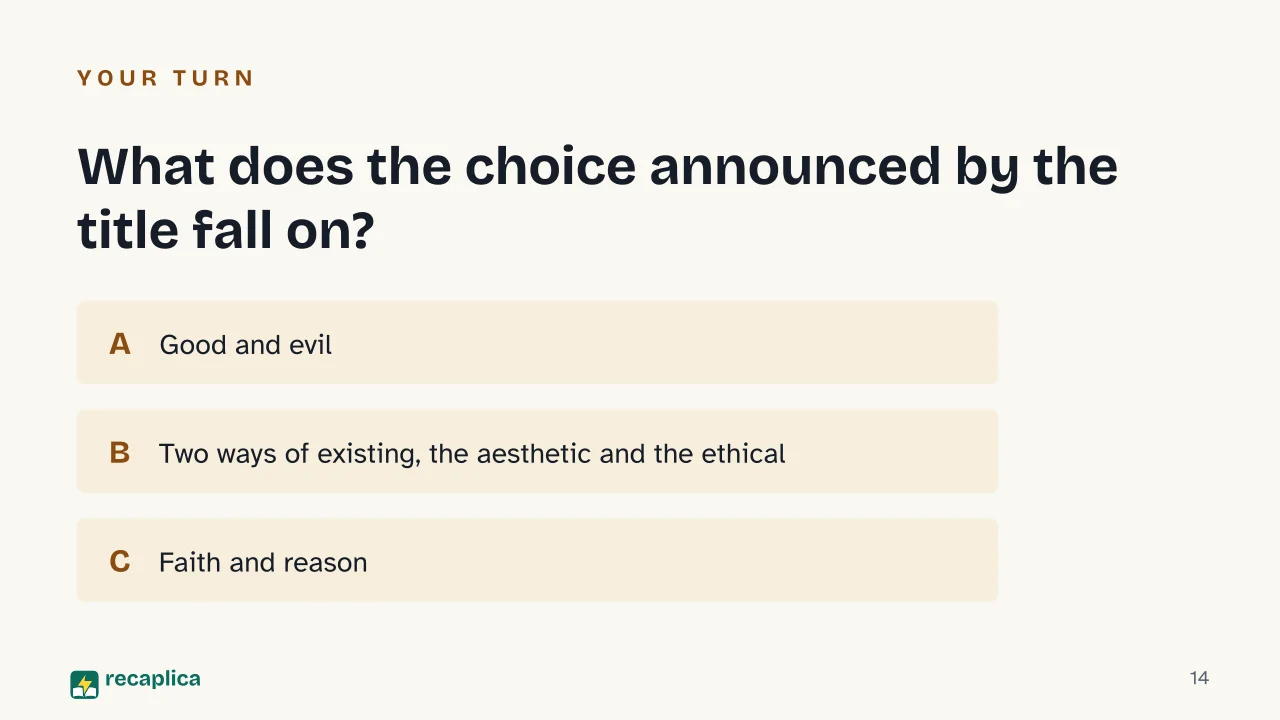  Common myths
Mind mapDrag the background to move around and the nodes to reposition them; use − and + to collapse and expand branches. 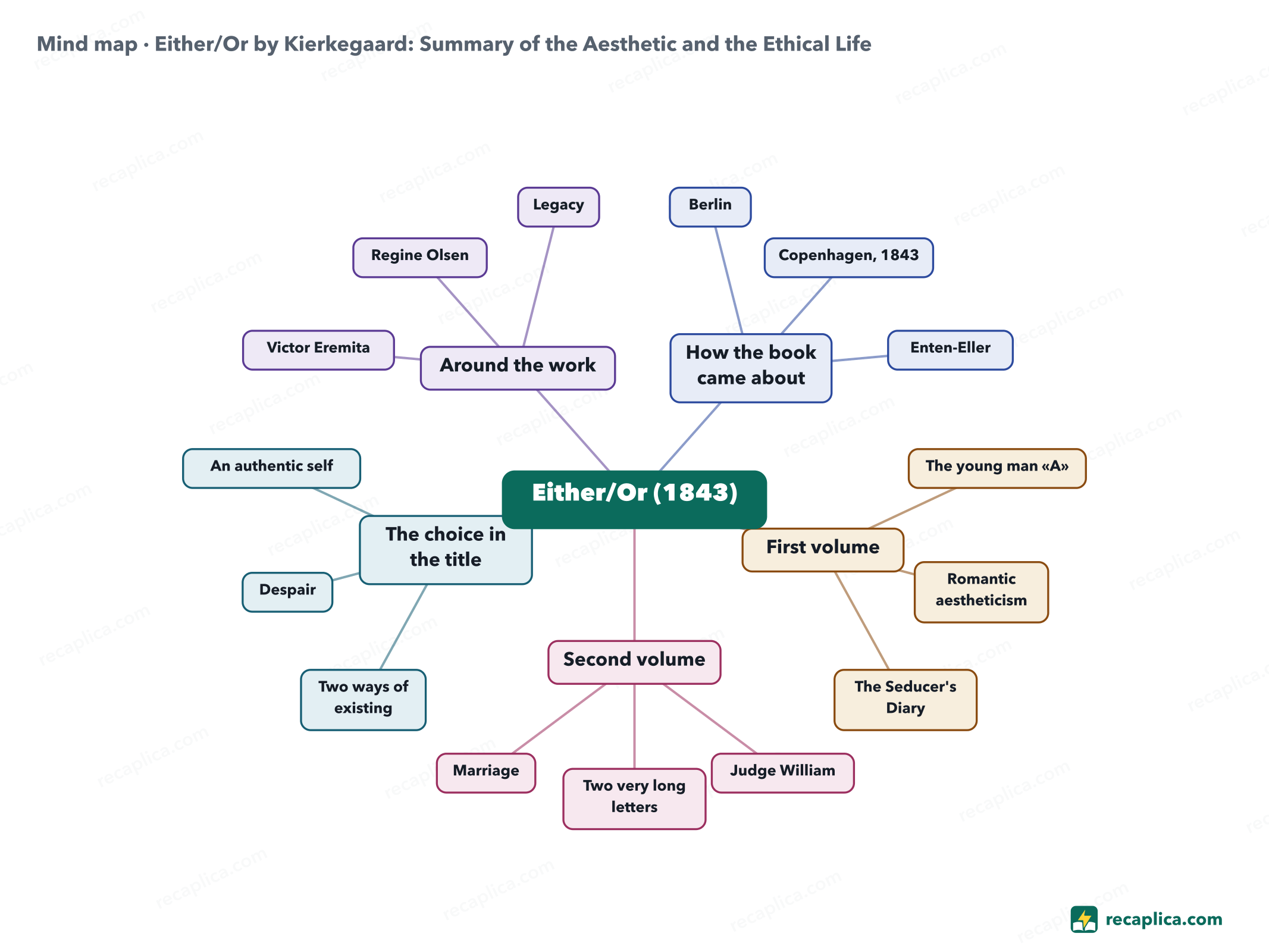
Quiz: test yourselfAnswer the questions to check what you have learned: you get instant feedback and a short explanation. Grade 0/10 0/5
FlashcardsTap the card to flip it and check whether you remember the answer, then move to the next one. 1 / 7 Explain it in your own wordsThe ultimate test: if you can explain it in simple words, you've truly understood it. Write your explanation, then compare it with the Recap. Your explanation is saved only on this device.
Frequently asked questionsWhat does the title Either/Or mean?It renders the Danish «Enten-Eller» of the original title, which works in English exactly as it does in Danish, naming one thing or the other. It announces an alternative between two spheres of existence, the aesthetic and the ethical. Why does the book not carry Kierkegaard's name?Either/Or presents itself as edited by a pseudonym, Victor Eremita, Latin for «victorious hermit». A reader in 1843 therefore found a work credited to an editor, with the two volumes assigned to a young man called «A» and to a judge called Judge William. What is The Seducer's Diary?It is the text the first volume of Either/Or builds towards, the volume given to the bored and cynical aestheticism of the character «A». It is not a book in its own right, but the closing part of the first half of the work. Does Either/Or talk about Regine Olsen?The Søren Kierkegaard Research Centre at the University of Copenhagen points out that Regine Olsen's name is not found in any of the works, and that it is the love conflicts of the pseudonymous texts, Either/Or included, that reflect her presence. The engagement had been broken off on 12 October 1841, well before the book was even written. Where should a reader start with Either/Or?The two volumes answer each other, so reading only The Seducer's Diary leaves out Judge William's reply, which fills the second half of the work. Anyone who wants the wider frame first can begin with Kierkegaard's philosophy of existence and come back to the book afterwards. Every Recap goes through an independent review before publication. |