Skip to content
recaplica

    One moment: security check

    Cloudflare wants to make sure you're not a robot. Tick the box below and your search will continue on its own.

    IT
    recaplica Spinoza: One Substance, God or Nature, and Freedom Through Knowledge
    © 2026 Recaplica · recaplica.com — All rights reserved
    Home › History

    Spinoza: One Substance, God or Nature, and Freedom Through Knowledge

    By Recaplica Newsroom · Updated on October 10, 2026

    What to print

    Page numbers appear when printing with default margins.

    Slides

    Choose a cut

    Flash10 slidesThe essential thread, to present in classFull14 slidesEvery chapter and the deeper detail

    Both come with speaker notes.

    Telegram channel
    recaplica Clear in 30 seconds, yours in 10 minutes.
    In 30 seconds Key points Figures Deep dive Slides Myths Mind map Quiz Flashcards FAQ

    In 30 seconds quick read

    Baruch Spinoza (1632-1677) argues that there is only one substance, something that exists on its own and can be understood on its own, and he gives it two names at once, God or Nature. Everything follows from that infinite being by necessity, and the Ethics states that nothing in nature is contingent. People take themselves to be free because they notice their own actions and miss the causes behind them. The freedom Spinoza offers is therefore an inner one, built by holding the passions in check through rational knowledge. The elders of the Amsterdam synagogue excommunicated him in 1656, and in 1678 his works were banned.

    Key Points

    • A substance, for Spinoza, depends on nothing else either to exist or to be understood, and only one thing meets that bar.
    • God and Nature are two names for the same reality, the Deus sive Natura, one infinite being with infinitely many attributes.
    • In the Ethics nothing is contingent, and no thing could have come into the world in an order other than the one it had.
    • Our sense of choosing freely comes from missing information, namely the causes that set our actions going.
    • The power of the mind is measured by knowledge, while passion amounts to a lack of knowledge, and that is where Spinoza's route to freedom runs.
    • In the Theological-Political Treatise, published anonymously in 1670, Spinoza denies that Moses wrote the Torah and defends the freedom to philosophise as something that holds a society together.

    Key figures

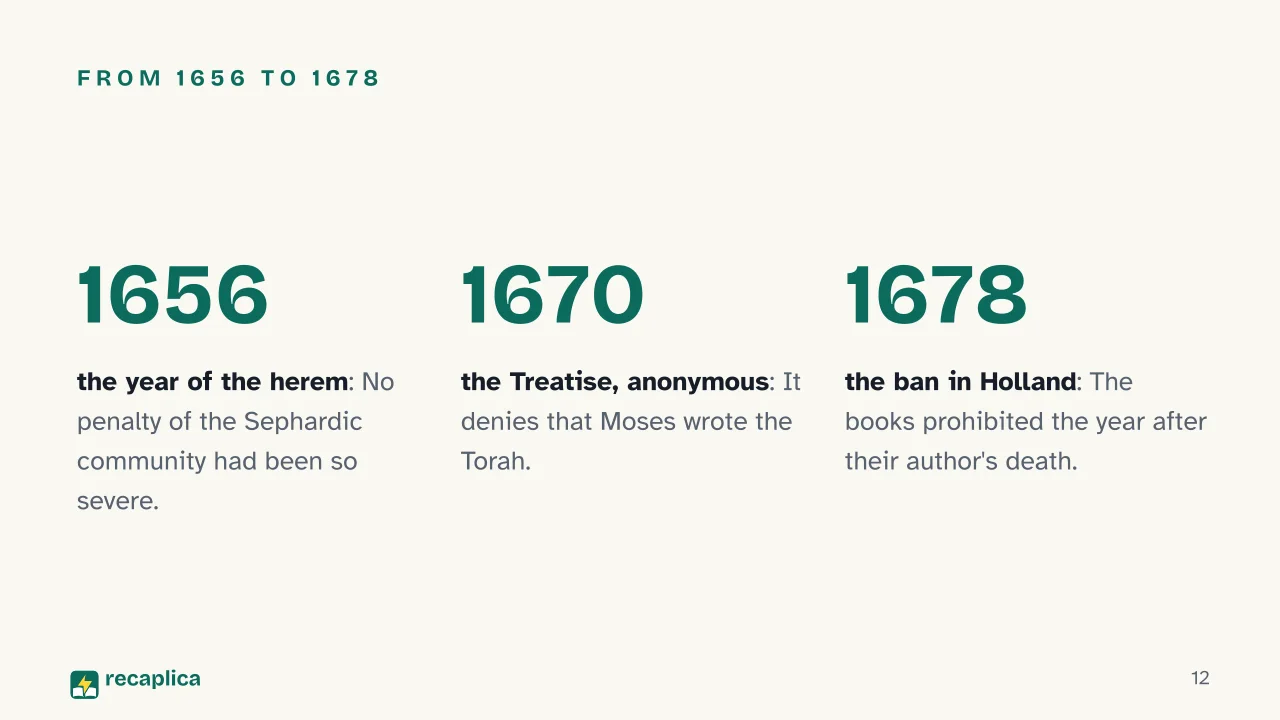
    • 1656 On 27 July the herem is pronounced against Spinoza, the harshest penalty the city's Sephardic community had ever issued, and nobody ever lifted it. Source: Stanford Encyclopedia of Philosophy
    • 1670 The Theological-Political Treatise appears anonymously and causes great alarm. Source: Stanford Encyclopedia of Philosophy
    • 1678 One year after Spinoza's death his works are banned across Holland. Source: Internet Encyclopedia of Philosophy

    Deep Dive

    Spinoza’s Ethics uses words that look familiar — substance, attribute, God, freedom — in senses that throw a first-time reader off balance. According to the Internet Encyclopedia of Philosophy entry, substance is what exists in itself and is conceived through itself, borrowing no other concept to be understood. The bar is a demanding one: anything that has to lean on something else in order to be thought falls outside. That vocabulary comes down a long road, from Aristotle’s Metaphysics onwards, and before that from the differences between Plato and Aristotle over how reality should be explained. Spinoza picks it up and tightens it until only one result is left: there is a single substance, which the IEP entry describes as an absolutely infinite being made up of infinite attributes.

    One substance that goes by two names, God or Nature

    Spinoza calls that infinite being by two names at once, Deus sive Natura, God or Nature. It is an eternal and infinite being that acts by necessity, as the Stanford Encyclopedia of Philosophy entry reports. Where the identification leads is not where a devout reader would expect: religious fear and devotional worship are not, the SEP entry warns, the right attitude to take up towards God or Nature.

    The encyclopedia entries cite the Ethics by proposition number, with labels like Ip29 and Ip33.

    Practical example: imagine asking Spinoza why a stone falls. No will decides the matter case by case; the fall follows from the nature of things the way a result follows from its premises, and the same goes for every other event, your own thoughts included.

    If everything is necessary: Spinoza on free will

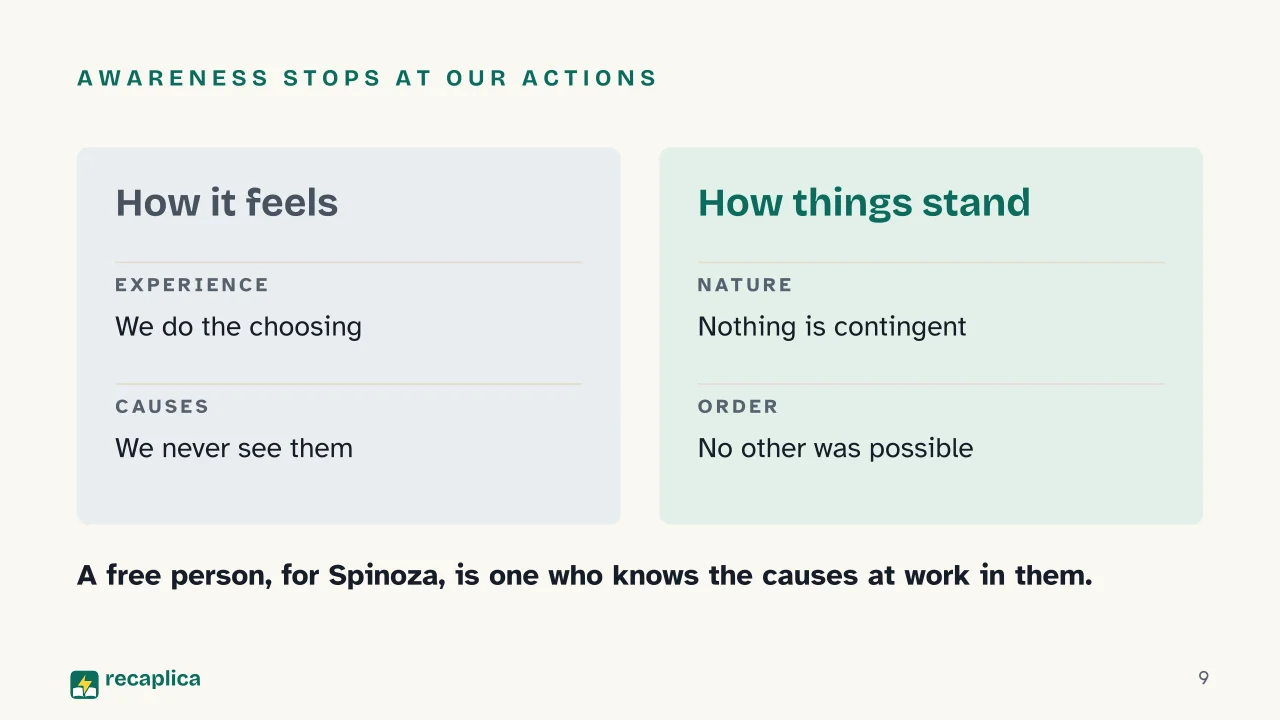
    Proposition Ip29 of the Ethics, reported by the SEP entry, says that there is nothing contingent in nature and that everything is determined by the necessity of the divine nature. Proposition Ip33 adds that things could not have been produced by God in any other way or in any other order than the one in which they were produced. That leaves our experience of choosing. The IEP entry explains it through partial awareness: people take themselves to be free because they are aware of their own actions and do not know the causes that determine them. Our sense of free will grows out of what we do not know.

    Spinoza draws no resignation from that determinism. For him, the IEP entry reports, reason asks for nothing against nature and pushes each person to seek their own real advantage. The ethical question changes shape and turns on what makes a person active.

    The Ethics, a programme for restraining the passions

    Spinoza’s ethical goal, as the SEP entry presents it, is learning to moderate and restrain the passions, so as to become an active and self-governing being. The IEP entry gives the measure of that work: the power of the mind is gauged by knowledge alone, and passion, being a want of power, amounts to a privation of knowledge. Aristotle too had written an Ethics, his treatise on virtue; Spinoza hands the same job to the intellect and to a knowledge of causes.

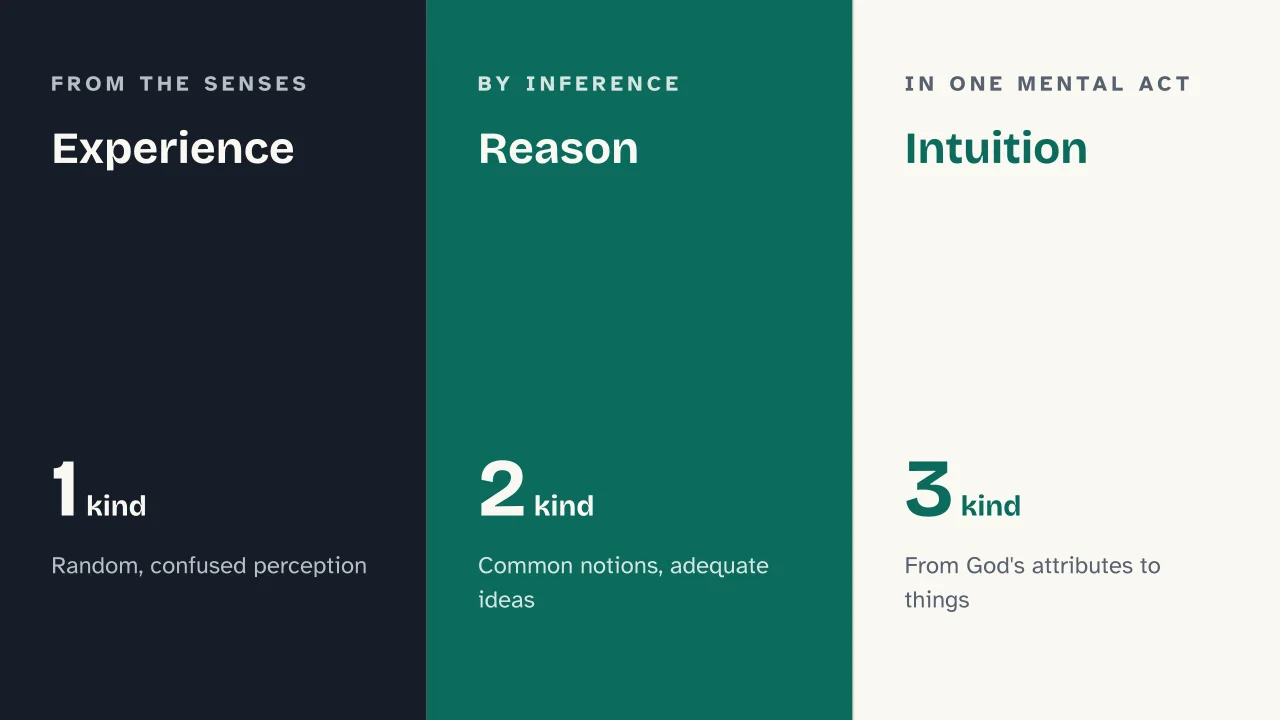
    Knowledge in the Ethics comes in three grades, and moving from one to the next is the route towards inner freedom.

    Kind of knowledgeHow it proceedsSource
    Random experienceFrom the senses, in a mutilated, confused and disordered wayIEP
    ReasonDiscursively and by inference, on common notions and adequate ideas of the properties of thingsSEP, IEP
    Intuitive knowledgeFrom an adequate idea of the essence of God’s attributes to the essence of things, in a single mental actSEP, IEP

    The last step concerns death. On the SEP entry’s account, the free person Spinoza describes does not fear it, having understood that the soul is not immortal as a person and shares only in a certain form of eternity.

    The Theological-Political Treatise: Spinoza on religion and free thought

    The Theological-Political Treatise came out anonymously in 1670. The book caused great alarm, to the point that one critic, the SEP entry recounts, called it a work forged in hell by the devil himself. Far more than metaphysics was at stake: in the Treatise Spinoza denies the Mosaic authorship of the Torah and argues that the biblical texts were not written by the authors to whom tradition assigns them.

    Keeping faith and philosophy apart is the move that holds the book together. For Spinoza, the SEP entry reports, Scripture is no source of truth about nature and counts as the carrier of a simple moral message, “love your neighbour”, while the job of knowing how things stand belongs to philosophy. On the political side the IEP entry sums up the aim of the work: to show that freedom of thought, and above all the freedom to philosophise, strengthens the stability of a society instead of threatening it.

    Underneath lies a principle the SEP entry states flatly: by absolute natural right, everyone is master of their own thoughts. The defence of freedom of thought starts there.

    The clergy, the charge of atheism and the herem of 1656

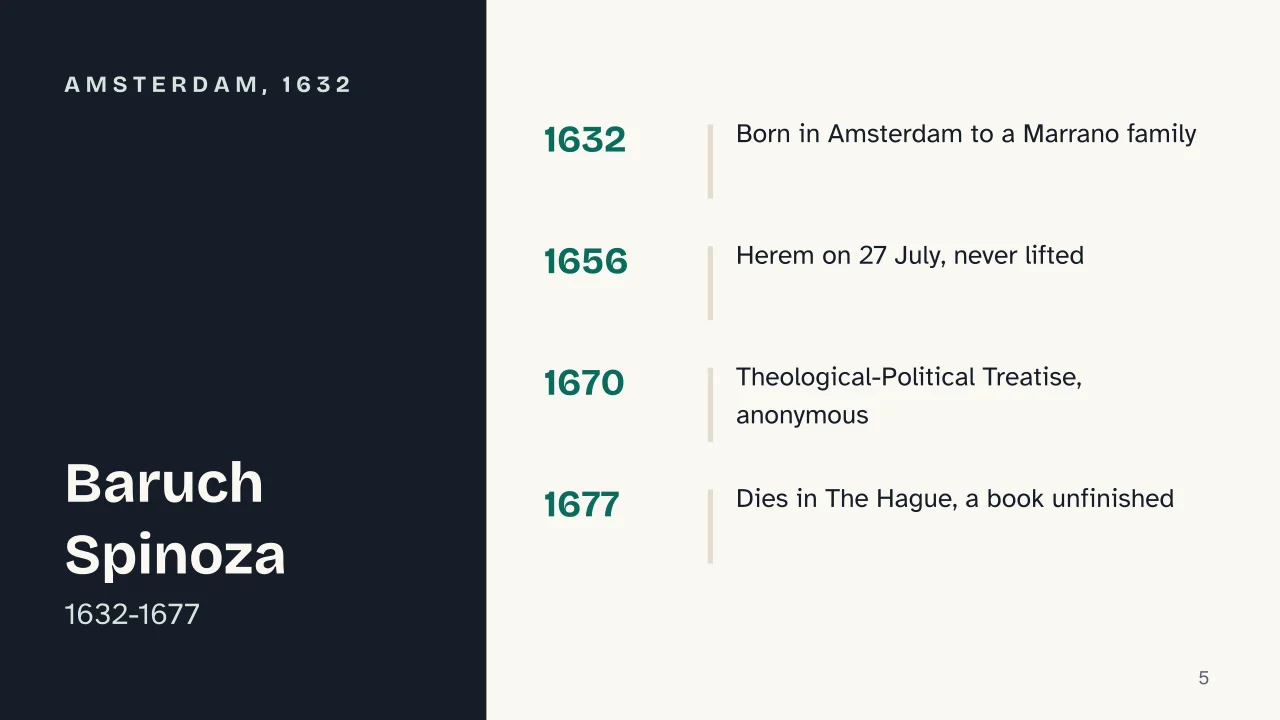
    The conflict had begun long before 1670. Spinoza’s family had arrived in Amsterdam from Portugal, and the IEP entry describes his parents as Marranos, Jews converted under duress, who emigrated to escape the Iberian Inquisition and to live in the relative tolerance of Holland. On 27 July 1656 the synagogue elders pronounced the herem, the excommunication, against their son. The SEP entry describes it as the harshest decree the Sephardic community of Amsterdam ever issued, and one never lifted; the IEP entry reports the charges, “abominable heresies” and “monstrous deeds”, with no detail provided.

    Even after the break with the synagogue, the pressure kept coming from the religious side. Spinoza saw the clergy as the main threat to freedom of thought, the IEP entry reports, and accused them of trading on popular fears and superstitions to hold on to power. Religious controversies drew him in personally, and the reputation for atheism attached to his name weighed on him.

    What happened after 1677

    Spinoza died in 1677 in The Hague, in the room he rented, while still at work on the Political Treatise, a separate book from the Theological-Political Treatise. The following year his works were banned across Holland. His figure has been read in two opposite ways ever since, the IEP entry recounts: for some a forerunner of a modernity led by reason, for others a threat to tradition.

    Slide deck

    Slides ready to download and make your own in PowerPoint or Google Slides, with speaker notes. Pick the Flash cut or the Full one.
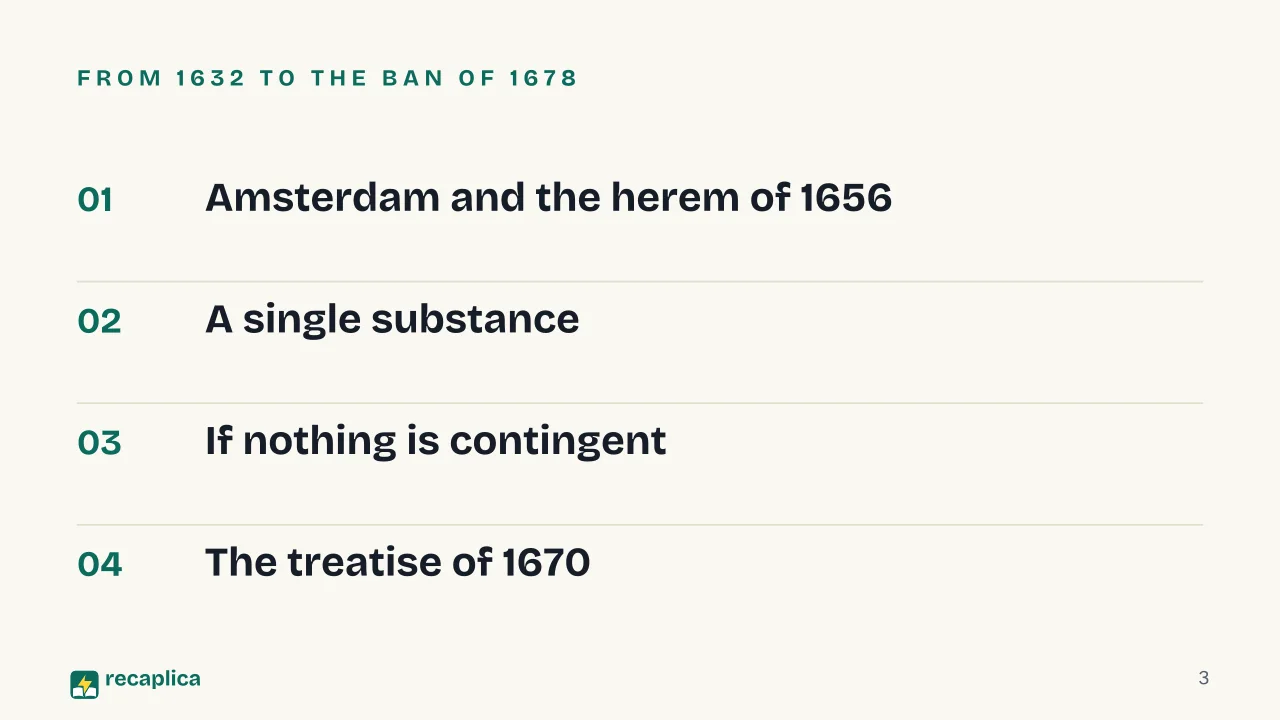
    Slide 1 of the presentation on Spinoza: SpinozaSlide 2 of the presentation on Spinoza: Why do we feel free?Slide 3 of the presentation on Spinoza: From 1632 to the ban of 1678Slide 4 of the presentation on Spinoza: Chapter 01: Amsterdam and the herem of 1656Slide 5 of the presentation on Spinoza: Amsterdam, 1632Slide 6 of the presentation on Spinoza: Chapter 02: A single substanceSlide 7 of the presentation on Spinoza: God stays at the centre of the system, under the name of Nature.Slide 8 of the presentation on Spinoza: Chapter 03: If nothing is contingentSlide 9 of the presentation on Spinoza: Awareness stops at our actionsSlide 10 of the presentation on Spinoza: Experience · Reason · IntuitionSlide 11 of the presentation on Spinoza: Chapter 04: The treatise of 1670Slide 12 of the presentation on Spinoza: From 1656 to 1678Slide 13 of the presentation on Spinoza: On Spinoza's account, where does the feeling of having free will come from?Slide 14 of the presentation on Spinoza: Time to review
    Flash10 slidesThe essential thread, to present in classFull14 slidesEvery chapter and the deeper detail

    Common myths

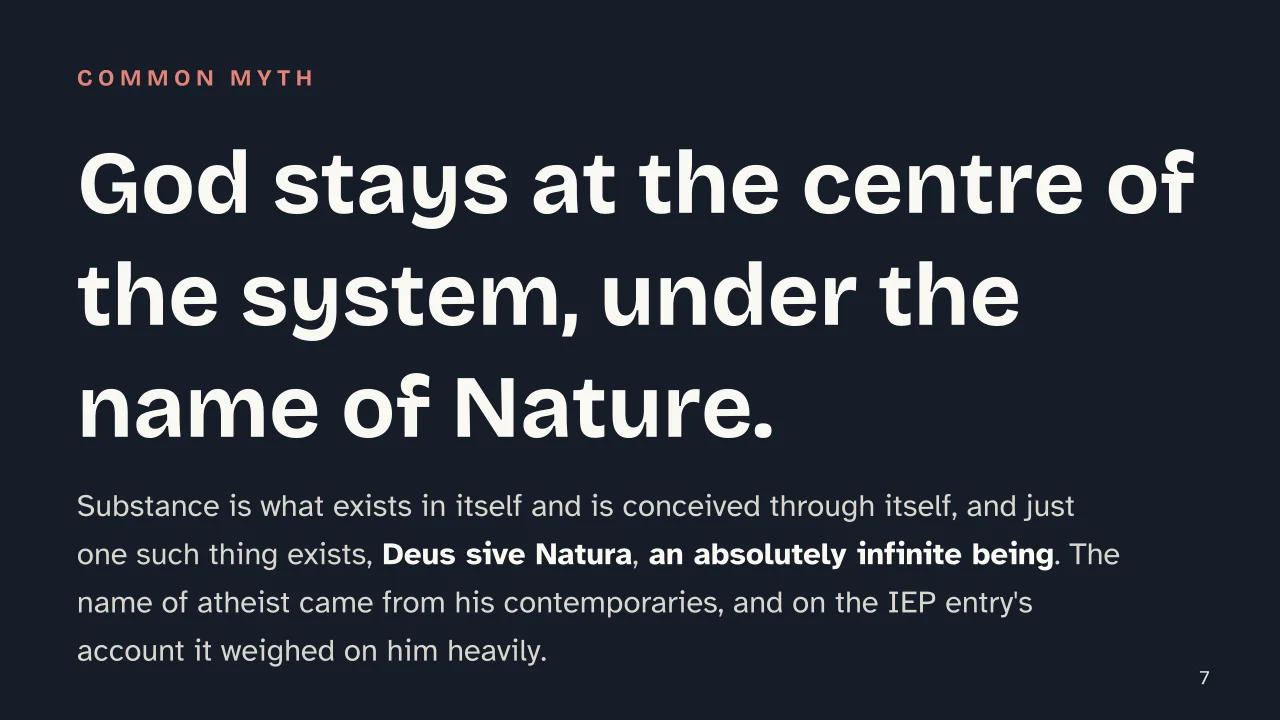
    • ✗ Myth Spinoza was an atheist who denied that God exists.

      ✓ Reality God sits at the centre of his system, identified with Nature in the formula Deus sive Natura and defined as an absolutely infinite being. The IEP entry reports that his contemporaries pinned a reputation for atheism on him and that it weighed on him heavily; the SEP entry adds that fearful devotion is not the attitude this God calls for.

    • ✗ Myth For Spinoza human beings have free will in the ordinary sense.

      ✓ Reality The Ethics states that nothing in nature is contingent and that things could not have been produced in another order. The IEP entry explains the feeling of being free as the effect of partial awareness, awareness of what we do but not of what makes us do it; what remains available is the move from passion to adequate knowledge.

    • ✗ Myth The Ethics is a collection of moral advice.

      ✓ Reality The encyclopedia entries cite it by proposition number, as with Ip29 and Ip33, because the text proceeds through demonstrated propositions. Before it reaches the passions and human freedom it deals with substance, attributes and God.

    Mind map

    Drag the background to move around and the nodes to reposition them; use − and + to collapse and expand branches.
    Customize
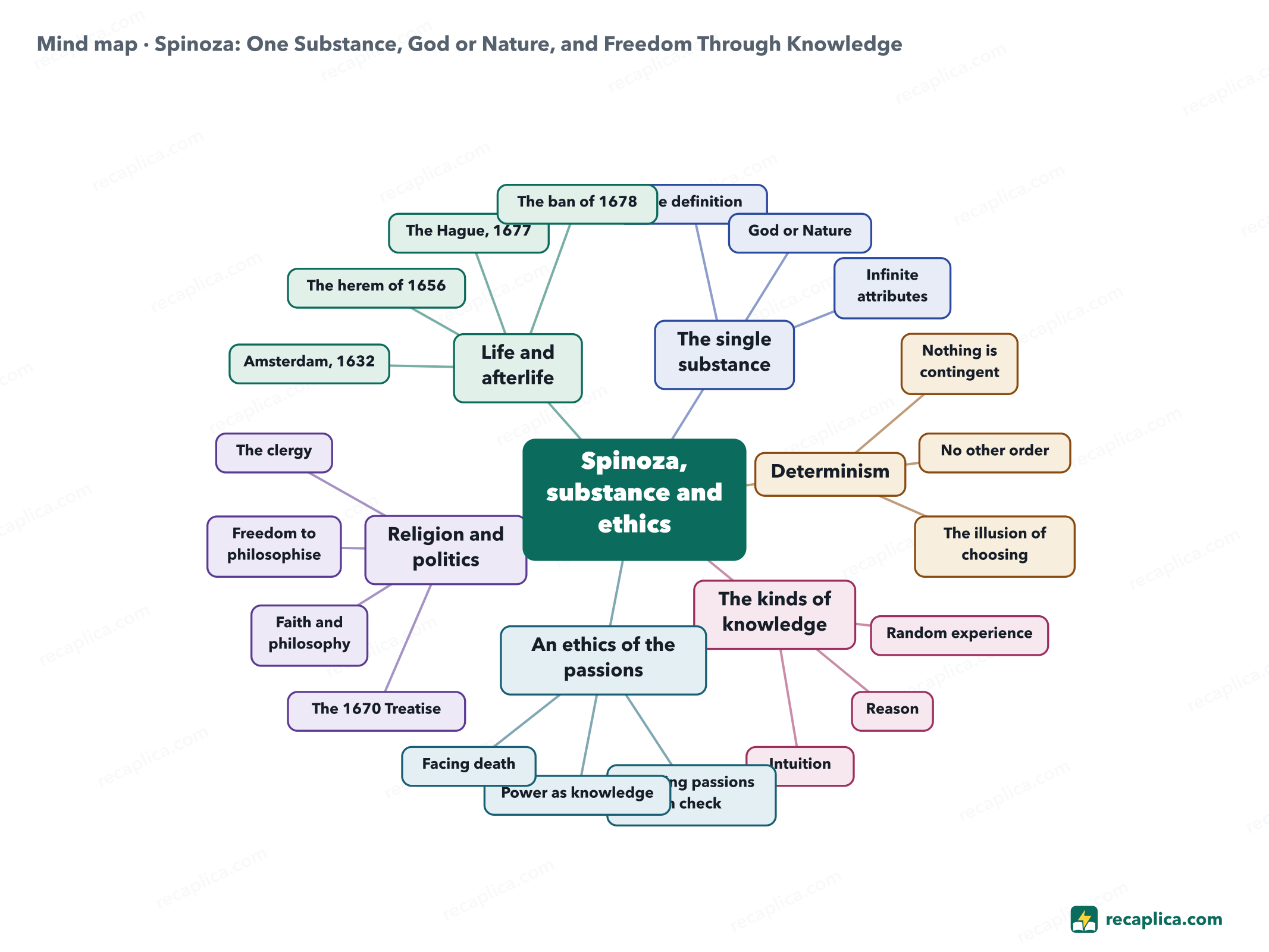
    Mind map: Spinoza: One Substance, God or Nature, and Freedom Through Knowledge
    • Spinoza, substance and ethics
      • The single substance
        • The definition Exists in itself, conceived through itself
        • God or Nature Deus sive Natura, the formula of the identification
        • Infinite attributes An absolutely infinite being
      • Determinism
        • Nothing is contingent Proposition Ip29 of the Ethics
        • No other order Proposition Ip33
        • The illusion of choosing We know our actions and miss their causes
      • The kinds of knowledge
        • Random experience From the senses, confusedly
        • Reason Common notions and adequate ideas
        • Intuition From God's attributes to the essence of things
      • An ethics of the passions
        • Holding passions in check Becoming active and self-governing
        • Power as knowledge Passion is a lack of knowledge
        • Facing death A certain form of eternity
      • Religion and politics
        • The 1670 Treatise Published anonymously, met with alarm
        • Faith and philosophy Kept apart, with different jobs
        • Freedom to philosophise Strengthens the stability of society
        • The clergy Accused of trading on fear and superstition
      • Life and afterlife
        • Amsterdam, 1632 A Portuguese-Jewish family of Marrano origin
        • The herem of 1656 Never lifted
        • The Hague, 1677 Death while a work was still open
        • The ban of 1678 Books prohibited across Holland

    Quiz: test yourself

    Answer the questions to check what you have learned: you get instant feedback and a short explanation.

    Grade 0/10 0/5
    1 How does Spinoza define substance?

    The definition reported by the IEP entry demands total independence, both in existing and in being thought, and from that requirement Spinoza concludes that there is only one substance.

    2 What does the formula Deus sive Natura mean?

    The SEP and IEP entries both report the identification, and the SEP recalls that this eternal being acts by necessity.

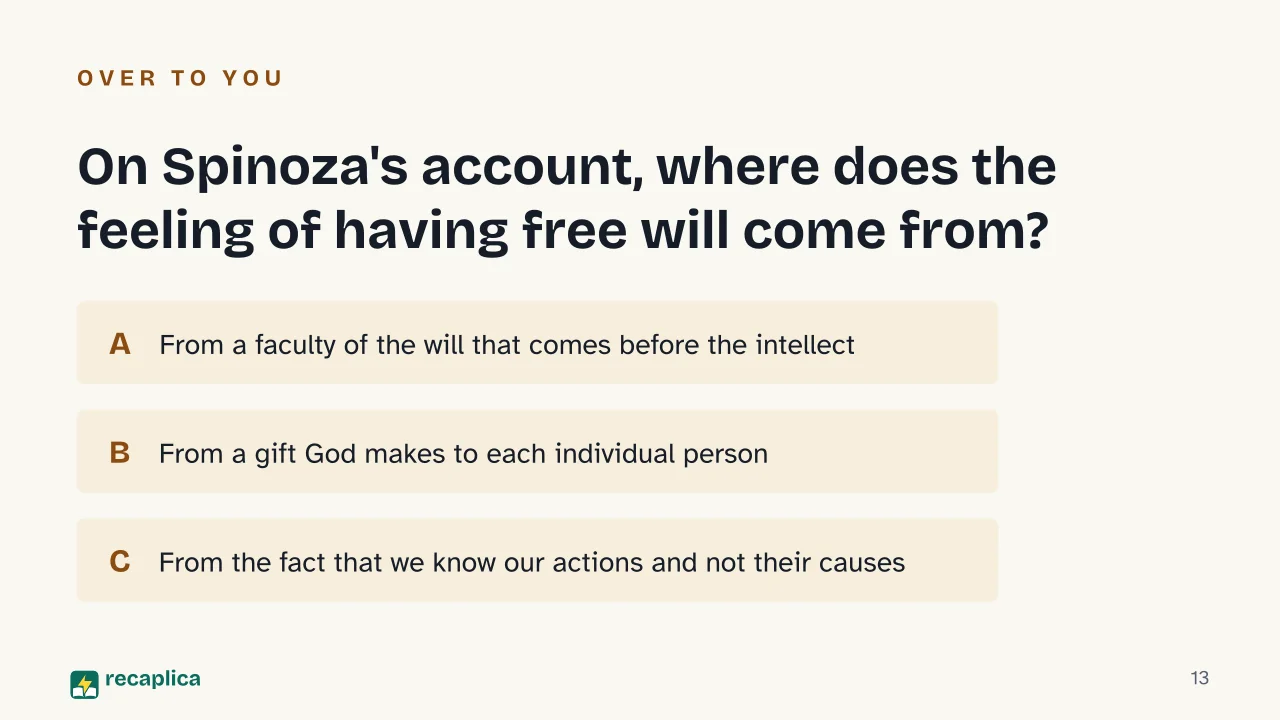
    3 On Spinoza's account, where does the feeling of having free will come from?

    The IEP entry traces that feeling back to partial awareness, and proposition Ip29 of the Ethics shuts the door on contingency in nature.

    4 What does Spinoza argue in the Theological-Political Treatise of 1670?

    In the Treatise the Mosaic authorship of the Torah falls, and Scripture counts as the carrier of a moral message rather than as a source of truth about nature.

    5 What is the third kind of knowledge in the Ethics?

    Intuition grasps in a single mental act what reason reaches step by step, and it starts from an adequate idea of God's attributes and arrives at the essence of things.

    Answers: 1-A · 2-B · 3-C · 4-C · 5-C

    Flashcards

    Tap the card to flip it and check whether you remember the answer, then move to the next one.

    1 / 7

    Explain it in your own words

    The ultimate test: if you can explain it in simple words, you've truly understood it. Write your explanation, then compare it with the Recap.

    Your explanation is saved only on this device.

    Baruch Spinoza (1632-1677) argues that there is only one substance, something that exists on its own and can be understood on its own, and he gives it two names at once, God or Nature. Everything follows from that infinite being by necessity, and the Ethics states that nothing in nature is contingent. People take themselves to be free because they notice their own actions and miss the causes behind them. The freedom Spinoza offers is therefore an inner one, built by holding the passions in check through rational knowledge. The elders of the Amsterdam synagogue excommunicated him in 1656, and in 1678 his works were banned.

    Frequently asked questions

    Was Spinoza an atheist?

    His contemporaries said so, and the IEP entry reports that the reputation weighed on him heavily. God does not drop out of his texts: he is identified with Nature and defined as an absolutely infinite being. The SEP entry points out, though, that the identification asks for no devotion, since fear and worship are not for Spinoza the right attitude towards God or Nature.

    What does Deus sive Natura mean?

    It is the Latin for God, or Nature, reported by both encyclopedia entries, and with it Spinoza states that the two words pick out the same infinite reality. From that identification it follows that whatever happens happens by the necessity of the divine nature.

    Did Spinoza believe in free will?

    He did not, and the reason lies in the build of his system, where nothing in nature is contingent. The IEP entry reports his account of our sense of freedom: an awareness of our actions that never reaches the causes producing them.

    What kind of freedom is left, then?

    An inner one. The SEP entry presents Spinoza's ethical goal as learning to restrain the passions, until a person becomes active and self-governing, and the IEP entry measures the power of the mind by knowledge. Whoever knows the causes at work in them is free in this sense, and on the SEP's account does not even fear death.

    Why was Spinoza excommunicated?

    On 27 July 1656 the elders of the Amsterdam synagogue pronounced the herem against him. The charges reported by the IEP entry speak of abominable heresies and monstrous deeds, with no specific details given; the SEP entry describes that decree as the harshest the city's Sephardic community ever issued, and one never lifted.

    Sources

    • Baruch Spinoza — Stanford Encyclopedia of Philosophy
    • Baruch Spinoza (1632—1677) — Internet Encyclopedia of Philosophy

    Every Recap goes through an independent review before publication.

    Every evening, the day's new Recaps on our Telegram channel. Join the channel →

    Keep learning

    • History What Is Existentialism? Heidegger, Being and Time, and Dasein Existentialism is a current of twentieth-century philosophy centered on human existence, freedom and the search for meaning. According to the Stanford Encyclopedia of Philosophy, the German philosopher Martin Heidegger (1889-1976) shaped that current more than almost anyone else, even though he never accepted the label. In 1927 he published Being and Time, his major work, where he introduced the concept of Dasein: the human being as the one entity that questions its own existence. That book influenced Jean-Paul Sartre's existentialism, but in 1946, in the Letter on Humanism, Heidegger openly broke with Sartre and refused to be called an existentialist. In 1933 he was elected rector of the University of Freiburg and became a Nazi party member, keeping that membership until the regime fell - an episode Heidegger himself later denied or played down more than once. Read the Recap →
    • History What Is Phenomenology? Husserl's Philosophy Explained Edmund Husserl founded phenomenology as a philosophical discipline around 1900-1901, with his Logical Investigations. His method starts from the epoché, a suspension of our everyday, unquestioning stance toward the world, and moves toward phenomenological reduction: studying how things appear to consciousness rather than what they are in themselves. At the center sits intentionality, the idea that every experience is always an experience of something specific, whether hoping, perceiving, or desiring. The method Husserl built carried into the 20th century through Heidegger, Sartre, and Merleau-Ponty, moving from German philosophy into French philosophy along the way. Read the Recap →
    • History Legal Positivism: What It Is, from Austin to Kelsen and Hart According to the Stanford Encyclopedia of Philosophy, legal positivism measures legal validity against observable social facts, keeping moral judgment on a separate track. Its roots lie in Hobbes and Hume. Jeremy Bentham produced the theory's first full account, which John Austin later took up and spread: for Austin, a rule is law only when a sovereign commands it under threat of punishment. In the twentieth century, Hans Kelsen grounded legal validity in a hierarchy that traces back to a presupposed basic norm, while Herbert Hart located it instead in a rule of recognition actually followed by judges and officials. Natural law theory takes the opposite view: an unjust law is not really a law. Legal positivism disagrees — a law stays valid even when it is morally unjust, as long as it was made the way the system requires. Read the Recap →

    recaplica

    Clear in 30 seconds, yours in 10 minutes.

    Recaps Mind maps Request a Recap Telegram channel Mind map maker Our method About Privacy & cookies Legal notes & terms of use

    © 2026 Recaplica · A project by Curi S.r.l. — VAT IT05472000750

    Statistics, only if you say so

    To learn which Recaps help most we would use Google Analytics, with aggregate, anonymous data. It starts only with your OK, and you can change your mind anytime. Privacy policy