Skip to content
recaplica

    One moment: security check

    Cloudflare wants to make sure you're not a robot. Tick the box below and your search will continue on its own.

    IT
    recaplica Aristotle and Plato: How Their Philosophies Differ
    © 2026 Recaplica · recaplica.com — All rights reserved
    Home › History

    Aristotle and Plato: How Their Philosophies Differ

    By Recaplica Newsroom · Updated on October 9, 2026

    What to print

    Page numbers appear when printing with default margins.

    Slides

    Choose a cut

    Flash10 slidesThe essential thread, to present in classFull16 slidesEvery chapter and the deeper detail

    Both come with speaker notes.

    Telegram channel
    recaplica Clear in 30 seconds, yours in 10 minutes.
    In 30 seconds Key points Figures Deep dive Slides Myths Mind map Quiz Flashcards FAQ

    In 30 seconds quick read

    Plato and Aristotle are the two Greek philosophers who shaped Western thought the most, yet they start from opposite ideas about reality. For Plato, the world we see with our eyes is only a shadow of a truer world, made of perfect and unchanging forms. For Aristotle, who studied under Plato for about twenty years, knowledge instead grows out of observing real things. The same split runs through their politics: Plato pictures a city ruled by philosophers, while Aristotle starts from the constitutions that actually exist. Plato founded the Academy, Aristotle the Lyceum, two schools that coexisted in Athens for decades.

    Key Points

    • Plato holds that the visible world is imperfect and that true reality lies in the forms, or ideas, which are eternal and unchanging.
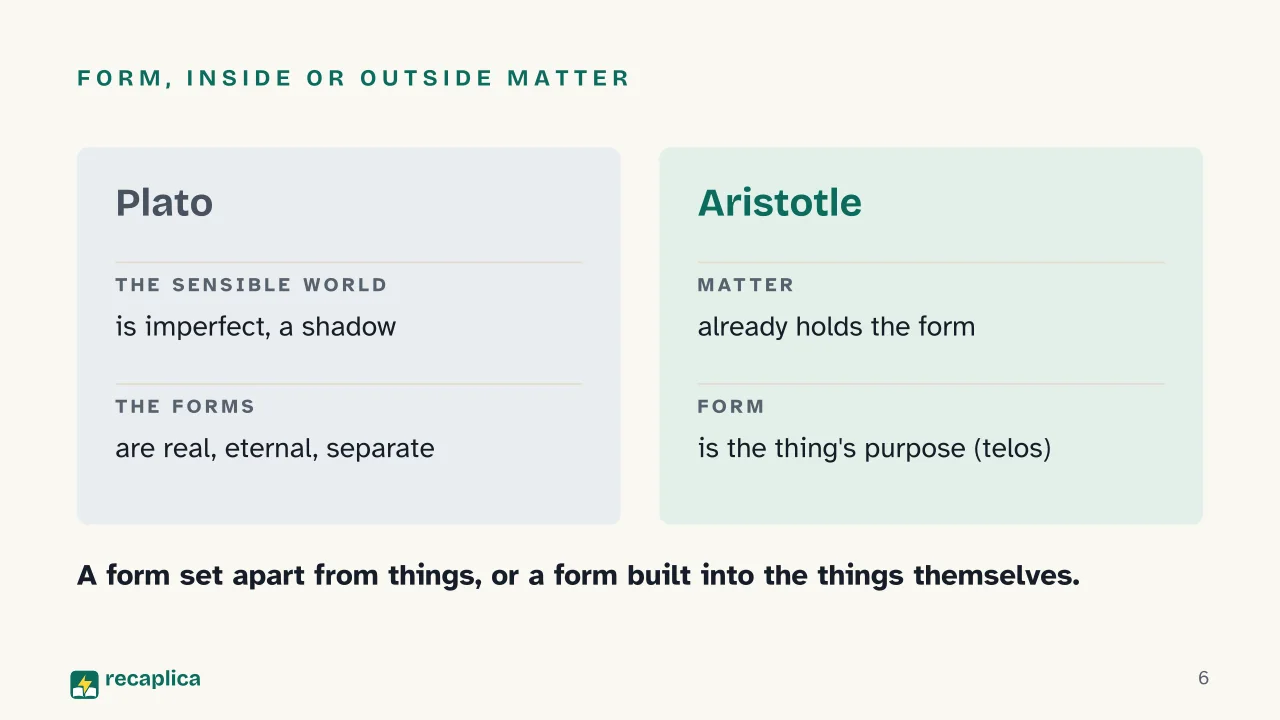
    • Aristotle rejects separate forms: for him, form exists inside things themselves, as their purpose or end (telos).
    • Aristotle's method starts from observing phenomena and from shared opinions (endoxa), before turning to theory.
    • In the Republic, Plato hands the government of the ideal city to philosophers; Aristotle instead looks at real constitutions and sorts them into correct and deviant ones.
    • Aristotle stayed at Plato's Academy for about twenty years, but after his teacher's death its leadership passed to Plato's nephew, Speusippus.
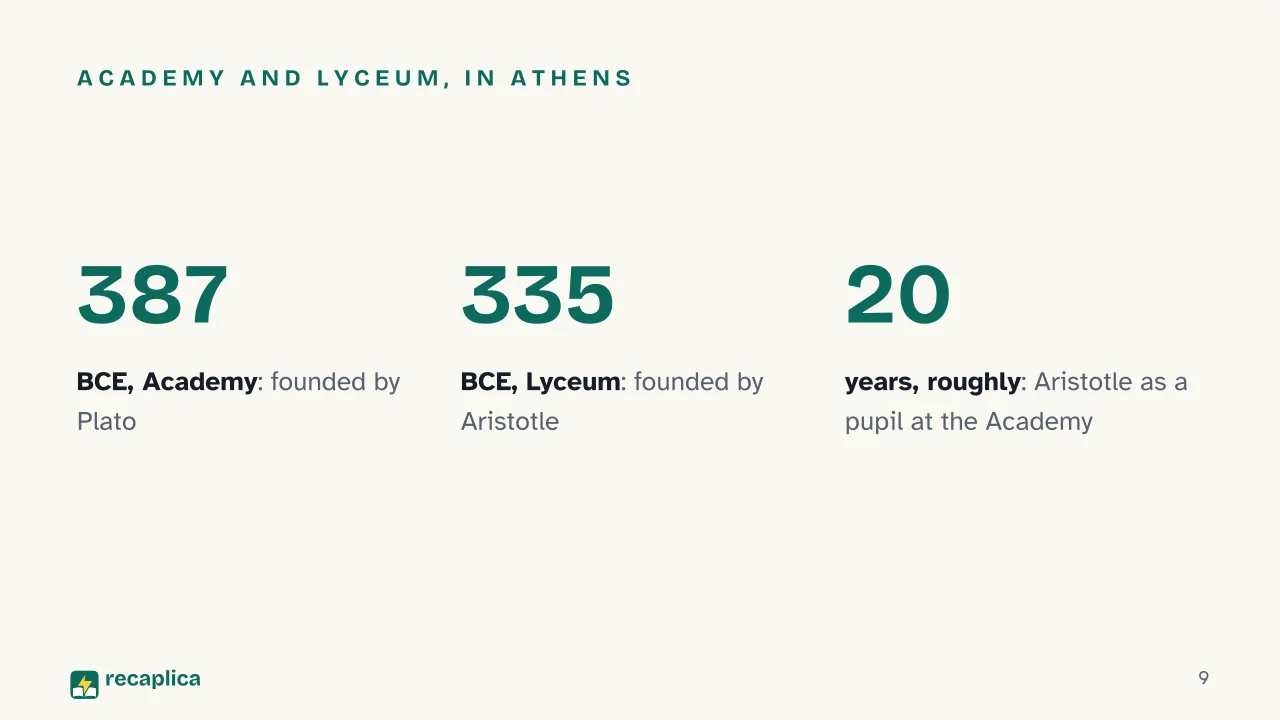
    • Plato founded the Academy in 387 BCE, Aristotle the Lyceum in 335 BCE: the two schools of Athens.

    Key figures

    • 387 BCE Year Plato founded the Academy in Athens. Source: Enciclopedia Treccani
    • 335 BCE Year Aristotle founded the Lyceum in Athens. Source: Enciclopedia Treccani
    • about 20 years How long Aristotle studied as a pupil at Plato's Academy. Source: Internet Encyclopedia of Philosophy

    Deep Dive

    Plato’s world of forms

    According to the Stanford Encyclopedia of Philosophy, Plato held that the world we grasp through the senses is in some sense imperfect: a more real and perfect realm exists, populated by entities called forms or ideas. The underlying distinction runs between the many things that strike us as beautiful or just, say, and the single entity that is truly beauty or justice itself.

    Ideas, according to Treccani’s entry on Plato, are forms or essences with their own existence: real entities that give sensible things their reason for being. The soul, for Plato, keeps the ability to recall (anamnesis) the forms it had grasped before birth, while it was still without a body: on this view, to know something is above all to remember it. In the Republic, book VII, Plato tells the famous allegory of the cave: people have lived since childhood chained inside an underground cave, forced to face only forward, while a fire burns behind them and, between the fire and the prisoners, a raised walkway carries figures that cast shadows on the wall ahead. The prisoners see only those shadows, and for them the shadows are the whole of reality.

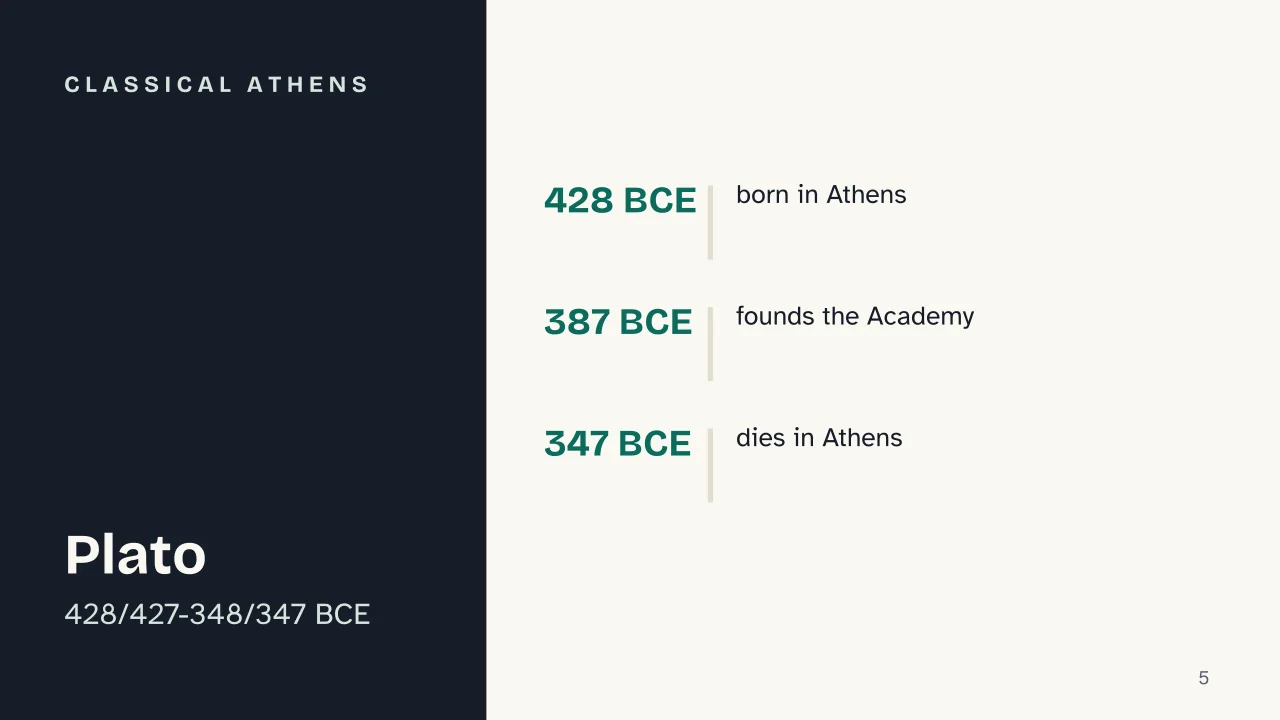
    Plato was born in Athens, according to Treccani, in 428 or 427 BCE and died in the same city in 348 or 347 BCE; the Stanford Encyclopedia of Philosophy instead gives 429 BCE as his birth year, marked with a question mark in the entry itself. In 387 BCE Plato founded the Academy, a religious community devoted to the cult of the Muses that doubled as a center of philosophical debate.

    Aristotle’s critique

    According to the Stanford Encyclopedia of Philosophy, Aristotle takes on Plato’s theory of forms in the Nicomachean Ethics (1096a11-16), where he says the inquiry is unwelcome to him because the people who introduced the forms were his friends. For Aristotle, form is the purpose (telos) of a thing, built into the matter of that very thing. Treccani’s entry on Aristotle calls this immanent form: what in Plato was the idea, eternal and separate, for Aristotle takes shape inside matter and gives rise to the single, concrete thing.

    Practical example: think of a table. For Plato, somewhere out there exists the perfect, unchanging idea of “table,” and the wooden piece of furniture in your home is only an imperfect copy of it. For Aristotle, instead, the table points to no world beyond itself: its form, being a flat surface on legs built to hold objects, already sits entirely inside that piece of worked wood.

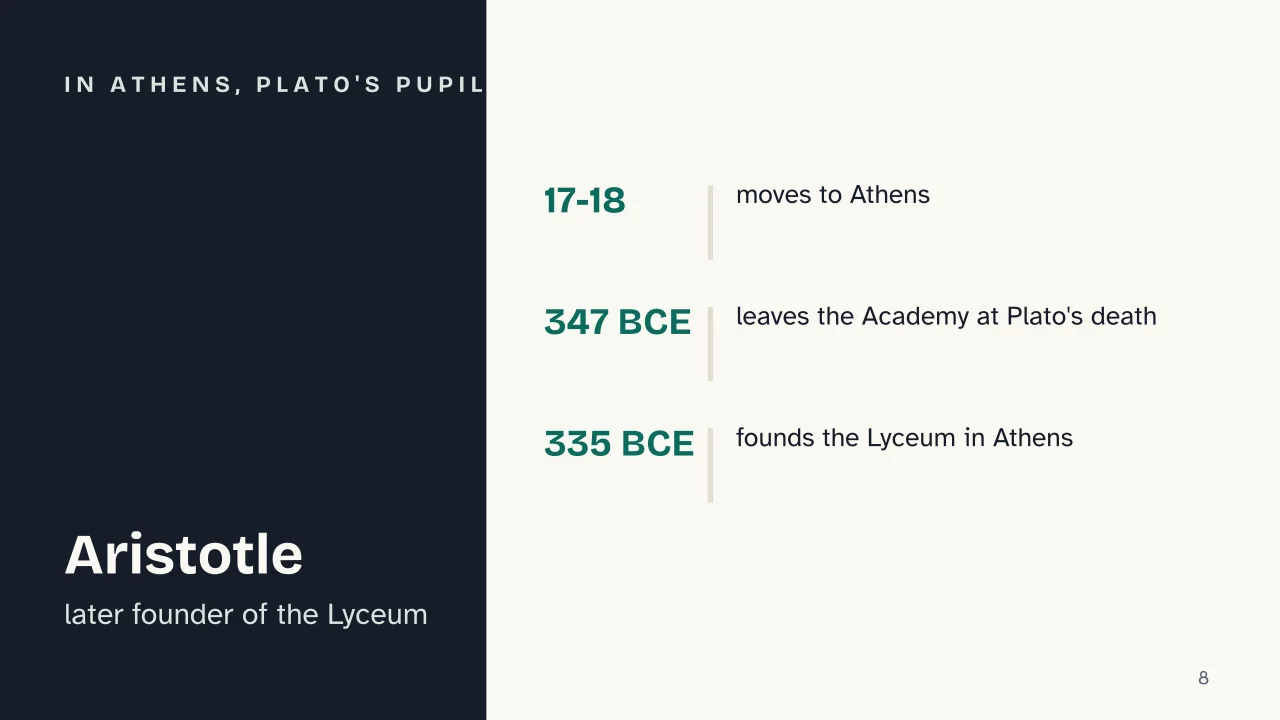
    The break with his teacher, though, was never a personal split. Aristotle studied under Plato at the Academy for close to twenty years, according to Treccani, staying until Plato’s death in 347 BCE; the same source reports that he kept, despite rumors to the contrary, a deep friendship and admiration for his teacher. After Plato’s death, though, Aristotle could not lead the Academy: as a foreign resident in Athens, he was legally barred from its leadership, which passed instead to Speusippus, Plato’s nephew and an Athenian citizen. Aristotle also left Athens as anti-Macedonian feeling grew with the expansion of Philip of Macedon; he had moved to the city, by some accounts, at age seventeen, while other sources put it at eighteen.

    Two theories of knowledge

    Aristotle’s method, according to the Nicomachean Ethics (1145b2-7) as cited by the Stanford Encyclopedia of Philosophy, starts from observing phenomena and from the opinions gathered about them, before turning to theoretical difficulties. In the Topics (100b21-23), Aristotle calls these shared opinions endoxa: what is accepted by everyone, by the majority, or by the wise, and he uses them as a starting point for reasoning. In the Posterior Analytics he then ties genuine scientific knowledge to grasping the cause that makes a thing what it is (71b9-16), even though the immediate premises, the first principles, cannot themselves be proven (72b21-23).

    Plato proceeds differently: he starts from the forms, and the task of knowledge is to climb back from what appears to what truly is. According to the Internet Encyclopedia of Philosophy, compared with Plato and Socrates, Aristotle’s approach was more empirical, grounded in observation: it is one of the reasons he is remembered above all for rejecting Plato’s theory of forms.

    Politics: the philosopher-king versus the political animal

    In the Republic, book V, Plato has Socrates say that cities will have no rest from their troubles until philosophers become kings, or kings and princes take on the spirit and ability of philosophy: the Smithsonian American Art Museum cites the line in connection with an artwork built around it. This is the core of the philosopher-king thesis: in the ideal city of the Republic, only those who possess knowledge of the forms should take charge of politics, in a regime the Stanford Encyclopedia of Philosophy describes as antidemocratic.

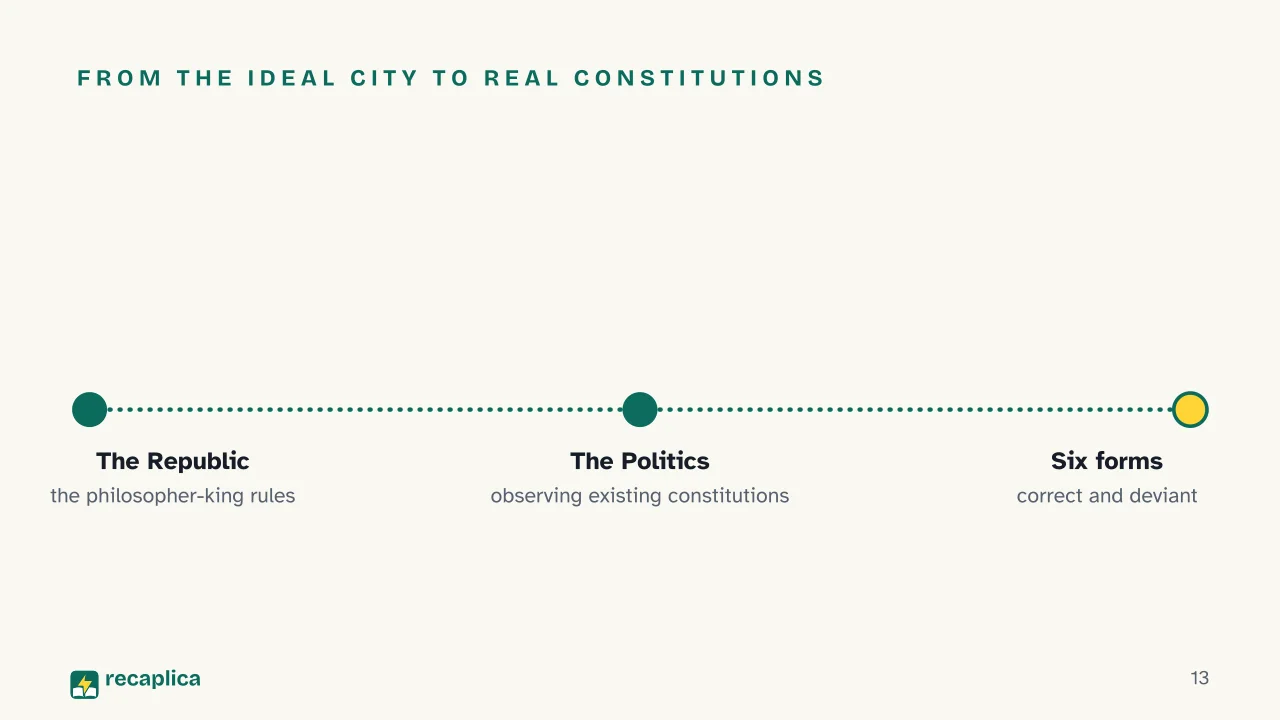
    Aristotle looks at politics from another angle. For him, according to the Stanford Encyclopedia of Philosophy’s entry on his political theory, human beings are by nature political animals (zoon politikon), who want to live together in a community; the task of the statesman and the lawgiver concerns the city-state, the polis, as a whole. Aristotle also starts from observing real constitutions, alongside the ideal model, and treats reforming an existing constitution as a task of politics just as important as setting up a new one. He then separates correct constitutions, aimed at the common good, from deviant ones, aimed only at the advantage of whoever governs: monarchy and aristocracy, with their corrupted versions tyranny and oligarchy, plus polity or democracy, six forms in all.

    AspectPlatoAristotle
    Realitythe forms, separate and perfectform inside matter (immanent form)
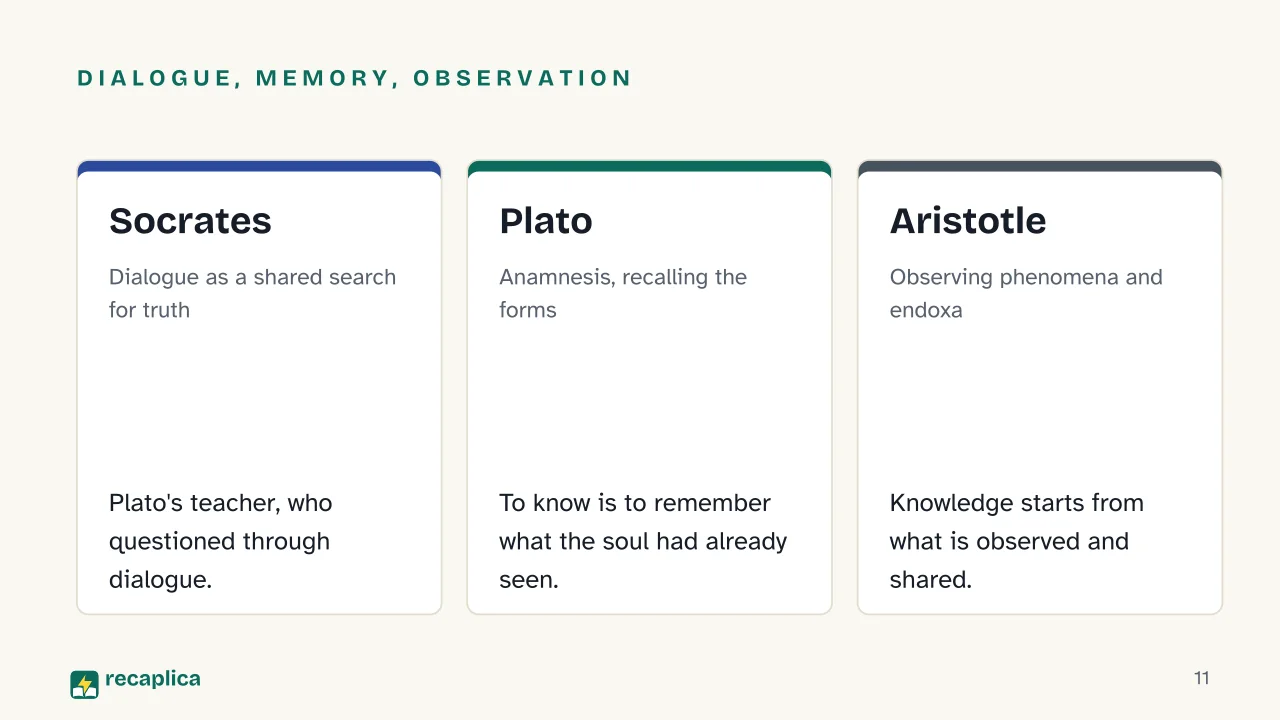
    Knowledgeanamnesis, recalling the formsobserving phenomena and endoxa
    Politicsthe philosopher-king in the ideal citythe zoon politikon, real constitutions
    SchoolAcademy, founded in 387 BCELyceum, founded in 335 BCE

    Two different philosophies, no winner

    Plato and Aristotle remain two different systems of thought, born in the same place and partly from the same question that the pre-Socratic philosophers had already asked about the ultimate nature of things. The Academy and the Lyceum stood for decades, in the same city, as two radically different ways of doing philosophy, founded roughly fifty years apart.

    Centuries later, Raphael painted the two philosophers side by side in the fresco The School of Athens, at the Vatican Museums. Plato stands at the center holding his book, the Timaeus; beside him Aristotle holds the Ethics.

    Slide deck

    Slides ready to download and make your own in PowerPoint or Google Slides, with speaker notes. Pick the Flash cut or the Full one.
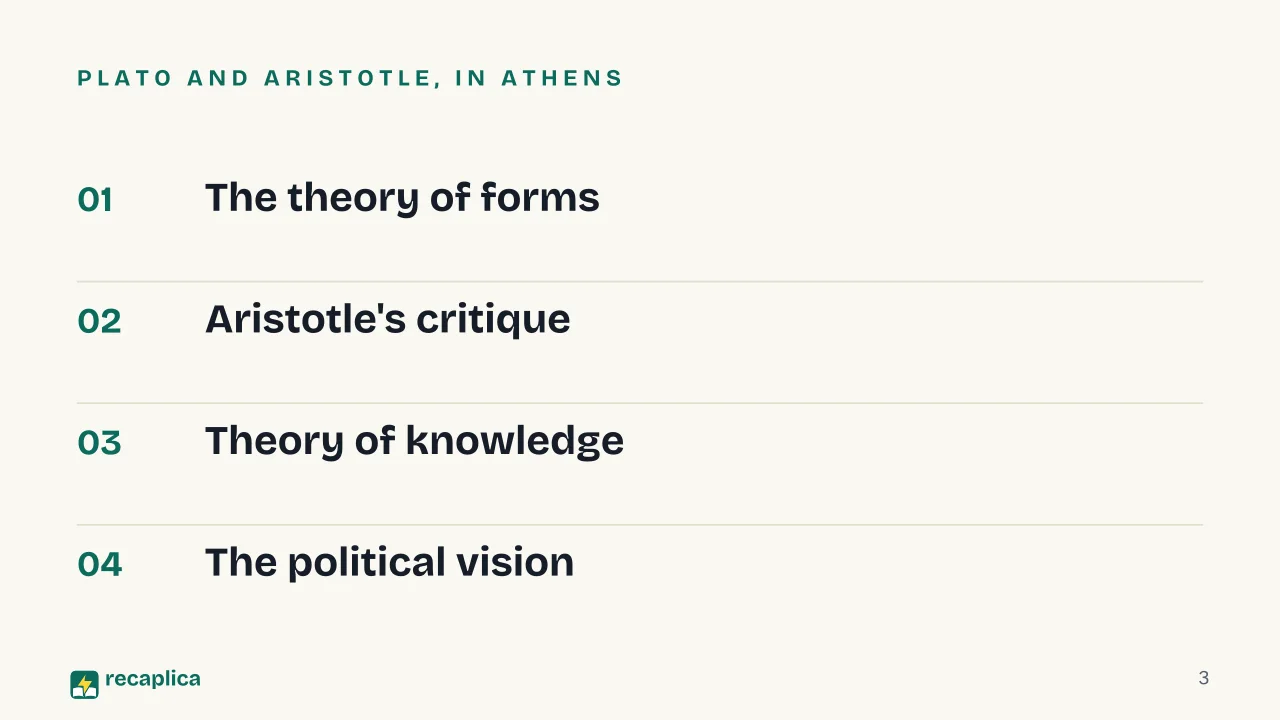
    Slide 1 of the presentation on Aristotle and Plato: Aristotle and PlatoSlide 2 of the presentation on Aristotle and Plato: Where does true reality sit, in ideas or in the things we see?Slide 3 of the presentation on Aristotle and Plato: Plato and Aristotle, in AthensSlide 4 of the presentation on Aristotle and Plato: Chapter 01: The theory of formsSlide 5 of the presentation on Aristotle and Plato: Classical AthensSlide 6 of the presentation on Aristotle and Plato: Form, inside or outside matterSlide 7 of the presentation on Aristotle and Plato: Chapter 02: Aristotle's critiqueSlide 8 of the presentation on Aristotle and Plato: In Athens, Plato's pupilSlide 9 of the presentation on Aristotle and Plato: Academy and Lyceum, in AthensSlide 10 of the presentation on Aristotle and Plato: Chapter 03: Theory of knowledgeSlide 11 of the presentation on Aristotle and Plato: Dialogue, memory, observation: Socrates, Plato, AristotleSlide 12 of the presentation on Aristotle and Plato: Chapter 04: The political visionSlide 13 of the presentation on Aristotle and Plato: From the ideal city to real constitutionsSlide 14 of the presentation on Aristotle and Plato: When Plato died, the Academy did not pass to Aristotle.Slide 15 of the presentation on Aristotle and Plato: In Plato's Republic, who should govern the ideal city?Slide 16 of the presentation on Aristotle and Plato: Now, time to review
    Flash10 slidesThe essential thread, to present in classFull16 slidesEvery chapter and the deeper detail

    Common myths

    • ✗ Myth Many assume Aristotle broke away from Plato out of plain pride or personal ambition.

      ✓ Reality Aristotle stayed at the Academy for about twenty years and, according to Treccani, kept a deep friendship and admiration for his teacher despite rumors to the contrary: philosophical disagreement over the forms never erased the personal bond.

    • ✗ Myth Many think Plato's ideas are just thoughts inside a mind, a kind of fantasy.

      ✓ Reality For Plato, according to Treccani, ideas have their own existence: they exist independently of whoever thinks them and are what gives sensible things their reason for being.

    • ✗ Myth Many assume that Aristotle took over the Academy after Plato died.

      ✓ Reality Leadership passed instead to Speusippus, Plato's nephew: as a foreign resident in Athens, Aristotle was barred by law from that role, according to the Internet Encyclopedia of Philosophy.

    Mind map

    Drag the background to move around and the nodes to reposition them; use − and + to collapse and expand branches.
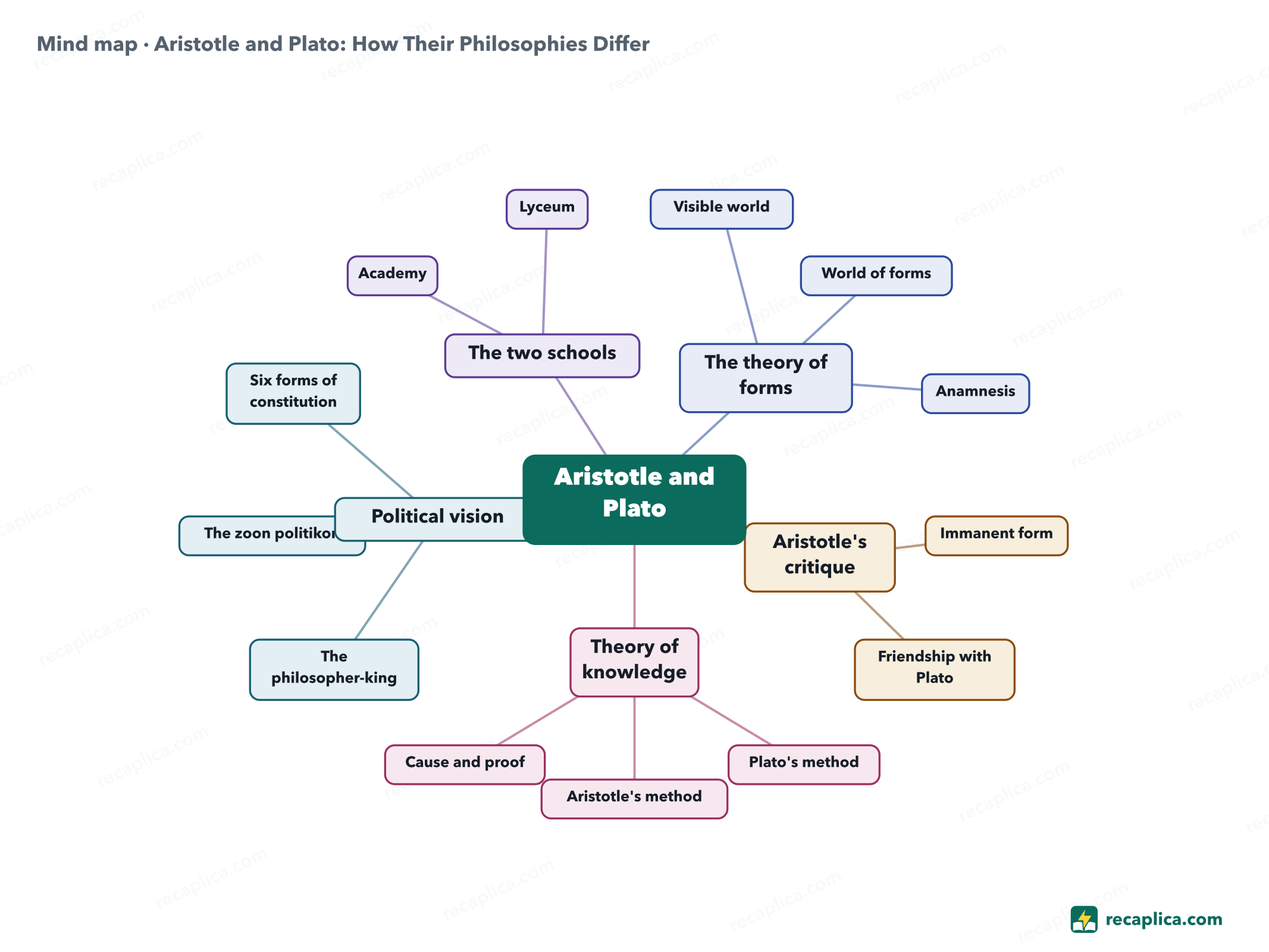
    Customize
    Mind map: Aristotle and Plato: How Their Philosophies Differ
    • Aristotle and Plato
      • The theory of forms Plato, the forms
        • Visible world imperfect, changing
        • World of forms real, unchanging
        • Anamnesis the soul recalls the forms
      • Aristotle's critique a return to matter
        • Immanent form inside matter, not separate
        • Friendship with Plato philosophical dissent, not a personal break
      • Theory of knowledge two different methods
        • Plato's method anamnesis, recalling the forms
        • Aristotle's method observation and endoxa
        • Cause and proof science, first principles
      • Political vision two models of government
        • The philosopher-king Republic, rule by the wise
        • The zoon politikon humans as political animals by nature
        • Six forms of constitution correct and deviant
      • The two schools Academy and Lyceum
        • Academy founded in 387 BCE
        • Lyceum founded in 335 BCE

    Quiz: test yourself

    Answer the questions to check what you have learned: you get instant feedback and a short explanation.

    Grade 0/10 0/5
    1 According to Plato, what is the relationship between the world we perceive with our senses and the world of forms?

    For Plato, the world grasped through the senses is in some sense imperfect, while the forms, in a more real realm, are the true reality.

    2 Where does Aristotle's method start, according to the Nicomachean Ethics?

    For Aristotle, phenomena come first, along with what people already think about them (endoxa); theoretical puzzles only come after.

    3 In Plato's Republic, who should govern the ideal city?

    Plato pictures an ideal city led by those who know the forms: this is the philosopher-king thesis.

    4 How does Aristotle tell political constitutions apart in his theory?

    Aristotle separates governments meant for everyone's benefit from those meant only for the benefit of whoever is in charge.

    5 True or false: after Plato's death, Aristotle took over the Academy.

    False: leadership passed to Speusippus, Plato's nephew; Aristotle, who lived in Athens as a foreigner, was legally barred from that role.

    Answers: 1-A · 2-B · 3-A · 4-A · 5-B

    Flashcards

    Tap the card to flip it and check whether you remember the answer, then move to the next one.

    1 / 7

    Explain it in your own words

    The ultimate test: if you can explain it in simple words, you've truly understood it. Write your explanation, then compare it with the Recap.

    Your explanation is saved only on this device.

    Plato and Aristotle are the two Greek philosophers who shaped Western thought the most, yet they start from opposite ideas about reality. For Plato, the world we see with our eyes is only a shadow of a truer world, made of perfect and unchanging forms. For Aristotle, who studied under Plato for about twenty years, knowledge instead grows out of observing real things. The same split runs through their politics: Plato pictures a city ruled by philosophers, while Aristotle starts from the constitutions that actually exist. Plato founded the Academy, Aristotle the Lyceum, two schools that coexisted in Athens for decades.

    Frequently asked questions

    What is the difference between Plato and Aristotle?

    Plato holds that true reality lies in the forms, perfect ideas separate from the sensible world; Aristotle holds instead that form lives inside things themselves and that knowledge starts from observing phenomena.

    What are the similarities and differences between Plato and Aristotle?

    Both wrestled with the same question about the ultimate nature of reality, and Aristotle himself studied under Plato at the Academy for about twenty years. They differ on where the answer lies: forms separate from things for Plato, form built into matter for Aristotle, with knock-on effects on how each approaches knowledge and politics.

    Who was right between Plato and Aristotle?

    Neither view simply wins: they are two different systems of thought, born from the same philosophical tradition, and later philosophy has drawn on elements of both.

    What is Plato's allegory of the cave?

    It is the story, in book VII of the Republic, of people chained inside a cave who see only shadows cast on a wall and mistake them for reality: an image of the condition of anyone who knows only the sensible world and not the forms.

    Sources

    • Stanford Encyclopedia of Philosophy — Plato
    • Stanford Encyclopedia of Philosophy — Aristotle
    • Internet Encyclopedia of Philosophy — Aristotle
    • Enciclopedia Treccani — Aristotele
    • Enciclopedia Treccani — Platone
    • Stanford Encyclopedia of Philosophy — Aristotle's Political Theory
    • Plato, Republic, Book VII (trans. Jowett) — Boston University
    • Smithsonian American Art Museum — Until Philosophers are Kings...
    • Vatican Museums — The School of Athens

    Every Recap goes through an independent review before publication.

    Every evening, the day's new Recaps on our Telegram channel. Join the channel →

    Keep learning

    • History Roman Education: How Rome's Three-Tier School System Worked Roman education grew out of an idea the Romans called humanitas: the belief that a full human being is shaped by learning, not born complete. The word humanus originally meant simply being kind to others, but by the 1st century BC Cicero had stretched it to cover liberal education too, what the Greeks called paideia. That idea took a very concrete shape in Roman schools, split into three stages: the litterator taught children to read and write, the grammaticus added Greek and the natural sciences, and the rhetor trained young men in public speaking and law. Very few girls went past the first stage, since most married while still in their teens. Read the Recap →
    • History Saint Augustine of Hippo: Life, Conversion, and Philosophy Augustine of Hippo (354-430) was born in Thagaste, in Roman Numidia, to a Roman father and a mother, likely Berber, who was Christian. After a youth of rhetorical study and years following Manichaeism, he converted to Christianity in Milan in 386 and was baptized the following year. He became bishop of Hippo and wrote the Confessions and the City of God, two works that shaped Western philosophy. His thought blends the Neoplatonic tradition with Christianity, around the themes of free will, sin, and grace. Read the Recap →
    • History Hellenistic Judaism: What It Was and How Philo Read the Bible with Plato Hellenistic Judaism is the name given to Jewish thought as it grew up inside Greek culture, and the Internet Encyclopedia of Philosophy treats Philo of Alexandria as the most elaborate case of that encounter in Alexandria. Philo was born in Alexandria in Egypt around 20 BCE, into a wealthy and prominent Jewish family, and he trained in Greek philosophy at a high level. He read Scripture on the assumption that the text carries a literal sense and, underneath it, an allegorical one. Out of that reading came the idea he is best known for, the Logos, the part of God that a human mind can actually reach. Read the Recap →

    recaplica

    Clear in 30 seconds, yours in 10 minutes.

    Recaps Mind maps Request a Recap Telegram channel Mind map maker Our method About Privacy & cookies Legal notes & terms of use

    © 2026 Recaplica · A project by Curi S.r.l. — VAT IT05472000750

    Statistics, only if you say so

    To learn which Recaps help most we would use Google Analytics, with aggregate, anonymous data. It starts only with your OK, and you can change your mind anytime. Privacy policy