|
recaplica
Categorical Imperative: What Is Kant's Moral Law? | ||||||||||||
| © 2026 Recaplica · recaplica.com — All rights reserved | ||||||||||||
Categorical Imperative: What Is Kant's Moral Law?What to print Page numbers appear when printing with default margins. SlidesChoose a cut Flash10 slidesThe essential thread, to present in classFull14 slidesEvery chapter and the deeper detailBoth come with speaker notes. In 30 seconds quick readThe categorical imperative is Kant's name for a moral command that holds without exception, regardless of what anyone happens to want. A hypothetical imperative only binds someone who already wants a particular goal; the categorical one applies to any rational will, whatever that will desires. The Stanford Encyclopedia of Philosophy lays out several formulations - universal law, universal law of nature, the formula of humanity, the kingdom of ends - as different angles on one principle. The false-promise example, used by both the Stanford Encyclopedia of Philosophy and the Internet Encyclopedia of Philosophy, shows the test in action: a maxim that defeats itself once everyone follows it cannot stand as a moral law. Key Points
Deep DiveA command that doesn’t wait for a reasonAccording to the Stanford Encyclopedia of Philosophy, Kant separates an imperative - a command aimed at someone who might not follow it - from a plain description of behavior. The categorical imperative is the one that holds “categorically,” meaning without conditions, for no reason other than that the person addressed has a rational will. It doesn’t depend on a desire, a goal, or a personal payoff: it reaches anyone capable of reasoning, in any circumstance at all. That sets it apart from the virtue ethics Aristotle develops in the Nicomachean Ethics, where goodness tracks character and habit rather than a law valid for every rational will. Categorical versus hypothetical imperativeThe Internet Encyclopedia of Philosophy describes a hypothetical imperative as a rule reason supplies for reaching an end already wanted: it commands an action only on condition that something has already been decided upon. Remove that desire and the command loses its grip, because its force depended on the desire in the first place. The categorical imperative needs none of this scaffolding; it holds for the mere existence of a rational will, whatever that will happens to want.
Kant’s formulations of the categorical imperativePer the Stanford Encyclopedia of Philosophy, Kant states the principle in several formulations that stay the same command seen from different angles. The first is the formula of universal law: act only on maxims you could will to become a universal law. A variant, recorded by the Internet Encyclopedia of Philosophy, calls it the universal law of nature: act as though your maxim were, by your own will, to become a law of nature. The second formulation is the formula of humanity. People, in ourselves and in others, must always be treated also as an end, never as a mere means. The third, the kingdom of ends, asks each person to act as a member who both legislates and obeys within an ideal community of rational beings who treat one another as ends. Treccani records all three in the classic Italian translation, variant of the first included. The false-promise test
Per the Stanford Encyclopedia of Philosophy, Kant uses this case to show the categorical-imperative test at work. The maxim would read: I will make a false promise whenever I need money. Universalized - if everyone followed it, always - the maxim contradicts itself: no one would trust a promise anymore, and the very institution of promising, which the maxim relies on to function, would stop existing. The Internet Encyclopedia of Philosophy reaches the same verdict: the maxim fails the test because it destroys the conditions that make it workable in the first place. Kant checks whether a maxim can survive becoming a rule for everyone. Duty beyond feelingIn his writings on empiricism, David Hume grounds morality in feeling, in the approval we experience watching an action unfold. Kant looks instead for a law that holds regardless of what we feel, rooted in reason alone. Where this law comes fromKant develops the categorical imperative inside a larger project, the one laid out in the Critique of Pure Reason, where he first maps the limits of human knowledge and only afterward turns to the question of how one ought to act. The route he takes to a law valid for every rational will, built from reason alone rather than drawn from experience, continues a path opened by the rationalism of Descartes, even though Kant lands on conclusions different from both rationalism and Hume’s empiricism. Treccani defines the categorical imperative as the pure law of duty: a form with no specific content, valid regardless of the agent’s particular purpose. It states how a maxim has to be built to count as moral; the concrete goal of any single case stays outside that definition. Slide deckSlides ready to download and make your own in PowerPoint or Google Slides, with speaker notes. Pick the Flash cut or the Full one.     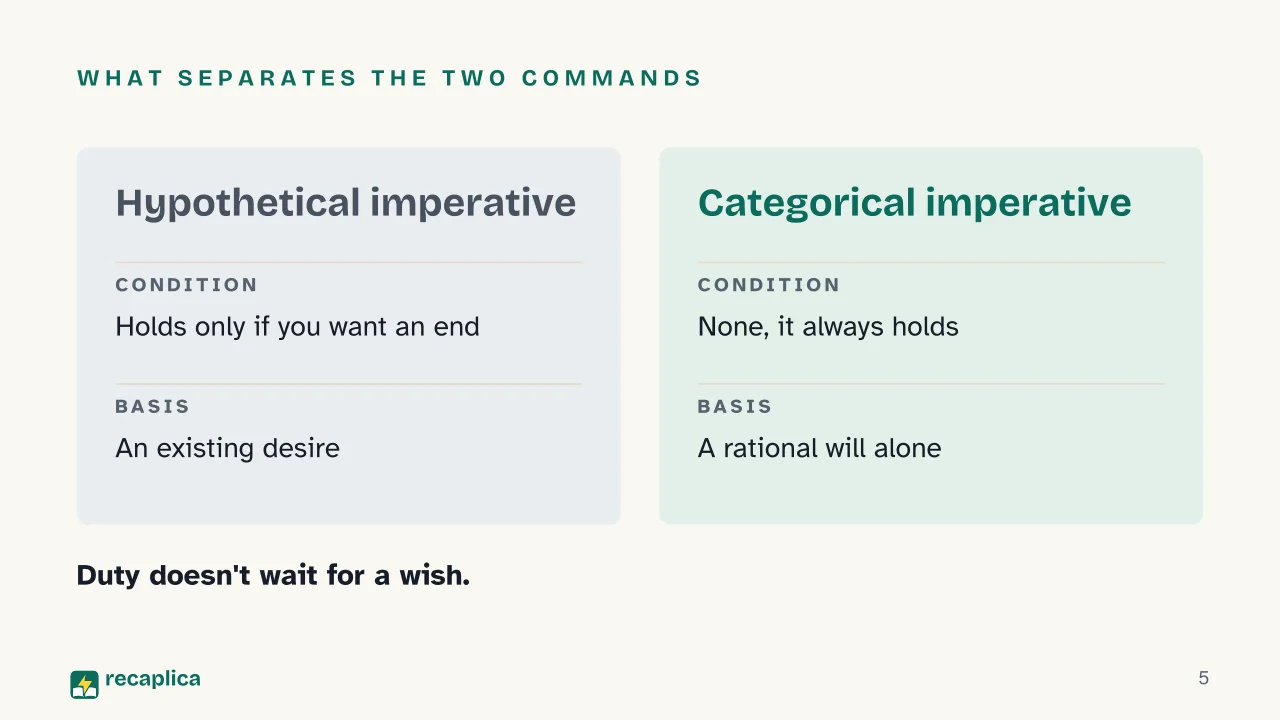  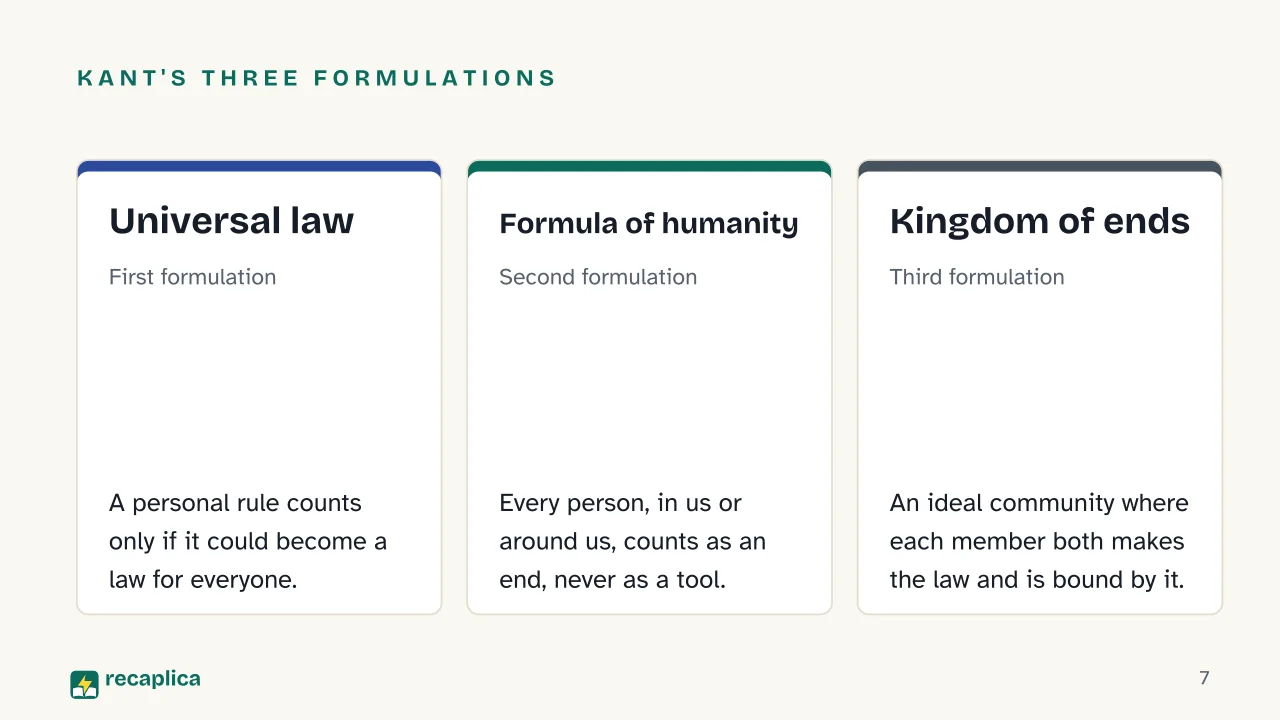  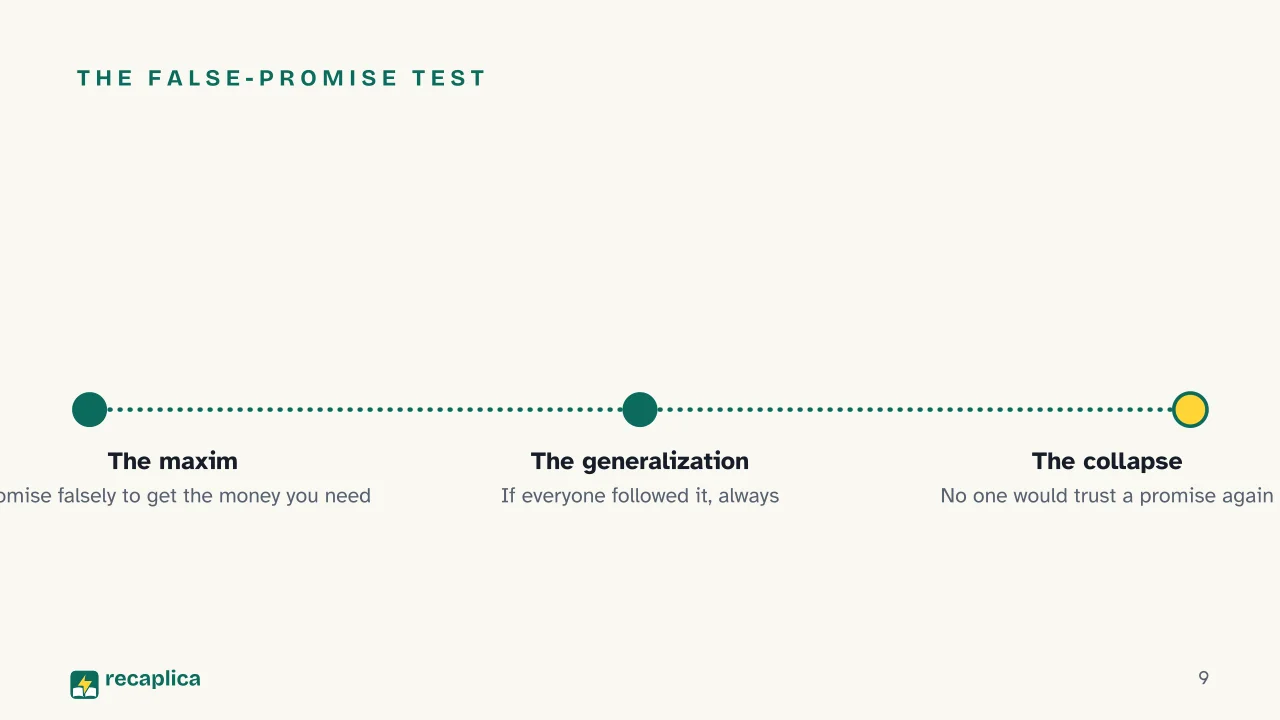  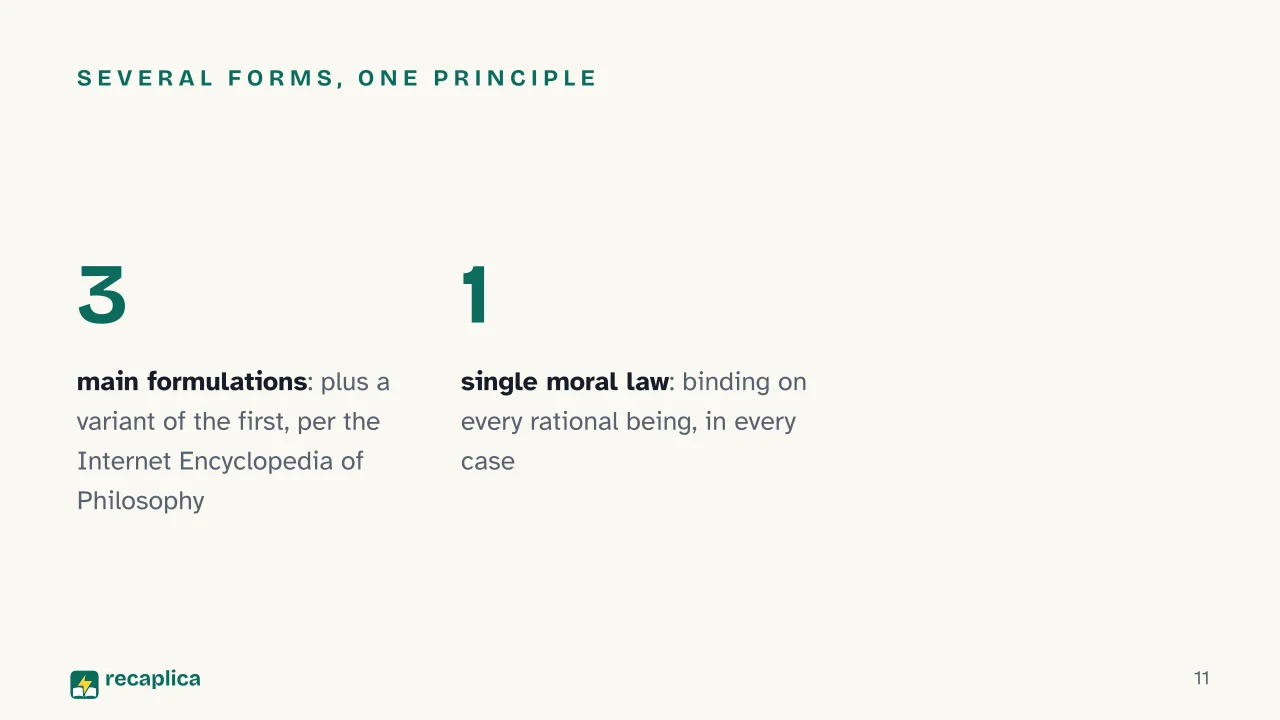 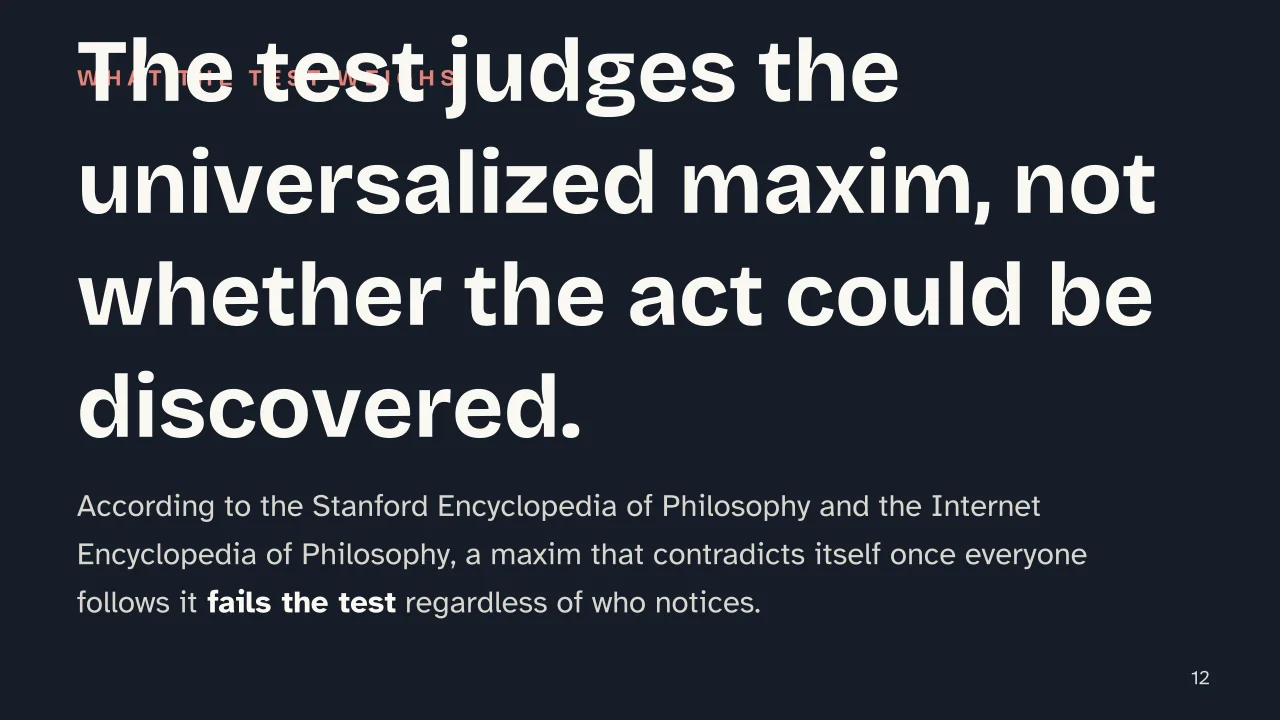 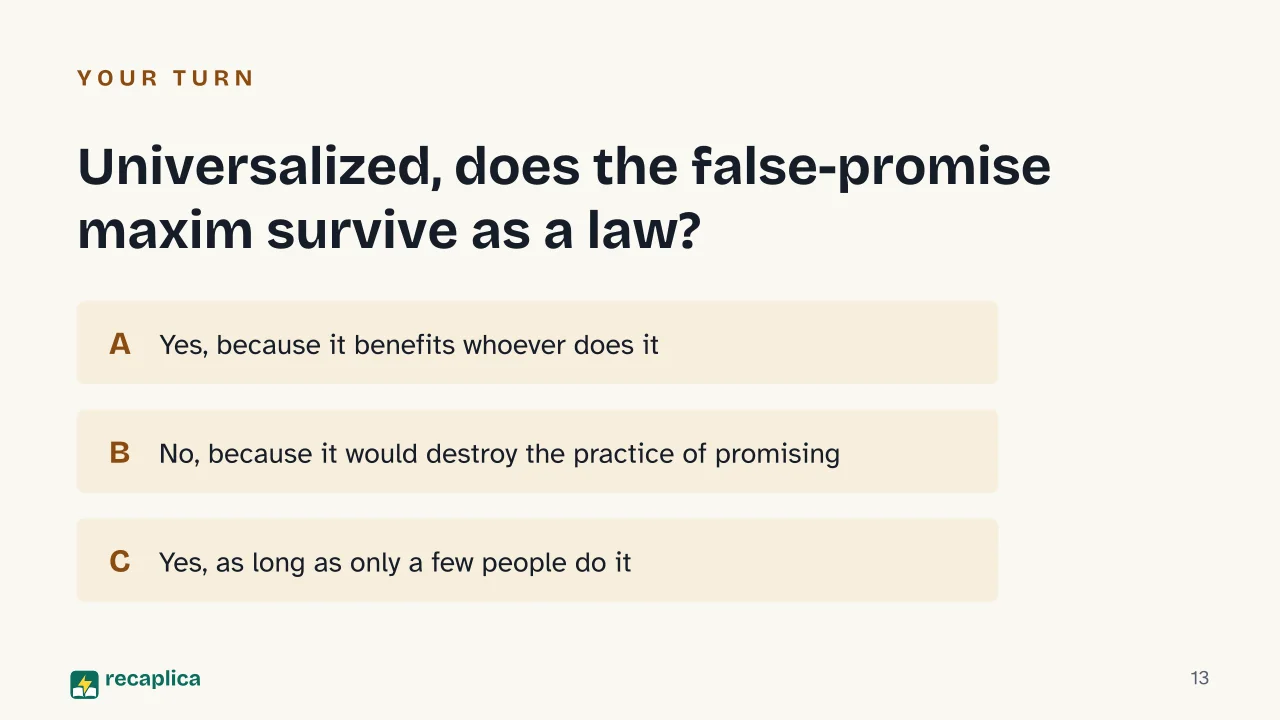  Common myths
Mind mapDrag the background to move around and the nodes to reposition them; use − and + to collapse and expand branches. 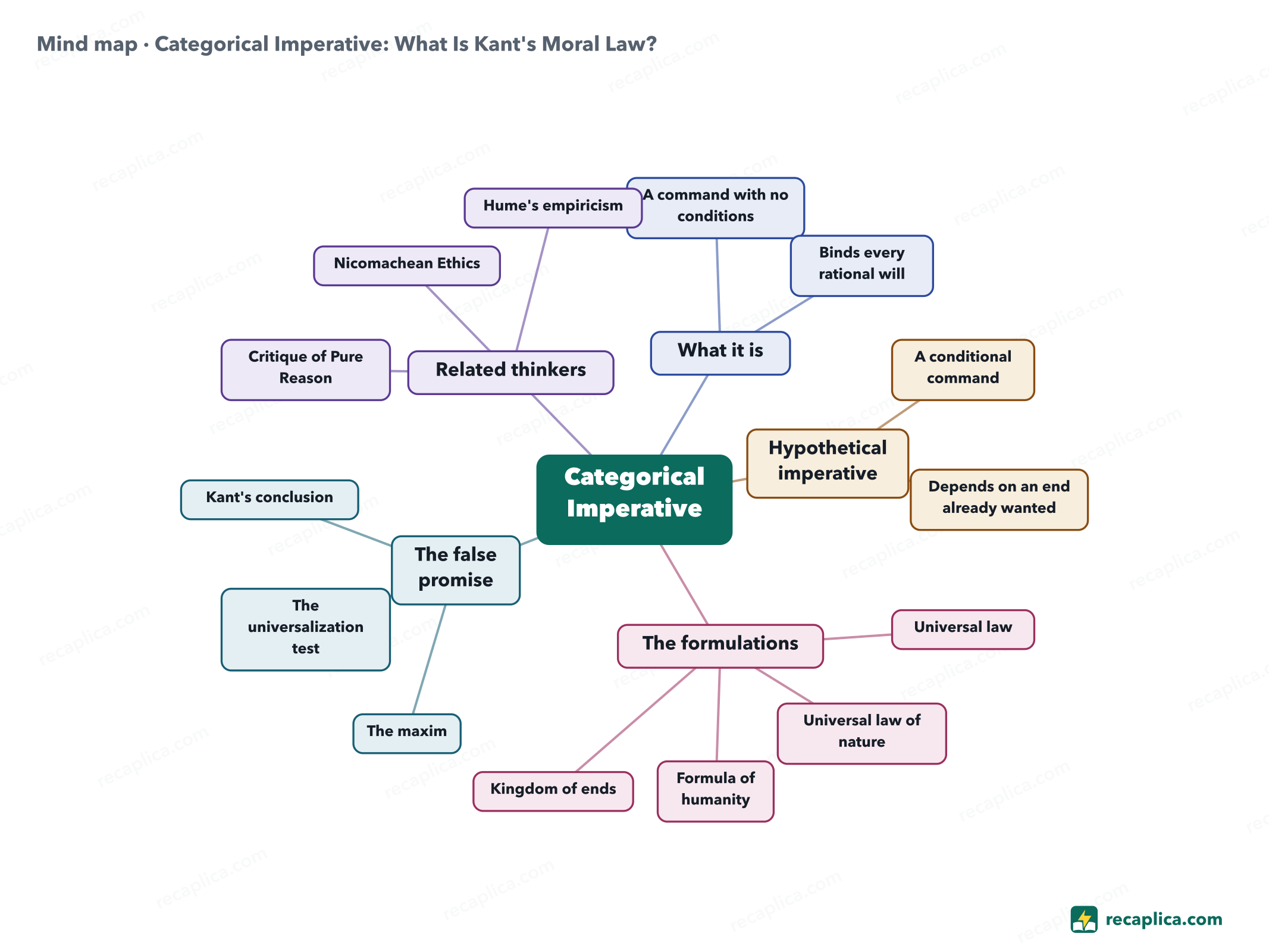
Quiz: test yourselfAnswer the questions to check what you have learned: you get instant feedback and a short explanation. Grade 0/10 0/5
FlashcardsTap the card to flip it and check whether you remember the answer, then move to the next one. 1 / 7 Explain it in your own wordsThe ultimate test: if you can explain it in simple words, you've truly understood it. Write your explanation, then compare it with the Recap. Your explanation is saved only on this device.
Frequently asked questionsWhat is the categorical imperative, in short?For Kant, it is the moral command that binds anyone with a rational will, regardless of what that person wants or hopes to achieve. What is the difference between a categorical and a hypothetical imperative?A hypothetical imperative commands an action only on condition that a certain end is already wanted; a categorical imperative commands regardless of that condition, by reason alone. How many formulations of the categorical imperative did Kant give?Three: universal law, formula of humanity, and kingdom of ends. The Internet Encyclopedia of Philosophy also lists a variant of the first, called the universal law of nature. Why does the false-promise maxim fail the categorical-imperative test?Because, once universalized, the maxim of promising falsely to get money destroys the very practice of promising: if everyone followed it, no one would ever trust a promise again. Does the categorical imperative tell you what to do in every single situation?No. Treccani describes it as duty in its pure form, with no goal of its own. It sets out how a maxim must be built to count as a moral law. Every Recap goes through an independent review before publication. |