Skip to content
recaplica

    One moment: security check

    Cloudflare wants to make sure you're not a robot. Tick the box below and your search will continue on its own.

    IT
    recaplica Phenomenology of Spirit: A Summary of Hegel's Book
    © 2026 Recaplica · recaplica.com — All rights reserved
    Home › History

    Phenomenology of Spirit: A Summary of Hegel's Book

    By Recaplica Newsroom · Updated on October 12, 2026

    What to print

    Page numbers appear when printing with default margins.

    Slides

    Choose a cut

    Flash10 slidesThe essential thread, to present in classFull14 slidesEvery chapter and the deeper detail

    Both come with speaker notes.

    Telegram channel
    recaplica Clear in 30 seconds, yours in 10 minutes.
    In 30 seconds Key points Figures Deep dive Slides Myths Mind map Quiz Flashcards FAQ

    In 30 seconds quick read

    Phenomenology of Spirit is the book Hegel published in 1807, finished at the end of 1806 while Napoleon's troops occupied Jena. The book follows a single path from the most basic form of consciousness to what Hegel calls Absolute Knowing, passing through self-consciousness, reason, spirit and religion. In the chapter on self-consciousness comes the struggle for recognition, which gives rise to the relationship between lord and bondsman, and the figure of the unhappy consciousness. According to the Stanford Encyclopedia of Philosophy, Hegel meant the book as a path that educates the reader up to the standpoint from which philosophy proper can be done.

    Key Points

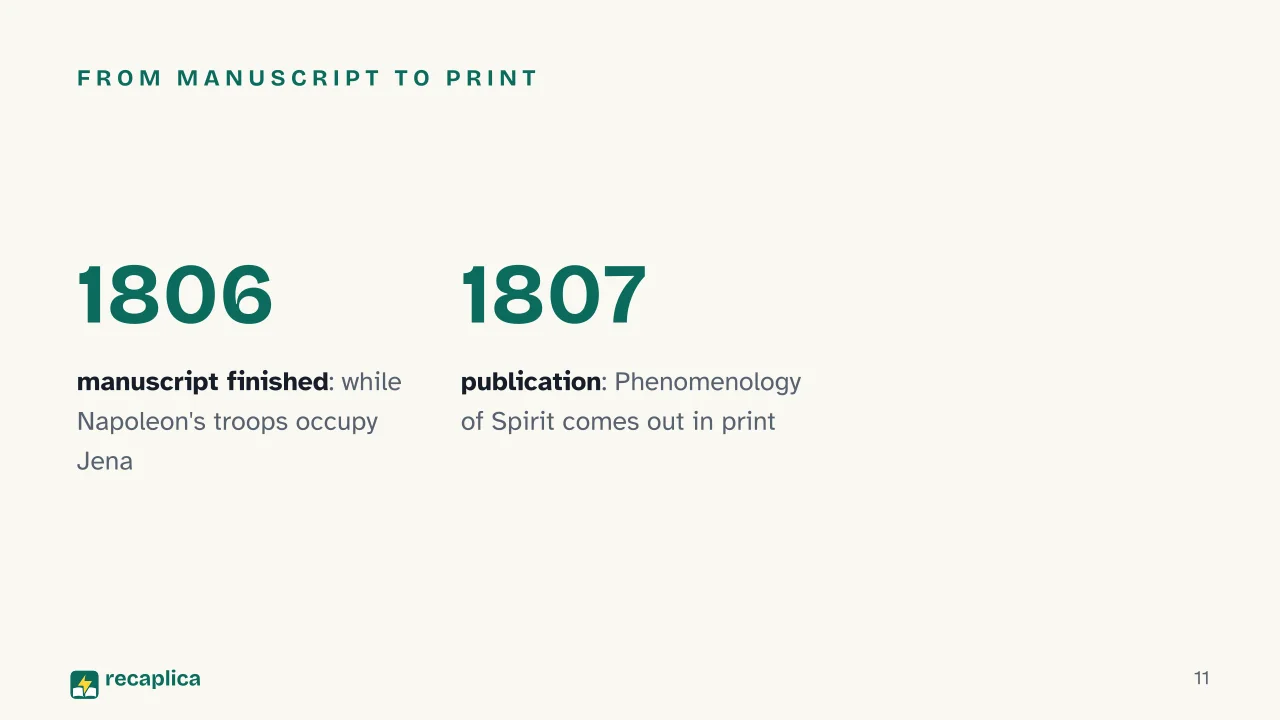
    • Phenomenology of Spirit was finished at the end of 1806 and published in 1807, while Napoleon's troops occupied Jena.
    • The book moves through the sections Consciousness, Self-Consciousness, Reason, Spirit, Religion and Absolute Knowing, in that order.
    • The chapter on Self-Consciousness tells the clash between two self-consciousnesses: out of it comes the relationship between lord and bondsman.
    • The last figure of the Self-Consciousness chapter is the unhappy consciousness, turned toward an otherworldly realm.
    • Hegel saw the book as a preparatory step toward pure conceptual thought, propaedeutic to philosophy proper.
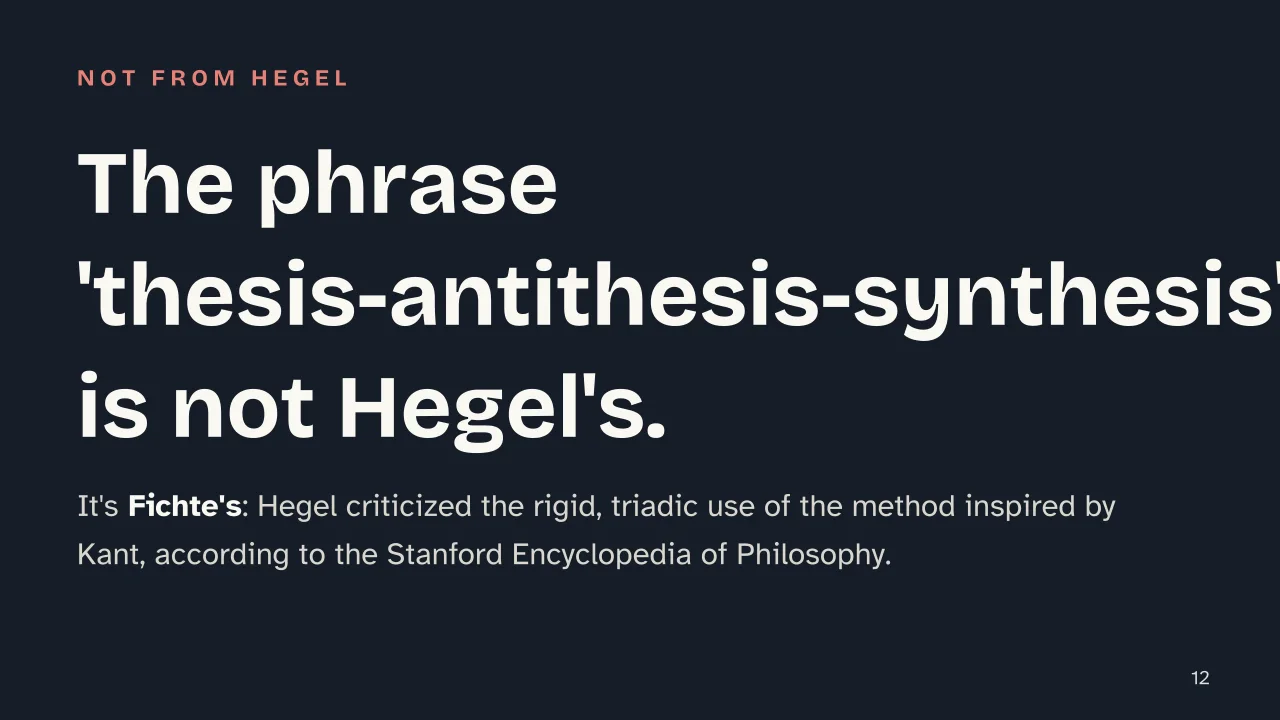
    • The formula 'thesis-antithesis-synthesis' is not Hegel's but Fichte's, according to the Stanford Encyclopedia of Philosophy.

    Key figures

    • 1806 Hegel finished the manuscript at the end of 1806, while Napoleon's troops occupied Jena and limited the university's activities. Source: Stanford Encyclopedia of Philosophy
    • 1807 Phenomenology of Spirit was published in 1807, a date also confirmed by the Internet Encyclopedia of Philosophy. Source: Internet Encyclopedia of Philosophy

    Deep Dive

    A Book Finished Under Siege

    According to the Stanford Encyclopedia of Philosophy, Hegel finished the manuscript of Phenomenology of Spirit at the end of 1806, while Napoleon’s troops occupied Jena and the university’s activities were running under constraint. The book came out the following year, in 1807: the Internet Encyclopedia of Philosophy confirms the same date in its entry on German Idealism, calling it a monumental work. English readers sometimes meet the book under an older title, Phenomenology of Mind, from an early translation of the text; it is the same book Hegel finished in Jena. The occupation of Jena arrived on the wave of events opened in 1789, told in the Recap on the French Revolution.

    For the wider philosophical context around Hegel, see the Recap on Hegel and German Idealism.

    Consciousness, in the First Three Chapters

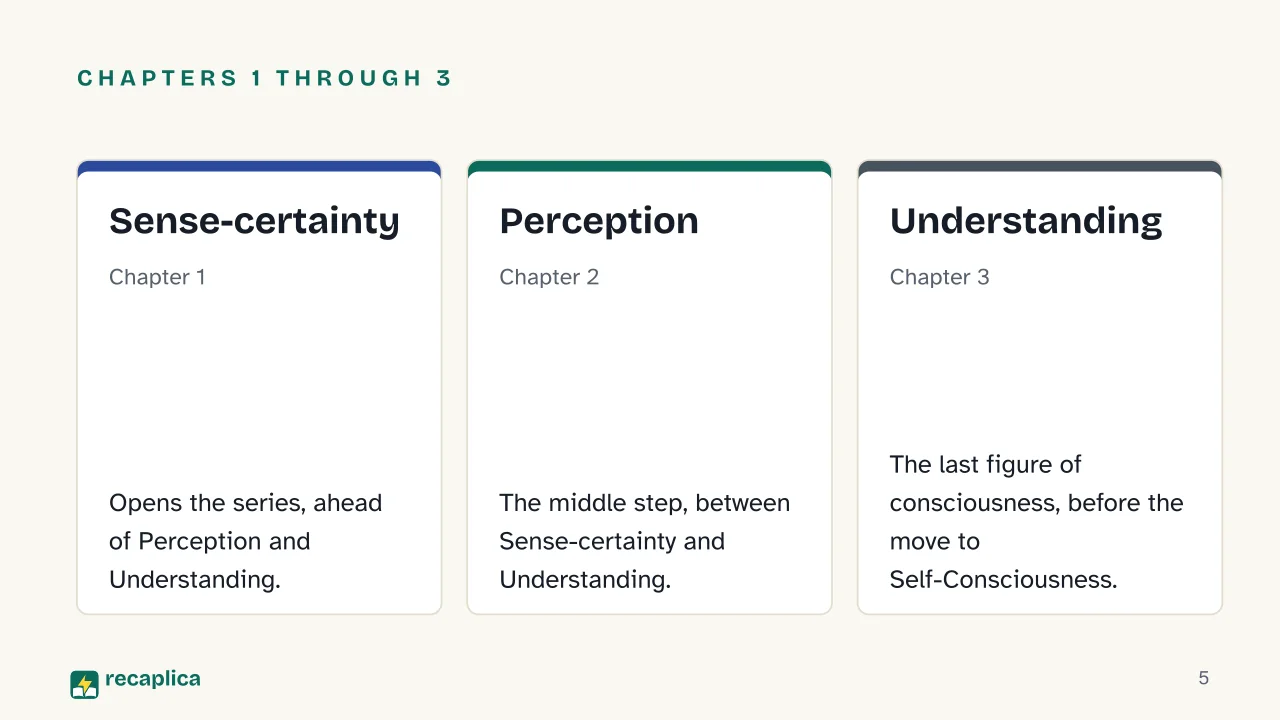
    The book’s first three chapters, Sense-certainty, Perception and Understanding, follow a series of distinct figures of consciousness. The move from chapter 3 to chapter 4 also marks the shift from the “Consciousness” section to the “Self-Consciousness” section: the book’s first major hinge.

    Self-Consciousness: the Struggle for Recognition and the Unhappy Consciousness

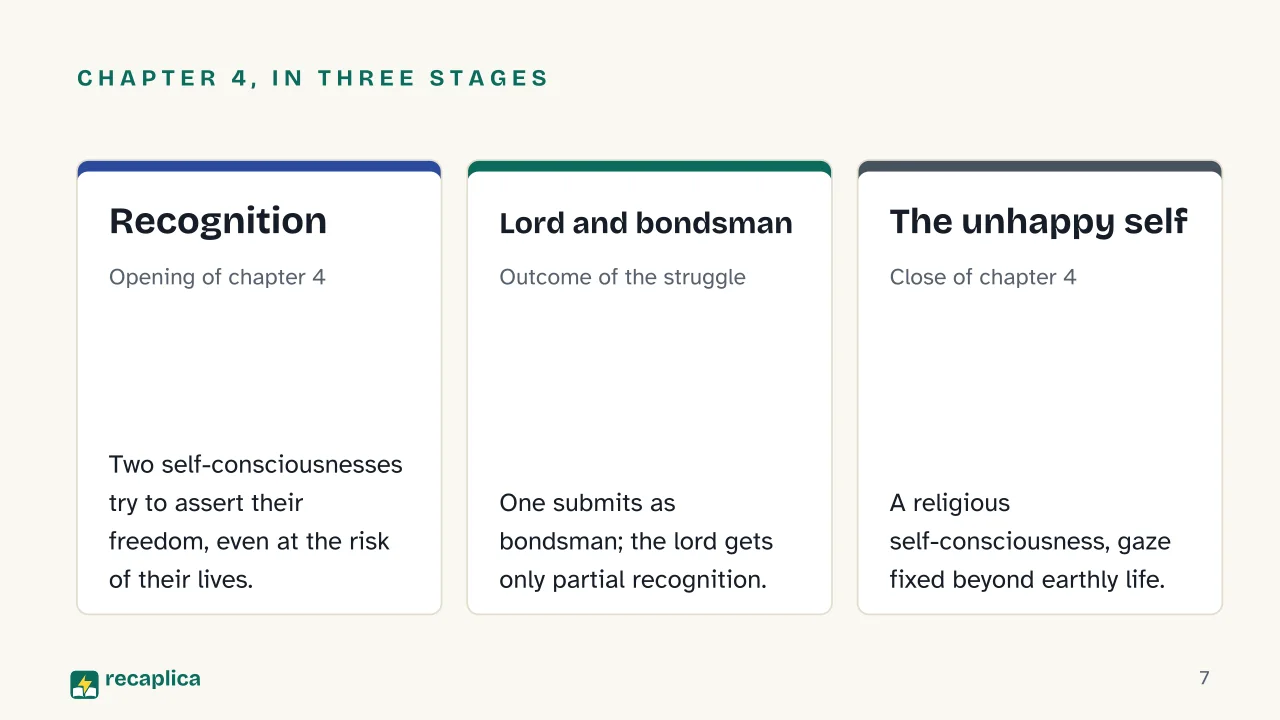
    Chapter 4 holds what is arguably the best-known part of the whole book, according to the Stanford Encyclopedia of Philosophy: the account of the struggle for recognition. The encyclopedia’s entry on Recognition describes it this way: each self-consciousness risks everything, even its own life, to show that its standing matters more than any instinct for self-preservation. The outcome is either the death of one or both subjects, or the submission of one as bondsman to the other as lord: this is where the lord-bondsman dialectic is born. According to that entry, though, not even the lord’s recognition is complete: the one granting it is a bondsman who lacks the status of an autonomous, equal judge, and a truly full reciprocity requires an institutionalized order of rights among equals, one that grants both parties the same standing as judge.

    Practical example: Two people compete for leadership of a group, each ready to risk everything rather than give up status to the other. That is the pattern behind the struggle for recognition, before one of the two submits as bondsman.

    Chapter 4 closes with another figure, the unhappy consciousness: a religious self-consciousness looking toward a horizon beyond earthly life.

    From Reason to Absolute Knowing

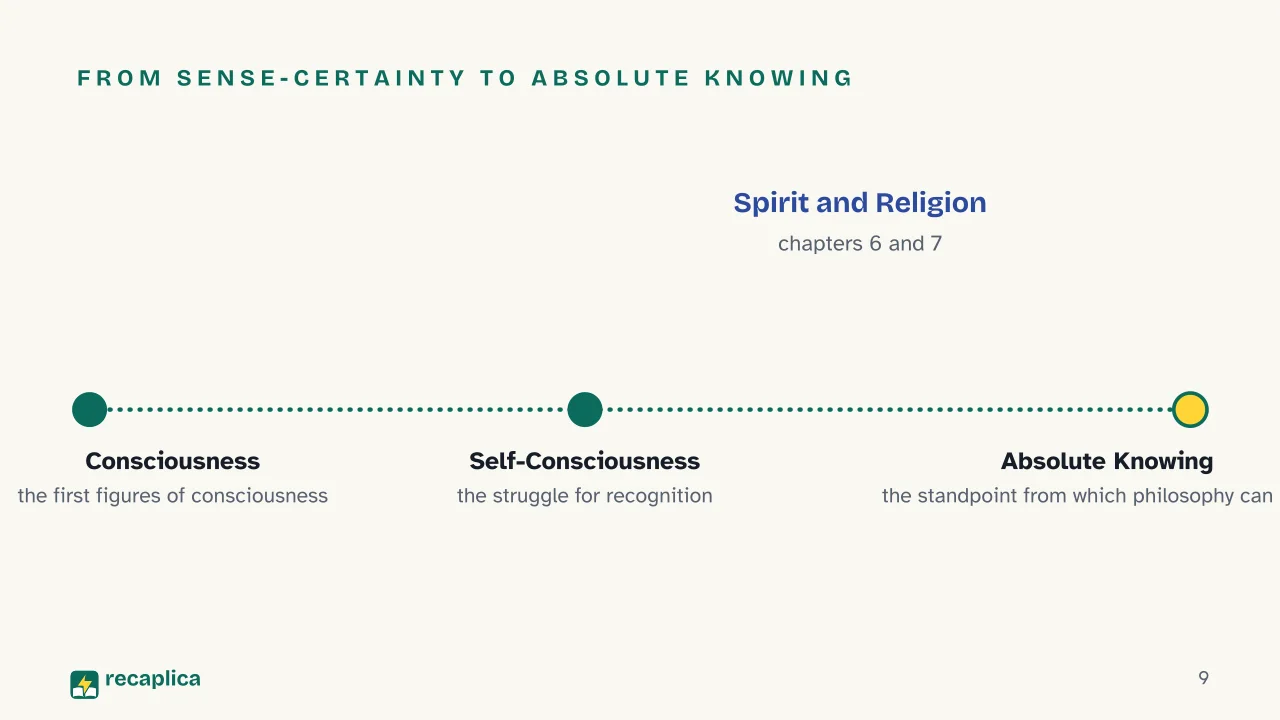
    After Self-Consciousness the book continues with Reason, then with a chapter devoted to Spirit, the sixth, and with Religion, the seventh, before closing with the eighth chapter, Absolute Knowing. For Hegel, the Stanford Encyclopedia of Philosophy notes, that last chapter is the goal of the entire path: the threshold from which philosophy proper begins.

    SectionChaptersNote
    Consciousness1-3Sense-certainty, Perception, Understanding
    Self-Consciousness4struggle for recognition, lord-bondsman dialectic, unhappy consciousness
    Reason5—
    Spirit6—
    Religion7—
    Absolute Knowing8endpoint of the path

    The Stanford Encyclopedia of Philosophy likens the book’s structure to a novel of education, with consciousness itself cast as the growing protagonist. It is a comparison that places Phenomenology of Spirit within the cultural climate of the early nineteenth century in Germany, also covered in the Recap on German Romanticism.

    Aufheben and Determinate Negation

    The Stanford Encyclopedia of Philosophy’s entry on Hegel’s Dialectics notes that Hegel applies, already in the Phenomenology, the same dialectical method he will use throughout his mature works. At the center of that method sits the term Aufhebung, from the verb aufheben, which in Hegel’s vocabulary carries a double meaning: to negate, or overcome, and at the same time to preserve. Dialectical negation does not erase its object: it is a “determinate negation”, one that carries a specific content along with it.

    A common mix-up grows out of this: the formula “thesis-antithesis-synthesis”, often pinned on Hegel, actually belongs to Fichte. Hegel criticized those who forced philosophy into rigid three-part schemes inspired by Kant — a criticism that, the same entry notes, could well have been aimed at Fichte himself. Readers who want to trace where that target comes from, Kant’s critical philosophy, find the context in the Recap on Kant’s Critique of Pure Reason.

    The Stated Aim: a Preparatory Work

    In the preface, Hegel uses an image against philosophies that treat everything as a single undifferentiated identity, aiming implicitly at Schelling: he compares them to a night in which every cow looks the same color, because refusing to draw any distinction eventually leaves nothing visible at all. In those pages Hegel spells out the book’s purpose: a step that prepares the reader for pure conceptual thought, the first condition for doing philosophy.

    Slide deck

    Slides ready to download and make your own in PowerPoint or Google Slides, with speaker notes. Pick the Flash cut or the Full one.
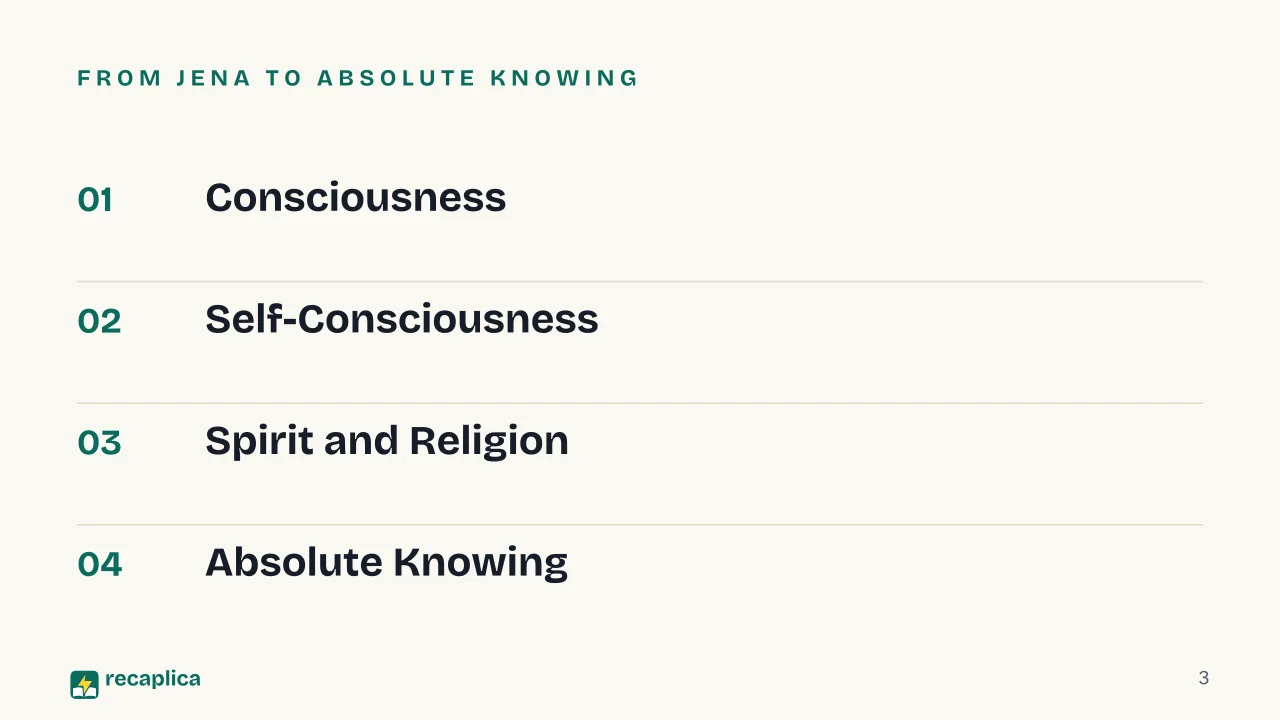
    Slide 1 of the presentation on Phenomenology of Spirit: Phenomenology of SpiritSlide 2 of the presentation on Phenomenology of Spirit: What book gets written while an army occupies the city?Slide 3 of the presentation on Phenomenology of Spirit: From Jena to Absolute KnowingSlide 4 of the presentation on Phenomenology of Spirit: Chapter 01: ConsciousnessSlide 5 of the presentation on Phenomenology of Spirit: Chapters 1 through 3: Sense-certainty, Perception, UnderstandingSlide 6 of the presentation on Phenomenology of Spirit: Chapter 02: Self-ConsciousnessSlide 7 of the presentation on Phenomenology of Spirit: Chapter 4, in three stages: Recognition, Lord and bondsman, The unhappy selfSlide 8 of the presentation on Phenomenology of Spirit: Chapter 03: Spirit and ReligionSlide 9 of the presentation on Phenomenology of Spirit: From sense-certainty to Absolute KnowingSlide 10 of the presentation on Phenomenology of Spirit: Chapter 04: Absolute KnowingSlide 11 of the presentation on Phenomenology of Spirit: From manuscript to printSlide 12 of the presentation on Phenomenology of Spirit: The phrase 'thesis-antithesis-synthesis' is not Hegel's.Slide 13 of the presentation on Phenomenology of Spirit: Who came up with the 'thesis-antithesis-synthesis' scheme?Slide 14 of the presentation on Phenomenology of Spirit: Now, the review
    Flash10 slidesThe essential thread, to present in classFull14 slidesEvery chapter and the deeper detail

    Common myths

    • ✗ Myth Many believe the formula 'thesis-antithesis-synthesis' is Hegel's own dialectical method.

      ✓ Reality According to the Stanford Encyclopedia of Philosophy, that formula belongs to Fichte: Hegel explicitly criticized schematic, rigid uses of the triadic method inspired by Kant.

    • ✗ Myth Many think the unhappy consciousness is simply a mood of personal sadness or dissatisfaction.

      ✓ Reality In the Phenomenology it is a precise figure from the Self-Consciousness chapter, a religious self-consciousness turned toward something beyond, not a generic state of mind.

    • ✗ Myth Readers starting the book often assume Phenomenology of Spirit is already Hegel's definitive philosophical system.

      ✓ Reality According to the Stanford Encyclopedia of Philosophy, for Hegel the book is an introduction leading to pure conceptual thought, not philosophy already completed in itself.

    Mind map

    Drag the background to move around and the nodes to reposition them; use − and + to collapse and expand branches.
    Customize
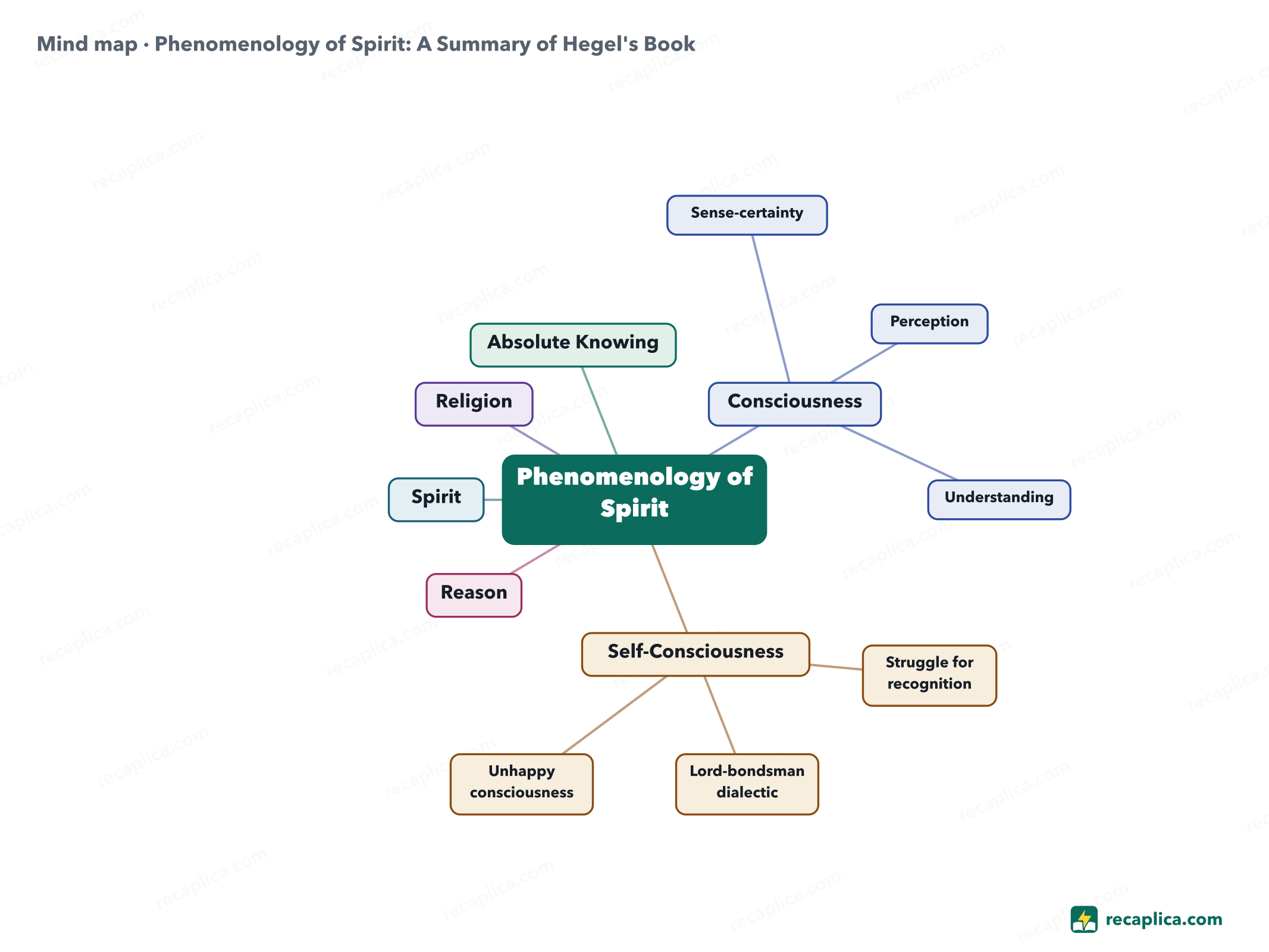
    Mind map: Phenomenology of Spirit: A Summary of Hegel's Book
    • Phenomenology of Spirit
      • Consciousness Chapters 1-3
        • Sense-certainty
        • Perception
        • Understanding
      • Self-Consciousness Chapter 4
        • Struggle for recognition
        • Lord-bondsman dialectic asymmetrical recognition between the two self-consciousnesses
        • Unhappy consciousness religious self-consciousness, turned toward the otherworldly
      • Reason Chapter 5
      • Spirit Chapter 6
      • Religion Chapter 7
      • Absolute Knowing Chapter 8, endpoint of the path

    Quiz: test yourself

    Answer the questions to check what you have learned: you get instant feedback and a short explanation.

    Grade 0/10 0/5
    1 In what year was Hegel's Phenomenology of Spirit published?

    Hegel finished the manuscript at the end of 1806, while Napoleon's troops occupied Jena, and the book was published in 1807, according to the Stanford Encyclopedia of Philosophy.

    2 Which relationship arises, in the Self-Consciousness chapter, from the struggle for recognition?

    According to the Stanford Encyclopedia of Philosophy entry on Recognition, the struggle for recognition ends with one self-consciousness submitting as bondsman and the other receiving only partial recognition as lord.

    3 What is the unhappy consciousness, in the Phenomenology?

    The Stanford Encyclopedia of Philosophy describes it as the last figure of chapter 4, a religious self-consciousness turned toward a realm beyond the earthly one.

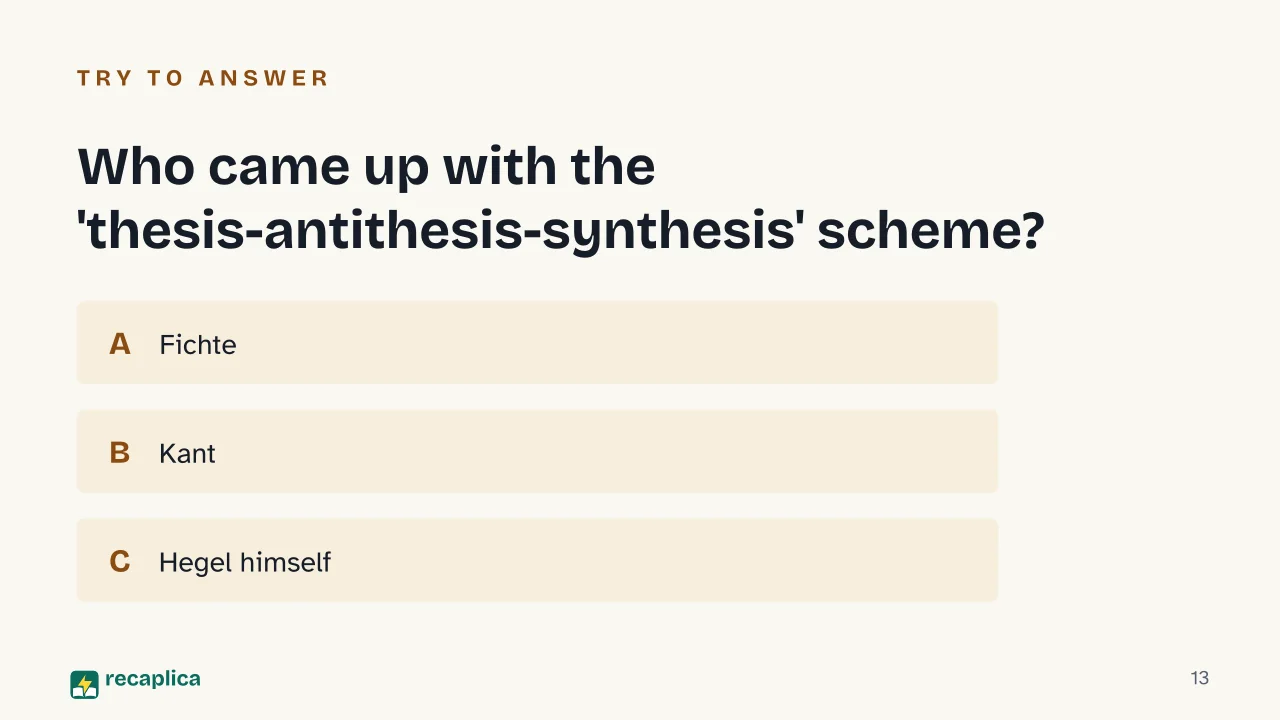
    4 Who came up with the 'thesis-antithesis-synthesis' scheme often attributed to Hegel?

    The Stanford Encyclopedia of Philosophy entry on Hegel's Dialectics attributes that formula to Fichte and notes that Hegel criticized schematic uses of the triadic method inspired by Kant.

    5 How did Hegel see Phenomenology of Spirit in relation to the rest of his philosophy?

    According to the Stanford Encyclopedia of Philosophy, for Hegel the book prepares the reader for pure conceptual thought, the starting point of philosophy proper.

    Answers: 1-A · 2-A · 3-A · 4-A · 5-A

    Flashcards

    Tap the card to flip it and check whether you remember the answer, then move to the next one.

    1 / 8

    Explain it in your own words

    The ultimate test: if you can explain it in simple words, you've truly understood it. Write your explanation, then compare it with the Recap.

    Your explanation is saved only on this device.

    Phenomenology of Spirit is the book Hegel published in 1807, finished at the end of 1806 while Napoleon's troops occupied Jena. The book follows a single path from the most basic form of consciousness to what Hegel calls Absolute Knowing, passing through self-consciousness, reason, spirit and religion. In the chapter on self-consciousness comes the struggle for recognition, which gives rise to the relationship between lord and bondsman, and the figure of the unhappy consciousness. According to the Stanford Encyclopedia of Philosophy, Hegel meant the book as a path that educates the reader up to the standpoint from which philosophy proper can be done.

    Frequently asked questions

    What is Hegel's Phenomenology of Spirit?

    It's the book Hegel published in 1807: it follows the development of consciousness through six sections, from sense-certainty to Absolute Knowing. According to the Stanford Encyclopedia of Philosophy, Hegel saw it as a preparatory work, a step toward pure conceptual thought.

    What is the unhappy consciousness in Hegel?

    It's the last figure of the Self-Consciousness chapter in Phenomenology of Spirit: a religious self-consciousness turned toward something beyond.

    What is the lord-bondsman dialectic, or struggle for recognition?

    It's the clash between two self-consciousnesses trying to assert their freedom; according to the Stanford Encyclopedia of Philosophy, it ends either with the death of one or both, or with the relationship between bondsman and lord, in which recognition stays incomplete for both.

    Does Phenomenology of Spirit follow the thesis-antithesis-synthesis scheme?

    That formula belongs to Fichte. According to the Stanford Encyclopedia of Philosophy, Hegel applies determinate negation in the Phenomenology and criticized schematic uses of the triadic method.

    Sources

    • Stanford Encyclopedia of Philosophy — Georg Wilhelm Friedrich Hegel
    • Stanford Encyclopedia of Philosophy — Hegel's Dialectics
    • Stanford Encyclopedia of Philosophy — Recognition
    • Internet Encyclopedia of Philosophy — German Idealism

    Every Recap goes through an independent review before publication.

    Every evening, the day's new Recaps on our Telegram channel. Join the channel →

    Keep learning

    • History What Is Existentialism? Heidegger, Being and Time, and Dasein Existentialism is a current of twentieth-century philosophy centered on human existence, freedom and the search for meaning. According to the Stanford Encyclopedia of Philosophy, the German philosopher Martin Heidegger (1889-1976) shaped that current more than almost anyone else, even though he never accepted the label. In 1927 he published Being and Time, his major work, where he introduced the concept of Dasein: the human being as the one entity that questions its own existence. That book influenced Jean-Paul Sartre's existentialism, but in 1946, in the Letter on Humanism, Heidegger openly broke with Sartre and refused to be called an existentialist. In 1933 he was elected rector of the University of Freiburg and became a Nazi party member, keeping that membership until the regime fell - an episode Heidegger himself later denied or played down more than once. Read the Recap →
    • History What Is Phenomenology? Husserl's Philosophy Explained Edmund Husserl founded phenomenology as a philosophical discipline around 1900-1901, with his Logical Investigations. His method starts from the epoché, a suspension of our everyday, unquestioning stance toward the world, and moves toward phenomenological reduction: studying how things appear to consciousness rather than what they are in themselves. At the center sits intentionality, the idea that every experience is always an experience of something specific, whether hoping, perceiving, or desiring. The method Husserl built carried into the 20th century through Heidegger, Sartre, and Merleau-Ponty, moving from German philosophy into French philosophy along the way. Read the Recap →
    • History Legal Positivism: What It Is, from Austin to Kelsen and Hart According to the Stanford Encyclopedia of Philosophy, legal positivism measures legal validity against observable social facts, keeping moral judgment on a separate track. Its roots lie in Hobbes and Hume. Jeremy Bentham produced the theory's first full account, which John Austin later took up and spread: for Austin, a rule is law only when a sovereign commands it under threat of punishment. In the twentieth century, Hans Kelsen grounded legal validity in a hierarchy that traces back to a presupposed basic norm, while Herbert Hart located it instead in a rule of recognition actually followed by judges and officials. Natural law theory takes the opposite view: an unjust law is not really a law. Legal positivism disagrees — a law stays valid even when it is morally unjust, as long as it was made the way the system requires. Read the Recap →

    recaplica

    Clear in 30 seconds, yours in 10 minutes.

    Recaps Mind maps Request a Recap Telegram channel Mind map maker Our method About Privacy & cookies Legal notes & terms of use

    © 2026 Recaplica · A project by Curi S.r.l. — VAT IT05472000750

    Statistics, only if you say so

    To learn which Recaps help most we would use Google Analytics, with aggregate, anonymous data. It starts only with your OK, and you can change your mind anytime. Privacy policy