Skip to content
recaplica

    One moment: security check

    Cloudflare wants to make sure you're not a robot. Tick the box below and your search will continue on its own.

    IT
    recaplica Elements of the Philosophy of Right: What Is Hegel's Ethical State?
    © 2026 Recaplica · recaplica.com — All rights reserved
    Home › History

    Elements of the Philosophy of Right: What Is Hegel's Ethical State?

    By Recaplica Newsroom · Updated on October 12, 2026

    What to print

    Page numbers appear when printing with default margins.

    Slides

    Choose a cut

    Flash10 slidesThe essential thread, to present in classFull14 slidesEvery chapter and the deeper detail

    Both come with speaker notes.

    Telegram channel
    recaplica Clear in 30 seconds, yours in 10 minutes.
    In 30 seconds Key points Figures Deep dive Slides Myths Mind map Quiz Flashcards FAQ

    In 30 seconds quick read

    The Elements of the Philosophy of Right is Hegel's main work of political philosophy, published in 1821 while he was teaching in Berlin. It moves through three stages: Abstract Right, Morality, and Ethical Life, which brings the first two together. Ethical life then splits into Family, Civil Society, and the State, which Hegel calls the actuality of the ethical Idea. One influential reading brands that state authoritarian. As of 2026, most commentators see something different: a community where individuals find their own freedom realized.

    Key Points

    • The work appeared in 1821 under a double German title, rendered in English by the source as both 'Natural Law and the Science of the State' and 'Elements of the Philosophy of Right.'
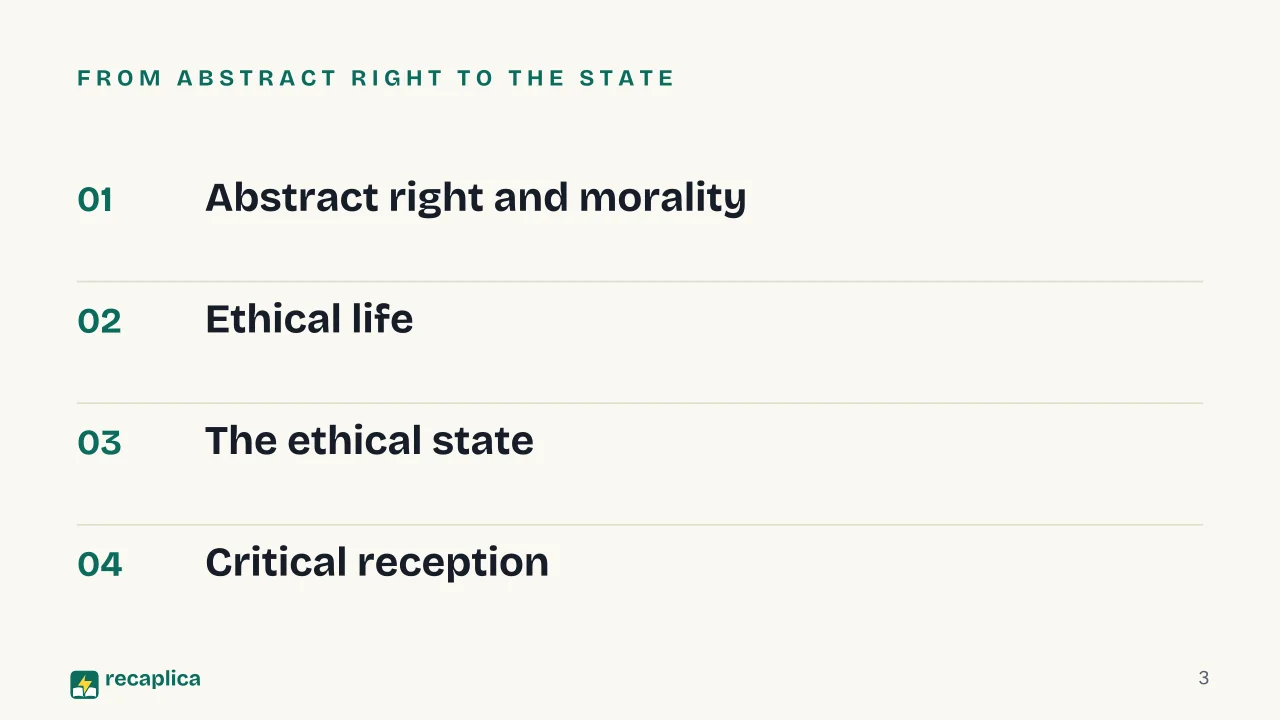
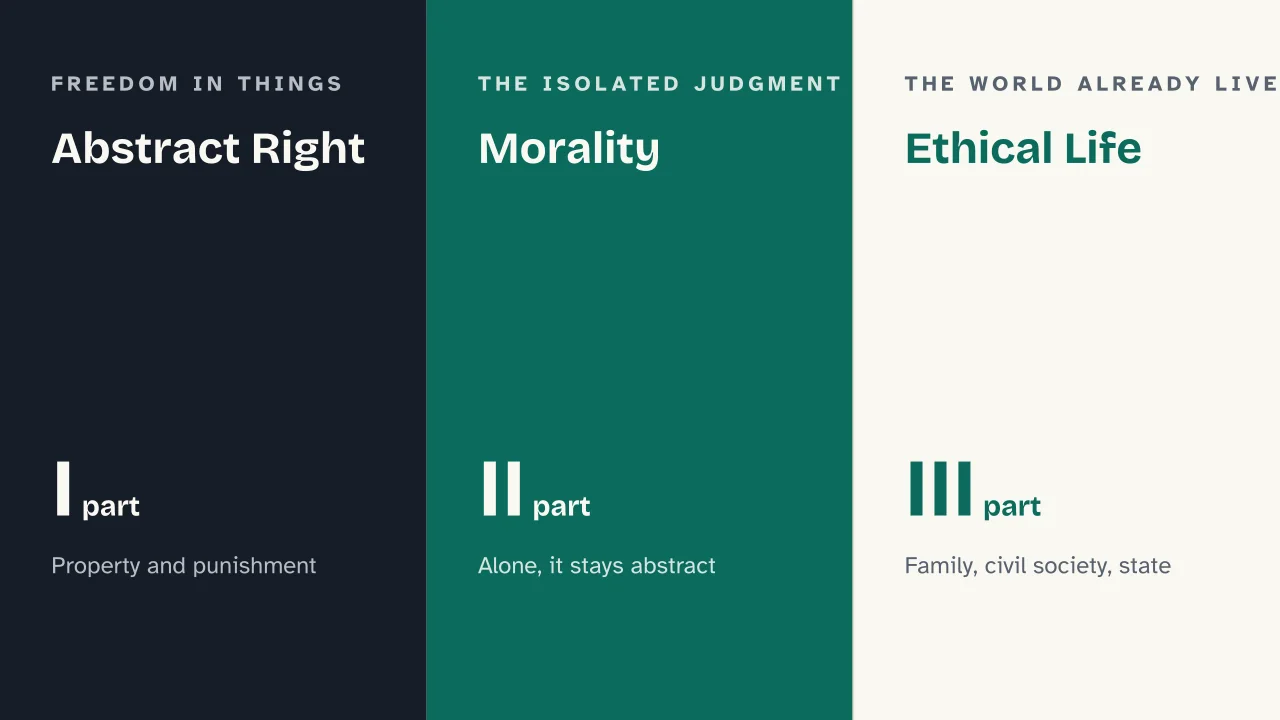
    • It falls into three parts: Abstract Right (property and punishment), Morality (conscience and moral responsibility), and Ethical Life, which unites them.
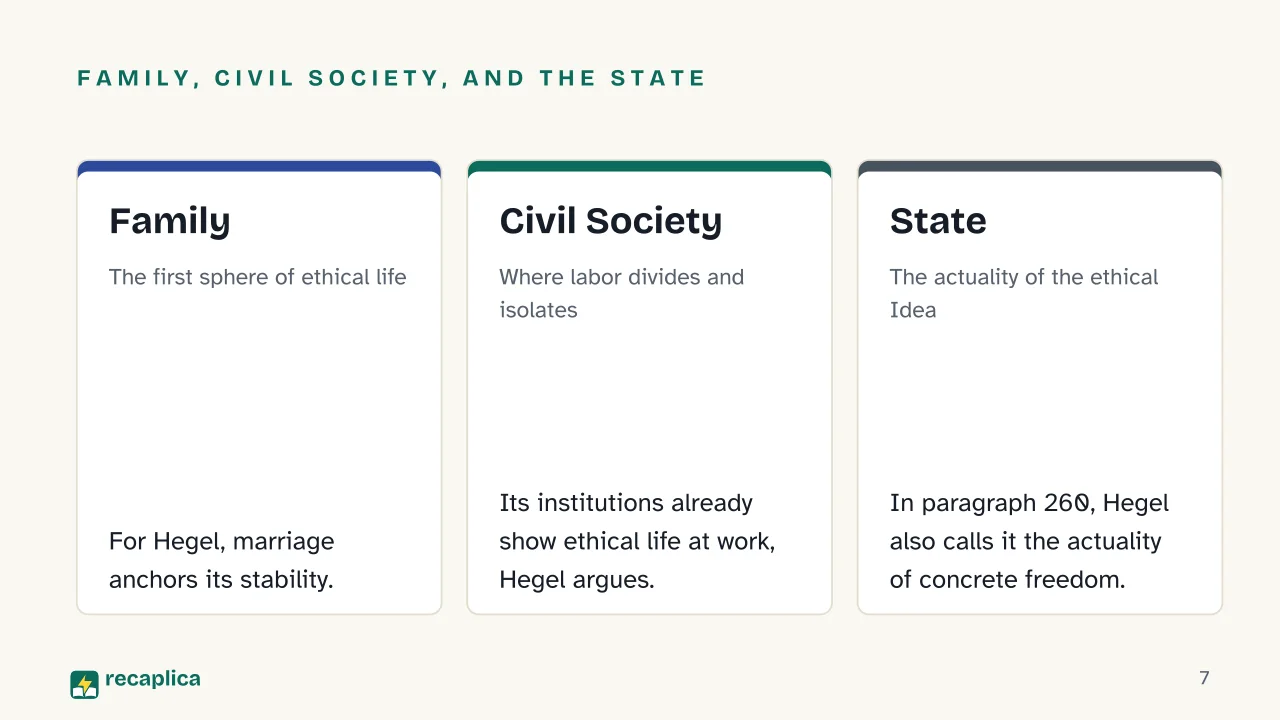
    • Ethical life covers Family, Civil Society, and the State: the three forms in which the Idea of freedom becomes real in the existing world.
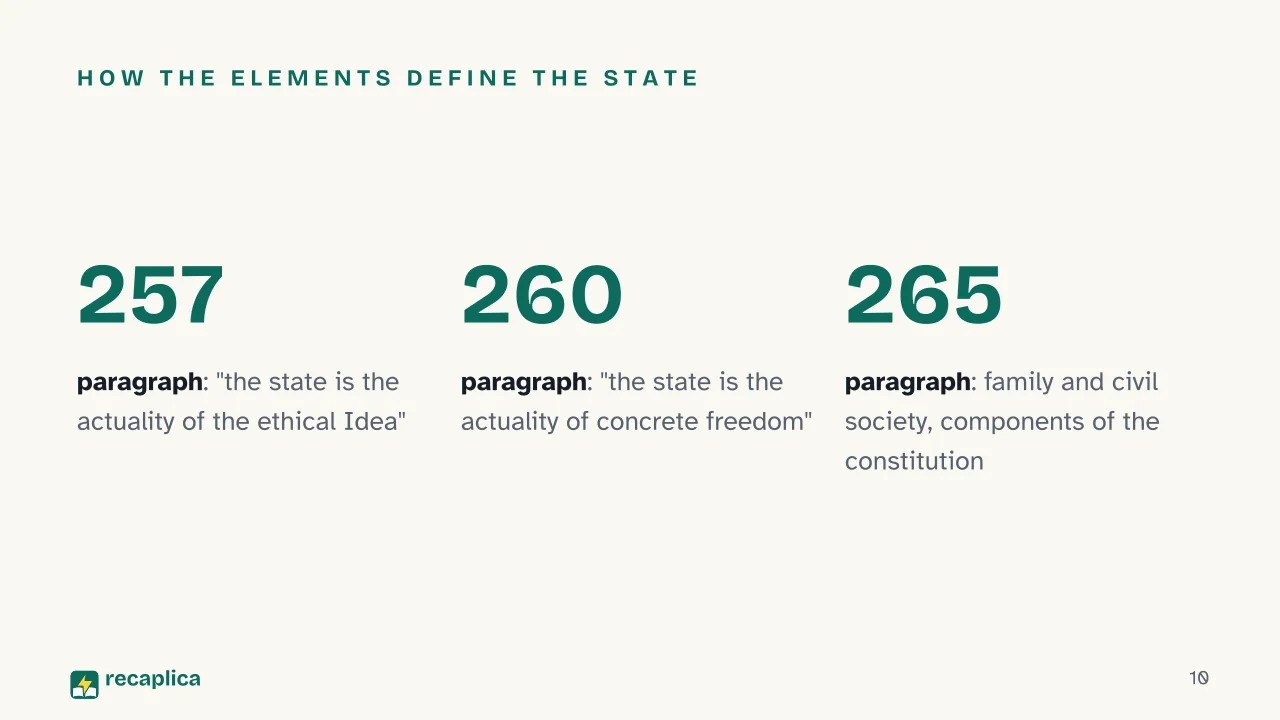
    • In paragraph 257, Hegel calls the state the actuality of the ethical Idea; in paragraph 260, the actuality of concrete freedom.
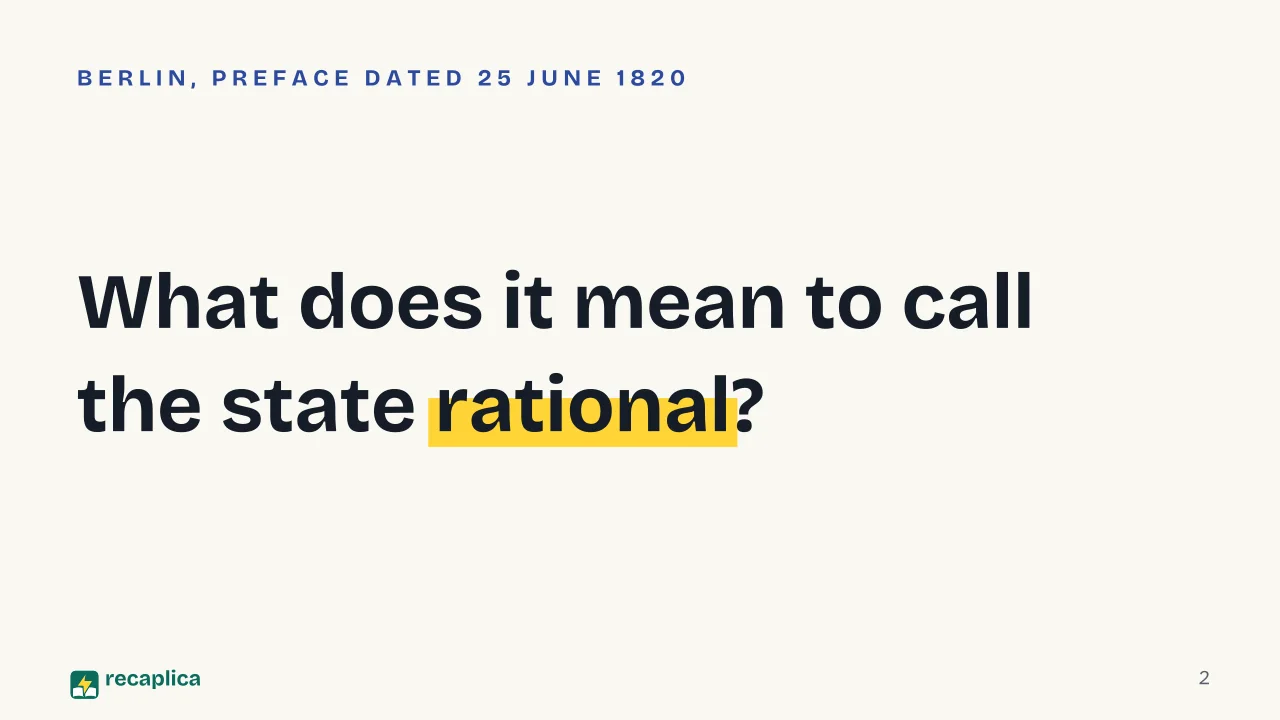
    • In the preface, dated Berlin, 25 June 1820, Hegel writes that what is rational is actual and what is actual is rational, adding that philosophy does not tell the state how it ought to be.
    • After Hegel's death, Eduard Gans reissued the work in 1833 and again in 1854, this time adding notes his students had taken at Hegel's lectures.

    Key figures

    • 1821 year the Elements of the Philosophy of Right first appeared, while Hegel was teaching in Berlin Source: Stanford Encyclopedia of Philosophy
    • 1833 year of the work's first re-edition, prepared by Eduard Gans and expanded with students' lecture notes Source: Internet Encyclopedia of Philosophy

    Deep Dive

    A Work of Political Philosophy, Written Between 1820 and 1821

    According to the Stanford Encyclopedia of Philosophy, the Elements of the Philosophy of Right is Hegel’s main work of political philosophy: it appeared in 1821, while he was teaching in Berlin. The preface, though, carries a different date, a year earlier — Berlin, 25 June 1820, in T.M. Knox’s translation. There, Hegel frames the treatise, in its political-science portion, as an attempt to grasp and present the state as inherently rational, and he adds that philosophy’s task is to make the ethical universe known. Telling the state how it ought to be is not philosophy’s job.

    The original title, the Internet Encyclopedia of Philosophy notes, ran in two parts in German: one half the source renders in English as “Natural Law and the Science of the State,” the other as “Elements of the Philosophy of Right.” After Hegel died, Eduard Gans republished the work in 1833 and again in 1854, this time folding in notes his students had taken during his Berlin lectures.

    Practical example: picture a manual that opens by stating its own purpose — to make clear the rational structure of laws that already exist, not to tell a lawmaker how to write new ones. That is the caution Hegel builds into the Elements from its very first pages.

    The work sits inside the wider system of Hegel’s thought, traced in the Recap on Hegel and German Idealism.

    From Abstract Right to Morality

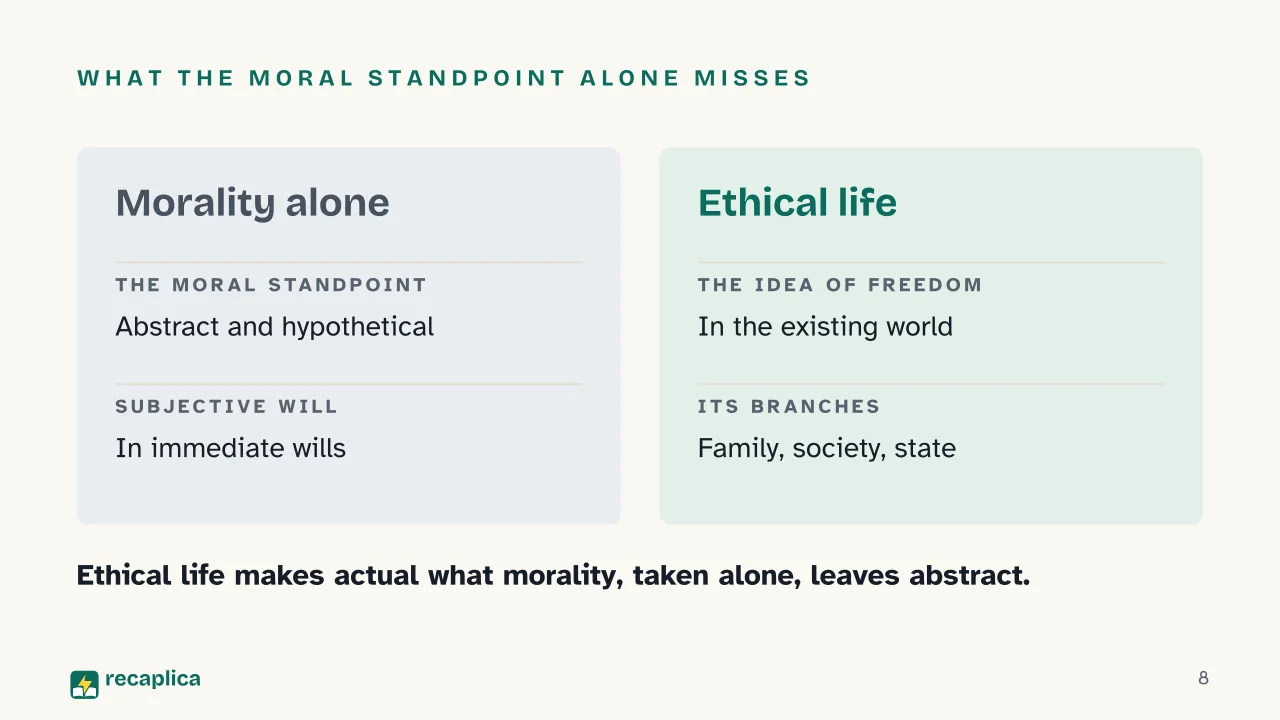
    The work’s main division, per the Internet Encyclopedia of Philosophy, tracks the stages through which the Idea of the absolutely free will develops. The first stage is Abstract Right, which the Stanford Encyclopedia of Philosophy sums up under property and punishment. The second is Morality: here, the Internet Encyclopedia of Philosophy notes, the right of subjective will takes shape in immediate wills rather than in immediate things such as property, and it concerns individual conscience and moral responsibility.

    Taken by itself, though, this moral standpoint stays limited: the Stanford Encyclopedia of Philosophy calls it an abstract and hypothetical exercise. It is one reason Hegel, in the Elements, sets his own framework apart from Kant’s moral law: isolated conscience, on its own, cannot deliver a fully realized ethical order.

    Ethical Life, or Sittlichkeit: Family, Civil Society, State

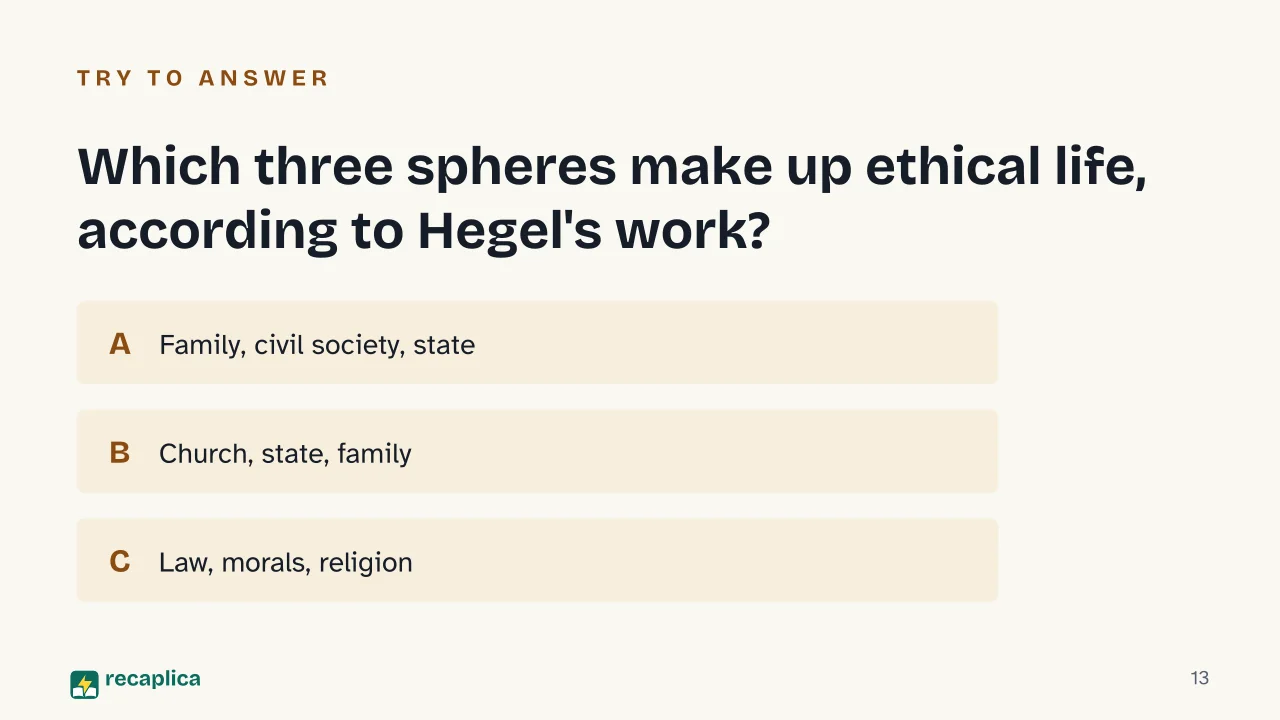
    Ethical life, Sittlichkeit, is the third stage, and the Internet Encyclopedia of Philosophy defines it as the Idea of freedom: the concept of freedom worked out in the existing world. Under ethical life fall the three branches of Family, Civil Society, and the State, and the Stanford Encyclopedia of Philosophy treats this concept as central to Hegel’s political and legal thought.

    StageThemesSource
    Abstract RightProperty, punishmentStanford Encyclopedia of Philosophy
    MoralityConscience, moral responsibilityStanford Encyclopedia of Philosophy
    Ethical LifeFamily, civil society, stateInternet Encyclopedia of Philosophy

    The Internet Encyclopedia of Philosophy also points to a thread running toward later debates: it links Hegel’s remarks on the division of labor, which produce fragmentation and an impoverished human life, to the Marxist notion of alienation, though the source does not take the comparison further.

    The Ethical State

    In paragraph 257 of the Elements, Hegel defines the state as the actuality of the ethical Idea; in paragraph 260, as the actuality of concrete freedom, adding that the universal only becomes real alongside particular interests and through the cooperation of particular knowing and willing. In paragraph 265, he names family and civil society as components of the state’s constitution, and in the Addition to that paragraph he points to the sanctity of marriage and to the institutions through which civil society shows itself as ethical life as sources of stability for the whole.

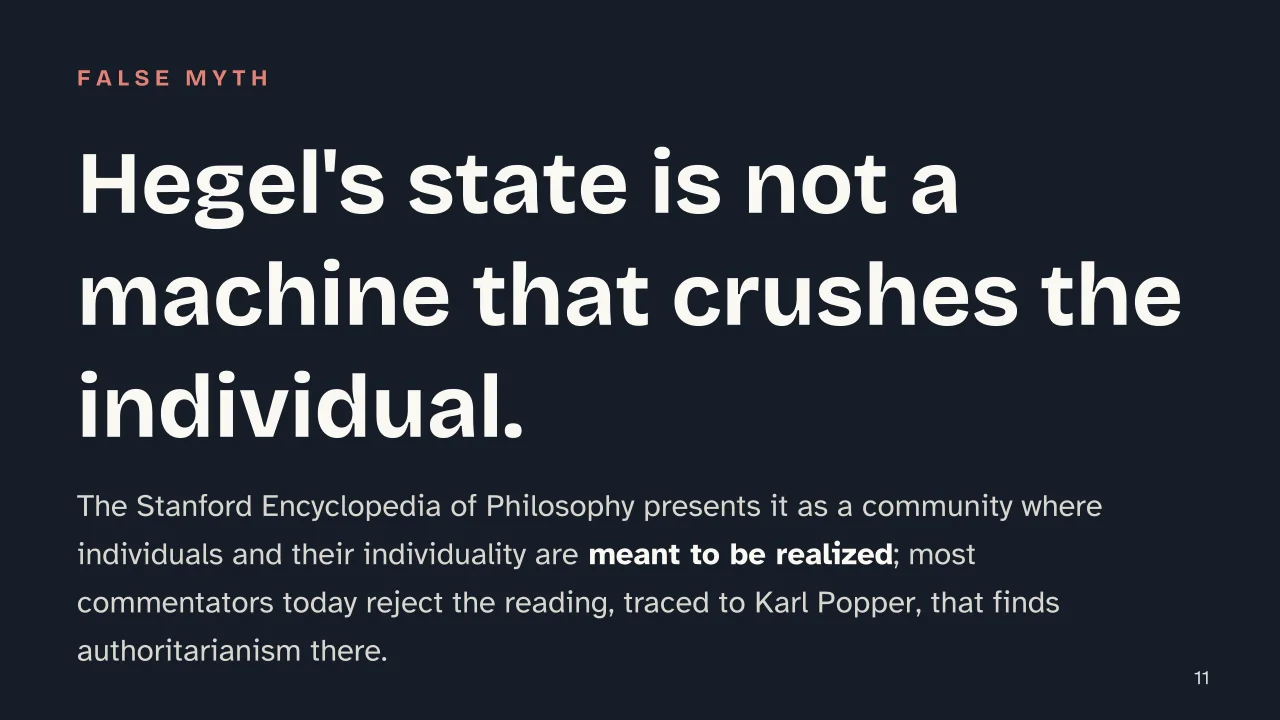
    For the Stanford Encyclopedia of Philosophy, this state is conceived as a community in which individuals and their individuality are meant to find themselves realized. That differs from the ideal state ruled by philosophers under a fixed model of justice discussed in the Recap on Plato, and it sits apart from the forms of government surveyed in the Recap on types of government. Hegel, according to the Stanford Encyclopedia of Philosophy, backed the more open and reformist currents of his own age — without ever giving up his commitment to the traditional family or to constitutional monarchy.

    A Contested Reading: Hegel and the Authoritarianism Charge

    One influential reading, traced back to Karl Popper and others, turned Hegel into an apologist for authoritarianism. The Stanford Encyclopedia of Philosophy notes, however, that, as of 2026, most commentators find that reading unconvincing.

    The Internet Encyclopedia of Philosophy records a related, more specific charge — that of a nationalist apologist for the early nineteenth-century Prussian state — but points to a broader philosophical meaning behind the work.

    Hegel’s work went on to shape later thinkers, from Karl Marx to Charles Taylor, according to the Stanford Encyclopedia of Philosophy.

    Slide deck

    Slides ready to download and make your own in PowerPoint or Google Slides, with speaker notes. Pick the Flash cut or the Full one.
    Slide 1 of the presentation on Elements of the Philosophy of Right: Elements of the Philosophy of RightSlide 2 of the presentation on Elements of the Philosophy of Right: What does it mean to call the state rational?Slide 3 of the presentation on Elements of the Philosophy of Right: From abstract right to the stateSlide 4 of the presentation on Elements of the Philosophy of Right: Chapter 01: Abstract right and moralitySlide 5 of the presentation on Elements of the Philosophy of Right: Abstract Right · Morality · Ethical LifeSlide 6 of the presentation on Elements of the Philosophy of Right: Chapter 02: Ethical lifeSlide 7 of the presentation on Elements of the Philosophy of Right: Family, Civil Society, and the State: Family, Civil Society, StateSlide 8 of the presentation on Elements of the Philosophy of Right: What the moral standpoint alone missesSlide 9 of the presentation on Elements of the Philosophy of Right: Chapter 03: The ethical stateSlide 10 of the presentation on Elements of the Philosophy of Right: How the Elements define the stateSlide 11 of the presentation on Elements of the Philosophy of Right: Hegel's state is not a machine that crushes the individual.Slide 12 of the presentation on Elements of the Philosophy of Right: Chapter 04: Critical receptionSlide 13 of the presentation on Elements of the Philosophy of Right: Which three spheres make up ethical life, according to Hegel's work?Slide 14 of the presentation on Elements of the Philosophy of Right: Now, time to review
    Flash10 slidesThe essential thread, to present in classFull14 slidesEvery chapter and the deeper detail

    Common myths

    • ✗ Myth Many assume Hegel's state is an authoritarian machine that crushes the individual

      ✓ Reality the Stanford Encyclopedia of Philosophy notes that, as of 2026, most commentators reject that reading, which traces back to Karl Popper and others: Hegel pictures the state as a community built for individuals to realize themselves in. He also backed several of the more democratic and progressive currents of his own time, while still holding on to the traditional family and constitutional monarchy.

    • ✗ Myth Ethical life is sometimes taken to be just another word for morality

      ✓ Reality the two are separate stages of the argument. Morality on its own, Hegel holds, stays an abstract and merely hypothetical exercise tied to individual conscience; ethical life is the Idea of freedom worked out in the existing world, split into Family, Civil Society, and the State.

    • ✗ Myth The work's original title is sometimes assumed to have simply been 'Philosophy of Right'

      ✓ Reality in 1821 the German title ran in two parts; the Internet Encyclopedia of Philosophy renders them in English as 'Natural Law and the Science of the State' and 'Elements of the Philosophy of Right.'

    Mind map

    Drag the background to move around and the nodes to reposition them; use − and + to collapse and expand branches.
    Customize
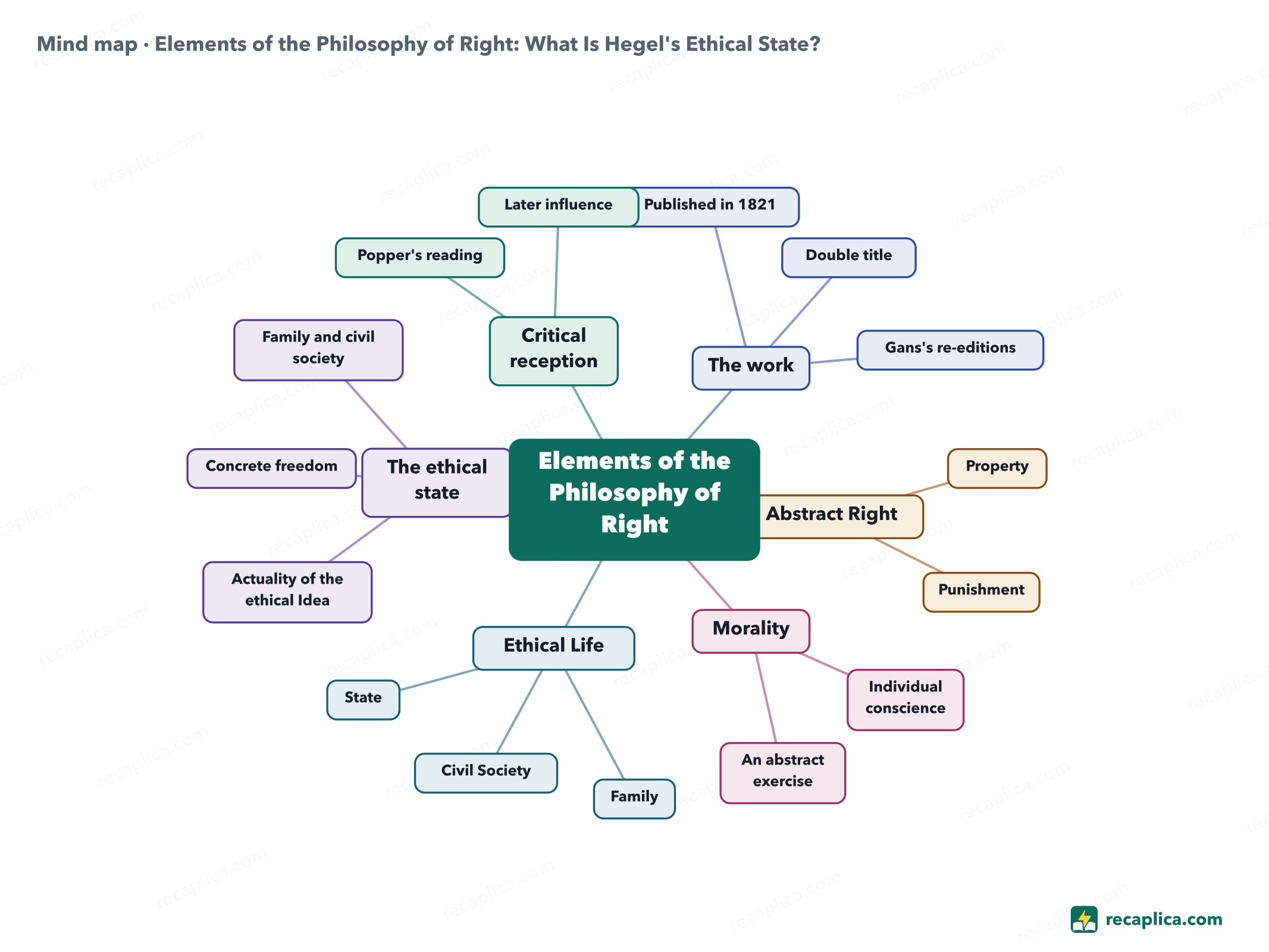
    Mind map: Elements of the Philosophy of Right: What Is Hegel's Ethical State?
    • Elements of the Philosophy of Right
      • The work
        • Published in 1821 Berlin, preface dated 25 June 1820
        • Double title Natural Law and the Science of the State, Elements of the Philosophy of Right
        • Gans's re-editions 1833 and 1854, with students' lecture notes
      • Abstract Right
        • Property
        • Punishment
      • Morality
        • Individual conscience
        • An abstract exercise On its own, it stays hypothetical
      • Ethical Life
        • Family
        • Civil Society
        • State
      • The ethical state
        • Actuality of the ethical Idea Paragraph 257
        • Concrete freedom Paragraph 260
        • Family and civil society Components of the constitution, paragraph 265
      • Critical reception
        • Popper's reading Rejected by most commentators
        • Later influence From Marx to Charles Taylor

    Quiz: test yourself

    Answer the questions to check what you have learned: you get instant feedback and a short explanation.

    Grade 0/10 0/5
    1 In what year was the Elements of the Philosophy of Right first published?

    The work appeared in 1821, while Hegel was teaching in Berlin; the preface, however, carries a date a year earlier, Berlin, 25 June 1820.

    2 How many parts does the work fall into?

    The work divides into three stages — Abstract Right, Morality, and Ethical Life — with the last pulling the first two into a single, realized order.

    3 What are the three branches of ethical life, according to the work?

    Family, Civil Society, and the State make up ethical life — the stage where Hegel's Idea of freedom stops being abstract and takes shape in the world people actually live in.

    4 True or false: according to the Stanford Encyclopedia of Philosophy, most commentators today accept the reading of Hegel as an advocate of authoritarianism.

    False: the source puts that reading, traced to Karl Popper and others, in the minority among commentators writing today.

    5 In paragraph 260, how does Hegel define the state?

    In paragraph 260, the state becomes the actuality of concrete freedom: for Hegel, the universal only lives alongside particular interests.

    Answers: 1-B · 2-B · 3-A · 4-B · 5-A

    Flashcards

    Tap the card to flip it and check whether you remember the answer, then move to the next one.

    1 / 8

    Explain it in your own words

    The ultimate test: if you can explain it in simple words, you've truly understood it. Write your explanation, then compare it with the Recap.

    Your explanation is saved only on this device.

    The Elements of the Philosophy of Right is Hegel's main work of political philosophy, published in 1821 while he was teaching in Berlin. It moves through three stages: Abstract Right, Morality, and Ethical Life, which brings the first two together. Ethical life then splits into Family, Civil Society, and the State, which Hegel calls the actuality of the ethical Idea. One influential reading brands that state authoritarian. As of 2026, most commentators see something different: a community where individuals find their own freedom realized.

    Frequently asked questions

    What is Hegel's ethical state?

    It is the state described in the Elements of the Philosophy of Right as the actuality of the ethical Idea (paragraph 257) and of concrete freedom (paragraph 260). The Stanford Encyclopedia of Philosophy presents it as a community built for individuals to find themselves realized in; a different reading, traced to Karl Popper, finds authoritarianism there instead, a view most commentators today reject.

    What is the Elements of the Philosophy of Right?

    Hegel's main work of political philosophy, published in Berlin in 1821. It moves through three stages — Abstract Right, Morality, and Ethical Life — before paragraph 257 names the state the actuality of the ethical Idea.

    What is Sittlichkeit in Hegel's philosophy?

    Sittlichkeit, or ethical life, is freedom taking concrete shape in shared life — family, civil society, and the state — as the Internet Encyclopedia of Philosophy defines it.

    Was Hegel an authoritarian thinker?

    According to the Stanford Encyclopedia of Philosophy, most commentators today reject the reading, traced to Karl Popper, that casts Hegel as a champion of authoritarianism: he backed more democratic and progressive strands of his own era, while remaining attached to the traditional family and constitutional monarchy.

    Sources

    • Stanford Encyclopedia of Philosophy, «Hegel's Social and Political Philosophy»
    • Internet Encyclopedia of Philosophy, «Hegel: Social and Political Thought»
    • G.W.F. Hegel, Elements of the Philosophy of Right (trans. T.M. Knox, Marxists Internet Archive)

    Every Recap goes through an independent review before publication.

    Every evening, the day's new Recaps on our Telegram channel. Join the channel →

    Keep learning

    • History What Is Existentialism? Heidegger, Being and Time, and Dasein Existentialism is a current of twentieth-century philosophy centered on human existence, freedom and the search for meaning. According to the Stanford Encyclopedia of Philosophy, the German philosopher Martin Heidegger (1889-1976) shaped that current more than almost anyone else, even though he never accepted the label. In 1927 he published Being and Time, his major work, where he introduced the concept of Dasein: the human being as the one entity that questions its own existence. That book influenced Jean-Paul Sartre's existentialism, but in 1946, in the Letter on Humanism, Heidegger openly broke with Sartre and refused to be called an existentialist. In 1933 he was elected rector of the University of Freiburg and became a Nazi party member, keeping that membership until the regime fell - an episode Heidegger himself later denied or played down more than once. Read the Recap →
    • History What Is Phenomenology? Husserl's Philosophy Explained Edmund Husserl founded phenomenology as a philosophical discipline around 1900-1901, with his Logical Investigations. His method starts from the epoché, a suspension of our everyday, unquestioning stance toward the world, and moves toward phenomenological reduction: studying how things appear to consciousness rather than what they are in themselves. At the center sits intentionality, the idea that every experience is always an experience of something specific, whether hoping, perceiving, or desiring. The method Husserl built carried into the 20th century through Heidegger, Sartre, and Merleau-Ponty, moving from German philosophy into French philosophy along the way. Read the Recap →
    • History Legal Positivism: What It Is, from Austin to Kelsen and Hart According to the Stanford Encyclopedia of Philosophy, legal positivism measures legal validity against observable social facts, keeping moral judgment on a separate track. Its roots lie in Hobbes and Hume. Jeremy Bentham produced the theory's first full account, which John Austin later took up and spread: for Austin, a rule is law only when a sovereign commands it under threat of punishment. In the twentieth century, Hans Kelsen grounded legal validity in a hierarchy that traces back to a presupposed basic norm, while Herbert Hart located it instead in a rule of recognition actually followed by judges and officials. Natural law theory takes the opposite view: an unjust law is not really a law. Legal positivism disagrees — a law stays valid even when it is morally unjust, as long as it was made the way the system requires. Read the Recap →

    recaplica

    Clear in 30 seconds, yours in 10 minutes.

    Recaps Mind maps Request a Recap Telegram channel Mind map maker Our method About Privacy & cookies Legal notes & terms of use

    © 2026 Recaplica · A project by Curi S.r.l. — VAT IT05472000750

    Statistics, only if you say so

    To learn which Recaps help most we would use Google Analytics, with aggregate, anonymous data. It starts only with your OK, and you can change your mind anytime. Privacy policy