|
recaplica
Encyclopedia of Philosophical Sciences: Hegel's Logic, Nature, and Spirit | ||||||||||||
| © 2026 Recaplica · recaplica.com — All rights reserved | ||||||||||||
Encyclopedia of Philosophical Sciences: Hegel's Logic, Nature, and SpiritWhat to print Page numbers appear when printing with default margins. SlidesChoose a cut Flash10 slidesThe essential thread, to present in classFull10 slidesEvery chapter and the deeper detailBoth come with speaker notes. In 30 seconds quick readThe Encyclopedia of Philosophical Sciences is the handbook in which Hegel condenses his entire philosophical system, first published in 1817 while he was teaching in Heidelberg and later revised twice, in 1827 and 1830. The book splits philosophy into three linked parts: Logic, which studies the idea in itself; the Philosophy of Nature, which follows that idea as it turns into the physical world; and the Philosophy of Spirit, which finds it again in the human mind, in institutions, and in art, religion, and philosophy. It began as a set of lecture notes for Hegel's university courses rather than a finished work meant to stand alone, which is why it reads as more schematic than the Phenomenology of Spirit, the book that had made his name years earlier. Key Points
Deep DiveA Handbook Written for the Lecture HallHegel’s Encyclopedia of Philosophical Sciences began as a practical book: a set of notes for his lectures at the University of Heidelberg, published in 1817. That same launching role had already been played by the Phenomenology of Spirit, which had appeared years earlier; this new book was meant instead as a compact map of the whole philosophical structure, something to walk through in class and fill in out loud. Its success came precisely in that handbook form: Hegel revised and republished it twice, expanding it in 1827 and settling on a final version in 1830. What “Encyclopedia” Means HereThe title itself needs a careful reading. For Hegel, “encyclopedia” doesn’t mean a set of independent entries, the way a dictionary works: it means setting out philosophy as one organic system, where each part depends on the others. That shows up in the three-part structure, Logic, the Philosophy of Nature, the Philosophy of Spirit, which Hegel describes as different ways the same idea relates to itself. In Logic the idea is studied in itself, before it becomes anything else. In the Philosophy of Nature that same idea becomes otherness, meaning the physical world, distinct from itself.
The Logic Section, Condensed for TeachingThe Logic section, also called the “Lesser Logic” or the “Logic of the Encyclopedia” to set it apart from the longer Science of Logic, condenses the same internal stages into a shorter form: being, essence, the concept. It’s built to be unpacked and discussed out loud in class: the handbook supplies the structure, the lecturer’s voice adds the examples and the objections.
The Philosophy of Nature traces the physical world’s gradual development through mechanics, physics, and organic physics. From Individual Mind to Absolute SpiritThe Philosophy of Spirit is the longest part of the system: it starts from the individual (subjective spirit), moves through institutions and law (objective spirit), and arrives at art, religion, and philosophy, the three faces of absolute spirit. Readers already familiar with the Philosophy of Right will recognize this same territory here, placed as one stage inside a far larger system. Not the Same Book as the PhenomenologyThe Phenomenology of Spirit and the Encyclopedia are different works, even though the two titles often get mixed up: the Phenomenology follows mainly the path consciousness takes, step by step, toward knowing itself, while in the Encyclopedia that same path fills only a portion of subjective and absolute spirit, inside a system that also covers Logic and Nature. One of the main routes through which Hegel’s philosophy shaped later thought ran through the Phenomenology in particular, carried by Alexandre Kojève’s lectures on the lord-bondsman dialectic, which spread widely through French philosophy. That line of influence stands apart from the one tied to the Encyclopedia and its more systematic framework.
A System That Still Holds TogetherThe Encyclopedia remains the place where Hegel gave his system its most complete shape, the same underlying structure that supports, from different starting points, the constructions of German idealism born out of the debate with Kant. Its strength still lies in the structure that holds the whole building together, piece by piece. Slide deckSlides ready to download and make your own in PowerPoint or Google Slides, with speaker notes. Pick the Flash cut or the Full one.   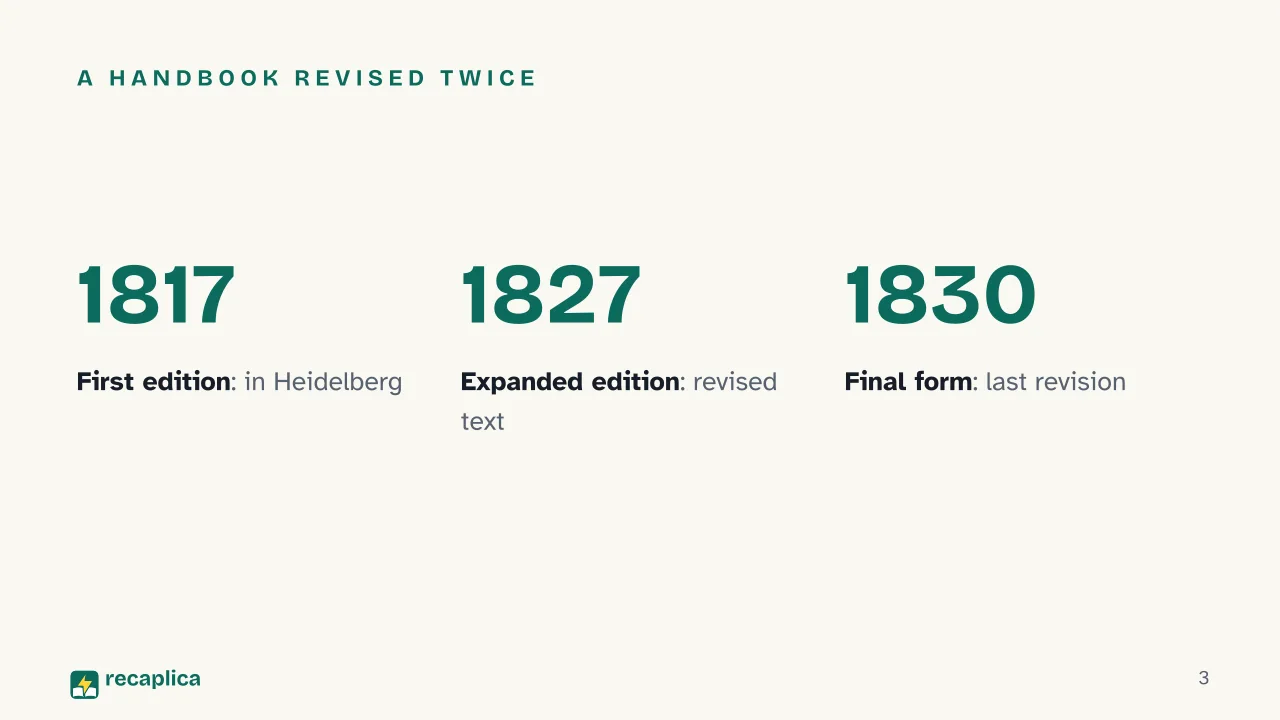  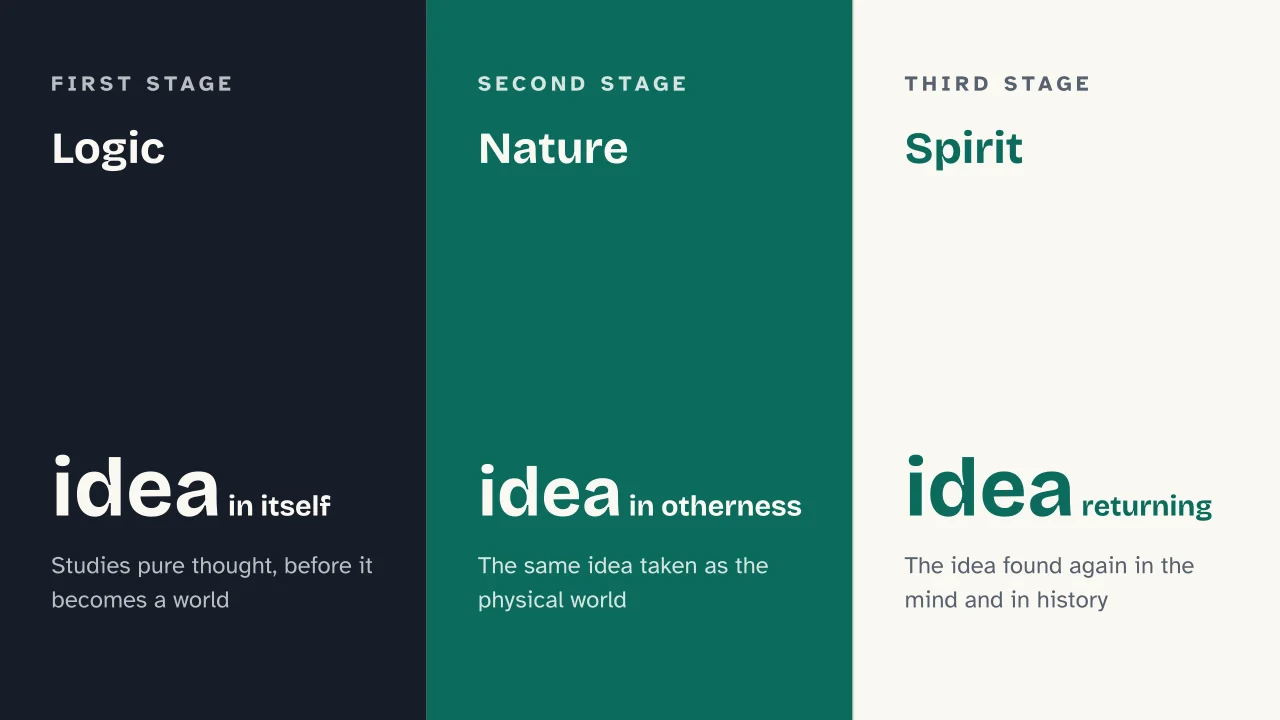 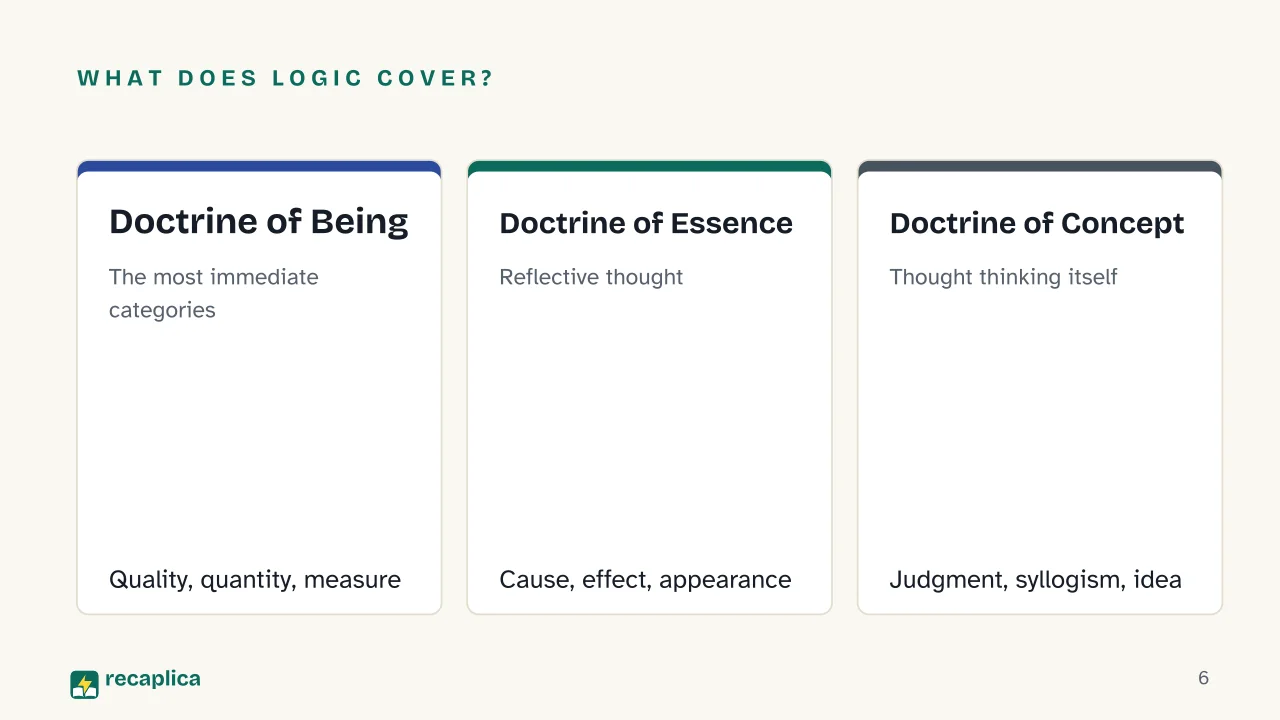 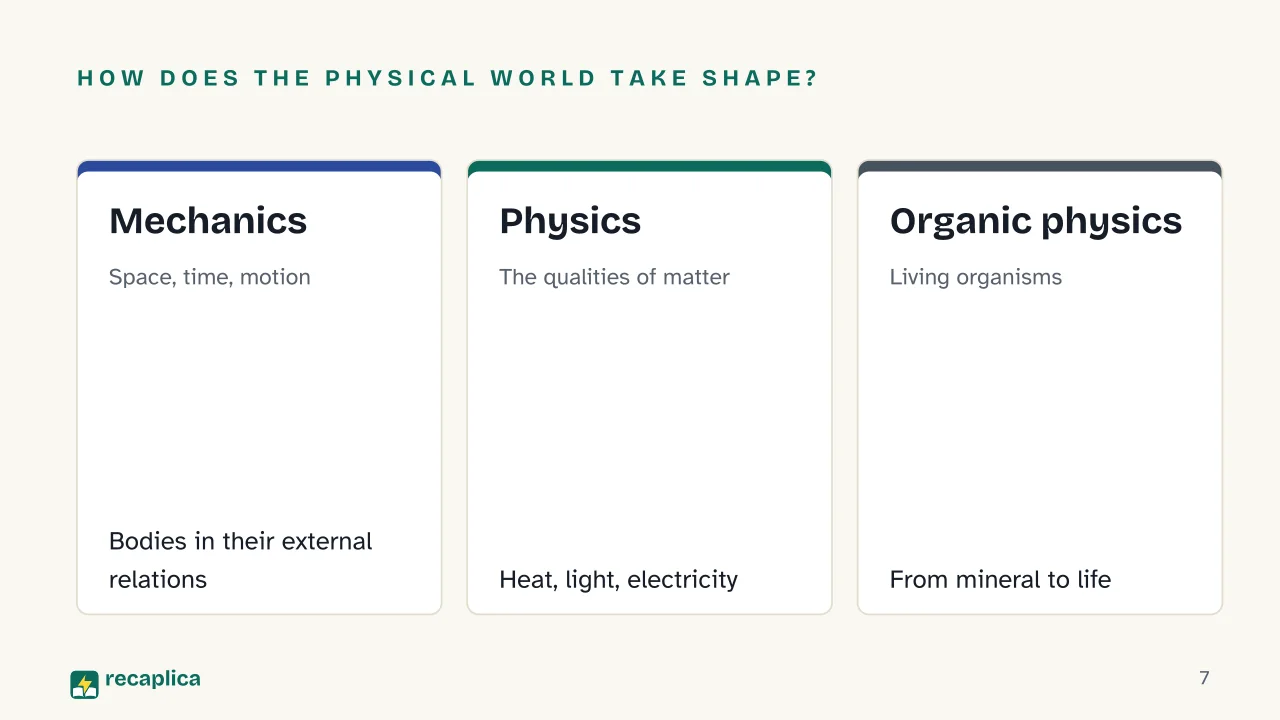 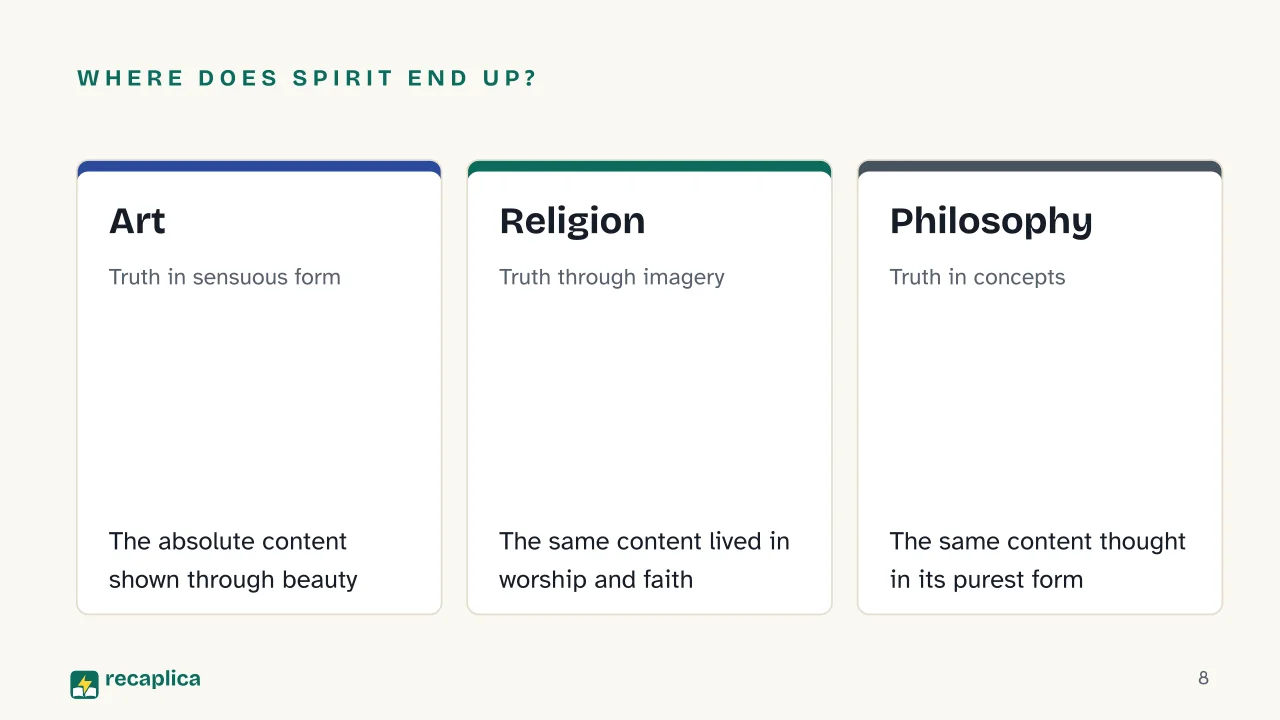 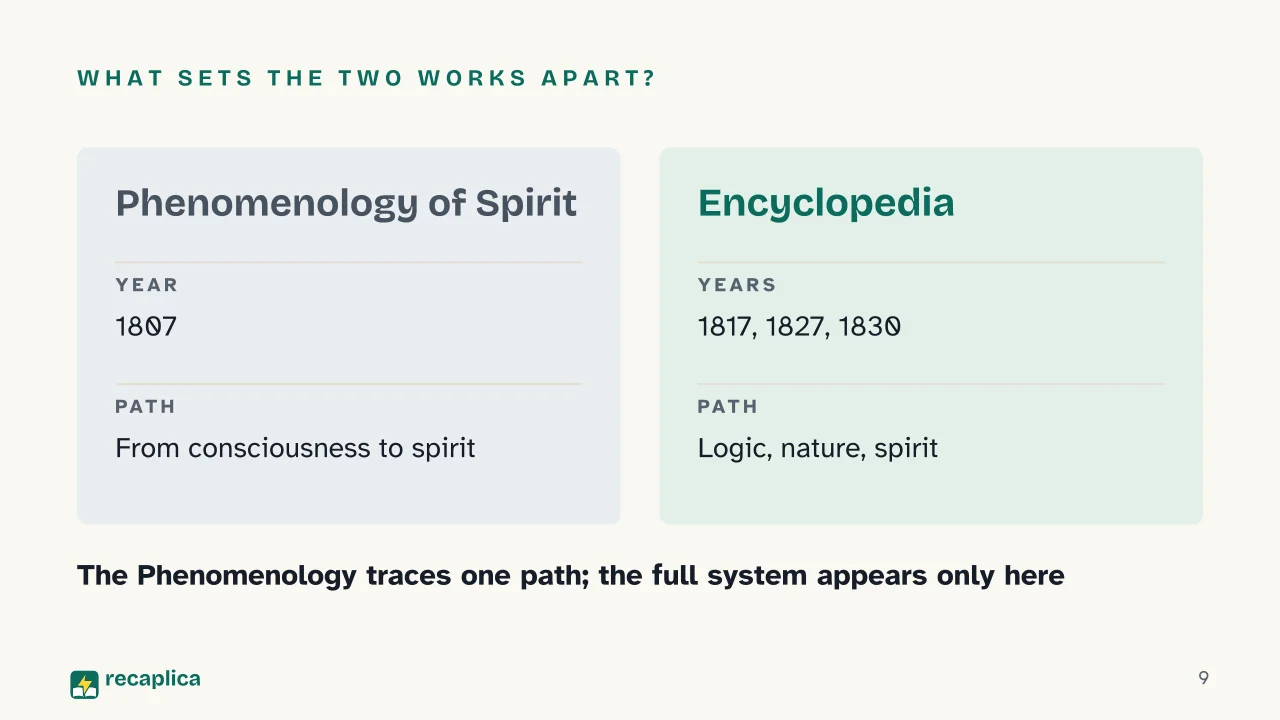  Common myths
Mind mapDrag the background to move around and the nodes to reposition them; use − and + to collapse and expand branches. 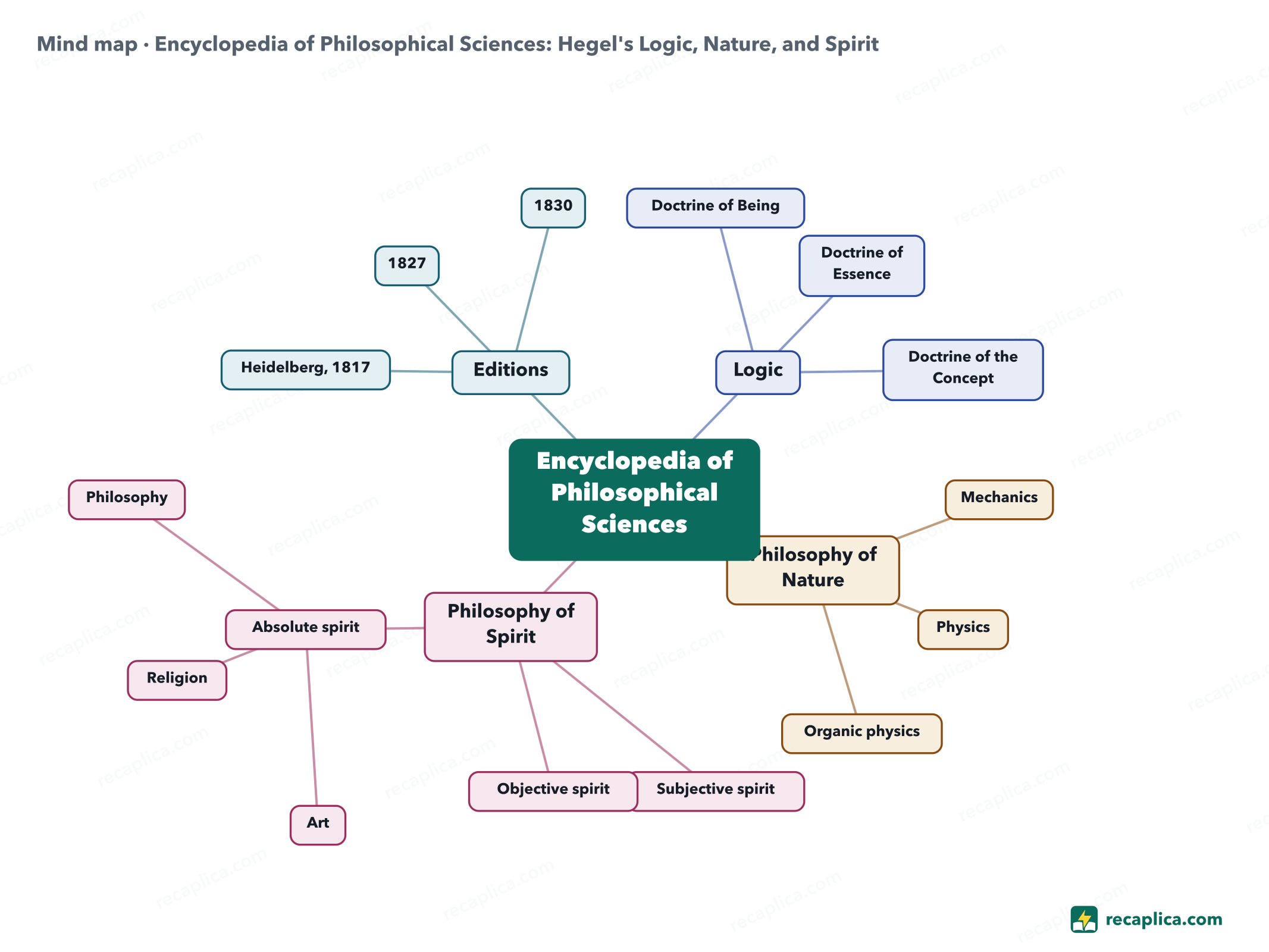
Quiz: test yourselfAnswer the questions to check what you have learned: you get instant feedback and a short explanation. Grade 0/10 0/5
FlashcardsTap the card to flip it and check whether you remember the answer, then move to the next one. 1 / 8 Explain it in your own wordsThe ultimate test: if you can explain it in simple words, you've truly understood it. Write your explanation, then compare it with the Recap. Your explanation is saved only on this device.
Frequently asked questionsWhat is Hegel's Encyclopedia of Philosophical Sciences?It is Hegel's handbook summary of his whole philosophical system, split into three parts, Logic, the Philosophy of Nature, and the Philosophy of Spirit, first published in 1817 in Heidelberg and later revised in 1827 and 1830. What is the original German title of the Encyclopedia of Philosophical Sciences?Encyclopädie der philosophischen Wissenschaften im Grundrisse, or 'Encyclopedia of the Philosophical Sciences in Outline': the word 'outline' signals a text built for teaching, not a treatise meant to be read on its own. What is the difference between the Encyclopedia of Philosophical Sciences and the Phenomenology of Spirit?The Phenomenology came out earlier and traces how consciousness arrives, step by step, at self-knowledge; the Encyclopedia sets aside only a slice of subjective and absolute spirit for that same journey, folding it into a system that also covers Logic and the Philosophy of Nature. How is Logic organized within the Encyclopedia?In three successive stages: first being, then essence, finally the concept, the same order as the Science of Logic, but compressed for teaching. What does the Philosophy of Spirit cover in Hegel's Encyclopedia?It runs from subjective spirit, the mind of the individual, to objective spirit, institutions and law, and on to absolute spirit, which covers art, religion, and philosophy. Every Recap goes through an independent review before publication. |