Skip to content
recaplica

    One moment: security check

    Cloudflare wants to make sure you're not a robot. Tick the box below and your search will continue on its own.

    IT
    recaplica What Is Epistemology? How Philosophy Looks at Science
    © 2026 Recaplica · recaplica.com — All rights reserved
    Home › History

    What Is Epistemology? How Philosophy Looks at Science

    By Recaplica Newsroom · Updated on October 17, 2026

    What to print

    Page numbers appear when printing with default margins.

    Slides

    Choose a cut

    Flash10 slidesThe essential thread, to present in classFull14 slidesEvery chapter and the deeper detail

    Both come with speaker notes.

    Telegram channel
    recaplica Clear in 30 seconds, yours in 10 minutes.
    In 30 seconds Key points Deep dive Slides Myths Mind map Quiz Flashcards FAQ

    In 30 seconds quick read

    Epistemology is the branch of philosophy that studies knowledge, especially scientific knowledge: what makes it count as knowledge, how it gets justified, when a belief earns the name. The word comes from the Greek episteme (knowledge) and logos (account), and the Scottish philosopher James Frederick Ferrier was the first to propose it. In Italian usage the term names the critical study of how the sciences are logically built and how they work; in English-speaking countries epistemology covers the theory of knowledge in general. One of its classic problems is the line Karl Popper drew between science and pseudoscience.

    Key Points

    • The word "epistemology" joins two Greek roots, episteme and logos; the Scottish philosopher James Frederick Ferrier was the first to propose it.
    • In Italian, epistemologia investigates the logical structure and method of the sciences; in English-speaking countries, epistemology covers the theory of knowledge in general.
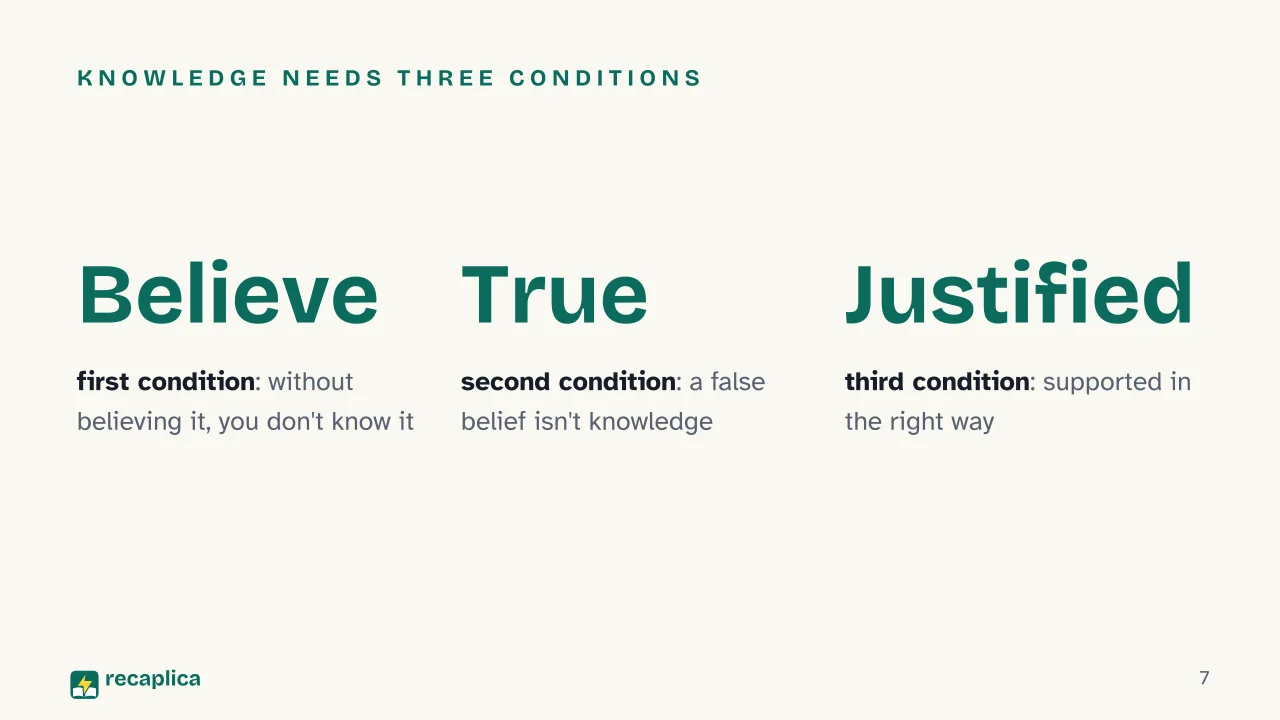
    • Counting as real knowledge takes three things together: believing something, its being true, and that belief being properly supported.
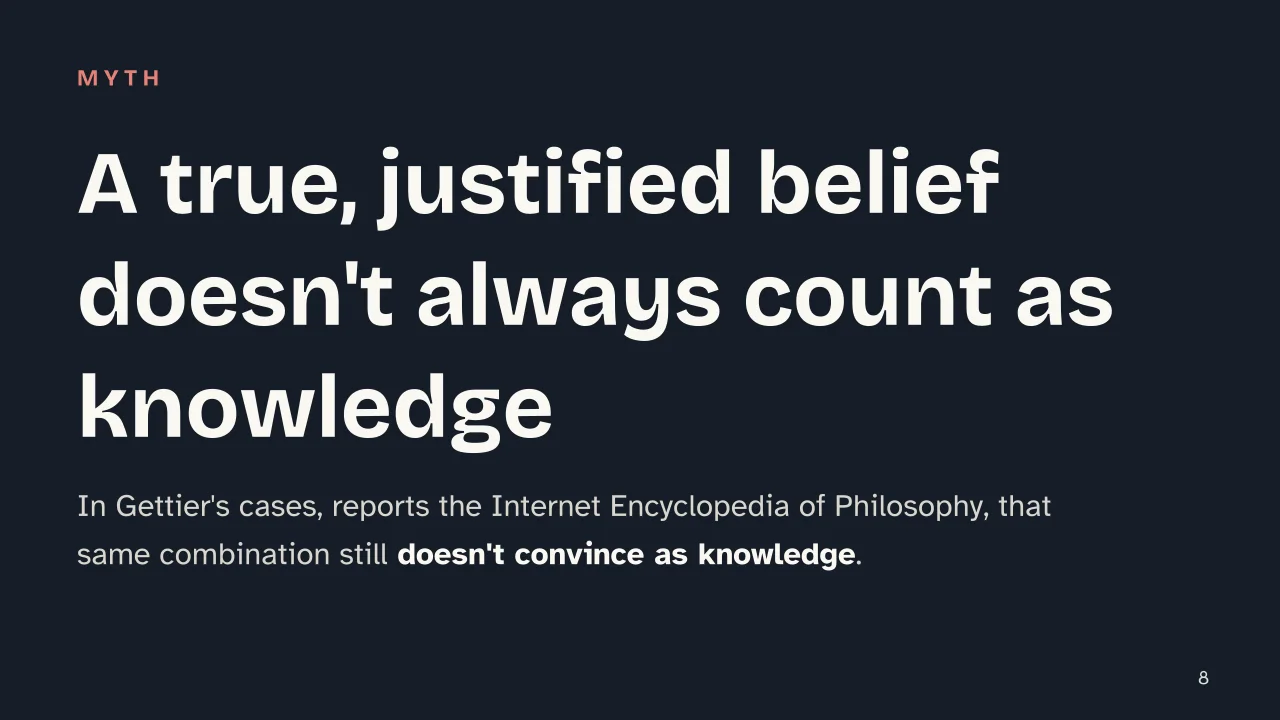
    • The Gettier problem, discussed by the Internet Encyclopedia of Philosophy, presents cases where belief, truth and justification all line up without the result convincing as genuine knowledge.
    • Karl Popper proposed a different line between science and pseudoscience: a theory counts as scientific if it could, at least in principle, be tested against a fact able to refute it.
    • Philosophical skepticism, per the Internet Encyclopedia of Philosophy, holds that knowledge is impossible, or at least unattainable for us.

    Deep Dive

    One term, different objects

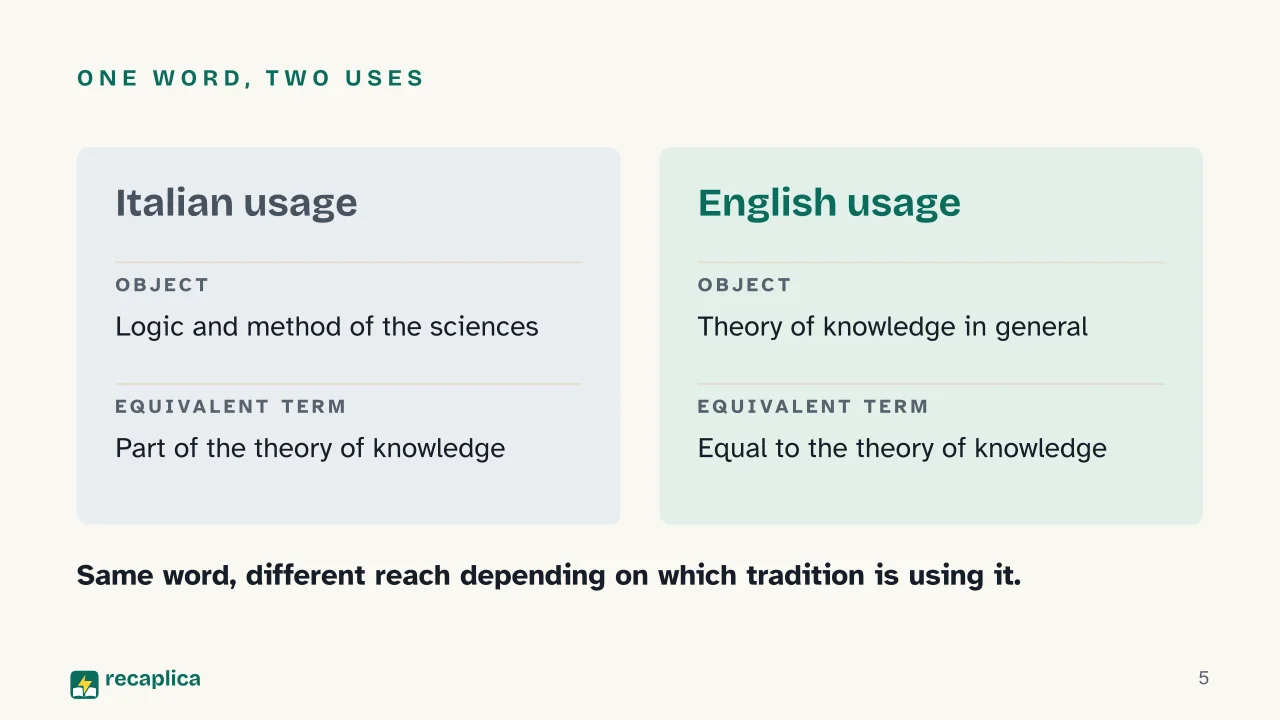
    The word “epistemology” joins two Greek roots: episteme (knowledge) and logos (account, reasoning). That’s how the Stanford Encyclopedia of Philosophy frames it, describing the discipline as the study of cognitive success, that is, of what makes an act of coming to believe something succeed or fail. Treccani credits the first use of the term to the Scottish philosopher James Frederick Ferrier, and adds a detail that explains a lot of cross-language confusion: in Italian usage, “epistemologia” originally names the part of the broader theory of knowledge devoted to the foundations and limits of scientific knowledge. In English-speaking countries the same word covers wider ground, equal to the whole theory of knowledge: an Italian essay on “epistemologia” is almost always about science, while an English chapter on “epistemology” can just as easily cover everyday knowledge.

    A reader used to the Italian sense who picks up an English-language book on the subject finds a much broader field than the title would suggest.

    AspectItalian usageEnglish usage
    Main objectLogical structure and method of the sciencesTheory of knowledge in general
    Equivalent termPart of the theory of knowledgeEqual to the theory of knowledge
    Origin of the termProposed by James Frederick FerrierProposed by James Frederick Ferrier

    The split between the forms of argument science itself relies on traces back to inductive and deductive reasoning: the difference with historical examples, and the twentieth-century push to put the logical analysis of science at the center of the debate runs through logical positivism.

    What counts as knowing, according to the classic definition

    The Stanford Encyclopedia of Philosophy and the Internet Encyclopedia of Philosophy both revisit the traditional analysis of knowledge, broken into three pieces that all have to hold at once. A person has to believe something is true; it has to actually be true, because a false belief can never count as knowledge; and a third ingredient is needed, justification, which the Internet Encyclopedia of Philosophy describes as the result of arriving at that belief the right way.

    Practical example: a horoscope predicting “you’ll have a demanding but manageable day” never clashes with any observation, since any day at all confirms it. A forecast like “it will snow in Turin tomorrow” can instead be proven wrong by a clear sky: it’s the kind of statement that, later in this Recap, Popper’s criterion classifies as scientific.

    This three-part scheme has a known weak point, the Gettier problem: the Internet Encyclopedia of Philosophy describes cases where a belief is true and properly supported, and yet philosophy hesitates to call it full-blown knowledge. The Stanford Encyclopedia of Philosophy ties the same knot to the difficulty of explaining why a cognitive act truly succeeds, beyond sheer luck.

    Readers who trace this thread back to its modern roots find common ground in Kant’s Critique of Pure Reason and in David Hume’s empiricism, which questioned how far past experience can really guarantee what happens next.

    Skepticism, the most radical doubt

    If knowing requires belief, truth and adequate support, a more radical question stays open: do we ever have knowledge at all, in any field? The Internet Encyclopedia of Philosophy defines philosophical skepticism as the position that there is nothing we know, or can know. It isn’t a side issue: the Internet Encyclopedia of Philosophy assigns epistemology two parallel tasks, determining what knowledge is and determining how far what we actually know extends.

    The line with pseudoscience

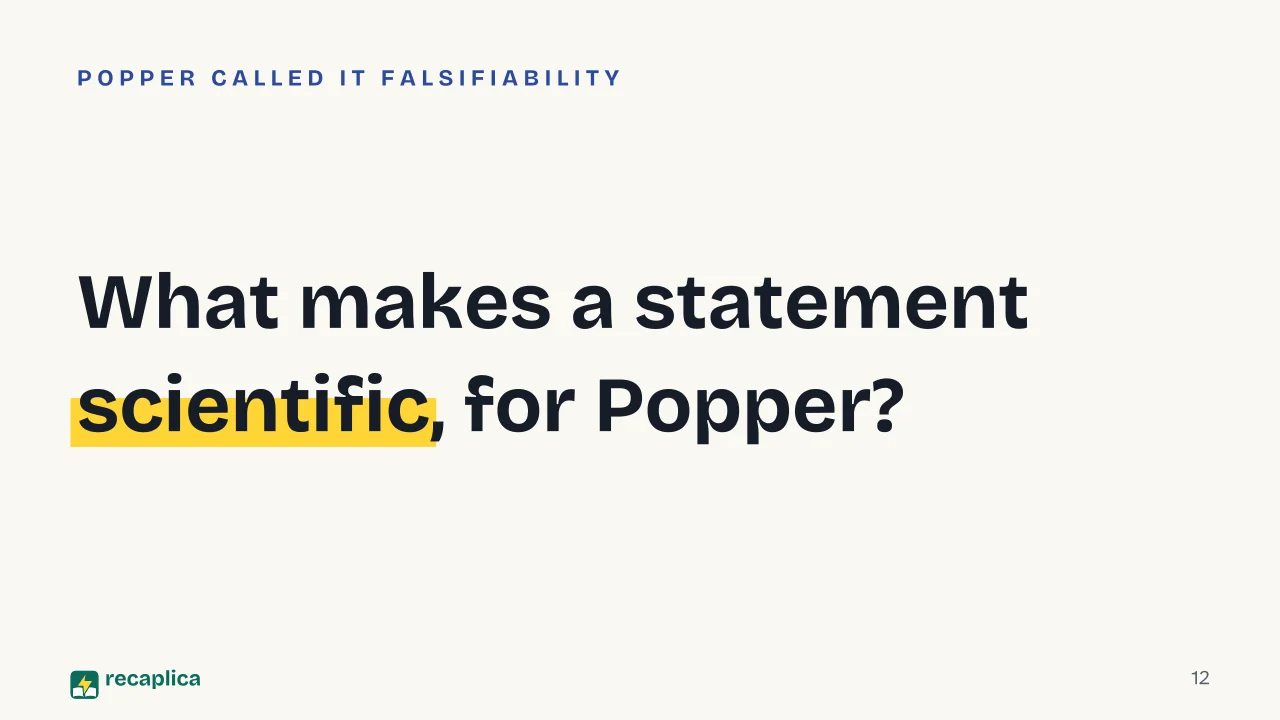
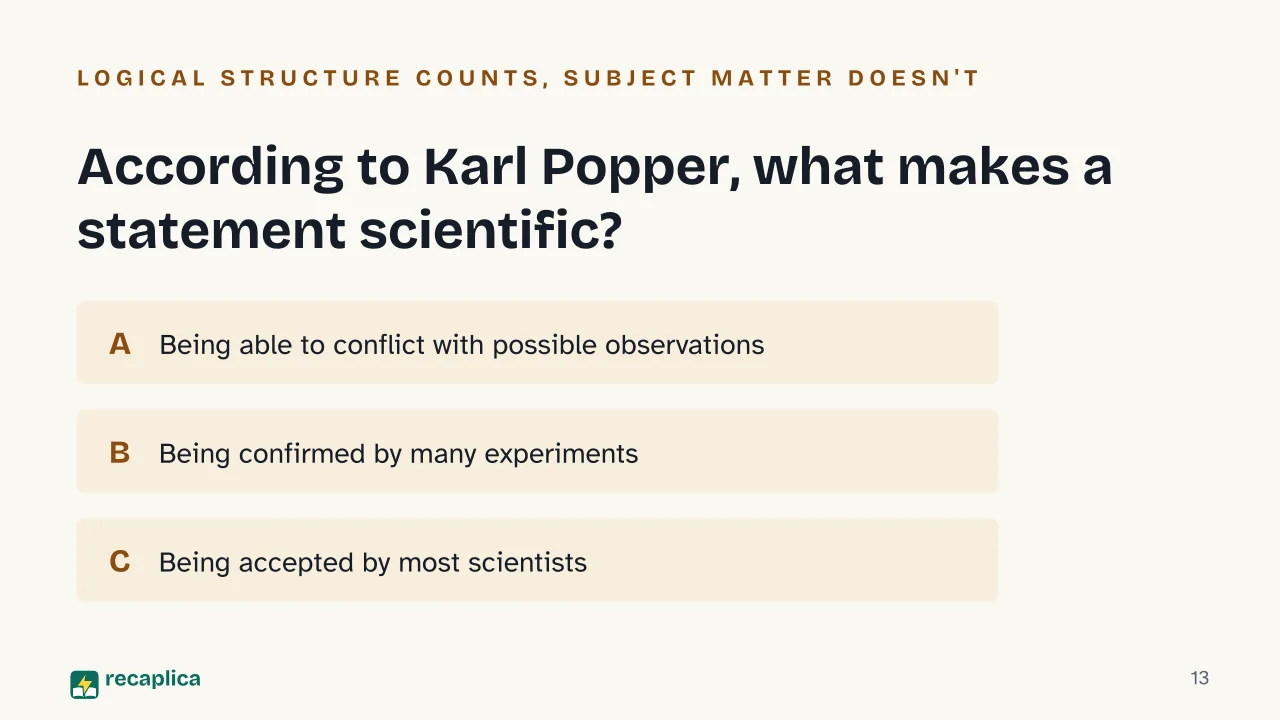
    Telling science and pseudoscience apart belongs to the same family of questions, aimed at a different target: what makes a body of knowledge scientific, beyond simply sounding confident? The most discussed answer is the demarcation criterion Karl Popper proposed, reported by the Stanford Encyclopedia of Philosophy: a statement or system of statements is scientific only if it can, in principle, conflict with possible or conceivable observations. The criterion concerns only the logical structure of the statements, not their specific content, which is why an idea considered metaphysical at one stage can later become a testable scientific theory — for Popper, this happens often. Popper adds a clause about how scientists behave, beyond the shape of the theories themselves: a doctrine loses its scientific status once its supporters refuse to accept falsification when it shows up against the facts.

    The Stanford Encyclopedia of Philosophy flags a limit of the criterion, though. Several pseudosciences were testable in principle, the facts have already contradicted them more than once, and their supporters keep defending them anyway. The mere theoretical possibility of being refuted separates testable statements from the rest; it doesn’t explain why a theory the evidence has already rejected stays in circulation.

    The falsifiability criterion meets actual history in Galileo Galilei and the Scientific Revolution, while the drive to make the method of the natural sciences the model for all knowledge defines positivism.

    Slide deck

    Slides ready to download and make your own in PowerPoint or Google Slides, with speaker notes. Pick the Flash cut or the Full one.
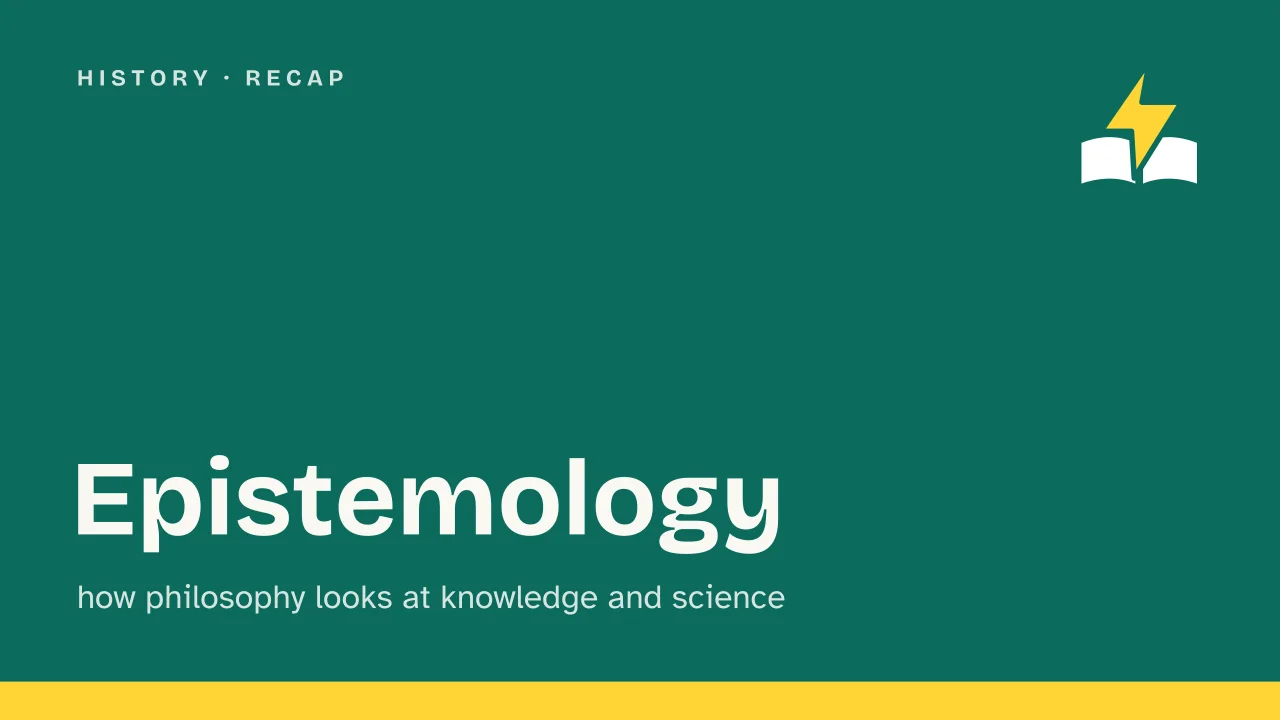
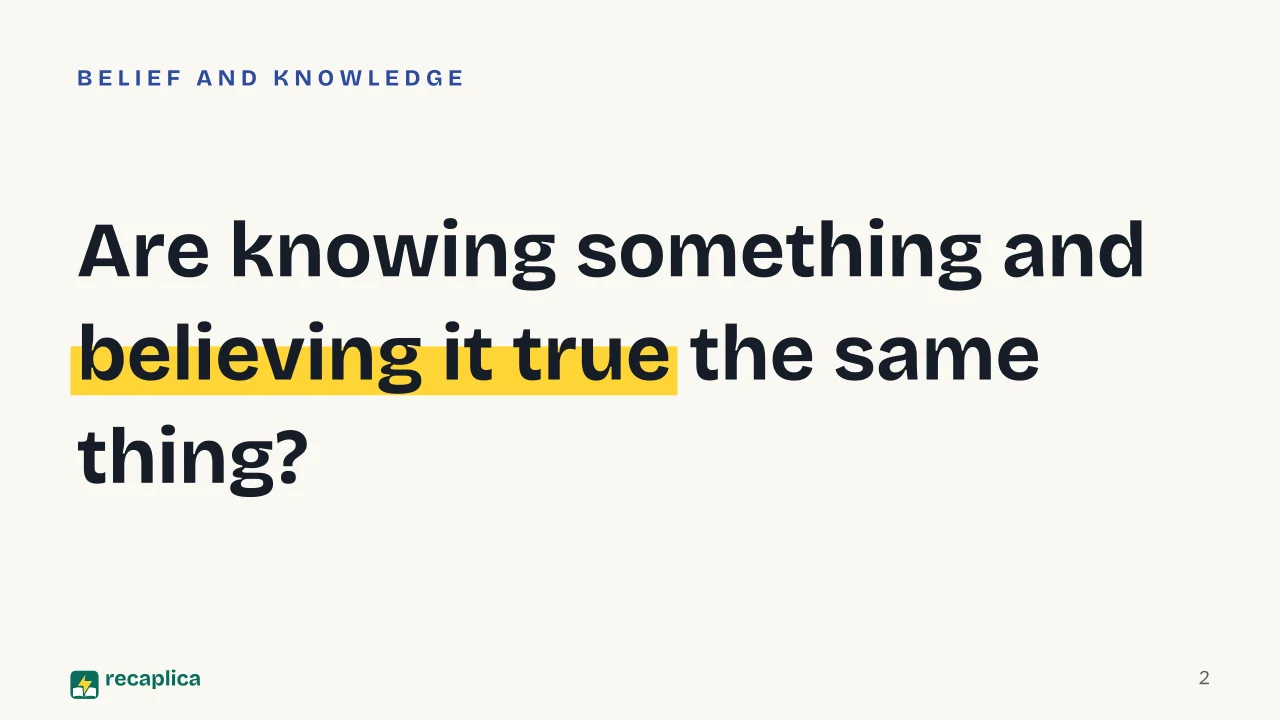
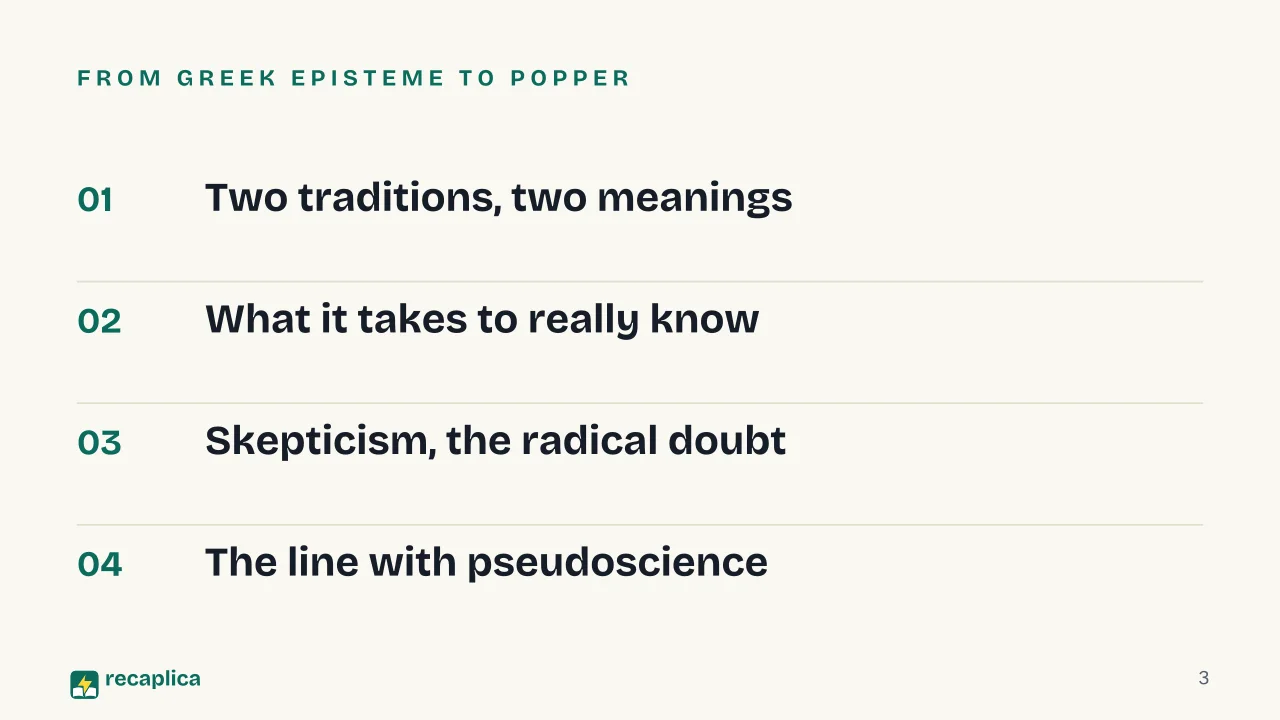
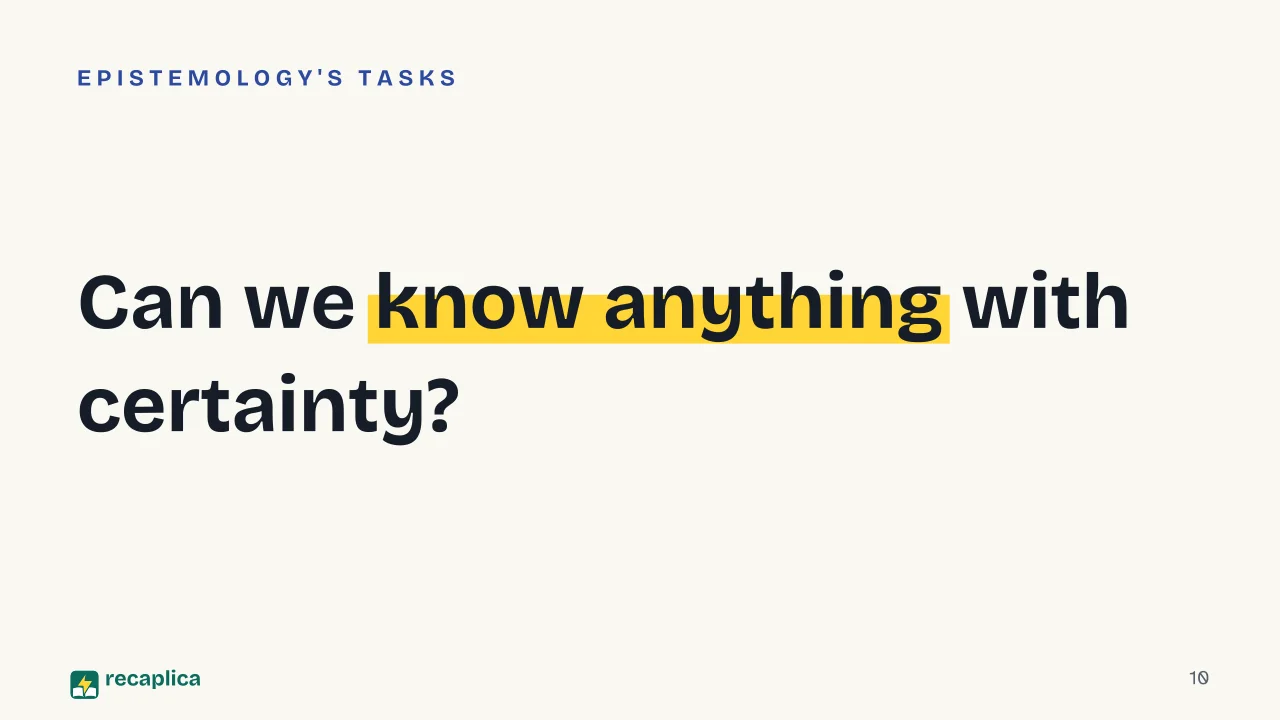
    Slide 1 of the presentation on What Is Epistemology? How Philosophy Looks at Science: EpistemologySlide 2 of the presentation on What Is Epistemology? How Philosophy Looks at Science: Are knowing something and believing it true the same thing?Slide 3 of the presentation on What Is Epistemology? How Philosophy Looks at Science: From Greek episteme to PopperSlide 4 of the presentation on What Is Epistemology? How Philosophy Looks at Science: Chapter 01: Two traditionsSlide 5 of the presentation on What Is Epistemology? How Philosophy Looks at Science: One word, two usesSlide 6 of the presentation on What Is Epistemology? How Philosophy Looks at Science: Chapter 02: What counts as knowingSlide 7 of the presentation on What Is Epistemology? How Philosophy Looks at Science: Knowledge needs three conditionsSlide 8 of the presentation on What Is Epistemology? How Philosophy Looks at Science: A true, justified belief doesn't always count as knowledgeSlide 9 of the presentation on What Is Epistemology? How Philosophy Looks at Science: Chapter 03: SkepticismSlide 10 of the presentation on What Is Epistemology? How Philosophy Looks at Science: Can we know anything with certainty?Slide 11 of the presentation on What Is Epistemology? How Philosophy Looks at Science: Chapter 04: The demarcationSlide 12 of the presentation on What Is Epistemology? How Philosophy Looks at Science: What makes a statement scientific, for Popper?Slide 13 of the presentation on What Is Epistemology? How Philosophy Looks at Science: According to Karl Popper, what makes a statement scientific?Slide 14 of the presentation on What Is Epistemology? How Philosophy Looks at Science: Review
    Flash10 slidesThe essential thread, to present in classFull14 slidesEvery chapter and the deeper detail

    Common myths

    • ✗ Myth Epistemology and the theory of knowledge always mean the same thing, in every language.

      ✓ Reality It depends on the linguistic tradition. Treccani reports that in Italian usage epistemologia is the part of the theory of knowledge dealing with the foundations of scientific knowledge, while in English-speaking countries epistemology covers the whole theory of knowledge: there the two terms line up, in Italian they don't.

    • ✗ Myth A true, justified belief always counts as knowledge.

      ✓ Reality The Internet Encyclopedia of Philosophy sets out cases where a true, justified belief still fails to count as full knowledge: the Gettier problem remains an open knot in the theory of knowledge.

    • ✗ Myth Popper's falsifiability criterion alone is enough to separate science from pseudoscience.

      ✓ Reality The Stanford Encyclopedia of Philosophy flags a limit: many pseudosciences have in fact been thoroughly falsified, yet their supporters keep defending them. The mere theoretical possibility of being refuted doesn't explain why that defense holds up.

    Mind map

    Drag the background to move around and the nodes to reposition them; use − and + to collapse and expand branches.
    Customize
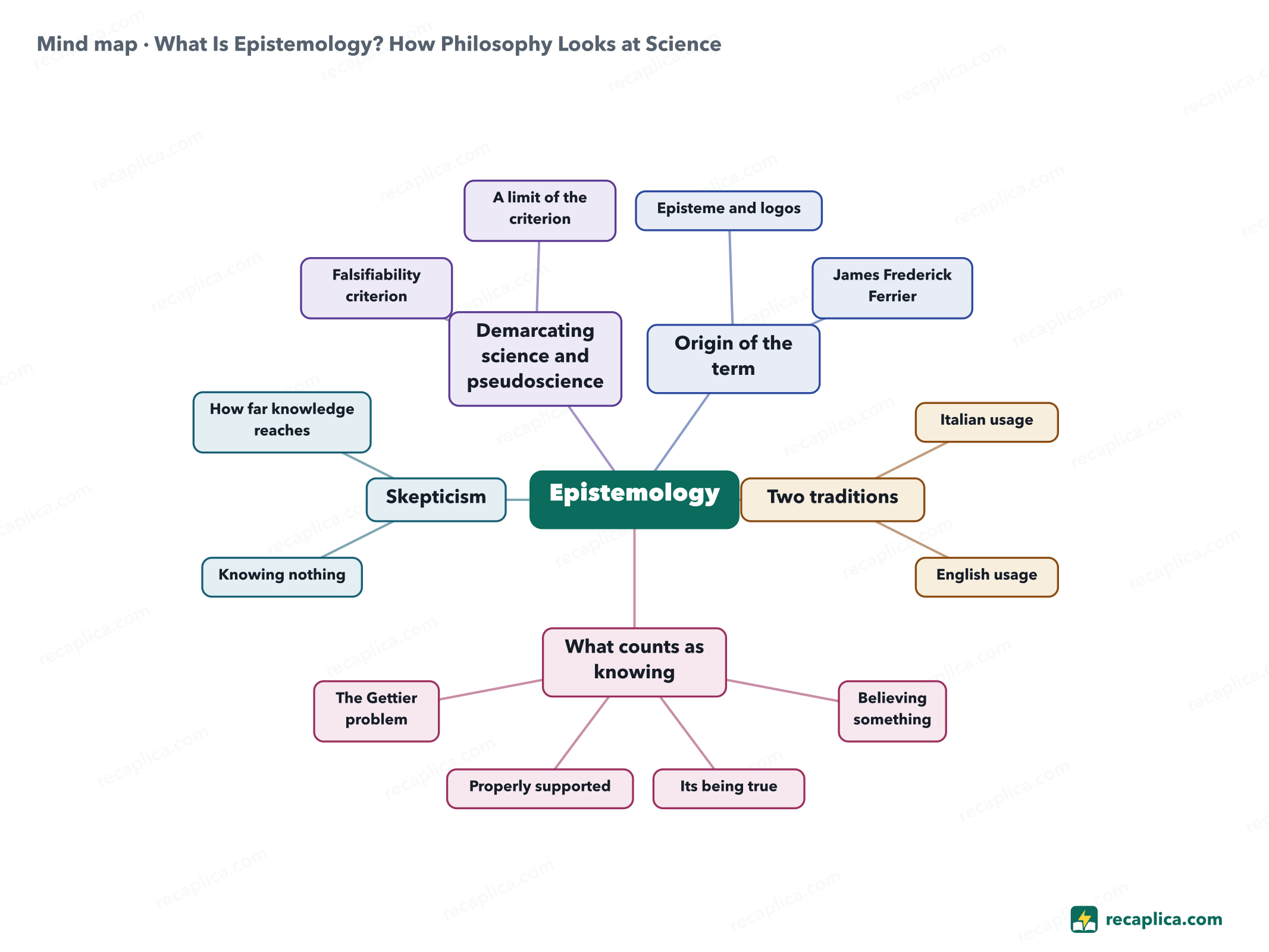
    Mind map: What Is Epistemology? How Philosophy Looks at Science
    • Epistemology
      • Origin of the term From Greek episteme and logos
        • Episteme and logos Knowledge and discourse
        • James Frederick Ferrier The Scottish philosopher who proposed it
      • Two traditions One term, different objects
        • Italian usage Logical structure and method of the sciences
        • English usage Theory of knowledge in general
      • What counts as knowing Three conditions together
        • Believing something Necessary, not sufficient alone
        • Its being true A false belief doesn't count as knowledge
        • Properly supported The outcome of a correct path to belief
        • The Gettier problem Cases where the three conditions aren't enough
      • Skepticism The most radical doubt
        • Knowing nothing The skeptical thesis in its extreme form
        • How far knowledge reaches Epistemology's second task
      • Demarcating science and pseudoscience The line Popper drew
        • Falsifiability criterion Scientific if it can conflict with an observable fact
        • A limit of the criterion Theories refuted but defended anyway

    Quiz: test yourself

    Answer the questions to check what you have learned: you get instant feedback and a short explanation.

    Grade 0/10 0/5
    1 Which Greek words does the term "epistemology" come from, according to the Stanford Encyclopedia of Philosophy?

    The Stanford Encyclopedia of Philosophy traces the term to episteme, meaning knowledge or understanding, joined with logos, discourse or reasoning.

    2 Who first proposed the term "epistemology", according to Treccani?

    Treccani credits the Scottish philosopher James Frederick Ferrier with proposing the term.

    3 True or false: in English-speaking countries, epistemology refers only to scientific knowledge.

    False: Treccani notes that in English-speaking countries the term extends to the theory of knowledge in general.

    4 According to the Internet Encyclopedia of Philosophy, what does the Gettier problem challenge?

    The Gettier problem shows that a belief can be true and well justified without that being enough to count as genuine knowledge: it's the very definition of knowledge as justified true belief, discussed by the Internet Encyclopedia of Philosophy, that ends up in trouble.

    5 For Karl Popper, what makes a statement scientific, according to the Stanford Encyclopedia of Philosophy?

    For Popper a scientific statement must be able to clash, at least conceptually, with an observable fact that contradicts it: that's the falsifiability criterion.

    Answers: 1-A · 2-A · 3-B · 4-A · 5-A

    Flashcards

    Tap the card to flip it and check whether you remember the answer, then move to the next one.

    1 / 8

    Explain it in your own words

    The ultimate test: if you can explain it in simple words, you've truly understood it. Write your explanation, then compare it with the Recap.

    Your explanation is saved only on this device.

    Epistemology is the branch of philosophy that studies knowledge, especially scientific knowledge: what makes it count as knowledge, how it gets justified, when a belief earns the name. The word comes from the Greek episteme (knowledge) and logos (account), and the Scottish philosopher James Frederick Ferrier was the first to propose it. In Italian usage the term names the critical study of how the sciences are logically built and how they work; in English-speaking countries epistemology covers the theory of knowledge in general. One of its classic problems is the line Karl Popper drew between science and pseudoscience.

    Frequently asked questions

    What is epistemology?

    It's the branch of philosophy devoted to what it means to know something. In Italian usage, Treccani reports, it is mostly about how scientific knowledge is built and tested; in English-speaking usage it equals the theory of knowledge in general.

    What's the difference between epistemology and the theory of knowledge?

    In Italian, epistemologia is, per Treccani, the part of the theory of knowledge that looks at the limits and validity of scientific knowledge. In English-speaking countries, by contrast, epistemology is synonymous with the theory of knowledge in its broadest sense.

    What is the Gettier problem?

    It's a case described by the Internet Encyclopedia of Philosophy where a true belief, properly supported, still isn't counted as full knowledge: it challenges the classic definition of knowledge.

    What is Popper's falsifiability criterion?

    According to Karl Popper a statement counts as scientific when there is, at least in principle, an observation able to contradict it; the criterion looks at the logical form of the statement, not its subject matter, reports the Stanford Encyclopedia of Philosophy.

    Are epistemology and philosophy of science the same thing?

    In Italian usage they sit very close together: Treccani describes epistemologia as the critical analysis of scientific method and its logical foundations, the same ground covered by the label philosophy of science.

    Sources

    • Stanford Encyclopedia of Philosophy - Epistemology
    • Internet Encyclopedia of Philosophy - Epistemology
    • Treccani, Enciclopedia - Epistemologia
    • Stanford Encyclopedia of Philosophy - Science and Pseudo-Science

    Every Recap goes through an independent review before publication.

    Every evening, the day's new Recaps on our Telegram channel. Join the channel →

    Keep learning

    • History Hermeneutics: What Is It? Philosophical hermeneutics asks what interpretation itself is, rather than treating it as a shortcut to some other goal. Schleiermacher proposed it as a universal discipline, valid for every kind of text, from scripture to literary and legal writing. Heidegger moved the question from method to existence: understanding becomes a way of being, shaped by the situation a person is already in. Gadamer pulled these threads together in "Truth and Method" and argued that understanding a text means letting its horizon meet the reader's own. Read the Recap →
    • History Wittgenstein and Analytic Philosophy: The Philosopher Who Changed His Mind Twice According to the Stanford Encyclopedia of Philosophy, Ludwig Wittgenstein was born in Vienna in 1889 and became one of the most influential philosophers of the twentieth century, despite publishing only one book in his lifetime. He trained first as an aeronautical engineer, then met Gottlob Frege and Bertrand Russell and turned to the philosophy of language, arguing in the Tractatus Logico-Philosophicus that traditional philosophical problems grow out of confused uses of words, a claim that struck the logical positivists of the Vienna Circle deeply. Later, in the Philosophical Investigations, he abandoned that logical system to focus on how people actually use words. Together, the two works are the most cited starting point for twentieth-century analytic philosophy. Read the Recap →
    • History Tractatus Logico-Philosophicus: What It Is and What It Says The Tractatus Logico-Philosophicus is the only philosophy book Ludwig Wittgenstein published during his lifetime, first printed in German in 1921 and translated into English the following year. In its pages the world is the totality of facts that are the case. A proposition, for Wittgenstein, works like a picture: its logical structure matches, point for point, the structure of the state of affairs it depicts, and this shared structure is what connects language to reality. The book then draws a line between what can be said with sense and what lies beyond that limit, ethics and aesthetics included, and closes with an injunction to stay silent about the rest. Read the Recap →

    recaplica

    Clear in 30 seconds, yours in 10 minutes.

    Recaps Mind maps Request a Recap Telegram channel Mind map maker Our method About Privacy & cookies Legal notes & terms of use

    © 2026 Recaplica · A project by Curi S.r.l. — VAT IT05472000750

    Statistics, only if you say so

    To learn which Recaps help most we would use Google Analytics, with aggregate, anonymous data. It starts only with your OK, and you can change your mind anytime. Privacy policy