|
recaplica
Wittgenstein and Analytic Philosophy: The Philosopher Who Changed His Mind Twice |
| © 2026 Recaplica · recaplica.com — All rights reserved |
Wittgenstein and Analytic Philosophy: The Philosopher Who Changed His Mind TwiceWhat to print Page numbers appear when printing with default margins. SlidesChoose a cut Flash10 slidesThe essential thread, to present in classFull16 slidesEvery chapter and the deeper detailBoth come with speaker notes. In 30 seconds quick readAccording to the Stanford Encyclopedia of Philosophy, Ludwig Wittgenstein was born in Vienna in 1889 and became one of the most influential philosophers of the twentieth century, despite publishing only one book in his lifetime. He trained first as an aeronautical engineer, then met Gottlob Frege and Bertrand Russell and turned to the philosophy of language, arguing in the Tractatus Logico-Philosophicus that traditional philosophical problems grow out of confused uses of words, a claim that struck the logical positivists of the Vienna Circle deeply. Later, in the Philosophical Investigations, he abandoned that logical system to focus on how people actually use words. Together, the two works are the most cited starting point for twentieth-century analytic philosophy. Key Points
Deep DiveAccording to the Stanford Encyclopedia of Philosophy, Ludwig Wittgenstein was born on April 26, 1889, in Vienna, into a wealthy and large industrial family. His father, Karl Wittgenstein, was one of the most successful entrepreneurs in the Austro-Hungarian Empire, and the family home hosted musicians and intellectuals passing through the city. Three of Ludwig’s four brothers died by suicide, a grief that ran through his family; the sources do not give the dates of the individual episodes. In 1908 Wittgenstein began studying aeronautical engineering at the University of Manchester (one source places an earlier period of mechanical engineering in Berlin before that). That technical interest, combined with a curiosity about the foundations of pure mathematics, led him to read Gottlob Frege. The meeting that changed his courseFrege, the German logician who lived between 1848 and 1925, did not keep Wittgenstein long as a student: he advised him to go study with Bertrand Russell instead. Wittgenstein moved to Cambridge in 1911. Russell, for his part, described him in an early reaction as a headstrong and difficult student, though hardly a dull one; later, in a different judgment, he wrote that he wanted to encourage him, expected great things from him, and felt genuine affection for him. Wittgenstein himself acknowledged a debt to Frege’s work and to Russell’s writings for many of the stimuli behind his own thinking. The problems of logic and mathematics Wittgenstein debated with Frege and Russell offer a direct demonstration of inductive and deductive reasoning: on that technical ground he built his own thought.
The war and the TractatusIn 1914, at the outbreak of the First World War, Wittgenstein volunteered for the Austrian army. He kept up his philosophical work during his service, received several medals for bravery, and was taken prisoner in November 1918. The work of those years culminated in the Tractatus Logico-Philosophicus, the only philosophy book Wittgenstein published during his lifetime. The core of the Tractatus can be summed up in a single claim: all philosophy is, at bottom, a critique of language. For Wittgenstein, traditional philosophical questions often arise from a confused or mistaken use of words. The Vienna Circle and the linguistic turnThe logical positivists of the Vienna Circle were deeply struck by what they found in the Tractatus. The Circle brought together, between 1924 and 1936, philosophers who met almost every week during term time to rework empiricism alongside the advances of the physical and formal sciences of the day. In line with the thesis of the Tractatus, the Circle carried out what has come to be called the linguistic turn. In 1930 these discussions gained real momentum from Friedrich Waismann’s accounts of Wittgenstein’s meetings with him and with Moritz Schlick. Wittgenstein himself returned to Cambridge to take up philosophical work again only in 1929, after being exposed to these exchanges on the philosophy of mathematics and science. The later Wittgenstein: the Philosophical InvestigationsWittgenstein’s later work, above all the Philosophical Investigations, shares with the Tractatus an interest in logic and language, but with a different, less technical approach. It is this later Wittgenstein, known chiefly for the Philosophical Investigations, who takes the most radical step in his critique of traditional philosophy, leaving behind the closed logical system of the Tractatus to observe how language actually gets used in everyday life. The book has its own Recap. The final yearsWittgenstein died of prostate cancer in Cambridge in April 1951. According to one source, his last words were, in translation, “Tell them I’ve had a wonderful life”: different sources report slightly different wordings of this phrase, and it should be read as testimony rather than an exact, settled quotation. The notes of his last years are collected in On Certainty, which has its own Recap. The logical empiricism developed by the Vienna Circle, drawing in part on the Tractatus, went on to influence the development of analytic philosophy of science in the period after the Second World War. The Tractatus and the Philosophical Investigations each have a longer story than the one told here: they are covered in separate Recaps, each devoted to a single work. Slide deckSlides ready to download and make your own in PowerPoint or Google Slides, with speaker notes. Pick the Flash cut or the Full one.   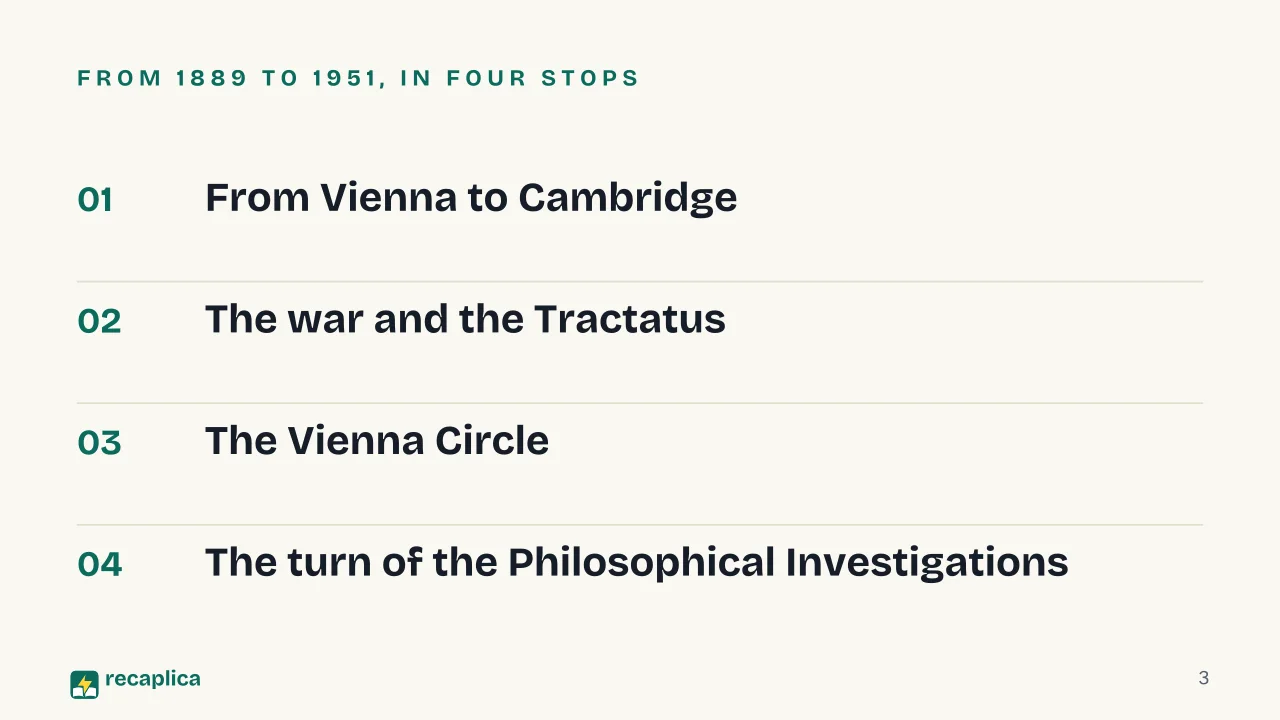  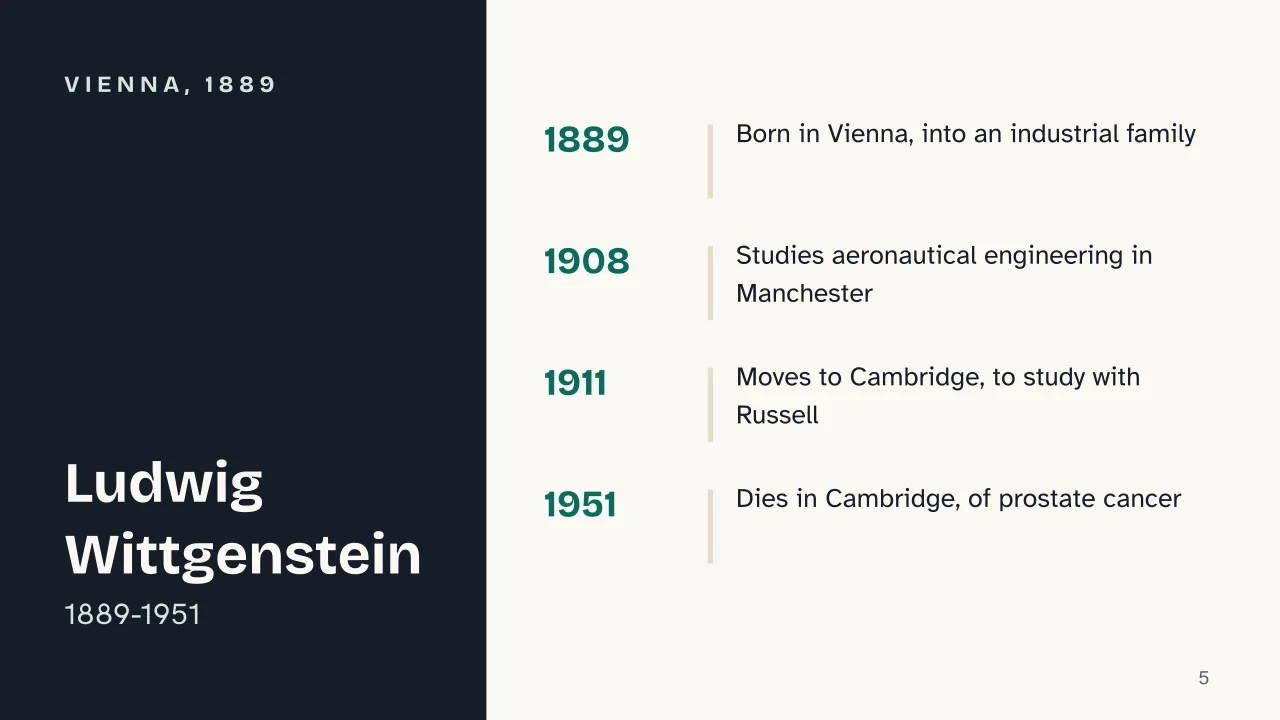 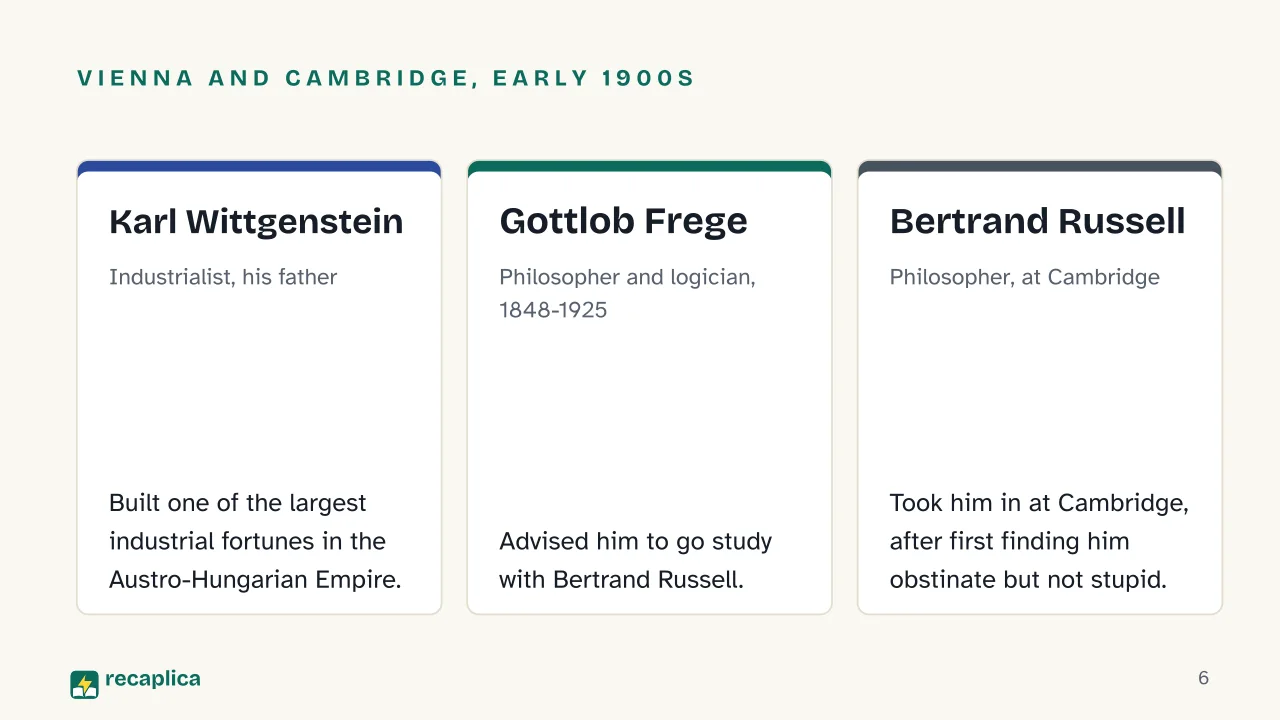  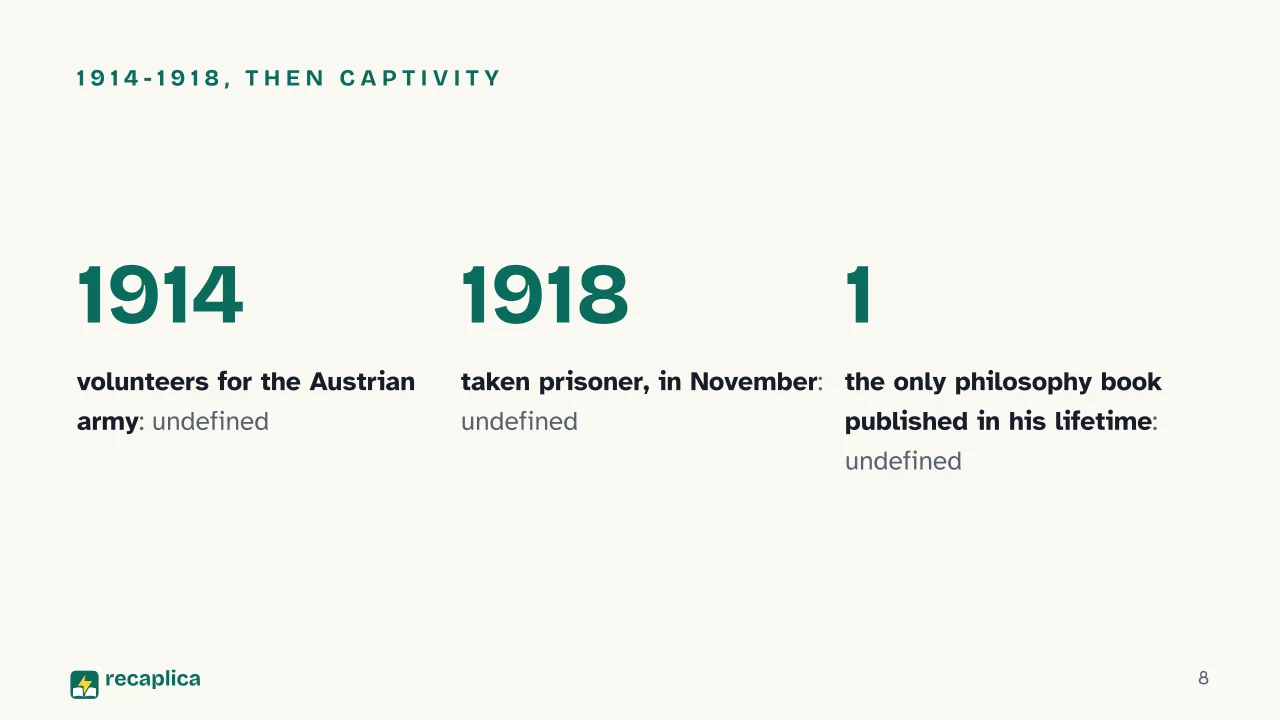   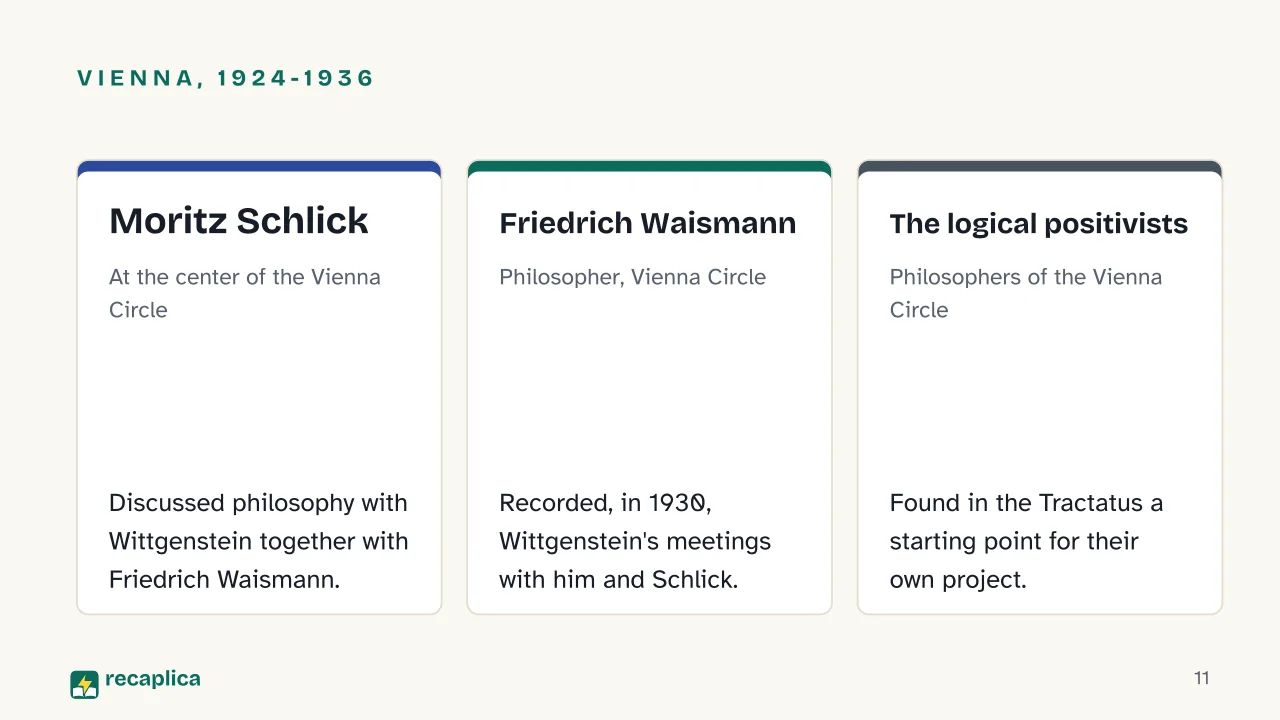 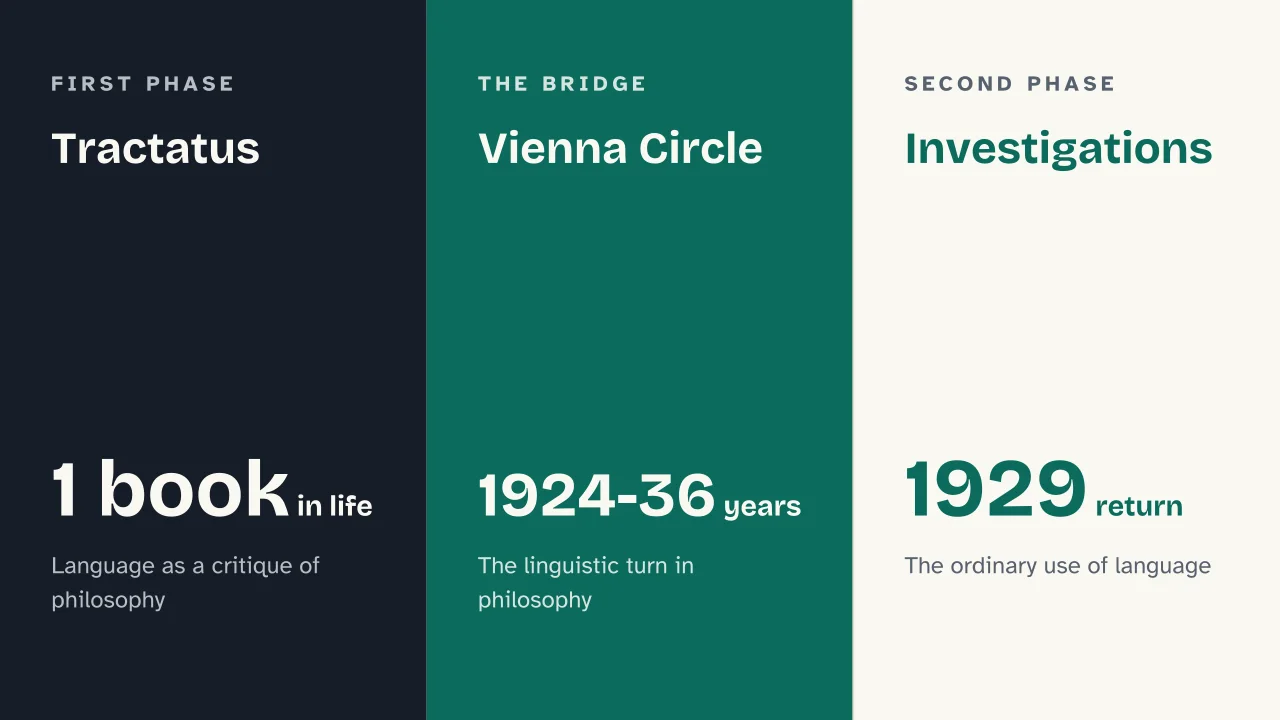  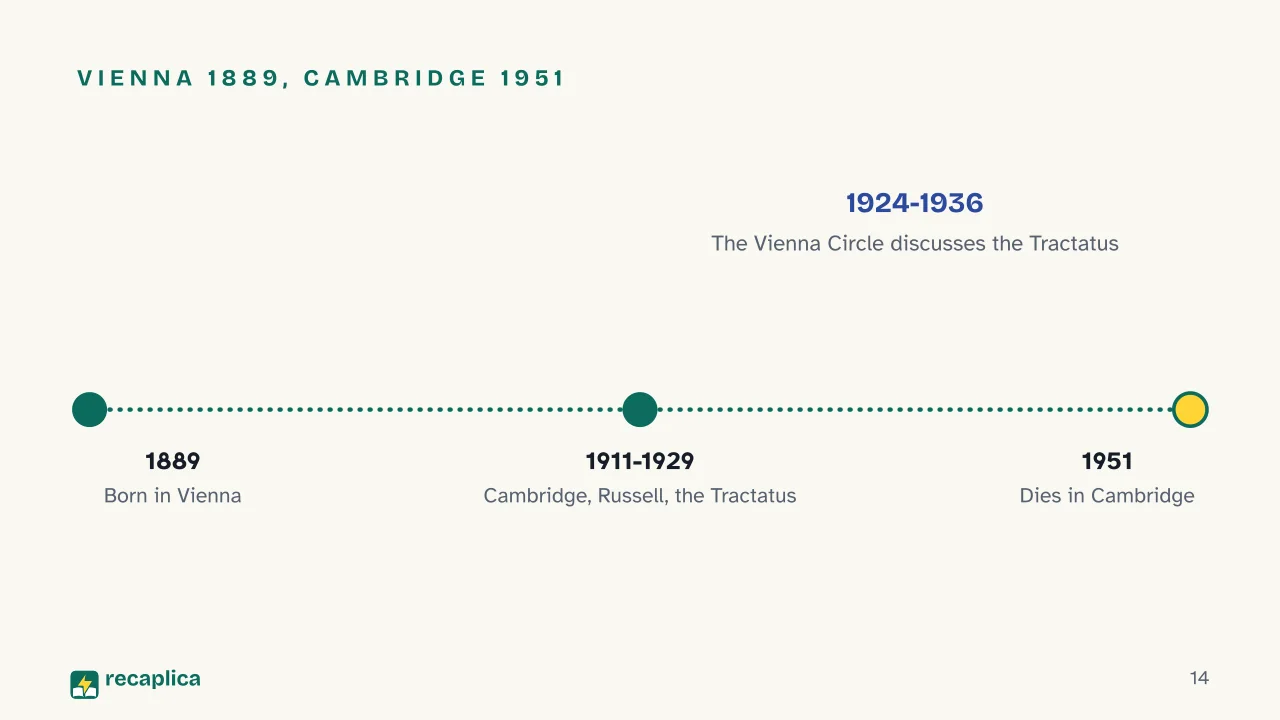 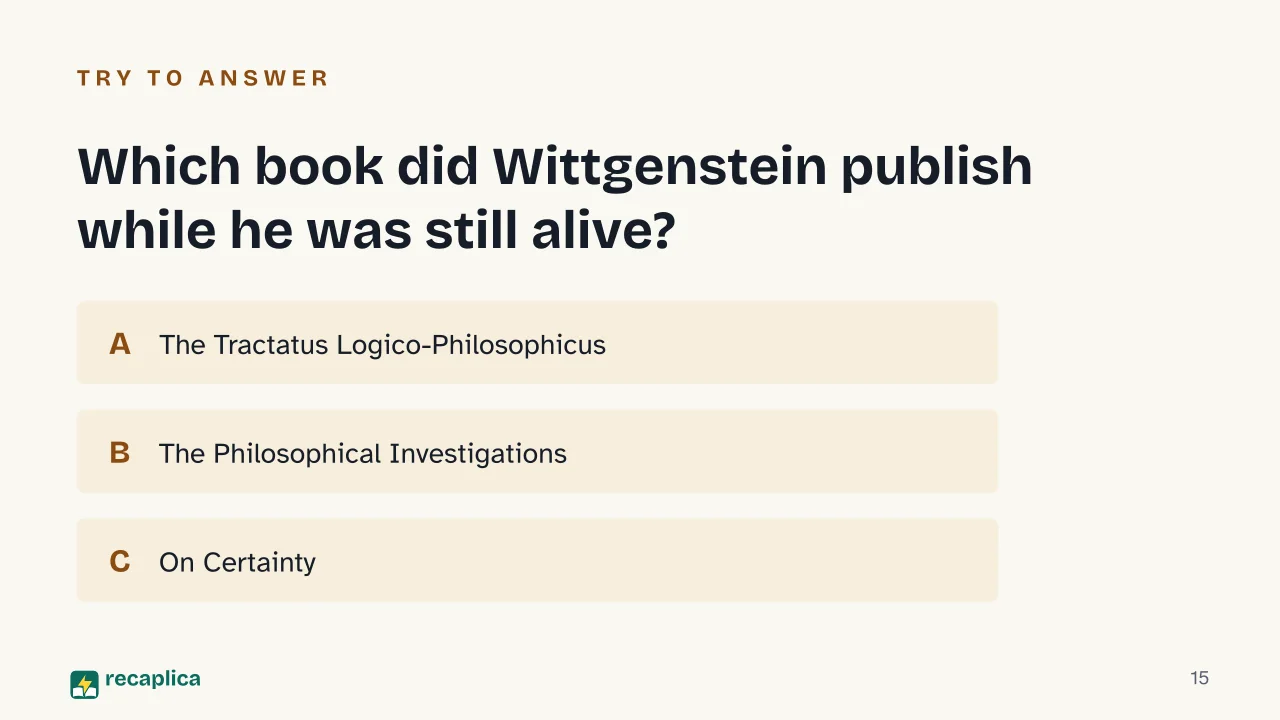  Common myths
Mind mapDrag the background to move around and the nodes to reposition them; use − and + to collapse and expand branches. 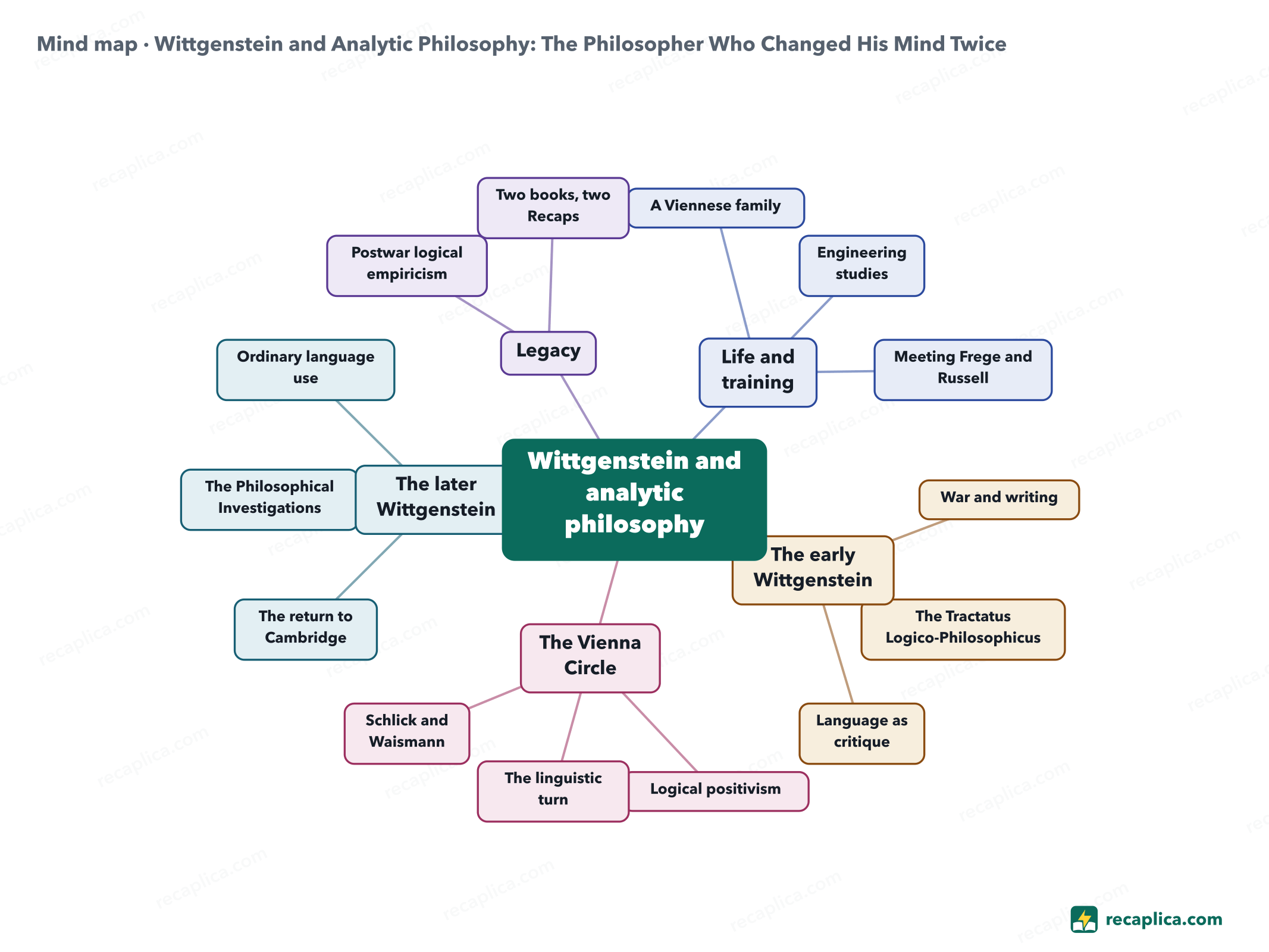
Quiz: test yourselfAnswer the questions to check what you have learned: you get instant feedback and a short explanation. Grade 0/10 0/5
FlashcardsTap the card to flip it and check whether you remember the answer, then move to the next one. 1 / 7 Explain it in your own wordsThe ultimate test: if you can explain it in simple words, you've truly understood it. Write your explanation, then compare it with the Recap. Your explanation is saved only on this device.
Frequently asked questionsWho was Ludwig Wittgenstein?A philosopher born in Vienna in 1889 and who died in Cambridge in 1951, considered one of the most influential thinkers of twentieth-century analytic philosophy, author of the Tractatus Logico-Philosophicus and the Philosophical Investigations. What is the Tractatus Logico-Philosophicus?It is the only work of philosophy Wittgenstein had printed during his lifetime, grown in part out of work he did during the First World War: it argues that philosophical questions often arise from poorly used words. What is the difference between the early and the later Wittgenstein?The early Wittgenstein, author of the Tractatus, builds a logical framework around the relationship between language and the world; the later Wittgenstein, author of the Philosophical Investigations, looks instead at how people use words in everyday conversation. What was the Vienna Circle, and how does it connect to Wittgenstein?A group of philosophers active between 1924 and 1936; its members discussed the foundations of empiricism in light of the sciences of their time, were struck by the Tractatus, and Wittgenstein spoke with some of them before returning to philosophical work in Cambridge, in 1929. Did Wittgenstein write more than one book?He left behind many writings, but published only one book during his lifetime, the Tractatus Logico-Philosophicus; the Philosophical Investigations appeared only after his death, in 1951. Every Recap goes through an independent review before publication. |