Skip to content
recaplica

    One moment: security check

    Cloudflare wants to make sure you're not a robot. Tick the box below and your search will continue on its own.

    IT
    recaplica Hermeneutics: What Is It?
    © 2026 Recaplica · recaplica.com — All rights reserved
    Home › History

    Hermeneutics: What Is It?

    By Recaplica Newsroom · Updated on October 17, 2026

    What to print

    Page numbers appear when printing with default margins.

    Telegram channel
    recaplica Clear in 30 seconds, yours in 10 minutes.
    In 30 seconds Key points Deep dive Myths Mind map Quiz Flashcards FAQ

    In 30 seconds quick read

    Philosophical hermeneutics asks what interpretation itself is, rather than treating it as a shortcut to some other goal. Schleiermacher proposed it as a universal discipline, valid for every kind of text, from scripture to literary and legal writing. Heidegger moved the question from method to existence: understanding becomes a way of being, shaped by the situation a person is already in. Gadamer pulled these threads together in "Truth and Method" and argued that understanding a text means letting its horizon meet the reader's own.

    Key Points

    • Philosophical hermeneutics studies interpretation as an independent object of inquiry, a phenomenon worth understanding on its own terms.
    • For Schleiermacher, hermeneutics is universal: it applies to sacred, legal and literary texts, spoken or written, alike.
    • Schleiermacher separates a linguistic side of interpretation (the rules of language) from a psychological side (the author).
    • For Heidegger, understanding is a way of existing, oriented toward whatever a given situation makes possible to interpret.
    • For Gadamer, prejudices are not a hurdle to clear before reading: they are what lets the reader get a foothold in the text at all.
    • In Gadamer's "fusion of horizons," interpreter and text meet each other without either one erasing the other.

    Deep Dive

    A question older than its name

    Before it had a name, the question was practical: how do you read an ancient or sacred text without getting it wrong? Medieval philosophy already had rules for reading scripture, but those rules stayed tied to that one field. Philosophical hermeneutics begins when the question widens: according to the Stanford Encyclopedia of Philosophy, interpretation gains its own standing as a field of inquiry from that point on.

    Schleiermacher: one method for every text

    Friedrich Schleiermacher is where the modern discipline starts. The entry devoted to him describes hermeneutics, in his view, as something that must be universal: it holds for any text or discourse, whatever the subject, language or era. It is a general theory of how understanding works, meant to reach far past the case it grew out of, the Bible.

    Within that theory, Schleiermacher separates two sides of interpretation: a linguistic side, which works back from the actual use of words to the rules and meanings of a language, and a psychological side, concerned with the mind of the person writing. An interpreter has to work on both at once, because a single sentence on its own settles neither. He is best remembered - the source frames this as the claim he is known for, not as a settled fact - for the idea that an interpreter should end up understanding an author better than the author understood themselves. It is a debatable claim: someone reading Kant’s Critique of Pure Reason now has tools Kant never had, but that does not automatically mean understanding him better on every point. For Schleiermacher, ideal interpretation always draws in the text as a whole, and understanding advances gradually, sometimes in small steps.

    Heidegger: understanding as a way of existing

    With Heidegger the question changes shape entirely. In the reading the Stanford Encyclopedia gives of him, understanding is itself a way human beings exist, an orientation toward whatever interpretive possibilities a given situation makes available. The structures that make up human existence, on this account, sit in being-in-the-world, a stance built into existence before any operation carried out by an isolated mind.

    That shift lands on ground Descartes’ problem of method had already staked out, searching for a fixed point in consciousness to build knowledge from. For Heidegger, a subject is always already situated in the world, caught up in circumstances that shape interpretation before conscious analysis even starts.

    Gadamer: prejudice as an opening

    Hans-Georg Gadamer is, according to the entry devoted to him, the decisive figure in the development of twentieth-century hermeneutics. Heidegger left the deepest and most lasting mark on his philosophical formation, and Gadamer published his major work, “Truth and Method,” in 1960.

    The core move of his hermeneutics, on this account, is to show that hermeneutic truth stands on its own - and is in fact more basic than - the kind of truth produced by the methods of modern science. For Gadamer, understanding a text is an experience with its own legitimacy, not the application of a procedure borrowed from science.

    From there follows the most counterintuitive part of his theory: for Gadamer, prejudices (Vorurteil) are the entry point into whatever is being understood. No one reads a text from a neutral vantage point; it is precisely that vantage point, with its own expectations, that makes the encounter with the text possible in the first place.

    The entry also credits Gadamer with the idea that every act of understanding carries what he calls an “anticipation of completeness”: one approaches a text already assuming it holds together as a coherent whole, and that assumption guides the reading that follows. Understanding, in this picture, unfolds as a fusion of horizons, where the interpreter’s horizon meets that of the text or the tradition it belongs to.

    Practical example: on this reading of Gadamer, standing in front of a painting is not a single instant of looking. One can dwell with the work, return to it repeatedly, and go deeper into it over time. The same holds for a philosophical text such as Kant’s Critique of Pure Reason: a first reading opens up one horizon, and every later rereading shifts it.

    The hermeneutic circle

    One idea runs through this whole story, even though it does not trace back to a single formulation by Schleiermacher: the hermeneutic circle. It describes how the parts of a text relate to the whole. Understanding a part well requires understanding the text as a whole, and understanding the whole requires understanding each part. This is not a logical flaw to be fixed, because the circle is never fully left behind: a reader enters a text with a provisional sense of the whole, revises it against the details, and watches the details come into focus as that sense of the whole sharpens.

    ThinkerObject of interpretationCentral idea
    SchleiermacherEvery text or discourseUniversal hermeneutics, linguistic and psychological sides
    HeideggerExistence itselfUnderstanding as a way of being-in-the-world
    GadamerText and traditionPrejudice as an opening, fusion of horizons

    This table does not close a debate that reaches into other questions about knowledge - the same questions raised by David Hume’s empiricism about the limits of what we can know - but it marks the three turning points philosophical hermeneutics passed through on its way to becoming a discipline.

    Where it applies, beyond the seminar

    Hermeneutics does not stay confined to philosophy textbooks. It applies to any act of reading that requires relating a text to the context that makes it intelligible: a judge interpreting a law, a critic reading a novel, a student rereading a favorite novel and noticing what has shifted since the first pass. In each case, the circle between part and whole, and the meeting between a reader’s horizon and the text’s, remain the same mechanisms Gadamer described.

    Common myths

    • ✗ Myth Hermeneutics is only about interpreting sacred texts.

      ✓ Reality According to the Stanford Encyclopedia of Philosophy, Schleiermacher argued that hermeneutics should be a universal discipline, reaching every kind of discourse - religious, legal, literary - well beyond the single case of the Bible it started from.

    • ✗ Myth Having preconceptions stops you from understanding a text.

      ✓ Reality For Gadamer, prejudices (Vorurteil) open the interpreter to understanding what is to be understood, because no one approaches a text from a blank slate.

    Mind map

    Drag the background to move around and the nodes to reposition them; use − and + to collapse and expand branches.
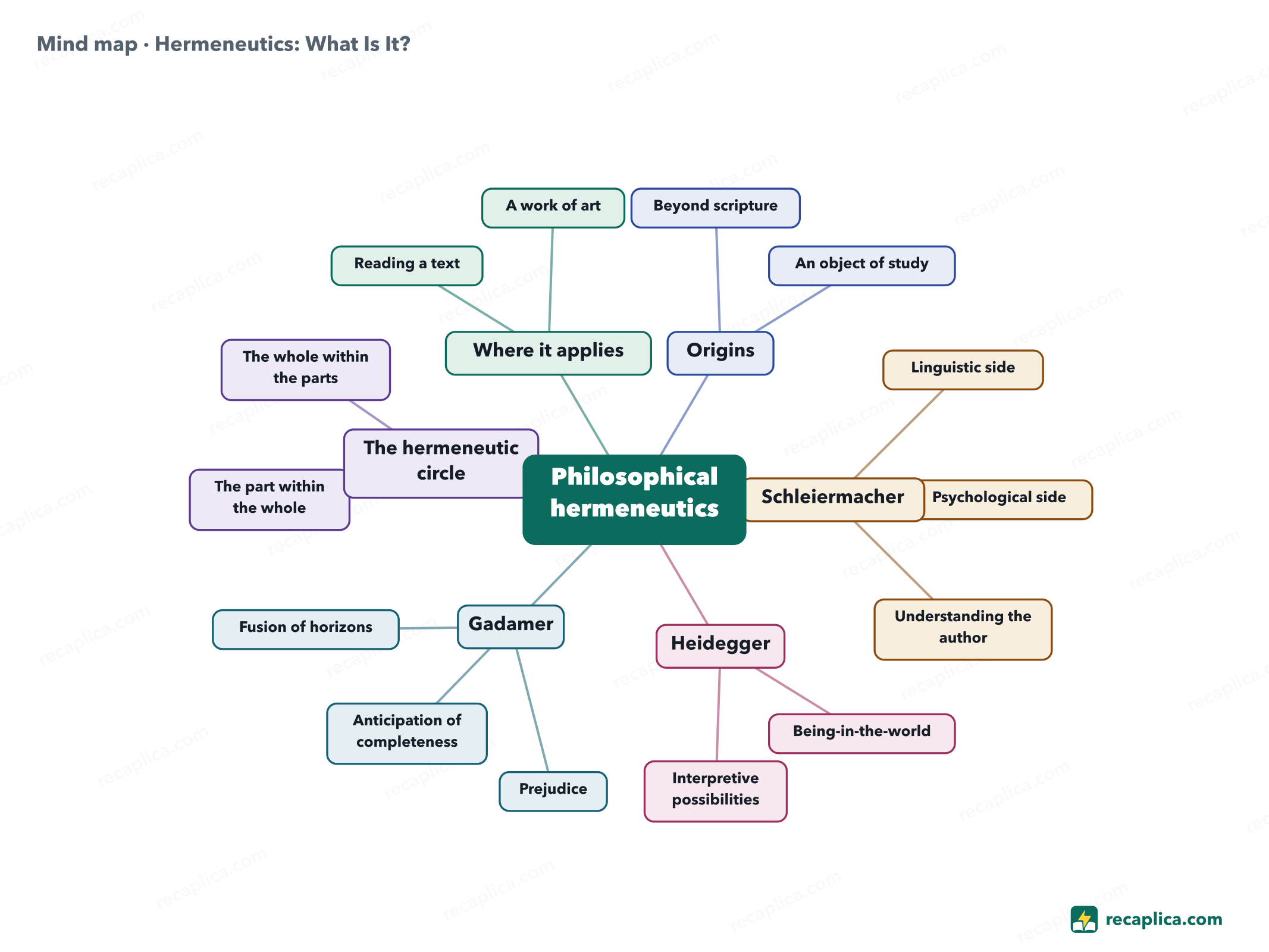
    Customize
    Mind map: Hermeneutics: What Is It?
    • Philosophical hermeneutics
      • Origins the question of how to read a text correctly
        • Beyond scripture first tied to sacred texts alone
        • An object of study interpretation examined on its own terms
      • Schleiermacher hermeneutics as a universal discipline
        • Linguistic side the rules and uses of language
        • Psychological side the author's psychology
        • Understanding the author beyond the author's own self-understanding
      • Heidegger understanding as a way of existing
        • Being-in-the-world structures that sit outside consciousness
        • Interpretive possibilities oriented by the concrete situation
      • Gadamer Wahrheit und Methode, the 1960 German edition
        • Prejudice an opening toward understanding
        • Anticipation of completeness every act of understanding assumes it
        • Fusion of horizons interpreter and text meet
      • The hermeneutic circle parts and whole explain each other
        • The part within the whole a sentence needs the whole text to make sense
        • The whole within the parts the whole text needs every sentence to make sense
      • Where it applies uses beyond the philosophy seminar
        • Reading a text literary, legal, philosophical
        • A work of art one can return to a painting over time

    Quiz: test yourself

    Answer the questions to check what you have learned: you get instant feedback and a short explanation.

    Grade 0/10 0/5
    1 What does philosophical hermeneutics mean when it treats interpretation as an "object of study"?

    The Stanford Encyclopedia of Philosophy defines philosophical hermeneutics this way: a study of interpretation pursued for its own sake, with its own questions and standards.

    2 According to Schleiermacher, which texts should hermeneutics apply to?

    For Schleiermacher, hermeneutics covers every text or discourse, religious or secular, and reaches past the biblical use it had originally grown out of.

    3 What are the two sides of interpretation Schleiermacher describes?

    Schleiermacher split interpretation into two tasks working together: recovering a language's own rules from how words are actually used, and reading the author's mind behind the text.

    4 In this account of Heidegger's view, where do the structures that make up human existence sit?

    On this reading of Heidegger, the structures of human existence sit in being-in-the-world, oriented toward what a concrete situation makes interpretable, instead of in consciousness alone.

    5 What does Gadamer mean by "fusion of horizons"?

    Gadamer treats understanding as a process in which the horizon of the interpreter and the horizon of the text or tradition being interpreted meet each other.

    Answers: 1-B · 2-C · 3-B · 4-B · 5-B

    Flashcards

    Tap the card to flip it and check whether you remember the answer, then move to the next one.

    1 / 8

    Explain it in your own words

    The ultimate test: if you can explain it in simple words, you've truly understood it. Write your explanation, then compare it with the Recap.

    Your explanation is saved only on this device.

    Philosophical hermeneutics asks what interpretation itself is, rather than treating it as a shortcut to some other goal. Schleiermacher proposed it as a universal discipline, valid for every kind of text, from scripture to literary and legal writing. Heidegger moved the question from method to existence: understanding becomes a way of being, shaped by the situation a person is already in. Gadamer pulled these threads together in "Truth and Method" and argued that understanding a text means letting its horizon meet the reader's own.

    Frequently asked questions

    What does it mean to interpret a text, in philosophy?

    It means looking for a text's sense by relating its parts to the whole, and one's own point of view to the text's. For Gadamer, this meeting is called a fusion of horizons: neither the text nor the reader is canceled out.

    Who is Gadamer, and why does he matter for hermeneutics?

    Hans-Georg Gadamer is, according to the Stanford Encyclopedia of Philosophy, the decisive figure in twentieth-century hermeneutics. He published "Truth and Method" in 1960, after being shaped above all by Heidegger's influence.

    What separates Heidegger and Gadamer on interpretation?

    Heidegger places understanding within human existence itself, as a way of being in the world. Gadamer takes up that view and builds it into a theory of hermeneutic truth, distinct from the truth reached through scientific method.

    What is the hermeneutic circle?

    It is the relation between the parts of a text and the text as a whole: understanding a sentence needs the wider context, and understanding the wider context needs the individual sentences.

    Does hermeneutics only apply to literary or religious texts?

    No. For Schleiermacher it applies to every kind of text or discourse - literary, legal, sacred, written or spoken, new or old - not to a single field.

    Sources

    • Hermeneutics (Stanford Encyclopedia of Philosophy)
    • Hans-Georg Gadamer (Stanford Encyclopedia of Philosophy)
    • Friedrich Daniel Ernst Schleiermacher (Stanford Encyclopedia of Philosophy)

    Every Recap goes through an independent review before publication.

    Every evening, the day's new Recaps on our Telegram channel. Join the channel →

    Keep learning

    • History What Is Epistemology? How Philosophy Looks at Science Epistemology is the branch of philosophy that studies knowledge, especially scientific knowledge: what makes it count as knowledge, how it gets justified, when a belief earns the name. The word comes from the Greek episteme (knowledge) and logos (account), and the Scottish philosopher James Frederick Ferrier was the first to propose it. In Italian usage the term names the critical study of how the sciences are logically built and how they work; in English-speaking countries epistemology covers the theory of knowledge in general. One of its classic problems is the line Karl Popper drew between science and pseudoscience. Read the Recap →
    • History Wittgenstein and Analytic Philosophy: The Philosopher Who Changed His Mind Twice According to the Stanford Encyclopedia of Philosophy, Ludwig Wittgenstein was born in Vienna in 1889 and became one of the most influential philosophers of the twentieth century, despite publishing only one book in his lifetime. He trained first as an aeronautical engineer, then met Gottlob Frege and Bertrand Russell and turned to the philosophy of language, arguing in the Tractatus Logico-Philosophicus that traditional philosophical problems grow out of confused uses of words, a claim that struck the logical positivists of the Vienna Circle deeply. Later, in the Philosophical Investigations, he abandoned that logical system to focus on how people actually use words. Together, the two works are the most cited starting point for twentieth-century analytic philosophy. Read the Recap →
    • History Tractatus Logico-Philosophicus: What It Is and What It Says The Tractatus Logico-Philosophicus is the only philosophy book Ludwig Wittgenstein published during his lifetime, first printed in German in 1921 and translated into English the following year. In its pages the world is the totality of facts that are the case. A proposition, for Wittgenstein, works like a picture: its logical structure matches, point for point, the structure of the state of affairs it depicts, and this shared structure is what connects language to reality. The book then draws a line between what can be said with sense and what lies beyond that limit, ethics and aesthetics included, and closes with an injunction to stay silent about the rest. Read the Recap →

    recaplica

    Clear in 30 seconds, yours in 10 minutes.

    Recaps Mind maps Request a Recap Telegram channel Mind map maker Our method About Privacy & cookies Legal notes & terms of use

    © 2026 Recaplica · A project by Curi S.r.l. — VAT IT05472000750

    Statistics, only if you say so

    To learn which Recaps help most we would use Google Analytics, with aggregate, anonymous data. It starts only with your OK, and you can change your mind anytime. Privacy policy