|
recaplica
Tractatus Logico-Philosophicus: What It Is and What It Says |
| © 2026 Recaplica · recaplica.com — All rights reserved |
Tractatus Logico-Philosophicus: What It Is and What It SaysWhat to print Page numbers appear when printing with default margins. SlidesChoose a cut Flash10 slidesThe essential thread, to present in classFull14 slidesEvery chapter and the deeper detailBoth come with speaker notes. In 30 seconds quick readThe Tractatus Logico-Philosophicus is the only philosophy book Ludwig Wittgenstein published during his lifetime, first printed in German in 1921 and translated into English the following year. In its pages the world is the totality of facts that are the case. A proposition, for Wittgenstein, works like a picture: its logical structure matches, point for point, the structure of the state of affairs it depicts, and this shared structure is what connects language to reality. The book then draws a line between what can be said with sense and what lies beyond that limit, ethics and aesthetics included, and closes with an injunction to stay silent about the rest. Key Points
Deep DiveWhat the Tractatus Logico-Philosophicus isAccording to the Stanford Encyclopedia of Philosophy, the Tractatus Logico-Philosophicus first appeared in German in 1921; the following year came C.K. Ogden’s English translation, made with the collaboration of F.P. Ramsey. The Internet Encyclopedia of Philosophy calls it the only philosophy book Ludwig Wittgenstein published during his lifetime. The work presented itself as a solution to the major problems of philosophy, and the same source notes that it was held in high esteem by the logical positivists, despite their openly anti-metaphysical stance. The Tractatus marks the first stretch of Wittgenstein’s philosophical path, from the early work on logic to his later thought on ordinary language. The picture theory of languageThe heart of the book is the picture theory. A proposition works as a model of reality, made up of elements that together constitute it. That picture’s structure — whether it lives in thought or in language — matches point for point how the state of affairs it depicts is itself put together; it is this shared structure, according to the Tractatus, that connects the picture to reality. The world and thought share with the proposition the same logical form, and this is the condition that lets thought, in the shape of a proposition, represent the world. The Internet Encyclopedia of Philosophy uses a similar image, calling a proposition a picture of reality.
The world as a totality of factsThe question of what the world is, and how language can speak of it, did not begin with Wittgenstein: the logic of Aristotle and the debates of scholastic philosophy had already raised it, in different terms. The Tractatus takes it up from a new angle, centered on the relationship between language and reality. The book’s opening proposition, in the Ogden/Ramsey translation available on The Wittgenstein Project, defines the world as everything that is the case, that is, the totality of existing facts. The world, for Wittgenstein, is thus the totality of facts. The book adds that states of affairs are combinations of simple objects, which can nonetheless combine with each other in various determinate ways: the same handful of objects, arranged differently, produces different states of affairs. For Wittgenstein, it is the proposition as a whole that has sense, and a name taken on its own has meaning only within the context of a proposition: isolated from any sentence, it signifies nothing definite. Saying and showing: the limit of languageThe book distinguishes between what language can say explicitly and what can only show itself through its logical form: propositions display the logical form of reality, the Internet Encyclopedia of Philosophy explains, rather than describing it as further content. For Wittgenstein, the limits of a person’s language coincide with the limits of their world: what cannot be said in a proposition with sense falls outside that world. The Tractatus identifies the set of true propositions with the whole of natural science and excludes from that domain ethics, aesthetics and metaphysics: subjects that remain outside the limits of what a proposition can say with sense. The final proposition: silence beyond what can be saidIn the Ogden/Ramsey translation, the book’s final proposition — number 7 — closes the work with an injunction to silence about everything that exceeds the limits of meaningful language. The Pears/McGuinness translation, in its own words, reaches the same point: it urges silence about what cannot be spoken of with sense. It is the most quoted proposition in the Tractatus. It marks the limit beyond which the book itself, made of propositions about the world, stops being able to speak with sense. Slide deckSlides ready to download and make your own in PowerPoint or Google Slides, with speaker notes. Pick the Flash cut or the Full one.     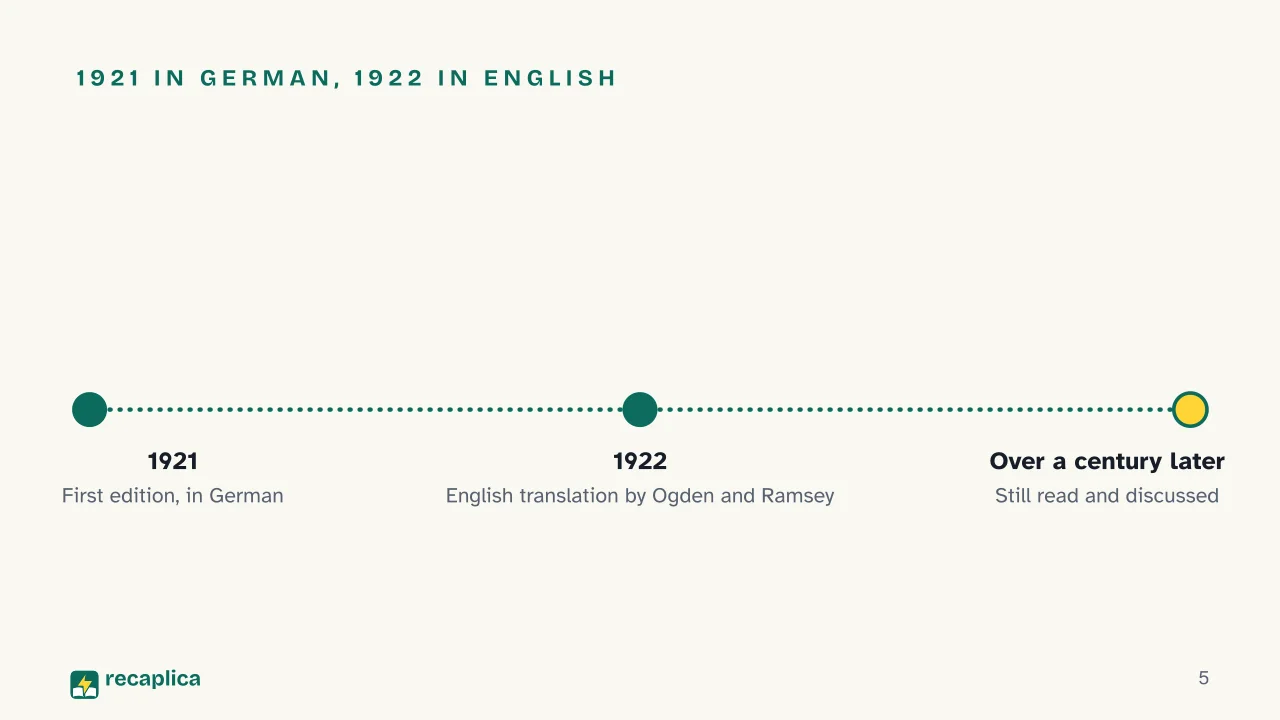  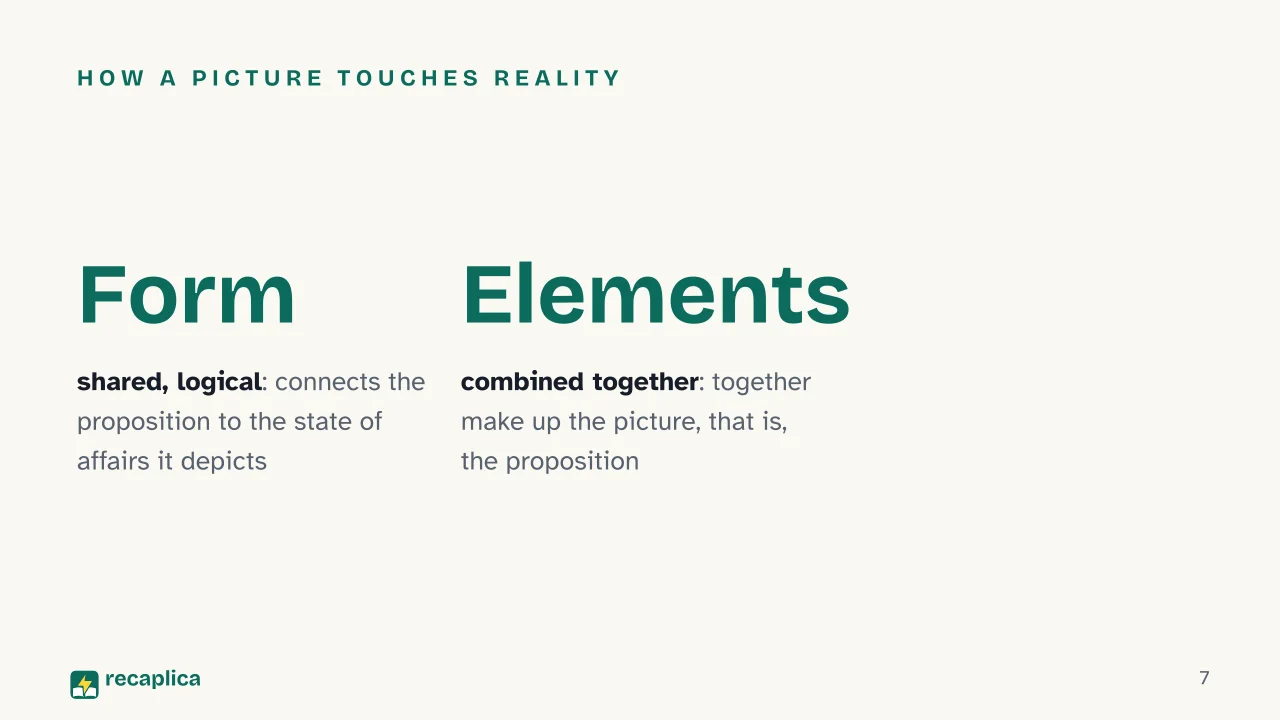 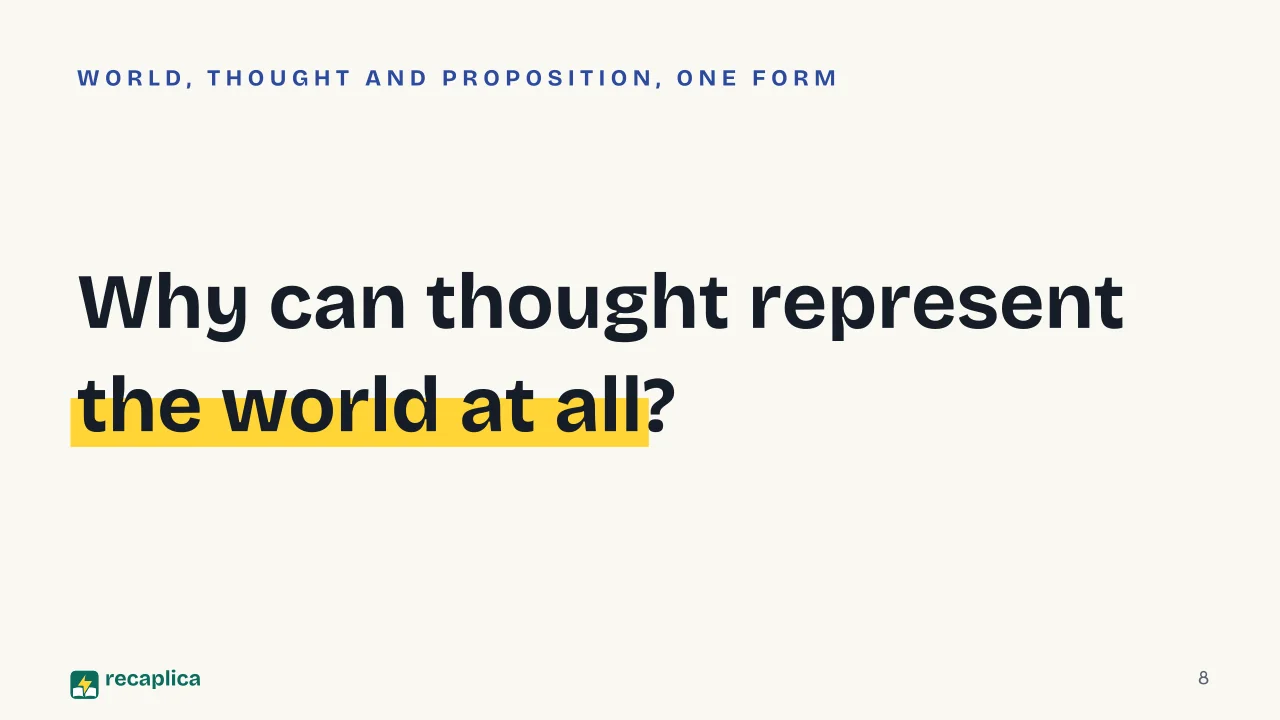  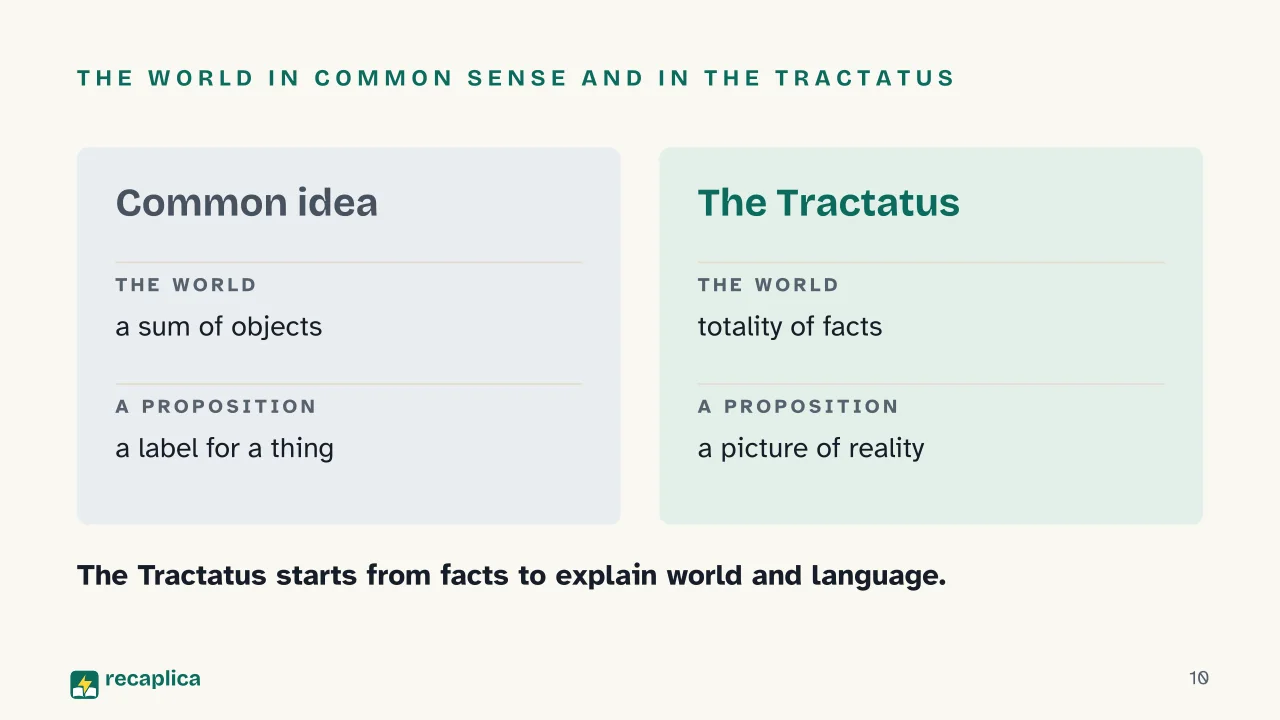  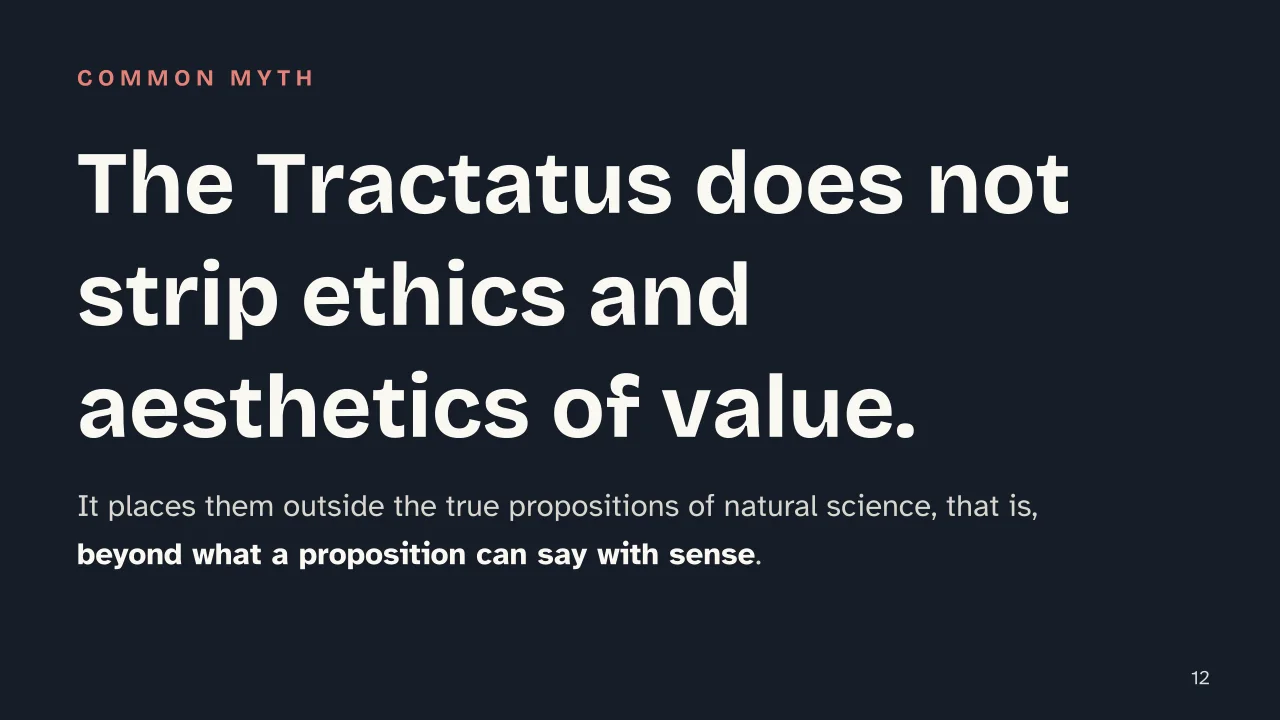 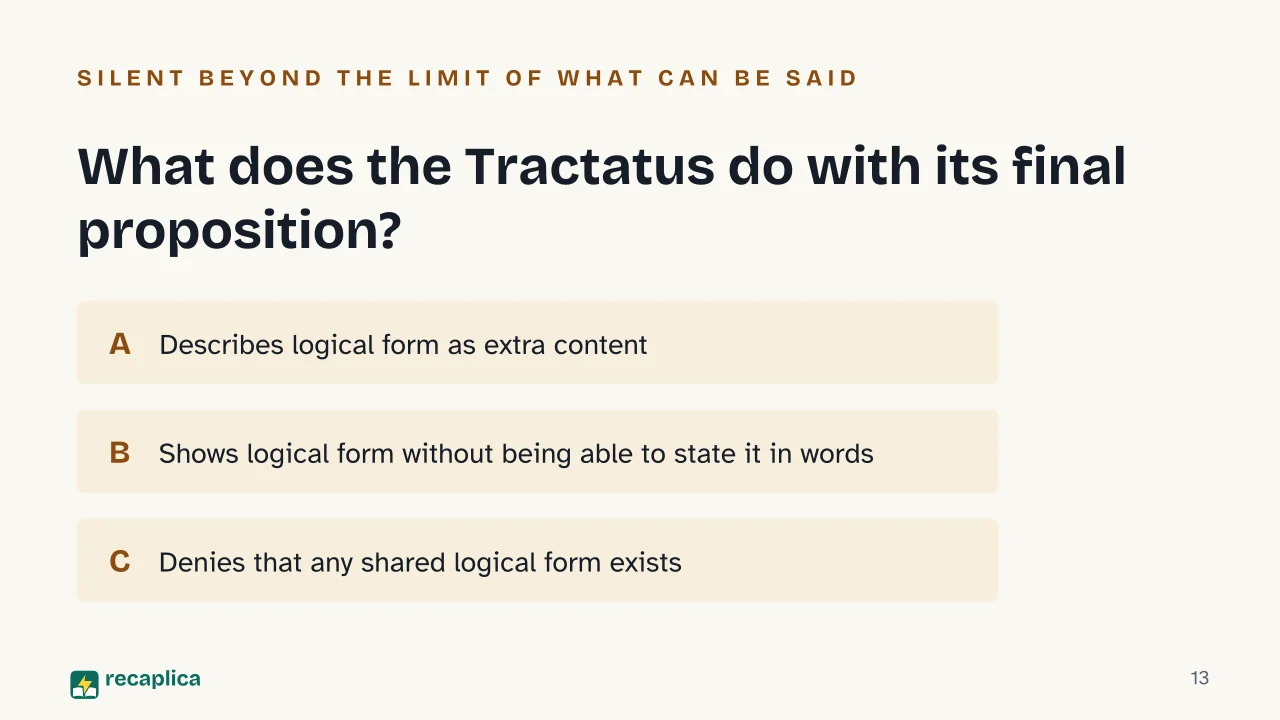  Common myths
Mind mapDrag the background to move around and the nodes to reposition them; use − and + to collapse and expand branches. 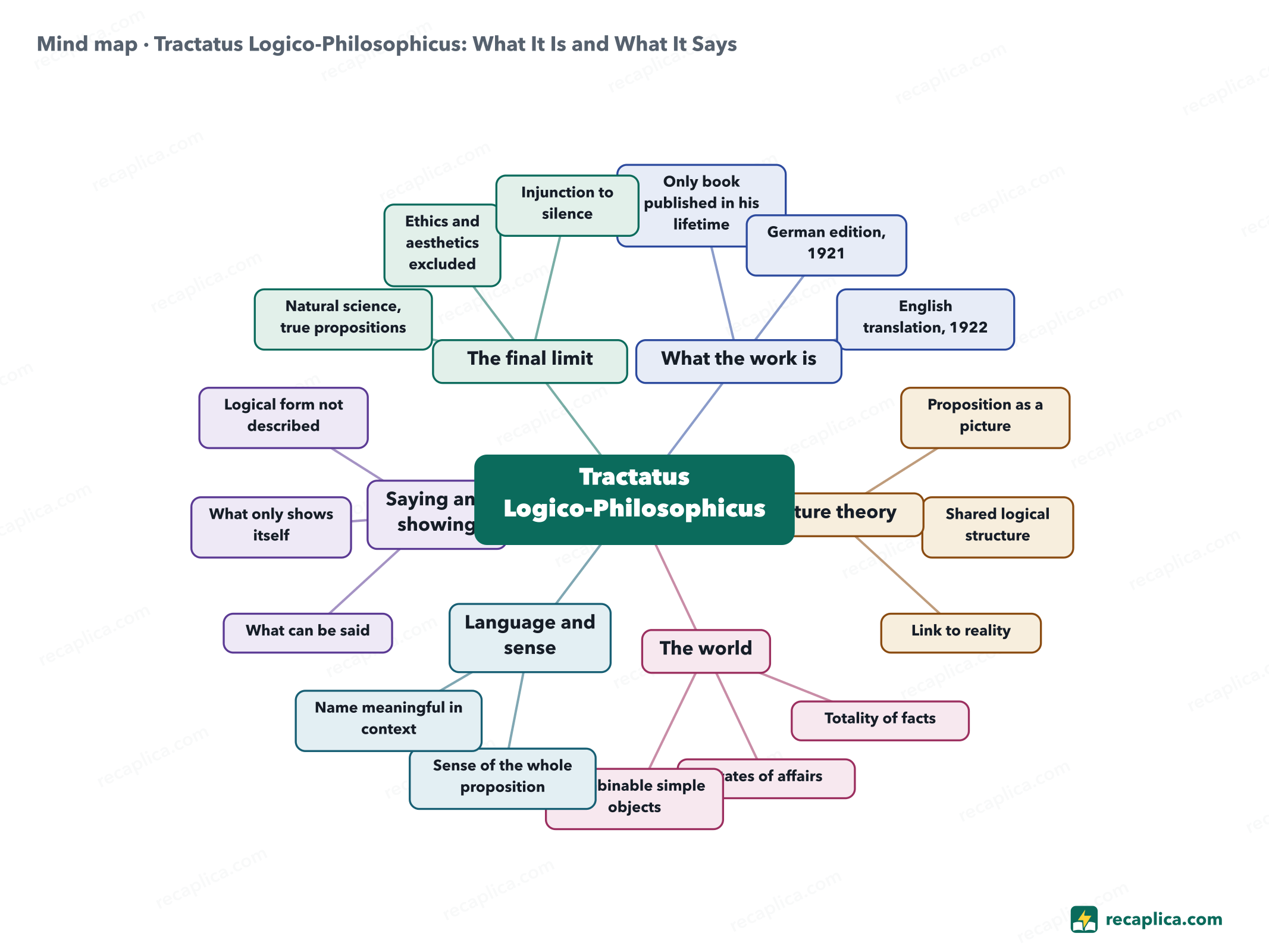
Quiz: test yourselfAnswer the questions to check what you have learned: you get instant feedback and a short explanation. Grade 0/10 0/5
FlashcardsTap the card to flip it and check whether you remember the answer, then move to the next one. 1 / 7 Explain it in your own wordsThe ultimate test: if you can explain it in simple words, you've truly understood it. Write your explanation, then compare it with the Recap. Your explanation is saved only on this device.
Frequently asked questionsIs the Tractatus Logico-Philosophicus hard to read?The text is written as short, numbered propositions, each one tightly packed with a logical step, which is why it is usually read alongside a commentary. What does the Tractatus's closing line about silence mean?It is proposition 7, the last in the book. In the Ogden/Ramsey translation the work ends by urging silence about everything beyond the limits of meaningful language; the Pears/McGuinness translation reaches the same point by telling the reader to stay silent about what cannot be spoken of with sense. What is the relationship between the Tractatus and logic?In the Tractatus, logic is the structure that world, thought and proposition hold in common, and that common structure is what makes representation possible in the first place. Does the Tractatus discuss ethics?Ethics, aesthetics and metaphysics are left, by the Tractatus, outside the set of true propositions of natural science: a boundary set on language itself, not a verdict on their worth. Who translated the Tractatus into English?C.K. Ogden, working with F.P. Ramsey, in 1922, a year after the first German edition of 1921. Every Recap goes through an independent review before publication. |