|
recaplica
Inductive and Deductive Reasoning: What Sets Them Apart | |||||||||||||||
| © 2026 Recaplica · recaplica.com — All rights reserved | |||||||||||||||
Inductive and Deductive Reasoning: What Sets Them ApartWhat to print Page numbers appear when printing with default margins. SlidesChoose a cut Flash10 slidesThe essential thread, to present in classFull14 slidesEvery chapter and the deeper detailBoth come with speaker notes. In 30 seconds quick readDeductive reasoning starts from general premises and, if they're true, guarantees the truth of the conclusion: Aristotle's syllogism is the classic model. Inductive reasoning climbs in the opposite direction, from particular cases up to a general conclusion that only carries a degree of probability, the path Francis Bacon mapped out in the Novum Organum in 1620. David Hume questioned whether that second path could ever be guaranteed, since a pattern seen in the past might simply fail to hold in the future. Science and daily life both lean on each method, depending on whether the goal is certainty or a generalization drawn from what's been observed. Key Points
Deep DiveFrom the General to the Particular, and Back AgainA syllogism like “all tigers are mammals, no mammal has scales, so no tiger has scales” shows deduction in its cleanest form. The Internet Encyclopedia of Philosophy calls an argument of this kind valid when its logical shape leaves no room for true premises to end in a false conclusion: two categorical premises are enough to close off every exit besides the one they point to. Induction runs the other way, building from particular cases toward a general claim; the Stanford Encyclopedia of Philosophy notes that true premises support an inductive conclusion only to some degree of probability, never with that same absolute guarantee. Watching a hundred white swans doesn’t prove every swan is white, it only adds supporting evidence — and that line separates the two kinds of argument: one only ever adds support, the other closes the case.
Aristotle and the Model of the SyllogismAristotle gave deduction its technical name through the syllogism. The Internet Encyclopedia of Philosophy notes that later commentators gathered Aristotle’s six logical treatises into a collection called the Organon, “instrument,” regarded as a general method for rigorous reasoning. Aristotle himself frames a syllogism as an argument where granting a set of statements forces a further claim to follow, simply because of how the argument is built. The example most quoted in logic textbooks, with Socrates and mortal men, doesn’t appear in Aristotle’s own texts: the same Internet Encyclopedia of Philosophy makes that point. It’s a classroom example that turned proverbial. Aristotle’s historical credit lies in giving this type of argument a full theory, not in that one textbook sentence. The piece on Who Was Aristotle? Logic, Nature, and Virtue, Summarized covers the rest of his thinking. Francis Bacon and the Reverse Path
Francis Bacon proposed the reverse direction to the syllogism in the Novum Organum, published in 1620. His method moves in stages, one claim building on the last, and reaches the general only as the final step instead of starting from the broadest principles. Every step toward a generalization is tested against observation and experiment, and for Bacon gathering those facts comes first, pursued in its own right well ahead of any generalizing; that stage occupies most of the method. The Recap on Francis Bacon’s Inductive Method: The Philosopher Behind the Novum Organum traces the setting this proposal came from, from rejecting given general principles to building knowledge one step at a time. The Problem Hume Left OpenDavid Hume is the one who exposed the sharpest edge of that difference. For Hume, a pattern repeated for years could still break down tomorrow without breaking any rule of logic: a past regularity stays a point in favor, never a proof. A deductive argument, by contrast, sets a conclusion whose denial would be contradictory in itself, and that’s where its certainty comes from. Hume lands on the core of the problem of induction this way: reason alone can’t justify stretching past experience beyond the cases already observed, a point the Recap on David Hume: The Empiricism That Questioned Cause and Effect places inside his broader project on human knowledge. Slide deckSlides ready to download and make your own in PowerPoint or Google Slides, with speaker notes. Pick the Flash cut or the Full one.   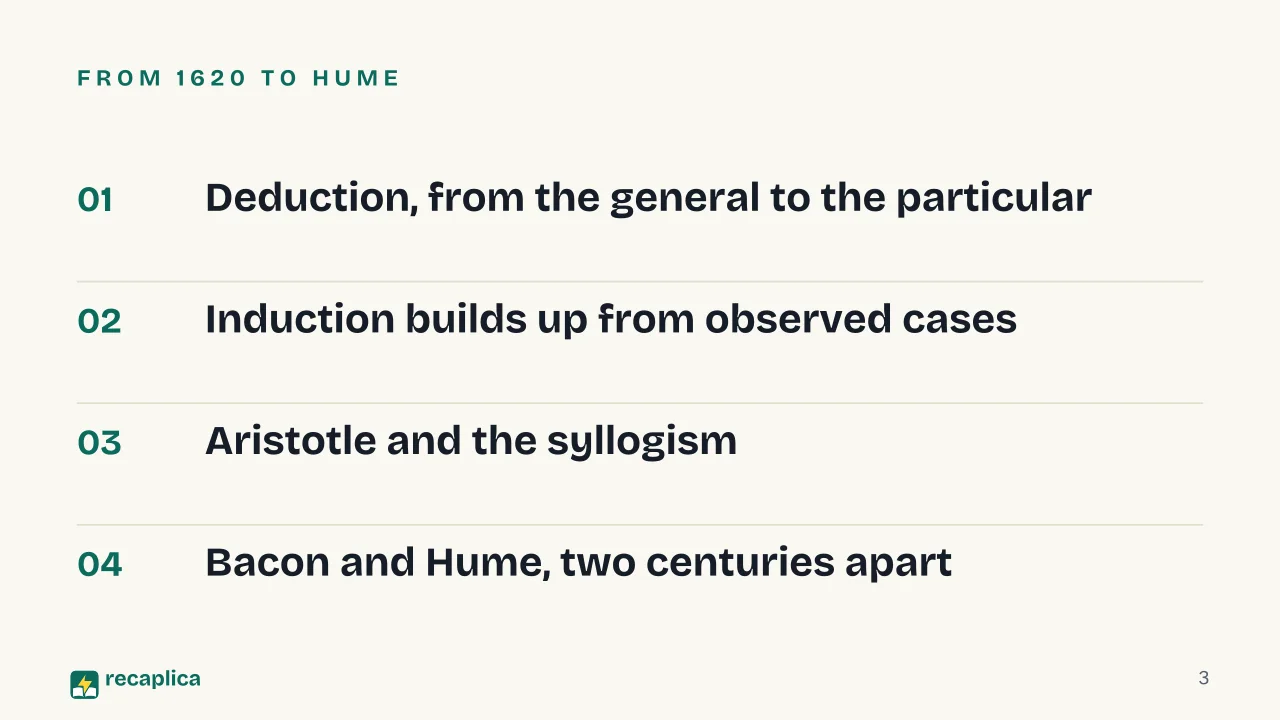  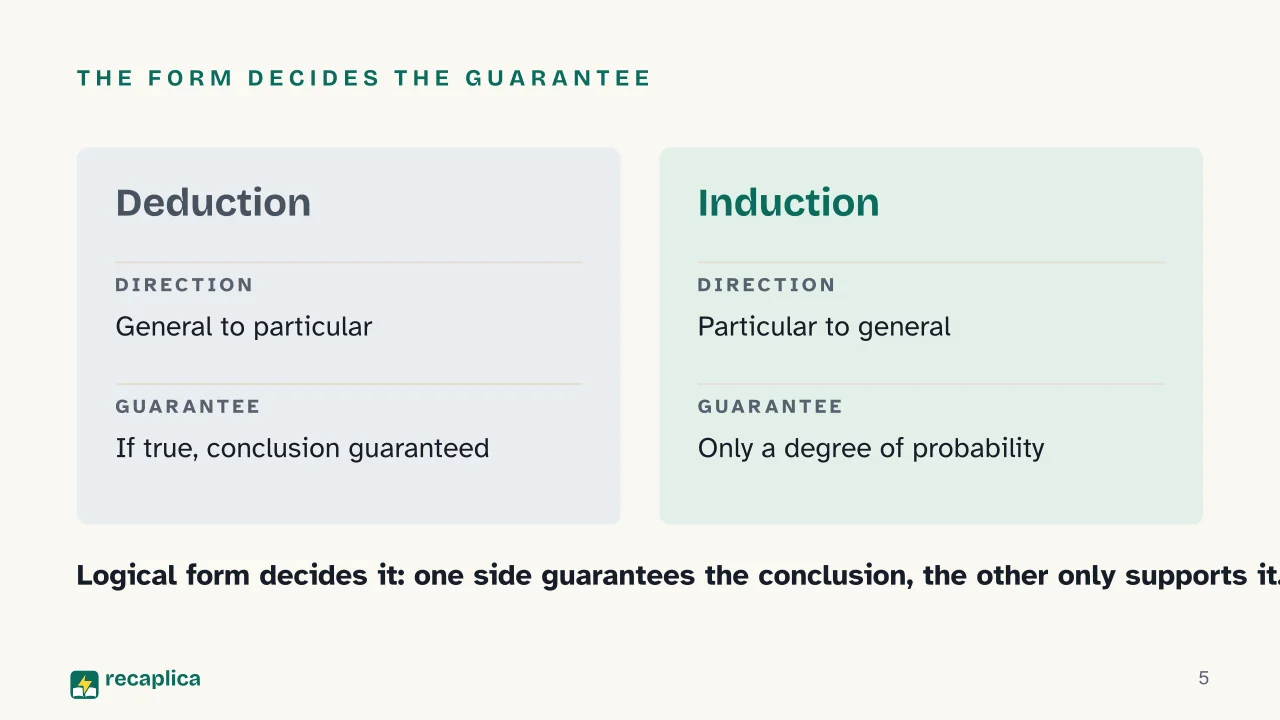  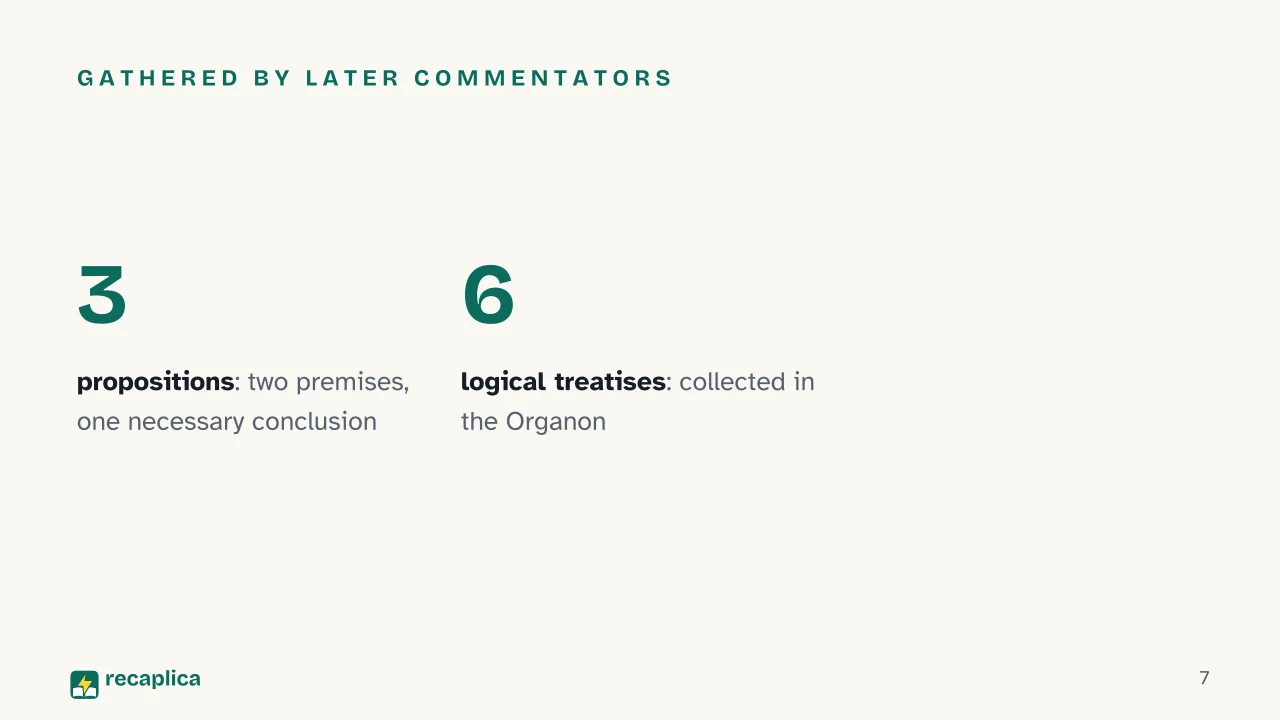 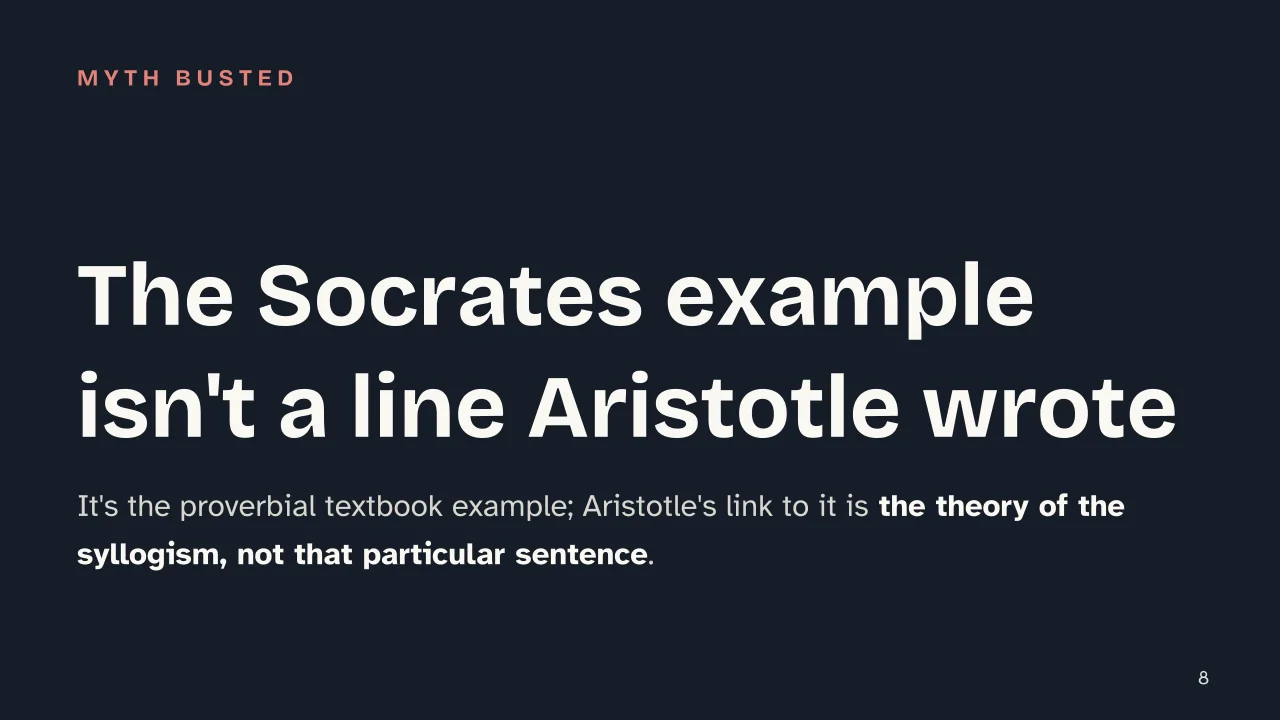  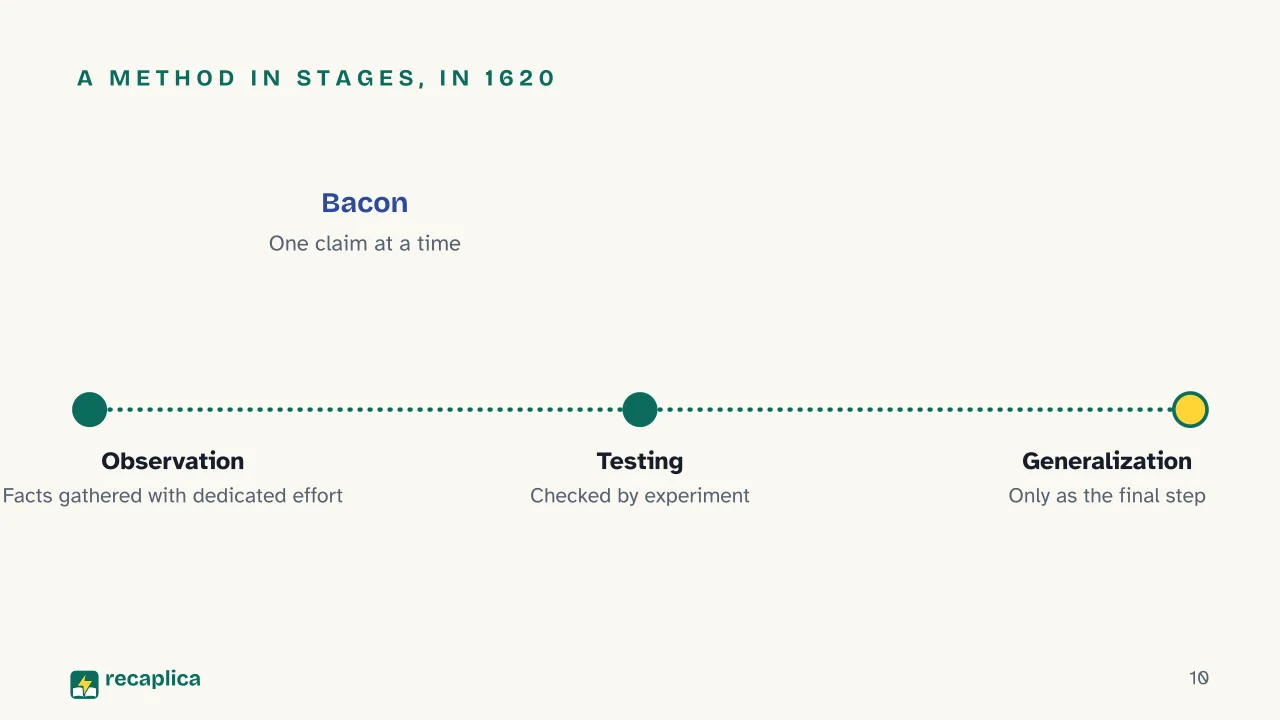  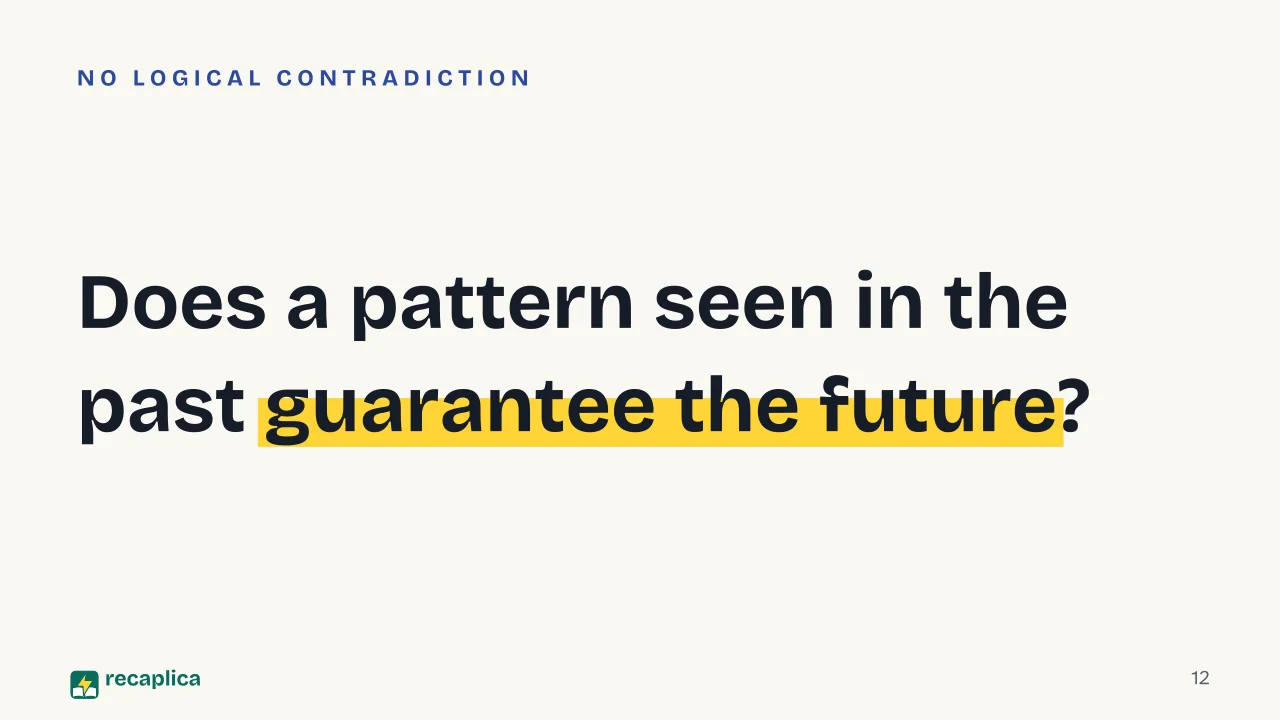 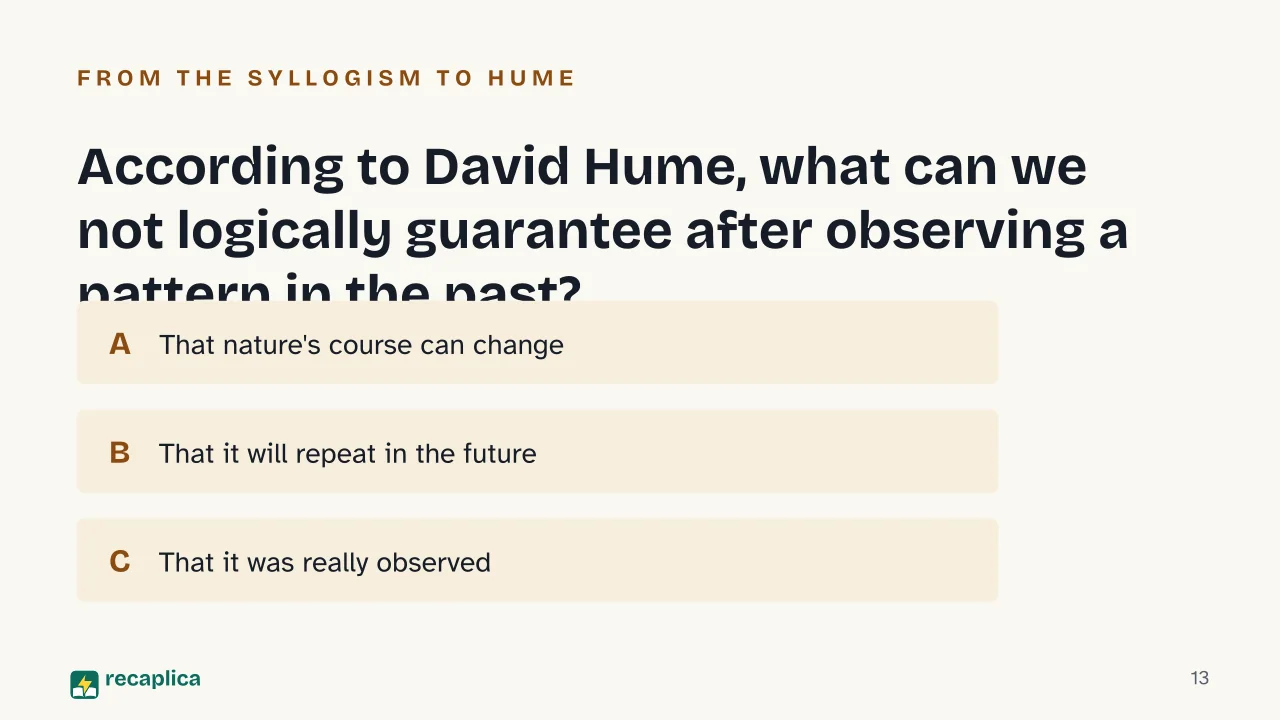  Common myths
Mind mapDrag the background to move around and the nodes to reposition them; use − and + to collapse and expand branches. 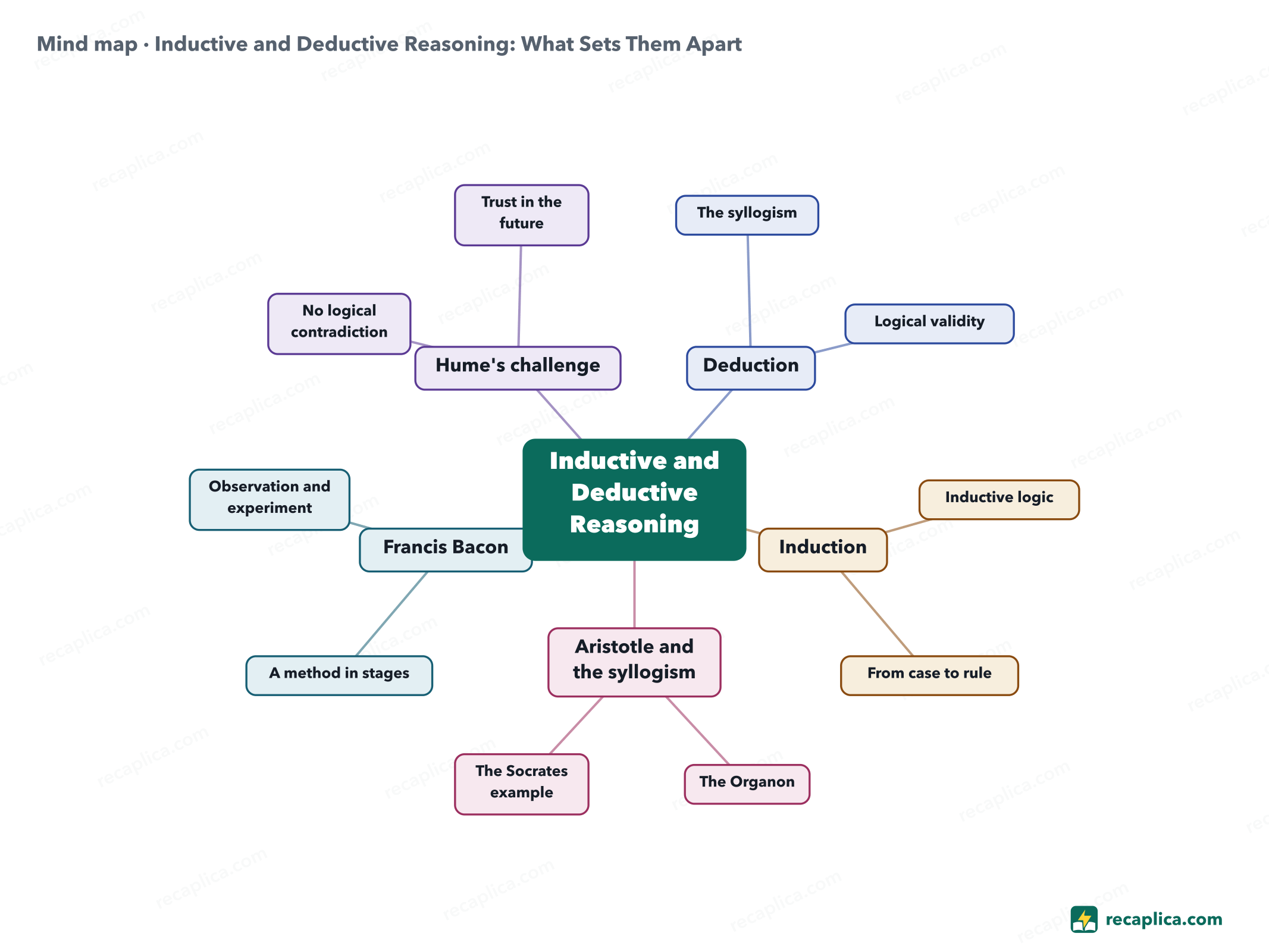
Quiz: test yourselfAnswer the questions to check what you have learned: you get instant feedback and a short explanation. Grade 0/10 0/5
FlashcardsTap the card to flip it and check whether you remember the answer, then move to the next one. 1 / 7 Explain it in your own wordsThe ultimate test: if you can explain it in simple words, you've truly understood it. Write your explanation, then compare it with the Recap. Your explanation is saved only on this device.
Frequently asked questionsWhat is deductive reasoning?Deductive reasoning starts from general premises and reaches a conclusion that is guaranteed true whenever the premises are true, as in Aristotle's syllogism; the Stanford Encyclopedia of Philosophy treats this guarantee as the defining mark of a sound deductive argument. What is inductive reasoning?Inductive reasoning starts from particular cases and builds up to a general conclusion, which the Stanford Encyclopedia of Philosophy says is supported only to some degree of probability, never with the same absolute guarantee as deduction. What's the difference between inductive and deductive reasoning?Deduction moves from general premises to a conclusion that follows of necessity, while induction moves from particular cases to a general claim backed only by probability, the contrast Francis Bacon's Novum Organum put at the center of his method against Aristotle's syllogism. Is Aristotle's syllogism an example of inductive or deductive reasoning?It's deductive: two categorical premises are enough to force the conclusion, as in the tigers example the Internet Encyclopedia of Philosophy uses to link being a mammal with having no scales. Why doesn't induction deliver certainty, according to David Hume?Because, for Hume, nature's course could change without any logical contradiction; seeing something happen the same way for years doesn't guarantee how the next case will turn out, and reason alone can't close that gap. Every Recap goes through an independent review before publication. |