Skip to content
recaplica

    One moment: security check

    Cloudflare wants to make sure you're not a robot. Tick the box below and your search will continue on its own.

    IT
    recaplica Caspar David Friedrich: Life and Major Works
    © 2026 Recaplica · recaplica.com — All rights reserved
    Home › History

    Caspar David Friedrich: Life and Major Works

    By Recaplica Newsroom · Updated on October 6, 2026

    What to print

    Page numbers appear when printing with default margins.

    Slides

    Choose a cut

    Flash10 slidesThe essential thread, to present in classFull15 slidesEvery chapter and the deeper detail

    Both come with speaker notes.

    Telegram channel
    recaplica Clear in 30 seconds, yours in 10 minutes.
    In 30 seconds Key points Figures Deep dive Slides Myths Mind map Quiz Flashcards FAQ

    In 30 seconds quick read

    Caspar David Friedrich (1774-1840) led German Romantic painting. Born in Greifswald, he trained at the Copenhagen academy and in 1798 settled in Dresden, where he lived for the rest of his life. His best-known paintings, including Wanderer above the Sea of Fog and The Sea of Ice, now hang at the Hamburger Kunsthalle. After a public breakthrough at the 1810 Berlin Academy exhibition his reputation faded, only to be recovered in 1906 and again in 1975.

    Key Points

    • Caspar David Friedrich was born in 1774 in Greifswald and died in 1840 in Dresden.
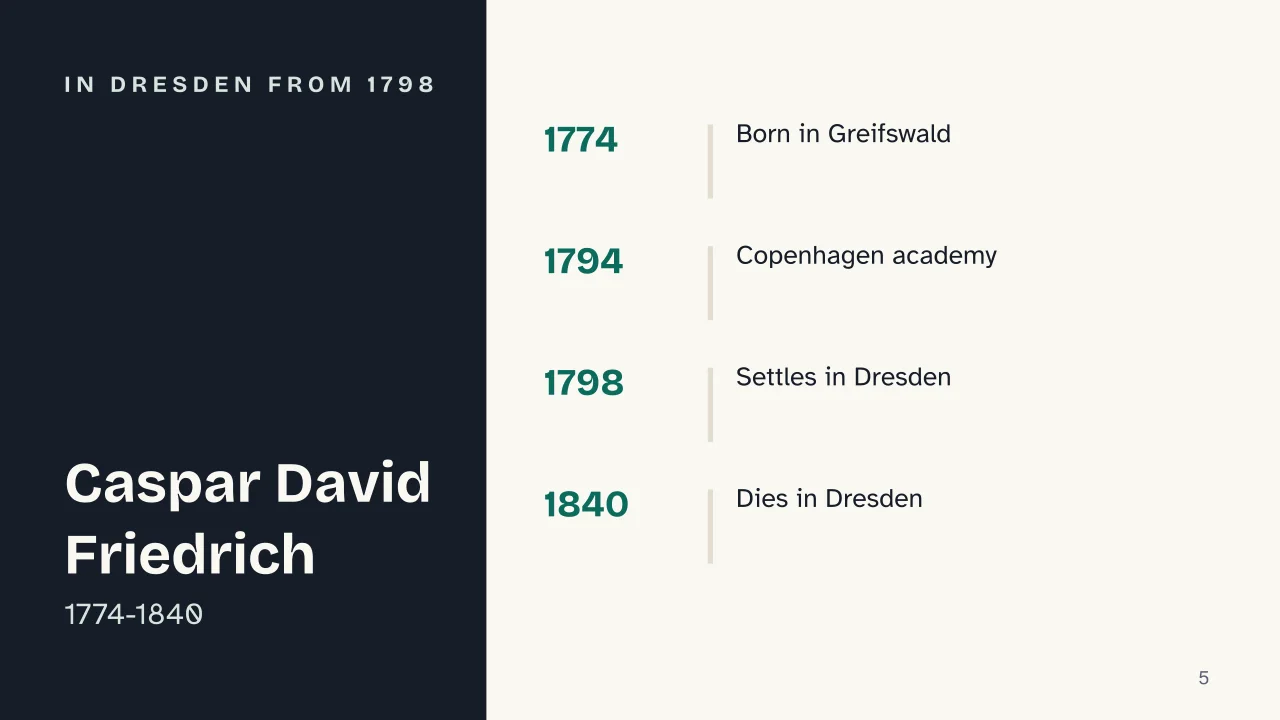
    • He trained at the Copenhagen academy from 1794 and settled in Dresden in 1798, staying there for the rest of his life.
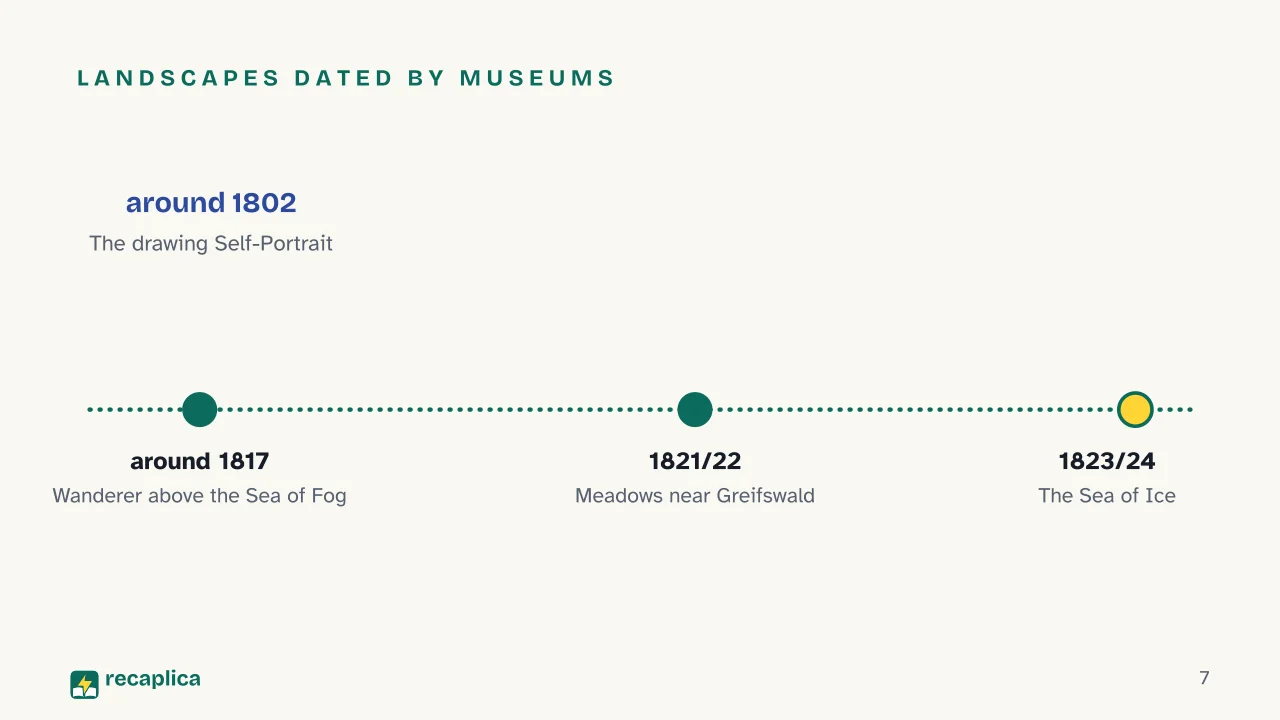
    • Wanderer above the Sea of Fog, dated by the Hamburger Kunsthalle to around 1817, is his most famous painting.
    • In 1810 he won his first public recognition at the Berlin Academy exhibition; his reputation declined in the years that followed.
    • Monk by the Sea and Abbey among Oak Trees, restored between 2013 and 2016, are what the Staatliche Museen zu Berlin calls the single best-known duo German Romanticism produced.
    • Friedrich's reputation was recovered in 1906 and again in 1975, after Nazi propaganda had attached a stigma to his imagery.

    Key figures

    • around 1817 Year the Hamburger Kunsthalle assigns to the painting Wanderer above the Sea of Fog. Source: Hamburger Kunsthalle
    • 450 thalers Price the fifteen-year-old crown prince of Prussia paid in 1810 for two paintings by Friedrich shown at the Berlin Academy. Source: Tate Etc., 2008
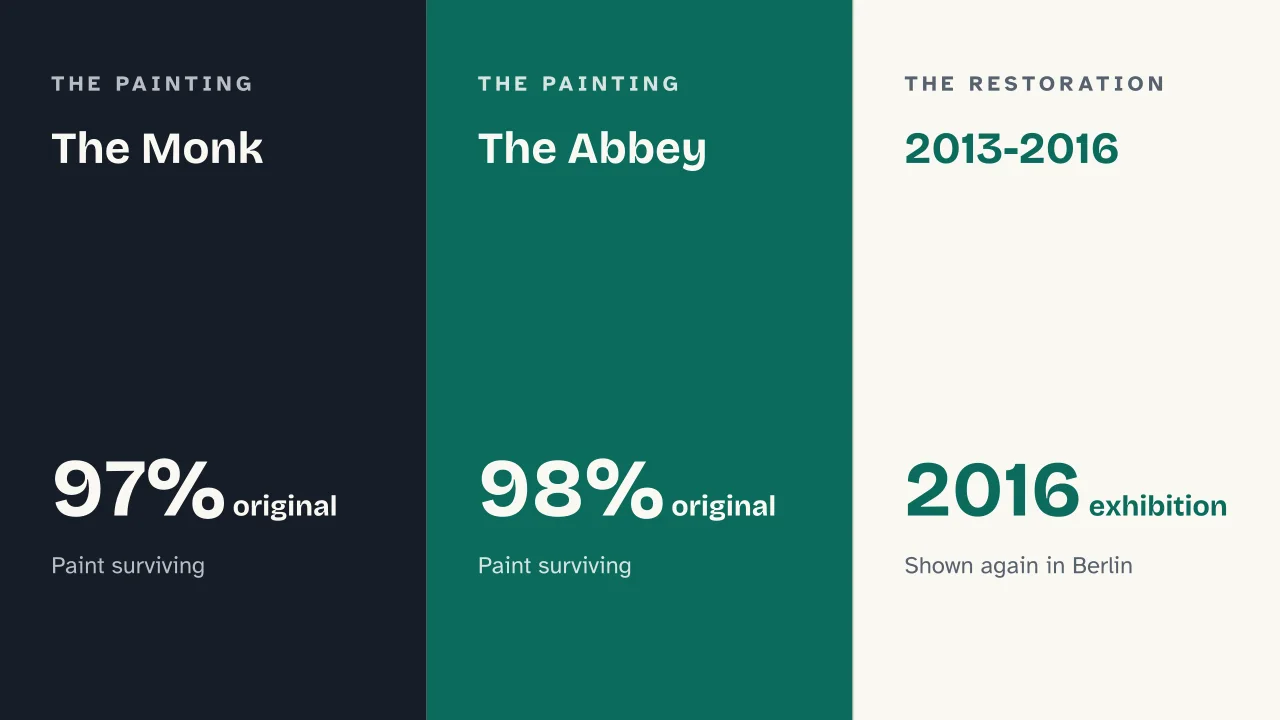
    • 97% and 98% Share of original paint surviving, according to the 2013-2016 restoration, in Monk by the Sea and Abbey among Oak Trees respectively. Source: Staatliche Museen zu Berlin

    Deep Dive

    A painter in Dresden

    Caspar David Friedrich was born in 1774 in Greifswald, on the Baltic coast. He trained in his hometown and then, from 1794, at the Copenhagen art academy. In 1798 he moved to Dresden, where he stayed for the rest of his life: from there, according to the Städel Museum in Frankfurt, he made regular trips — to the island of Rügen from 1801 onward, with stops at Berlin, Neubrandenburg, Saxon Switzerland and Greifswald itself. In Dresden his career grew intertwined with the city’s art institutions: in 1816 Friedrich became a member of the Dresden Academy, which in 1824 appointed him professor of landscape painting. In 1808, partway through this period, he showed the painting Cross in the Mountains, also known as the Tetschen Altar, in his studio: the work set off a critical row that history remembers as the “Ramdohr dispute.”

    The 1810 breakthrough, and the decline

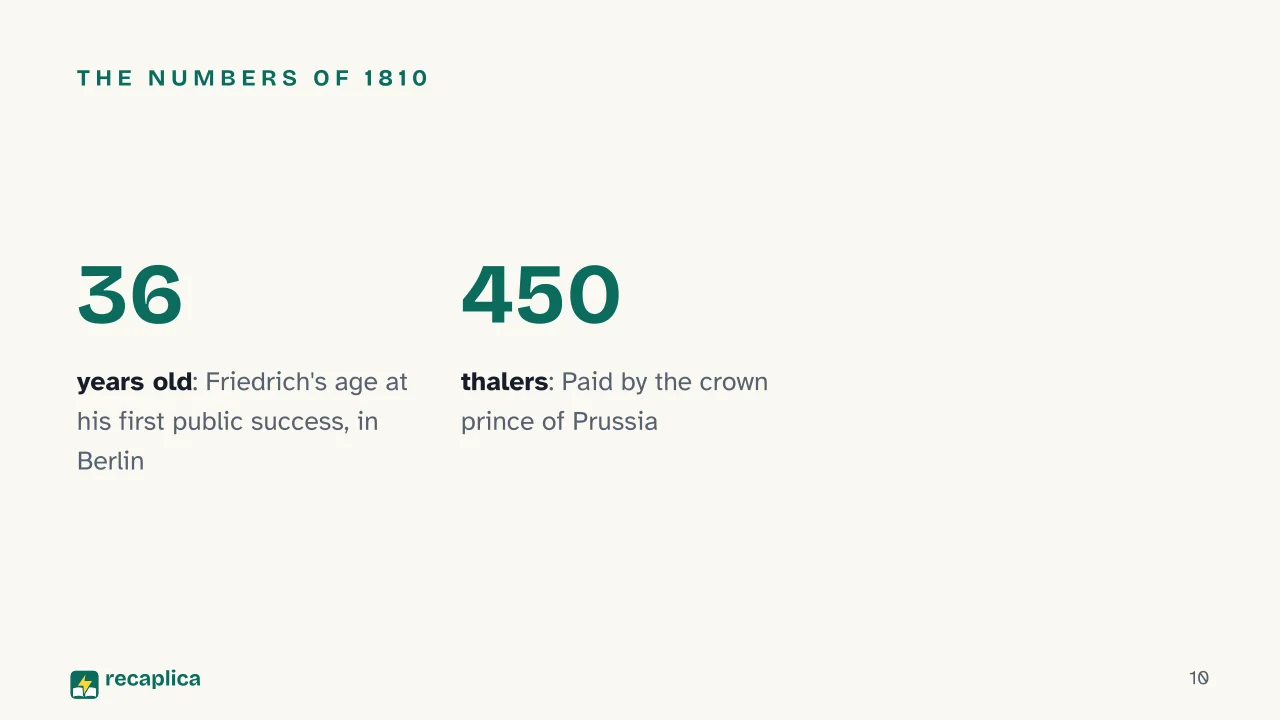
    In 1810, at 36, Friedrich won his first real public success by exhibiting a painting at the Berlin Academy, as Tate’s magazine recounts in a 2008 article. The fifteen-year-old crown prince of Prussia, Friedrich Wilhelm, liked two paintings shown on that occasion and bought them for 450 thalers.

    The good run did not last. According to Tate Etc., Friedrich’s critical fortune fell fairly quickly after that 1810 success: the sources do not spell out why taste turned, only that his Romanticism went out of fashion. His output, the Städel Museum notes, also began to slow from 1826 onward, until his death in Dresden in 1840.

    Caspar David Friedrich’s major paintings

    The painting most associated with Friedrich’s name today, held at the Hamburger Kunsthalle, is Wanderer above the Sea of Fog, which the museum dates to “around 1817.”

    The same Hamburger Kunsthalle also holds The Sea of Ice, an oil on canvas measuring 96.7 by 126.9 centimeters dated by the museum to 1823/24, and Meadows near Greifswald, from 1821/22. The museum also keeps an earlier drawing, the Self-Portrait with Propped-Up Arm — pen and brown ink over pencil, dated to “around 1802.” A Hamburger Kunsthalle exhibition devoted to Friedrich has brought together more than 60 paintings and around 100 drawings by the artist.

    Practical example: when a museum writes that a work is dated “around 1817,” it is not rounding out of laziness. It means no document carries the exact date, and the estimate comes from stylistic comparison with other works whose dates are certain.

    The Abbey among Oak Trees and the Monk by the Sea

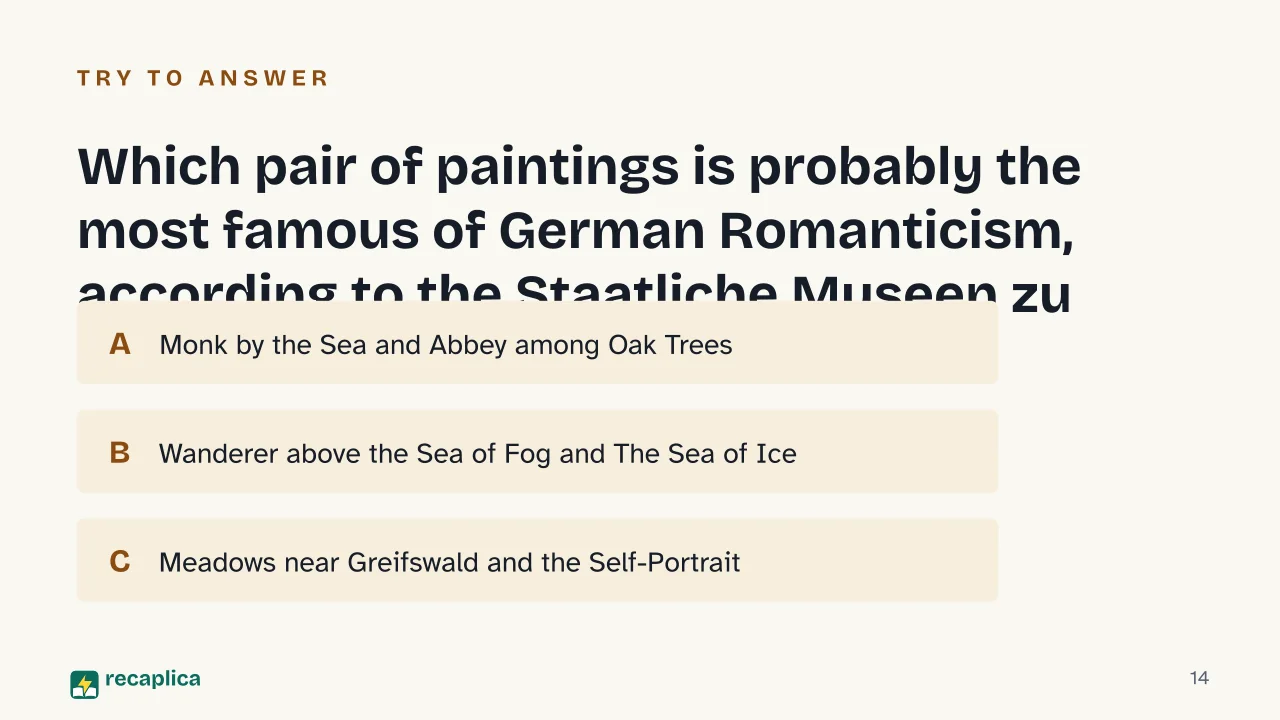
    Two of Friedrich’s paintings form, according to the Staatliche Museen zu Berlin’s official blog, probably the most famous pair in German Romanticism: Monk by the Sea and Abbey among Oak Trees, both held at the Alte Nationalgalerie in Berlin.

    Between May 2013 and January 2016 the museum’s restoration department carried out a thorough technical and art-historical study of the two paintings. The examination found that about 97% of the original paint survived in the Monk and 98% in the Abbey, a high share for paintings over two centuries old. After the work, the two paintings were shown together in a special exhibition at the Alte Nationalgalerie, from January 22 to May 22, 2016.

    Romantic ideas in Friedrich

    Friedrich is tied to the Romantic idea of the “artist as monk” and to painting as inner vision: showing not only what one sees outdoors, but also what one sees “with the inner eye,” with the eyes closed, as Tate Etc. recounts. For the Hamburger Kunsthalle, Friedrich turned the landscape genre into art fit for a new era, making him the leading artist of German Romanticism.

    That label makes more sense next to the wider picture of German culture at the time. The Romanticism in art that Friedrich belongs to runs alongside German Romanticism in literature, and has roots in the late-eighteenth-century Sturm und Drang movement. Set against the Neoclassicism that preceded it, Friedrich’s landscape is inner experience rather than an ideal of form. After his generation, German-speaking culture turned toward Biedermeier, a more domestic and less visionary mood.

    A stigma and two rediscoveries

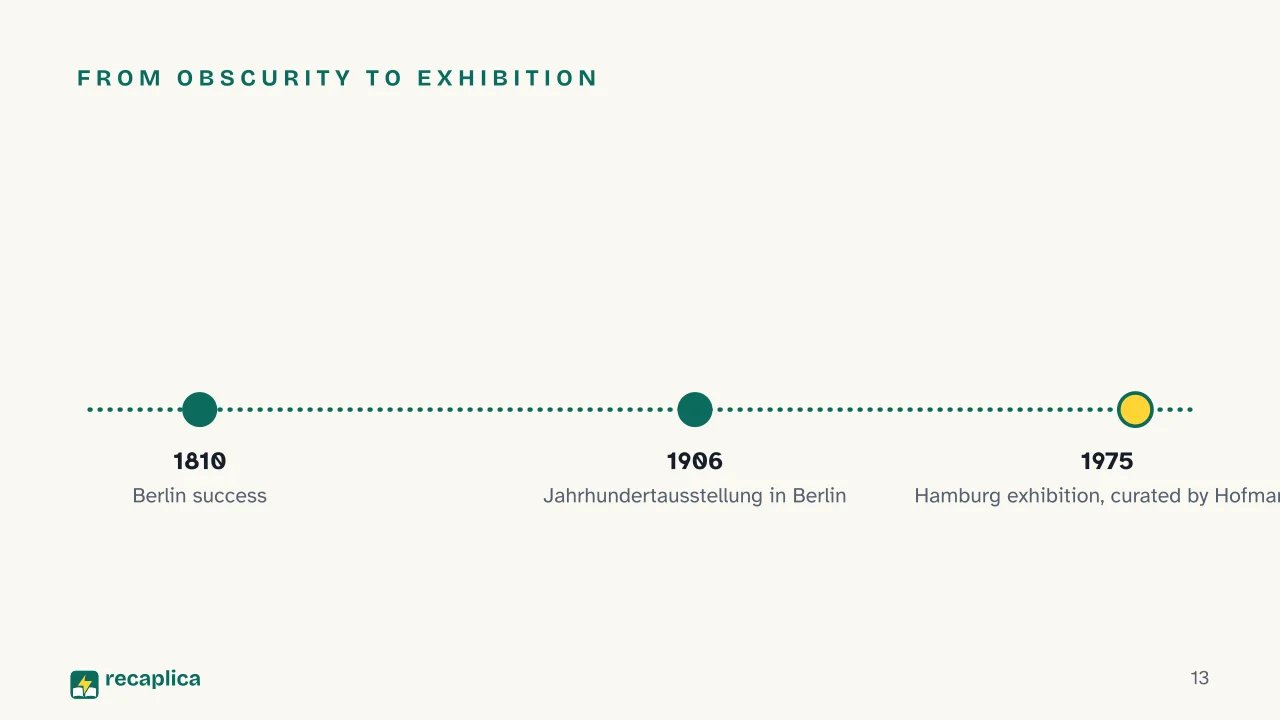
    In the twentieth century Friedrich’s historical standing was rediscovered twice. The first time came with the Jahrhundertausstellung — the “Century Exhibition” — held in Berlin in 1906. The second came later, after his imagery had been used for propaganda purposes under Nazism: the modern reassessment resumed with the 1975 Hamburg exhibition curated by Werner Hofmann.

    Slide deck

    Slides ready to download and make your own in PowerPoint or Google Slides, with speaker notes. Pick the Flash cut or the Full one.
    Slide 1 of the presentation on Caspar David Friedrich: Caspar David FriedrichSlide 2 of the presentation on Caspar David Friedrich: Who was the painter critics call the 'monk-artist'?Slide 3 of the presentation on Caspar David Friedrich: Training, works, fame, rediscoverySlide 4 of the presentation on Caspar David Friedrich: Chapter 01: Training and DresdenSlide 5 of the presentation on Caspar David Friedrich: In Dresden from 1798Slide 6 of the presentation on Caspar David Friedrich: Chapter 02: The major worksSlide 7 of the presentation on Caspar David Friedrich: Landscapes dated by museumsSlide 8 of the presentation on Caspar David Friedrich: The Monk · The Abbey · 2013-2016Slide 9 of the presentation on Caspar David Friedrich: Chapter 03: The 1810 breakthroughSlide 10 of the presentation on Caspar David Friedrich: The numbers of 1810Slide 11 of the presentation on Caspar David Friedrich: Friedrich's success did not lastSlide 12 of the presentation on Caspar David Friedrich: Chapter 04: Twentieth-century rediscoverySlide 13 of the presentation on Caspar David Friedrich: From obscurity to exhibitionSlide 14 of the presentation on Caspar David Friedrich: Which pair of paintings is probably the most famous of German Romanticism, according to the Staatliche Museen zu Berlin?Slide 15 of the presentation on Caspar David Friedrich: From museum sources
    Flash10 slidesThe essential thread, to present in classFull15 slidesEvery chapter and the deeper detail

    Common myths

    • ✗ Myth Many assume Friedrich's landscapes are straightforward views painted on the spot.

      ✓ Reality The Hamburger Kunsthalle credits Friedrich with reinventing landscape as a genre fit for his era, and Tate's magazine adds that he drew on the Romantic idea of the artist as a solitary, monk-like figure, who builds a picture out of what the mind pictures, not only out of what the eye records.

    • ✗ Myth Many assume Friedrich's success lasted unbroken until his death.

      ✓ Reality After the 1810 recognition at the Berlin Academy, Tate Etc. reports, interest in Friedrich cooled off quickly, and his name sat on the margins for decades; only Berlin's Jahrhundertausstellung in 1906 and the 1975 Hamburg exhibition brought him back into view.

    Mind map

    Drag the background to move around and the nodes to reposition them; use − and + to collapse and expand branches.
    Customize
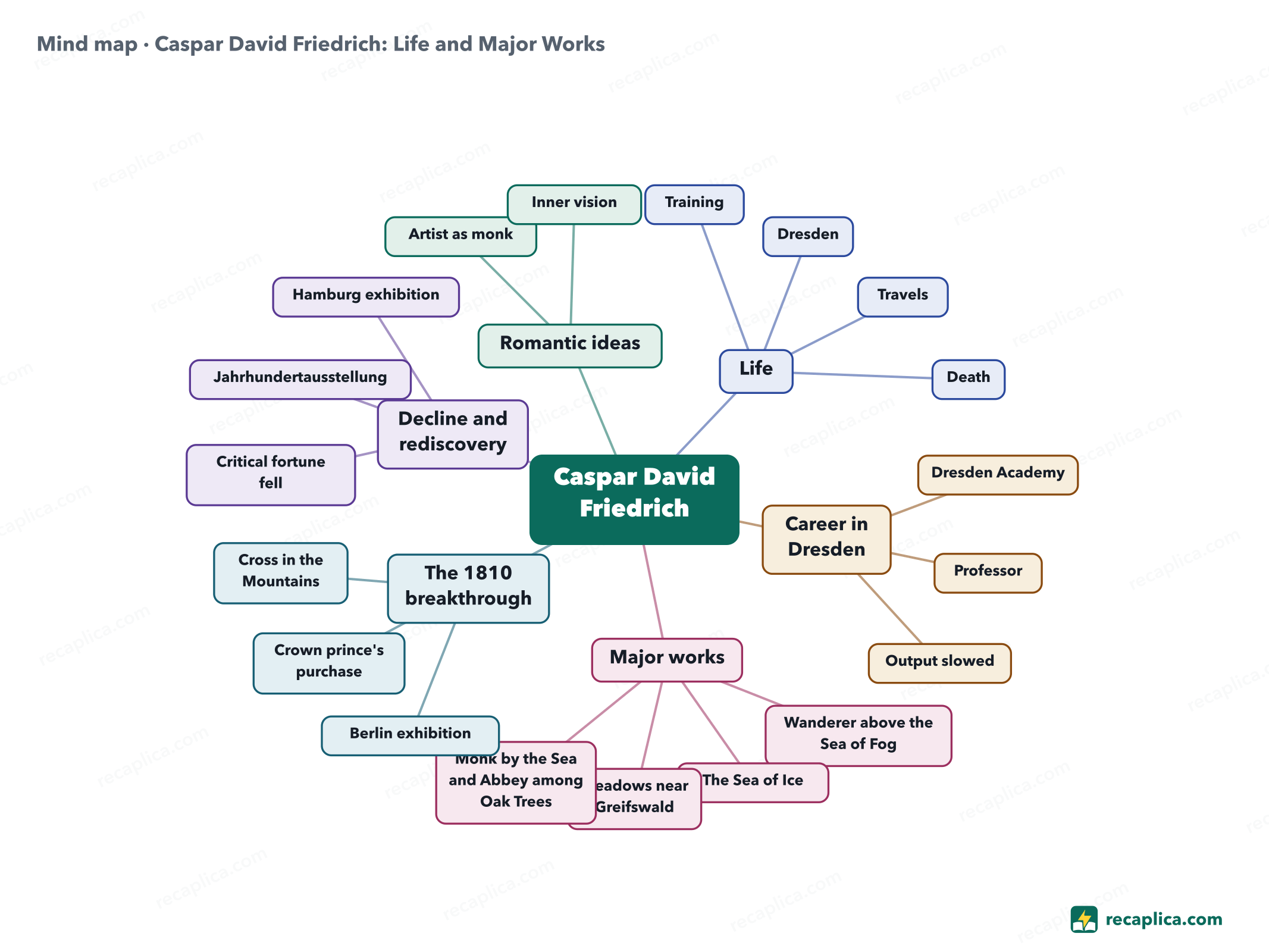
    Mind map: Caspar David Friedrich: Life and Major Works
    • Caspar David Friedrich
      • Life
        • Training Greifswald, then Copenhagen from 1794
        • Dresden From 1798, for the rest of his life
        • Travels Rügen from 1801, Saxon Switzerland, Berlin
        • Death In 1840, in Dresden
      • Career in Dresden
        • Dresden Academy Member from 1816
        • Professor Of landscape painting, from 1824
        • Output slowed From 1826
      • Major works
        • Wanderer above the Sea of Fog Dated to around 1817, Hamburger Kunsthalle
        • The Sea of Ice 1823/24, Hamburger Kunsthalle
        • Meadows near Greifswald 1821/22
        • Monk by the Sea and Abbey among Oak Trees Restored between 2013 and 2016
      • The 1810 breakthrough
        • Berlin exhibition At the Berlin Academy
        • Crown prince's purchase 450 thalers, for two paintings
        • Cross in the Mountains 1808, the Ramdohr dispute
      • Decline and rediscovery
        • Critical fortune fell After 1810
        • Jahrhundertausstellung Berlin, 1906
        • Hamburg exhibition 1975, curated by Werner Hofmann
      • Romantic ideas
        • Artist as monk Romantic idea tied to Friedrich
        • Inner vision Painting with the eyes closed

    Quiz: test yourself

    Answer the questions to check what you have learned: you get instant feedback and a short explanation.

    Grade 0/10 0/5
    1 Where and when was Caspar David Friedrich born?

    Friedrich was born in 1774 in Greifswald, on the Baltic coast, according to both the Hamburger Kunsthalle and the Städel Museum.

    2 In which city did Friedrich settle from 1798, living there for the rest of his life?

    In 1798 Friedrich moved to Dresden, where the Städel Museum places the rest of his life.

    3 Which 1810 event marked Friedrich's first real public success?

    Tate Etc. reports that Friedrich, at 36, found public recognition for the first time with a painting shown at the Berlin Academy, in 1810.

    4 Which pair of paintings does the Staatliche Museen zu Berlin blog call probably the most famous of German Romanticism?

    The Berlin museum calls Monk by the Sea and Abbey among Oak Trees probably the most famous pair of paintings in German Romanticism.

    5 True or false: Friedrich's fame stayed high without interruption from 1810 until his death in 1840.

    False: according to Tate Etc. his critical fortune fell fairly quickly after 1810, and rediscovery only came with the 1906 Berlin exhibition and the 1975 Hamburg exhibition.

    Answers: 1-A · 2-B · 3-B · 4-B · 5-B

    Flashcards

    Tap the card to flip it and check whether you remember the answer, then move to the next one.

    1 / 8

    Explain it in your own words

    The ultimate test: if you can explain it in simple words, you've truly understood it. Write your explanation, then compare it with the Recap.

    Your explanation is saved only on this device.

    Caspar David Friedrich (1774-1840) led German Romantic painting. Born in Greifswald, he trained at the Copenhagen academy and in 1798 settled in Dresden, where he lived for the rest of his life. His best-known paintings, including Wanderer above the Sea of Fog and The Sea of Ice, now hang at the Hamburger Kunsthalle. After a public breakthrough at the 1810 Berlin Academy exhibition his reputation faded, only to be recovered in 1906 and again in 1975.

    Frequently asked questions

    Why is Wanderer above the Sea of Fog so famous?

    It is the painting most people associate with Friedrich's name, held at the Hamburger Kunsthalle and dated by the museum to around 1817.

    Where can Caspar David Friedrich's paintings be seen today?

    Mainly at the Hamburger Kunsthalle (including Wanderer above the Sea of Fog and The Sea of Ice), at the Alte Nationalgalerie in Berlin, run by the Staatliche Museen zu Berlin (Monk by the Sea and Abbey among Oak Trees), and at the Städel Museum in Frankfurt, which keeps his official biography.

    What sets Friedrich apart from other German Romantic painters?

    The Hamburger Kunsthalle calls him the leading artist of German Romanticism: critics read his work through a monastic sense of devotion, painting from a spiritual experience rather than a plain account of the landscape.

    Why was Friedrich forgotten and then reassessed?

    After the 1810 success, interest in him faded within a few years; his imagery was later used for propaganda purposes under Nazism, and the modern reassessment came with Berlin's Jahrhundertausstellung in 1906 and the 1975 Hamburg exhibition.

    Sources

    • Hamburger Kunsthalle — Caspar David Friedrich
    • Städel Museum — Caspar David Friedrich
    • Tate Etc. — Whispering Zeitgeist
    • Staatliche Museen zu Berlin — Caspar David Friedrich

    Every Recap goes through an independent review before publication.

    Every evening, the day's new Recaps on our Telegram channel. Join the channel →

    Keep learning

    • History What Is Existentialism? Heidegger, Being and Time, and Dasein Existentialism is a current of twentieth-century philosophy centered on human existence, freedom and the search for meaning. According to the Stanford Encyclopedia of Philosophy, the German philosopher Martin Heidegger (1889-1976) shaped that current more than almost anyone else, even though he never accepted the label. In 1927 he published Being and Time, his major work, where he introduced the concept of Dasein: the human being as the one entity that questions its own existence. That book influenced Jean-Paul Sartre's existentialism, but in 1946, in the Letter on Humanism, Heidegger openly broke with Sartre and refused to be called an existentialist. In 1933 he was elected rector of the University of Freiburg and became a Nazi party member, keeping that membership until the regime fell - an episode Heidegger himself later denied or played down more than once. Read the Recap →
    • History What Is Phenomenology? Husserl's Philosophy Explained Edmund Husserl founded phenomenology as a philosophical discipline around 1900-1901, with his Logical Investigations. His method starts from the epoché, a suspension of our everyday, unquestioning stance toward the world, and moves toward phenomenological reduction: studying how things appear to consciousness rather than what they are in themselves. At the center sits intentionality, the idea that every experience is always an experience of something specific, whether hoping, perceiving, or desiring. The method Husserl built carried into the 20th century through Heidegger, Sartre, and Merleau-Ponty, moving from German philosophy into French philosophy along the way. Read the Recap →
    • History Legal Positivism: What It Is, from Austin to Kelsen and Hart According to the Stanford Encyclopedia of Philosophy, legal positivism measures legal validity against observable social facts, keeping moral judgment on a separate track. Its roots lie in Hobbes and Hume. Jeremy Bentham produced the theory's first full account, which John Austin later took up and spread: for Austin, a rule is law only when a sovereign commands it under threat of punishment. In the twentieth century, Hans Kelsen grounded legal validity in a hierarchy that traces back to a presupposed basic norm, while Herbert Hart located it instead in a rule of recognition actually followed by judges and officials. Natural law theory takes the opposite view: an unjust law is not really a law. Legal positivism disagrees — a law stays valid even when it is morally unjust, as long as it was made the way the system requires. Read the Recap →

    recaplica

    Clear in 30 seconds, yours in 10 minutes.

    Recaps Mind maps Request a Recap Telegram channel Mind map maker Our method About Privacy & cookies Legal notes & terms of use

    © 2026 Recaplica · A project by Curi S.r.l. — VAT IT05472000750

    Statistics, only if you say so

    To learn which Recaps help most we would use Google Analytics, with aggregate, anonymous data. It starts only with your OK, and you can change your mind anytime. Privacy policy