|
recaplica
Sturm und Drang: the meaning behind Germany's storm-and-stress movement | ||||||||||||||||
| © 2026 Recaplica · recaplica.com — All rights reserved | ||||||||||||||||
Sturm und Drang: the meaning behind Germany's storm-and-stress movementWhat to print Page numbers appear when printing with default margins. SlidesChoose a cut Flash10 slidesThe essential thread, to present in classFull14 slidesEvery chapter and the deeper detailBoth come with speaker notes. In 30 seconds quick readSturm und Drang is the German literary and cultural movement that ran from roughly 1760 to 1785, just before Romanticism. Its name, literally storm and stress, was borrowed from a 1776 play by Friedrich Maximilian Klinger. The movement turned against Enlightenment rationalism and put feeling and the irrational at the center, celebrating a figure who acts on personal passions and inner longing. Its best-known work, Goethe's novel The Sorrows of Young Werther, follows a protagonist driven mainly by passion. The movement later merged into Weimar Classicism, paving the way for early German Romanticism. Key Points
Deep DiveWhat the name means and where it beganSturm und Drang takes its name from a play by Friedrich Maximilian Klinger, published in 1776 and set during the American Revolution. The title translates literally as storm and stress, and it ended up naming the whole movement. Treccani places the period between roughly 1760 and 1785, as the closing phase of German pre-Romanticism. The groundwork was laid earlier than the name itself. According to Treccani, it drew together the work of Gotthold Ephraim Lessing, the rehabilitation of feeling in English and Swiss aesthetics, religious Pietism, and Jean-Jacques Rousseau’s naturalism. A program against Enlightenment reasonThe movement’s program, according to Treccani, leans entirely on the irrational as a force in life and art, set against Enlightenment intellectualism. The Encyclopedia of German Literature reaches a similar conclusion: under Rousseau’s influence, Sturm und Drang moved away from the Neoclassicism that dominated at the time and put subjectivity, artistic invention and the pull of nature at its center. The New World Encyclopedia adds that the individual and extreme emotion found room to breathe, as a reaction against the limits Enlightenment rationalism had imposed. Among its central themes, Treccani also points to the idea that every individual has a right to pursue their own deepest longings; from there comes the celebration of figures such as the natural man, the titan and the superman. These are not reassuring heroes, though.
Leading authors and worksTreccani names Goethe, Schiller, Lenz, Herder and Klopstock as the movement’s main authors, with Goethe as its central figure. The Encyclopedia of German Literature narrows that list to Goethe, Schiller and Herder. Three works stand out above the rest. Goethe’s 1774 novel The Sorrows of Young Werther follows a hopeless love that ends with the protagonist’s suicide; the New World Encyclopedia reports that it is believed to have inspired several imitative suicides among young readers at the time, an effect the sources describe with caution and without precise numbers. Schiller’s Die Räuber, from 1781, laid the groundwork for melodrama to be recognized as a theatrical form in its own right. Götz von Berlichingen, also by Goethe and dating to 1773, is the historical drama that marked his stage debut. Herder, for his part, laid out the movement’s theoretical program in the essay collection Von deutscher Art und Kunst, from 1773.
Treccani also points to Prometheus and Urfaust, both by Goethe, as works that represent the movement’s highest synthesis. From pre-Romanticism to RomanticismThe movement did not stand still. According to the New World Encyclopedia, both Goethe and Schiller moved into Weimar Classicism, and from there the path continued toward early German Romanticism, which carried over its concern with feeling and nature while adding social and political goals and an almost religious regard for everything natural. The Encyclopedia of German Literature sums it up as a forerunner of Romanticism. Treccani notes that the movement found no direct followers in Italy, though it points to a kindred spirit in Vittorio Alfieri. Slide deckSlides ready to download and make your own in PowerPoint or Google Slides, with speaker notes. Pick the Flash cut or the Full one.   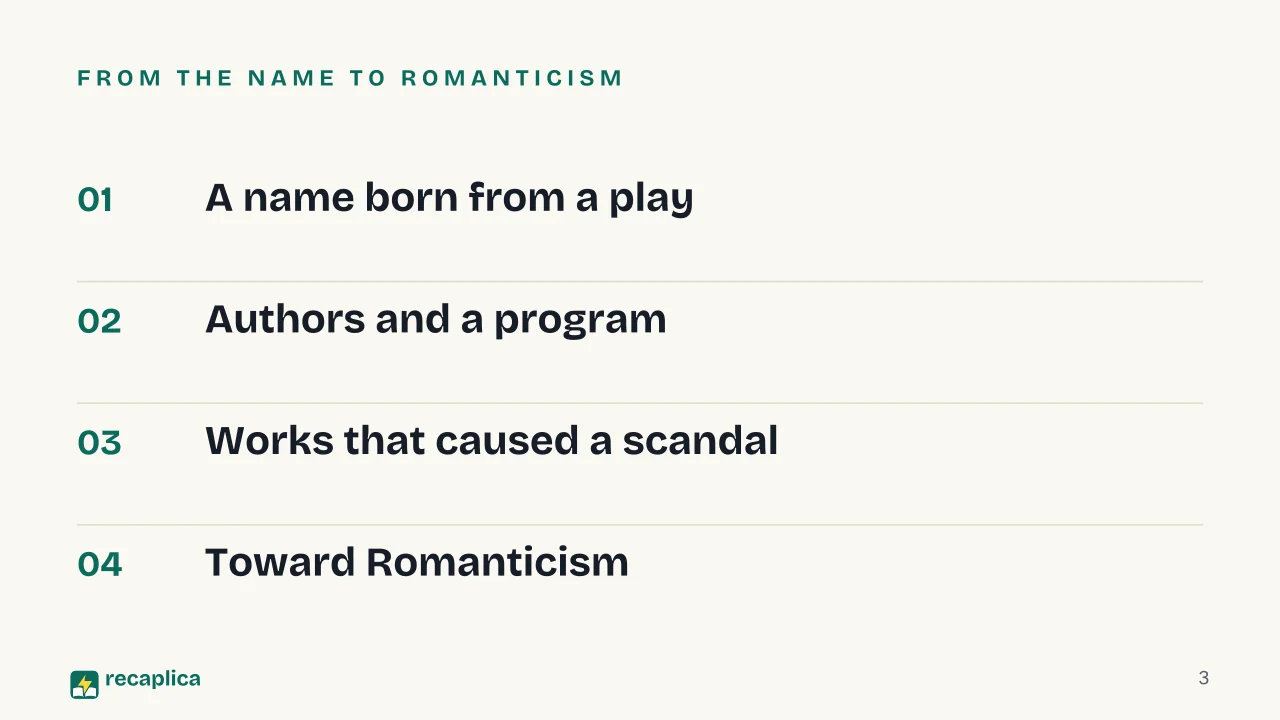  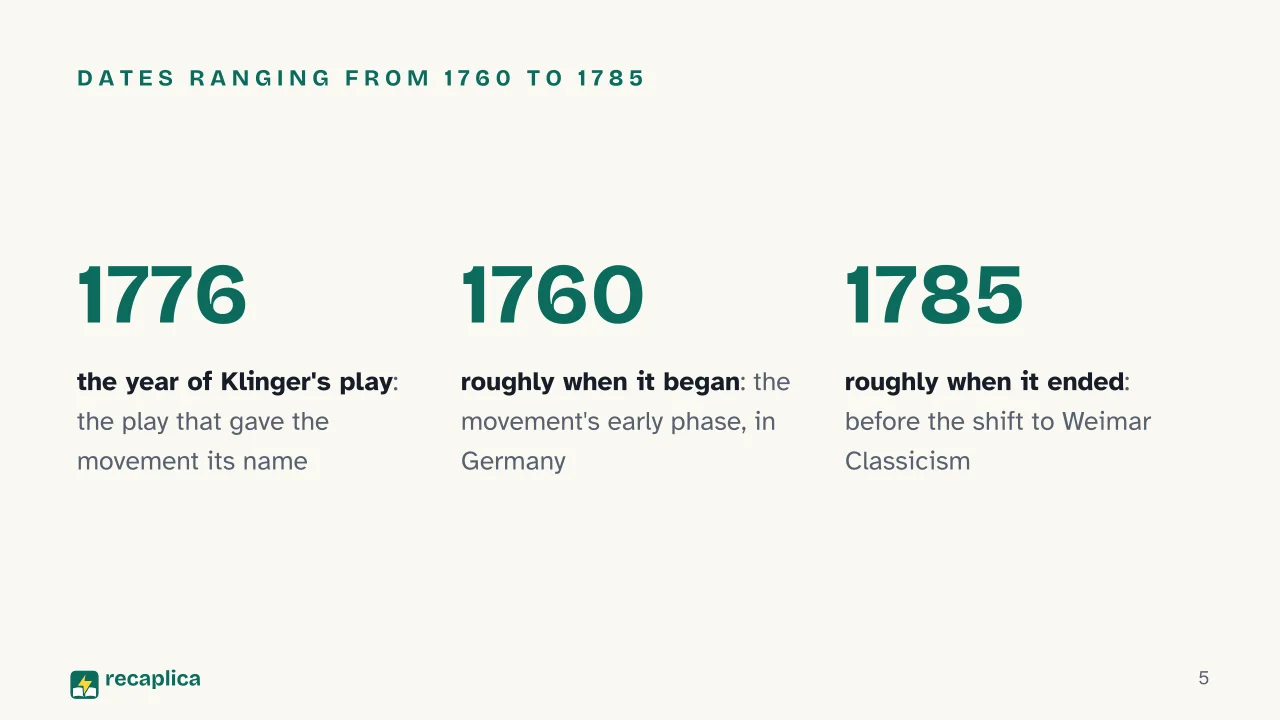  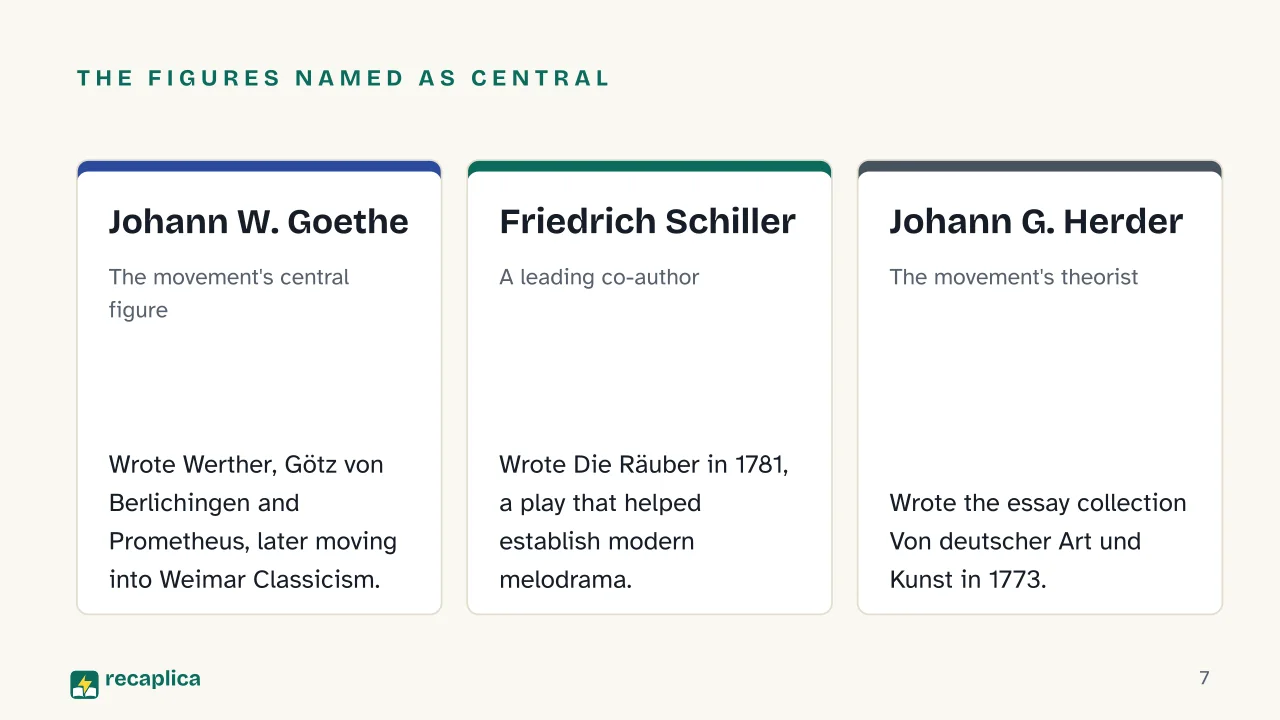  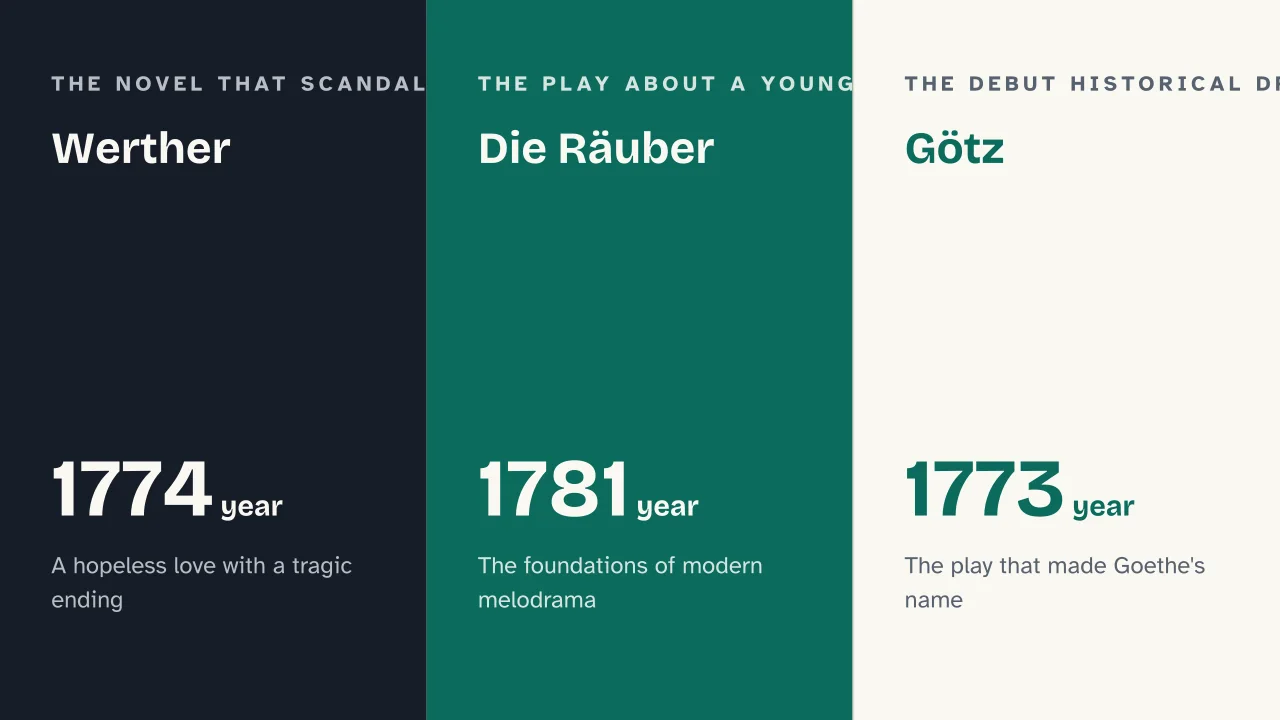   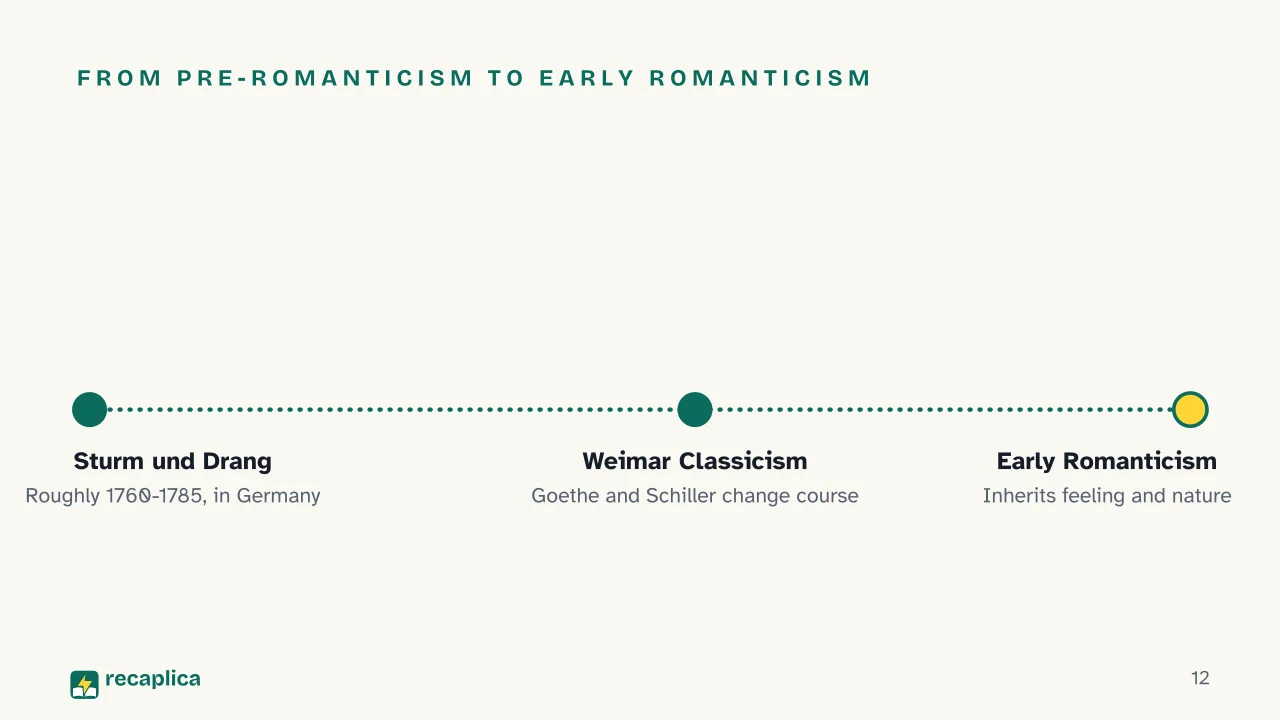 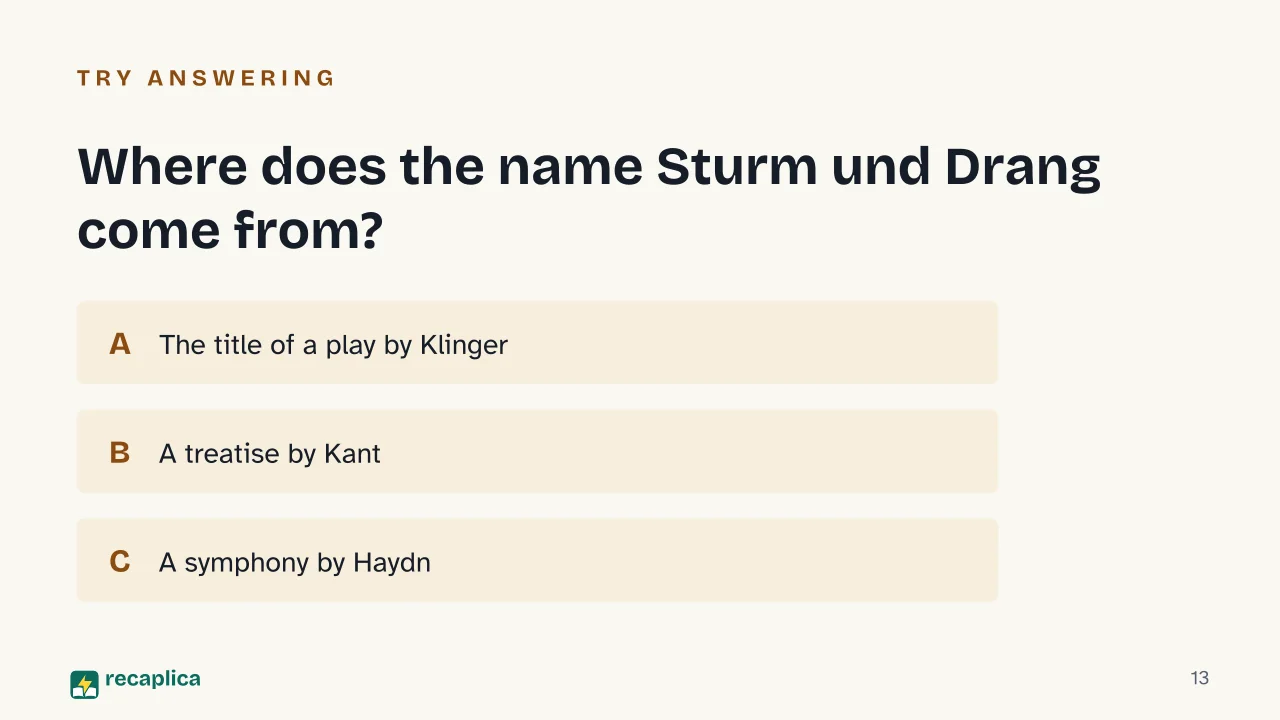  Common myths
Mind mapDrag the background to move around and the nodes to reposition them; use − and + to collapse and expand branches. 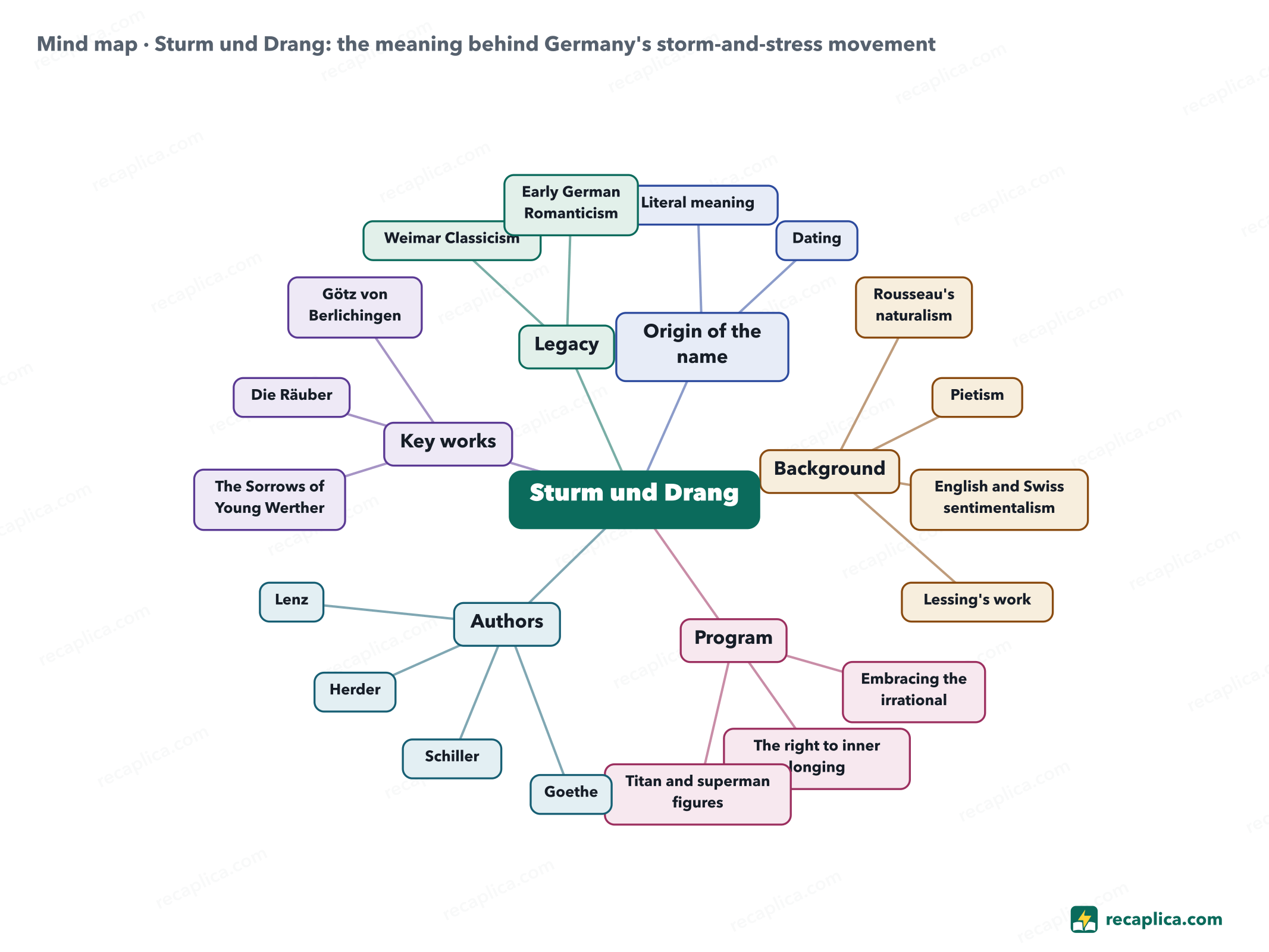
Quiz: test yourselfAnswer the questions to check what you have learned: you get instant feedback and a short explanation. Grade 0/10 0/5
FlashcardsTap the card to flip it and check whether you remember the answer, then move to the next one. 1 / 7 Explain it in your own wordsThe ultimate test: if you can explain it in simple words, you've truly understood it. Write your explanation, then compare it with the Recap. Your explanation is saved only on this device.
Frequently asked questionsWhat is Sturm und Drang?Sturm und Drang, literally storm and stress, is the German literary movement that, roughly between 1760 and 1785, put feeling ahead of Enlightenment rationalism. The label was taken from a 1776 play by Friedrich Maximilian Klinger. When did Sturm und Drang begin?It runs roughly from 1760 to 1785, as the final phase of German pre-Romanticism, prepared by Rousseau's naturalism, religious Pietism and Lessing's work. Who are the main Sturm und Drang authors?Johann Wolfgang von Goethe, Friedrich Schiller, Johann Gottfried Herder, Jakob Michael Reinhold Lenz and Friedrich Gottlieb Klopstock, with Goethe as the movement's central figure. How is Sturm und Drang related to Romanticism?It is a forerunner of Romanticism. After passing through Weimar Classicism, its concerns with feeling and nature carried over into early German Romanticism, which added social and political goals of its own. What happens in The Sorrows of Young Werther?Goethe's 1774 novel follows a love with no way out, which the protagonist ends by taking his own life. Sources say it may have inspired a number of imitative suicides among young readers at the time. Every Recap goes through an independent review before publication. |