|
recaplica
What Is Biedermeier? The Style and Period Behind the Name |
| © 2026 Recaplica · recaplica.com — All rights reserved |
What Is Biedermeier? The Style and Period Behind the NameWhat to print Page numbers appear when printing with default margins. SlidesChoose a cut Flash10 slidesThe essential thread, to present in classFull10 slidesEvery chapter and the deeper detailBoth come with speaker notes. In 30 seconds quick readBiedermeier is the style of living, furniture, literature, and art that spread across the German- and Austrian-speaking lands between roughly 1815 and 1848, the years between the Congress of Vienna and the revolutions of mid-century. It began in the drawing rooms of the imperial family and the Viennese nobility, then spread to the middle class, which for the first time became a mass of buyers with money of its own. The name, though, arrived late and as a joke: it is a satirical pen name coined in 1850, after the period's conventional end. In painting and literature it mostly tells the story of everyday life, with a caution art historians urge against turning into too rigid a label. Key Points
Key figures
Deep DiveIn the early decades of the nineteenth century, across the German-speaking lands and in Austria, the style known as Biedermeier emerged as a response to an unsettled, fast-changing age: the reign of Emperor Francis II (I) of Austria. The Möbelmuseum Wien places its origin between the Napoleonic Wars and the Congress of Vienna of 1814-15 on one side, and the revolution of 1848-49 on the other: the same anchor years Wikipedia uses to bracket the period, from 1815 to roughly 1848. Furniture for a new class of buyersAlongside the more formal neoclassical Empire style, already established across Neoclassicism in Europe, the Möbelmuseum Wien describes a connected yet plainer, far more home-oriented furnishing style taking shape. The museum ties it to the unsettled mood of those years: many families sought shelter in a quieter, more private home life. That is how the style took shape, first among the imperial family and the nobility, for the less formal rooms of their own homes, before it spread to the middle class. The MAK describes a shift in scale: as the Industrial Revolution took hold and the middle class grew economically, Austria saw, for the first time, a buying public on a scale nobody had seen before, able to afford objects that had once been nearly exclusive to the aristocracy. That is one reason why, in this period, chairs and furniture from both middle-class and imperial-royal households multiplied into forms very different from one another, the MAK adds.
The Möbelmuseum Wien also shows walls covered in bold patterns and bright colours, a departure from the plain image often tied to the period’s furniture. Literature under censorshipDuring the Biedermeier period, many writers worked under the political stability imposed by the Austrian chancellor Klemens von Metternich and under tight censorship of publications. According to Wikipedia, that climate pushed writers toward mostly non-political subjects, a quieter way of storytelling set apart from the German Romanticism that came just before it, even while still owing it a debt. Among the authors linked to Biedermeier, without the list being definitive, are Annette von Droste-Hülshoff, Friedrich Halm, Adelbert von Chamisso, Eduard Mörike, and Wilhelm Müller. The last three are also remembered through music: Wikipedia notes that Chamisso was set by Robert Schumann, Mörike by Hugo Wolf, and Müller by Franz Schubert. A kind of painting hard to pin to one labelWikipedia describes the period’s painting as marked by a sentimental tone and close attention to everyday life, naming Carl Spitzweg, Ferdinand Georg Waldmüller, and Friedrich von Amerling among its leading figures. The Belvedere, which has dedicated an exhibition to painting between 1830 and 1860 — a span that begins within Biedermeier but runs well past its conventional end in 1848 — calls that output “secular” painting: portraits, landscapes, and genre scenes in a broad sense. The Belvedere itself cautions that Waldmüller is often labelled, unfairly, “the Biedermeier painter”, because many of his most celebrated works came after 1848. The artistic development of those years, the museum writes, resists being sealed neatly inside a historical label: a good number of the period’s works feel instead like one last flourish before the whole style turned a corner. A name born as a joke, once the era was overOne last detail will surprise anyone expecting a self-aware era: the name “Biedermeier” did not exist during the period it describes. It began as a satirical pen name, “Gottlieb Biedermaier”, used by the country doctor Adolf Kussmaul and the lawyer Ludwig Eichrodt for poems published in the Munich satirical magazine Fliegende Blätter starting in 1850 — two years after the conventional end of the period it designates. The furniture of those years, meanwhile, kept being valued for its craftsmanship and comfort: those who could afford it, among the middle class, bought it or had it made to order, if only to enjoy their leisure time at home a little more, inside a domestic life where music had a real place. In Vienna, around 1815, nearly 400 piano makers were in business, a sign of how much instruments and music-making at home belonged to that everyday middle-class world. A world that grew out of the Industrial Revolution and the middle class’s own economic rise, and had already taken shape, in a smaller way, inside the drawing rooms of the nobility. Slide deckSlides ready to download and make your own in PowerPoint or Google Slides, with speaker notes. Pick the Flash cut or the Full one.   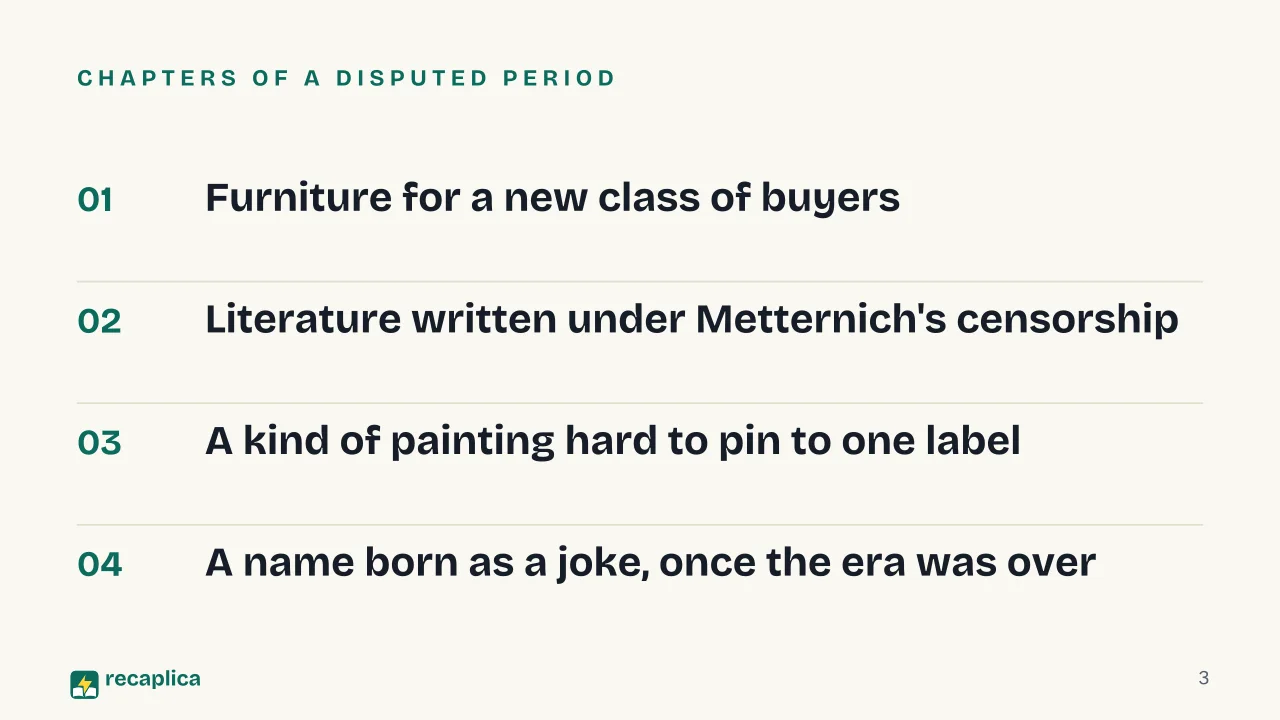 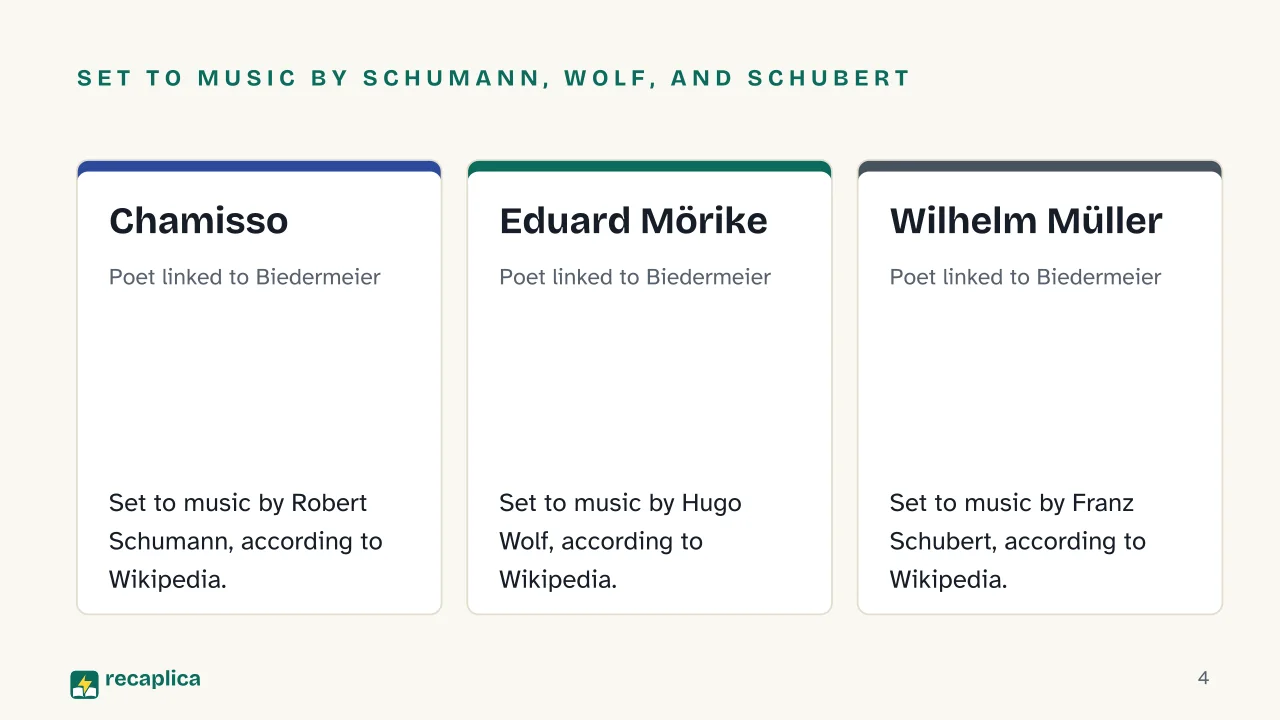 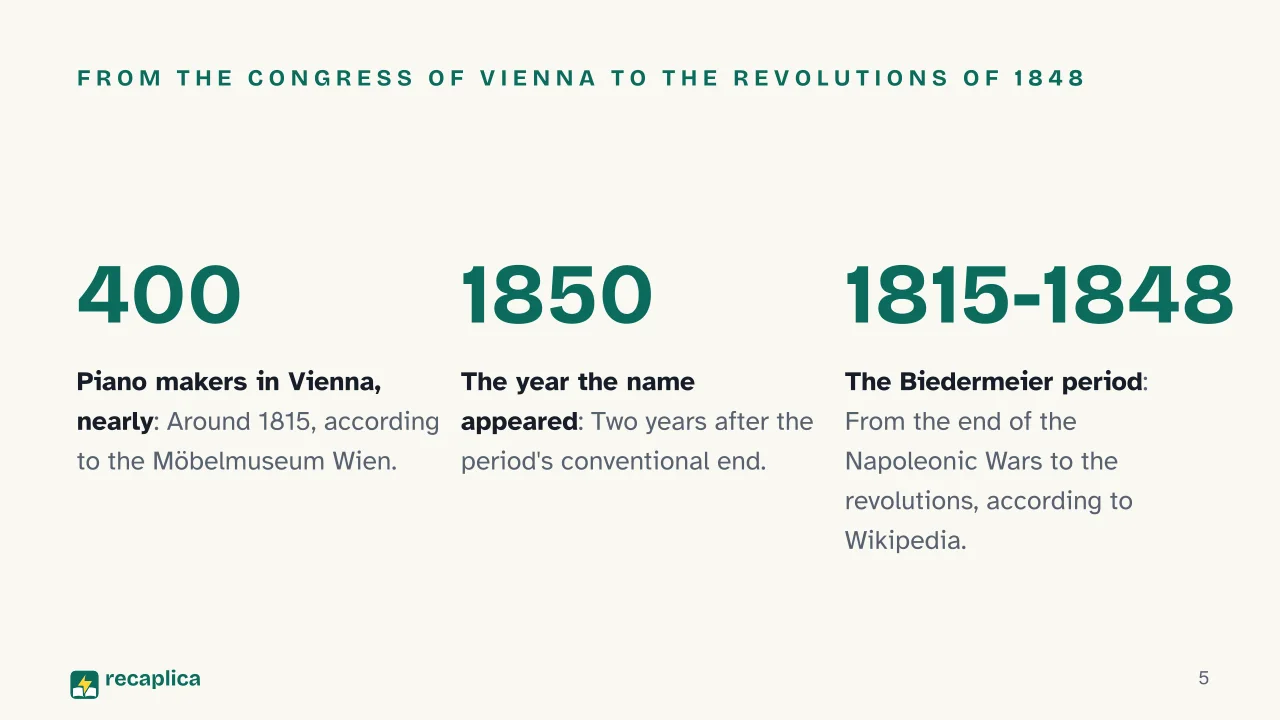 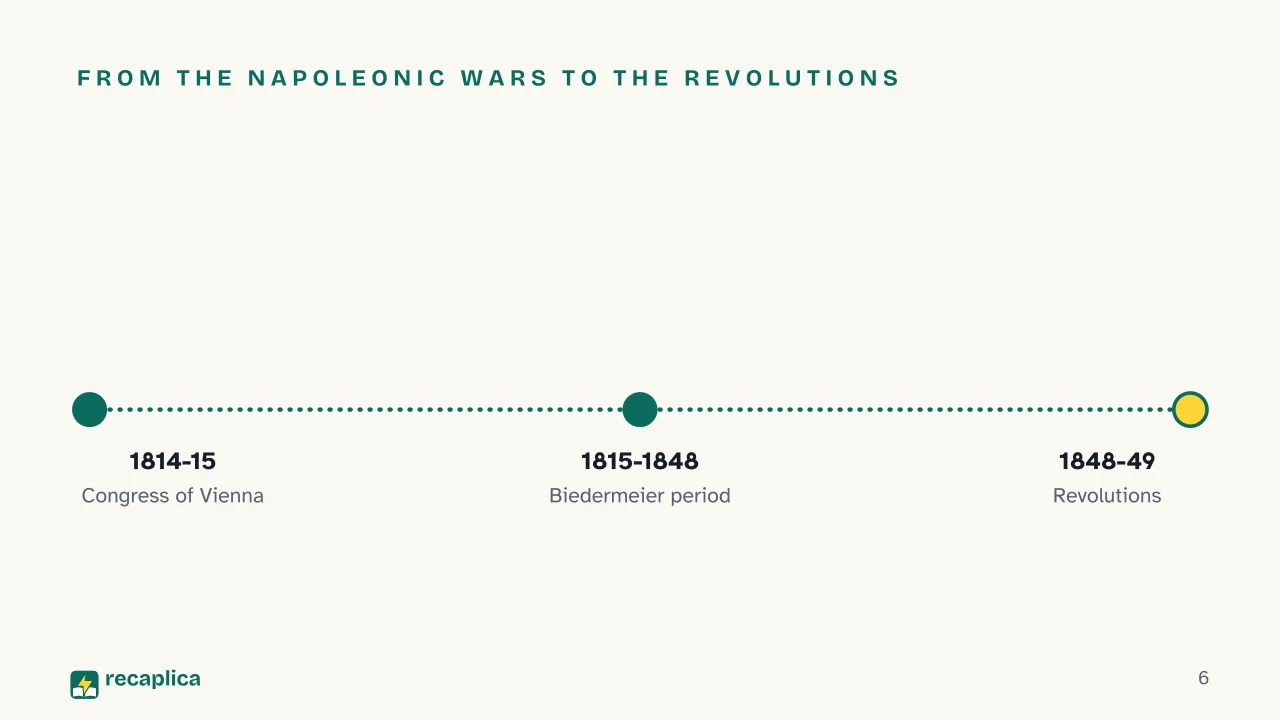 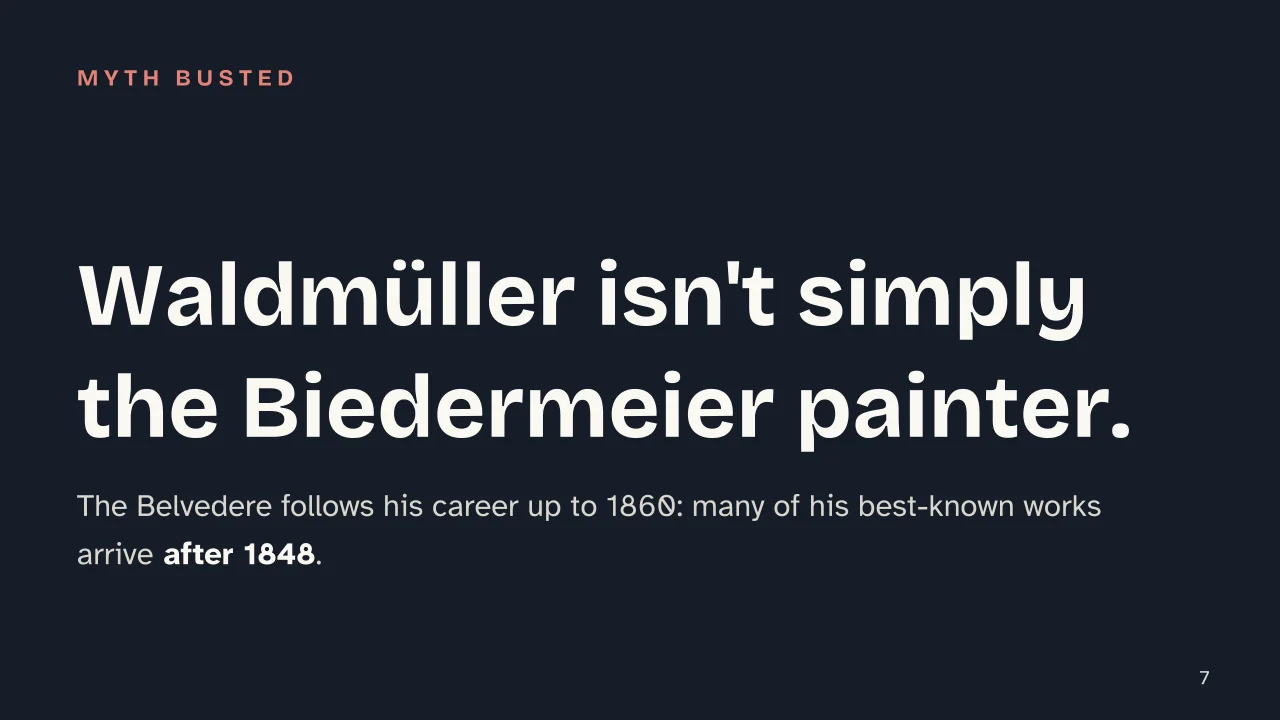 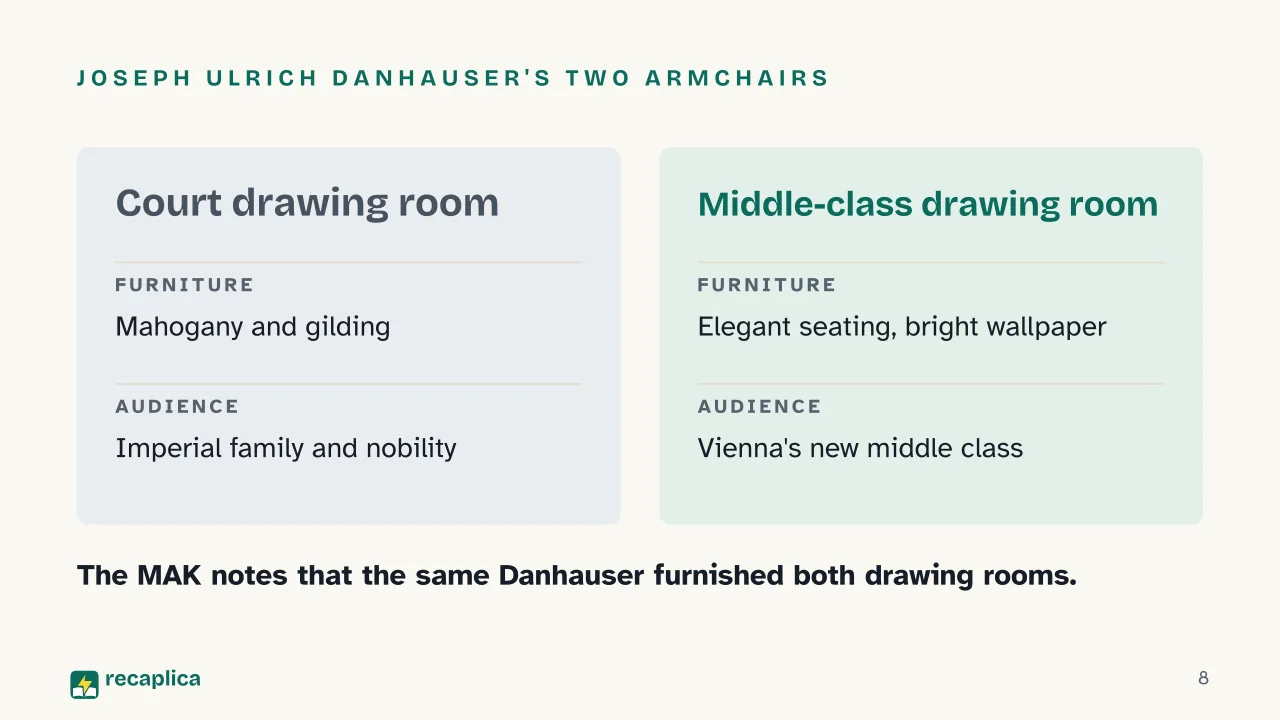   Common myths
Mind mapDrag the background to move around and the nodes to reposition them; use − and + to collapse and expand branches. 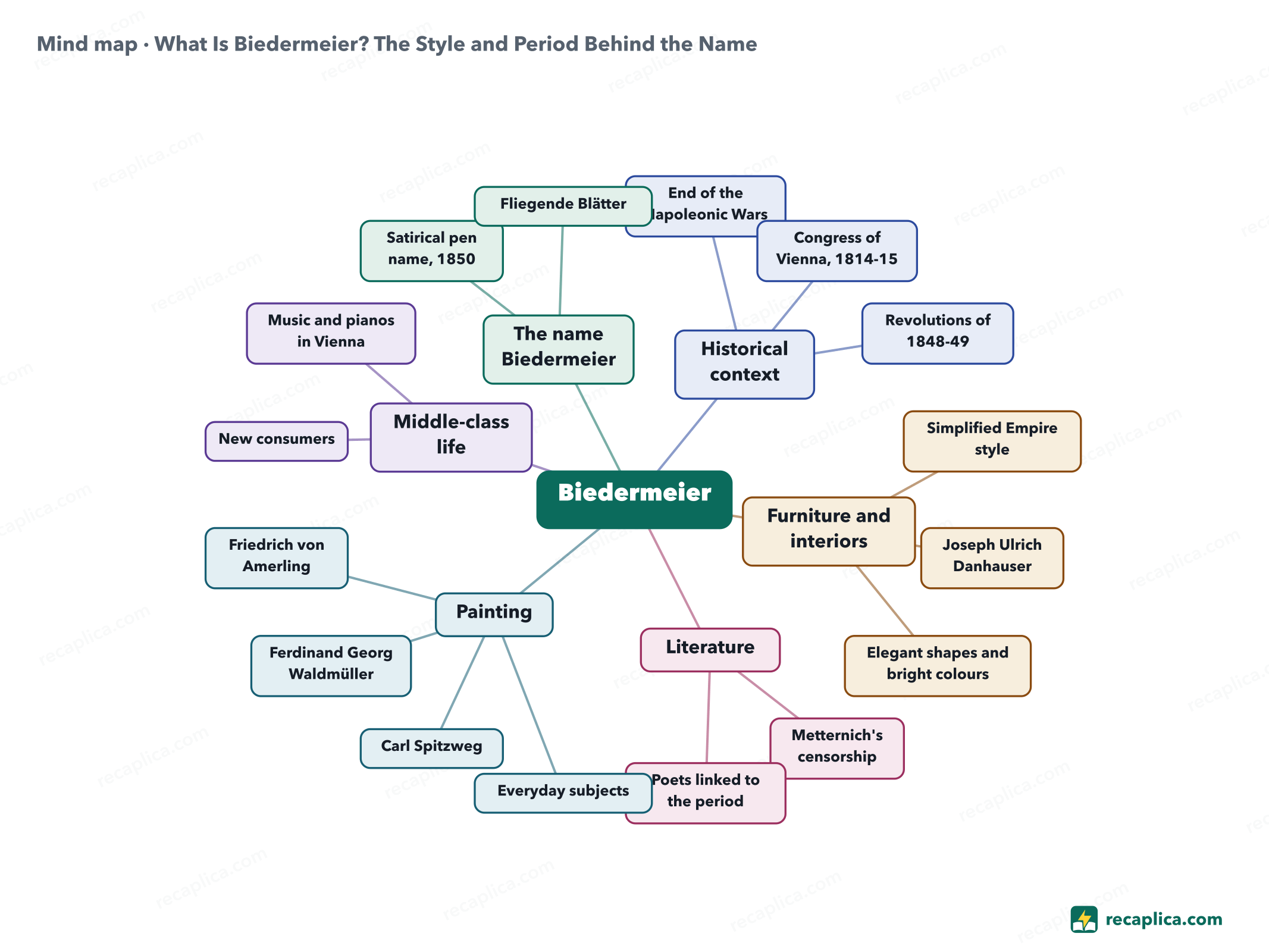
Quiz: test yourselfAnswer the questions to check what you have learned: you get instant feedback and a short explanation. Grade 0/10 0/5
FlashcardsTap the card to flip it and check whether you remember the answer, then move to the next one. 1 / 7 Explain it in your own wordsThe ultimate test: if you can explain it in simple words, you've truly understood it. Write your explanation, then compare it with the Recap. Your explanation is saved only on this device.
Frequently asked questionsWhat does "Biedermeier" mean?It is the name later given to a way of living, decorating, writing, and painting that spread across Germany and Austria in the decades between 1815 and 1848. When does the Biedermeier period start and end?Conventionally between 1815, with the end of the Napoleonic Wars, and 1848, with the start of the revolutions, according to Wikipedia. Is Biedermeier only a furniture style?No: it also covers literature and painting, along with a particular middle-class way of life built around drawing rooms, music at home, and objects designed for everyday comfort. Who are the main painters linked to Biedermeier?Among others, Carl Spitzweg, Ferdinand Georg Waldmüller, and Friedrich von Amerling, according to Wikipedia; the Belvedere, however, cautions against fitting their often broader output into a single historical label. Why did the name "Biedermeier" appear after the period it describes had already ended?Because it was coined in 1850 as the satirical pen name "Gottlieb Biedermaier", used by Adolf Kussmaul and Ludwig Eichrodt for poems published in Fliegende Blätter. Every Recap goes through an independent review before publication. |