|
recaplica
German Romanticism: Die Romantik from Jena to the Brothers Grimm | |||||||||||||||
| © 2026 Recaplica · recaplica.com — All rights reserved | |||||||||||||||
German Romanticism: Die Romantik from Jena to the Brothers GrimmWhat to print Page numbers appear when printing with default margins. SlidesChoose a cut Flash10 slidesThe essential thread, to present in classFull17 slidesEvery chapter and the deeper detailBoth come with speaker notes. In 30 seconds quick readGerman Romanticism, die Romantik, took shape in Jena in the final years of the eighteenth century around a circle of writers and philosophers gathered near the Schlegel brothers and Novalis. They published the journal Athenäum and pushed for an art that fused philosophy, poetry and criticism, building on the break with French classicism that the Sturm und Drang movement had already started. The center then moved to Heidelberg, where Clemens Brentano, Achim von Arnim and the Brothers Grimm turned to folk songs and fairy tales. Alongside the writers, painters such as Caspar David Friedrich and Philipp Otto Runge turned landscapes into states of mind. According to the Stanford Encyclopedia of Philosophy, it was in Germany that Romanticism reached its most philosophical form, before spreading across the rest of Europe. Key Points
Key figures
Deep DiveGerman Romanticism did not appear out of nowhere. According to Treccani, it was prepared by Sturm und Drang: in the closing decades of the eighteenth century, that movement had already built, within Germany, a literary consciousness independent of French classicism. Alongside that break, the 1790s produced a whole generation of philosophers and poets: besides the Schlegel brothers and Novalis, it included the idealists Schelling and Hegel and the poet Hölderlin. Friedrich Schlegel worked to reconcile Fichte’s philosophy of a free subject with Spinoza’s holism, a project that was as much philosophical as literary, one the Stanford Encyclopedia of Philosophy reads two ways at once: pushing back against German idealism while also feeding into how it developed. The Jena circle and the journal AthenäumThe first German Romantic school, Treccani writes, formed in the closing years of the eighteenth century in Jena, before later moving to Berlin. Its outlet was the journal Athenäum, published by the circle between 1798 and 1800. Among its leading figures were the Schlegel brothers: Friedrich, born in 1772, and August Wilhelm, five years his senior, who would later render Shakespeare into German and build a reputation as a leading literary critic of the period. Gathered around them were Novalis, Ludwig Tieck, Caroline Schlegel and Dorothea Veit-Schlegel. For Friedrich Schlegel, the fragment — the short form in which the circle published much of its thinking — had to stand apart from everything around it, complete in itself, “like a hedgehog.”
Novalis was born in 1772 into a pietist family of the lesser Saxon nobility and died of tuberculosis in 1801, at 28. According to the Internet Encyclopedia of Philosophy, he was a central figure of the Jena circle, shaped by Fichte, Herder, Goethe and the mystic Jakob Böhme. He wrote philosophical fragments partly published in the Athenäum, poetry, the unfinished novels “The Novices of Sais” and “Henry of Ofterdingen,” and essays such as “Christianity or Europe.” His “Hymns to the Night” earned him a reputation as an otherworldly, at times somber poet. He built on Fichte’s philosophy, but worried that its emphasis on the subject developing through opposition to the object would leave the physical world without a freedom and identity of its own. The Heidelberg circle: folk songs and fairy talesAfter Jena, the movement’s center of gravity shifted. According to the Deutsches Historisches Museum (LeMO), Heidelberg became home to the two Romantics Clemens Brentano (1778-1842) and Achim von Arnim (1781-1831); the same source also names E.T.A. Hoffmann (1776-1822) and Joseph von Eichendorff (1788-1857) among the era’s other important Romantic writers. Brentano and Arnim edited the folk-song collection Des Knaben Wunderhorn, to which Wilhelm and Jacob Grimm also contributed anonymously, through the mediation of Friedrich Carl von Savigny — it was through Savigny that the two brothers first made contact with the movement’s leading figures. Wilhelm Grimm was born in 1786 in Hanau, the son of court official Philipp Wilhelm Grimm, and died in 1859 in Berlin of a blood infection; Jacob was born in 1785, also in Hanau, and died in 1863 following a stroke. After five years of work, the brothers published the first volume of the Kinder- und Hausmärchen, the Children’s and Household Tales, in a print run of 900 copies. In 1837 they were among seven Göttingen professors, the Göttinger Sieben, dismissed for a political protest — for Wilhelm, it remained the only real political act of his life; Jacob, later on, sat as a deputy in the Frankfurt National Assembly after the revolution of March 1848.
Other figures: Hoffmann, Eichendorff, KleistThe movement also had figures beyond Jena and Heidelberg. Heinrich von Kleist was born in 1777 in Frankfurt an der Oder and died by suicide in 1811, near Berlin at the Wannsee; Deutsche Biographie places him among the writers of the classical-Romantic era, noting his unusual influence, for his time, on twentieth-century literature. Hoffmann and Eichendorff, mentioned above for their dates, broadened the movement beyond its two main circles. German Romantic painting: Friedrich and RungeAlongside the writers, the movement also had a pictorial side. Caspar David Friedrich was born in 1774 and died in 1840; he trained at the University of Greifswald and the Copenhagen Academy, was elected to the Berlin Academy in 1810 and to the Dresden Academy in 1816. The National Gallery in London places him among the defining names of Romantic painting in Germany; a stroke in 1835 limited his output in his final years. Philipp Otto Runge was born in 1777 in Wolgast and died in 1810 in Hamburg. Deutsche Biographie describes him as one of the founders of Romantic art in Germany: from July 1802 he spent time in Dresden with, among others, Caspar David Friedrich himself. The two painters shared the same circles, not just the same period. A European movement with a German centerSigns of a break with classicism appeared elsewhere in the same years: Treccani notes that England, France and Italy — where later writers such as Ugo Foscolo and Giacomo Leopardi would emerge — show early, independent signals, in some cases even predating the German movement. But it was in Germany, Treccani adds, that the formative period of Romanticism went deepest, and from there it spread across the rest of the continent. The Stanford Encyclopedia of Philosophy reaches a similar conclusion on the philosophical side: while weighing the English and French Romanticisms as well, it places German Romanticism in a position of particular importance because it opened the way for the others, pointing to the aesthetic vision developed in Germany roughly between 1796 and 1801-1802 as the movement’s most philosophical expression. The legacy: Romantic music and the idea of nationAccording to Encyclopedia.com, the idea of nationalism — a people defined by shared culture or ethnicity as the only legitimate basis for a state — spread across Europe in the early nineteenth century as an outgrowth of German Romanticism. The fusion of national feeling and art followed the model set out by the poet and philosopher Friedrich von Schiller, and found one of its most elaborate expressions in Carl Maria von Weber’s opera Der Freischütz, from 1821. Later, after the Franco-Prussian War of 1870-1871 and the German unification that followed, the Bayreuth theater built by Richard Wagner became a lasting monument to it. This part of the story belongs to a later generation than Jena and Heidelberg: the source describes it as an outgrowth of German Romanticism, not as its direct cause. Slide deckSlides ready to download and make your own in PowerPoint or Google Slides, with speaker notes. Pick the Flash cut or the Full one.     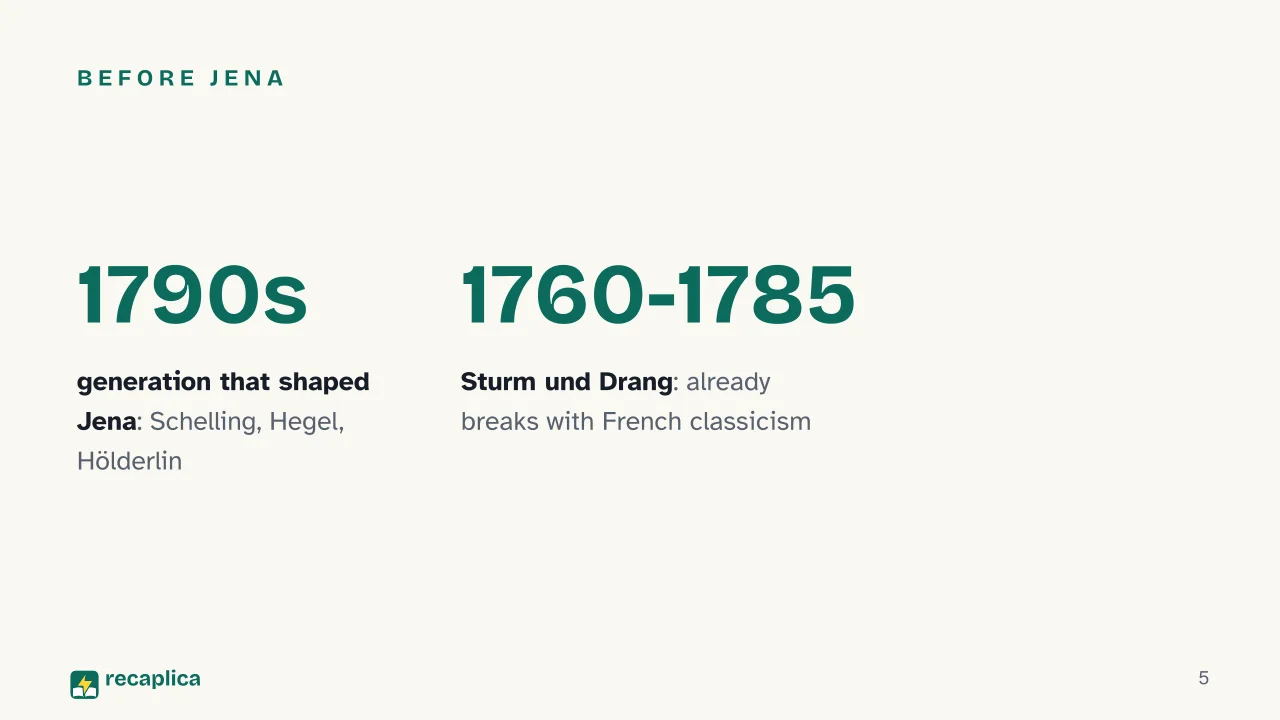  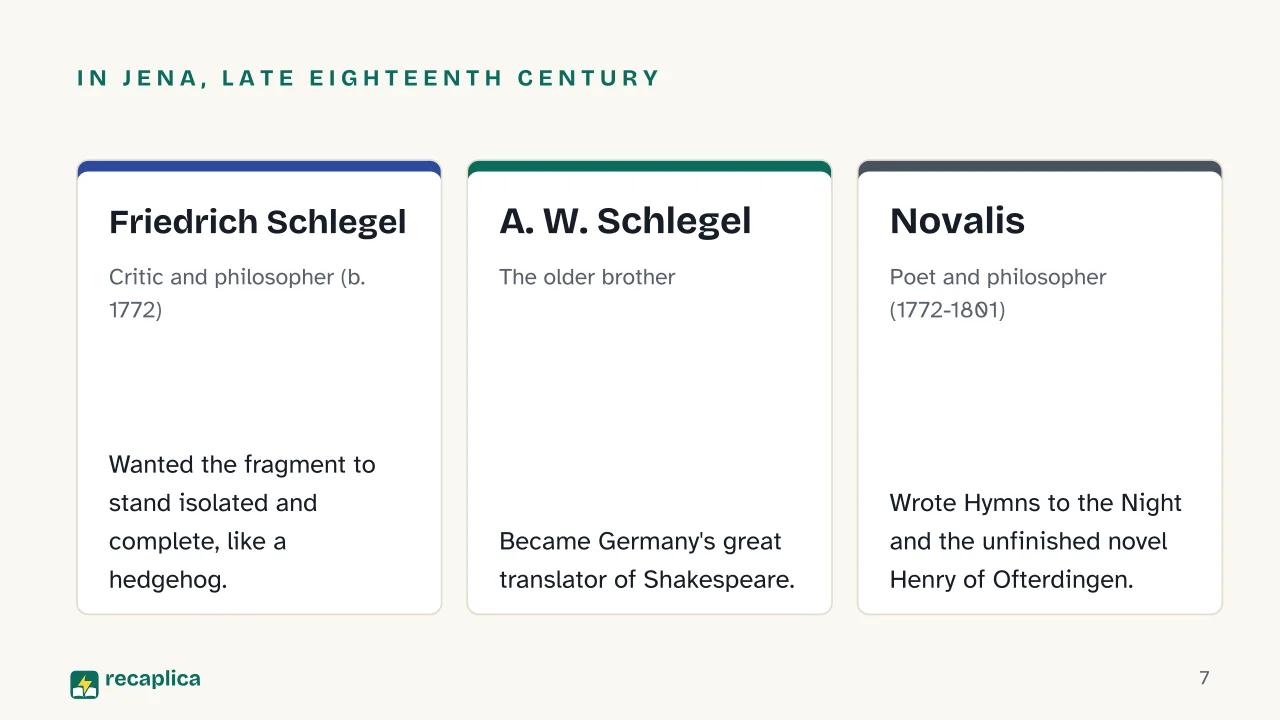 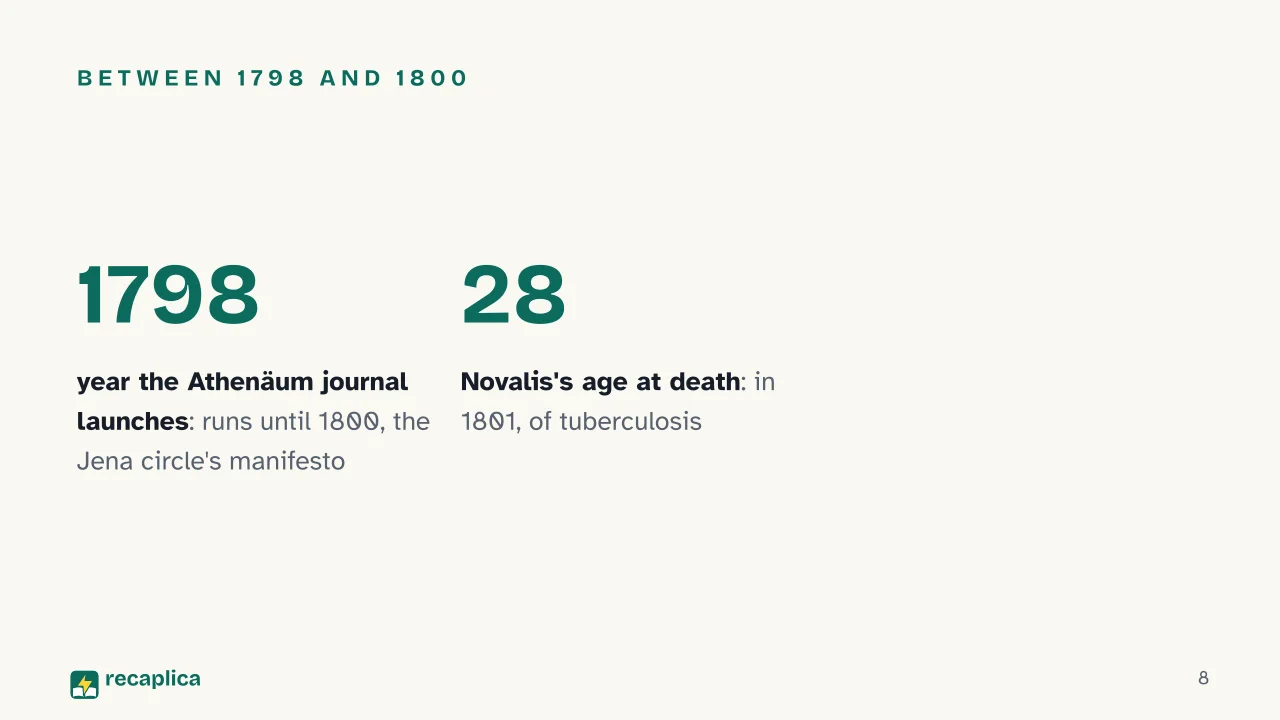  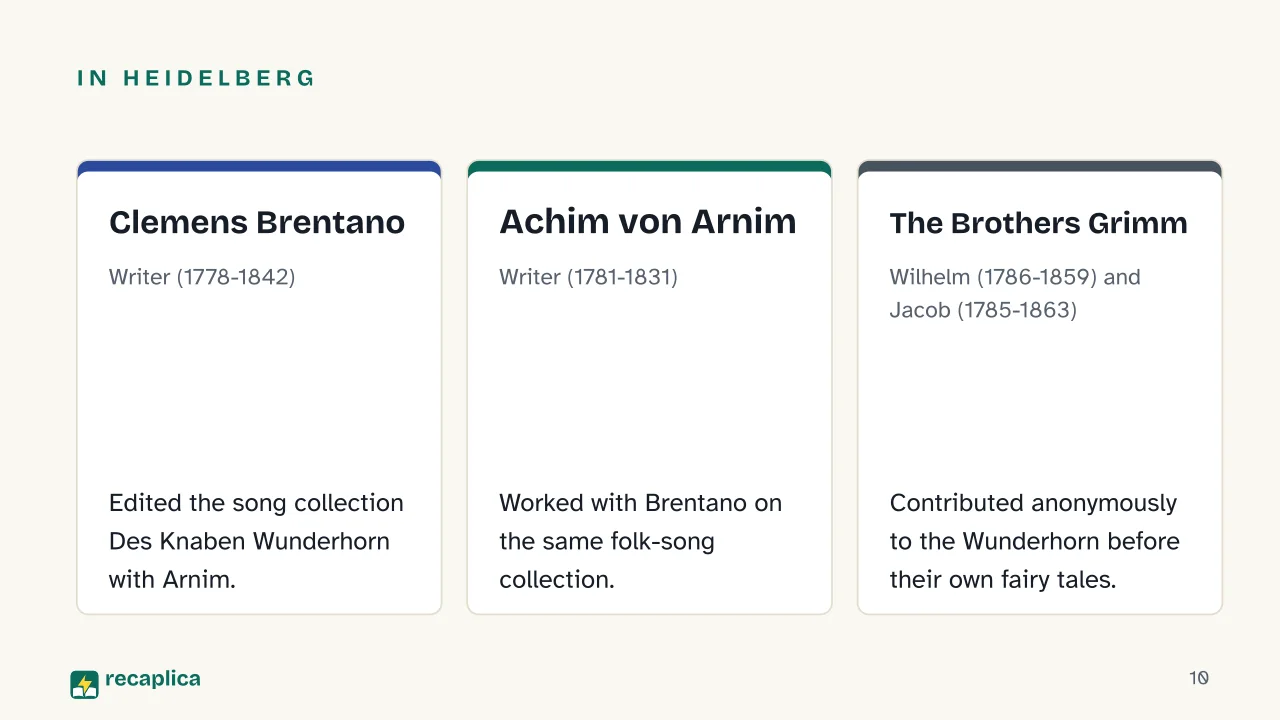 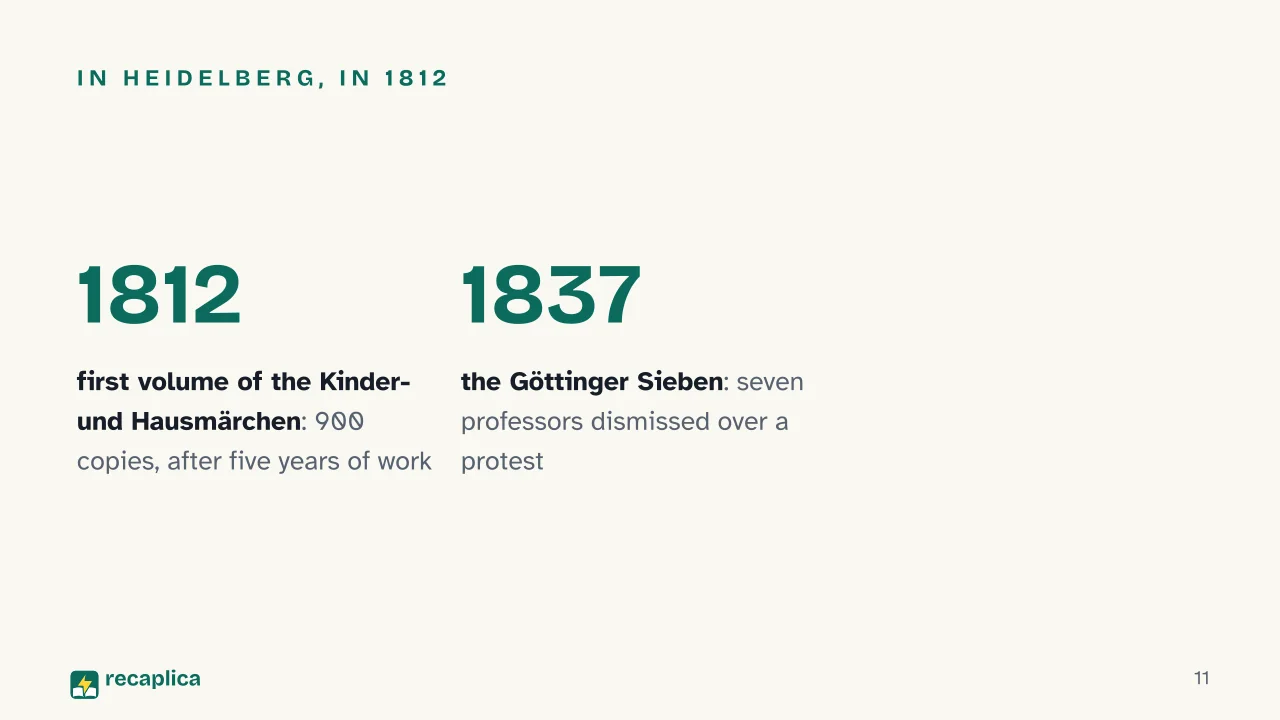  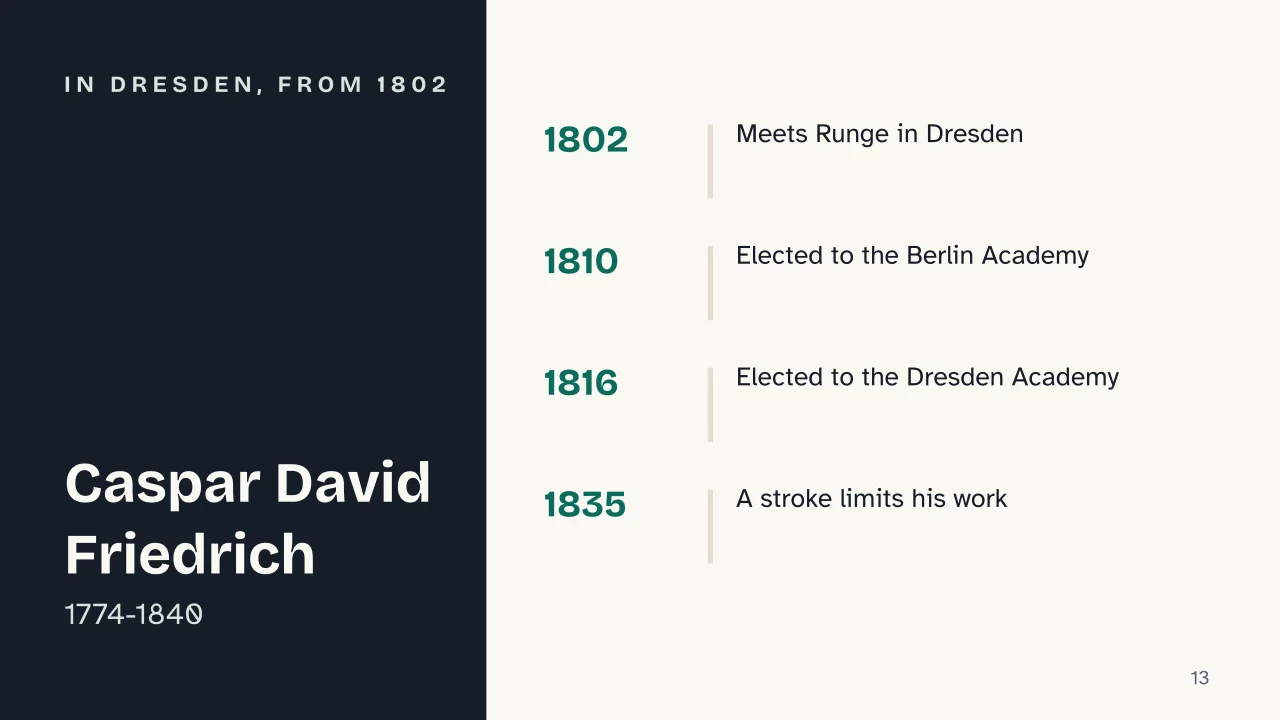 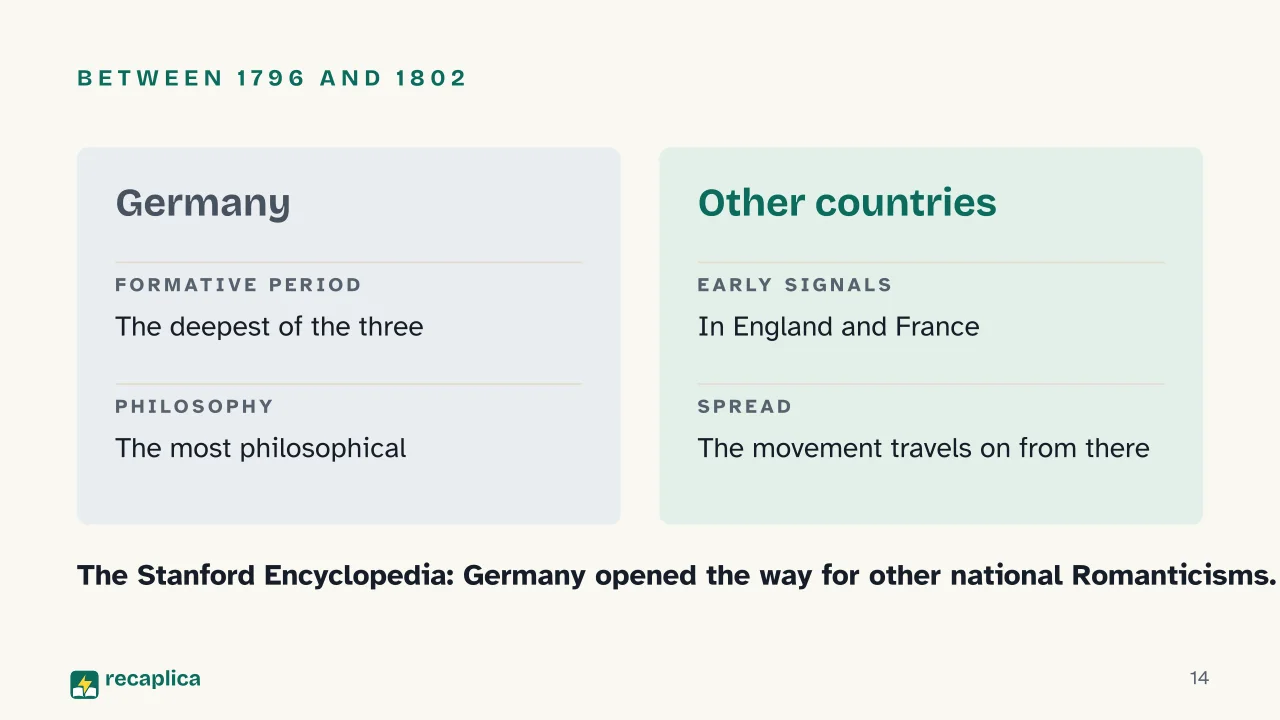 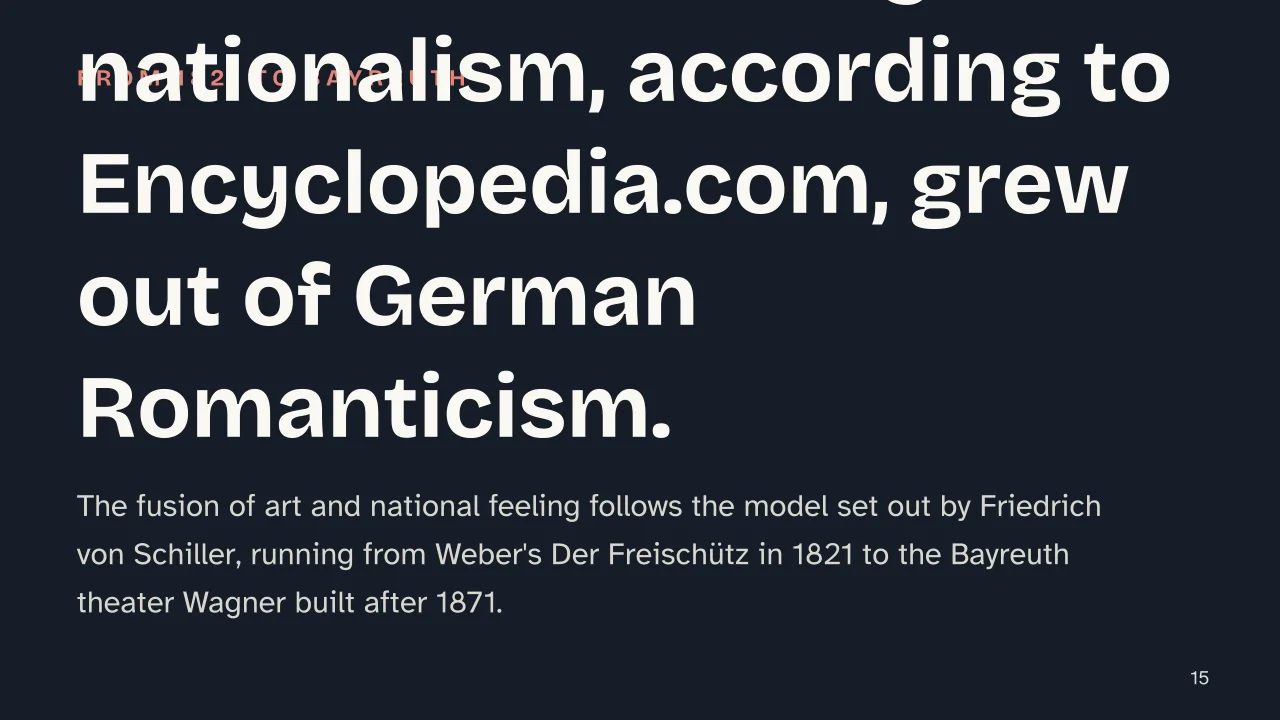 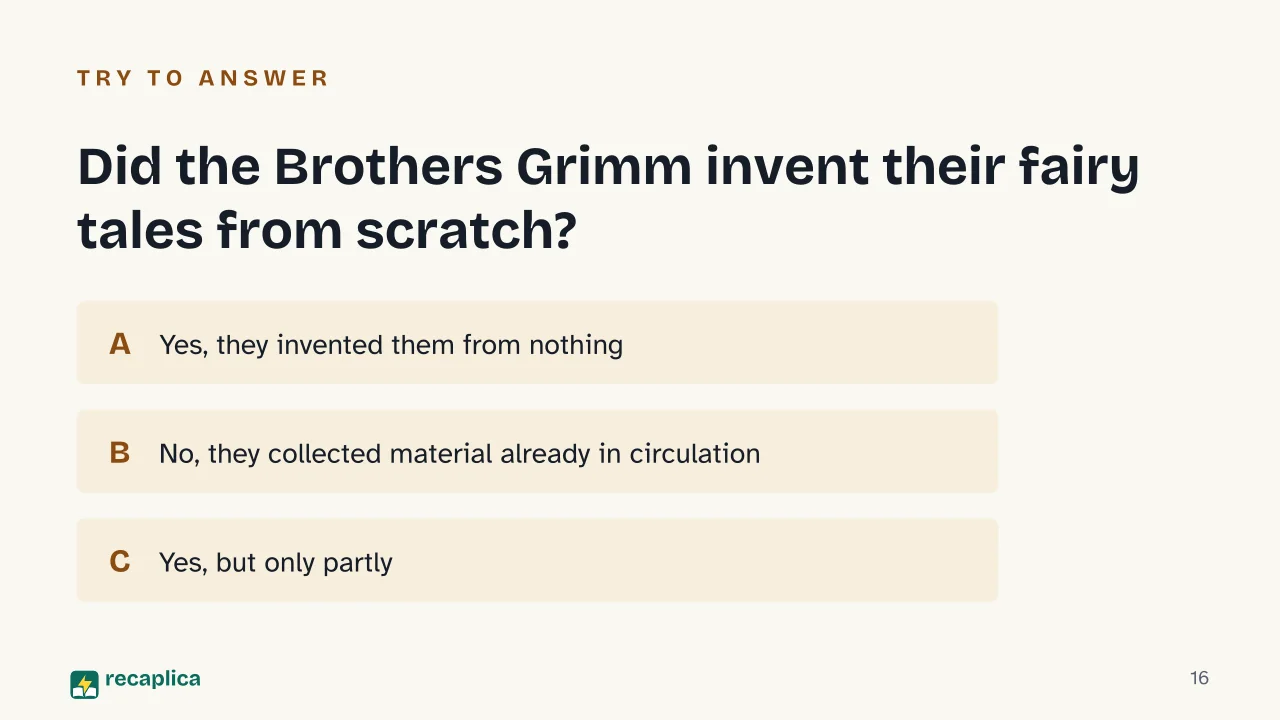  Common myths
Mind mapDrag the background to move around and the nodes to reposition them; use − and + to collapse and expand branches. 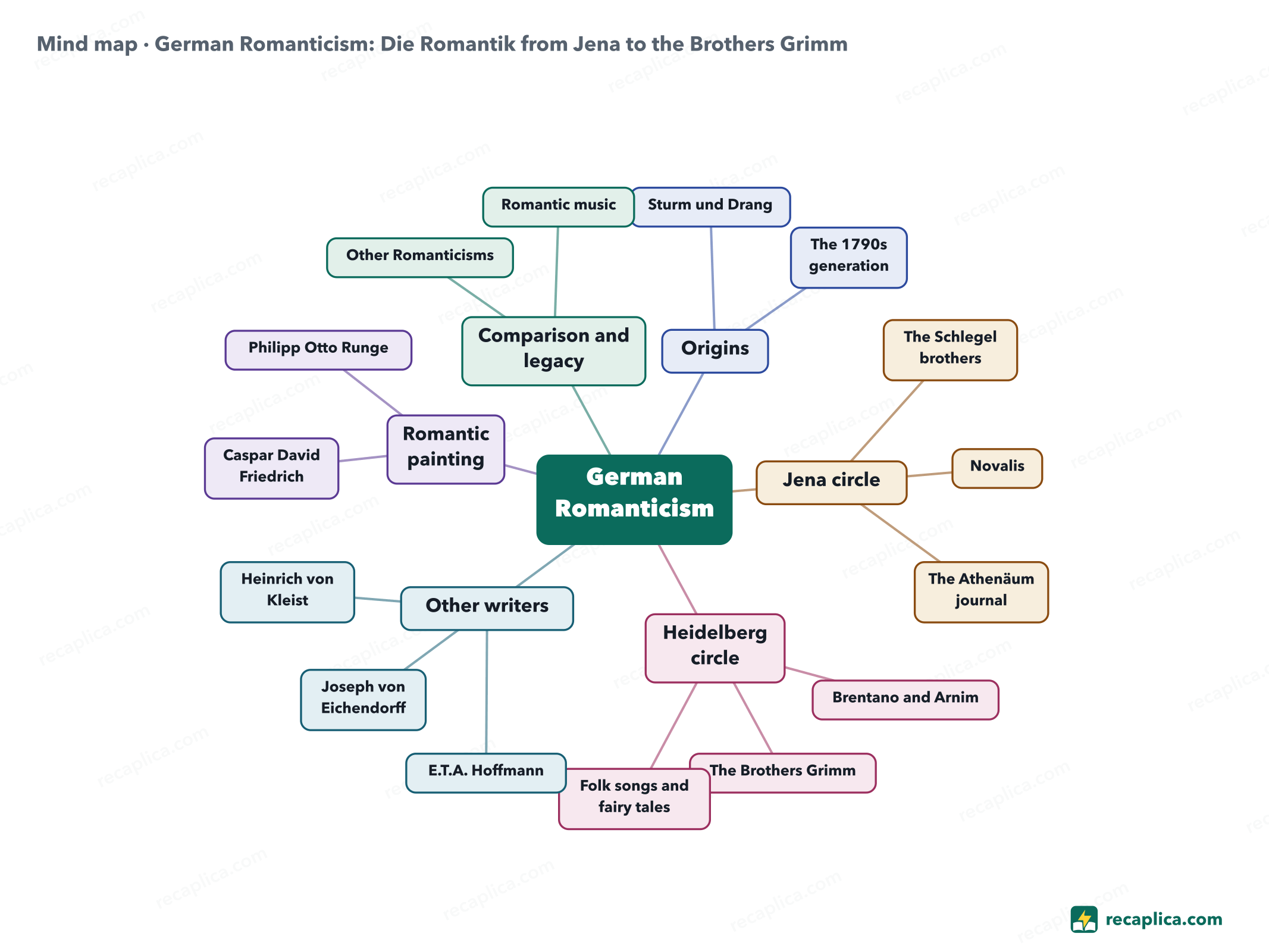
Quiz: test yourselfAnswer the questions to check what you have learned: you get instant feedback and a short explanation. Grade 0/10 0/5
FlashcardsTap the card to flip it and check whether you remember the answer, then move to the next one. 1 / 7 Explain it in your own wordsThe ultimate test: if you can explain it in simple words, you've truly understood it. Write your explanation, then compare it with the Recap. Your explanation is saved only on this device.
Frequently asked questionsWhat is German Romanticism, in short?It is die Romantik, the movement that arose in Jena in the late eighteenth century around the Schlegel brothers and Novalis, fusing poetry, criticism and philosophy, and that later shifted to Heidelberg with Brentano, Arnim and the Brothers Grimm. What is the difference between German and Italian Romanticism?The sources behind this Recap do not cover Italian Romanticism in detail, but the Stanford Encyclopedia of Philosophy places Germany's aesthetic vision, roughly 1796-1802, as the most philosophical expression of the movement, while Treccani places only early, less developed signals in England, France and Italy. For Italian Romanticism, see the Recaps on Ugo Foscolo and Giacomo Leopardi. Who were the main figures of German Romanticism?In Jena, the Schlegel brothers and Novalis; in Heidelberg, Clemens Brentano, Achim von Arnim and the Brothers Grimm; alongside them, E.T.A. Hoffmann, Joseph von Eichendorff and Heinrich von Kleist in literature, and Caspar David Friedrich and Philipp Otto Runge in painting. Did the Brothers Grimm invent their fairy tales themselves?Not as an invention from scratch: before publishing their own collection, Wilhelm and Jacob Grimm had already contributed to Des Knaben Wunderhorn, the folk-song collection by Arnim and Brentano. Every Recap goes through an independent review before publication. |