|
recaplica
What Is Romanticism in Art? Period, Style and National Schools |
| © 2026 Recaplica · recaplica.com — All rights reserved |
What Is Romanticism in Art? Period, Style and National SchoolsWhat to print Page numbers appear when printing with default margins. SlidesChoose a cut Flash10 slidesThe essential thread, to present in classFull16 slidesEvery chapter and the deeper detailBoth come with speaker notes. In 30 seconds quick readRomanticism in art is the movement that, roughly between 1780 and 1830, moves the center of art away from classical restraint and toward personal feeling, human psychology and nature experienced as a force larger than any individual. It never settles into one look: in Germany, Caspar David Friedrich paints solitary figures against vast landscapes; in Britain, J.M.W. Turner and William Blake work the sublime and the visionary; in France, Théodore Géricault and Eugène Delacroix bring current events and politics onto large, dramatic canvases. A shared thread is the taste for what unsettles and resists control, a quality Edmund Burke had already theorized in 1757 as the sublime. Its relationship with the earlier Neoclassical movement, though, is more tangled than a clean break. Key Points
Key figures
Deep DiveStart a conversation about Romantic painting and the first thing to let go of is the idea of a single recognizable look. Tate dates the movement’s peak to roughly 1780-1830, though its influence ran well past that window, and it defines itself first of all against the restraint of the classical painting that came before it. The center of gravity shifts from shared rules to personal feeling, from the exemplary scene to individual psychology. It is a change of outlook more than of technique, which is exactly why it took such different shapes from one country to the next. One idea that holds these distant pieces together is the sublime. In 1757 Edmund Burke published an essay defining it, in the summary Tate gives, as the mind’s most intense possible emotion — one tied to what is terrible, or to whatever acts the way terror does. From that theory, Tate notes, follows a claim with real weight for Romantic art: that a painting can legitimately unsettle its viewer instead of simply putting them at ease. In painting, the most cited examples are the sea storms and mountain scenes of J.M.W. Turner (1775-1851), and, in history painting, the work of Henry Fuseli (1741-1825): subjects where nature or imagination outgrow human scale. In Germany, that same tension takes the shape of solitude. Between 1808 and 1810, Caspar David Friedrich painted Monk by the Sea, a canvas measuring 171.5×110 centimeters in which a barefoot monk looks out over an expanse of water, gulls circling around him. The critic and writer Heinrich von Kleist described that figure as the only sign of life in an immensity that felt like the kingdom of death, a lone center inside an equally lone circle. The composition splits into just three horizontal bands — land, sea, sky — a starkness that shocked Friedrich’s contemporaries, who were used to more crowded landscapes. The painting was first shown alongside The Abbey in the Oakwood at the Berlin Academy exhibition of 1810; the two canvases now hang side by side at the Alte Nationalgalerie in Berlin.
Britain develops the sublime in directions beyond landscape too. Besides Turner, Tate links British Romanticism to the landscape painter John Constable (1776-1837) and to William Blake (1757-1827), a painter and poet whose visionary work explores humanity’s place in the cosmos and its relationship with God, along with new ways of reading human history. Another sign of how closely Romantic painting and literature were tied comes from Turner again: in 1839 he completed The Fighting Temeraire, about the last voyage of a warship that had fought at Trafalgar in 1805 and was obsolete by 1838, the year it was towed from Sheerness, in Kent, up the Thames to Rotherhithe, in southeast London, to be broken up. The National Gallery ties the blazing sunset in the background to a larger meaning, the shift from the age of sail to the age of steam; Turner accompanied the canvas with lines he adapted from a Thomas Campbell poem. France, by contrast, often measures Romanticism against recent events and politics. Théodore Géricault (1791-1824) showed The Raft of the Medusa at the Paris Salon of 1819, a canvas measuring 4.91×7.16 meters painted between 1818 and 1819 and drawn from a real shipwreck on 2 July 1816: of about 150 survivors left on a raft, only 15 were still alive after roughly 12 days. The harsh, livid light Géricault uses on the emaciated bodies of the dead and the living crowded onto the raft pushes the drama to the center of the scene. The Louvre, though, points out a detail that complicates any idea of a clean break with the past: the painting’s pyramidal composition and precise drawing still carry a classical imprint, even inside an already Romantic subject and light — the painting has hung at the museum since 1826. Eugène Delacroix works in a more allegorical register. Liberty Leading the People does not show, as is often assumed, the French Revolution of 1789: the Louvre clarifies that the subject is the Three Glorious Days of July 1830, a political episode much closer to the painter’s own time. In the figure of Liberty, per the Louvre, the features of a Greek goddess meet those of a sensual, vivid woman — a classical reference put to work for a message rooted in the painter’s own political present. The relationship between Romantic painting and Neoclassicism is not, then, the clean boundary it is often pictured as. A painting’s composition can stay classical even as its subject changes register, as Géricault himself shows. A few decades earlier, in Germany, the literary movement known as Sturm und Drang had already cultivated a taste for intense feeling and for the individual at odds with the rules of their time — ground on which Friedrich would later paint his solitary figures. In Italy, the same cultural season found a literary voice in Giacomo Leopardi, even if his cosmic pessimism followed a different path from the painters covered here. Slide deckSlides ready to download and make your own in PowerPoint or Google Slides, with speaker notes. Pick the Flash cut or the Full one.         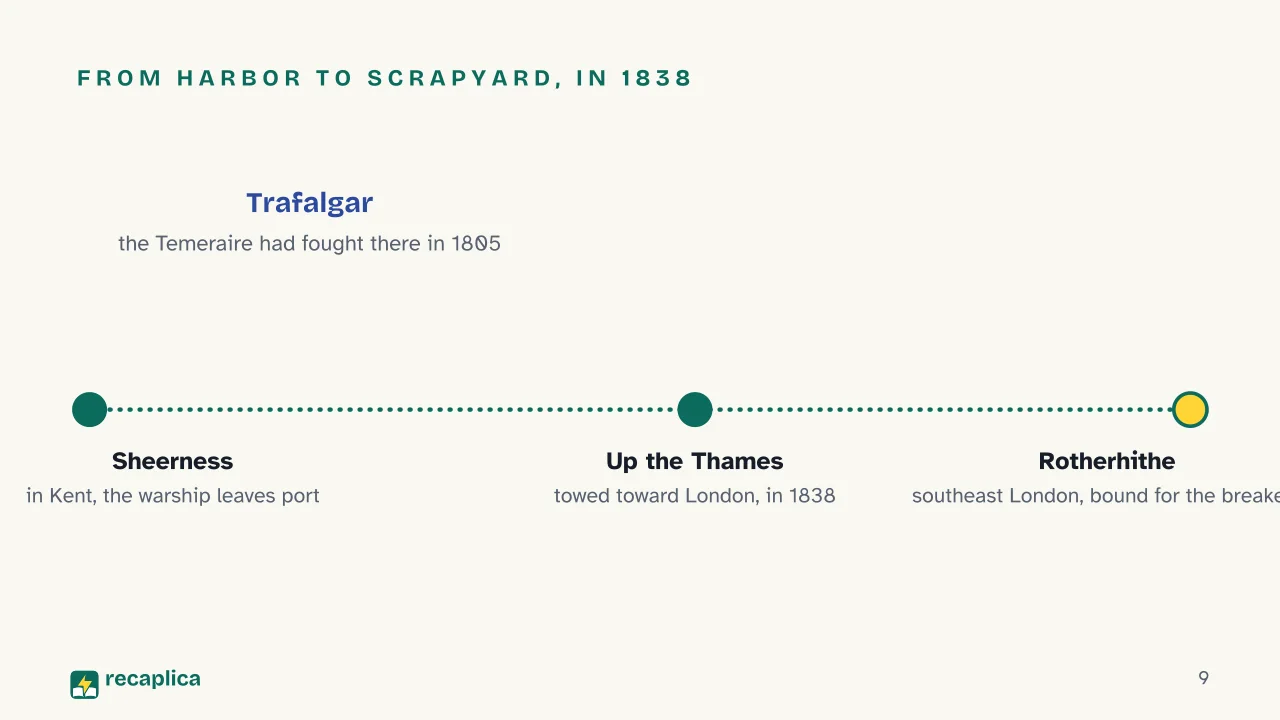  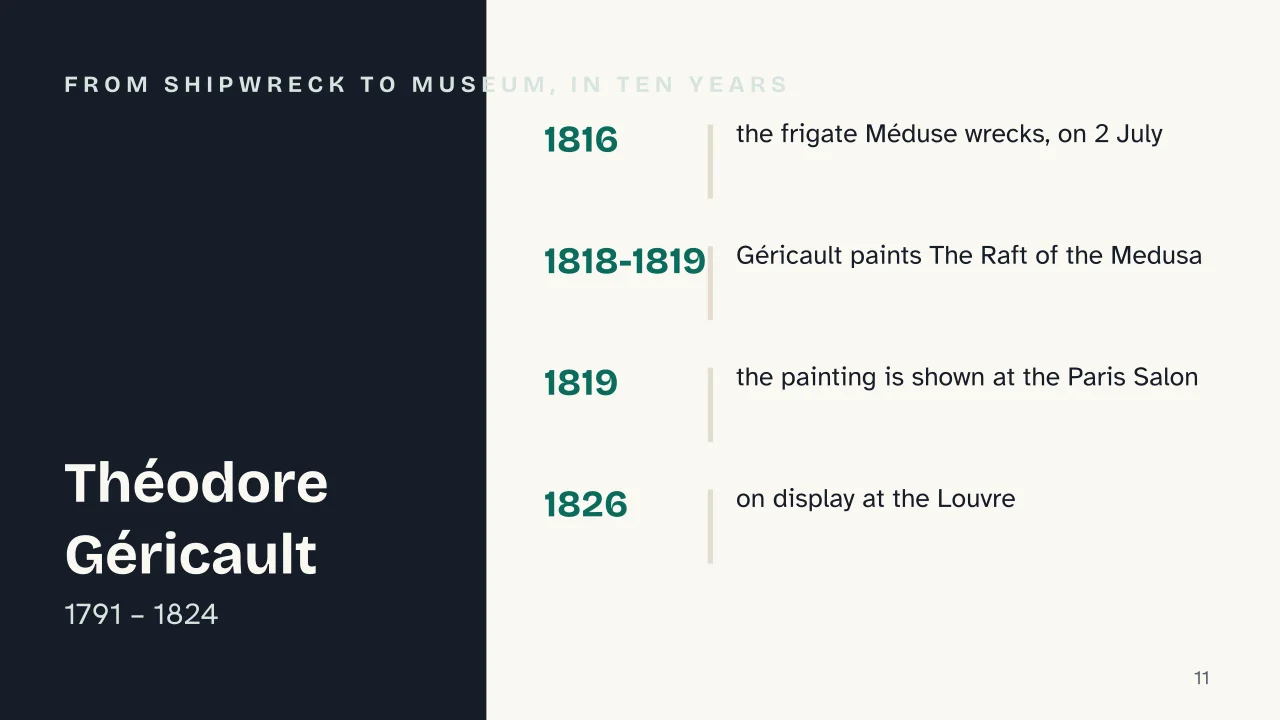 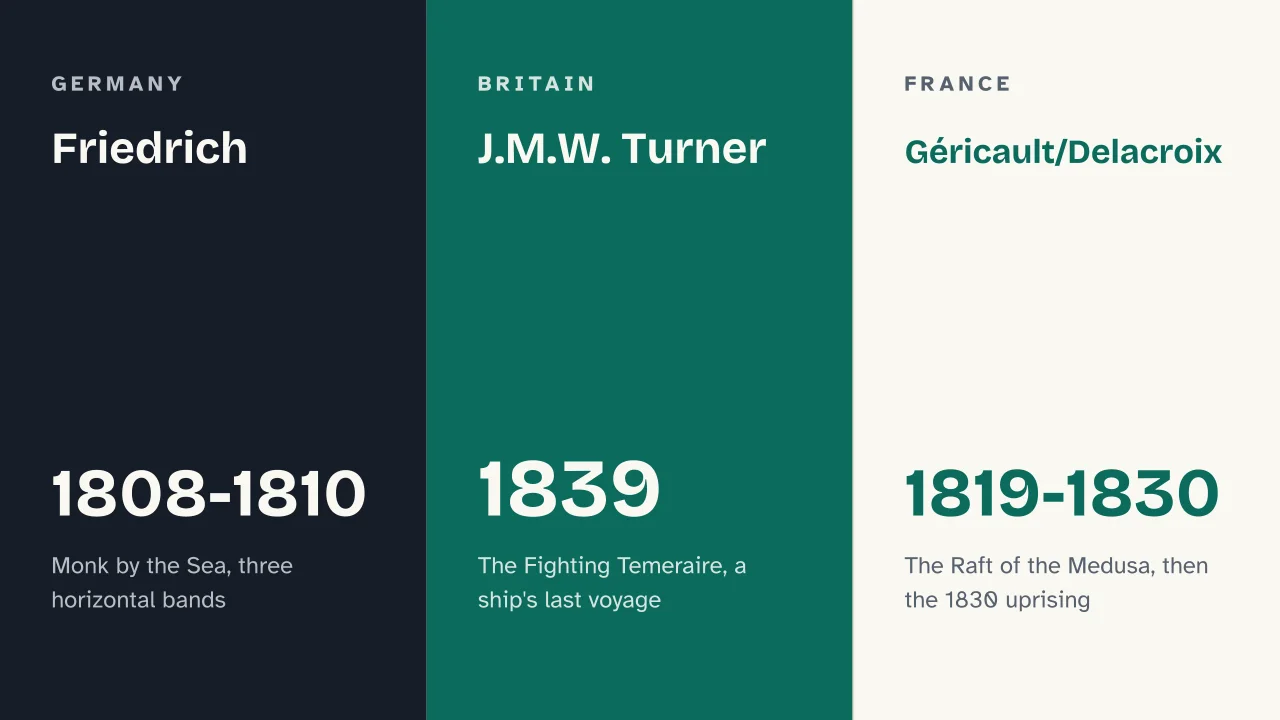 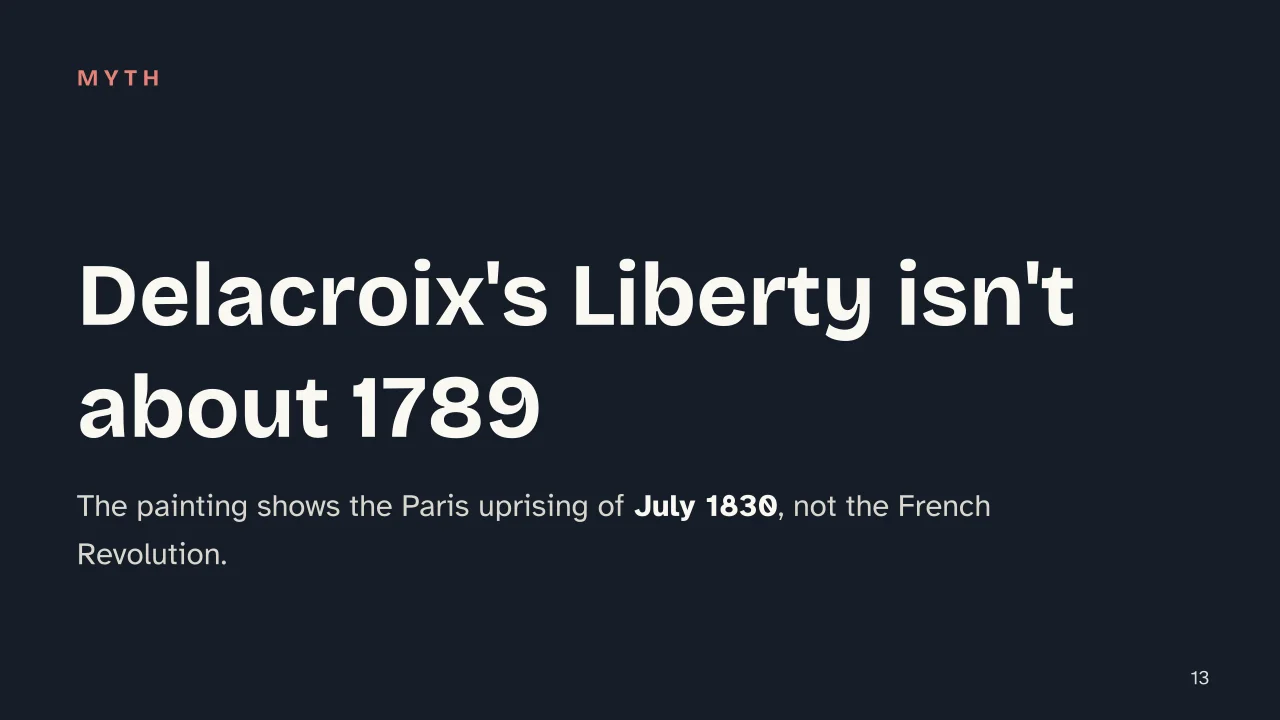 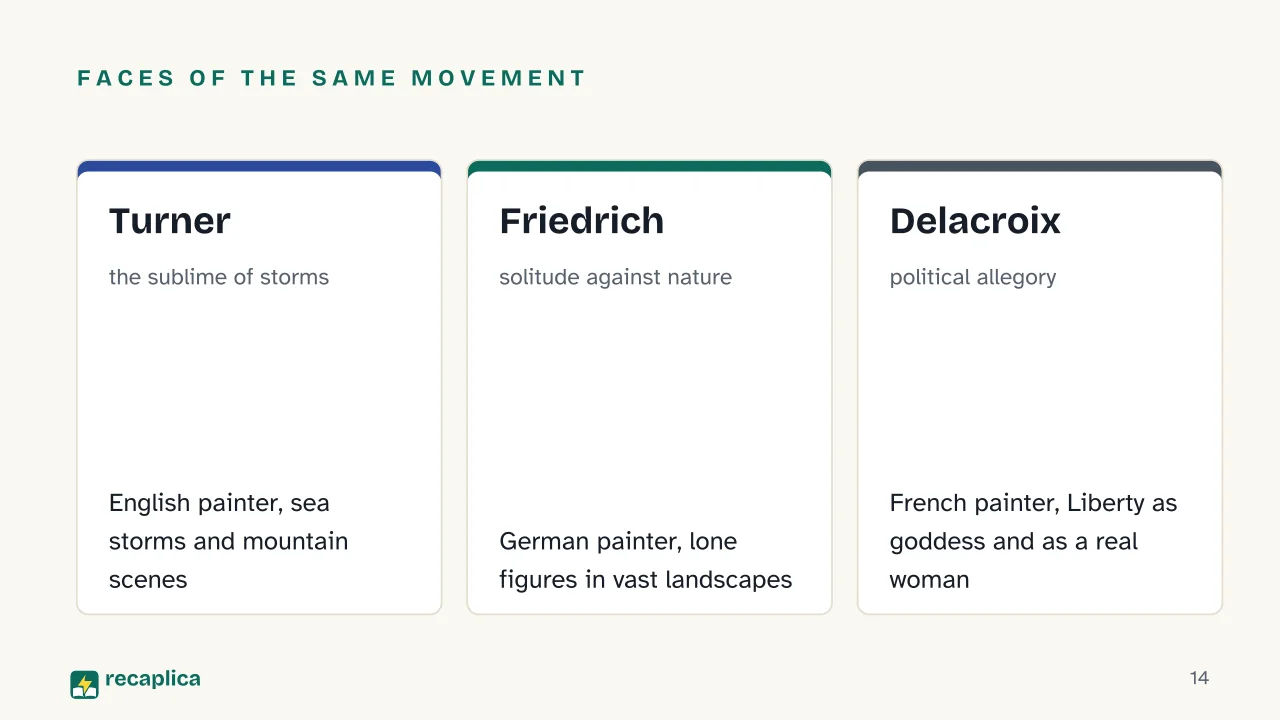 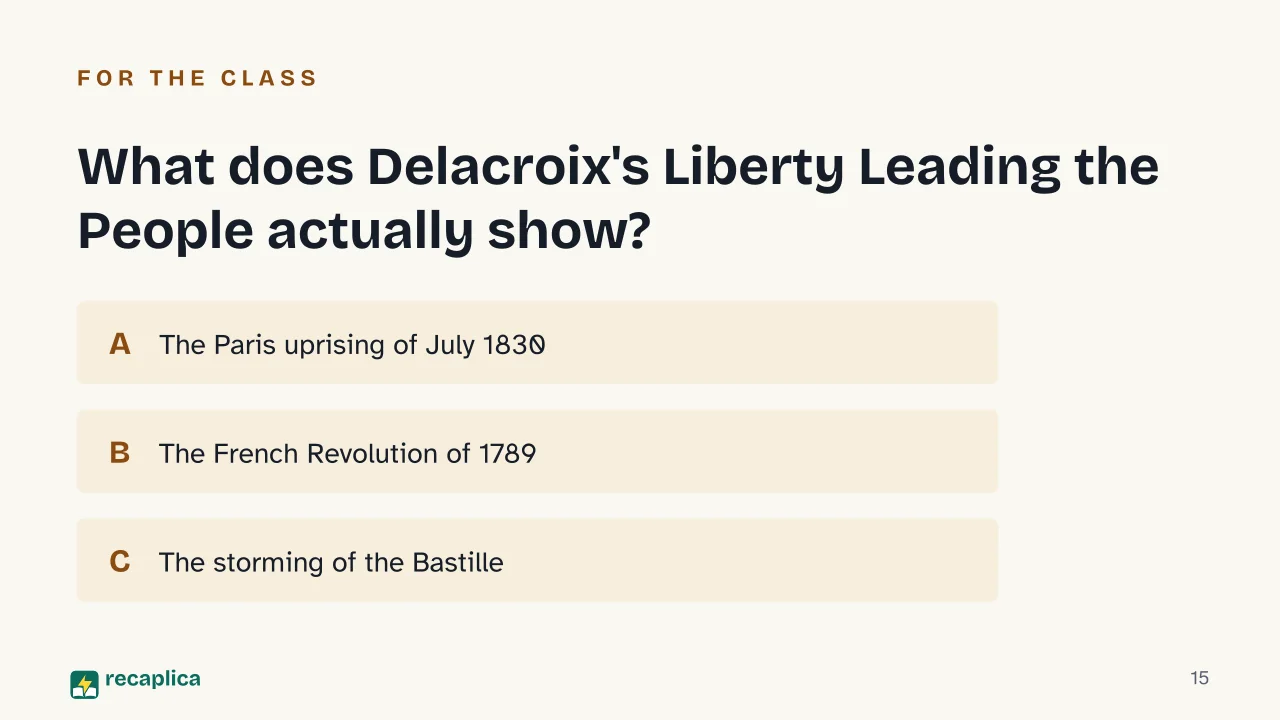  Common myths
Mind mapDrag the background to move around and the nodes to reposition them; use − and + to collapse and expand branches. 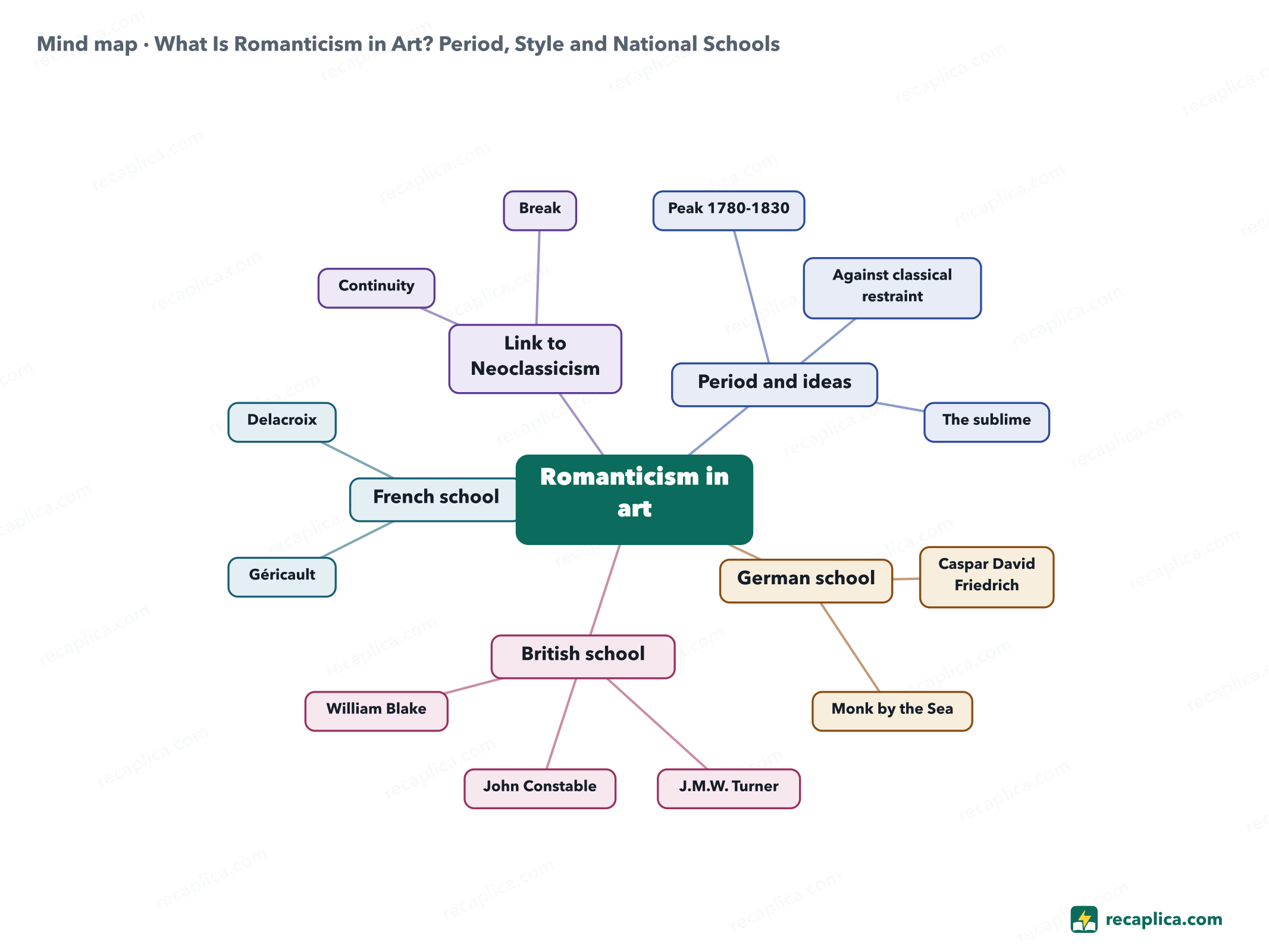
Quiz: test yourselfAnswer the questions to check what you have learned: you get instant feedback and a short explanation. Grade 0/10 0/5
FlashcardsTap the card to flip it and check whether you remember the answer, then move to the next one. 1 / 7 Explain it in your own wordsThe ultimate test: if you can explain it in simple words, you've truly understood it. Write your explanation, then compare it with the Recap. Your explanation is saved only on this device.
Frequently asked questionsWhat are the key works of Romantic painting?Among the most cited are Géricault's Raft of the Medusa (1818-1819), Delacroix's Liberty Leading the People (on the 1830 uprising), Caspar David Friedrich's Monk by the Sea (1808-1810) and J.M.W. Turner's The Fighting Temeraire (1839), on the last voyage of a warship. Who was J.M.W. Turner in British Romantic painting?Turner (1775-1851) is the English painter Tate most often links to the Romantic sublime, through his sea storms and mountain scenes. In 1839 he completed The Fighting Temeraire, about the final voyage of a ship that had fought at Trafalgar in 1805; he paired the painting with lines adapted from a poem by Thomas Campbell, borrowing from verse to deepen a painted scene. What is the difference between Romanticism and Neoclassicism in painting?Tate defines Romanticism by its opposition to classical restraint, favoring personal feeling and human psychology instead. The two movements still overlap in practice: the Louvre points to Géricault's Raft of the Medusa, where classical drawing and a pyramidal layout sit underneath a thoroughly Romantic subject. Why does the sublime matter for Romantic painting?For Burke, in the 1757 essay Tate draws on, the sublime is the highest point of human emotion, triggered by what frightens or threatens. In Romantic painting, Turner's sea storms and, in history painting, Henry Fuseli's work embody it. Every Recap goes through an independent review before publication. |