Skip to content
recaplica

    One moment: security check

    Cloudflare wants to make sure you're not a robot. Tick the box below and your search will continue on its own.

    IT
    recaplica Wanderer above the Sea of Fog: Caspar David Friedrich's Painting
    © 2026 Recaplica · recaplica.com — All rights reserved
    Home › History

    Wanderer above the Sea of Fog: Caspar David Friedrich's Painting

    By Recaplica Newsroom · Updated on October 6, 2026

    What to print

    Page numbers appear when printing with default margins.

    Slides

    Choose a cut

    Flash10 slidesThe essential thread, to present in classFull14 slidesEvery chapter and the deeper detail

    Both come with speaker notes.

    Telegram channel
    recaplica Clear in 30 seconds, yours in 10 minutes.
    In 30 seconds Key points Figures Deep dive Slides Myths Mind map Quiz Flashcards FAQ

    In 30 seconds quick read

    Wanderer above the Sea of Fog is one of Caspar David Friedrich's best-known paintings, dated to around 1817-1818 (the exact year is disputed). It shows a man seen from behind, standing on a rocky outcrop above a sea of fog from which other mountain ridges emerge. The scene is not a real place: Friedrich built it in his studio from sketches made on hiking trips through the Elbe Sandstone Mountains. Now an icon of German Romanticism, the painting hangs today at the Hamburger Kunsthalle, where it arrived in 1970.

    Key Points

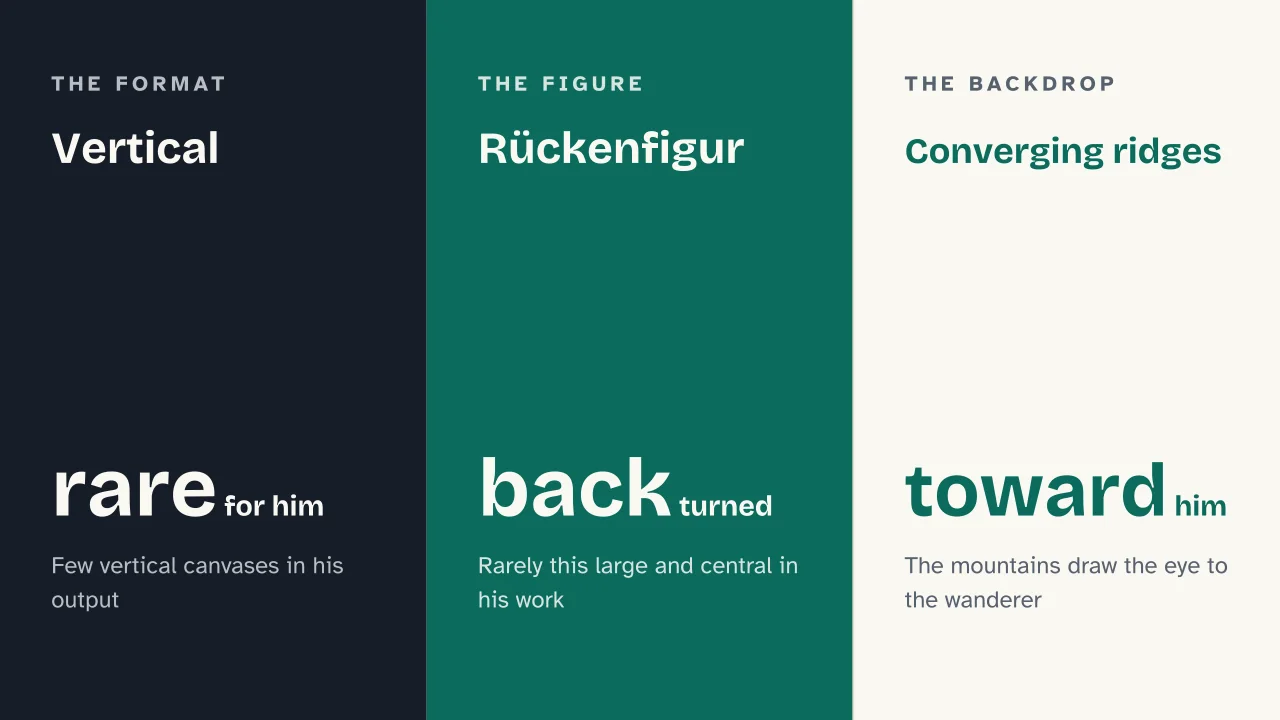
    • The central figure is a Rückenfigur, a man shown from behind, placed so the viewer seems to stand at his side, looking where he looks.
    • The mountain ridges in the fog pull the eye toward the wanderer, according to the analysis published by the cdfriedrich.de project dedicated to the painting.
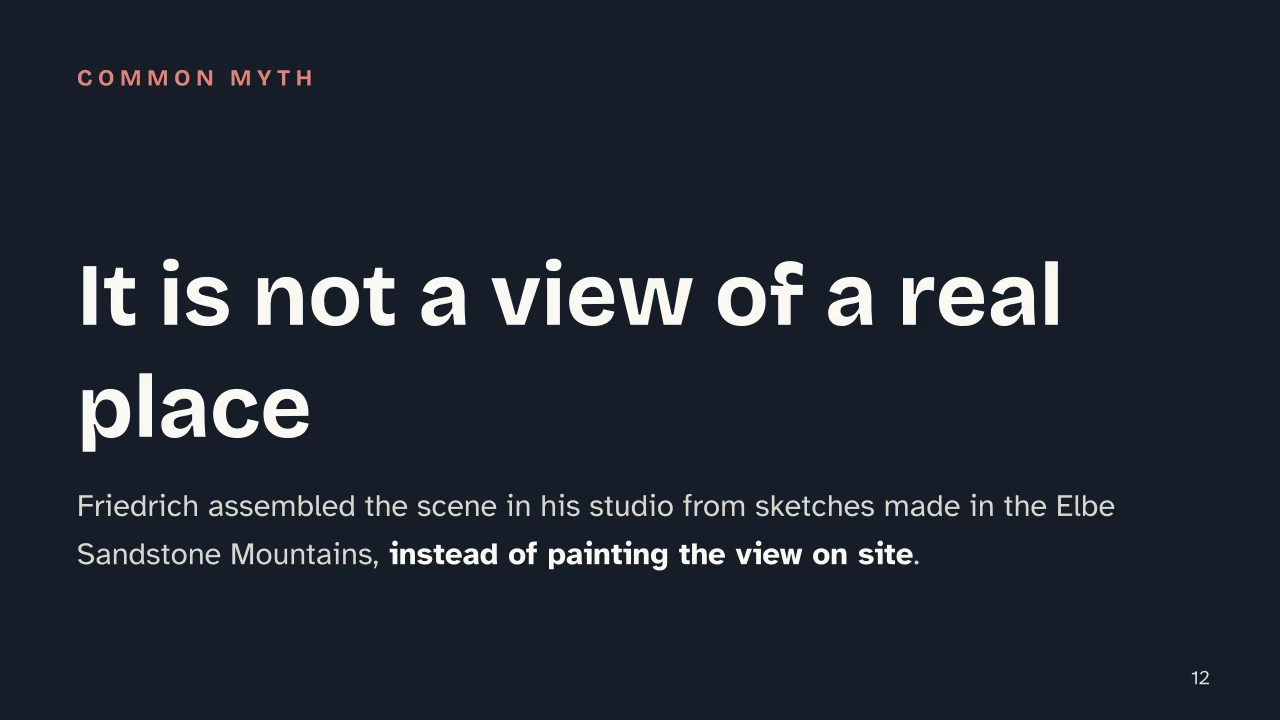
    • The landscape is a studio composition: Friedrich combined outdoor sketches instead of painting an existing place.
    • The exact date is disputed: the Stiftung Hamburger Kunstsammlungen, which owns the work, dates it to around 1817, while the more common convention in art books gives 1818.
    • Some interpreters read the wanderer as a possible self-portrait of Friedrich, an idea that has never been confirmed.
    • The painting entered the Hamburger Kunsthalle in 1970, acquired on the initiative of director Werner Hofmann, and has remained on permanent display there since.

    Key figures

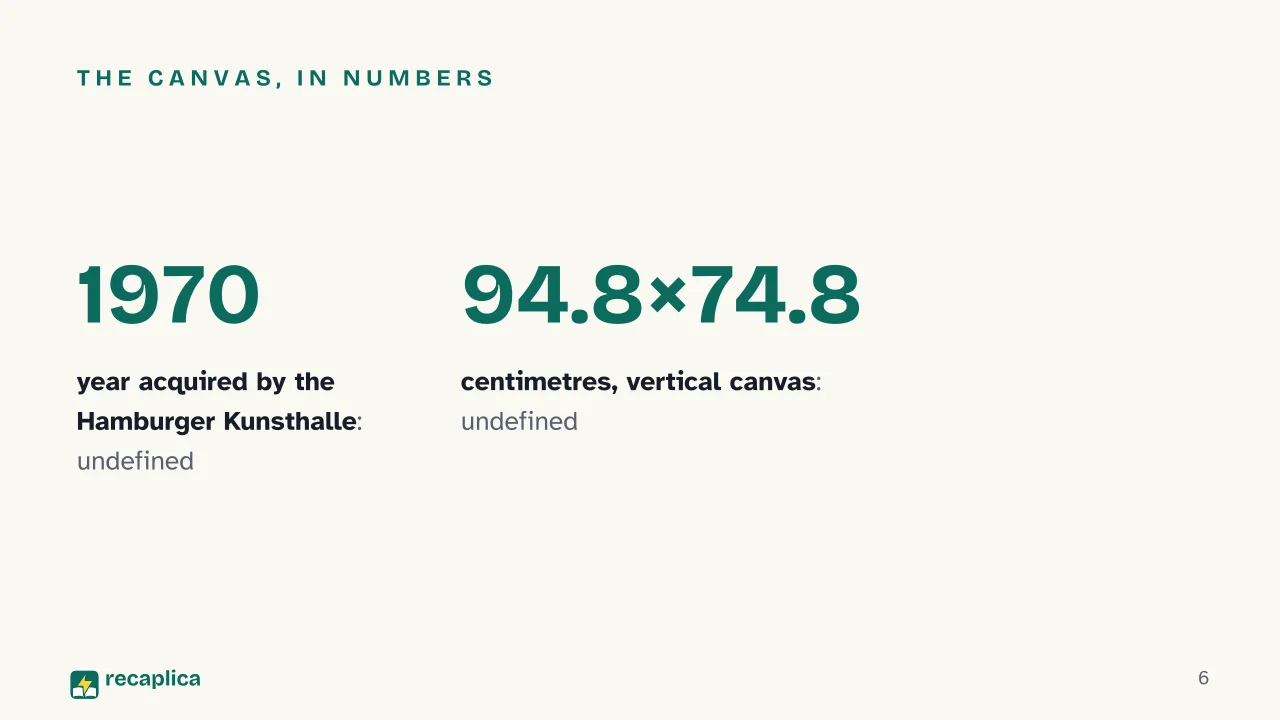
    • 94.8 × 74.8 cm the size of the canvas, painted between 1817 and 1818, an unusually vertical format for Friedrich. Source: Stiftung Hamburger Kunstsammlungen
    • 1970 the year the painting entered the collection of the Hamburger Kunsthalle, acquired on the initiative of director Werner Hofmann. Source: Hamburger Kunsthalle

    Deep Dive

    The first thing most people notice about Wanderer above the Sea of Fog is where the figure is standing, more than the landscape around him. The man is shown from behind, on a rocky outcrop, which places the viewer at his side, looking where he looks — the device art historians call a Rückenfigur. According to the Stiftung Hamburger Kunstsammlungen, the foundation that owns the painting, Friedrich rarely gave a single human figure this much size and centrality, and the vertical canvas is itself unusual in his output, where horizontal formats are far more common.

    The mountain ridges rising out of the sea of fog are not arranged randomly. The Wanderer above the Sea of Fog project, a site dedicated entirely to the painting, finds that the landscape lines converge visually on the wanderer, producing a near-circular pull that keeps bringing the eye back to him. The same source argues that the figure sits on the canvas’s vertical centre line according to the golden ratio, a choice that would reinforce how central he is to the composition.

    Example: try tracing the strongest mountain ridges in pencil on a printed copy of the painting. Most of the lines end up pointing straight at the wanderer’s outline — a quick way to see for yourself how Friedrich steers the eye, with no need to know the rules of composition beforehand.

    Who that man really is stays unanswered. The painting keeps it to itself.

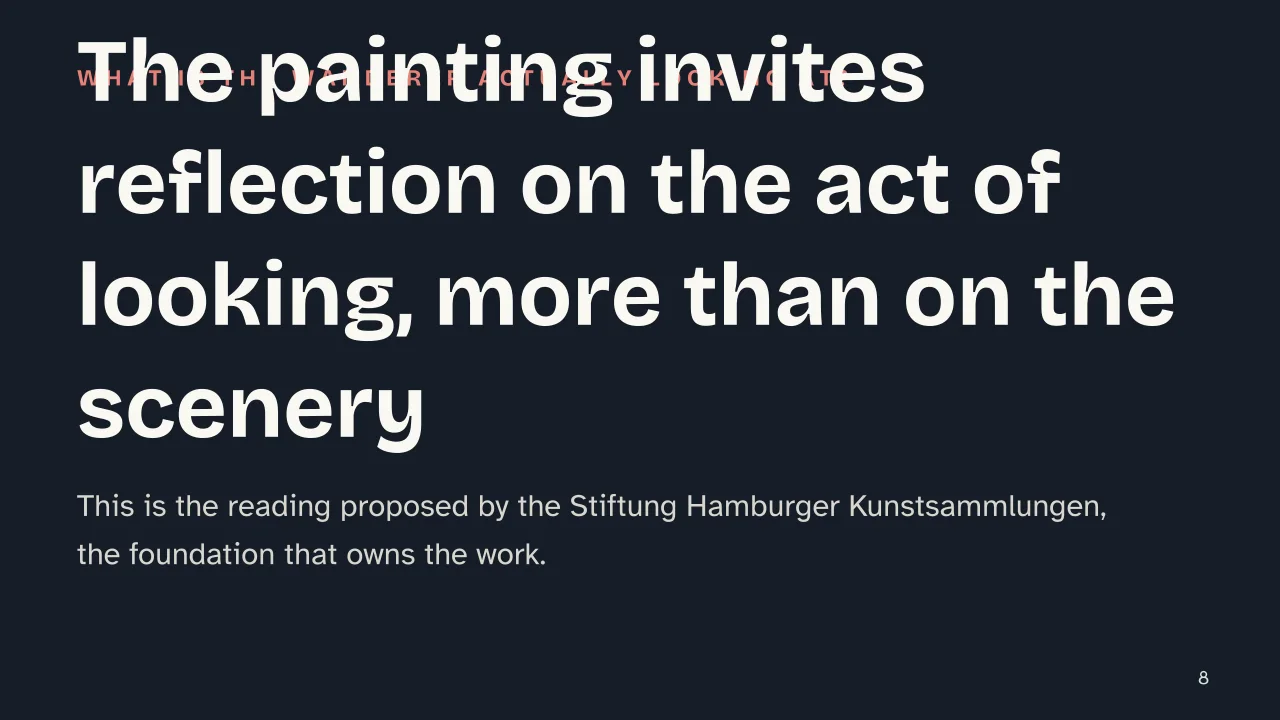
    On the question of meaning, the most authoritative voice — the Stiftung Hamburger Kunstsammlungen, which owns the work — offers a narrower reading: the painting prompts reflection on the act of looking itself, more than on the scenery it depicts. That differs from the more familiar popular reading, which treats the wanderer as a symbol of humanity conquering nature. Some interpreters, according to the Wikipedia entry on the painting, have also read it as a picture of self-reflection or of looking back over one’s own life; others have proposed that the wanderer is a self-portrait of Friedrich, pointing to physical traits such as hair colour. None of this is settled; these remain readings, not established facts.

    The view the wanderer is looking at does not correspond to any place you could visit. According to the cdfriedrich.de project, Friedrich did not paint on site: he combined individual outdoor studies in his studio, building the final scene only after holding the whole image in his mind. For this painting, the underlying studies came from Friedrich’s hikes through the Elbe Sandstone Mountains, in Saxon Switzerland, merged into a scene that exists only on the canvas. The same method explains why no single identifiable peak appears in the picture — there is none to identify.

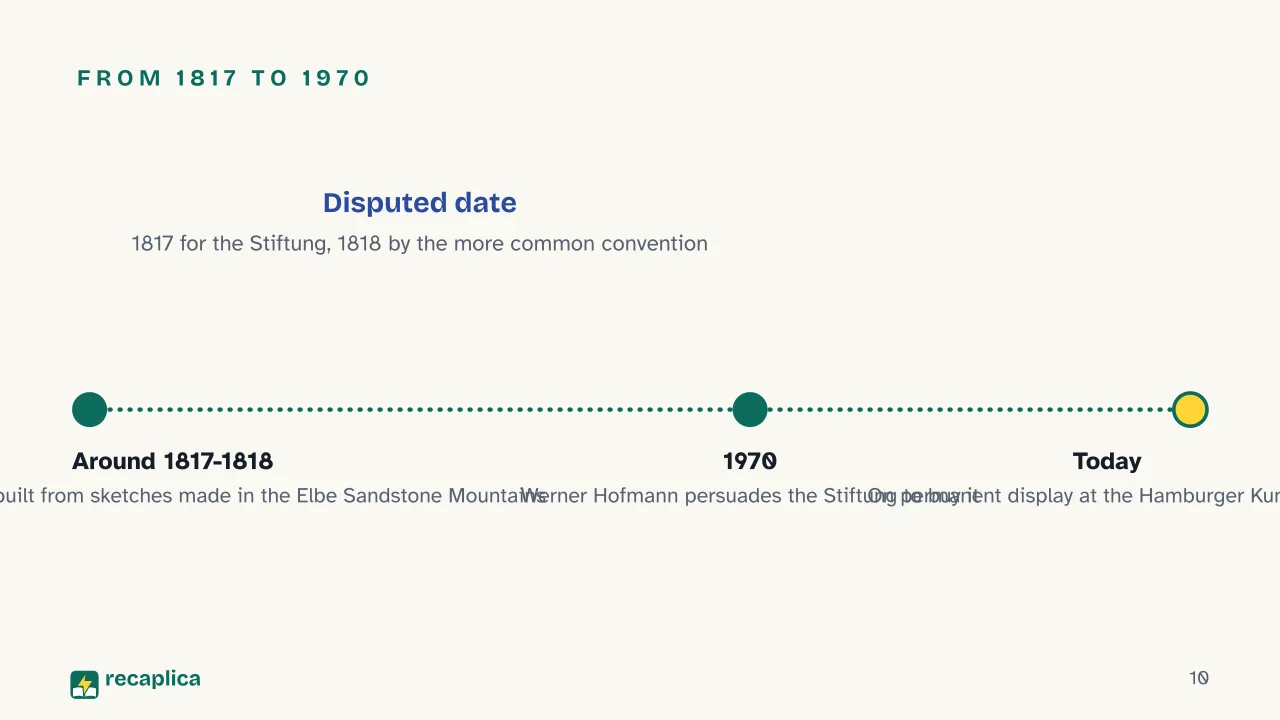
    The exact date of the painting is not settled either. The Stiftung Hamburger Kunstsammlungen dates it to “around 1817,” while the convention more common in art books gives 1818; the Wikipedia entry confirms that sources disagree on this point. Firmer ground is the painting’s entry into public ownership: in 1970 the Hamburger Kunsthalle’s director at the time, Werner Hofmann, persuaded the Stiftung für die Hamburger Kunstsammlungen to buy it. The painting has hung on permanent display in the Hamburg museum ever since, as the museum’s own page on the nineteenth century confirms. For a canvas under a metre on either side — 94.8 × 74.8 centimetres — it is a long way to the wall where visitors still see it today.

    In the decades after the acquisition, the museum notes, the Wanderer became an icon of Romantic art, turning up again and again as a visual motif right up to the present. The Stiftung goes further, calling it the defining image of Romanticism and noting that no other work by Friedrich is reproduced or echoed as often. The cdfriedrich.de project documents one specific strand of that legacy: the painting became a compositional template still copied by countless travel photographs, with the same figure seen from behind facing a view. The same project also records a more critical take on that legacy: some contemporary readings question whether the Rückenfigur represents a universal viewpoint, noting that it does not include every identity equally. They point to artists such as Kehinde Wiley, who have reworked the same composition with figures other than a white European man of the early nineteenth century.

    Wanderer above the Sea of Fog does not stand alone: it belongs to a larger story told in the biography of Caspar David Friedrich, and it fits into a wider artistic movement covered in the Recap on Romanticism in art. Set beside icons from other eras — such as Botticelli’s Birth of Venus, painted roughly three and a half centuries earlier — the Wanderer shows how much the very idea of a painting’s subject had changed. It goes from a recognisable mythological figure to an anonymous man, seen from behind, who never shows his face.

    Slide deck

    Slides ready to download and make your own in PowerPoint or Google Slides, with speaker notes. Pick the Flash cut or the Full one.

    Slide 1 of the presentation on Wanderer above the Sea of Fog: Wanderer above the Sea of FogSlide 2 of the presentation on Wanderer above the Sea of Fog: Why has a man seen from behind, on a rock, become an icon of Romanticism?Slide 3 of the presentation on Wanderer above the Sea of Fog: The painting, piece by pieceSlide 4 of the presentation on Wanderer above the Sea of Fog: Chapter 01: CompositionSlide 5 of the presentation on Wanderer above the Sea of Fog: Vertical · Rückenfigur · Converging ridgesSlide 6 of the presentation on Wanderer above the Sea of Fog: The canvas, in numbersSlide 7 of the presentation on Wanderer above the Sea of Fog: Chapter 02: MeaningSlide 8 of the presentation on Wanderer above the Sea of Fog: The painting invites reflection on the act of looking, more than on the scenerySlide 9 of the presentation on Wanderer above the Sea of Fog: Chapter 03: History of the workSlide 10 of the presentation on Wanderer above the Sea of Fog: From 1817 to 1970Slide 11 of the presentation on Wanderer above the Sea of Fog: Chapter 04: Cultural legacySlide 12 of the presentation on Wanderer above the Sea of Fog: It is not a view of a real placeSlide 13 of the presentation on Wanderer above the Sea of Fog: Does the landscape behind the wanderer match a real place?Slide 14 of the presentation on Wanderer above the Sea of Fog: Time to review
    Flash10 slidesThe essential thread, to present in classFull14 slidesEvery chapter and the deeper detail

    Common myths

    • ✗ Myth The landscape in the painting is a real view, a place you could visit in Germany today.

      ✓ Reality According to the cdfriedrich.de project, Friedrich worked from memory in his studio, combining sketches made during hikes through the Elbe Sandstone Mountains into an imagined scene with no real-world counterpart.

    • ✗ Myth The man seen from behind is definitely a self-portrait of Friedrich.

      ✓ Reality According to Wikipedia, some interpreters have proposed a self-portrait based on physical traits such as hair colour, but it remains a hypothesis: no source confirms it as an established fact.

    • ✗ Myth Such a famous, widely reproduced painting must be large.

      ✓ Reality The canvas measures 94.8 × 74.8 cm, less than a metre on either side, according to the Stiftung Hamburger Kunstsammlungen: reproductions, often enlarged on posters and book covers, make people forget how small the original actually is.

    Mind map

    Drag the background to move around and the nodes to reposition them; use − and + to collapse and expand branches.
    Customize
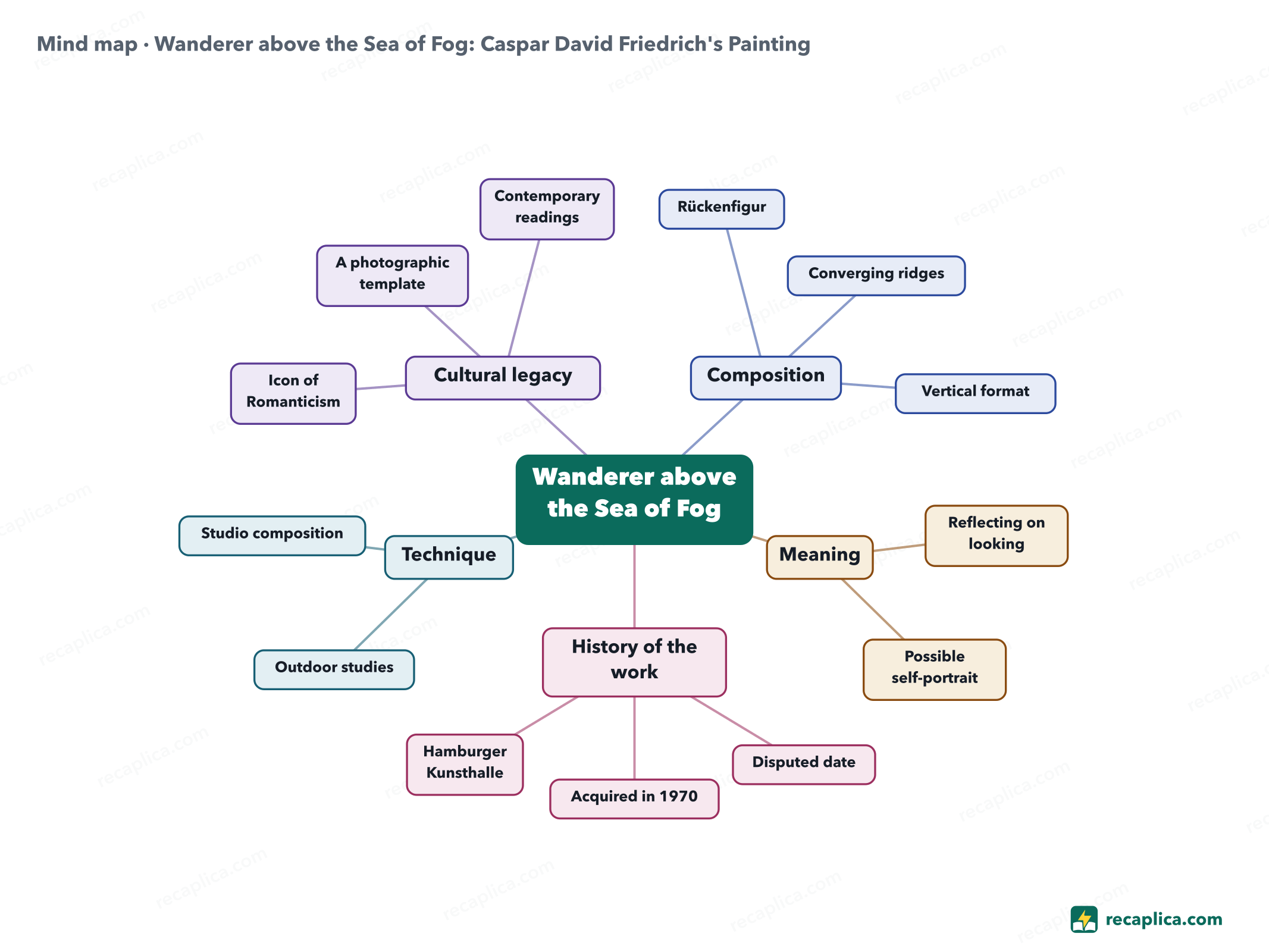
    Mind map: Wanderer above the Sea of Fog: Caspar David Friedrich's Painting
    • Wanderer above the Sea of Fog
      • Composition
        • Rückenfigur A figure seen from behind, on a rocky outcrop
        • Converging ridges The mountains in the fog converge on the wanderer
        • Vertical format Unusual within Friedrich's output
      • Meaning
        • Reflecting on looking The Stiftung reads the painting as a prompt to think about the act of looking itself
        • Possible self-portrait A hypothesis raised by some interpreters, still unconfirmed
      • History of the work
        • Disputed date 1817 for the Stiftung, 1818 by the more common convention
        • Acquired in 1970 Werner Hofmann persuaded the Stiftung to buy it
        • Hamburger Kunsthalle On permanent display since 1970
      • Technique
        • Outdoor studies Sketches made in the Elbe Sandstone Mountains
        • Studio composition The landscape is a studio assembly, built from separate sketches
      • Cultural legacy
        • Icon of Romanticism The Stiftung calls it the movement's defining image
        • A photographic template Echoed by countless travel photographs
        • Contemporary readings Kehinde Wiley has reinterpreted the Rückenfigur with different figures

    Quiz: test yourself

    Answer the questions to check what you have learned: you get instant feedback and a short explanation.

    Grade 0/10 0/5
    1 What does the figure at the centre of the painting show?

    A Rückenfigur shows a subject from behind; here it is a man standing on a rocky outcrop, as described by the Stiftung Hamburger Kunstsammlungen.

    2 When was the painting made, according to the sources?

    The owning foundation dates it to around 1817, while the more common convention gives 1818: the exact year remains unsettled.

    3 Where is the painting kept today?

    The painting entered the Hamburger Kunsthalle's collection in 1970 and has been on permanent display there ever since.

    4 Does the landscape behind the wanderer match a real place?

    According to the cdfriedrich.de project, Friedrich worked in his studio, combining outdoor landscape studies made in the Elbe Sandstone Mountains instead of painting a view on site.

    5 The idea that the wanderer is a self-portrait of Friedrich is...

    Some interpreters see a possible self-portrait in the wanderer, based on the reddish hair colour: it remains an unconfirmed hypothesis.

    Answers: 1-A · 2-B · 3-A · 4-A · 5-A

    Flashcards

    Tap the card to flip it and check whether you remember the answer, then move to the next one.

    1 / 8

    Explain it in your own words

    The ultimate test: if you can explain it in simple words, you've truly understood it. Write your explanation, then compare it with the Recap.

    Your explanation is saved only on this device.

    Wanderer above the Sea of Fog is one of Caspar David Friedrich's best-known paintings, dated to around 1817-1818 (the exact year is disputed). It shows a man seen from behind, standing on a rocky outcrop above a sea of fog from which other mountain ridges emerge. The scene is not a real place: Friedrich built it in his studio from sketches made on hiking trips through the Elbe Sandstone Mountains. Now an icon of German Romanticism, the painting hangs today at the Hamburger Kunsthalle, where it arrived in 1970.

    Frequently asked questions

    Where is the painting Wanderer above the Sea of Fog kept?

    At the Hamburger Kunsthalle in Hamburg, where it entered the collection in 1970 and has been on permanent display ever since.

    Who is the man shown in the painting?

    His identity remains an open question. Some interpreters have read him as a possible self-portrait of Friedrich, based on the hair colour: it is a plausible reading, never confirmed by a reliable source.

    How has the composition of the painting been analysed?

    A man seen from behind (a Rückenfigur) stands on a rocky outcrop, in an unusually vertical format for Friedrich; the cdfriedrich.de project's analysis finds that the surrounding peaks guide the eye straight to him.

    What year was Wanderer above the Sea of Fog painted?

    Around 1817-1818: the Stiftung Hamburger Kunstsammlungen, which owns the work, gives 1817, while the convention more common in books gives 1818.

    What does Wanderer above the Sea of Fog mean?

    According to the Stiftung Hamburger Kunstsammlungen, the painting is above all an invitation to think about what it means to look. Some readings also treat it as a meditation on one's own path through life.

    Sources

    • Hamburger Kunsthalle, Nineteenth Century
    • Stiftung Hamburger Kunstsammlungen, entry on Wanderer über dem Nebelmeer
    • Wanderer above the Sea of Fog (project dedicated to the painting, cdfriedrich.de)
    • Wikipedia (EN), Wanderer above the Sea of Fog

    Every Recap goes through an independent review before publication.

    Every evening, the day's new Recaps on our Telegram channel. Join the channel →

    Keep learning

    • History What Is Existentialism? Heidegger, Being and Time, and Dasein Existentialism is a current of twentieth-century philosophy centered on human existence, freedom and the search for meaning. According to the Stanford Encyclopedia of Philosophy, the German philosopher Martin Heidegger (1889-1976) shaped that current more than almost anyone else, even though he never accepted the label. In 1927 he published Being and Time, his major work, where he introduced the concept of Dasein: the human being as the one entity that questions its own existence. That book influenced Jean-Paul Sartre's existentialism, but in 1946, in the Letter on Humanism, Heidegger openly broke with Sartre and refused to be called an existentialist. In 1933 he was elected rector of the University of Freiburg and became a Nazi party member, keeping that membership until the regime fell - an episode Heidegger himself later denied or played down more than once. Read the Recap →
    • History What Is Phenomenology? Husserl's Philosophy Explained Edmund Husserl founded phenomenology as a philosophical discipline around 1900-1901, with his Logical Investigations. His method starts from the epoché, a suspension of our everyday, unquestioning stance toward the world, and moves toward phenomenological reduction: studying how things appear to consciousness rather than what they are in themselves. At the center sits intentionality, the idea that every experience is always an experience of something specific, whether hoping, perceiving, or desiring. The method Husserl built carried into the 20th century through Heidegger, Sartre, and Merleau-Ponty, moving from German philosophy into French philosophy along the way. Read the Recap →
    • History Legal Positivism: What It Is, from Austin to Kelsen and Hart According to the Stanford Encyclopedia of Philosophy, legal positivism measures legal validity against observable social facts, keeping moral judgment on a separate track. Its roots lie in Hobbes and Hume. Jeremy Bentham produced the theory's first full account, which John Austin later took up and spread: for Austin, a rule is law only when a sovereign commands it under threat of punishment. In the twentieth century, Hans Kelsen grounded legal validity in a hierarchy that traces back to a presupposed basic norm, while Herbert Hart located it instead in a rule of recognition actually followed by judges and officials. Natural law theory takes the opposite view: an unjust law is not really a law. Legal positivism disagrees — a law stays valid even when it is morally unjust, as long as it was made the way the system requires. Read the Recap →

    recaplica

    Clear in 30 seconds, yours in 10 minutes.

    Recaps Mind maps Request a Recap Telegram channel Mind map maker Our method About Privacy & cookies Legal notes & terms of use

    © 2026 Recaplica · A project by Curi S.r.l. — VAT IT05472000750

    Statistics, only if you say so

    To learn which Recaps help most we would use Google Analytics, with aggregate, anonymous data. It starts only with your OK, and you can change your mind anytime. Privacy policy