|
recaplica
Who Was Aristotle? Logic, Nature, and Virtue, Summarized |
| © 2026 Recaplica · recaplica.com — All rights reserved |
Who Was Aristotle? Logic, Nature, and Virtue, SummarizedWhat to print Page numbers appear when printing with default margins. SlidesChoose a cut Flash10 slidesThe essential thread, to present in classFull14 slidesEvery chapter and the deeper detailBoth come with speaker notes. In 30 seconds quick readAristotle was a Greek philosopher born in Stagira in 384 B.C.E. and he died in Chalcis in 322 B.C.E., at sixty-three. At seventeen he joined Plato's Academy in Athens, where he studied for twenty years, and he later tutored a teenage Alexander the Great at the request of King Philip of Macedon. Back in Athens, he opened his own school, the Lyceum, and historians of philosophy credit him as the founder of Western logic through his theory of the syllogism, gathered under the title Organon. His natural philosophy combines reasoning with direct observation to explain why things happen, while his ethics ties happiness, or eudaimonia, to becoming a virtuous person. Key Points
Key figures
Deep DiveWho Aristotle wasThe Stanford Encyclopedia of Philosophy dates Aristotle’s birth to 384 B.C.E., in the northeastern Greek city of Stagira, part of the Macedonian sphere at the time. He died at sixty-three in Chalcis, on the island of Euboea, in 322 B.C.E., having retired there the year before. At seventeen, according to the Internet Encyclopedia of Philosophy and the Stanford Encyclopedia of Philosophy (Treccani gives eighteen), he moved to Athens and joined the Academy, the school founded by Plato, himself a former student of Socrates: he studied there for twenty years, and the Stanford Encyclopedia adds that he stayed connected to the school until Plato died, in 347 B.C.E., in the Athens described in the Recap on ancient Greece (the differences between the two philosophers are in the Recap on Aristotle and Plato). In 343 B.C.E., according to the Stanford Encyclopedia of Philosophy, Aristotle moved to Pella, the Macedonian capital, at the request of King Philip, who wanted him to teach his thirteen-year-old boy, Alexander. Treccani dates the same assignment to between 343 and 342 B.C.E., while the Internet Encyclopedia of Philosophy sums it up simply: Philip hired Aristotle to tutor the boy who would become Alexander the Great. Back in Athens, Aristotle founded the Lyceum, his own school, between 335 and 334 B.C.E., according to Treccani. Logic and the OrganonAncient commentators, not Aristotle himself, grouped several of his treatises under the title Organon, “Instrument,” treating them as his complete body of work on logic, explains the Stanford Encyclopedia of Philosophy in its entry on Aristotle’s Logic. That is where the syllogism appears: for Aristotle, an argument in which, given certain premises, something else follows by necessity.
Treccani confirms that the syllogism is the standard form of Aristotelian reasoning, and the Internet Encyclopedia of Philosophy credits Aristotle as the first to build a formal system of reasoning — one of the reasons he is seen as the founder of Western logic. In later antiquity, through the work of his commentators, this logic became the dominant system and passed on to the Arabic traditions and to medieval Latin thought, reports the Stanford Encyclopedia of Philosophy; the rival Stoic logic of Chrysippus, developed around the same time, did not survive in its original texts. Natural philosophyIn his natural philosophy, notes the Internet Encyclopedia of Philosophy, Aristotle joins logic with observation to reach general causal claims: he does not stop at watching nature, he looks for its causes using the same tools as rigorous argument. Aristotle’s physics, the Stanford Encyclopedia of Philosophy specifies, looks at the natural universe as a single whole and leans toward conceptual puzzles tied to nature. The same source draws a line between theoretical science, knowledge sought for its own sake, and practical science, aimed instead at action; Treccani lists the fields this inquiry covered, among them metaphysics, physics, biology, and psychology. Ethics and Aristotle’s legacyIn his ethics, according to the Internet Encyclopedia of Philosophy, Aristotle argues that becoming virtuous is the only way to reach eudaimonia. Treccani describes virtue as a settled disposition of the will to act a certain way, a thread the Nicomachean Ethics picks up in closer detail. Aristotle’s works left a deep mark on ancient and medieval thought, according to the Internet Encyclopedia of Philosophy; the Stanford Encyclopedia adds that they shaped centuries of philosophy from later antiquity through the Renaissance. Treccani goes further, crediting Aristotle’s thought with dominating Western culture until the seventeenth century. Slide deckSlides ready to download and make your own in PowerPoint or Google Slides, with speaker notes. Pick the Flash cut or the Full one.   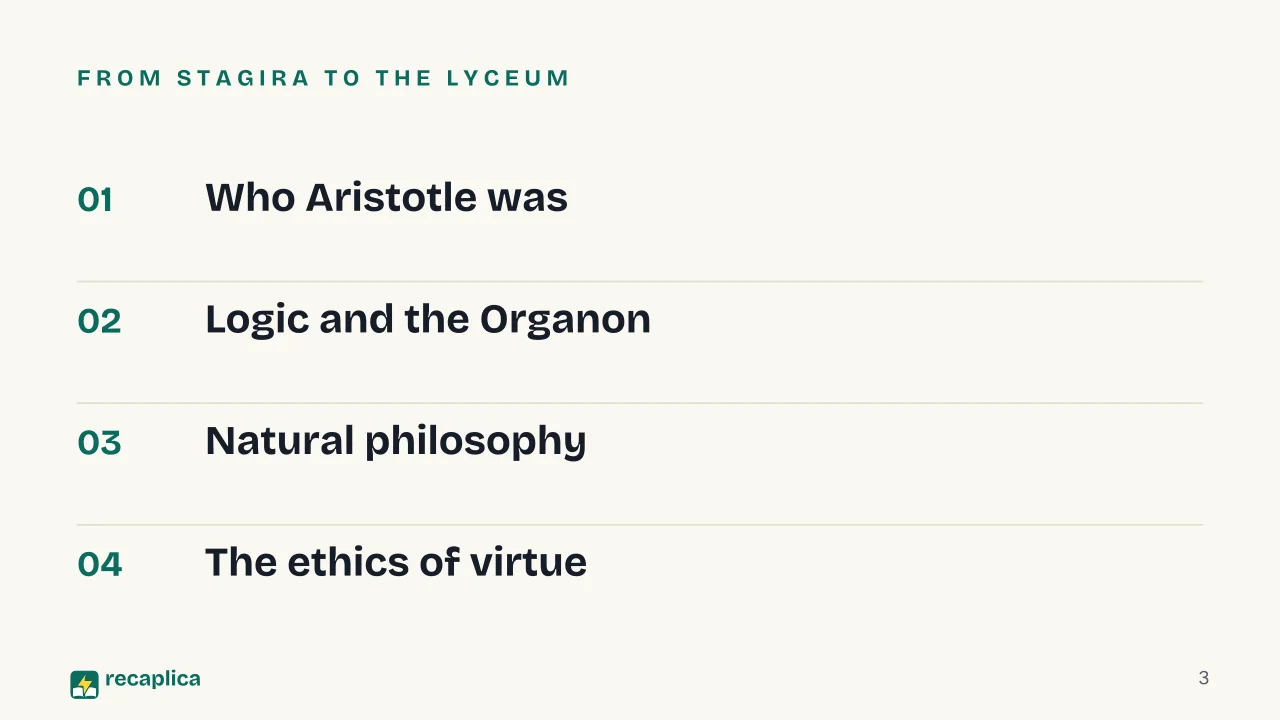  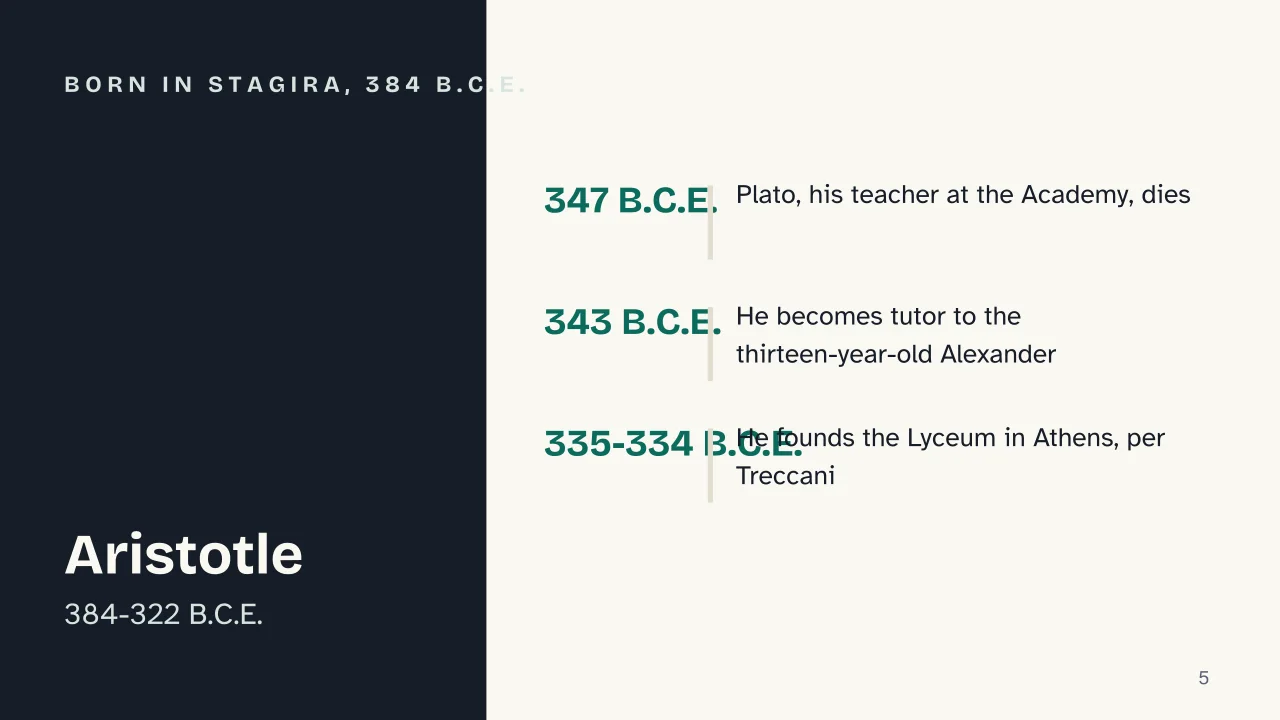  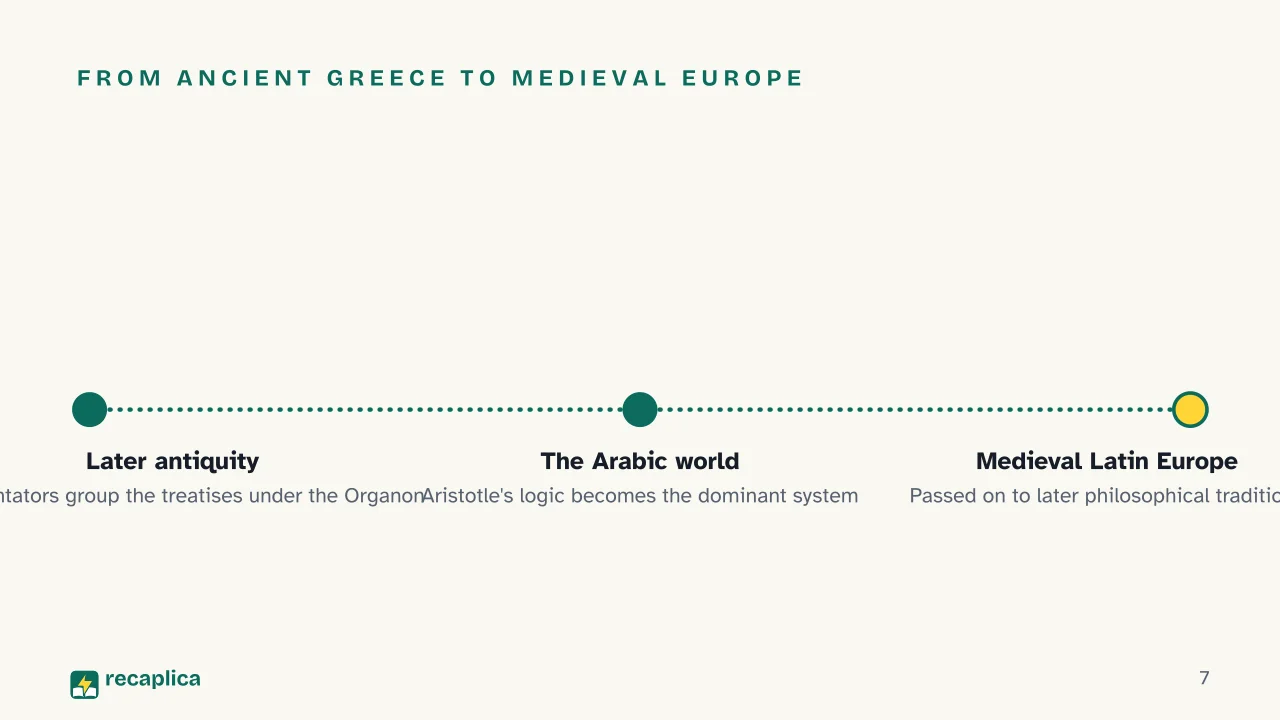 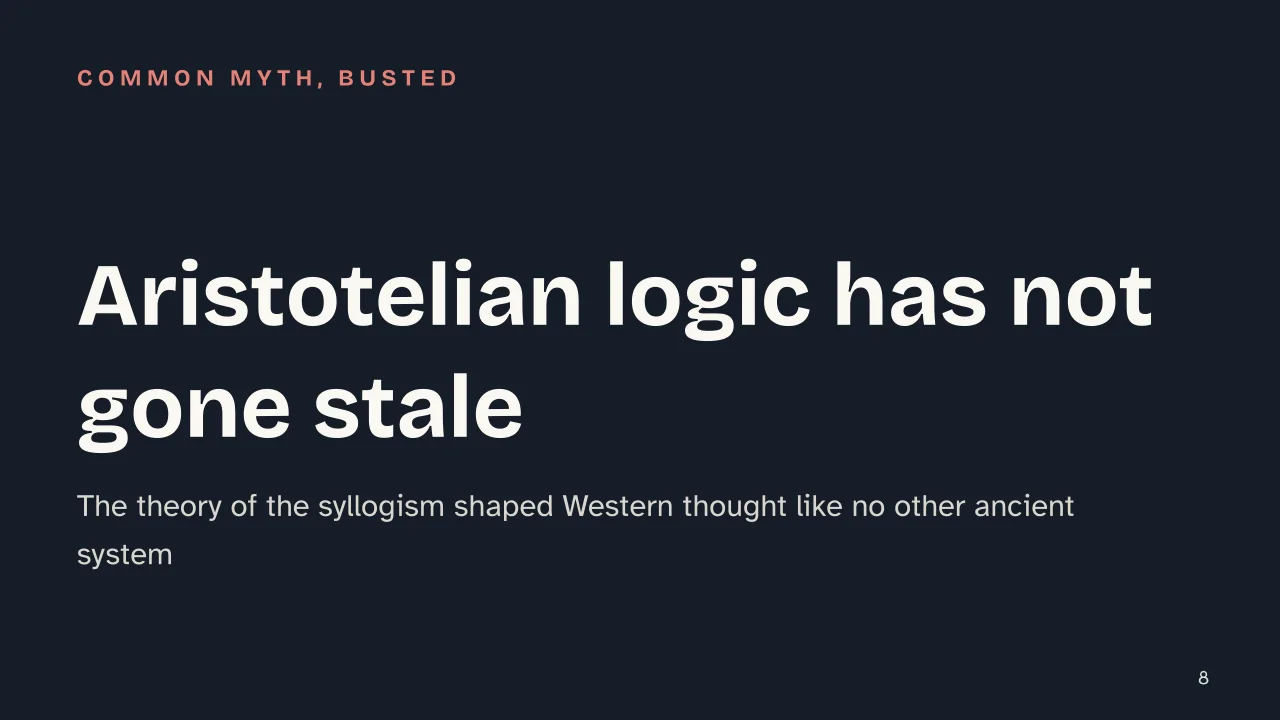  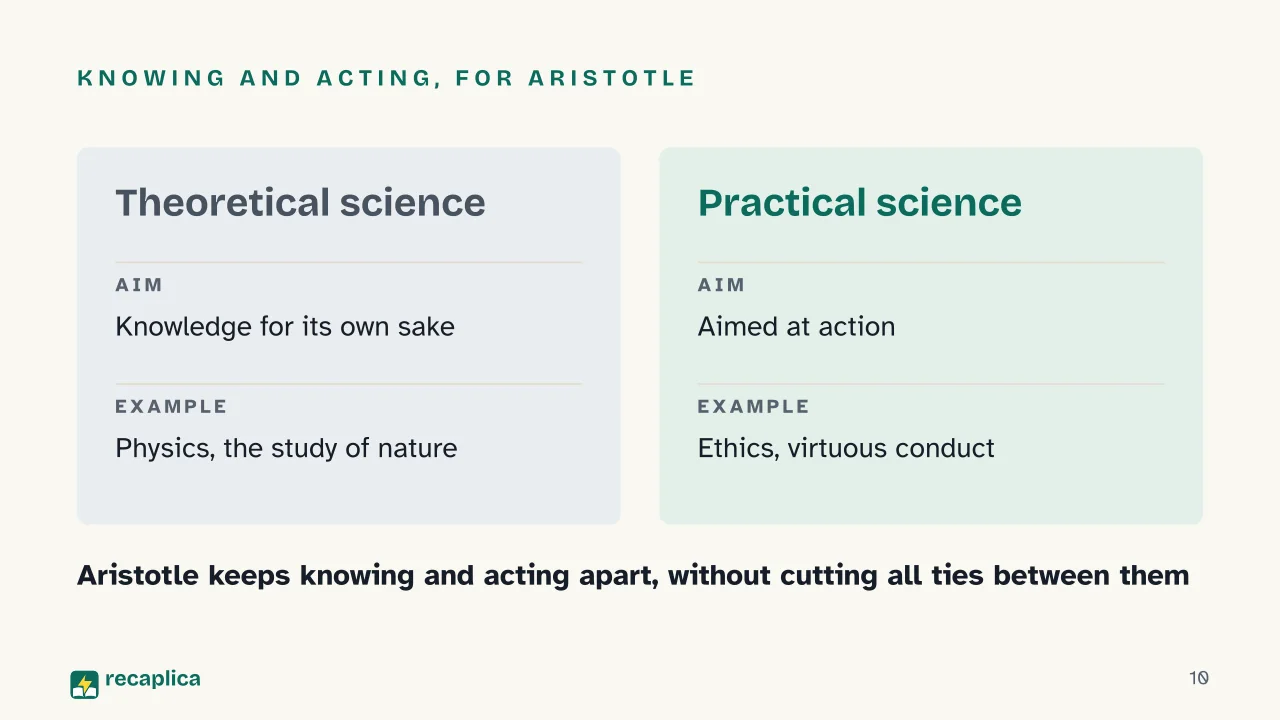  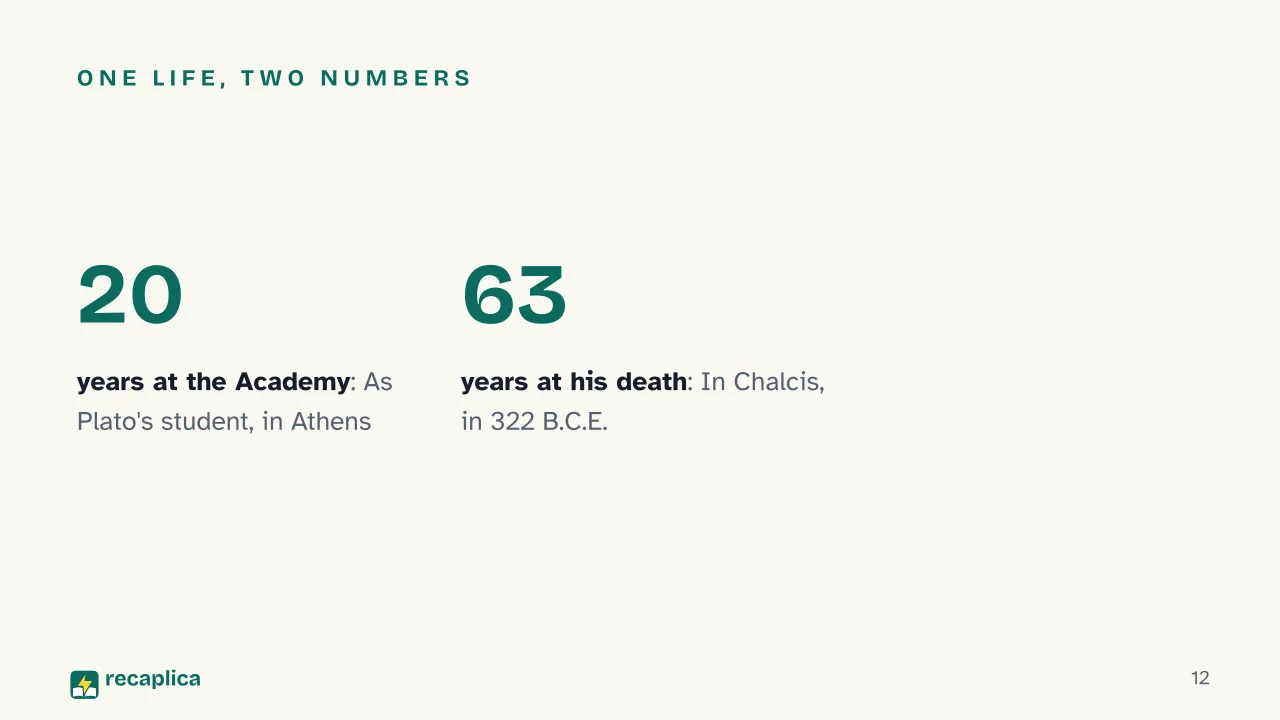 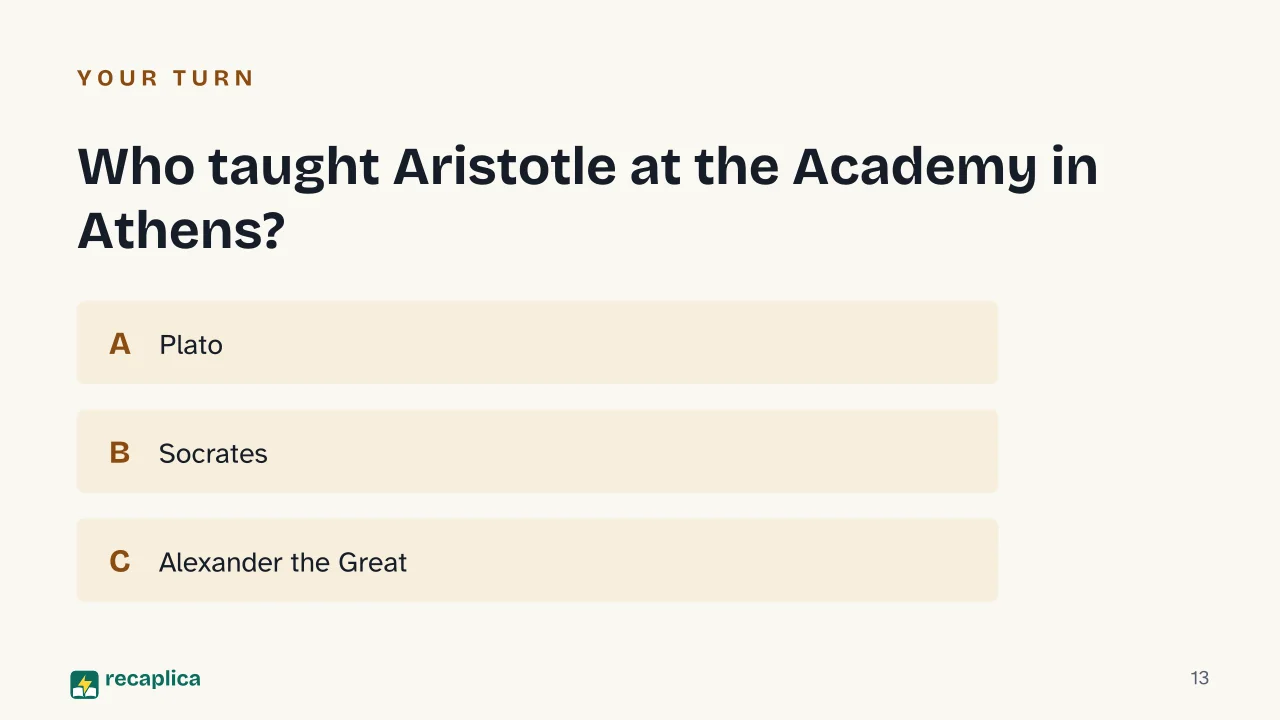  Common myths
Mind mapDrag the background to move around and the nodes to reposition them; use − and + to collapse and expand branches. 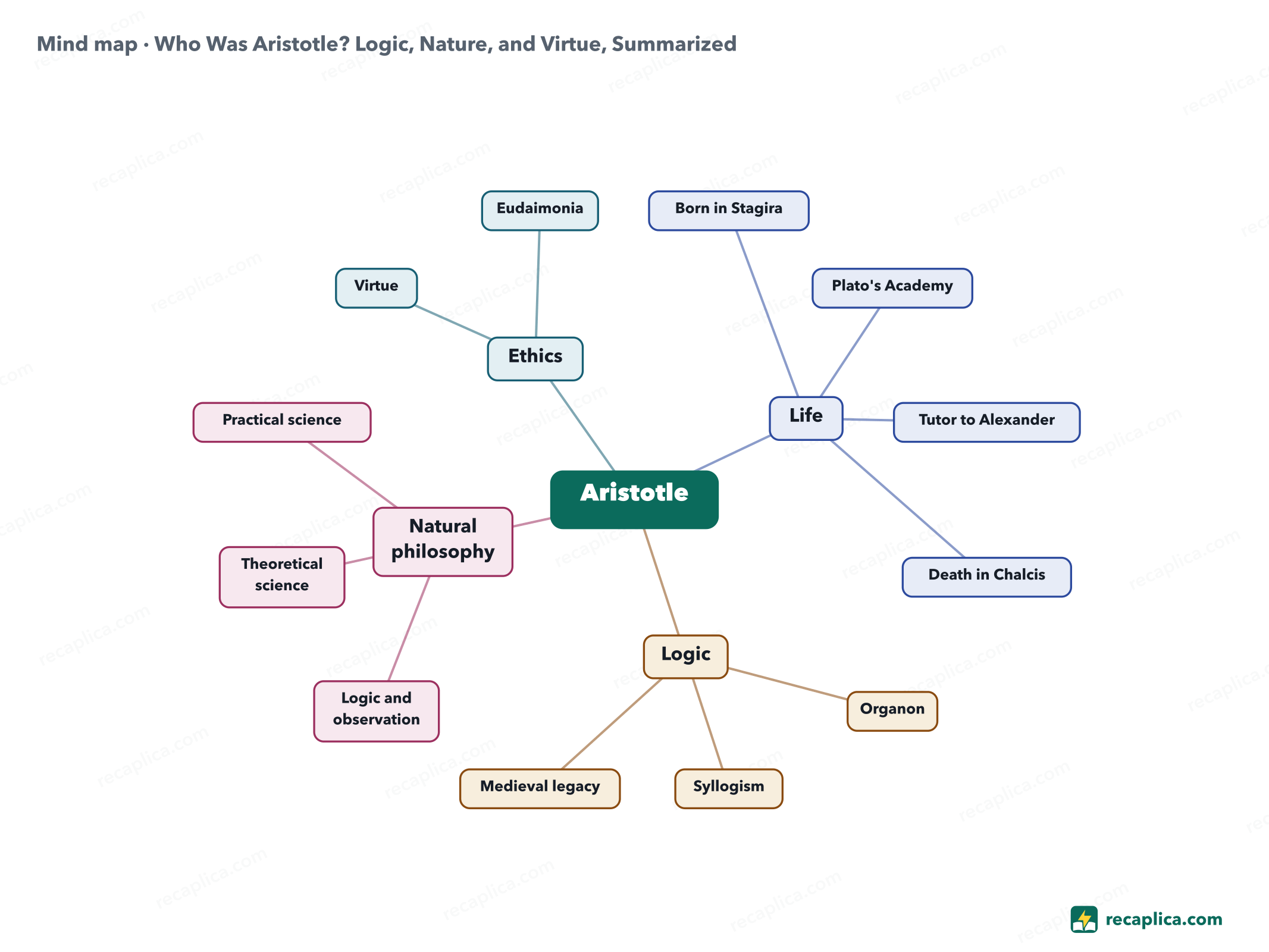
Quiz: test yourselfAnswer the questions to check what you have learned: you get instant feedback and a short explanation. Grade 0/10 0/5
FlashcardsTap the card to flip it and check whether you remember the answer, then move to the next one. 1 / 8 Explain it in your own wordsThe ultimate test: if you can explain it in simple words, you've truly understood it. Write your explanation, then compare it with the Recap. Your explanation is saved only on this device.
Frequently asked questionsWho was Aristotle, in simple terms?Aristotle was a Greek philosopher born in Stagira in 384 B.C.E. who spent twenty years studying under Plato in Athens, tutored Alexander the Great, and then founded his own school, the Lyceum. He is credited as the founder of Western logic and also worked on natural philosophy and ethics, according to Treccani and the Stanford Encyclopedia of Philosophy. What is the connection between Aristotle and Plato, and how does Aristotle fit into the history of philosophy?Aristotle was a student at Plato's Academy in Athens for twenty years, until his teacher's death in 347 B.C.E.; a period of travel followed, says Treccani, before he built a natural philosophy that joins logic with direct observation, according to the Internet Encyclopedia of Philosophy. His school, the Lyceum, became one of the main centers of ancient philosophy. What makes Aristotle's life story unusual for a philosopher of his time?Aristotle moved between three cities that shaped the ancient world in different ways: he studied in Athens, tutored a future king in the Macedonian court at Pella, and then returned to Athens to found his own school. Few philosophers of the period combined a scholar's life with a direct role at a royal court, according to the Stanford Encyclopedia of Philosophy. What is Aristotelian logic, and why does it still matter?It is the theory of the syllogism, Aristotle's tool for formal deduction: from given premises, a conclusion follows by logical necessity. The Stanford Encyclopedia of Philosophy credits it with an influence on Western thought that no other ancient logical system matched. How are Alexander the Great and Aristotle connected?King Philip of Macedon hired Aristotle in 343 B.C.E. to tutor his teenage son, who later became Alexander the Great, according to the Stanford Encyclopedia of Philosophy; the Internet Encyclopedia of Philosophy confirms the same assignment. Every Recap goes through an independent review before publication. |