|
recaplica
Who Was Socrates: the Socratic Method, the Trial, and the Search for Truth | ||||||||||
| © 2026 Recaplica · recaplica.com — All rights reserved | ||||||||||
Who Was Socrates: the Socratic Method, the Trial, and the Search for TruthWhat to print Page numbers appear when printing with default margins. SlidesChoose a cut Flash10 slidesThe essential thread, to present in classFull16 slidesEvery chapter and the deeper detailBoth come with speaker notes. In 30 seconds quick readSocrates never wrote a word of his own: almost everything we know about his thought comes down to us through Plato, which is why historians speak of a "Socratic problem" about the sources. His method was a dialogue built from questions and answers, carried out with an irony that made him look ignorant while he quietly steered the conversation — Plato also calls it maieutics, the art of drawing ideas out of someone instead of handing them over ready-made. In 399 BCE, at age 70, Socrates stood trial in Athens on a charge of impiety, and a jury convicted him and sent him to his death. In the dialogue Crito, Plato recounts that Socrates refused to escape from prison: he considered himself bound for life by an unspoken agreement with the laws of the city, one to be honored even in his own condemnation. Key Points
Key figures
Deep DiveWhat We Know About Socrates Comes from OthersSocrates never wrote a word of his own. Everything we know about him, then, reaches us secondhand, through other authors who knew him or passed down his memory. We’re in Athens, in the fifth century BCE — the same city and century as the Sophists and the democratic life born in the polis. According to the Stanford Encyclopedia of Philosophy, the three main ancient sources on Socrates are the comic playwright Aristophanes and his students Xenophon and Plato, and they offer portraits of Socrates that don’t always agree with each other. Plato is the source most of what is known about Socrates comes from, according to the Internet Encyclopedia of Philosophy; Xenophon contributes on a smaller scale, and later Aristotle’s writings add still more, according to the World History Encyclopedia. Telling apart which ideas inside Plato’s dialogues were genuinely Socrates’s own, and which were the student’s elaboration, is what scholars commonly call the “Socratic problem,” a lively and unsettled dispute, as the Stanford Encyclopedia of Philosophy notes. The Method: Questions That Take Certainty ApartHow Socrates philosophized was, first of all, a recognizable behavior: he pressed his conversation partners in dialogue, often leading them, not always comfortably, to realize their own ignorance, according to the Stanford Encyclopedia of Philosophy. The method was a back-and-forth of questions and answers meant to examine important matters closely; the Internet Encyclopedia of Philosophy also calls it elenchus, and describes how Socrates spent his life, lived simply, questioning the common beliefs of the people he met. The pre-Socratic philosophers had mostly asked about the nature of things, the arché; with Socrates, the center of inquiry shifts to human beings and how they live. Socrates paired this with irony: he claimed to know nothing of importance and to want only to listen to others, while in practice keeping control of every discussion, the Stanford Encyclopedia of Philosophy notes. In the dialogue Theaetetus, Plato has Socrates describe himself as a kind of “midwife” of ideas — hence maieutics, from the Greek maieutikē, the midwife’s art, the name given to his method, because it helps the other person draw an idea out on their own, according to the Internet Encyclopedia of Philosophy.
The Oracle at Delphi and a Life Worth ExaminingAccording to the story reported by the Internet Encyclopedia of Philosophy, Socrates’s friend Chaerephon travelled to Delphi and put a question to the oracle: who was the wisest man alive? The answer that came back ranked nobody above Socrates. The same episode appears in the World History Encyclopedia, which places it at a point when Socrates was already middle-aged. Socrates considered himself aware of his own ignorance, and it was from that awareness that he drew the meaning of the oracle’s answer, according to the Internet Encyclopedia of Philosophy. Socrates is also credited with the idea that a life never put to critical examination isn’t worth living: the same habit of questioning everything, turned onto his own existence. The Trial of 399 BCEIn Athens, Socrates was charged with the capital offense of impiety (asebeia): failing to show the proper devotion to the city’s gods, according to the Stanford Encyclopedia of Philosophy. The formal charges included not believing in the gods of Athens and introducing new deities; the World History Encyclopedia adds that he was also accused of corrupting the young. The charge was put in writing by a young poet named Meletus; according to the World History Encyclopedia, he was joined by the tanner Anytus and the orator Lycon, three accusers for a single trial. One of them, Anytus, had been among the democratic exiles who returned to Athens, according to the Internet Encyclopedia of Philosophy. The jury found Socrates guilty, according to the Stanford Encyclopedia of Philosophy. According to the most common historical reconstruction — a secondary source, to be read with caution — there were probably 501 jurors, as Athenian legal practice called for in this kind of trial, and the guilty vote is said to have been 280 to 221; the death sentence then passed by an even wider margin. At age 70, according to the Internet Encyclopedia of Philosophy, Socrates was put to death by his own fellow citizens.
The Crito: Why He Didn’t FleeDuring his last days, recounted in the Platonic dialogues Euthyphro, Apology, Crito, and Phaedo according to the World History Encyclopedia, Socrates had the chance to escape from prison, but didn’t take it. In the Crito, according to the Stanford Encyclopedia of Philosophy, Socrates argues that it’s never right to do wrong, not even to pay back a wrong suffered: fleeing the city illegally would have caused Athens a harm that no injury done to him personally could justify. The Internet Encyclopedia of Philosophy tells the same refusal from a complementary angle: Socrates considered himself in debt to Athens for his entire life lived under its laws, and wanted to honor that debt even in his own condemnation. The Phaedo, again according to the World History Encyclopedia, describes the day of Socrates’s death, which came by drinking hemlock. Slide deckSlides ready to download and make your own in PowerPoint or Google Slides, with speaker notes. Pick the Flash cut or the Full one.   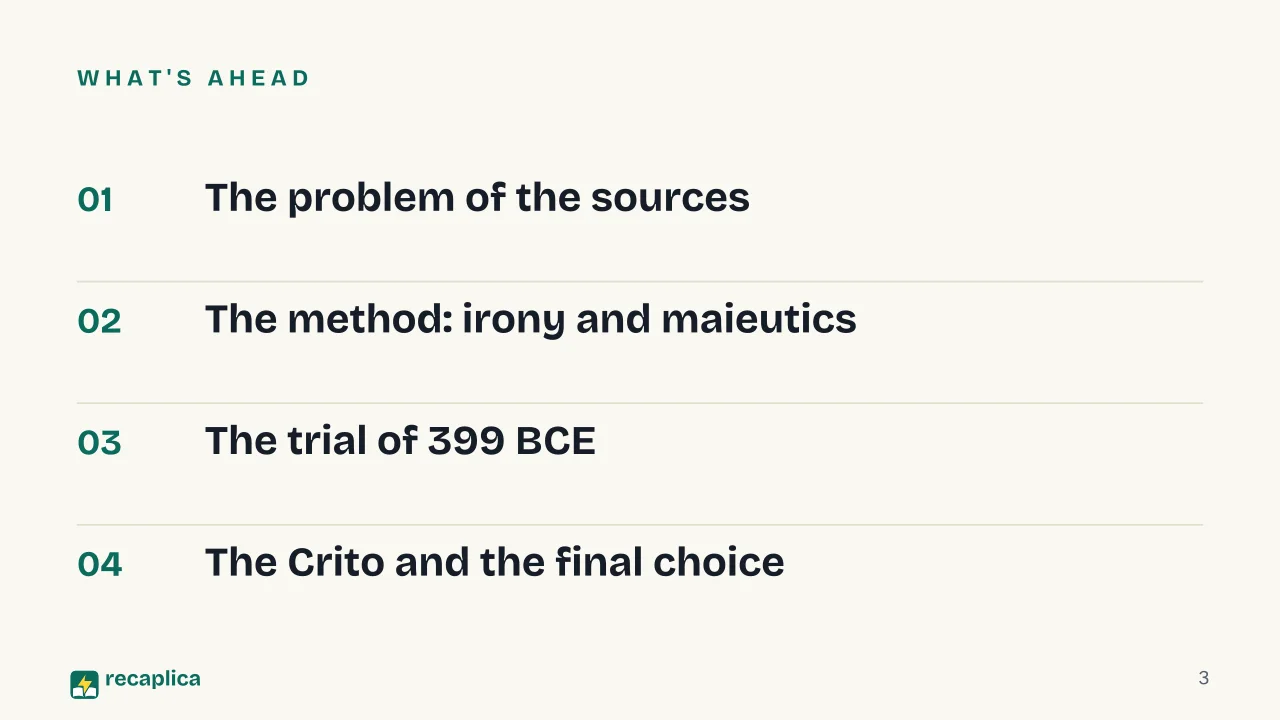  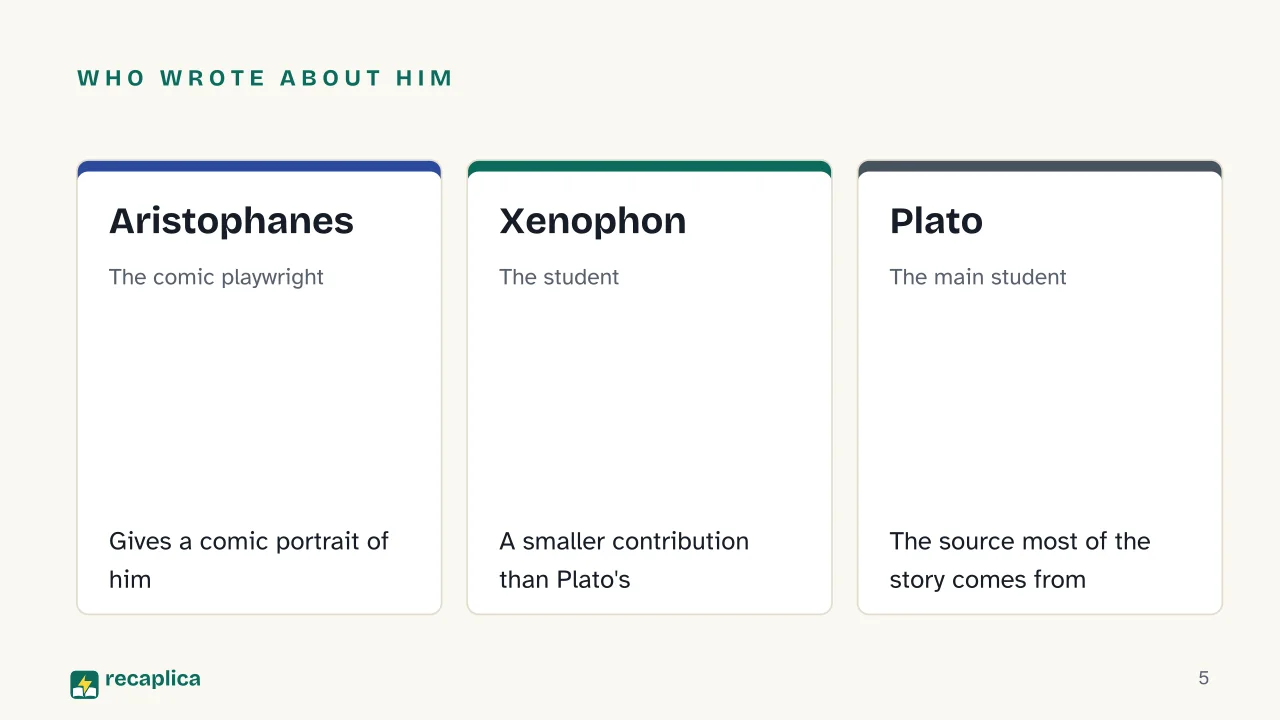 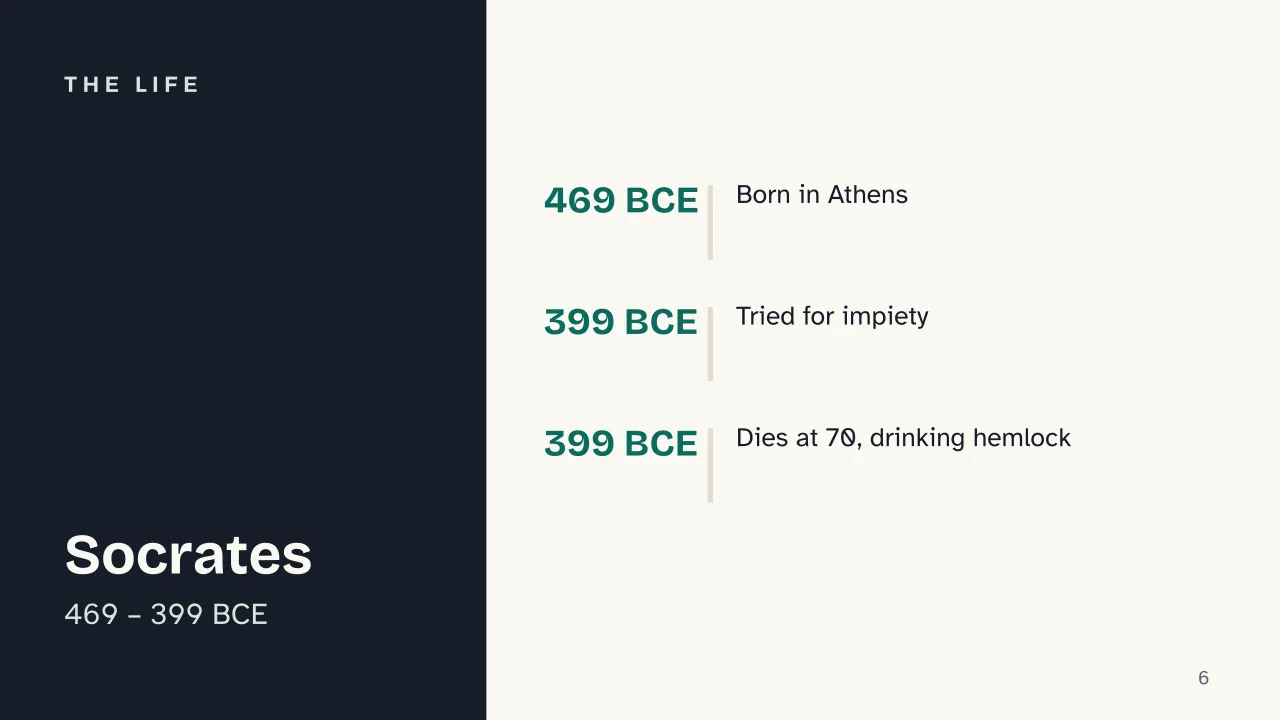  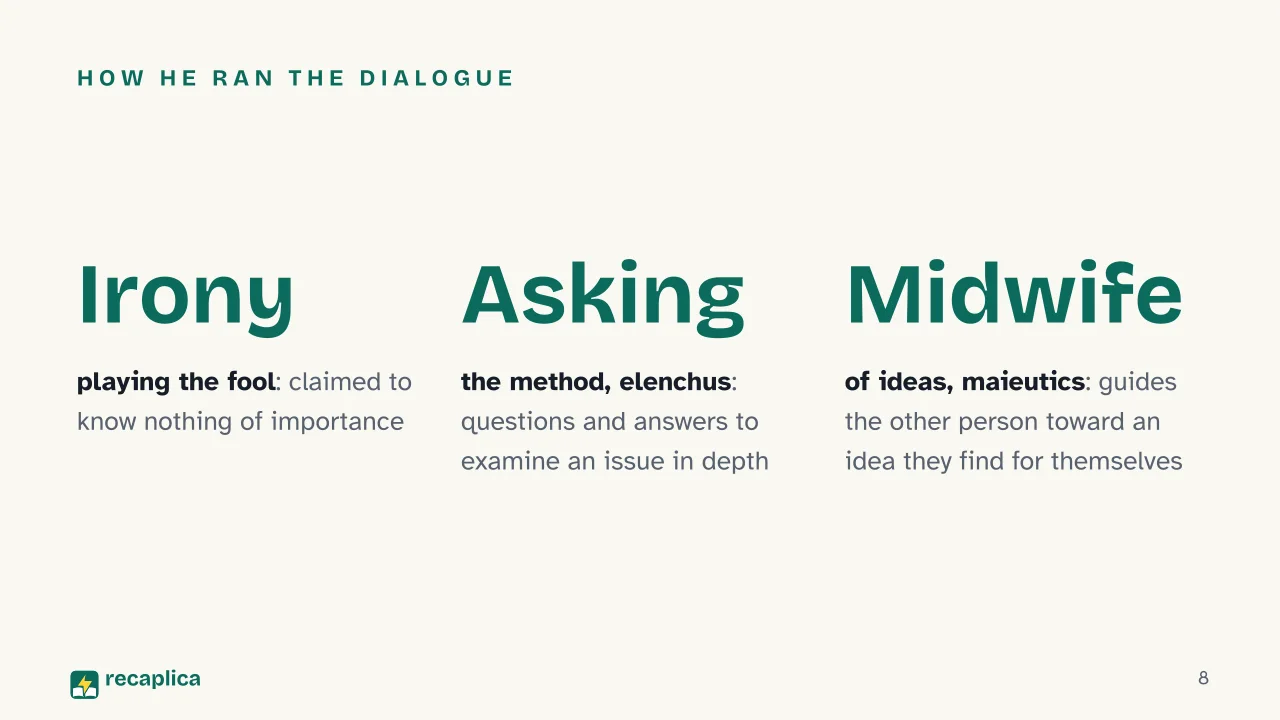   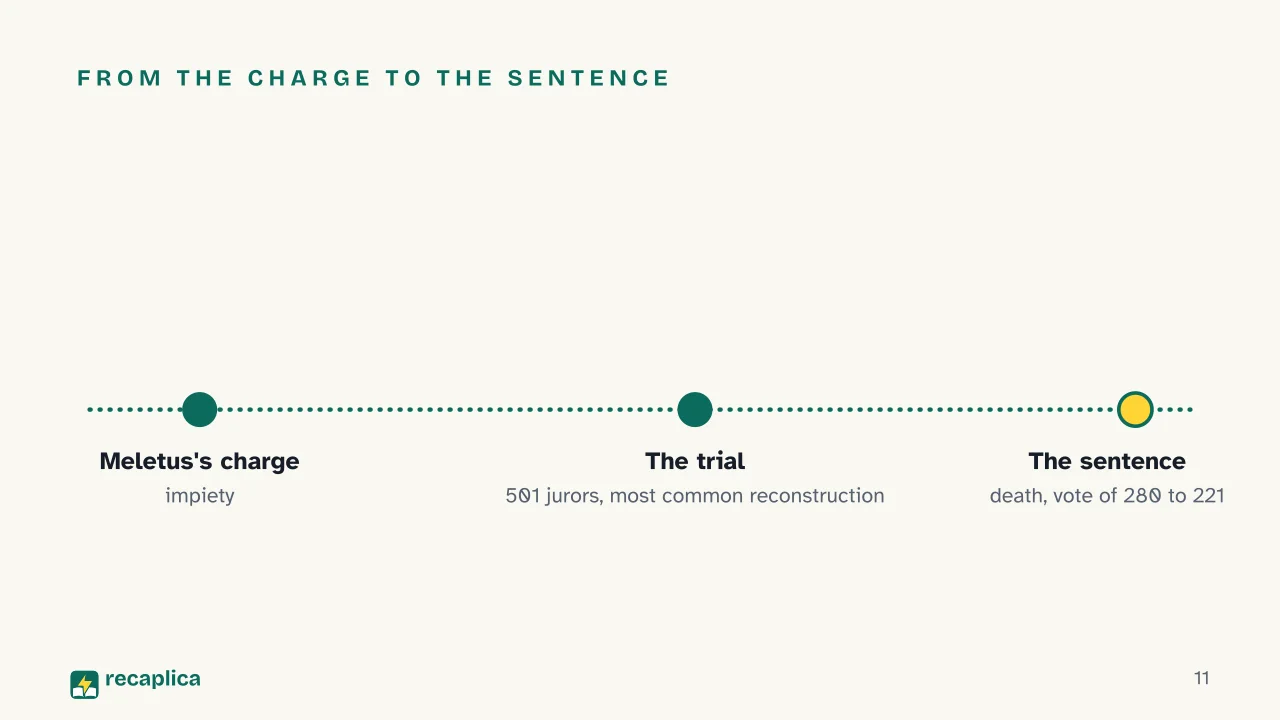 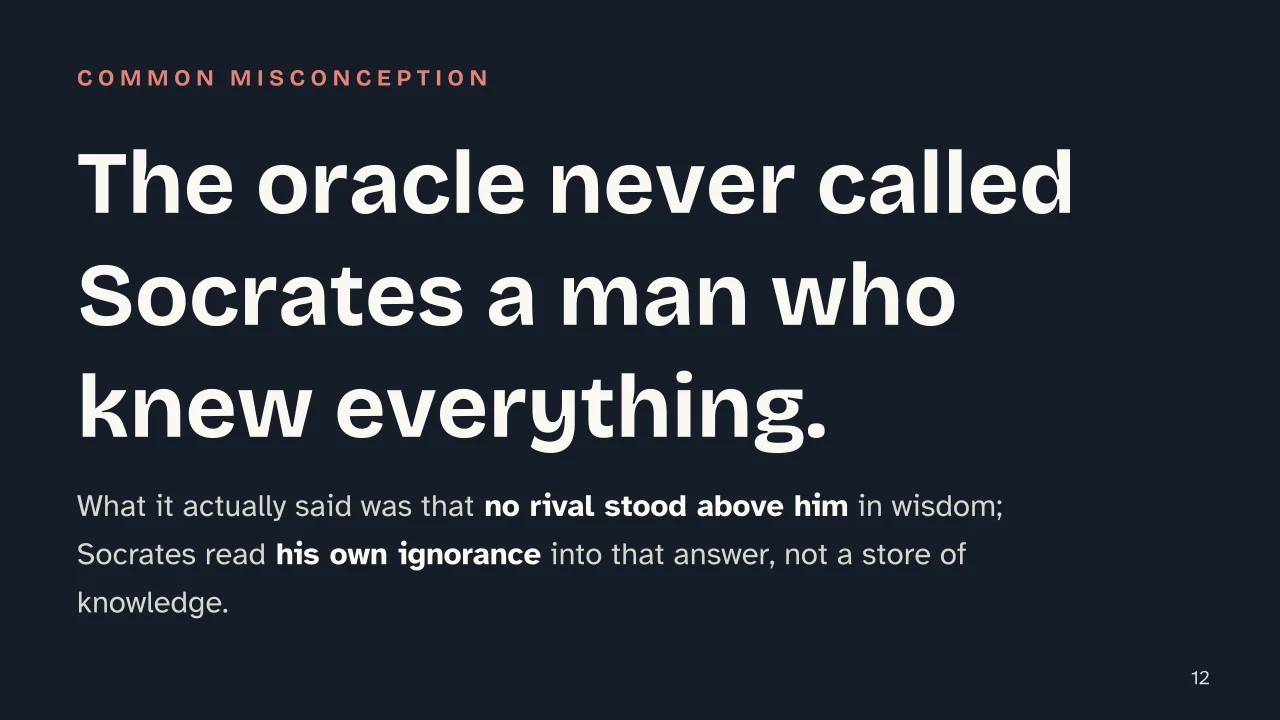  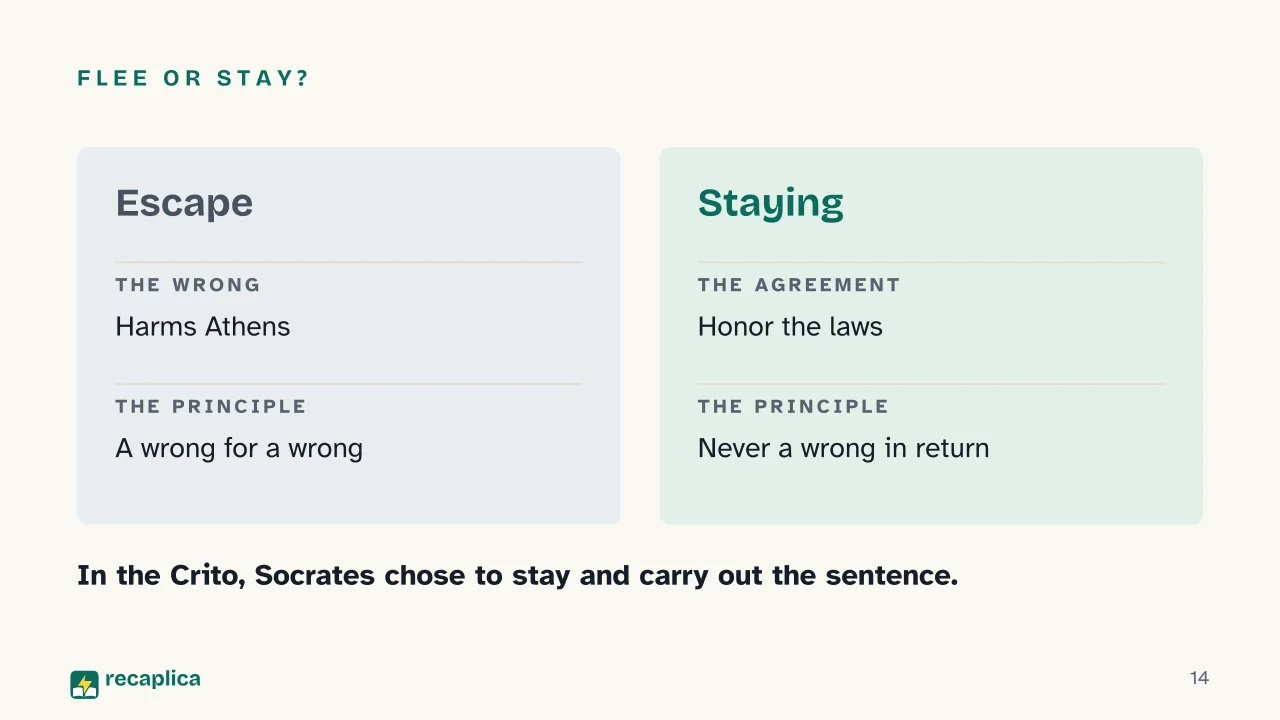 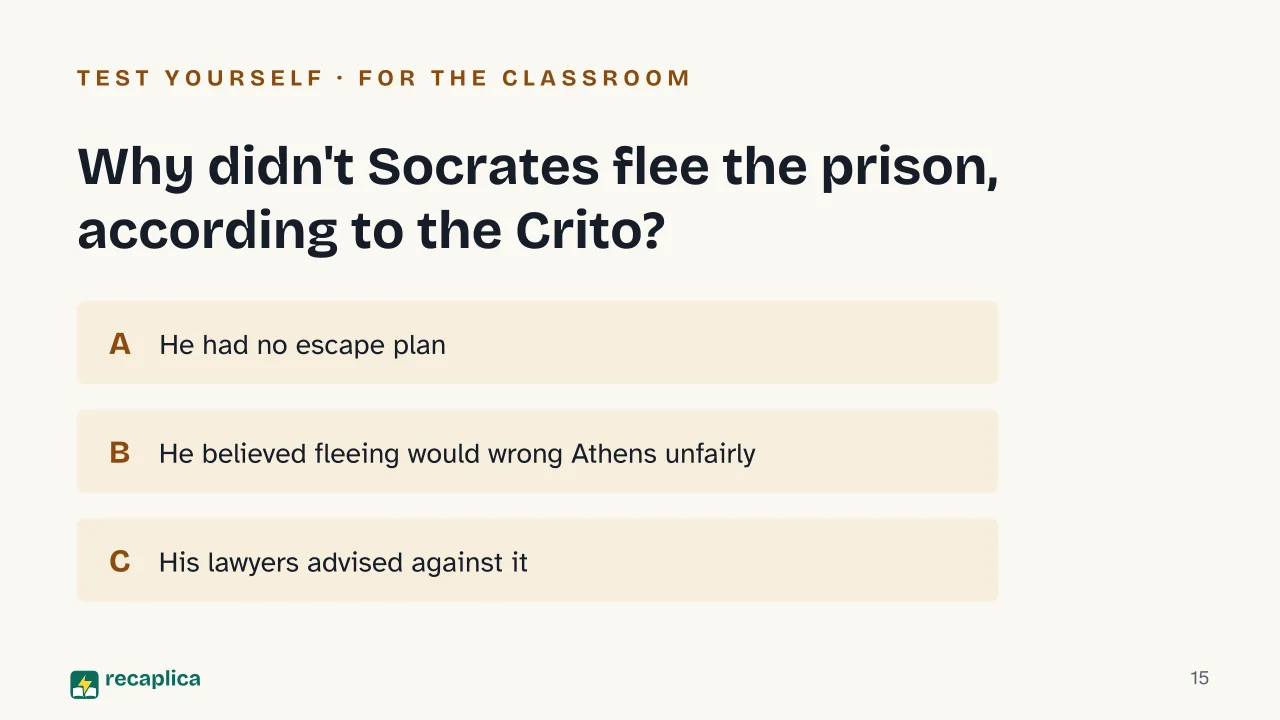  Common myths
Mind mapDrag the background to move around and the nodes to reposition them; use − and + to collapse and expand branches. 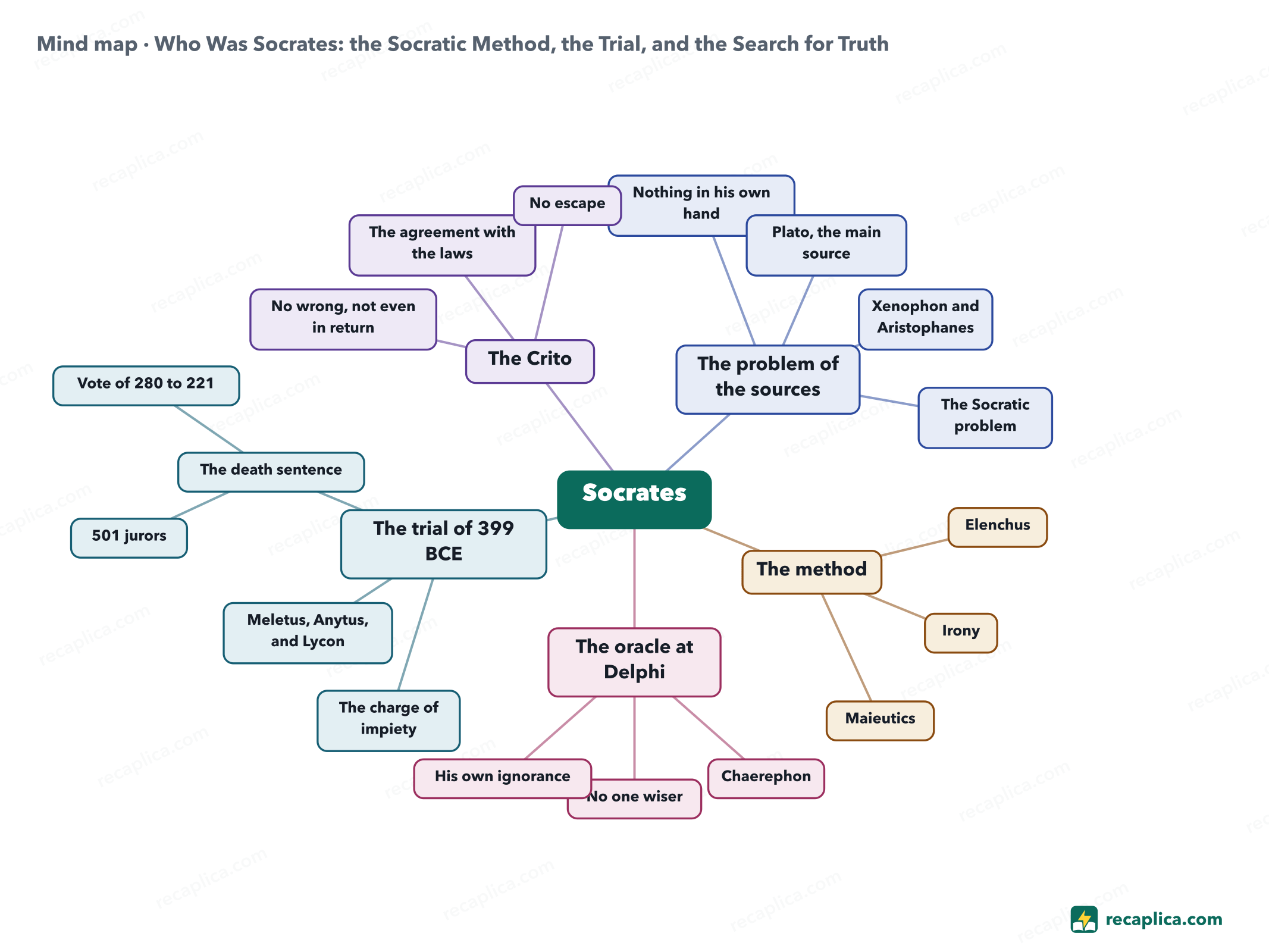
Quiz: test yourselfAnswer the questions to check what you have learned: you get instant feedback and a short explanation. Grade 0/10 0/5
FlashcardsTap the card to flip it and check whether you remember the answer, then move to the next one. 1 / 8 Explain it in your own wordsThe ultimate test: if you can explain it in simple words, you've truly understood it. Write your explanation, then compare it with the Recap. Your explanation is saved only on this device.
Frequently asked questionsWhat is the Socratic method?It was how Socrates philosophized in Athens: a back-and-forth of questions and answers — the elenchus — built to probe the everyday beliefs of whoever he was talking to, according to the Stanford Encyclopedia of Philosophy. He paired it with irony, claiming to know nothing of importance, and with what Plato's Theaetetus calls maieutics: Socrates as a midwife, bringing an idea into the open without substituting his own thinking for it. Why don't we have anything Socrates wrote himself?Because Socrates never wrote anything of his own, according to the Stanford Encyclopedia of Philosophy and the Internet Encyclopedia of Philosophy. Everything we know about him comes from other authors — mainly his student Plato, with smaller contributions from Xenophon, the comic playwright Aristophanes, and later Aristotle — who don't always agree with each other. That gap is what scholars call the "Socratic problem": telling apart what Socrates actually thought from what the people writing about him attribute to him. What was the relationship between Socrates and Plato?Plato was Socrates's student and the main source for most of what we know about his thought, according to the Internet Encyclopedia of Philosophy. It's in Plato's dialogues — among them the Apology, Crito, Phaedo, and Theaetetus — that Socrates describes his own trial, explains his refusal to escape from prison, and lays out his method as a form of maieutics. How much of that is the historical Socrates speaking, and how much is Plato speaking through him, remains an open question. What was Socrates accused of, and how did his trial end?Socrates was charged with impiety — not recognizing the gods of the city of Athens and introducing new ones — and with corrupting the young, according to the Stanford Encyclopedia of Philosophy and the World History Encyclopedia. The charge was put in writing by the poet Meletus, joined by Anytus and Lycon; the jury convicted him and condemned him to death. He was 70 years old, and carried out the sentence by drinking hemlock. Why didn't Socrates escape from prison during his last days, when he had the chance?According to the Stanford Encyclopedia of Philosophy, in the dialogue Crito, Socrates weighs the escape mainly by the harm it would do to the city. Fleeing, in his view, would have cost Athens more than the sentence had cost him. The Internet Encyclopedia of Philosophy adds a second reason: Socrates had accepted the laws of the city his whole life as an unwritten agreement, one to honor even facing his own condemnation. Every Recap goes through an independent review before publication. |