|
recaplica
Roman Education: How Rome's Three-Tier School System Worked | ||||||||||||||||
| © 2026 Recaplica · recaplica.com — All rights reserved | ||||||||||||||||
Roman Education: How Rome's Three-Tier School System WorkedWhat to print Page numbers appear when printing with default margins. SlidesChoose a cut Flash10 slidesThe essential thread, to present in classFull14 slidesEvery chapter and the deeper detailBoth come with speaker notes. In 30 seconds quick readRoman education grew out of an idea the Romans called humanitas: the belief that a full human being is shaped by learning, not born complete. The word humanus originally meant simply being kind to others, but by the 1st century BC Cicero had stretched it to cover liberal education too, what the Greeks called paideia. That idea took a very concrete shape in Roman schools, split into three stages: the litterator taught children to read and write, the grammaticus added Greek and the natural sciences, and the rhetor trained young men in public speaking and law. Very few girls went past the first stage, since most married while still in their teens. Key Points
Deep DiveA Word That Changes MeaningIn early Latin, calling someone humanus meant one thing above all: that they treated others with kindness. It was a judgment about a person’s character, more than about their schooling. That starts to shift in the 1st century BC: Cicero begins using humanitas for the education received in the liberal arts as well, what the Greeks called paideia, alongside the benevolent attitude they called philanthropia. This wasn’t invented out of nothing: according to what Aulus Gellius reports — testimony passed down through a secondary source, not a directly verified Latin text — Latin authors of the period used humanitas roughly the way the Greeks used paideia. That double meaning took shape in an actual school system, the same one that also helped model much of education across the rest of the ancient world touched by Greek culture, including the Roman Empire that this schooling served directly. The First Stage: The LitteratorFormally, Roman education began at age seven. This first level of school was called the ludus litterarius, and its teacher, the litterator, carved the letters of the alphabet into a wooden board for the child to copy, one letter at a time, until writing became second nature. The curriculum covered reading, writing and simple arithmetic: the groundwork the next two stages were built on.
Discipline was generally harsh, as suggested by a line from Juvenal about a hand pulled back from the ferula, the rod used to punish pupils. Of the girls who did study, most stopped here, at the first level: very few went past that point, since their families usually arranged marriage while they were still teenagers. The Second Stage: The GrammaticusAround age ten or eleven, those who kept studying moved on to the grammaticus. It was reached mostly by children from wealthier families: a costlier stage, and so a less common one, than the first. The curriculum widened considerably compared with the ludus litterarius: more advanced reading and writing, Greek, and then music, philosophy, astronomy and natural science. This is where the double meaning of humanitas — kindness and education together — starts to become visible in practice: a boy studying Greek alongside Latin was already living out that blending of two cultures on which the whole Roman school system was built. The Third Stage: The RhetorAfter receiving the toga of manhood, from around age 15 (sometimes earlier), students moved to the third and final stage, that of the rhetor. The central subject was public speaking: arguing a case, persuading an audience, holding a room. Alongside it came Roman law and politics, and then astronomy, geography, literature, philosophy, music and mythology.
In Roman public life, arguing well in court or in the senate counted as a practical skill. That same importance of public speech, in the Greek culture Rome had absorbed, traced back to the life of the polis and Athenian democracy, where a speech delivered in the assembly was already a tool of power. An Education Looking Toward GreeceThe third stage, with the rhetor, also brought philosophy into the curriculum: a direct inheritance from Greek thought that Roman schooling made its own. The entire second and third stages of Roman education, with Greek taught by the grammaticus and philosophy taught by the rhetor, show how deeply Roman culture had absorbed Greek culture while still remaining recognizably its own. In this very overlap, the path travelled by the word humanitas can be seen: from a judgment about a kind person’s character, to a word that also comes to hold an entire school career — the three stages, the subjects, the art of public speaking. The term ends up describing both everyday behavior toward others and the entire school path a young Roman went through. Slide deckSlides ready to download and make your own in PowerPoint or Google Slides, with speaker notes. Pick the Flash cut or the Full one.     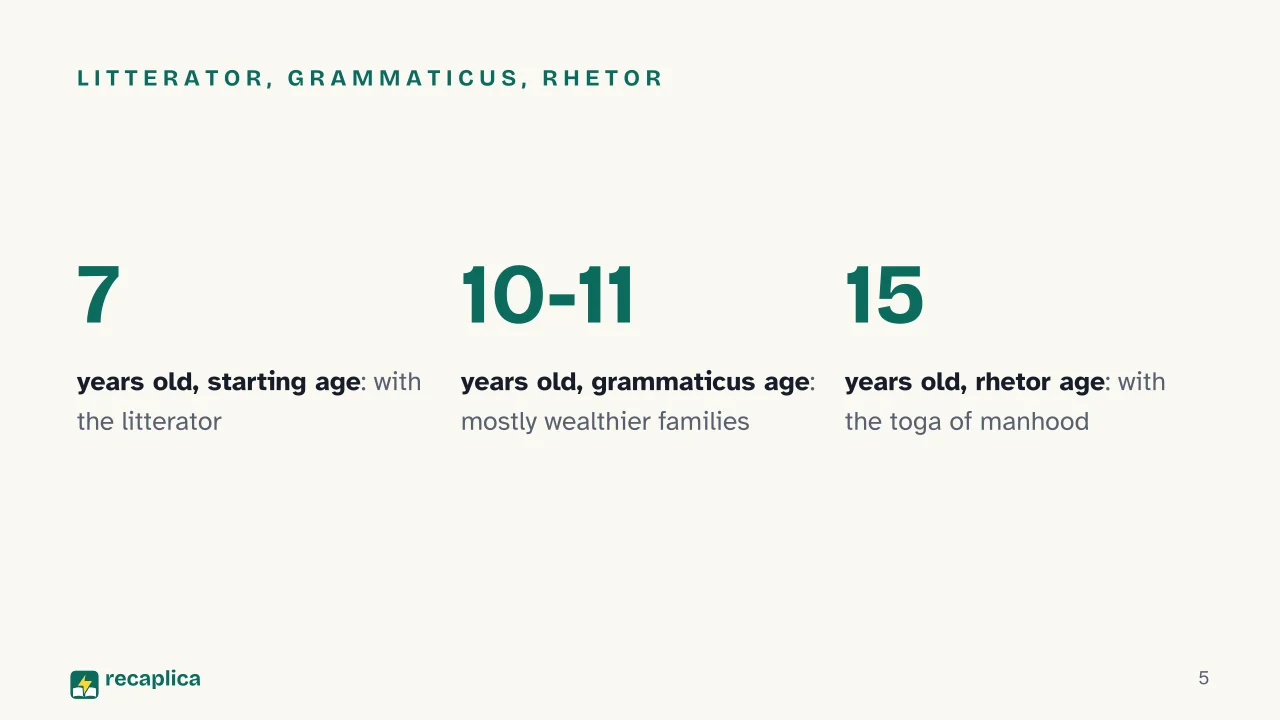  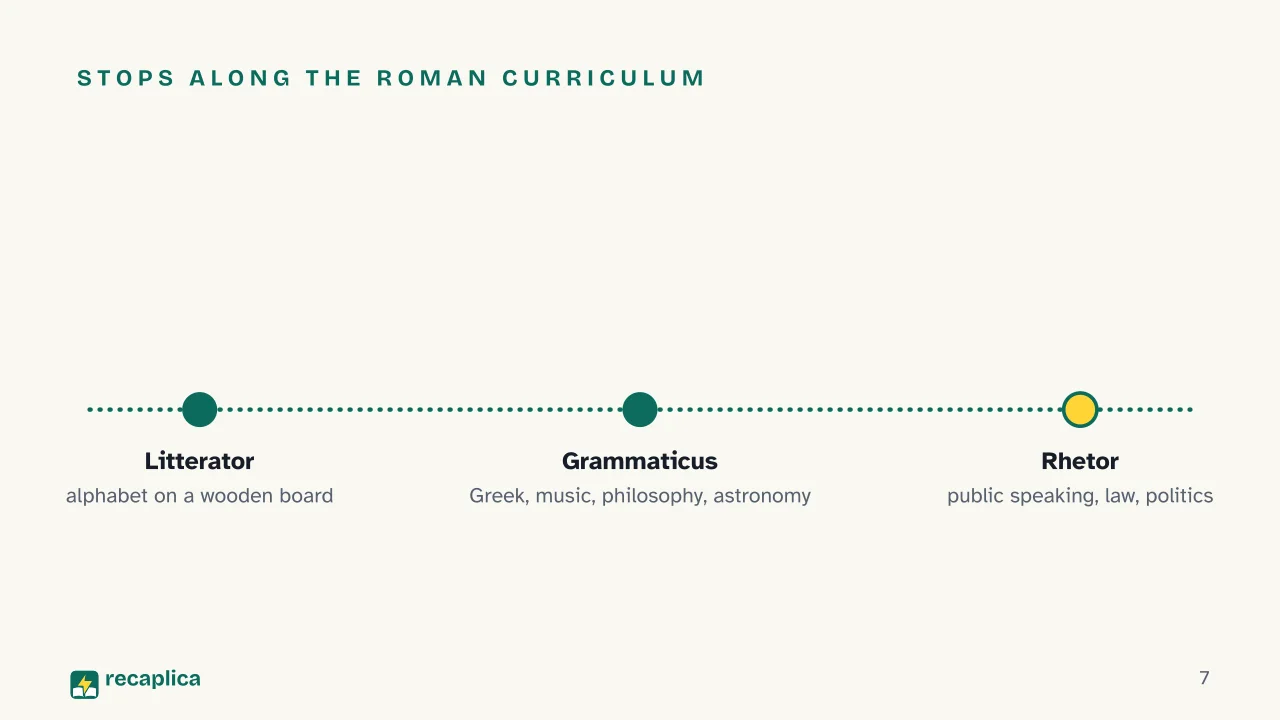 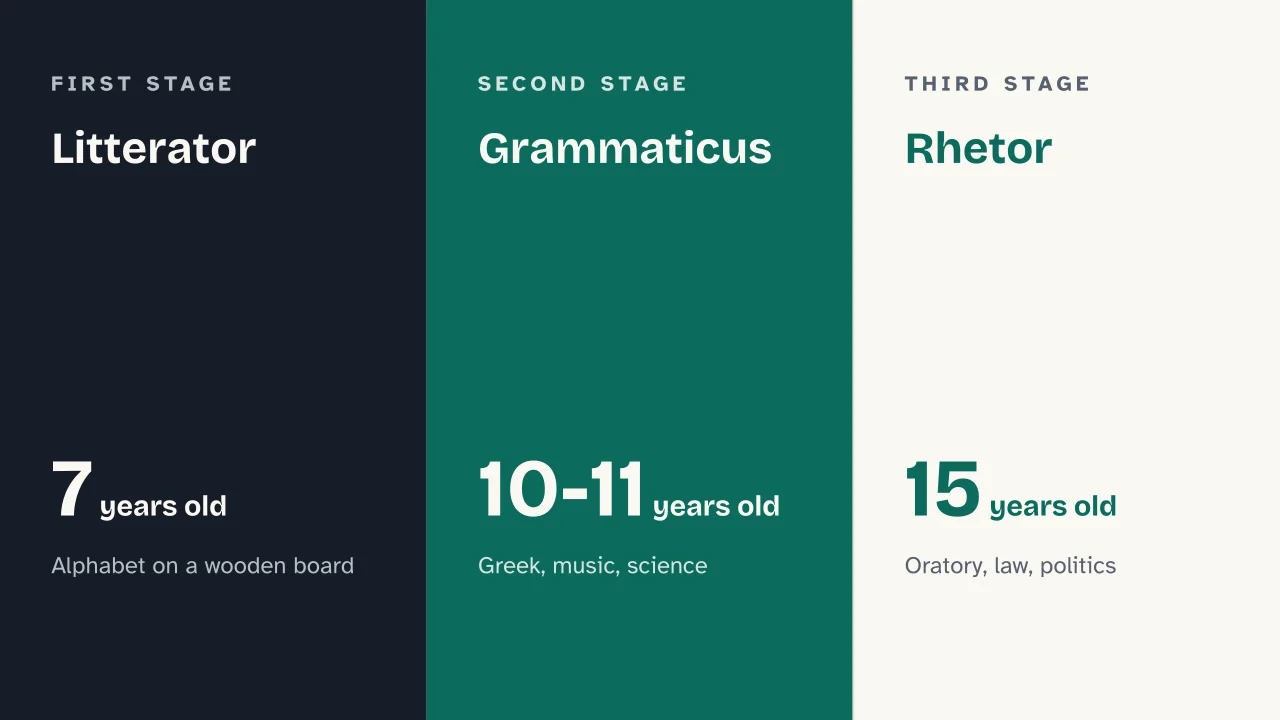    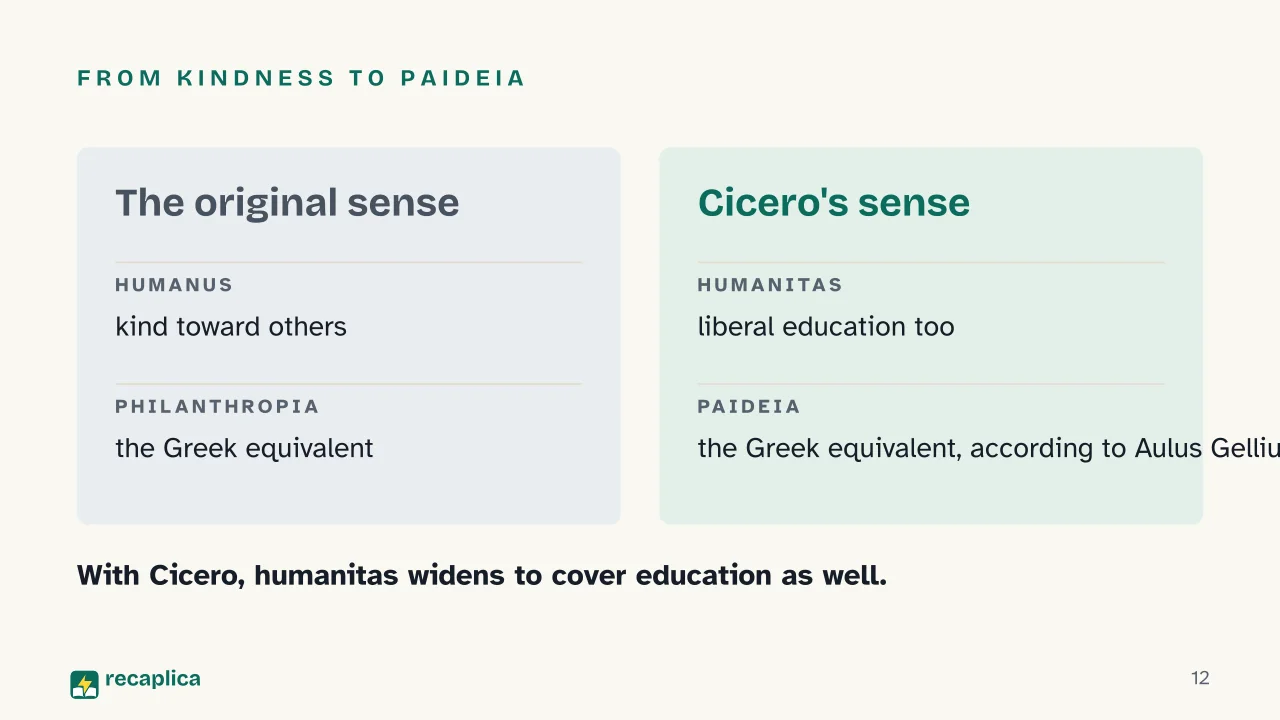 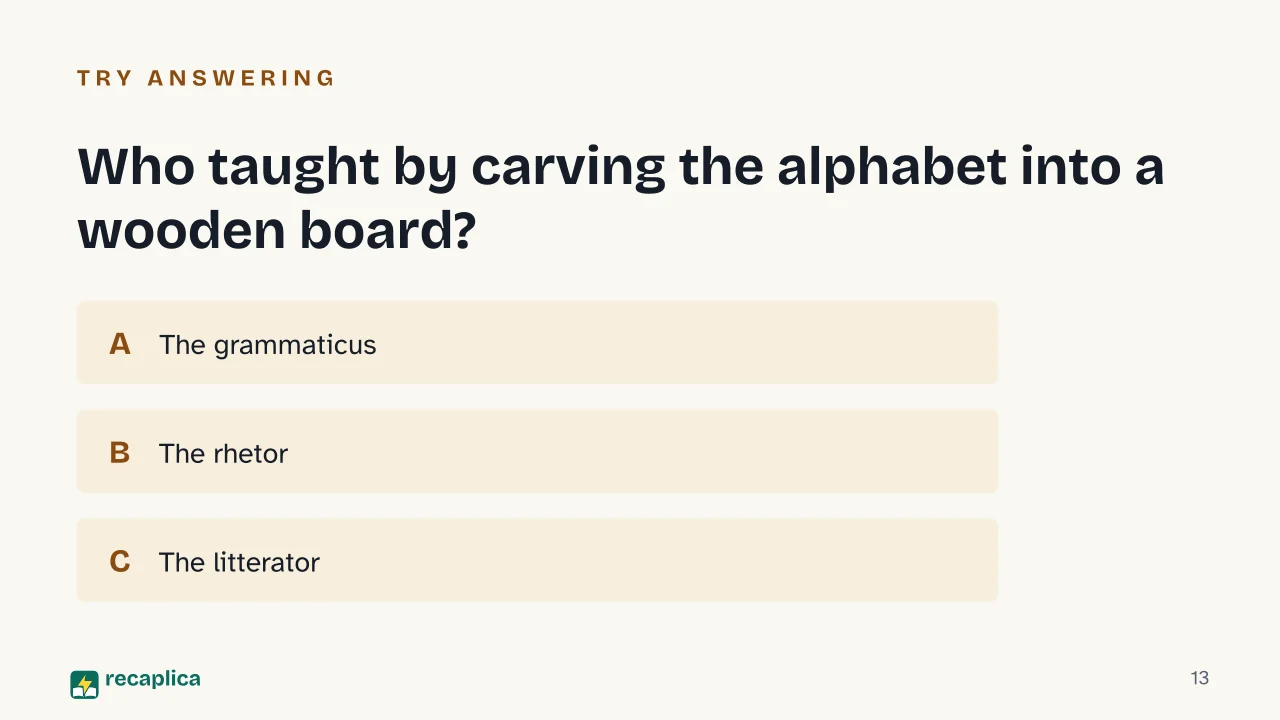  Common myths
Mind mapDrag the background to move around and the nodes to reposition them; use − and + to collapse and expand branches. 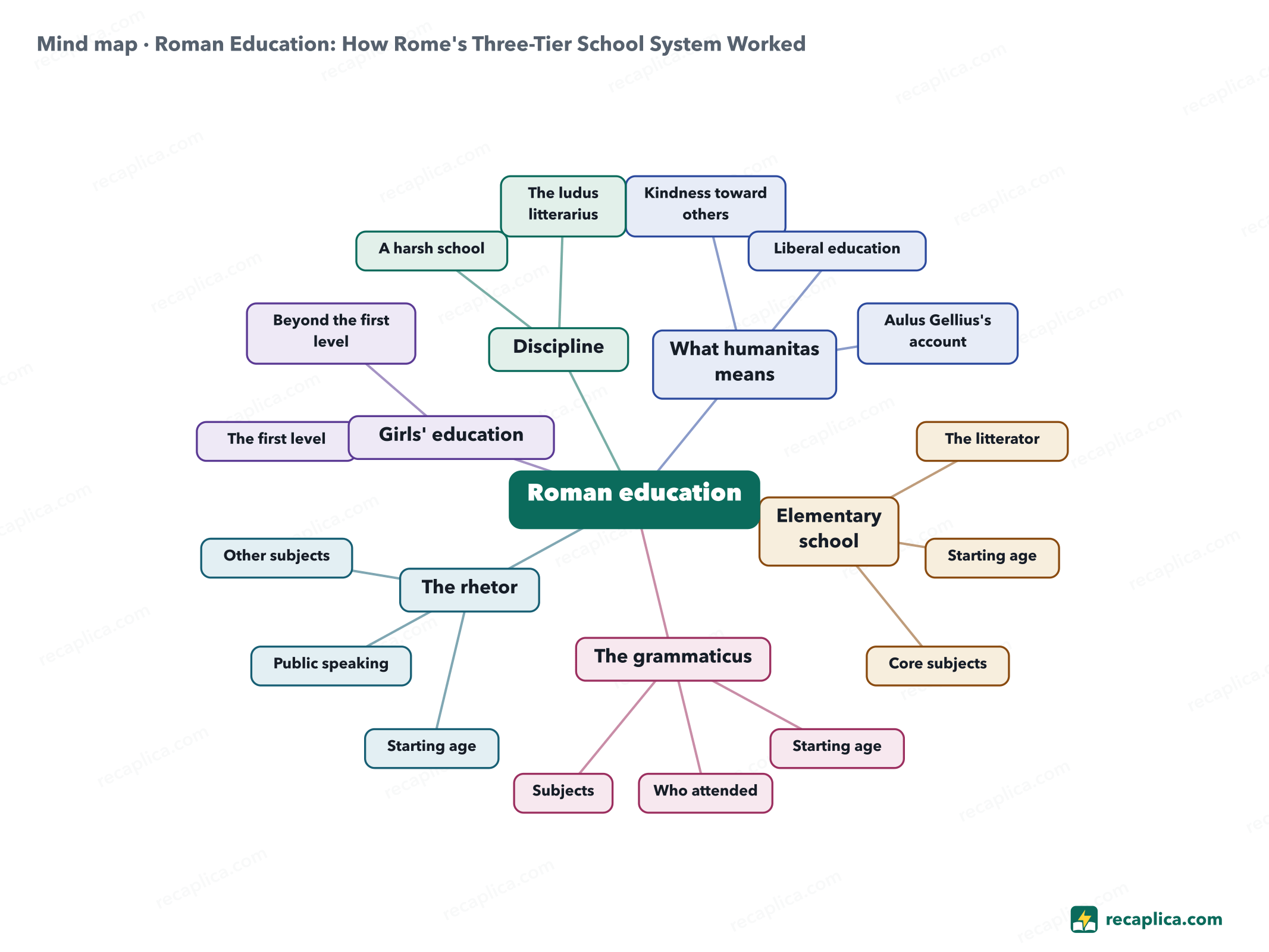
Quiz: test yourselfAnswer the questions to check what you have learned: you get instant feedback and a short explanation. Grade 0/10 0/5
FlashcardsTap the card to flip it and check whether you remember the answer, then move to the next one. 1 / 7 Explain it in your own wordsThe ultimate test: if you can explain it in simple words, you've truly understood it. Write your explanation, then compare it with the Recap. Your explanation is saved only on this device.
Frequently asked questionsWhat is Roman humanitas?It's the idea, taking hold with Cicero in the 1st century BC, that a person becomes fully human partly through liberal education, not only through kindness toward others — a concept close to Greek paideia. At what age did school start in ancient Rome?Formally at age seven, though in many households there was probably already some instruction from parents before that. What's the difference between the litterator, the grammaticus and the rhetor?They were the three successive stages of Roman schooling: the litterator taught the basics of reading and writing, the grammaticus broadened the curriculum with Greek and the sciences around age ten or eleven, and the rhetor trained students in public speaking and law from around age 15. Did Roman girls go to school?Some did, mostly at the first level; they rarely continued further, since they tended to marry young in their teens. Where does the word humanitas come from?From the Latin humanus, which originally meant chiefly being kind to others; with Cicero the sense widened to include liberal education too. Every Recap goes through an independent review before publication. |