recaplica
Clear in 30 seconds, yours in 10 minutes.
In 30 seconds quick read
Aristotle's Metaphysics is one of his major works, although the title is not his own: Andronicus of Rhodes added it in the first century BCE, when he arranged these writings right after the Physics. The treatise asks what a thing is purely as a thing, a question Aristotle calls first philosophy. In one passage he identifies that primary being, substance, with form. He also argues that actuality is conceptually prior to potentiality, and in Book Lambda concludes that an unmoved mover exists: a principle whose very substance is activity, itself still, that draws everything else toward it the way an object of desire pulls someone.
Key Points
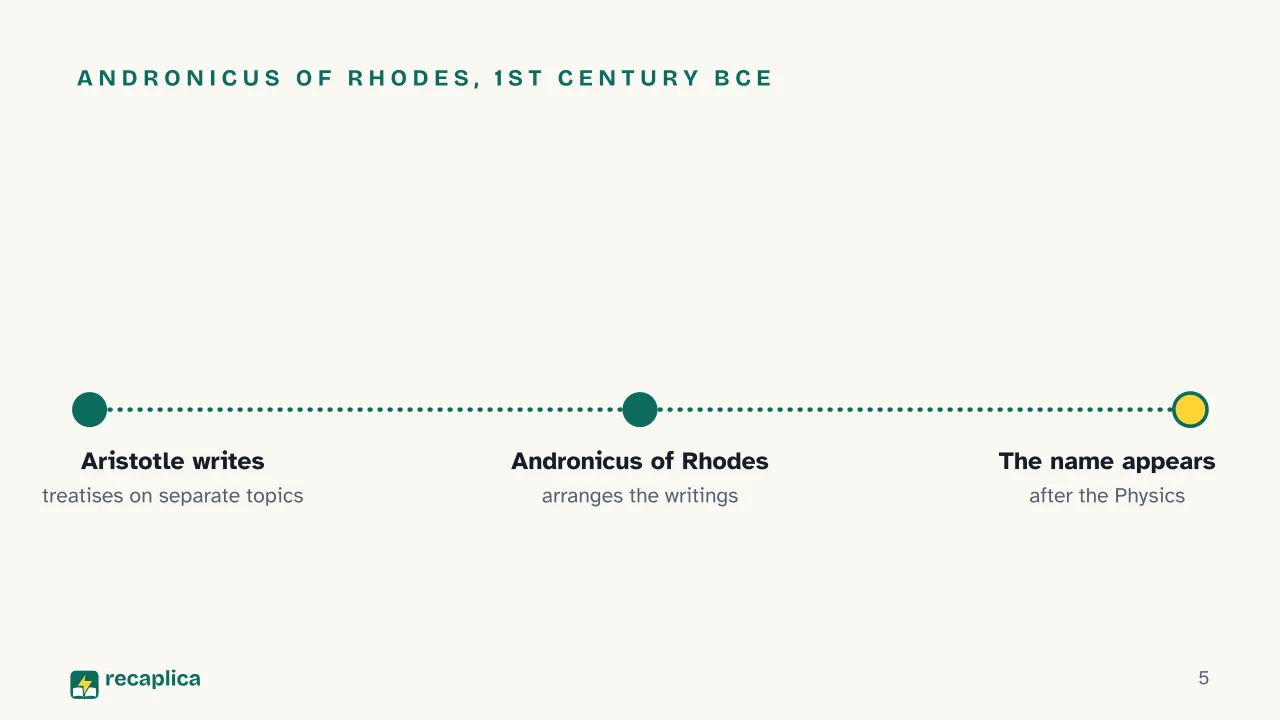
The name "Metaphysics" is centuries younger than the work itself: Andronicus of Rhodes coined it in the first century BCE, when he placed these texts after the treatises on Physics.
The work studies things simply as things: Aristotle sets aside any one particular feature, such as quantity or color, to look at the thing itself.
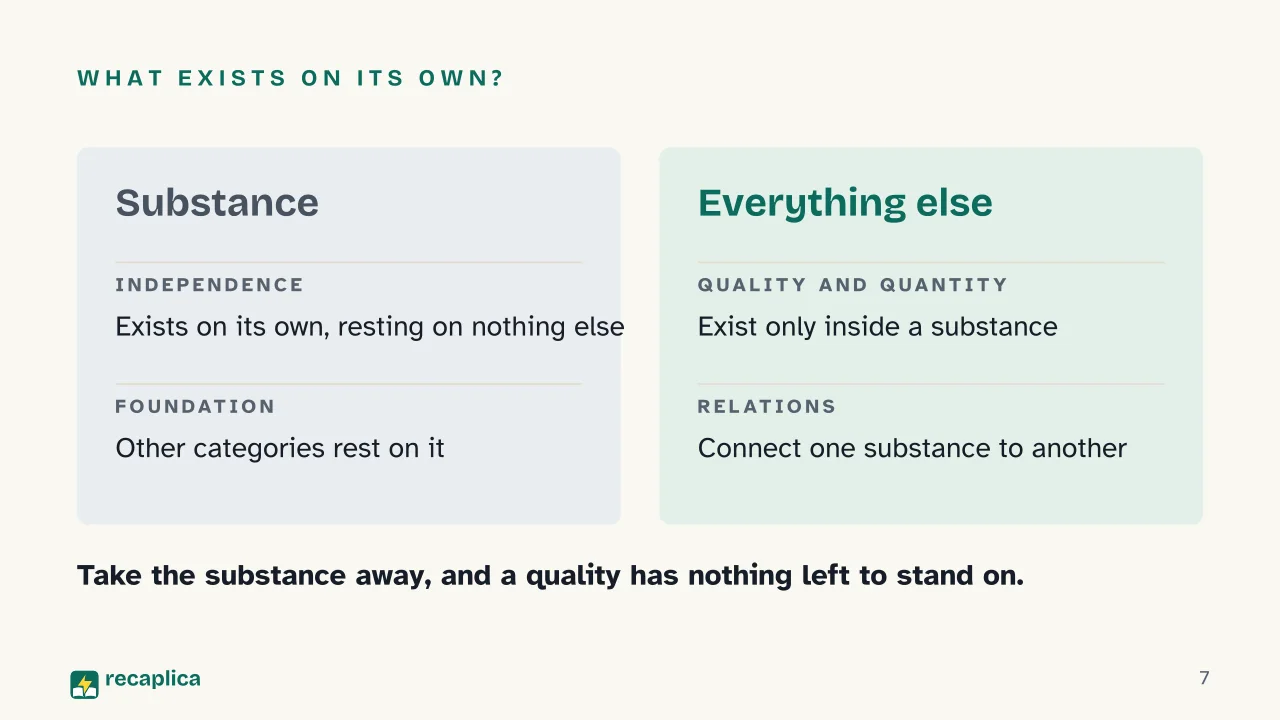
For Aristotle, substances are the only independent entities: qualities, quantities, and relations always rest on one of them.
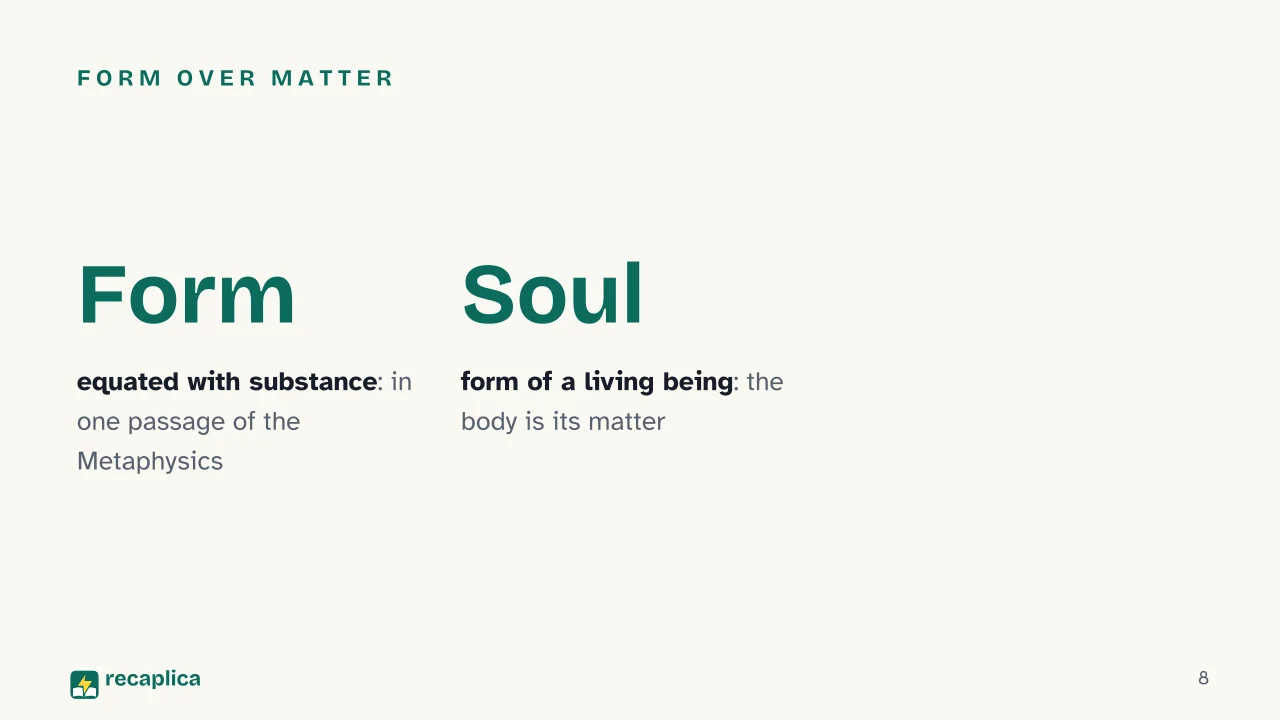
In one passage Aristotle equates the substance of a thing with its form — the example he gives is the soul, which gives shape to a living being while the body supplies the matter.
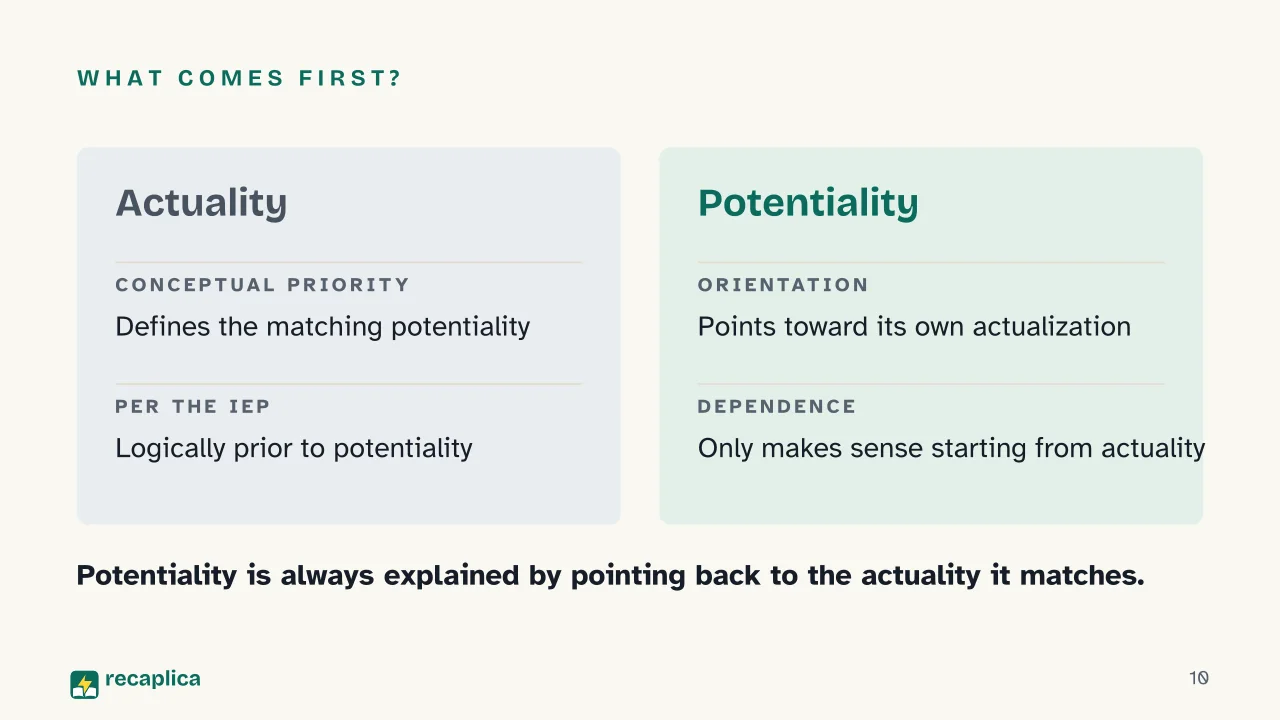
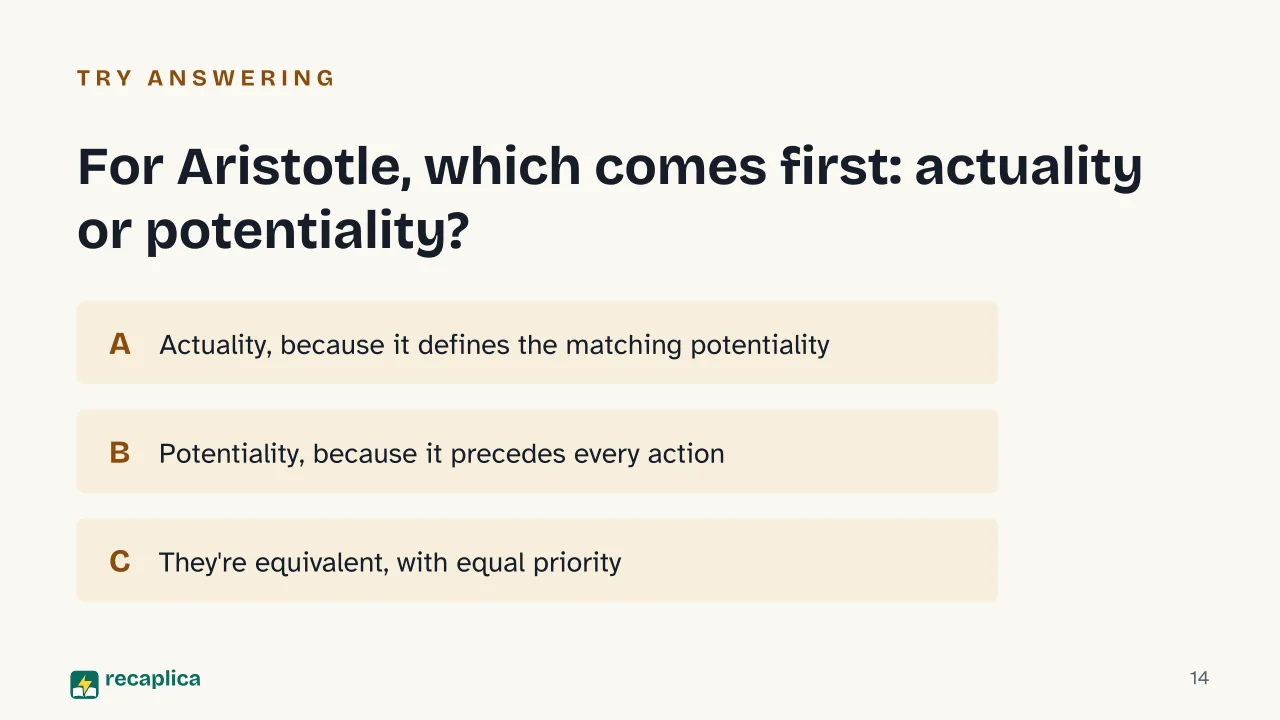
For Aristotle, actuality comes before potentiality conceptually, because every potentiality is defined in terms of the actuality it corresponds to.
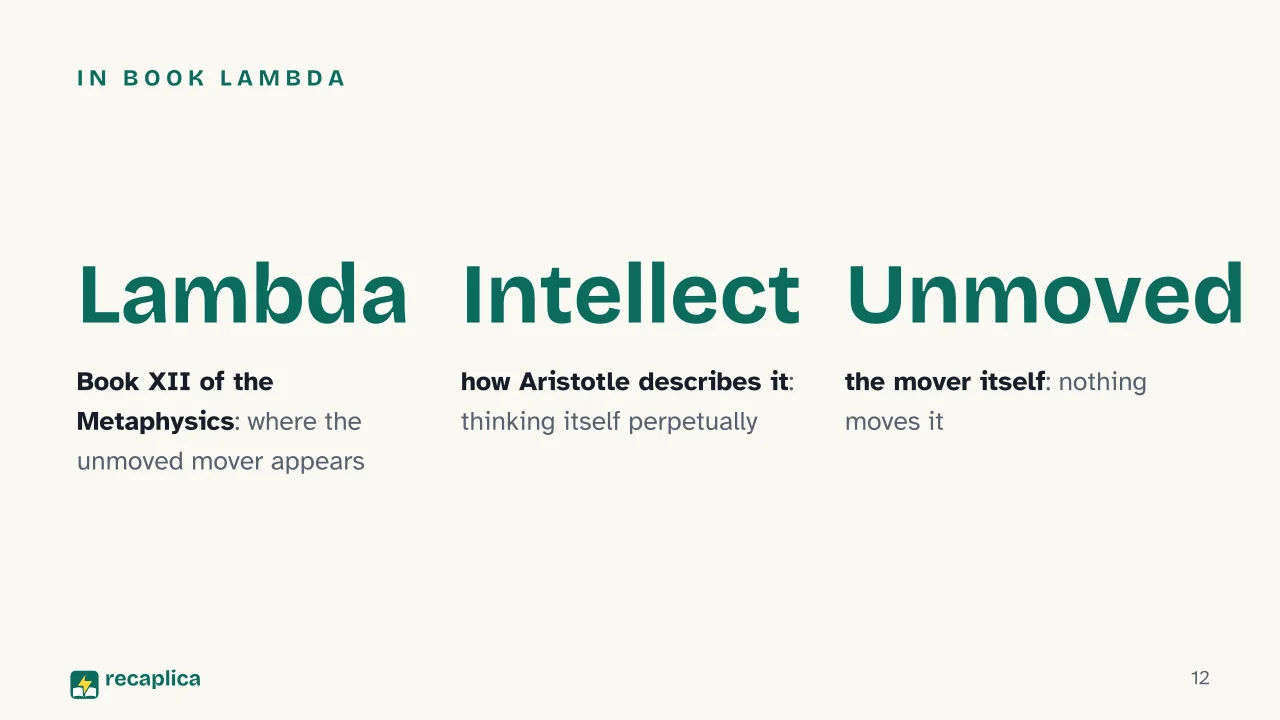
In Book Lambda, Aristotle concludes that an unmoved mover must exist: it stays unmoved itself, yet pulls everything else its way the way an object of desire pulls whoever wants it.
Deep Dive
Aristotle (who he was and what he argued) never gave his work this title. It was Andronicus of Rhodes who chose it, when in the first century BCE he placed these writings right after the Physics.
The Metaphysics that resulted is a collection of distinct texts, put together after the philosopher’s death. Between them they cover the theory of substance, the different types of cause, how form relates to matter, whether mathematical objects exist, and the structure of the cosmos.
The study of things as things
Aristotle calls this science first philosophy, or wisdom, according to the Internet Encyclopedia of Philosophy. It deals with things in their own being, apart from one particular feature such as quantity, color, or motion. In Book Zeta he writes that “being” has several senses, and that philosophy’s task is to work out the primary sense of being: substance, in Greek ousia, according to Wikipedia.
Substance, the one thing that stands on its own
For Aristotle, substances are the only independent entities. Everything else — a thing’s qualities, its quantity, the relations it has with other things — always rests on a substance: a color sits on a surface, a measurement measures something. In one passage of the Metaphysics, Aristotle argues that what defines a thing is its form, more than the matter it’s made of. In the example the Internet Encyclopedia of Philosophy traces back to him, the soul gives form to a living being, and the body remains its matter: on this reading, form organizes the body, and that’s why Aristotle treats it as the real substance.
Practical example: a clay pot and a clay bowl are made of the same matter. What separates them — the fact that one is a pot and the other a bowl — is the form: for Aristotle, form is what tells us what a thing really is, more than the matter it happens to be made of.
Actuality and potentiality, like form and matter
The relationship between actuality and potentiality, according to Wikipedia, can be thought of as similar to the one between form and matter. For Aristotle, actuality is conceptually prior to potentiality, because defining a potentiality requires reference to the actuality it corresponds to (Stanford Encyclopedia of Philosophy). The Internet Encyclopedia of Philosophy puts it in different terms: actuality has logical priority over potentiality, since any given potentiality is oriented toward becoming actual.
The unmoved mover, in Book Lambda
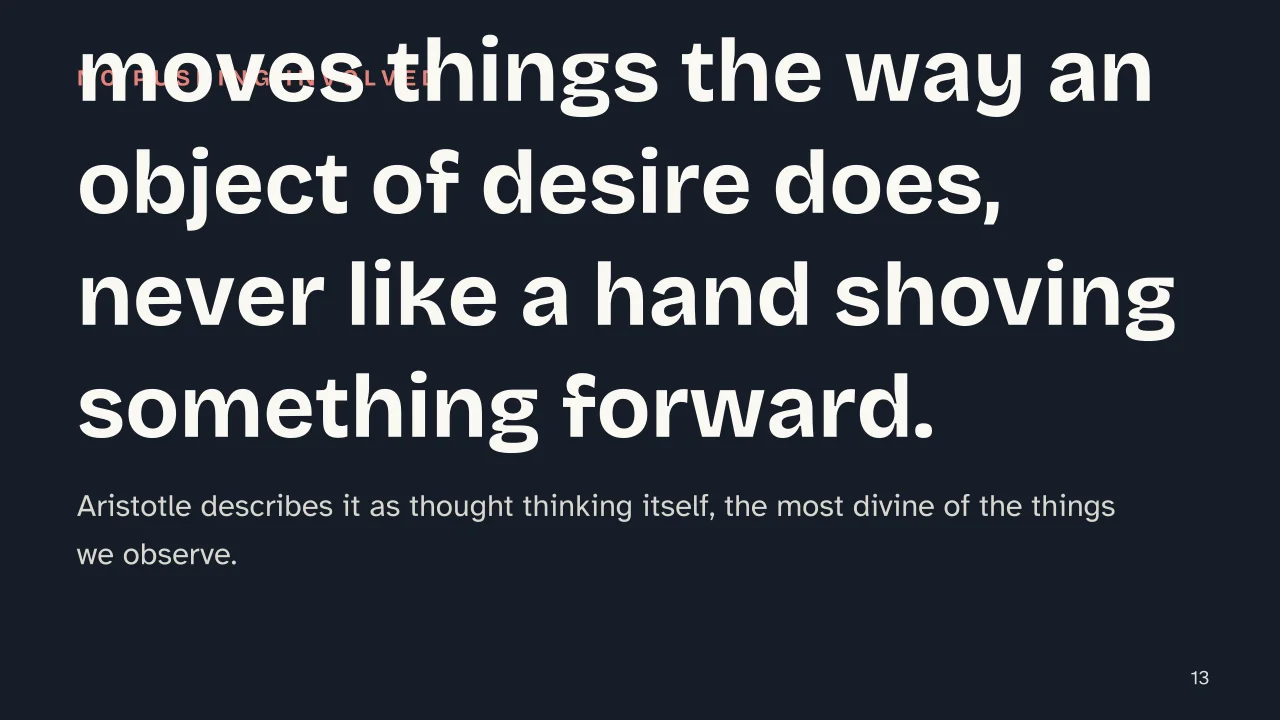
In Book Lambda, the twelfth of the Metaphysics, Aristotle reaches a conclusion that goes beyond the physics of moving bodies: a principle whose very substance is activity must exist, an unmoved mover, according to the Stanford Encyclopedia of Philosophy. It isn’t a mover that pushes.
What is desired and what is intelligible can move other things while staying unmoved themselves: for Aristotle, that is how the unmoved mover causes motion, through attraction. The Internet Encyclopedia of Philosophy reports that Aristotle describes this primary being as an intellect, or something close to an intellect, perpetually thinking itself, while the first mover receives motion from nothing: it remains unmoved itself. Wikipedia adds two images Aristotle uses for the same principle, in the book devoted to the unmoved mover: the most divine of the things we observe, and the thought that thinks itself.
An inquiry that didn’t start from scratch
Questions about substance didn’t come out of nowhere. Before Aristotle, the pre-Socratic philosophers had asked what the arché, the principle underlying everything, might be, and Socrates had turned the inquiry toward defining concepts through his own method. The sophists taught rhetoric and argued about truth too, in a setting — the polis of ancient Greece — where philosophy happened through public debate.
Slide deck
Slides ready to download and make your own in PowerPoint or Google Slides, with speaker notes. Pick the Flash cut or the Full one.
✗ Myth Many people assume the Metaphysics is a single book Aristotle sat down and wrote in one sweep.
✓ Reality It is actually a collection of separate texts put together by Andronicus of Rhodes, who in the first century BCE placed them after the Physics — that placement is where the name comes from.
✗ Myth Many people think "metaphysics" means the study of the paranormal or the supernatural.
✓ Reality For Aristotle the term covers the study of things as things, meaning the substance underlying everything; the name simply marks where these writings sit relative to the Physics.
✗ Myth Many people picture the unmoved mover pushing things along, the way a hand pushes a ball.
✓ Reality Aristotle describes the unmoved mover as causing motion by being an object of desire and an intelligible object: it moves things by attraction rather than physical contact, and nothing moves it in turn.
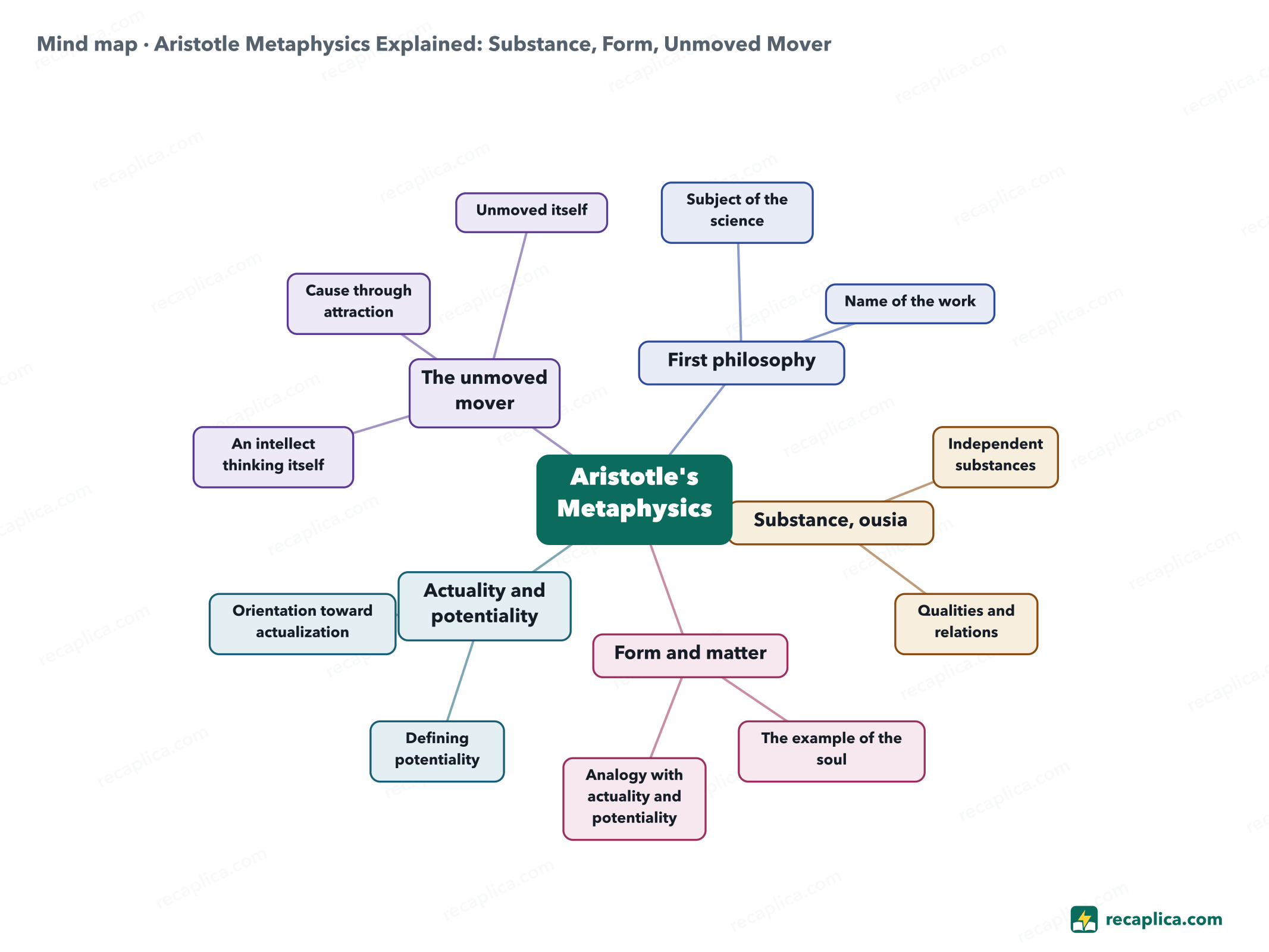
Mind map
Drag the background to move around and the nodes to reposition them; use − and + to collapse and expand branches.
Subject of the scienceThings considered in themselves, apart from any one particular feature
Name of the workCoined by Andronicus of Rhodes, in the first century BCE
Substance, ousiaThe primary kind of being, in Book Zeta
Independent substancesThe only entities that exist on their own
Qualities and relationsDepend on substances
Form and matterForm is what makes a thing what it is
The example of the soulThe soul is the form; the body supplies the matter
Analogy with actuality and potentialityA relationship thought of as similar to form and matter
Actuality and potentialityActuality comes first conceptually
Defining potentialityRequires reference to the matching actuality
Orientation toward actualizationPotentiality points toward actuality, in Book Theta
The unmoved moverA principle whose substance is activity, in Book Lambda
An intellect thinking itselfThinks itself perpetually
Cause through attractionMoves as an object of desire, never by direct contact
Unmoved itselfNothing else moves it
Quiz: test yourself
Answer the questions to check what you have learned: you get instant feedback and a short explanation.
Grade0/100/5
Answers: 1-B · 2-B · 3-B · 4-C · 5-B
Flashcards
Tap the card to flip it and check whether you remember the answer, then move to the next one.
1 / 8
Explain it in your own words
The ultimate test: if you can explain it in simple words, you've truly understood it. Write your explanation, then compare it with the Recap.
Your explanation is saved only on this device.
Aristotle's Metaphysics is one of his major works, although the title is not his own: Andronicus of Rhodes added it in the first century BCE, when he arranged these writings right after the Physics. The treatise asks what a thing is purely as a thing, a question Aristotle calls first philosophy. In one passage he identifies that primary being, substance, with form. He also argues that actuality is conceptually prior to potentiality, and in Book Lambda concludes that an unmoved mover exists: a principle whose very substance is activity, itself still, that draws everything else toward it the way an object of desire pulls someone.
Frequently asked questions
What is Aristotle's Metaphysics?
It's the work in which Aristotle looks for substance, examines the relationship between form and matter, and, in Book Lambda, arrives at the unmoved mover. The title was given centuries later by the editor Andronicus of Rhodes.
What are substance and form according to Aristotle?
Substance, according to the Stanford Encyclopedia of Philosophy, is the only independent entity. In one passage Aristotle equates it with form: the soul, for instance, shapes a living creature, and its body is what supplies the matter.
What's the difference between actuality and potentiality, for Aristotle?
Actuality comes first: for Aristotle, every potentiality only makes sense when you look at the actuality it corresponds to, the goal it's oriented toward.
What is Aristotle's unmoved mover?
It's the principle that, in Book Lambda of the Metaphysics, Aristotle describes as an intellect capable of thinking itself for eternity: it draws motion the way an object of desire does, while remaining still itself.
Why is the work called "Metaphysics"?
Because, arranging Aristotle's works in the first century BCE, Andronicus of Rhodes positioned these writings right after the treatises on Physics: the name literally means after the Physics.
Every Recap goes through an independent review before publication.
Statistics, only if you say so
To learn which Recaps help most we would use Google Analytics, with aggregate, anonymous data. It starts only with your OK, and you can change your mind anytime. Privacy policy