recaplica
Clear in 30 seconds, yours in 10 minutes.
In 30 seconds quick read
The Nicomachean Ethics is where Aristotle asks what makes an action good and what makes a life happy. He describes virtue as a middle state between two opposite extremes, widely known as the golden mean: temperance, for instance, sits between unchecked indulgence and the total denial of pleasure. The ultimate goal of a virtuous life is eudaimonia, which for Aristotle comes from using reason well across an entire lifetime. The work also gives two full books to friendship, a sign of how closely Aristotle tied it to virtuous action. The title, according to the Stanford Encyclopedia of Philosophy, comes from the philosopher's son, Nicomachus, who edited it.
Key Points
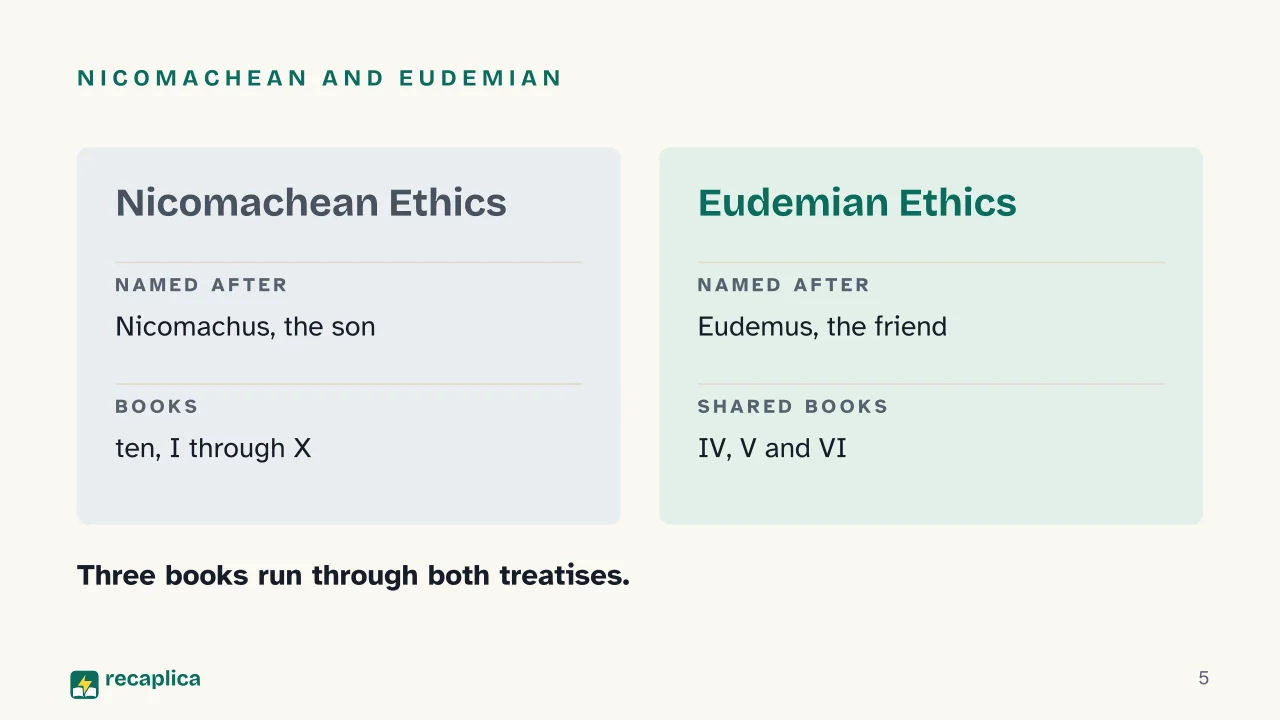
The Nicomachean Ethics is one of Aristotle's two ethical treatises, alongside the Eudemian Ethics; books V-VII of the Nicomachean match books IV-VI of the Eudemian.
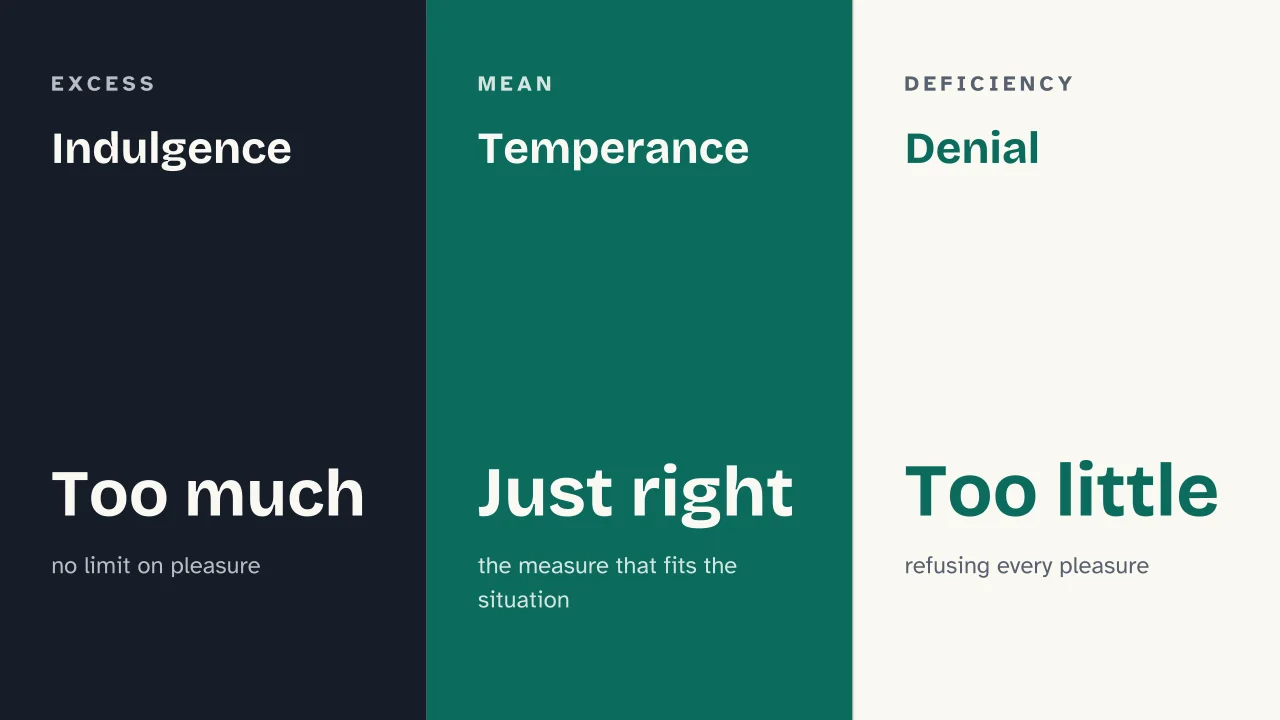
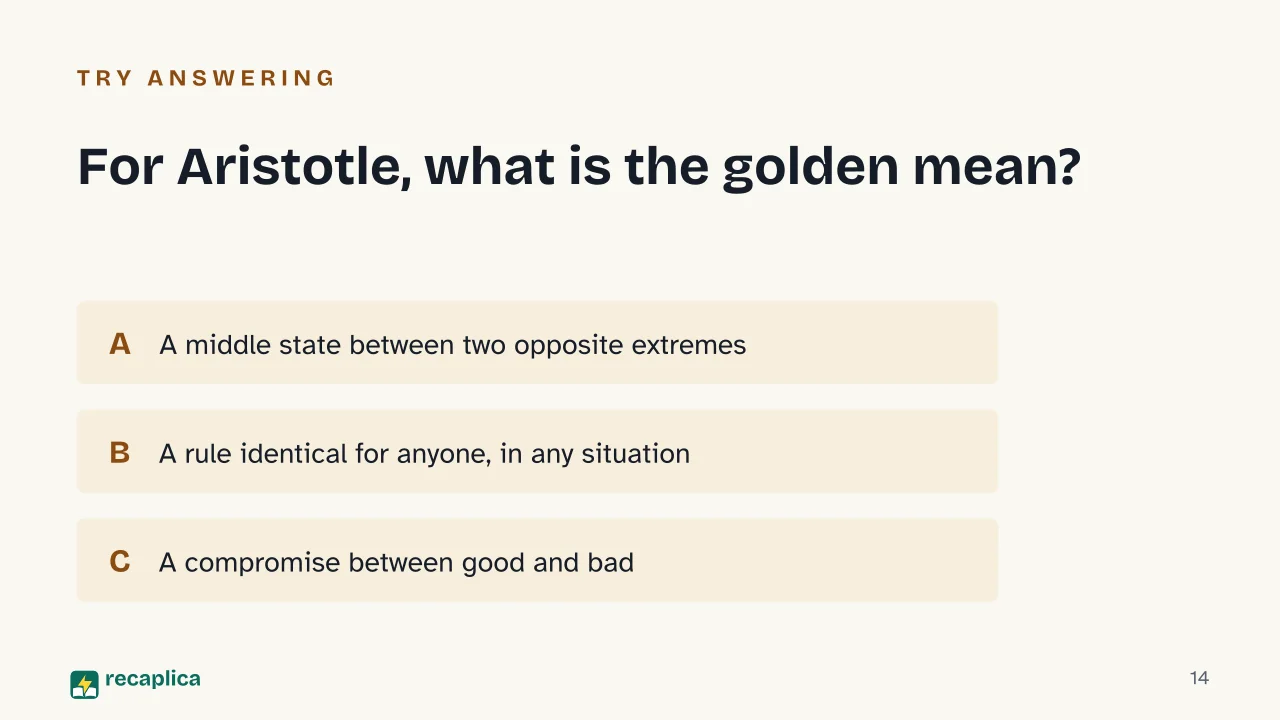
Ethical virtue is a middle state between an excess and a deficiency, widely known as the golden mean.
The mean isn't the same for everyone: it depends on the particular circumstances of the person acting.
The ultimate goal is eudaimonia, the happiness Aristotle grounds in the good use of reason, sustained across a whole life.
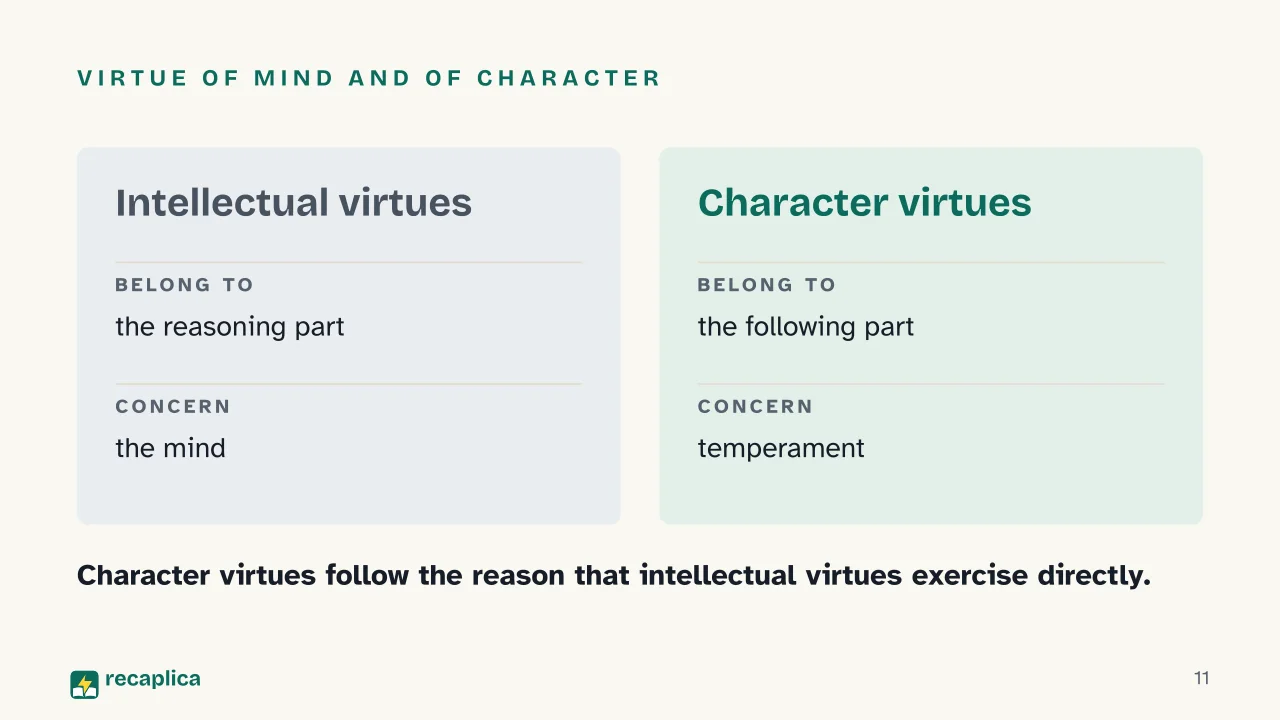
Aristotle separates intellectual virtues, which belong to the reasoning part of the soul, from character virtues, which belong to the part that follows reason without reasoning on its own.
Books VIII and IX are devoted to friendship (philia), which Aristotle links closely to virtuous activity.
Deep Dive
Per the Stanford Encyclopedia of Philosophy, Aristotle wrote two ethical treatises: the Nicomachean Ethics and the Eudemian Ethics. The names come from their respective editors — the Eudemian Ethics from Eudemus, a friend of the philosopher, the Nicomachean Ethics from his son Nicomachus.
Aristotle writes within the intellectual frame of Ancient Greece, picking up questions the pre-Socratic philosophers had already raised about the nature of things. But the Nicomachean Ethics shifts the focus from nature to human action, toward the question of what makes a life good.
At the heart of the work is the theory of virtue as a middle state, widely known as the golden mean. Aristotle compares virtues to a craft: just as a skilled craftsman avoids too much and too little in the work itself, a person with an ethical virtue avoids the two opposite extremes in behavior. That middle point isn’t a fixed value, the same for anyone in any situation: it has to be set according to the particular circumstances of the person acting, the Stanford Encyclopedia of Philosophy adds.
Every moral virtue, the Internet Encyclopedia of Philosophy explains, is itself an “extreme,” in the sense that it represents excellence. The same source notes that what sets courage apart is that a courageous act is always done for the sake of the noble.
The same principle applies to temperance, the virtue concerned with bodily pleasures.
Practical example: temperance toward bodily pleasures, according to the Internet Encyclopedia of Philosophy, comes from finding a mean between two opposite extremes: someone who gives in to every pleasure without restraint sits at one end, someone who denies every bodily pleasure sits at the other. Virtue lies in the middle measure between the two, calibrated to the situation of the person acting.
Nicomachean Ethics
Eudemian Ethics
Named after
Nicomachus, Aristotle’s son
Eudemus, Aristotle’s friend
Shared books
V, VI, VII
IV, V, VI
Total books
ten, I through X
—
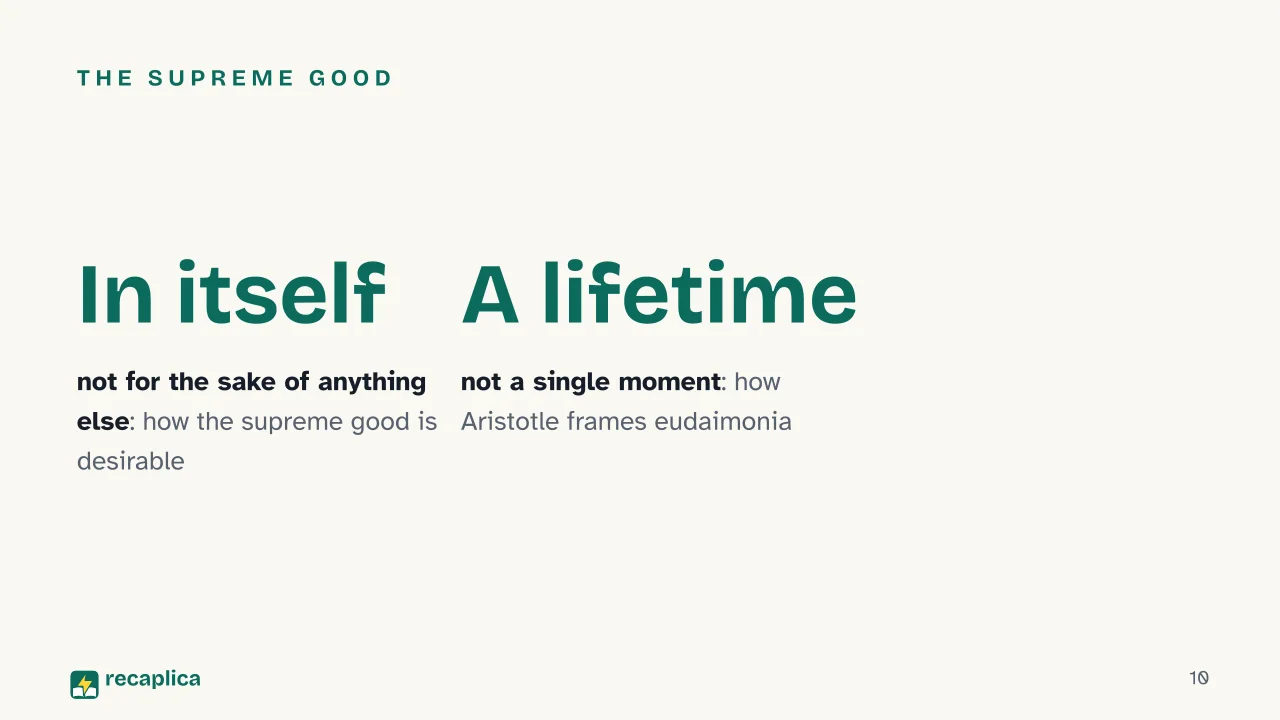
The ultimate point of this whole structure is eudaimonia. Per the Stanford Encyclopedia of Philosophy, the supreme good has three traits: it is desirable in itself, not for the sake of anything else, and every other good is desirable for its sake. Eudaimonia, for Aristotle, is the correct use of reason sustained across an entire life. The Internet Encyclopedia of Philosophy adds that the proper task of a human being is to put the capacity for reason into practice, and that a virtuous life is pleasant in itself. To exercise that capacity, Aristotle distinguishes two families of virtue: intellectual virtues belong to the reasoning part of the soul, while character virtues belong to the part that follows reason without generating it on its own, again per the Stanford Encyclopedia of Philosophy.
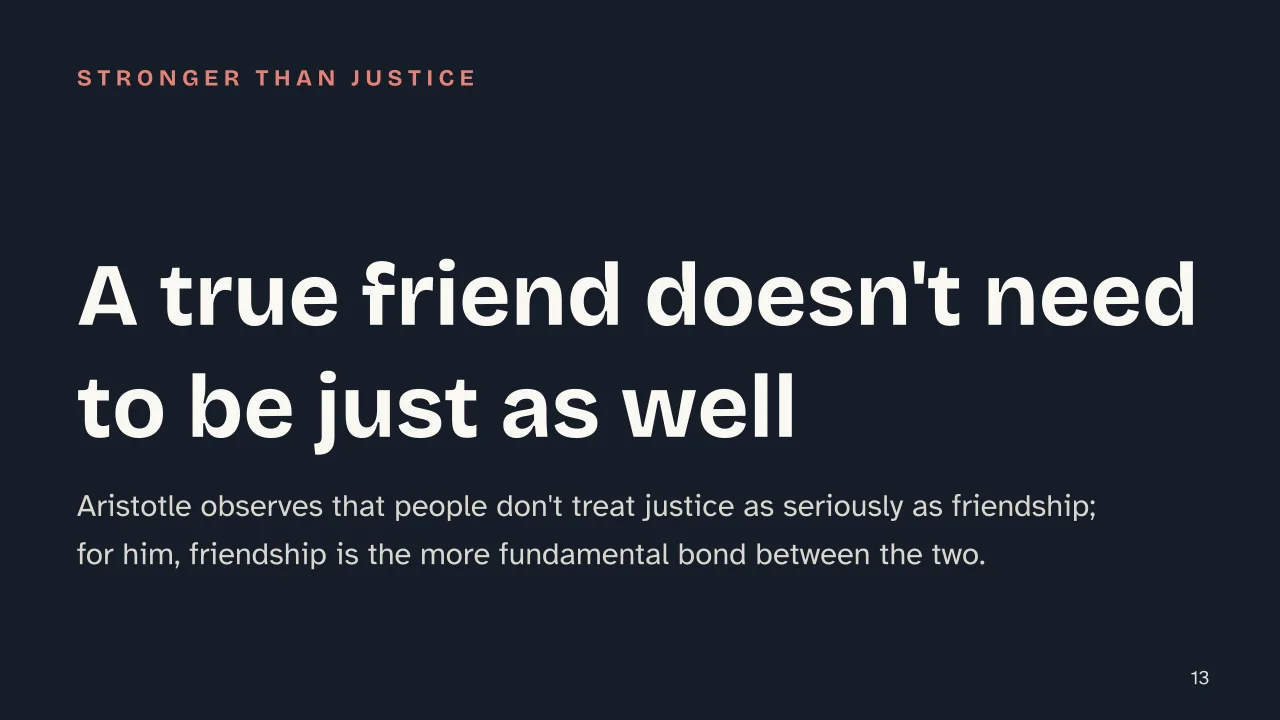
Books VIII and IX of the work are devoted entirely to friendship (philia). Aristotle observes that people don’t treat justice as seriously as friendship, and states that friends don’t need to be just toward each other as well: a sign, for him, of how much more fundamental friendship is than justice itself. It’s a question that, within Greek philosophy, recalls the method of Socrates, who spent his life testing the moral definitions his interlocutors took for granted — a different approach from what the sophists practiced in the same Athens.
The MIT Internet Classics Archive’s full digital edition of the text divides it into ten books, I through X.
Slide deck
Slides ready to download and make your own in PowerPoint or Google Slides, with speaker notes. Pick the Flash cut or the Full one.
✗ Myth The golden mean between two vices is a mediocre middle ground, a watered-down compromise.
✓ Reality According to the Internet Encyclopedia of Philosophy, each moral virtue is itself an extreme, in the sense of excellence, even though it sits between two opposite vices; it isn't a dull compromise.
✗ Myth The Nicomachean Ethics and the Eudemian Ethics have nothing in common.
✓ Reality The Stanford Encyclopedia of Philosophy notes the two works share material: books IV-VI of the Eudemian Ethics correspond to books V-VII of the Nicomachean Ethics.
✗ Myth The title 'Nicomachean Ethics' means the work was written by Nicomachus.
✓ Reality Per the Stanford Encyclopedia of Philosophy, the names of both treatises come from their editors: the Eudemian Ethics from Eudemus, a friend of Aristotle, the Nicomachean Ethics from his son Nicomachus, who edited it rather than wrote it.
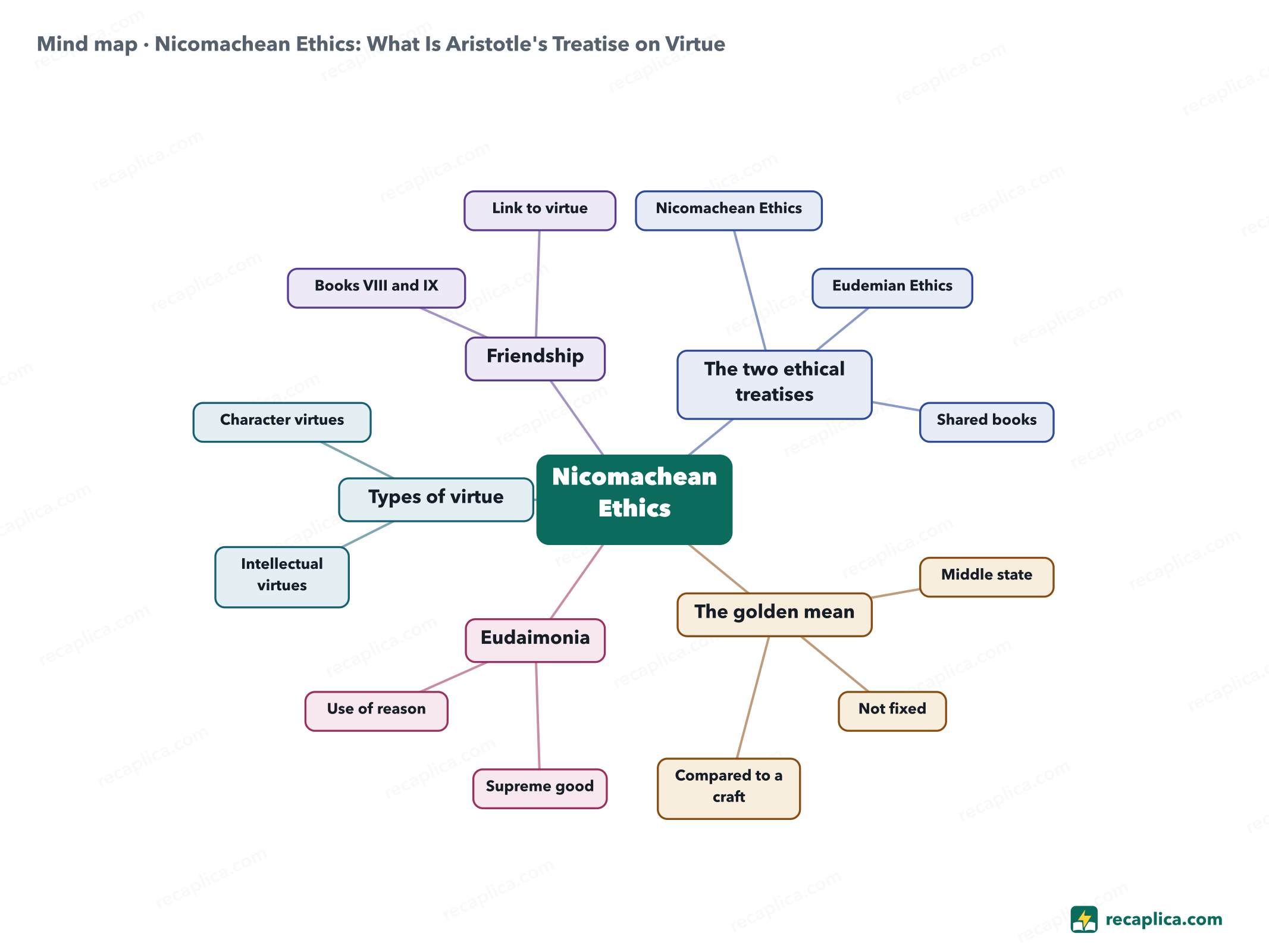
Mind map
Drag the background to move around and the nodes to reposition them; use − and + to collapse and expand branches.
Compared to a crafta skilled craftsman avoids excess and deficiency
Eudaimonia
Supreme gooddesirable in itself
Use of reasonsustained across a whole life
Types of virtue
Intellectual virtuesof the reasoning part of the soul
Character virtuesof the part that follows reason
Friendship
Books VIII and IXdevoted to philia
Link to virtuevirtuous activity and friendship, closely tied
Quiz: test yourself
Answer the questions to check what you have learned: you get instant feedback and a short explanation.
Grade0/100/5
Answers: 1-A · 2-A · 3-A · 4-A · 5-A
Flashcards
Tap the card to flip it and check whether you remember the answer, then move to the next one.
1 / 8
Explain it in your own words
The ultimate test: if you can explain it in simple words, you've truly understood it. Write your explanation, then compare it with the Recap.
Your explanation is saved only on this device.
The Nicomachean Ethics is where Aristotle asks what makes an action good and what makes a life happy. He describes virtue as a middle state between two opposite extremes, widely known as the golden mean: temperance, for instance, sits between unchecked indulgence and the total denial of pleasure. The ultimate goal of a virtuous life is eudaimonia, which for Aristotle comes from using reason well across an entire lifetime. The work also gives two full books to friendship, a sign of how closely Aristotle tied it to virtuous action. The title, according to the Stanford Encyclopedia of Philosophy, comes from the philosopher's son, Nicomachus, who edited it.
Frequently asked questions
Are the Nicomachean Ethics and the Eudemian Ethics the same work?
No, they're two separate treatises, but they share material: per the Stanford Encyclopedia of Philosophy, books IV-VI of the Eudemian Ethics correspond to books V-VII of the Nicomachean Ethics.
What does "golden mean" mean in the Nicomachean Ethics?
It's the middle state between an excess and a deficiency where Aristotle places every ethical virtue, as the Stanford Encyclopedia of Philosophy explains; the exact point varies from person to person, depending on circumstances.
Why is the work called "Nicomachean"?
Because, per the Stanford Encyclopedia of Philosophy, the name comes from Nicomachus, Aristotle's son, who edited it.
How many books make up the Nicomachean Ethics?
Ten, numbered I through X, as the MIT Internet Classics Archive's full edition of the text reports.
What is eudaimonia for Aristotle?
It's the happiness that comes from a correct, sustained use of reason across an entire life, per the Stanford Encyclopedia of Philosophy.
Every Recap goes through an independent review before publication.
Statistics, only if you say so
To learn which Recaps help most we would use Google Analytics, with aggregate, anonymous data. It starts only with your OK, and you can change your mind anytime. Privacy policy