Skip to content
recaplica

    One moment: security check

    Cloudflare wants to make sure you're not a robot. Tick the box below and your search will continue on its own.

    IT
    recaplica Saint Augustine of Hippo: Life, Conversion, and Philosophy
    © 2026 Recaplica · recaplica.com — All rights reserved
    Home › History

    Saint Augustine of Hippo: Life, Conversion, and Philosophy

    By Recaplica Newsroom · Updated on October 11, 2026

    What to print

    Page numbers appear when printing with default margins.

    Slides

    Choose a cut

    Flash10 slidesThe essential thread, to present in classFull17 slidesEvery chapter and the deeper detail

    Both come with speaker notes.

    Telegram channel
    recaplica Clear in 30 seconds, yours in 10 minutes.
    In 30 seconds Key points Deep dive Slides Myths Mind map Quiz Flashcards FAQ

    In 30 seconds quick read

    Augustine of Hippo (354-430) was born in Thagaste, in Roman Numidia, to a Roman father and a mother, likely Berber, who was Christian. After a youth of rhetorical study and years following Manichaeism, he converted to Christianity in Milan in 386 and was baptized the following year. He became bishop of Hippo and wrote the Confessions and the City of God, two works that shaped Western philosophy. His thought blends the Neoplatonic tradition with Christianity, around the themes of free will, sin, and grace.

    Key Points

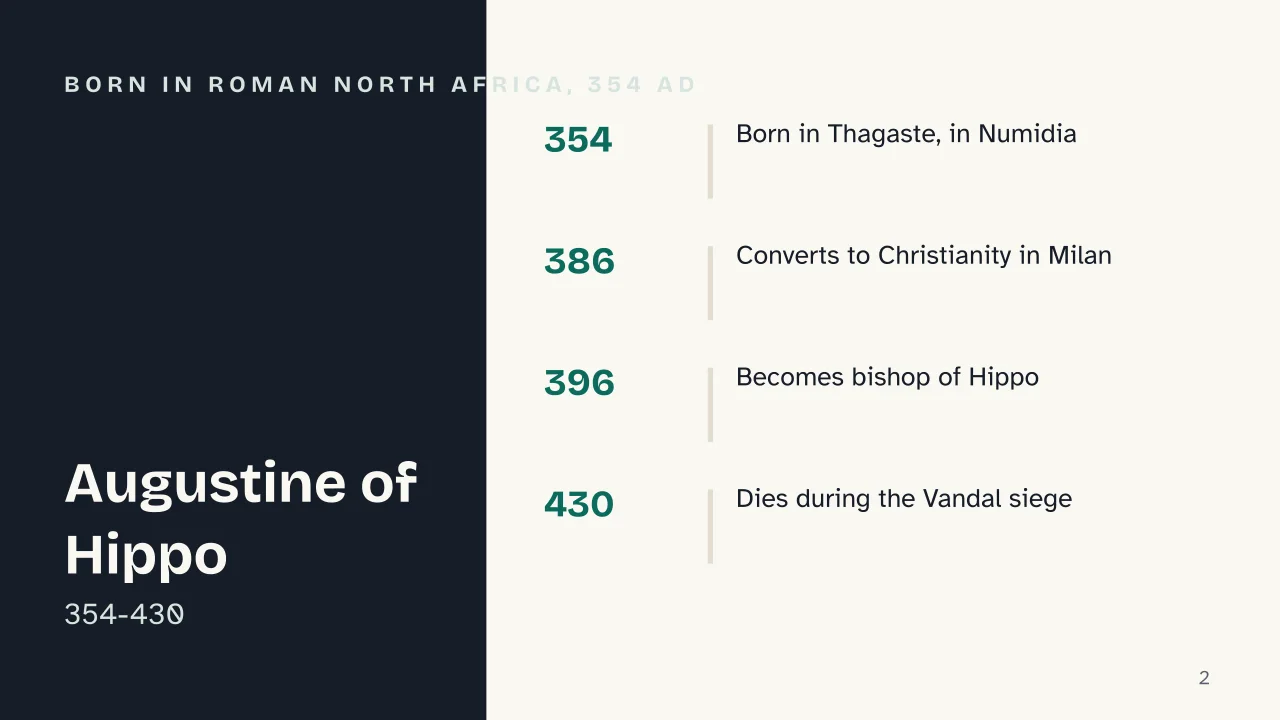
    • Born in 354 in Thagaste, Roman North Africa, to a pagan Roman father and a Christian mother, likely Berber.
    • Followed Manichaeism for nine years before converting to Christianity in 386, in Milan.
    • Became bishop of Hippo in 396 and died there in 430, during the Vandal siege.
    • The Confessions are regarded as the earliest autobiography in the Western tradition.
    • In the City of God, he answered those who blamed the sack of Rome in 410 on the abandonment of the old gods.
    • His ideas on free will and grace influenced medieval philosophers such as Anselm of Canterbury and Thomas Aquinas.

    Deep Dive

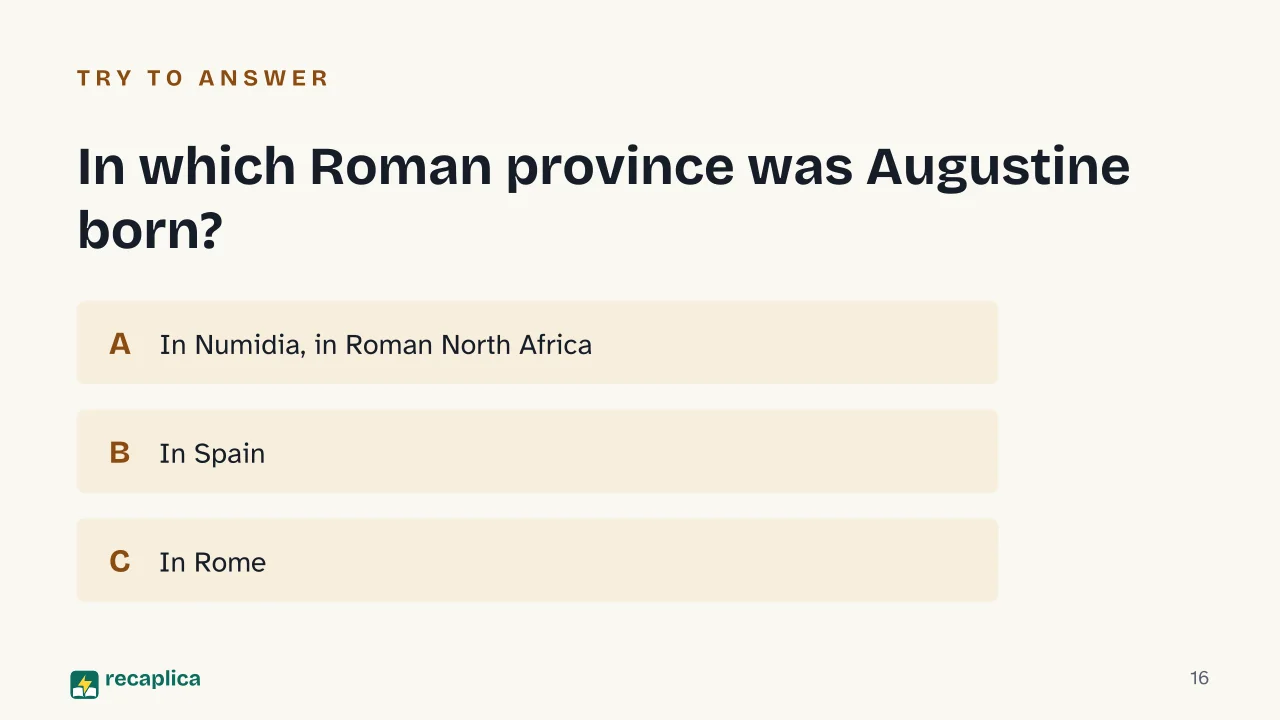
    Augustine was born on 13 November 354 in Thagaste, a city in the Roman province of Numidia, in Roman North Africa, known today as Souk Ahras, in Algeria. His father, Patricius, was a pagan Roman who was baptized only on his deathbed, in 372; his mother, Monica, was a devout Christian, likely Berber. Her influence on her son’s religious path, though, was not entirely straightforward: sources from the period point to a more complicated relationship than the simple label of “devoted mother” suggests.

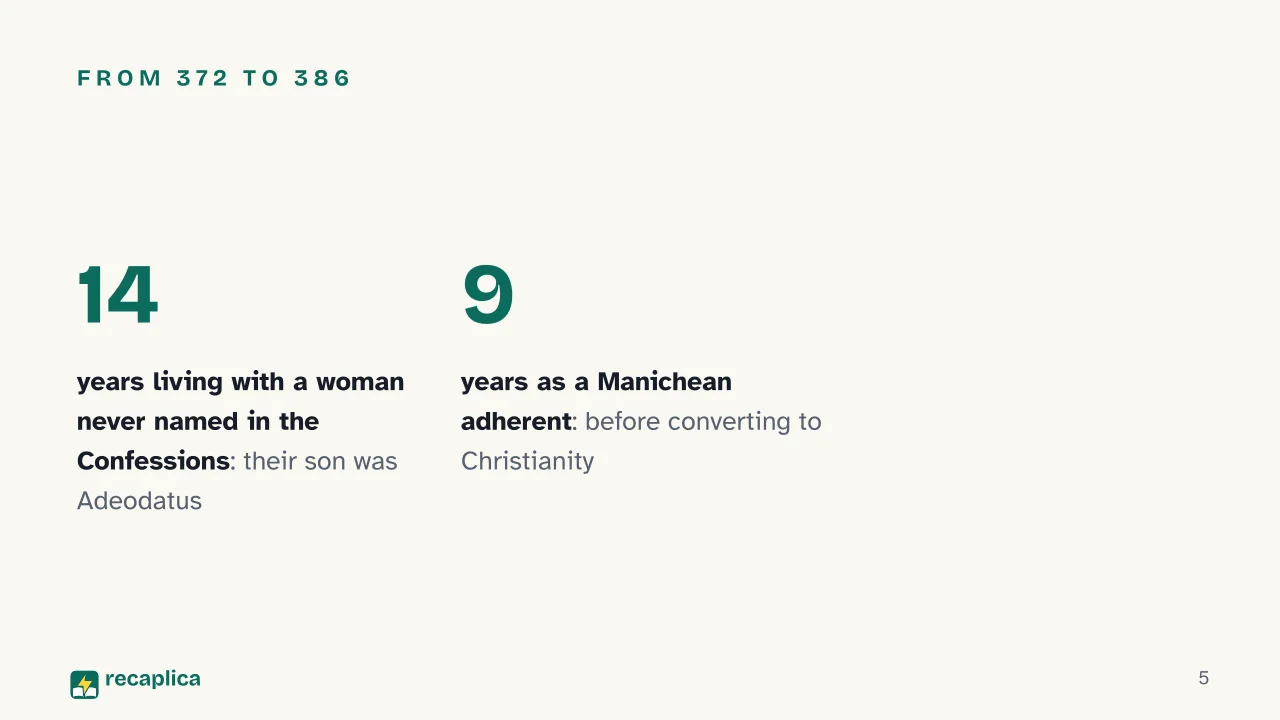
    Augustine studied grammar and rhetoric first in Madauros and then in Carthage, showing an early talent for the Latin classics: he excelled above all in his study of Virgil’s Aeneid. Around the age of eighteen he began a relationship with a woman he never names in the Confessions, living with her for about fourteen years in a monogamous union. Their son, Adeodatus, was born from that relationship. During the same period, Augustine turned to Manichaeism, becoming an “adherent” - a first-level follower - for nine years.

    The Confessions of Saint Augustine

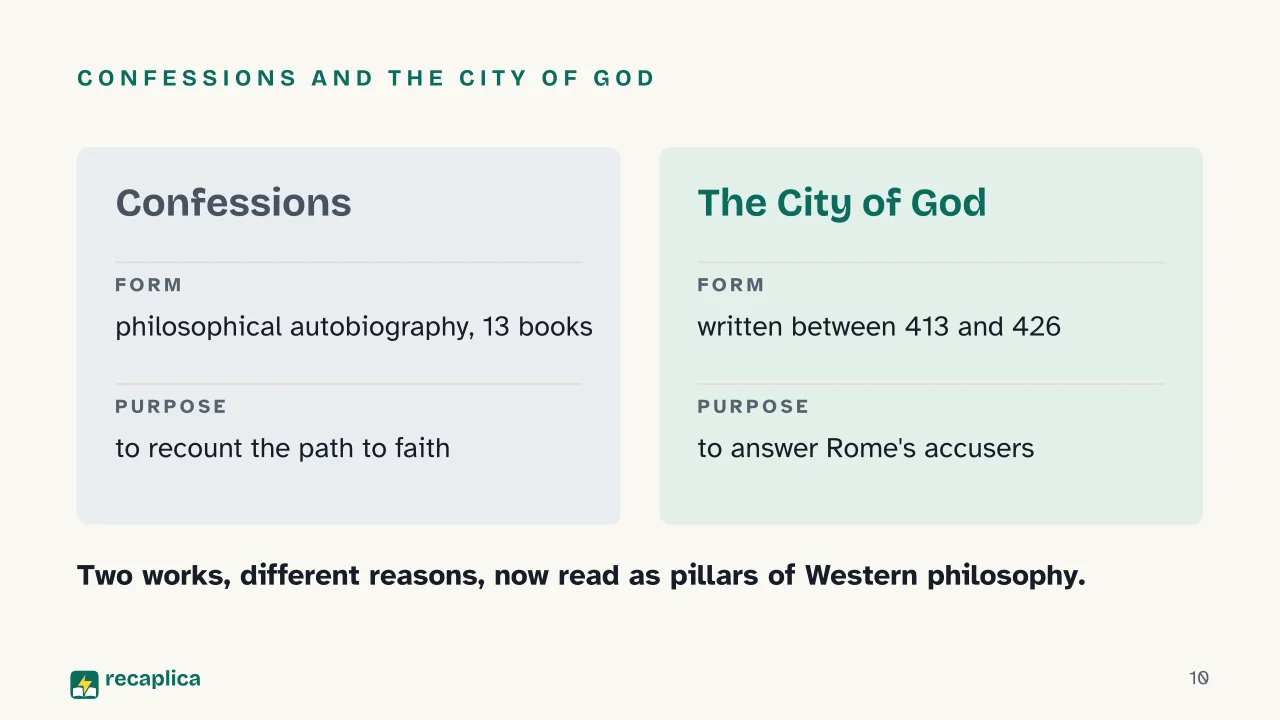
    The Confessions tell the story of that very path: a work of philosophy written in autobiographical form, divided into thirteen books, the first nine of which retrace Augustine’s life up to his conversion. Many historians treat it as the opening work of Western autobiography, and it has deeply shaped how people have written about their inner lives ever since.

    Practical example: anyone who keeps a diary or writes a memoir today is, in a sense, continuing a genre the Confessions opened: narrating an inner life, not just outward events.

    The Conversion in Milan

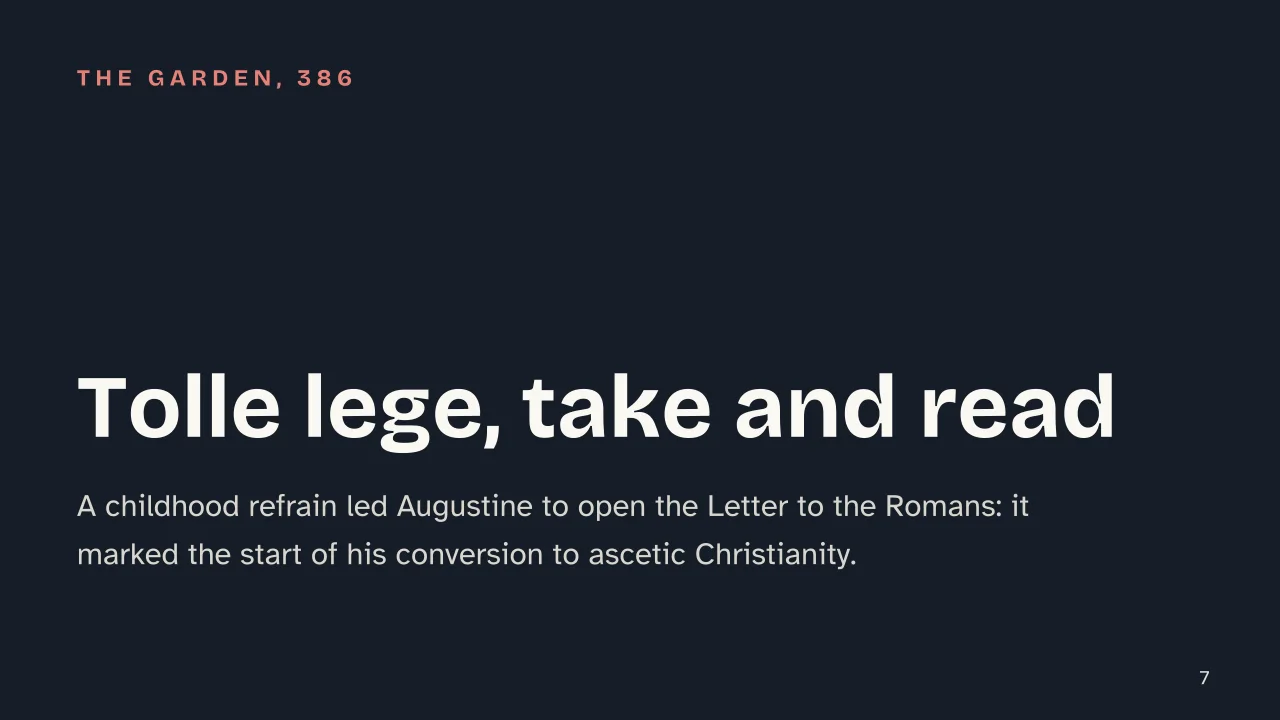
    The decisive moment came in 386, in Milan. Augustine was in the garden of his house with his friend Alypius when he heard a child’s chant, “tolle lege”, take and read. He opened a text of the Letter to the Romans, at chapter 13, and that reading marked his conversion to ascetic Christianity. That same year he had also read some “books of the Platonists”, treatises by Plotinus translated into Latin by Marius Victorinus, which helped shape how he thought about reality and the divine. One of the factors behind his conversion was therefore philosophical as well as religious: sources do not point to a single cause, but to an interplay of readings, encounters, and circumstances.

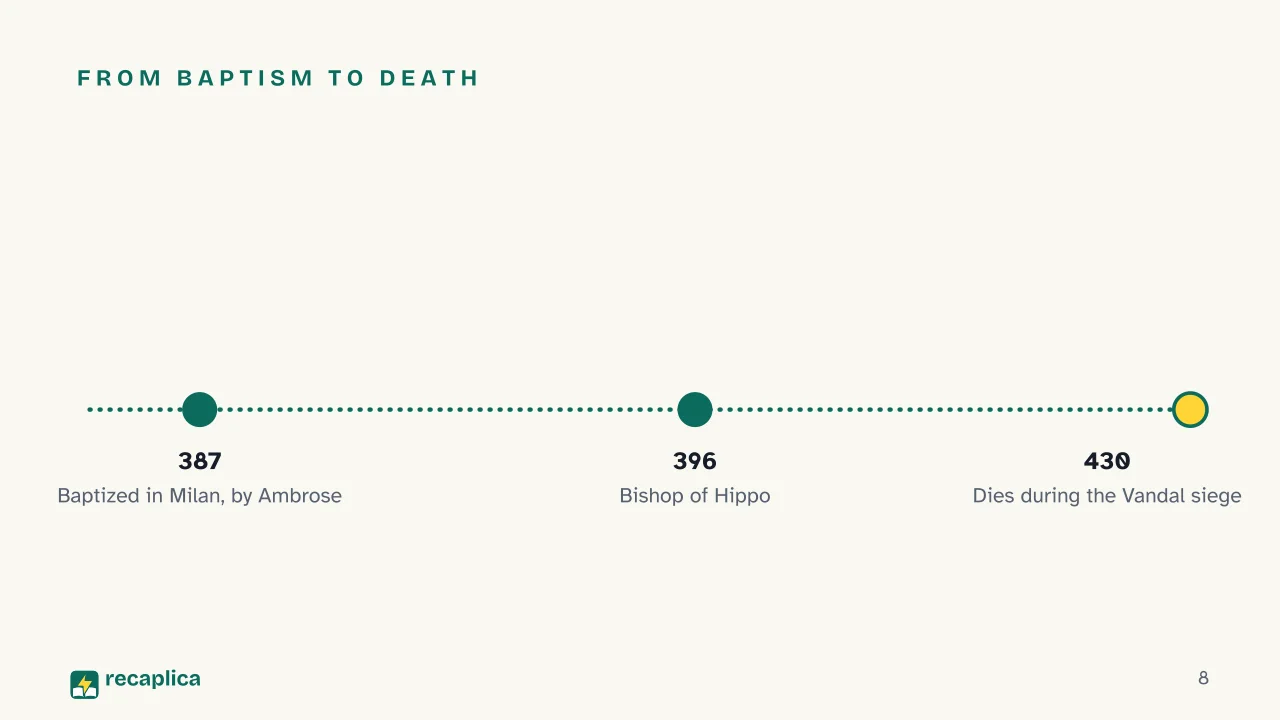
    He was baptized by Ambrose, bishop of Milan, at Easter in 387.

    In 391 he was ordained a priest in the diocese of Hippo, a coastal city in Roman North Africa: a role he had not sought and accepted against his own will. About five years later, in 396, he succeeded the local bishop. In Hippo he also founded his own monastery, and became known for his preaching and teaching. He died in the same city in 430, during the Vandal siege.

    The City of God and the Sack of Rome

    Augustine’s second major work, the City of God, written between 413 and 426, grew out of a specific occasion: the sack of Rome in 410, carried out by Alaric I. Some blamed that fall on the abandonment of the old gods in favor of Christianity, and Augustine responded by contrasting two ways of living, not two armies: the City of God, made up of those who love God above all else, and the City of Man, made up of those bound together by self-love.

    Augustine’s Philosophy: Evil, Freedom, and Grace

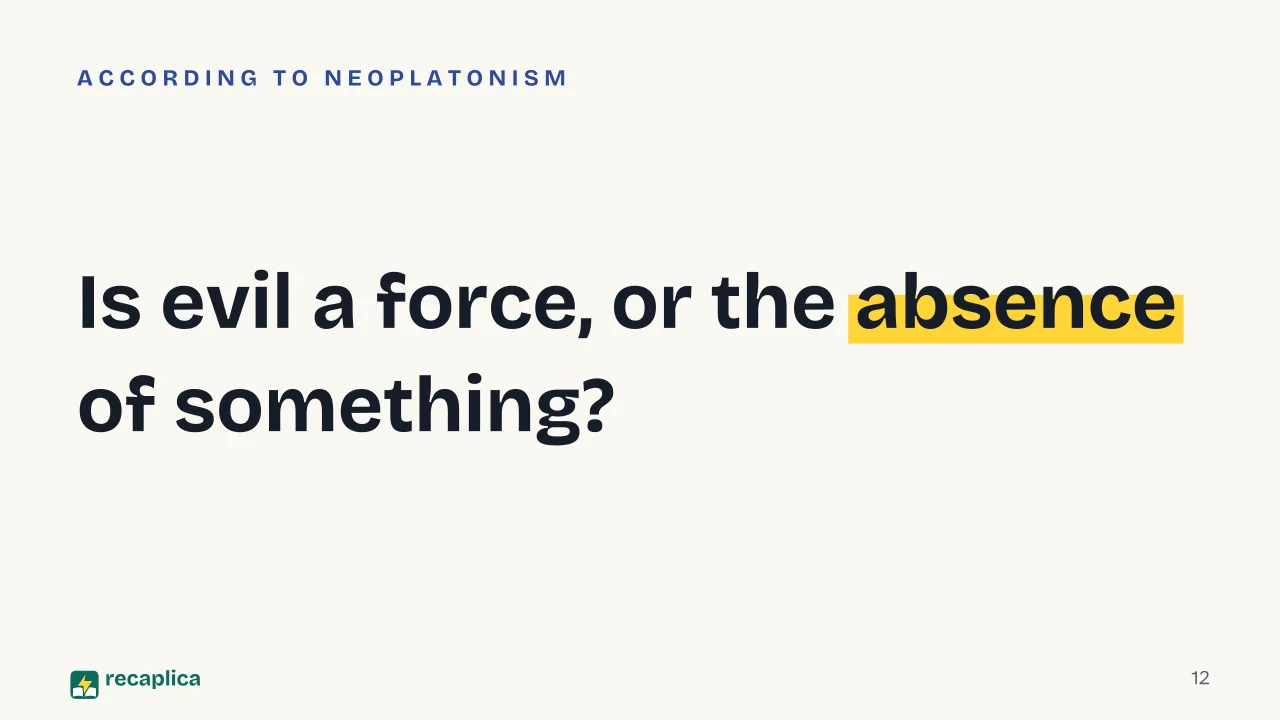
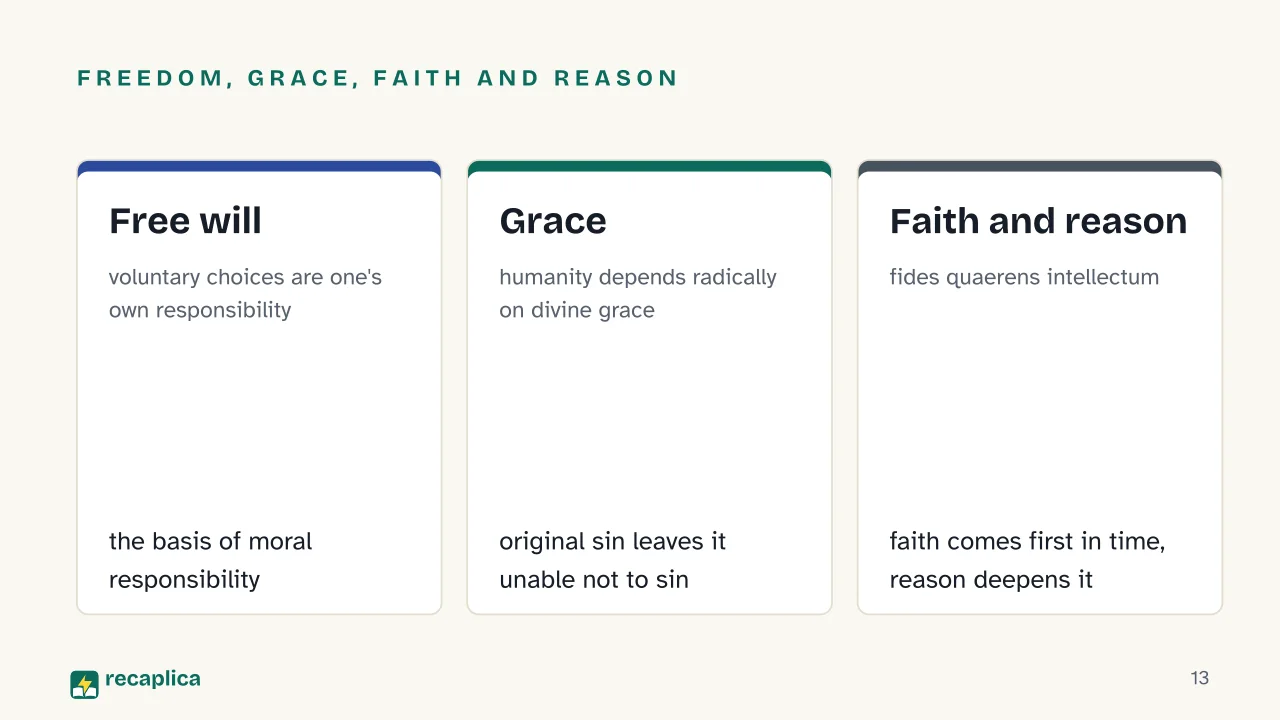
    The philosophical core of Augustine’s thought draws in part on Neoplatonism, the school founded by Plotinus. In Plotinus’ Enneads, evil is argued to have no substance of its own, but to be the privation or corruption of good: Augustine adopted this view and made it a pillar of his ethics. Sin, for him, is the will to pursue something unjustly; voluntary choices remain attributable to whoever makes them, and this is the foundation of free will and moral responsibility.

    Alongside freedom, Augustine argued just as forcefully for humanity’s radical dependence on divine grace: original sin, in his view, left a once-free will unable to resist sin without God’s help. Freedom and grace coexist in his thought without canceling each other out.

    Augustine’s philosophical program can be summed up in the phrase “fides quaerens intellectum”, faith seeking understanding: faith comes before understanding in time, but remains subordinate to it in importance and value. It is not a relationship of opposition between faith and reason, as is sometimes assumed, but one of priority and mutual service.

    Practical example: a student who trusts a teacher’s word before verifying a mathematical rule alone lives out, on a small scale, the same pattern: trust comes first, full understanding follows later, through study.

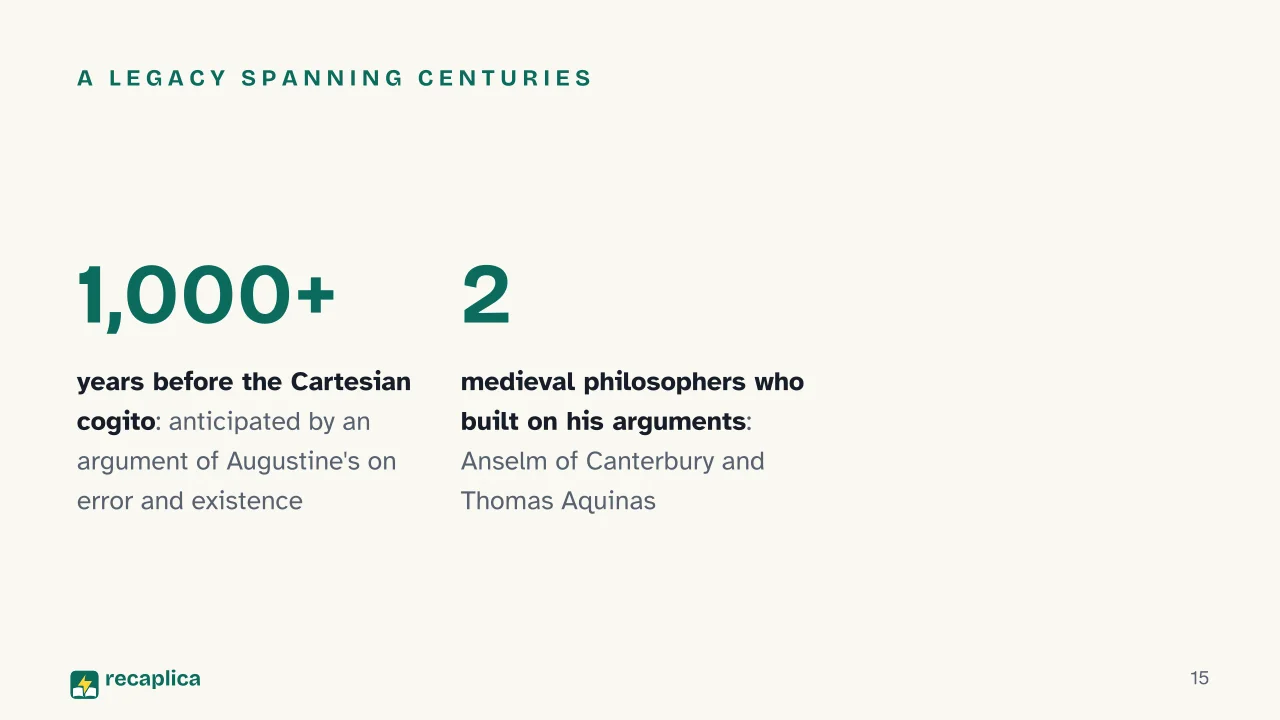
    One of Augustine’s most cited arguments anticipates the Cartesian “cogito” by more than a thousand years: if I am mistaken in stating a proposition, it remains true that I, the one who is mistaken, exist. It is a different argument from Descartes’s in its premises and purpose, but it precedes it in structure.

    Given the importance of these themes in the history of philosophy, Augustine is often regarded as the first medieval philosopher. Anselm of Canterbury, who lived between 1033 and 1109, and Thomas Aquinas, between 1225 and 1274, drew on his arguments for their own reflections on the union of faith and reason: a legacy that connects Augustine’s thought to the heart of the Middle Ages and its philosophy.

    Was Saint Augustine Black? The Origins of a Debate

    It is a question many people ask once they discover that Augustine was African. Answering it means looking at the historical context Augustine lived in, a world far removed from today’s racial categories. Augustine was African, born in Numidia into a family sources consider likely of Berber lineage: a Roman father, a Berber mother. In his writings he never shows awareness of a racial difference in the modern sense, and he does not describe his own physical appearance or skin color in any passage that has survived.

    In late antiquity, social advancement depended mainly on how one spoke and which region of the empire one came from, not on physical appearance: the category that mattered was regional and linguistic. Once in Rome, Augustine was mocked by his students for his way of speaking, perceived as “African” in accent, even though he was perfectly fluent in Latin. Modern categories of “white” and “black” simply do not match how Augustine, or his contemporaries, thought about their own identity: in the terms of his time, he was a Romanized North African Berber.

    The Confessions and the City of God remain among the most widely read texts of ancient philosophy today: Augustine occupies a border position, between the classical world and the medieval one.

    Slide deck

    Slides ready to download and make your own in PowerPoint or Google Slides, with speaker notes. Pick the Flash cut or the Full one.

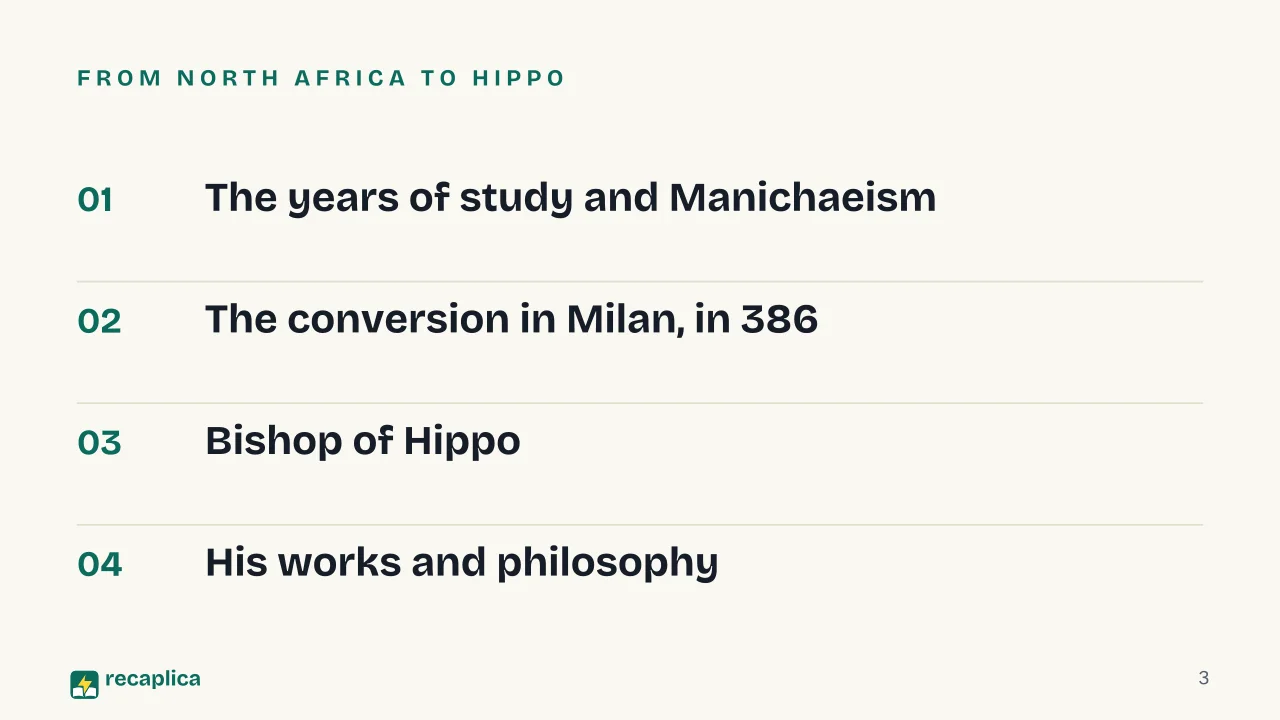
    Slide 1 of the presentation on Saint Augustine of Hippo: Saint Augustine of HippoSlide 2 of the presentation on Saint Augustine of Hippo: Born in Roman North Africa, 354 ADSlide 3 of the presentation on Saint Augustine of Hippo: From North Africa to HippoSlide 4 of the presentation on Saint Augustine of Hippo: Chapter 01: Before the faithSlide 5 of the presentation on Saint Augustine of Hippo: From 372 to 386Slide 6 of the presentation on Saint Augustine of Hippo: Chapter 02: The garden in MilanSlide 7 of the presentation on Saint Augustine of Hippo: Tolle lege, take and readSlide 8 of the presentation on Saint Augustine of Hippo: From baptism to deathSlide 9 of the presentation on Saint Augustine of Hippo: Chapter 03: The worksSlide 10 of the presentation on Saint Augustine of Hippo: Confessions and the City of GodSlide 11 of the presentation on Saint Augustine of Hippo: Chapter 04: His philosophySlide 12 of the presentation on Saint Augustine of Hippo: Is evil a force, or the absence of something?Slide 13 of the presentation on Saint Augustine of Hippo: Freedom, grace, faith and reason: Free will, Grace, Faith and reasonSlide 14 of the presentation on Saint Augustine of Hippo: Chapter 05: His legacySlide 15 of the presentation on Saint Augustine of Hippo: A legacy spanning centuriesSlide 16 of the presentation on Saint Augustine of Hippo: In which Roman province was Augustine born?Slide 17 of the presentation on Saint Augustine of Hippo: To learn more
    Flash10 slidesThe essential thread, to present in classFull17 slidesEvery chapter and the deeper detail

    Common myths

    • ✗ Myth Saint Augustine was a white European man.

      ✓ Reality Augustine was born in Thagaste, in Roman North Africa: his father was a pagan Roman, his mother a Christian Berber, and sources consider the family likely of Berber origin. He never describes his own physical appearance in his writings: in late antiquity, regional origin and spoken language mattered far more than any physical trait. Today's categories of "white" or "black" belong to a different historical era.

    • ✗ Myth Augustine was a saint from birth, with no life before his faith.

      ✓ Reality Before his conversion, Augustine spent about fourteen years with a woman never named in the Confessions, with whom he had a son, Adeodatus, and he followed Manichaeism for nine years. His conversion, in 386 in Milan, came at the end of a long path, not as a starting point.

    • ✗ Myth Augustine's conversion was caused by a single, sudden event.

      ✓ Reality The garden episode in Milan, in 386, came at the end of a long process of reading and reflection: that same year Augustine had also read some treatises by Plotinus translated into Latin, which helped prepare the ground. Philosophy, not only religion, played a part in that outcome.

    Mind map

    Drag the background to move around and the nodes to reposition them; use − and + to collapse and expand branches.
    Customize
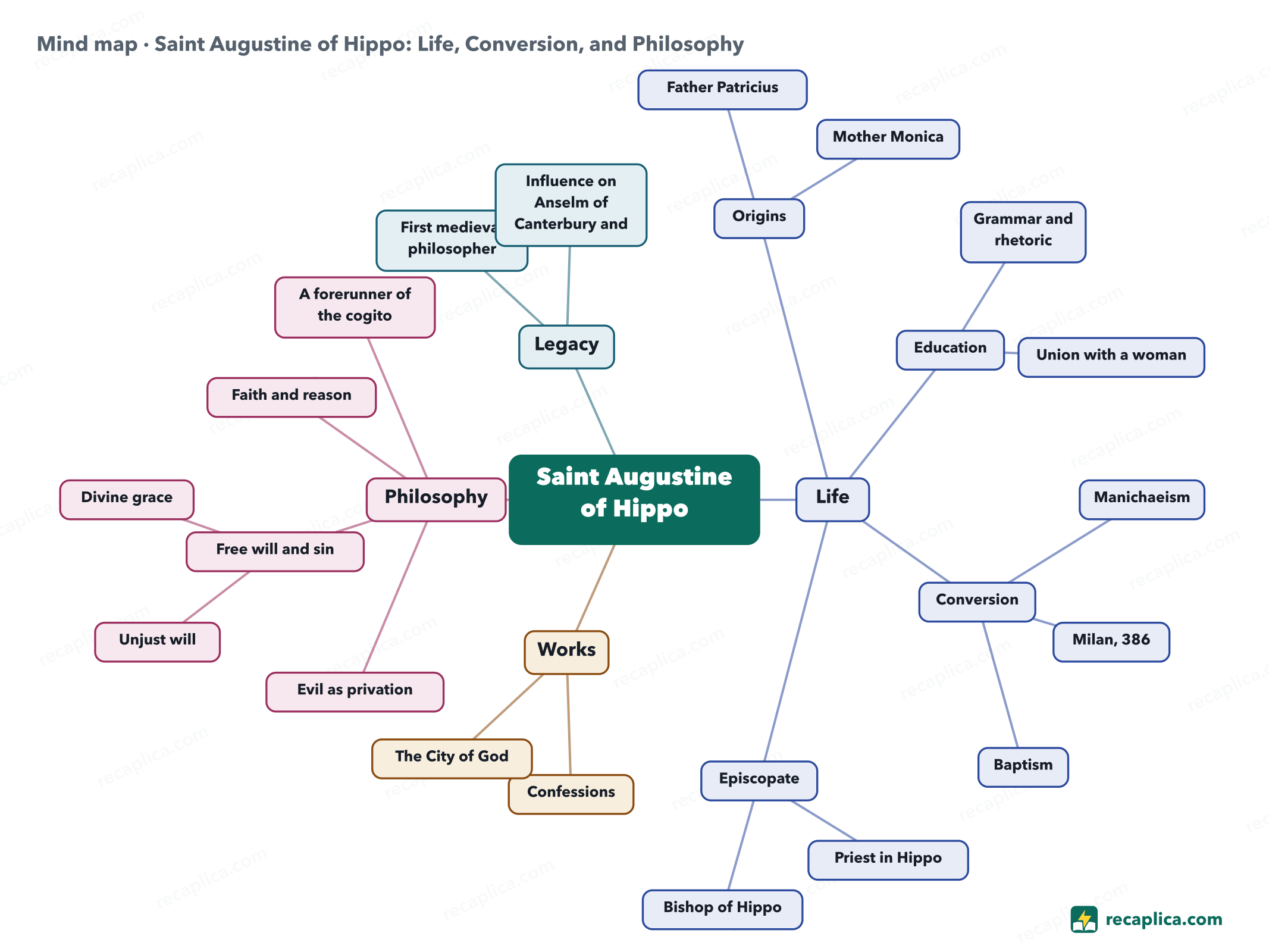
    Mind map: Saint Augustine of Hippo: Life, Conversion, and Philosophy
    • Saint Augustine of Hippo
      • Life
        • Origins Thagaste, Numidia, 354
          • Father Patricius Roman, pagan, baptized on his deathbed
          • Mother Monica Berber, devout Christian
        • Education
          • Grammar and rhetoric Madauros and Carthage
          • Union with a woman about 14 years together, their son Adeodatus
        • Conversion
          • Manichaeism adherent for nine years
          • Milan, 386 the garden episode, reading the Letter to the Romans
          • Baptism Easter 387, by Ambrose
        • Episcopate
          • Priest in Hippo 391
          • Bishop of Hippo 396, until his death in 430
      • Works
        • Confessions philosophical autobiography in thirteen books
        • The City of God written between 413 and 426
      • Philosophy
        • Evil as privation Neoplatonic view taken from Plotinus
        • Free will and sin
          • Unjust will definition of sin
          • Divine grace humanity's radical dependence on grace
        • Faith and reason fides quaerens intellectum
        • A forerunner of the cogito argument that error presupposes existence
      • Legacy
        • First medieval philosopher
        • Influence on Anselm of Canterbury and Thomas Aquinas

    Quiz: test yourself

    Answer the questions to check what you have learned: you get instant feedback and a short explanation.

    Grade 0/10 0/5
    1 In which Roman province was Augustine born?

    Augustine was born in Thagaste, in the Roman province of Numidia, corresponding to today's Souk Ahras, in Algeria.

    2 What event marked Augustine's conversion in 386?

    In Milan, prompted by a childhood chant ("tolle lege", take and read), Augustine opened and read a passage from the Letter to the Romans together with his friend Alypius.

    3 What role did Augustine hold in Hippo?

    Augustine was ordained a priest in Hippo in 391 and became bishop of the city in 396, remaining so until his death in 430.

    4 What does Augustine claim about evil, drawing on a Neoplatonic idea?

    Augustine adopted Plotinus's view that evil is not a substance in itself, but the privation or corruption of good.

    5 True or false: Augustine's Confessions are considered the first autobiography in the Western tradition.

    The Confessions, in thirteen books, with the first nine devoted to recounting Augustine's life, are often described as the first true autobiography in Western literature and have shaped the modern genre ever since.

    Answers: 1-A · 2-B · 3-A · 4-B · 5-A

    Flashcards

    Tap the card to flip it and check whether you remember the answer, then move to the next one.

    1 / 8

    Explain it in your own words

    The ultimate test: if you can explain it in simple words, you've truly understood it. Write your explanation, then compare it with the Recap.

    Your explanation is saved only on this device.

    Augustine of Hippo (354-430) was born in Thagaste, in Roman Numidia, to a Roman father and a mother, likely Berber, who was Christian. After a youth of rhetorical study and years following Manichaeism, he converted to Christianity in Milan in 386 and was baptized the following year. He became bishop of Hippo and wrote the Confessions and the City of God, two works that shaped Western philosophy. His thought blends the Neoplatonic tradition with Christianity, around the themes of free will, sin, and grace.

    Frequently asked questions

    Was Saint Augustine black?

    Augustine was African, born in Numidia into a family likely of Berber lineage: a Roman father, a Berber mother. In his writings he never discusses his own physical appearance, because in late antiquity what mattered was regional and linguistic origin, not a racial category in the modern sense: today's labels of "white" or "black" do not map directly onto him.

    What are Saint Augustine's Confessions?

    It is his best-known work: a text of philosophy written in autobiographical form, in thirteen books, the first nine devoted to Augustine's life before his conversion. Historians widely treat it as the earliest autobiography to survive from the Western tradition, and it has had a lasting influence on the genre.

    What is Saint Augustine's philosophy, in brief?

    Augustine combines elements of Neoplatonism (evil as the privation of good) with Christian theology: he defines sin as the will to pursue something unjustly, defends free will alongside humanity's radical dependence on divine grace, and proposes the principle that faith precedes reason in time but remains subordinate to it in value.

    Why is Augustine considered the first medieval philosopher?

    Because his thought marks the transition between late antique and medieval philosophy: philosophers such as Anselm of Canterbury and Thomas Aquinas drew on Augustinian arguments for their own ideas on the union of faith and reason.

    What connects Augustine to Descartes?

    Augustine observed that even someone mistaken in forming a thought still exists, because the mistake itself requires a subject to make it. This line of reasoning came more than a thousand years before Descartes's "cogito", even while sitting within a different philosophical framework.

    Sources

    • Stanford Encyclopedia of Philosophy - Augustine
    • Internet Encyclopedia of Philosophy - Augustine
    • World History Encyclopedia - Augustine of Hippo
    • Notre Dame Church Life Journal - on Augustine

    Every Recap goes through an independent review before publication.

    Every evening, the day's new Recaps on our Telegram channel. Join the channel →

    Keep learning

    • History Roman Education: How Rome's Three-Tier School System Worked Roman education grew out of an idea the Romans called humanitas: the belief that a full human being is shaped by learning, not born complete. The word humanus originally meant simply being kind to others, but by the 1st century BC Cicero had stretched it to cover liberal education too, what the Greeks called paideia. That idea took a very concrete shape in Roman schools, split into three stages: the litterator taught children to read and write, the grammaticus added Greek and the natural sciences, and the rhetor trained young men in public speaking and law. Very few girls went past the first stage, since most married while still in their teens. Read the Recap →
    • History Hellenistic Judaism: What It Was and How Philo Read the Bible with Plato Hellenistic Judaism is the name given to Jewish thought as it grew up inside Greek culture, and the Internet Encyclopedia of Philosophy treats Philo of Alexandria as the most elaborate case of that encounter in Alexandria. Philo was born in Alexandria in Egypt around 20 BCE, into a wealthy and prominent Jewish family, and he trained in Greek philosophy at a high level. He read Scripture on the assumption that the text carries a literal sense and, underneath it, an allegorical one. Out of that reading came the idea he is best known for, the Logos, the part of God that a human mind can actually reach. Read the Recap →
    • History Neoplatonism: What It Is, Who Founded It, and Why It Lasted Centuries Neoplatonism is the philosophical current born in the Greco-Roman world of late antiquity, between the mid-3rd and mid-7th centuries CE. It is commonly traced back to Plotinus, a philosopher born in Egypt around 204 or 205 CE, for whom all of reality flows from a single, absolute, simple principle: the One. Plotinus's work survives today thanks to the editorial work of his student Porphyry, who arranged it into the Enneads. The ideas spread through medieval Christian thought, from Augustine of Hippo to the Cappadocian Fathers, and resurfaced at the center of Florentine culture during the Renaissance with Marsilio Ficino. Read the Recap →

    recaplica

    Clear in 30 seconds, yours in 10 minutes.

    Recaps Mind maps Request a Recap Telegram channel Mind map maker Our method About Privacy & cookies Legal notes & terms of use

    © 2026 Recaplica · A project by Curi S.r.l. — VAT IT05472000750

    Statistics, only if you say so

    To learn which Recaps help most we would use Google Analytics, with aggregate, anonymous data. It starts only with your OK, and you can change your mind anytime. Privacy policy