|
recaplica
Hellenistic Judaism: What It Was and How Philo Read the Bible with Plato | ||||||||||||
| © 2026 Recaplica · recaplica.com — All rights reserved | ||||||||||||
Hellenistic Judaism: What It Was and How Philo Read the Bible with PlatoWhat to print Page numbers appear when printing with default margins. SlidesChoose a cut Flash10 slidesThe essential thread, to present in classFull14 slidesEvery chapter and the deeper detailBoth come with speaker notes. In 30 seconds quick readHellenistic Judaism is the name given to Jewish thought as it grew up inside Greek culture, and the Internet Encyclopedia of Philosophy treats Philo of Alexandria as the most elaborate case of that encounter in Alexandria. Philo was born in Alexandria in Egypt around 20 BCE, into a wealthy and prominent Jewish family, and he trained in Greek philosophy at a high level. He read Scripture on the assumption that the text carries a literal sense and, underneath it, an allegorical one. Out of that reading came the idea he is best known for, the Logos, the part of God that a human mind can actually reach. Key Points
Deep DiveHellenistic Judaism and Philo of AlexandriaHellenistic Judaism is the shorthand for Jewish thought that took shape inside Greek culture, and it flourished in Alexandria: the Internet Encyclopedia of Philosophy treats Philo as the most significant and philosophically developed case of the Judeo-Hellenistic syncretism that grew up there. The Jewish Encyclopedia reports that Philo was born around 20 BCE in Alexandria in Egypt and died after 40 CE. The Internet Encyclopedia of Philosophy also dates his life from about 20 BCE to 40 CE and adds that his family was wealthy and prominent in the Jewish community of the city. The Stanford Encyclopedia of Philosophy places his life between the last decades BCE and the middle of the first century CE, and notes that he received an advanced Greek education in philosophy and in the liberal arts. That schooling left its mark. According to the Jewish Encyclopedia, Philo had read the Greek philosophers widely and admired them, and his own learning came out of that reading: the tradition born in the cities of ancient Greece, from the pre-Socratic philosophers onward, was as familiar to him as the Bible. Two bodies of learning, then, and the work of making them agree. Then there is the politics. In 40 CE the Jewish community of Alexandria sent a delegation to the emperor Caligula, at the head of the Roman Empire, and Philo was one of its members, as the Jewish Encyclopedia records. The Stanford Encyclopedia of Philosophy specifies that the embassy followed a riot and that Philo went in person, leaving a written account, the Legatio ad Gaium. The philosopher who wrote about the Logos found himself in Rome, speaking for his own community. Two readings of one textPhilo does not take the Bible for a collection of stories and nothing further. The text, for him, works on two levels. His method rests on an idea the Jewish Encyclopedia sums up as the double meaning of Scripture, literal and allegorical. That entry identifies allegory as the instrument with which Philo tries to fuse and harmonise Greek wisdom and the Jewish religion inside his own philosophy. The Stanford Encyclopedia of Philosophy shows how it works on the legal texts: Philo takes them at face value, as rules to be observed, and reads them at the same time as symbols of intelligible realities, things grasped by thought. The operation comes with a stated limit, since the Stanford entry reports that for Philo the hidden meanings of the biblical texts are reached only with God’s help. The interpreter does not get wherever he likes on skill alone.
The Logos, as much of God as thought can reachFor the Stanford Encyclopedia of Philosophy the Logos is not God, because God in full stays out of reach of the human mind; the Logos is whatever of the divine essence turns out to be understandable to a human being. It works as a threshold, the point where the unbounded becomes legible. The Internet Encyclopedia of Philosophy looks at the Logos from the side of how the world runs and describes it as the bond holding all the parts of the universe together, with a function like the one it serves in the human soul towards the body. In the pages of that encyclopedia the Logos receives two further descriptions, as the thoughts of God taken together and as those same thoughts hypostatised so that a physical world could be created. Philo’s vocabulary then picks up an image from Jewish life: the Jewish Encyclopedia notes that the Logos is compared to the high priest, an office that after the Exile had become the real centre of the Jewish state. The ground Philo builds onA synthesis on this scale does not appear from nowhere. The Internet Encyclopedia of Philosophy observes that Philo’s thought reflects the Platonism of his time, a version into which Stoic doctrine and Stoic words had already entered, carried by philosophers such as Antiochus of Ascalon. The allegorical method comes from a distance as well, since the IEP sets it within a Greek tradition of reading stories allegorically and offers Theagenes of Rhegium as a precedent. Even Philo’s boldest claim had circulated before him. The Stanford Encyclopedia of Philosophy recalls that earlier Jewish thinkers, Aristobulus in particular, had already proposed a Plato inspired by Moses. Philo picks the claim up and pushes it to its limit, because the Internet Encyclopedia of Philosophy notes that he ends by presenting Moses as the first sage and the teacher of the early Greek thinkers. The Internet Encyclopedia of Philosophy adds one more thing about that body of work: the concepts Philo worked out went on to shape Hellenistic readings of Jewish messianic thought. Slide deckSlides ready to download and make your own in PowerPoint or Google Slides, with speaker notes. Pick the Flash cut or the Full one.     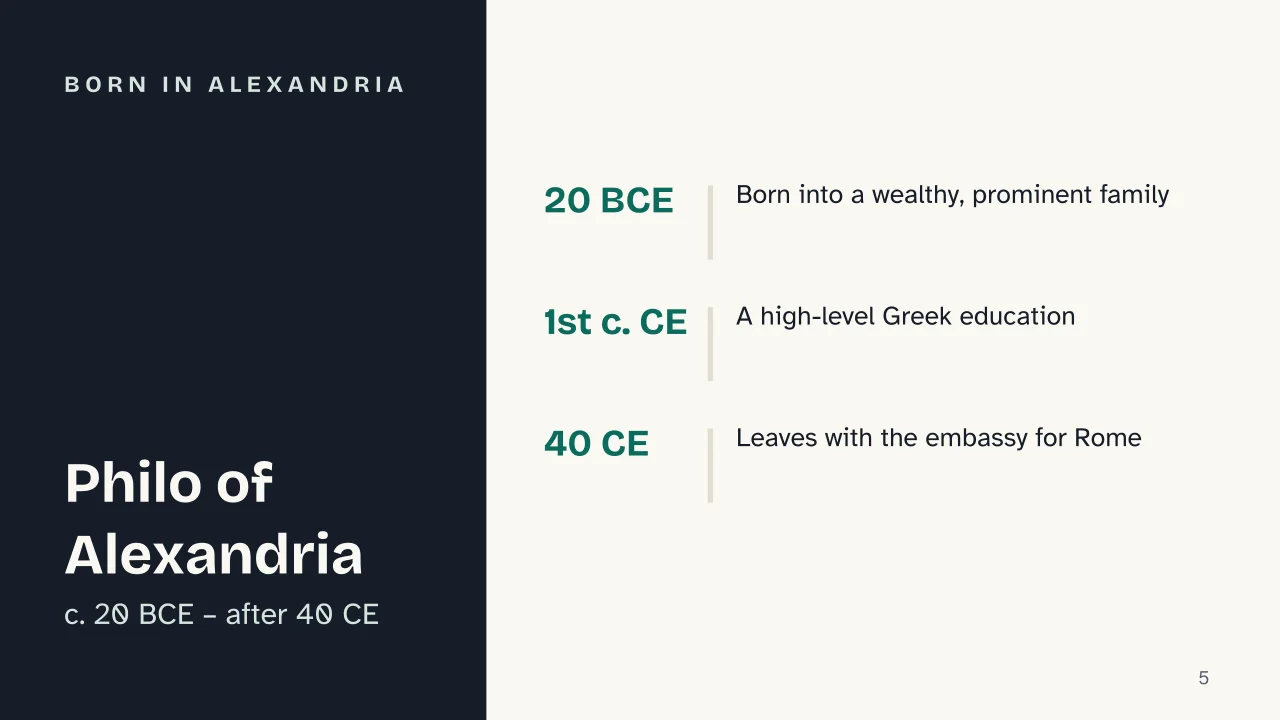 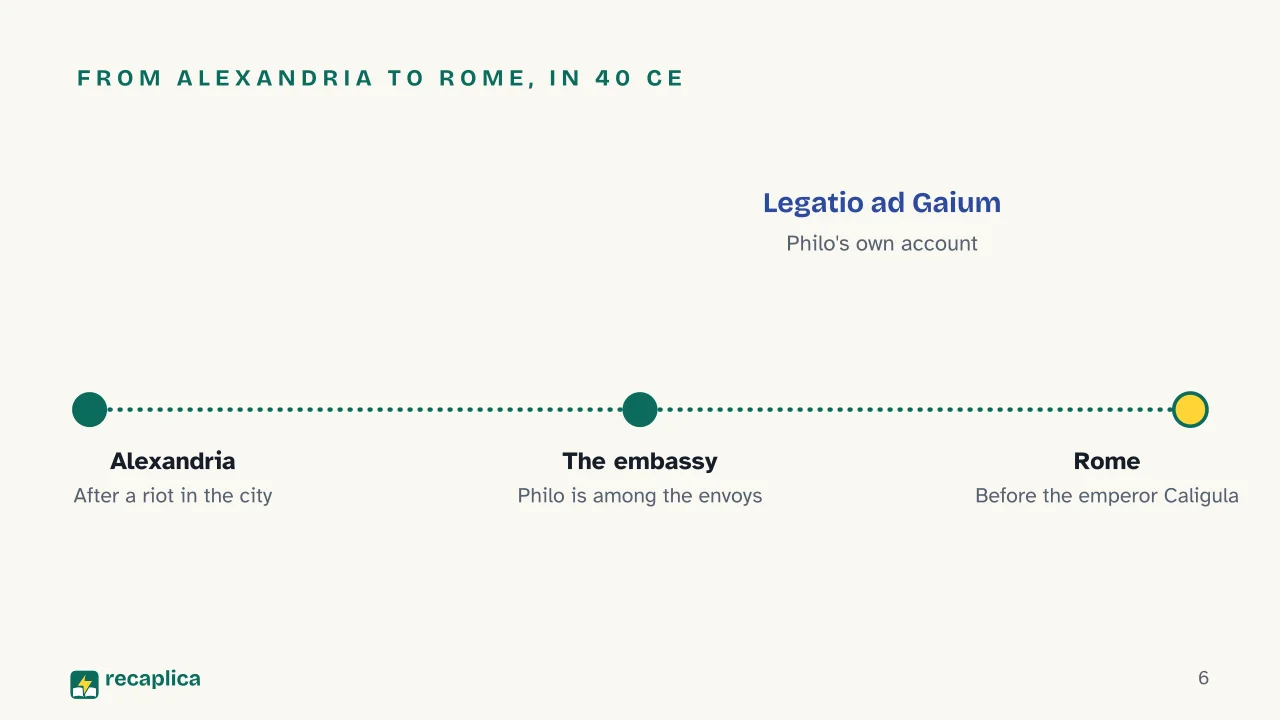  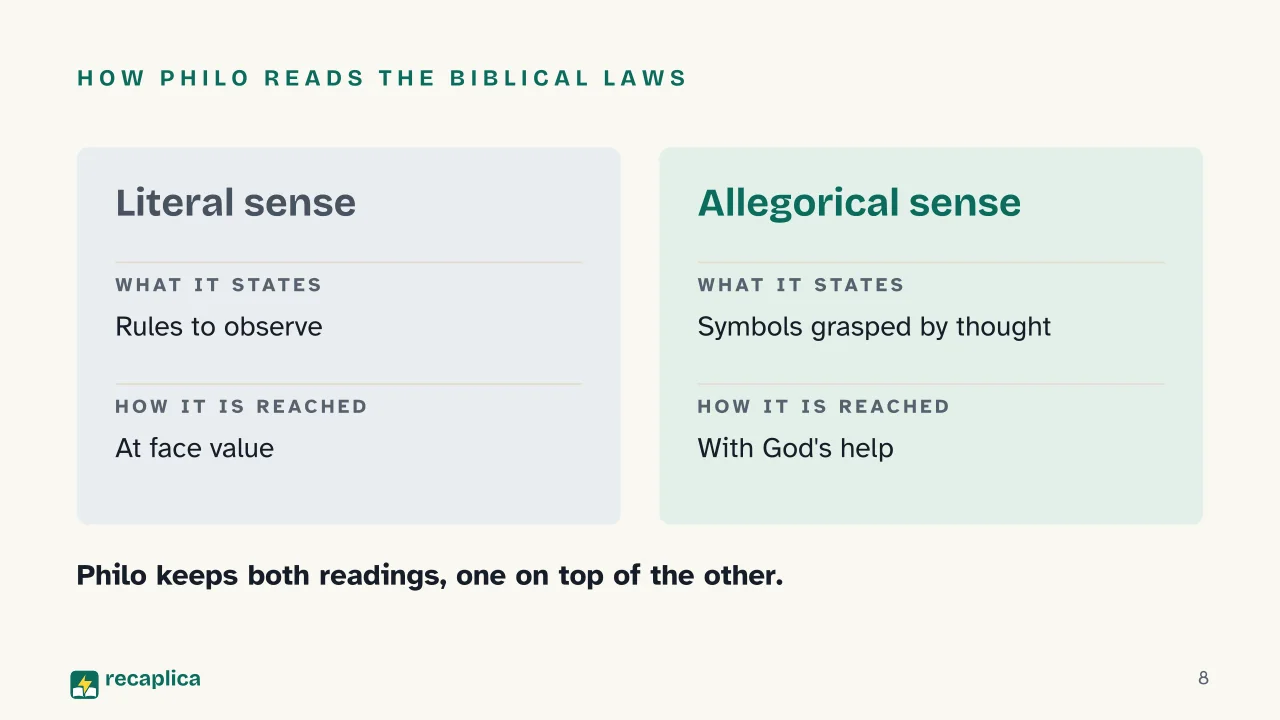  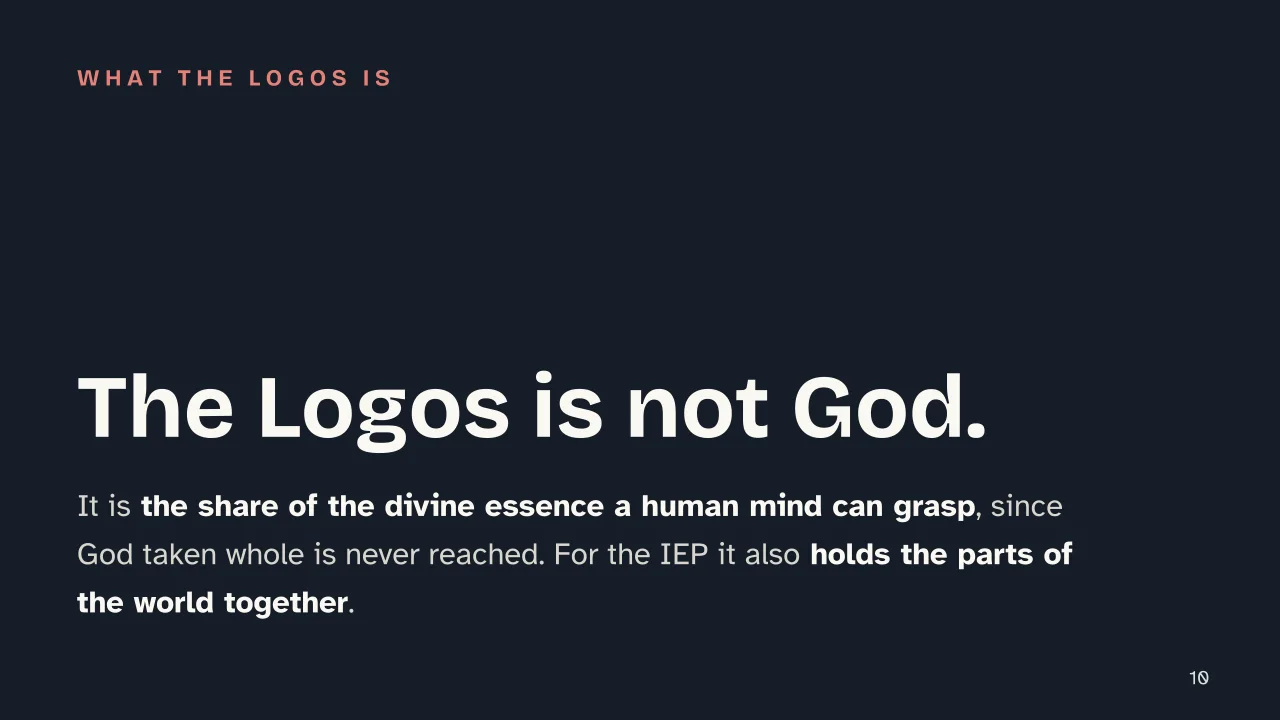  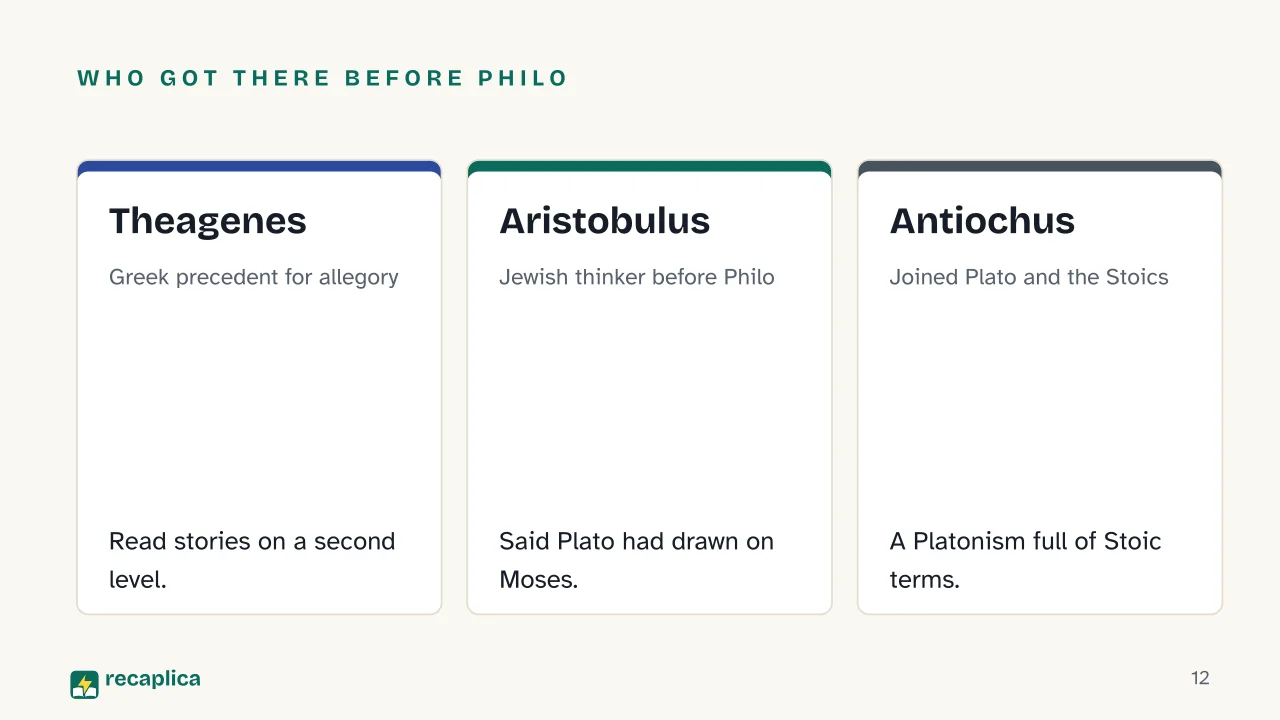 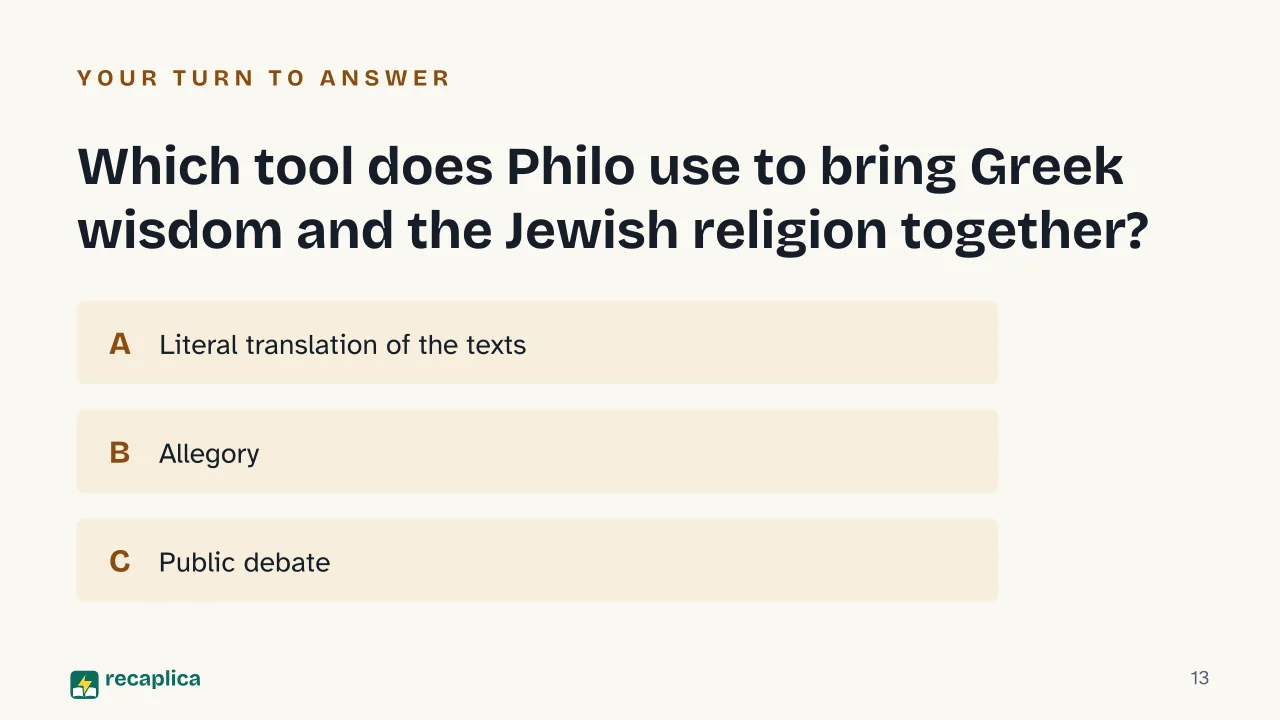  Common myths
Mind mapDrag the background to move around and the nodes to reposition them; use − and + to collapse and expand branches. 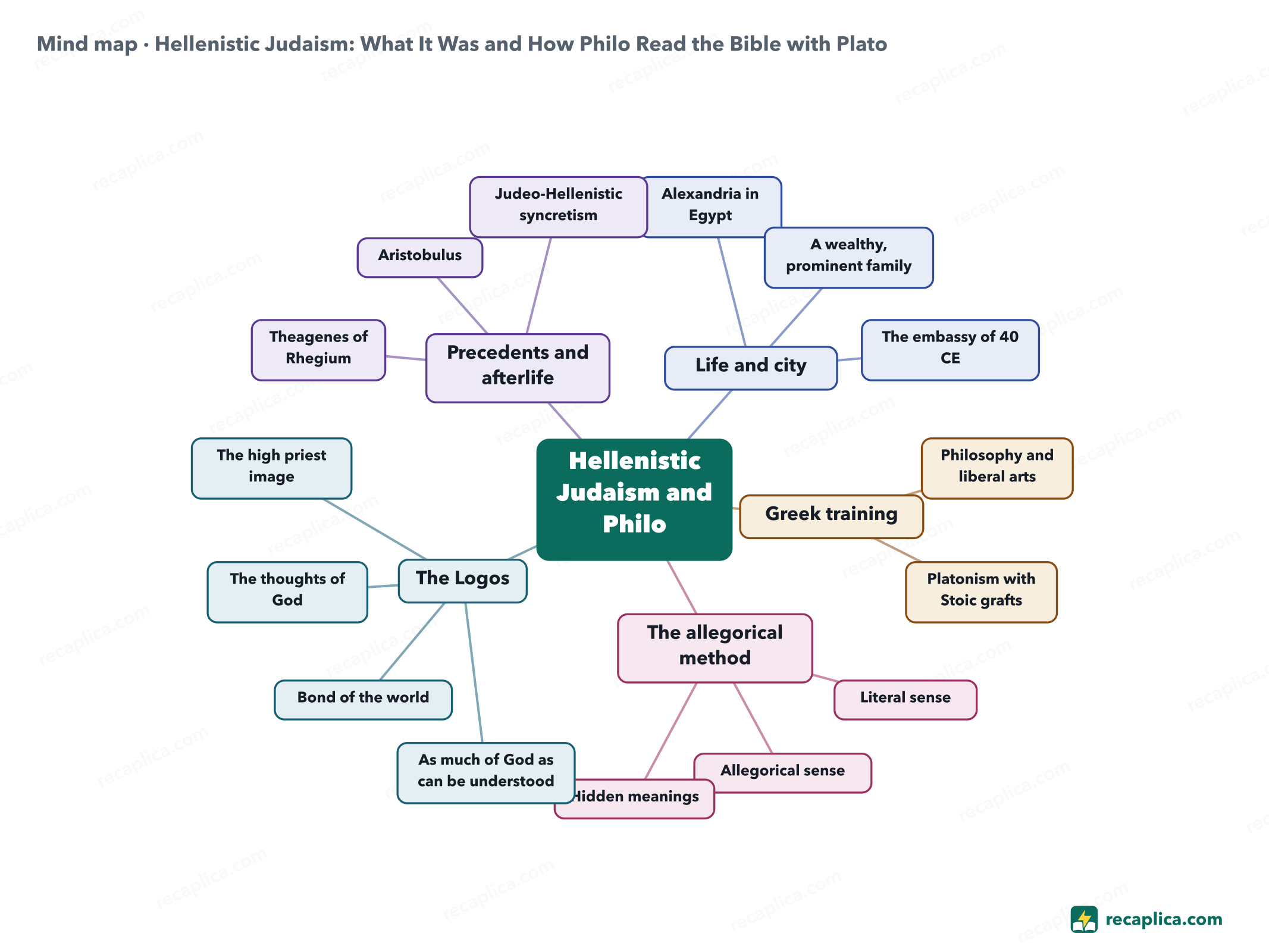
Quiz: test yourselfAnswer the questions to check what you have learned: you get instant feedback and a short explanation. Grade 0/10 0/5
FlashcardsTap the card to flip it and check whether you remember the answer, then move to the next one. 1 / 7 Explain it in your own wordsThe ultimate test: if you can explain it in simple words, you've truly understood it. Write your explanation, then compare it with the Recap. Your explanation is saved only on this device.
Frequently asked questionsWhat was Hellenistic Judaism?It is the name for Jewish thought shaped by the Greek culture it lived inside, and Alexandria in Egypt was its great workshop. The Internet Encyclopedia of Philosophy calls Philo the most significant case of the Judeo-Hellenistic syncretism that flourished there, and the most philosophically developed one. What is Philo's Logos, in simple terms?It is the part of God a human being can reach by thinking. God in full stays out of range, while the Logos is whatever of that essence becomes understandable. The Internet Encyclopedia of Philosophy adds two further descriptions, the thoughts of God taken together and those same thoughts hypostatised for the sake of physical creation. Did Philo invent the allegorical reading of the Bible?No. His method belongs to a Greek tradition of allegorical reading, for which the Internet Encyclopedia of Philosophy cites Theagenes of Rhegium as a precedent. Philo applied it to the Jewish texts, and for the Jewish Encyclopedia allegory is the tool with which he joined Greek wisdom and the Jewish religion. Was Philo Jewish or Christian?He was Jewish, and he belonged to the Jewish community of Alexandria in Egypt. In 40 CE he was part of the embassy that community sent to Rome, to the emperor Caligula, after a riot in the city. How is Philo related to Plato?Philo writes inside the Platonism of his time, already mixed with Stoic doctrine. He then turns the usual chronology around and presents Moses as the first sage of all, teacher of the early Greeks. Every Recap goes through an independent review before publication. |