|
recaplica
Plato: The Theory of Forms and the Ideal State, Summary | ||||||||||||
| © 2026 Recaplica · recaplica.com — All rights reserved | ||||||||||||
Plato: The Theory of Forms and the Ideal State, SummaryWhat to print Page numbers appear when printing with default margins. SlidesChoose a cut Flash10 slidesThe essential thread, to present in classFull15 slidesEvery chapter and the deeper detailBoth come with speaker notes. In 30 seconds quick readPlato, an Athenian philosopher born around 427-428 BCE and died around 347-348 BCE, studied under Socrates and later founded the Academy in Athens, in 387 BCE. In his dialogues he draws a line between the world we know through the senses, changeable and imperfect, and the Forms, stable and perfect realities that only reason can grasp: the allegory of the cave, in Book VII of the Republic, tells exactly this passage from ignorance to knowledge. In the Republic, written in the middle period of his work, he applies the same idea to running a city: only someone who knows the Forms, the philosopher, is fit to lead the state, while warriors and producers have other jobs. For Plato, justice is harmony among the parts of the soul in a person, and among the classes in a city. Key Points
Deep DiveWho Plato wasPlato was born in Athens on an uncertain date: around 427-428 BCE, according to the Stanford Encyclopedia of Philosophy and Treccani. He died, in turn, around 347-348 BCE, at about eighty or eighty-one years old, reports the Internet Encyclopedia of Philosophy. He studied under Socrates, who died in 399 BCE, when Plato was about twenty-eight. After his travels in Italy and Sicily, around age forty, he returned to Athens and founded the Academy, a school outside the city walls, roughly a mile away: the name comes from a sacred grove dedicated to the hero Academus. Treccani dates the founding to 387 BCE. This was the Athens of ancient Greece and its poleis, fertile ground for this kind of philosophical and political reflection.
The allegory of the cave and the theory of FormsFor Plato, the world we grasp through the senses falls short of full reality, while a more perfect realm exists, populated by entities he calls Forms, or Ideas: goodness, beauty, equality, unity, sameness, and change are among those discussed in his dialogues. According to the Internet Encyclopedia of Philosophy, everything we perceive is merely a copy of that eternal and changeless realm of Forms. Two sticks are equal not because equality resides in them, but because they “participate” in the character of the Form of Equality. This same passage, reports the Internet Encyclopedia of Philosophy, is also the subject of the allegory of the cave, told in Book VII of the Republic: someone chained among the shadows inside a cave takes those shadows for the whole of reality, until he steps out into the light and discovers the true world outside; the first state corresponds to someone who stops at sensible appearances, the second to knowledge of the Forms. Under the doctrine of recollection, the Forms already dwell in our soul before birth: Treccani calls anamnesis this act of remembering that, for Plato, amounts to knowing. When the freed prisoner goes back into the cave to teach those who stayed behind, Treccani reads into this the philosopher’s political task in the city: the metaphysics of Forms already sets up, in this gesture, the argument about the state that follows in the Republic. The Republic and the philosopher-kingScholars place the Republic in the middle period of Plato’s work, roughly between 380 and 360 BCE, and its aim is to define justice and then use it as a model for a just state. In the ideal city, which the Stanford Encyclopedia of Philosophy calls Kallipolis, Plato distinguishes three classes: rulers and auxiliaries, together called guardians, and a producing class made up of craftspeople and farmers. Per Treccani, only this last class keeps private property and its own family; warriors and rulers, instead, share goods, and in Plato’s design, also women. It is a direct contrast with property rights and their limits, covered in another Recap.
The Stanford Encyclopedia of Philosophy reports that, in the Republic’s argument, the philosopher has access to the unchanging essence of the Forms beyond mere appearances: that is why Plato designates him as the city’s ideal ruler, the philosopher-king. This access still stays restricted: the study of dialectic, the Republic’s highest form of knowledge, is reserved for the best among the guardians, and not before age fifty. Compared with the types of government described in civics textbooks, power in Plato’s city rests on philosophical knowledge, rather than birth or elections. Justice in the soul and in the cityThe Republic’s psychology rests on dividing the soul into reason, an impulsive element (spirit), and appetite. Plato defines individual justice as the condition in which these three parts each do their own job, without encroaching on the other two; the same thing happens in the city among the three social classes. The good the ideal city’s rulers must aim at, reports the Stanford Encyclopedia of Philosophy, is the unity of the city itself. Slide deckSlides ready to download and make your own in PowerPoint or Google Slides, with speaker notes. Pick the Flash cut or the Full one.     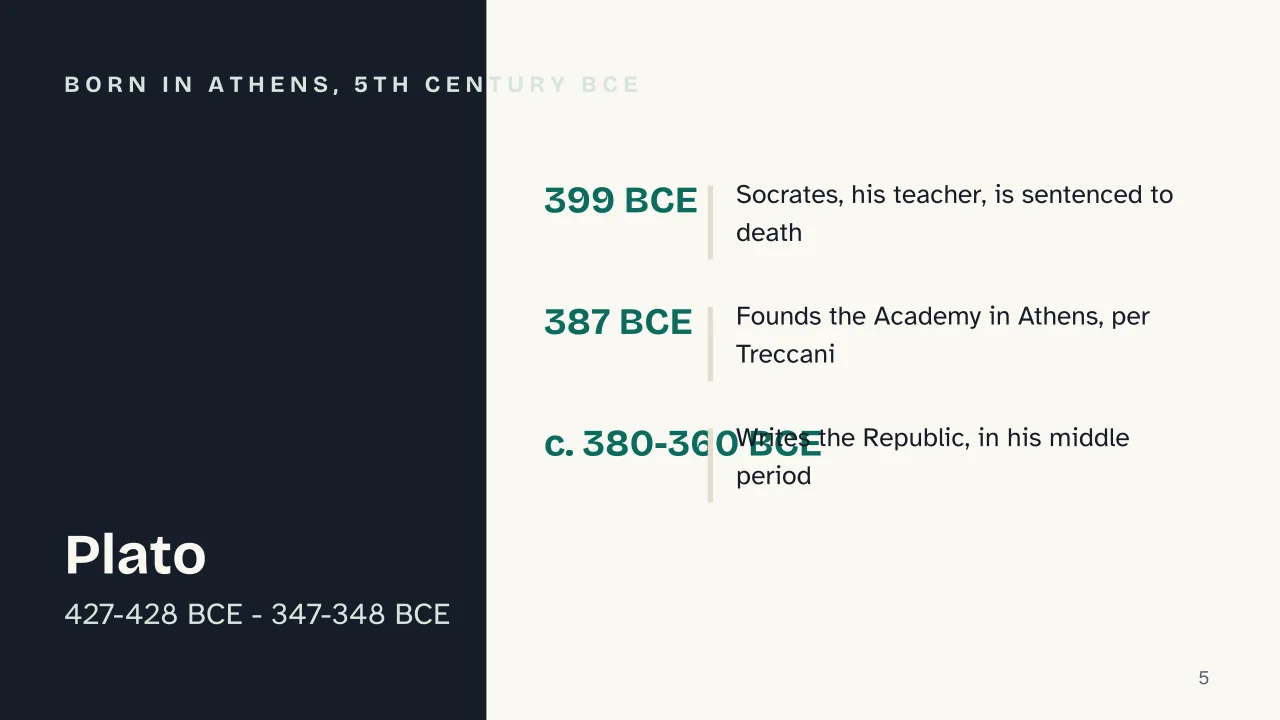  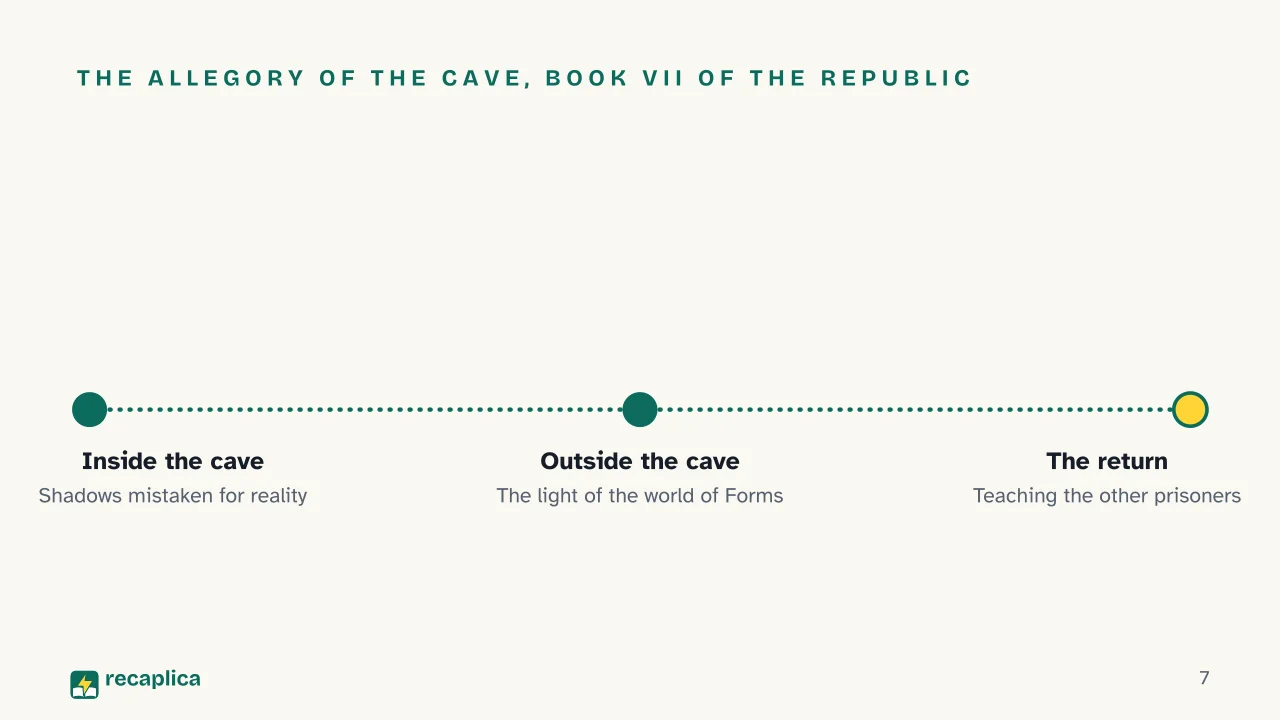   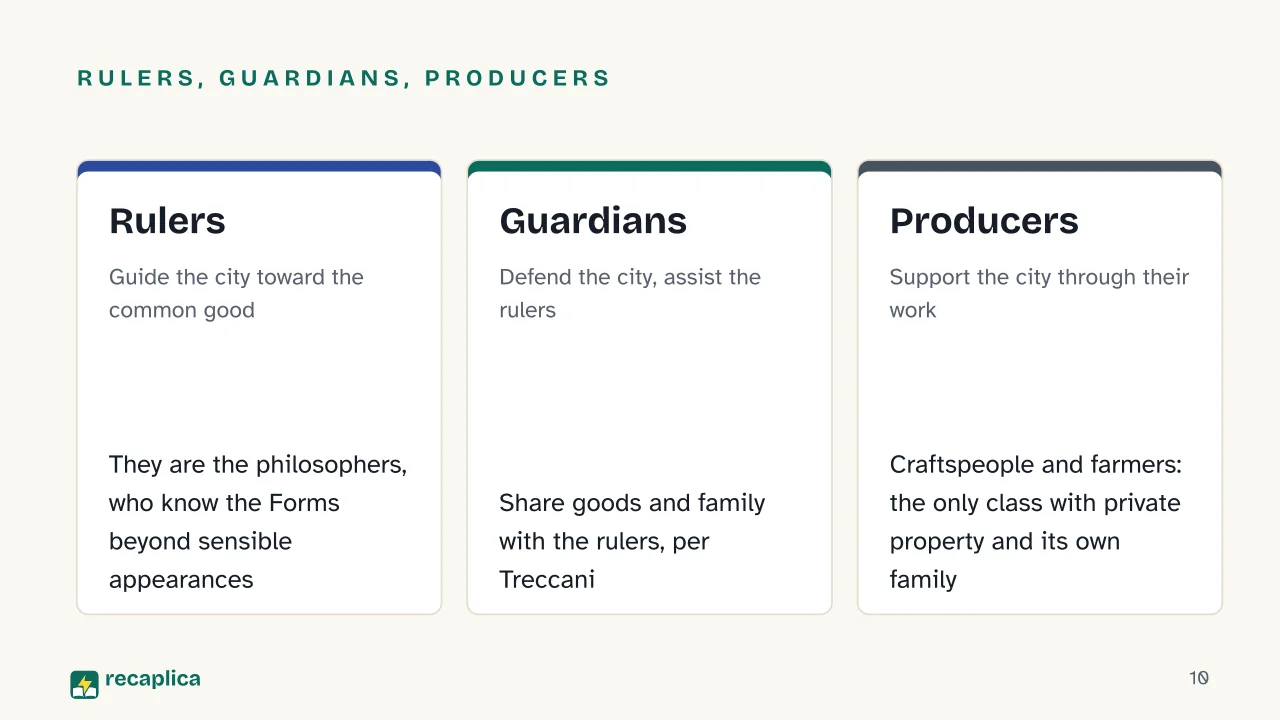  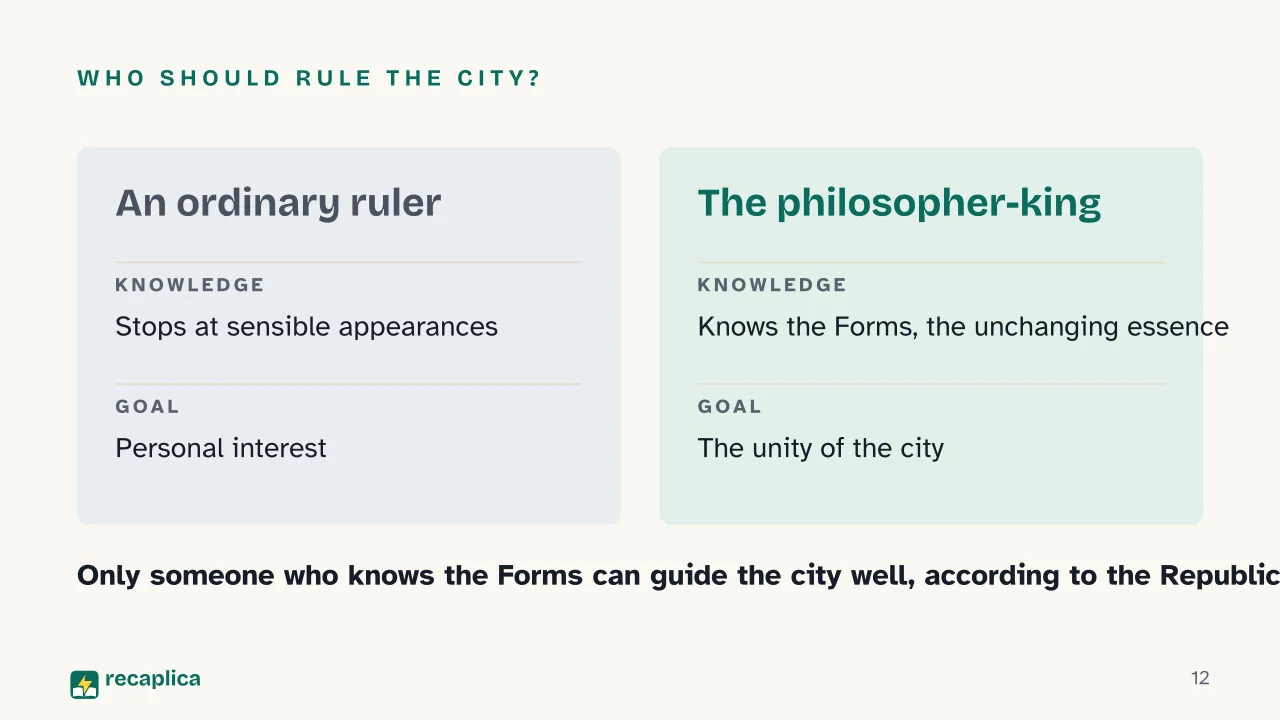 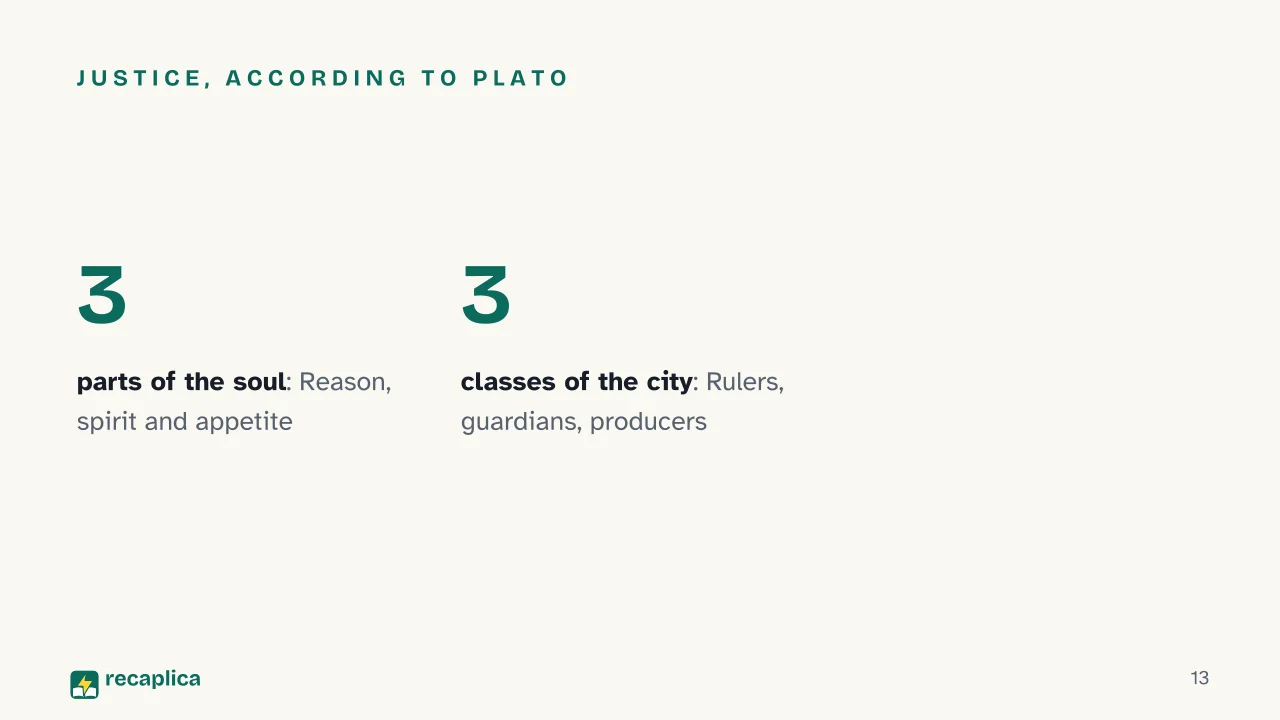 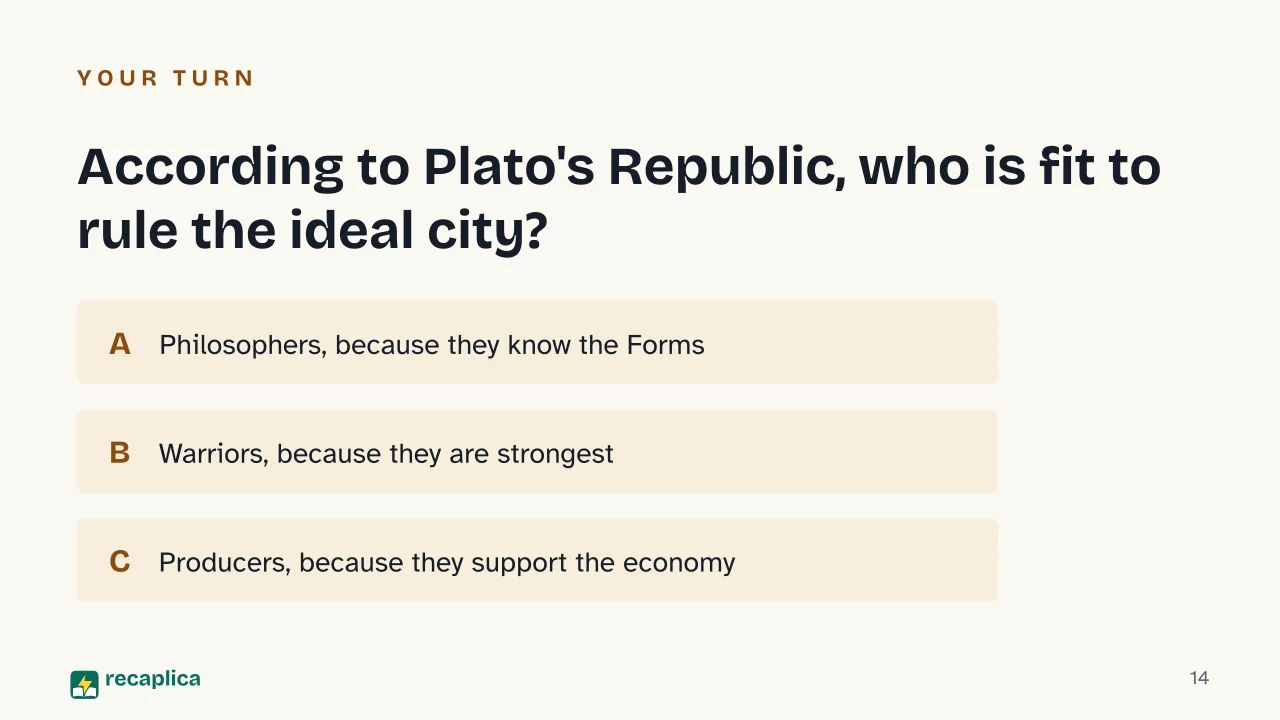  Common myths
Mind mapDrag the background to move around and the nodes to reposition them; use − and + to collapse and expand branches. 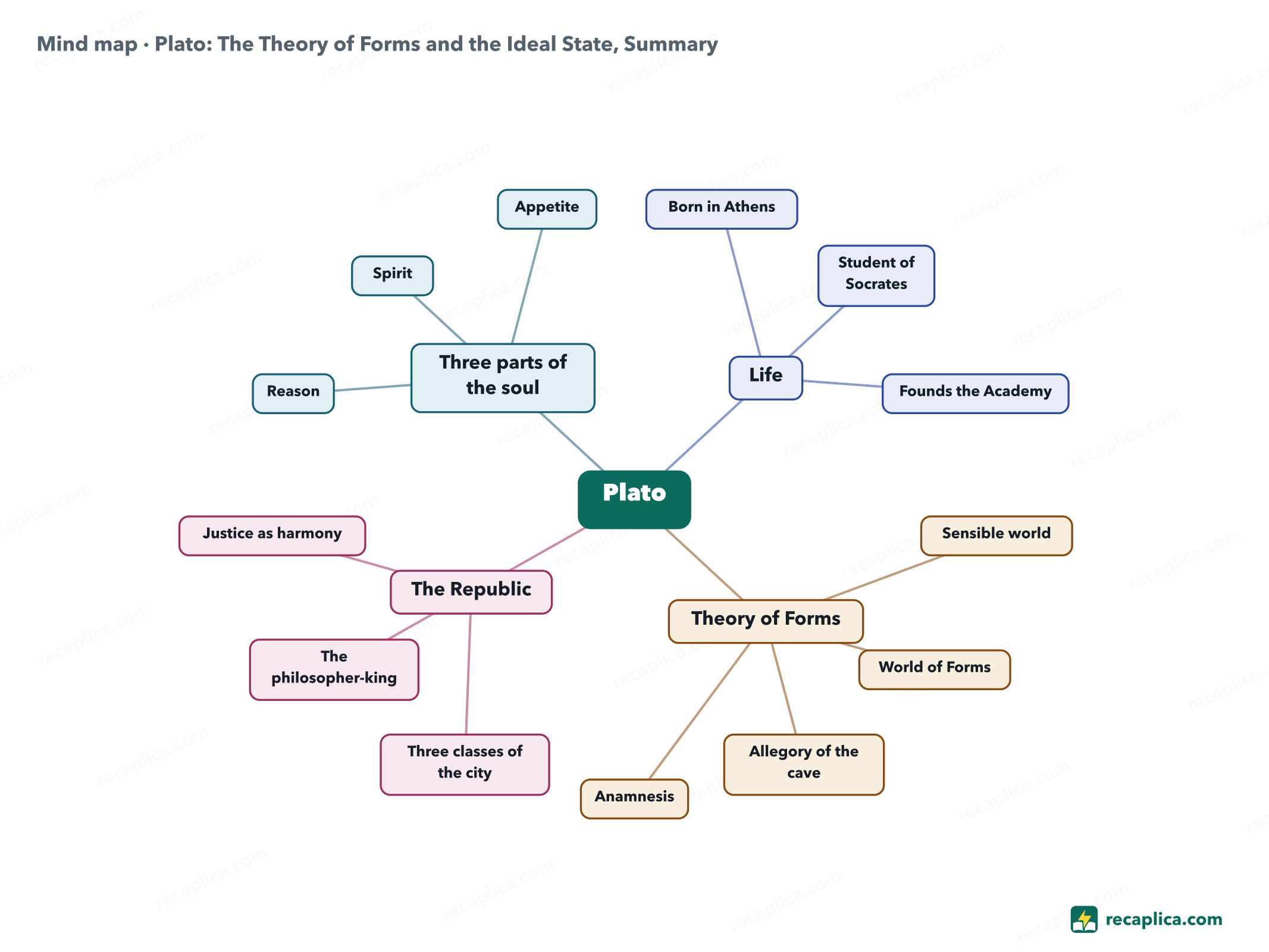
Quiz: test yourselfAnswer the questions to check what you have learned: you get instant feedback and a short explanation. Grade 0/10 0/5
FlashcardsTap the card to flip it and check whether you remember the answer, then move to the next one. 1 / 8 Explain it in your own wordsThe ultimate test: if you can explain it in simple words, you've truly understood it. Write your explanation, then compare it with the Recap. Your explanation is saved only on this device.
Frequently asked questionsWho was Plato?Plato was an Athenian philosopher, born around 427-428 BCE and died around 347-348 BCE; he studied under Socrates and founded the Academy in Athens, in 387 BCE per Treccani. What is Plato's theory of Forms?For Plato there exist Forms, or Ideas: stable and perfect entities such as goodness, beauty or equality, the objects of true knowledge; the things we touch and see, instead, always change and are only imperfect copies, linked to their Form by resemblance, not by a nature of their own. What does the allegory of the cave mean?It is a story from Book VII of the Republic: a prisoner stays chained among the shadows inside a cave, convinced they are the whole of reality, until the day he sees the light outside; when he goes back to tell the others, Treccani reads into this the image of the philosopher taking on a political task. What is the philosopher-king in Plato's Republic?It is the ruler chosen from among the philosophers because, the Stanford Encyclopedia of Philosophy argues, they are the ones with access to the essence of things, not just its appearances, and so know how to guide the city better than anyone else. What are the three classes of the ideal city according to Plato?Rulers, guardians (the rulers' auxiliaries) and producers, that is craftspeople and farmers: for Treccani, this last class is the only one of the three that keeps a home and a family, while the other two live in common. Every Recap goes through an independent review before publication. |