|
recaplica
Ancient Greece: What Is a Polis and How Athenian Democracy Began | |||||||||||||||||||||||||||
| © 2026 Recaplica · recaplica.com — All rights reserved | |||||||||||||||||||||||||||
Ancient Greece: What Is a Polis and How Athenian Democracy BeganWhat to print Page numbers appear when printing with default margins. SlidesChoose a cut Flash10 slidesThe essential thread, to present in classFull17 slidesEvery chapter and the deeper detailBoth come with speaker notes. In 30 seconds quick readAncient Greece was never a single state, but hundreds of independent city-states, the poleis, each with its own laws and its own form of government. In Athens, through two separate rounds of reform, Solon and later Cleisthenes opened the way to democracy, a government in which citizens decided the laws themselves by meeting in assembly. That same world of rival cities also produced philosophy, theatre, a large share of Western literature and the Olympic Games. It is a legacy still taught in schools, not least because so many of its words (polis, democracy, theatre) have reached us intact. Key Points
Key figures
Deep DiveThe polis: a city that was also a stateHistorians conventionally translate “polis” as “city-state”, but the Greek word covers something more precise: an urban centre, often walled from the 7th century BC onward (except at Sparta), with a citadel on high ground, the acropolis, and a public square for trade and civic life, the agora. Around the city stretched the farmland, the chora: together, city and countryside made up the polis. There is no exact date or place of birth for the polis. According to the Treccani encyclopedia entry on the subject, it is a long, complex process that starts with the dissolution of the Mycenaean kingdoms and closes in the 7th century BC. The 8th century BC was long treated as the crucial period of its formation, but more recent evidence — growing numbers of settlements, the invention of the Greek alphabet — has led some scholars to push the start of the process back to the 9th, perhaps the 10th century BC. A firmer marker comes around 625 BC, when an inscription found at Dreros, on Crete, provides the first precise written record of a community’s public offices: it is among the oldest surviving evidence of institutional rules in any polis.
Hundreds of poleis, no single political modelThe best-documented poleis in history — Athens, Sparta, Corinth, Thebes, Syracuse, Aegina, Rhodes, Argos, Eretria and Elis — tell only part of the story: most of the rest are known only in fragments, or not at all. Their size, too, was almost always modest: 75% of poleis covered less than 100 km² of territory, and poleis with at least 10,000 adult male citizens can be counted, across the whole of Greek history, on one hand. Sparta, the largest, covered about 8,500 km²: an exception, not the rule. Politically, too, there was no single model. From one polis to another, government could take the form of tyranny, oligarchy or democracy; in earlier periods, in many cities, political power stayed concentrated among a few aristocratic families, with a growing gap between wealthy and poor. Athens is the best-documented case of a move toward democracy, not a snapshot of the whole Greek world. Polis versus monarchy: a basic choiceThere is a distinction worth holding onto, because it is the one historians use to place the polis among the forms of government of antiquity: unlike neighbouring great civilizations — pharaonic Egypt, covered in the Recap on ancient Egypt, Persia, and later Rome before it became a republic and then an empire — the Greek polis rejected the rule of a single man. Power never fully rested in the hands of one sovereign: it stayed, to varying degrees depending on the city, with the community of citizens.
For the Greeks, in other words, the political organization of citizens was enough to make the idea of a state complete: it did not require, as in the modern concept of a nation-state, a precisely delimited territory. From Solon to Cleisthenes: democracy in two stagesIn Athens, the path to democracy did not run through a single event, but through two reforms nearly a century apart, each with a different job to do. In 594 BC the lawgiver Solon carried out a reform that went down in history as the seisachtheia, literally the “shaking off of burdens”: he cancelled all the debts of Athenian citizens, freed the hektemoroi (farmers who had lost their personal freedom over debt), tore down the horoi — the boundary markers on mortgaged land — and returned the land to its rightful owners. From that point on, he also banned using farmland or personal freedom as collateral for a debt. For Encyclopaedia Britannica, these reforms are the foundation on which Athenian democracy was later built, because they extended legal rights and reduced economic inequality among citizens. Solon, however, did not introduce democracy as a system: he laid the groundwork. It was Cleisthenes, an Athenian statesman who served as chief archon in 525-524 BC, who took the next step. In 508 BC he allied with the popular Assembly against the nobility and imposed a radical reform: from then on, a citizen’s political standing would rest on residence (the deme), not on membership of a clan or family. He reorganized the entire citizen body into 10 new tribes, each made up of people drawn from across Attica, and built the new Council of Five Hundred on those same tribes, bringing the whole territory into the political process for the first time. In 507 BC he gave this system the name it has kept ever since: “demokratia”, “rule of the people”, from demos (“the people”) and kratos (“power”). That is why he is regarded as the true founding father of classical Athenian democracy, even though Solon had made all citizens equal before the law a century earlier.
How Athenian democracy workedAt the heart of the system was the Ecclesia, the popular assembly: up to 6,000 citizens gathered on the Pnyx hill, at least once a month, probably 2-3 times, and voted by a show of hands, following the majority. It was chaired by nine proedroi, chosen by lot and barred from holding the post twice; the assembly decided on military and financial matters, laws, political trials, treaties and ostracism, and every citizen had the right to speak (parrhesia).
Beneath the Ecclesia sat the Boule, the Council of Five Hundred: 500 citizens chosen by lot, serving one-year terms with a maximum of two non-consecutive terms each, representing the 139 demes of Attica grouped into ten tribes. Its job was to set the assembly’s agenda, oversee the administration and, in moments of crisis, decide on its own. The Boule’s executive committee was the prytany: 50 citizens from a single tribe at a time, rotating for a tenth of the year, with a chairman (the epistates) chosen by lot each day and based at the Bouleuterion, on the agora. The judicial system followed the same logic of drawing lots: the courts, the dikasteria, counted 6,000 jurors in total, and magistrates (the archai) were chosen annually by lot with a mechanism using coloured tokens, the kleroterion. A citizen judged to have grown too powerful for the city’s safety could finally be removed by ostracism: a secret vote written on a piece of broken pottery, the ostrakon, which meant 10 years of exile. The first recorded ostracism dates to around 487 BC, the last to around 417 BC. In some periods, to encourage participation among those who could not afford to leave their work, pay was introduced for attending the assembly or serving on juries, meant as reimbursement rather than profit, which was expressly forbidden. A minority decided, not “the people” as a wholeThis is where the picture needs correcting, against the more common image. The adult male population with Athenian citizenship is estimated at between 30,000 and 60,000, a range that varies considerably depending on the period and should not be read as a fixed number over time. Of these citizens alone, historians estimate that only around 3,000 actively took part in political life, and that an elite of barely a hundred people — the wealthiest, the most skilled speakers — effectively dominated public debate in the assembly. Women, enslaved people and resident foreigners, the metics, stayed outside political citizenship: only male citizens aged 18 and over could vote in the assembly, while holding public office or serving on juries required a minimum age of 30. Even a system built on direct participation, it should be added, was neither perfect nor unchanging: in 411 BC a coup installed a brief oligarchic government, with democracy restored in 403 BC; in 406 BC the assembly voted to execute the six generals who had won the battle of Arginusae; in 399 BC it sentenced the philosopher Socrates to death. Historians cite these episodes precisely to recall that Athenian democracy was a real experiment, with its own crises, not an infallible mechanism. Direct democracy versus representative democracy: two different thingsThis is the second distinction teachers often ask about in tests, and it is trickier than it looks. In Athens, citizens with voting rights decided laws and policies themselves, meeting in person in assembly and controlling every stage of the process directly: this is what is meant by direct democracy. Modern democracies, including those born centuries later out of revolutions such as the French Revolution, work differently: they are representative, meaning citizens elect representatives who decide on their behalf in parliaments or elected assemblies, rather than gathering in person to vote on every single law. The two differences add up: alongside the mechanism (direct participation versus delegation through elections), the breadth of citizenship also changes. In Athens, voting rights stayed reserved to a minority of free men; modern representative democracies, by contrast, tend toward universal suffrage, extended regardless of gender or wealth. A system with 6,000 people seated on the Pnyx and a system with millions of voters casting ballots are, in other words, two different answers to the same question: who decides, and how. Philosophy, theatre and letters: a lasting legacyThat same world of rival cities produced much of the intellectual vocabulary still in use. Even before the great classical era, the pre-Socratic philosophers — Thales of Miletus, active around 585 BC, followed by Anaximander, Anaximenes, Pythagoras, Xenophanes, Heraclitus — tried to explain the natural world without relying only on myth: Thales is described as engaged in a kind of inquiry we would today recognize as scientific, while Democritus and Leucippus were the first to propose the idea of a universe made of atoms. The classical period of philosophy, between 480 and 323 BC, brought the three best-known names: Socrates (circa 469-399 BC), who taught in the Athenian agora without ever writing anything down; Plato (427-347 BC), his student, who founded the Academy in Athens around 380 BC; and Aristotle (384-322 BC), in turn Plato’s student, who from 343 BC tutored Alexander the Great. The same classical period saw theatre flourish: tragedy, tied to the names of Aeschylus (circa 525-456 BC), Sophocles and Euripides, and the comedy of Aristophanes (circa 460-380 BC). In literature, Greek tradition traced its own roots back to Homer, active between roughly 800 and 700 BC as the author of the Iliad and the Odyssey — works that, centuries later in Rome, would give Virgil the model for the Aeneid — and to Hesiod, his contemporary; later, Herodotus wrote his “Histories”, datable to around 430-415 BC. Art, too, evolved over centuries: from the distinctive sculptural style of the Archaic period (800-500 BC) to the large-scale use of marble around 650 BC, to the “red-figure” pottery style that emerged around 530 BC. The Parthenon, built between 447 and 432 BC to house the statue of Athena, with architects Ictinus and Callicrates working under the artistic direction of Phidias, remains, alongside the Parthenon Marbles and the Discobolus, one of the most cited examples of that classical realism. The Olympic Games and the ties between poleisPoleis stayed independent of one another politically, judicially and religiously, but they did not live in isolation: they formed alliances such as the Delian League and the Peloponnesian League, fought together against common non-Greek enemies, as in the Persian Wars of the 5th century BC, and shared pan-Hellenic religious festivals. The most prestigious of these festivals were the Olympic Games, held at Olympia, in the western Peloponnese, in honour of Zeus, the supreme god of Greek religion. The first edition dates to 776 BC; from then on the Games were held every four years, for a total of 293 consecutive editions, until 393 AD, when the Roman emperor Theodosius I decreed an end to all pagan cult practices, the Games included. The very first event was the stadion race, one stadium-length of about 192 metres, won by Coroebus of Elis, the first recorded champion in Greek history: from that victory onward, each edition was conventionally named after that year’s stadion winner, giving historians the first accurate chronology of the ancient Greek world. Spectators numbered in the tens of thousands, drawn in part by the sacred truce, the ekecheiria: initially one month long, later extended to three, during which war and the carrying of weapons were forbidden in the territory of Elis. Alongside the Olympics there were smaller pan-Hellenic festivals, at Delphi, Isthmia and Nemea, but none ever reached the same prestige. A model that outlived its own political twilightIn the 4th century BC, the conquests of Alexander the Great and his successors carried the polis model well beyond the borders of Greece, into the provinces of the Macedonian world; under Roman rule, with the expansion of the Roman Empire, poleis survived as urban centres but lost their political independence, remaining subordinate to imperial authority while keeping a civic and cultural role. The political form of the polis, in other words, faded long before the ideas, words and works it had produced: “polis”, “democracy”, “philosophy” and “theatre” are all Greek words that reached, through Latin, the languages we speak today. Slide deckSlides ready to download and make your own in PowerPoint or Google Slides, with speaker notes. Pick the Flash cut or the Full one.     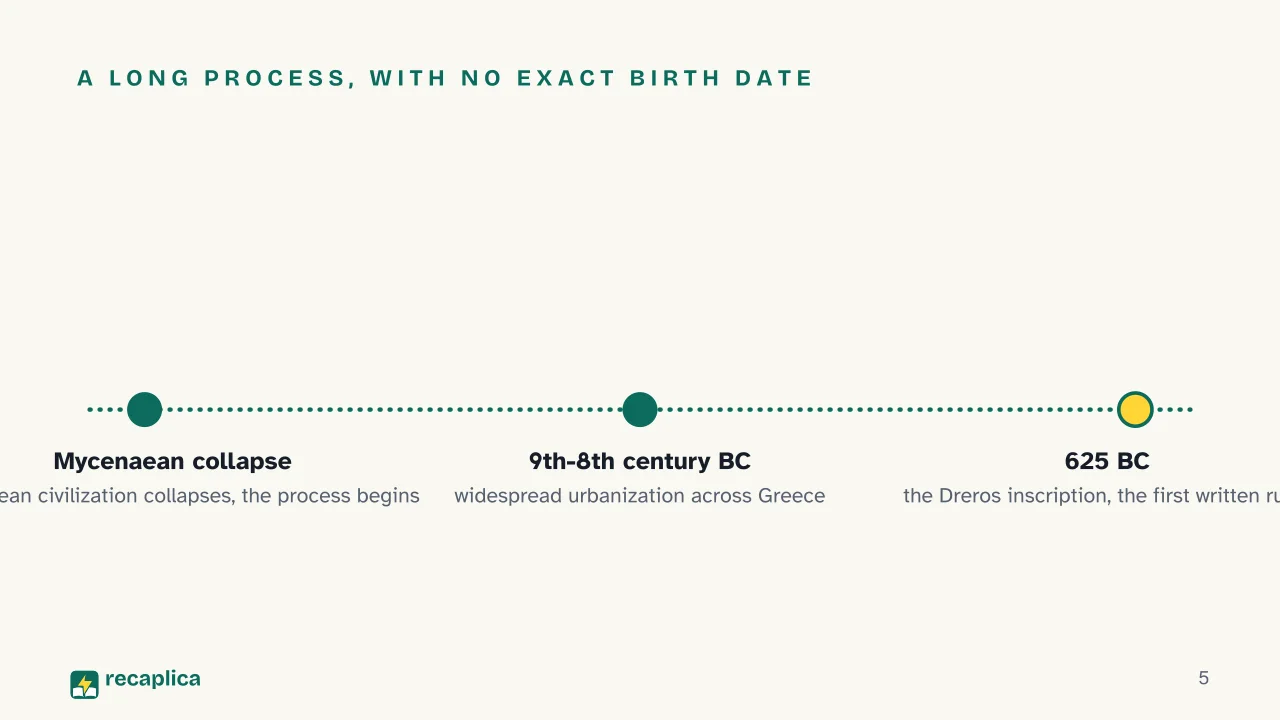 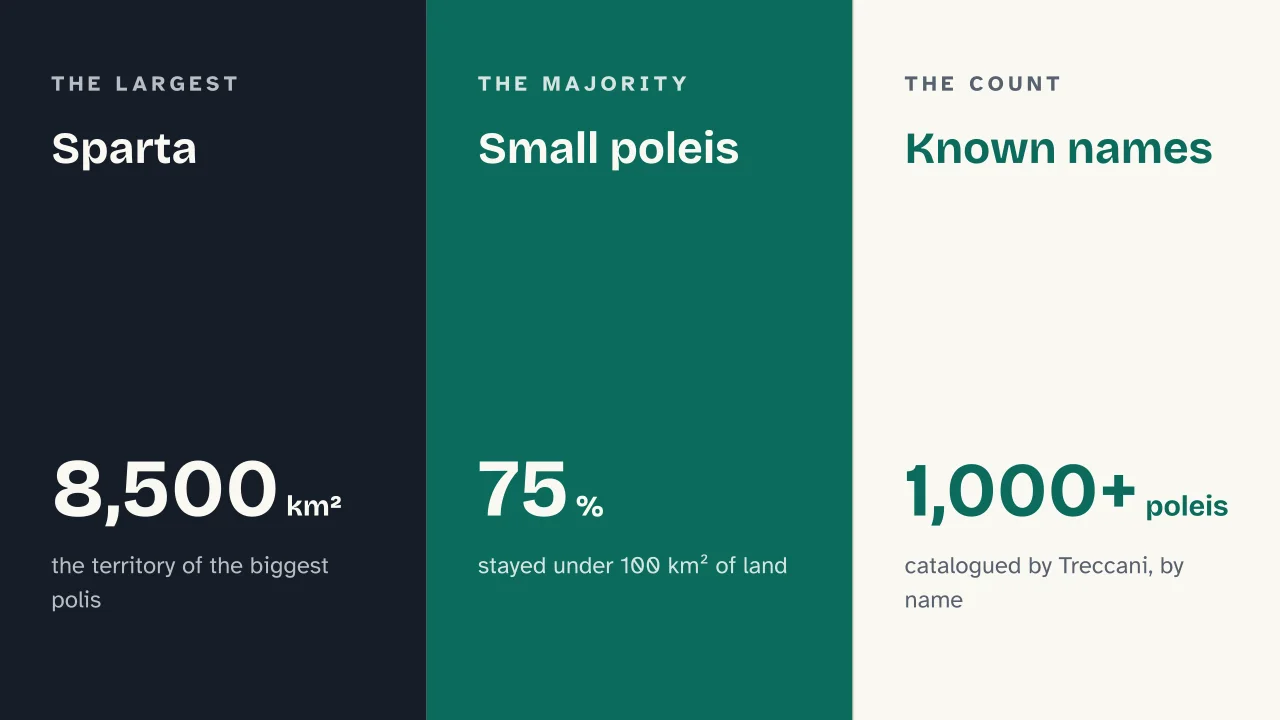  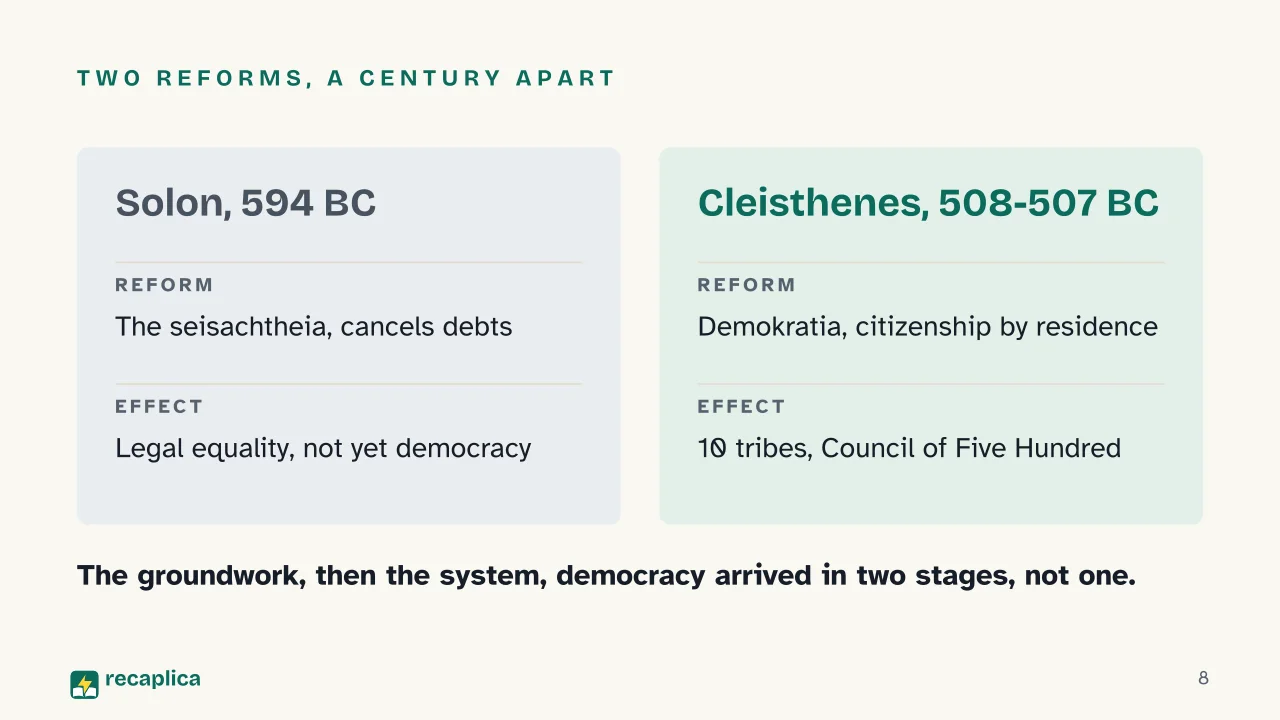 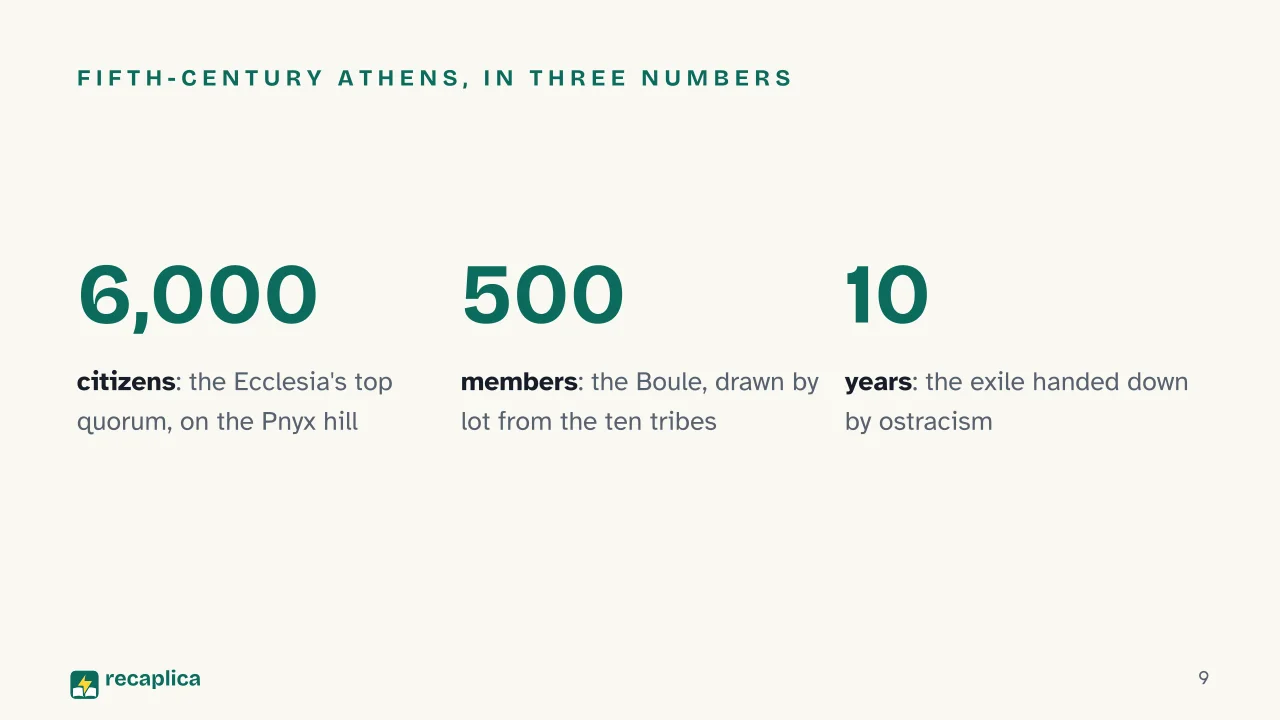  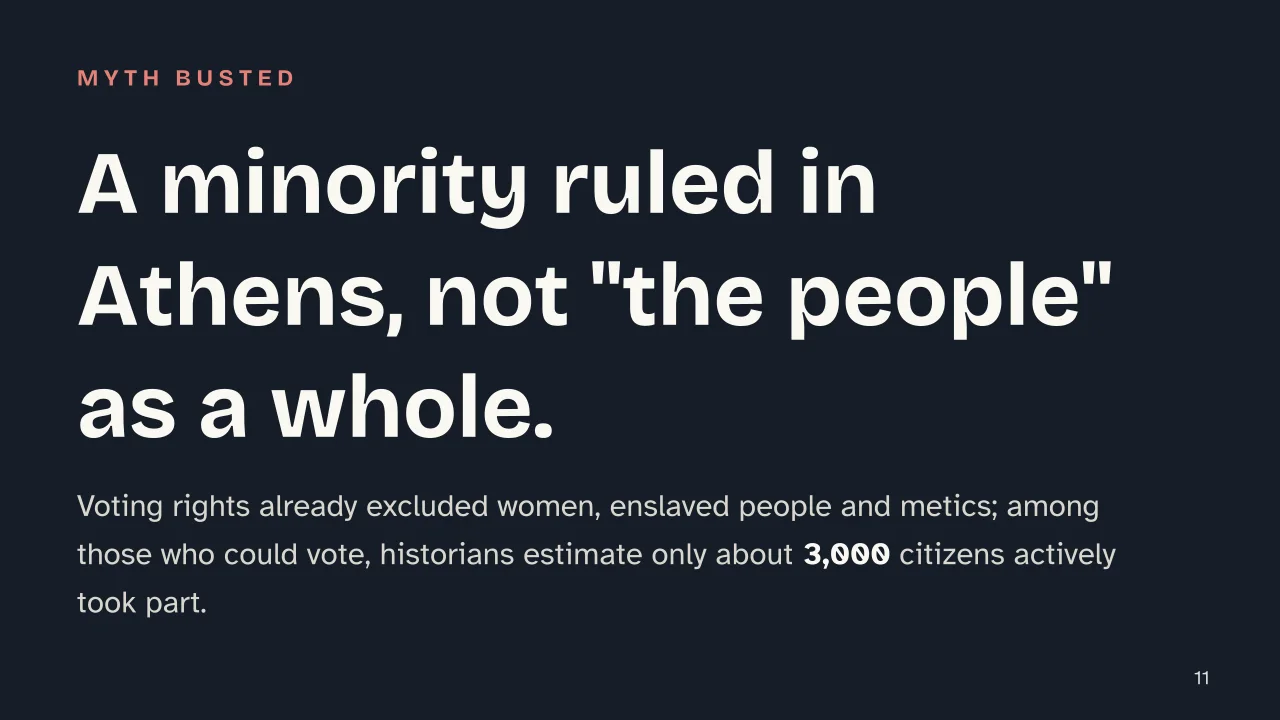   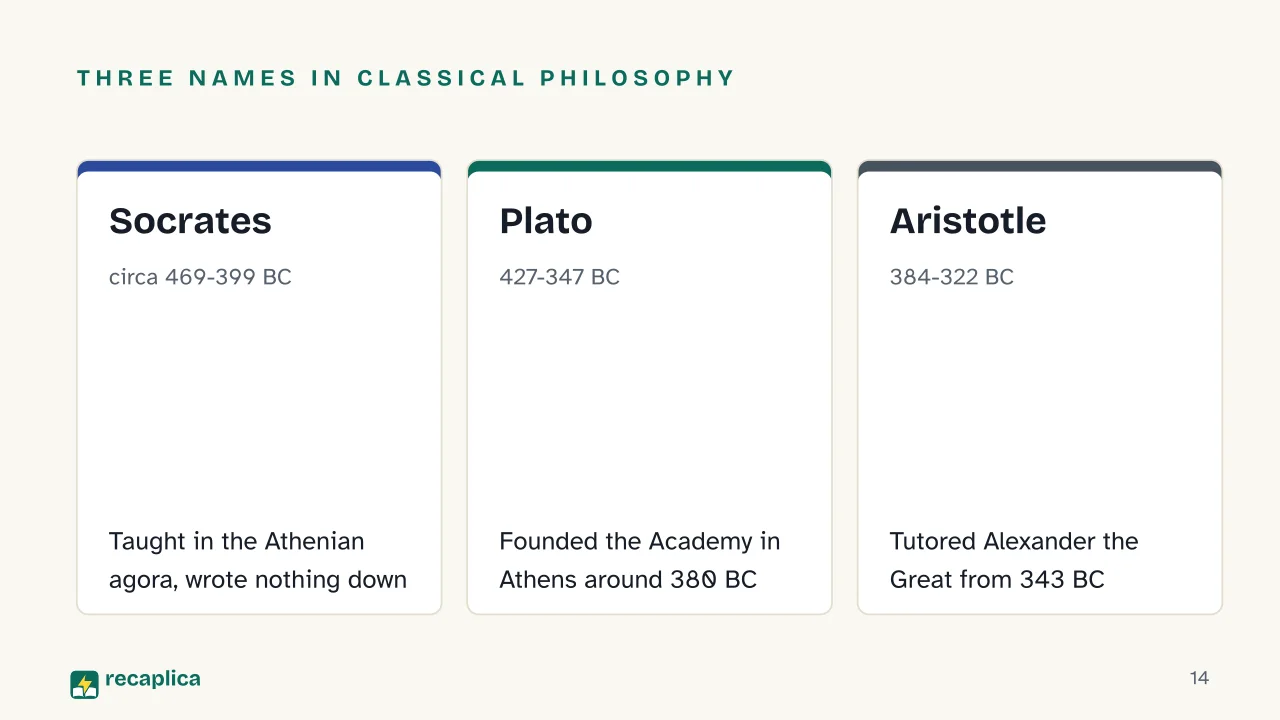 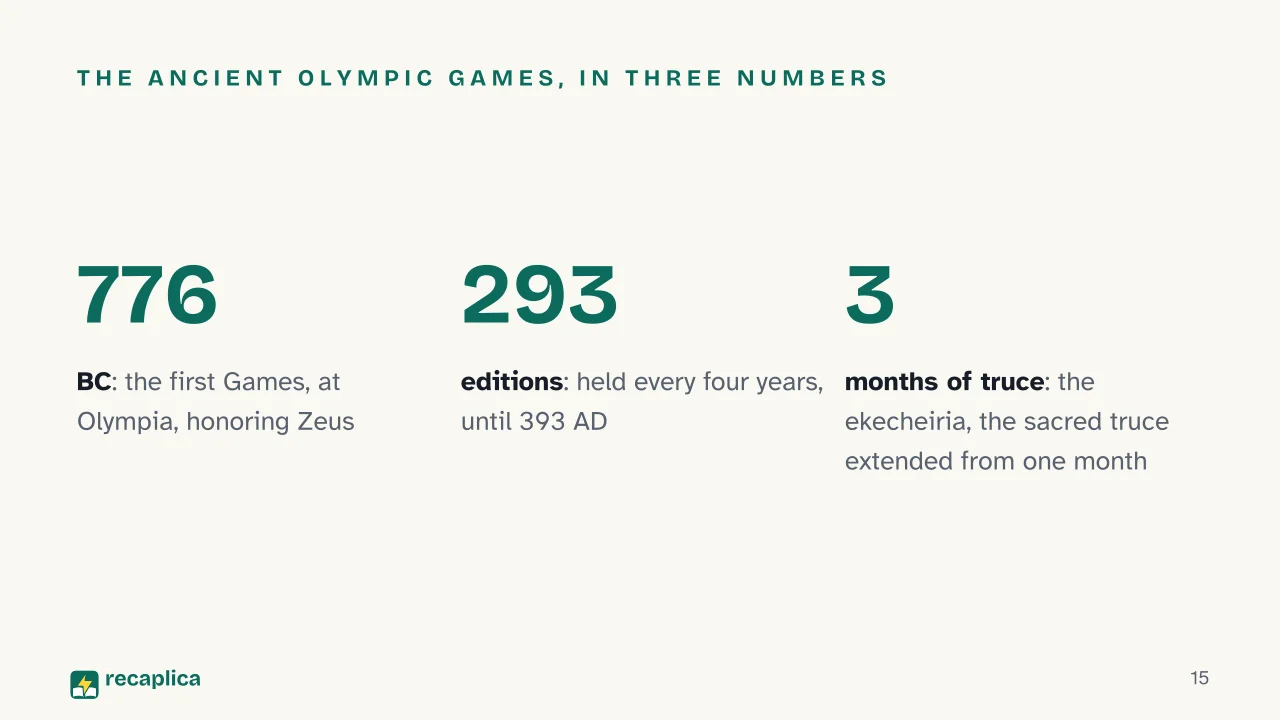 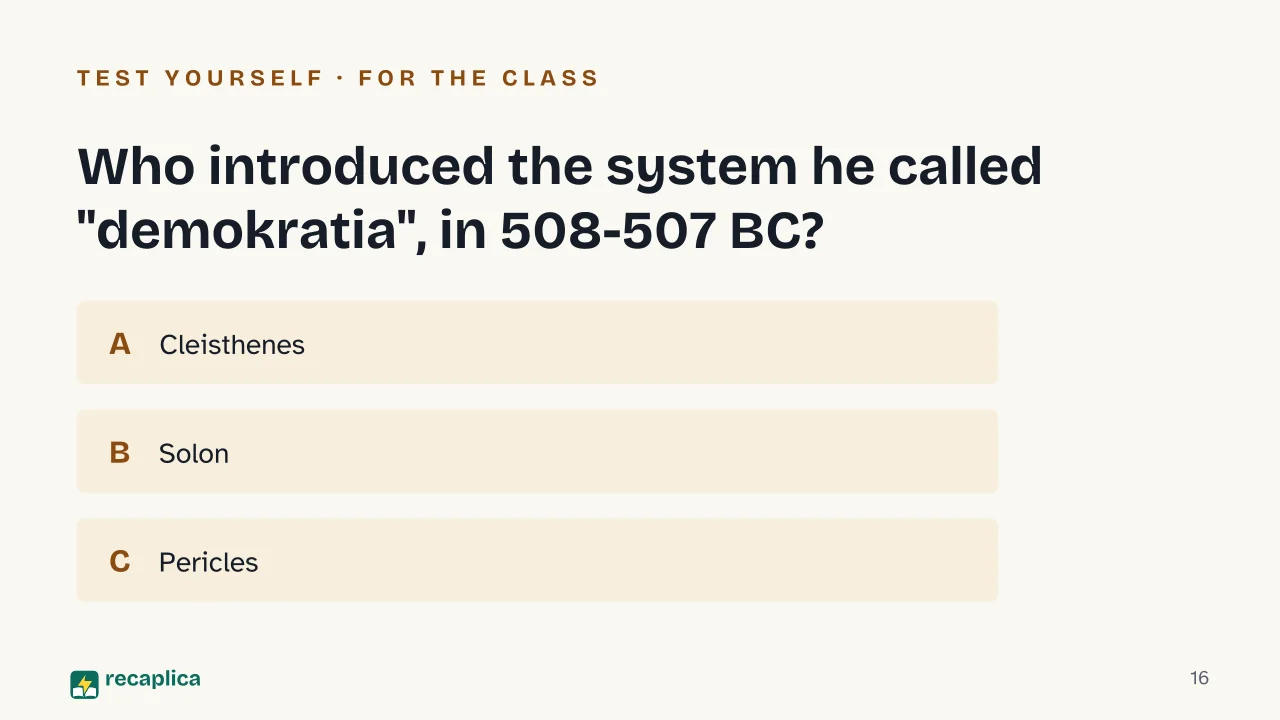  Common myths
Mind mapDrag the background to move around and the nodes to reposition them; use − and + to collapse and expand branches. 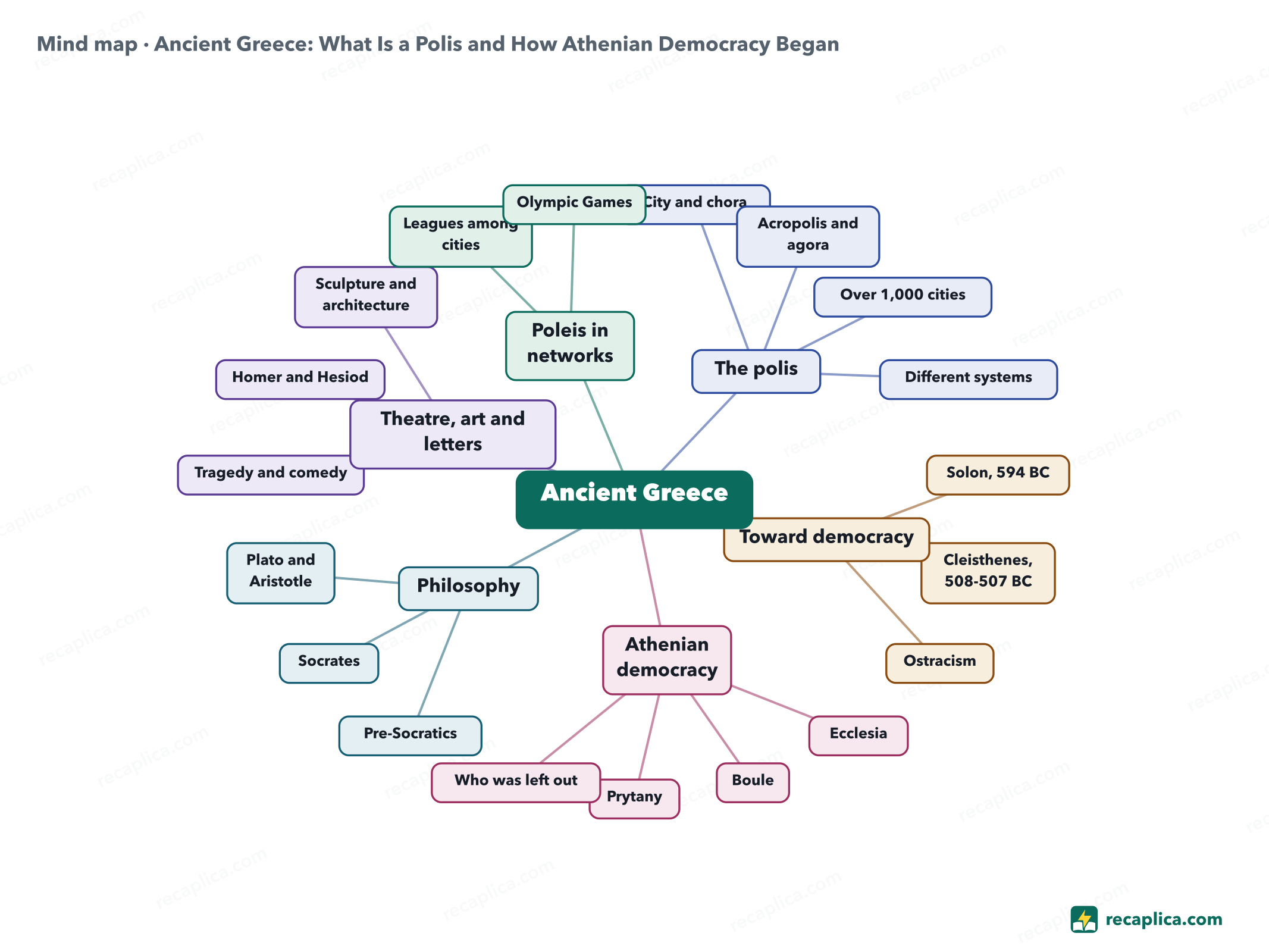
Quiz: test yourselfAnswer the questions to check what you have learned: you get instant feedback and a short explanation. Grade 0/10 0/5
FlashcardsTap the card to flip it and check whether you remember the answer, then move to the next one. 1 / 8 Explain it in your own wordsThe ultimate test: if you can explain it in simple words, you've truly understood it. Write your explanation, then compare it with the Recap. Your explanation is saved only on this device.
Frequently asked questionsWhat was a polis in ancient Greece?It was the ancient Greek city-state, an urban centre often fortified, with an acropolis on high ground and an agora as its civic square, together with the surrounding farmland (the chora). Each polis had its own laws and institutions, independent of neighbouring poleis; at least 1,000 are known by name. Who invented democracy in Greece?It was not the work of a single person. In 594 BC the lawgiver Solon laid the groundwork by cancelling debts and making citizens more equal before the law; it was Cleisthenes, with his reforms of 508-507 BC, who introduced the system he called "demokratia", basing citizenship on residence rather than family. How long did Athenian democracy last?The direct-democracy period runs, roughly, from about 460 BC to about 320 BC (the fifth and fourth centuries BC), with an oligarchic interruption in 411 BC and the restoration of democracy in 403 BC. What is the difference between direct and representative democracy?In a direct democracy, like Athens, citizens with voting rights decide laws and policies themselves by meeting in assembly. In a modern representative democracy, citizens instead elect representatives who decide on their behalf in parliaments or elected assemblies. Who could vote in Athenian democracy?Only free male citizens aged 18 and over could vote in the assembly (for public office and juries the minimum age was 30). Women, enslaved people and resident foreigners (the metics) were excluded from political citizenship. Every Recap goes through an independent review before publication. |