Skip to content
recaplica

    One moment: security check

    Cloudflare wants to make sure you're not a robot. Tick the box below and your search will continue on its own.

    IT
    recaplica Globalization: Definition, History, and How World Trade Works
    © 2026 Recaplica · recaplica.com — All rights reserved
    Home › Economics

    Globalization: Definition, History, and How World Trade Works

    By Recaplica Newsroom · Updated on October 1, 2026

    What to print

    Page numbers appear when printing with default margins.

    Slides

    Choose a cut

    Flash10 slidesThe essential thread, to present in classFull15 slidesEvery chapter and the deeper detail

    Both come with speaker notes.

    Telegram channel
    recaplica Clear in 30 seconds, yours in 10 minutes.
    In 30 seconds Key points Figures Deep dive Slides Myths Mind map Quiz Flashcards FAQ

    In 30 seconds quick read

    Globalization, as the International Monetary Fund defines it, is the world's economies growing more integrated: goods, services and capital crossing borders, along with labor and knowledge, plus broader political and cultural dimensions. It isn't a recent or a straight-line phenomenon: Our World in Data describes two major waves, the first starting in the 19th century and cut short by World War I in 1914, the second launched after World War II and still underway. World trade in goods and services reached $34.89 trillion in 2025, according to the World Trade Organization, while the map of trade flows has shifted: in 2024, China was the top import source for around four countries out of ten worldwide.

    Key Points

    • For the IMF, economic globalization means the world's economies becoming ever more integrated, chiefly as goods, services and capital cross borders; the term also takes in labor, knowledge, and wider political, cultural and environmental dimensions.
    • Our World in Data identifies two historical waves rather than one continuous climb: the first begins in the 19th century, the second restarts after World War II, with a break between them caused by World War I.
    • Between 1830 and 1900, intra-European trade rose from 1% to 10% of GDP (Our World in Data): the first real leap in globalization is a 19th-century story.
    • Per the IMF, world trade in goods and services rose from 42.1% to 62.1% of global GDP between 1980 and 2007, while foreign direct investment climbed from 6.5% to 31.8% of world GDP between 1980 and 2006.
    • The World Trade Organization (WTO) was created on 1 January 1995, succeeding the GATT, which had been in force from 1948 to 1994; in 2025, world trade in goods and services reached $34.89 trillion, up 8% on the previous year.
    • In 2024, roughly 40% of the world's countries bought more imports from China than from anywhere else: the map of trade flows has moved on from the postwar era led by the United States and Europe (Our World in Data).

    Key figures

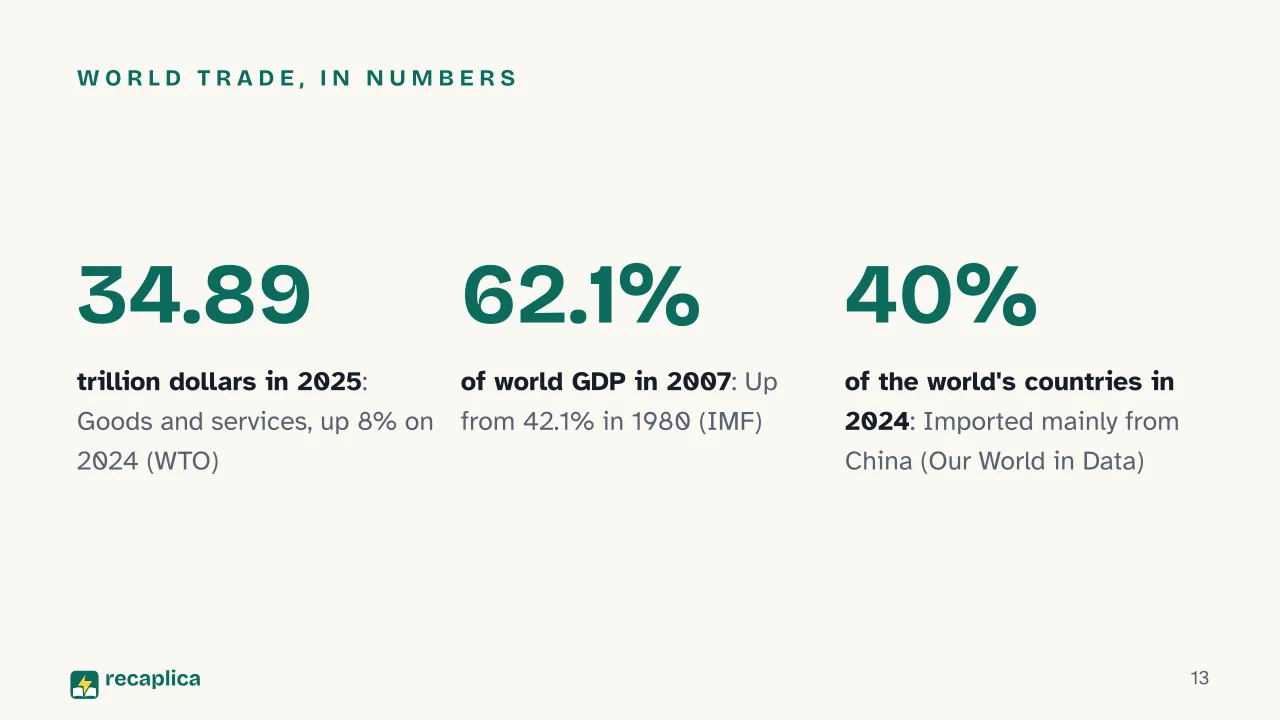
    • $34.89 trillion The value of world trade in goods and services in 2025, up 8% on the previous year Source: WTO, World Trade Statistics 2025
    • 62.1% World trade in goods and services as a share of global GDP in 2007, up from 42.1% in 1980 Source: IMF, Issues Brief 2008
    • 40% The share of the world's countries whose largest import supplier, in 2024, was China Source: Our World in Data, Trade and Globalization

    Deep Dive

    What globalization means, for the IMF

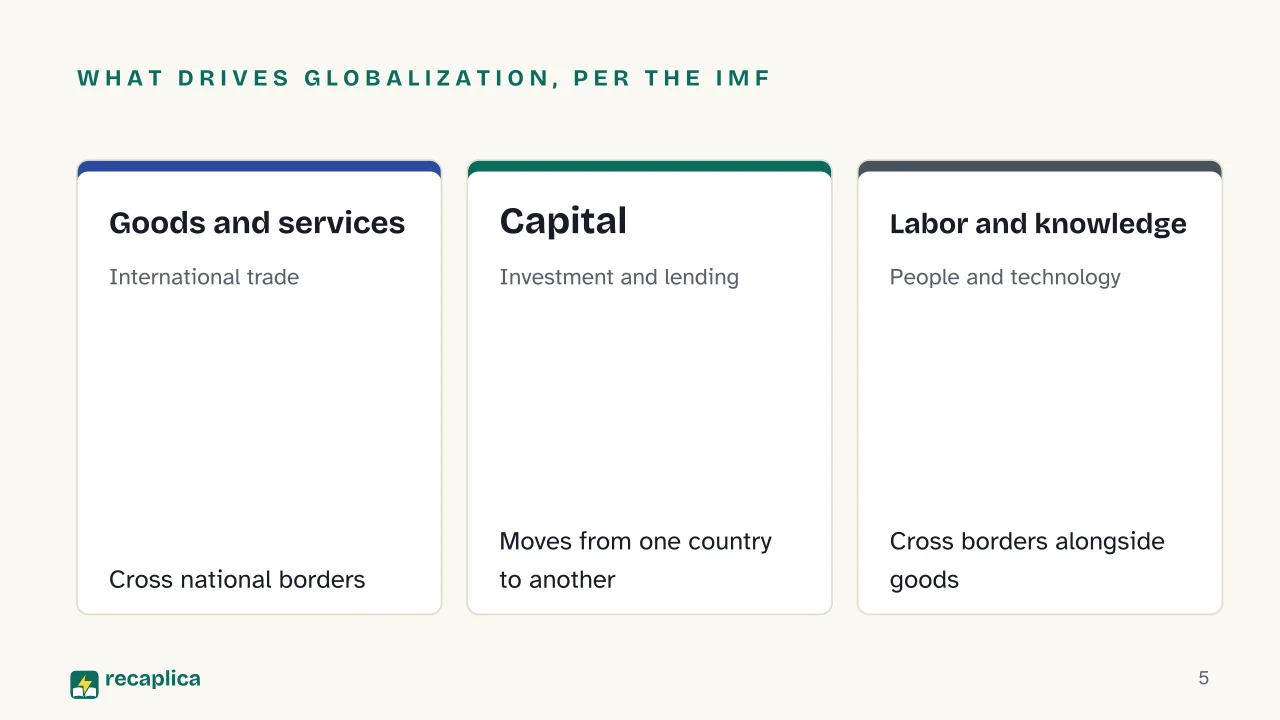
    The International Monetary Fund defines economic globalization as a historical process, the result of human innovation and technological progress: the growing integration of the world’s economies, mainly through the movement of goods, services and capital across national borders. The term, per the IMF, sometimes also covers the movement of labor and knowledge between countries, and reaches beyond economics alone into broader dimensions: political and cultural ones, as well as environmental. The IMF places the word’s most common use in the 1980s, when technological advances made international transactions faster and easier.

    A central part of this integration is the expansion of world trade through lower customs barriers, such as import tariffs. The IMF notes that trade gives an economy more resilience and flexibility: higher imports help offset negative shocks on the domestic supply side, while citizens of countries that open up to trade gain access to a wider range of goods and services, lower prices and more widespread jobs.

    The phenomenon isn’t new: before it became an economic term, it already had a doctrinal predecessor pulling in the opposite direction.

    Mercantilism, dominant in Europe from the 1500s to the 1700s, aimed to sell more abroad than a country bought, to build up gold and silver reserves — not to integrate economies with one another.

    Two waves, not a straight line

    Anyone picturing globalization as a recent invention runs into the long-run data gathered by Our World in Data. Before 1800, international trade stayed a marginal phenomenon: a global index never rose above 10% in that period. Exports were worth less than 10% of world output in the early 1800s, against a share that in Our World in Data’s most recent figures tops 20%.

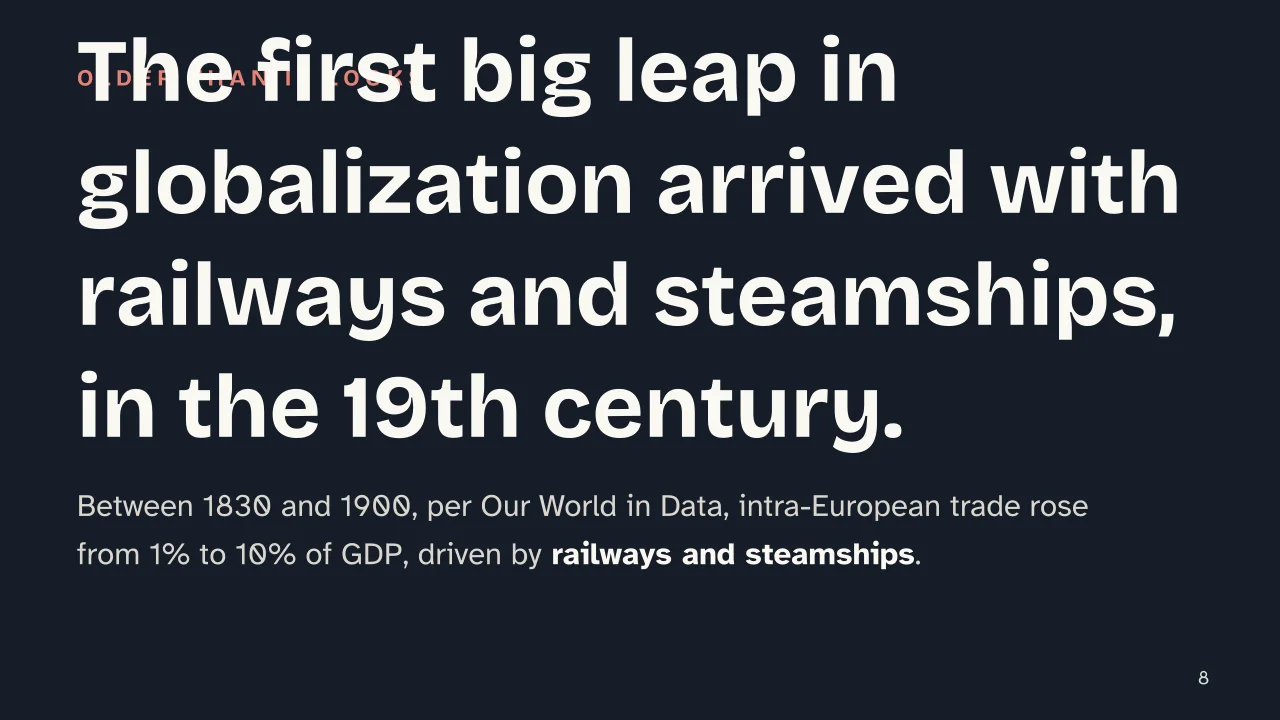
    Example: between 1830 and 1900, according to Our World in Data, intra-European trade rose from 1% to 10% of GDP. The jump was driven by railways and steamships, not computers or the internet: the first big leap in globalization is a 19th-century story.

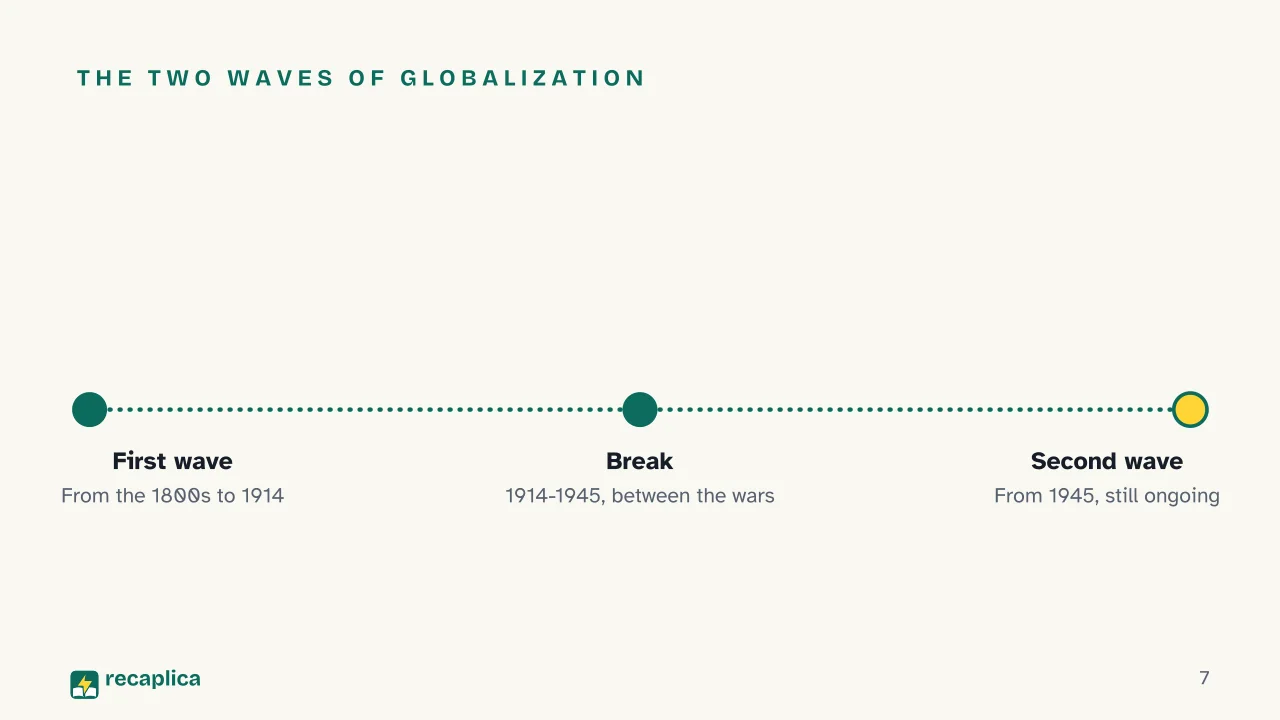
    That growth wasn’t continuous. Our World in Data describes two distinct waves. The first begins in the 19th century and breaks off with the start of World War I, when declining liberalism and rising nationalism caused international trade to collapse. The second wave restarts after World War II and continues today: per Our World in Data, the average volume of imports and exports in 2024 was, adjusted for inflation, more than two thousand times larger than in 1800. This second wave also sees a rise in intra-industry trade — the exchange between countries of broadly similar goods and services — a feature the first wave didn’t share.

    Trade’s geography shifted along with its volume. Our World in Data notes that by 2014, trade between non-rich countries had become just as important as trade between rich countries, complicating the idea of a world split cleanly between an industrialized core and a poor periphery — an issue closely tied to inequality between countries and to the ranking of the poorest countries in the world. In 2024, Our World in Data adds, China was the top source of imports for roughly four countries out of ten worldwide, and in more than half of those cases the value of Chinese imports was at least twice that of US imports: a sign of how trade flows have shifted away from the postwar order led by the United States and Europe.

    From the GATT to the WTO: the rules of world trade

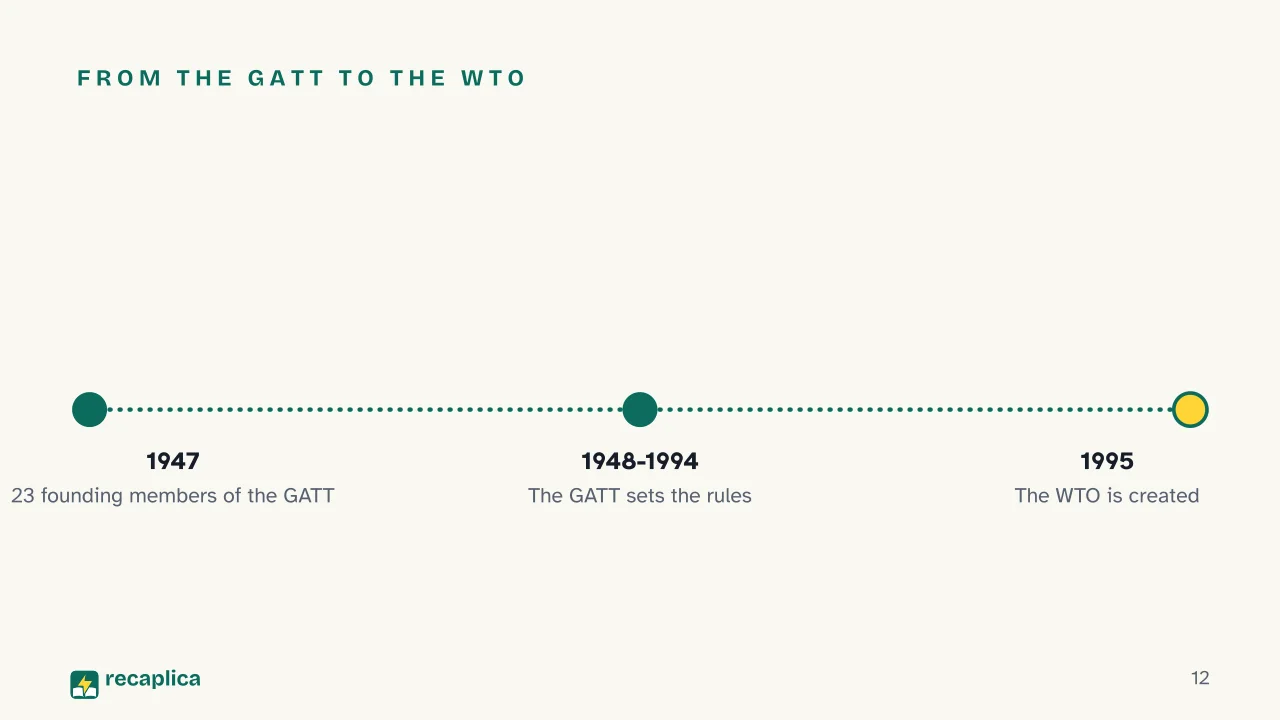
    The second wave of globalization also built an institutional framework. In 1947, a group of 23 countries signed the General Agreement on Tariffs and Trade (GATT), which, per the World Trade Organization (WTO), provided the rules for most of world trade from 1948 to 1994. A parallel attempt, the International Trade Organization agreed in Havana in March 1948, never took effect: ratification failed in several national parliaments.

    The GATT moved forward through successive negotiating rounds: Geneva (1947), Annecy (1949), Torquay (1951), Geneva again (1956), the Dillon Round (1960-1961), the Kennedy Round (1964-1967), the Tokyo Round (1973-1979) and finally the Uruguay Round (1986-1994), the last and largest, with 123 participating countries per the WTO. It was the Uruguay Round that led to the creation of the WTO on 1 January 1995 — a date the WTO itself calls the biggest reform of international trade since the end of World War II.

    GATTWTO
    Period1948-1994Since 1 January 1995
    OriginAgreement among 23 signatory countries in 1947Born from the Uruguay Round (1986-1994, 123 countries)
    RoleRules for most of world tradeThe most extensive trade reform since the postwar era

    World trade in 2025, by the numbers

    The WTO’s latest data show world trade growing at a strong pace. In 2025, the value of trade in goods and services, on a balance-of-payments basis, rose 8% from the previous year, reaching $34.89 trillion; in 2024, growth had been 4%. Alongside these figures sits a different historical series, the weight of trade on world GDP: per the IMF, the value of trade in goods and services rose from 42.1% to 62.1% of global GDP between 1980 and 2007. Over the same span, foreign direct investment grew from 6.5% to 31.8% of world GDP between 1980 and 2006, and the stock of international claims — mainly bank loans — rose from roughly 10% to 48% of world GDP, also between 1980 and 2006.

    Indicator1980Latest available year
    Trade (goods and services) / world GDP42.1%62.1% (2007)
    Foreign direct investment / world GDP6.5%31.8% (2006)
    International claims / world GDP~10%48% (2006)

    That same web of international bank lending, built up through 2006, became the channel through which the 2008 financial crisis spread from one market to another within months.

    Cross-border communication grew in a similar way: per-capita minutes spent on international phone calls rose from 7.3 in 1991 to 28.8 in 2006, according to the IMF, while the number of foreign workers worldwide climbed from 78 million (2.4% of the world’s population) in 1965 to 191 million (3.0%) in 2005.

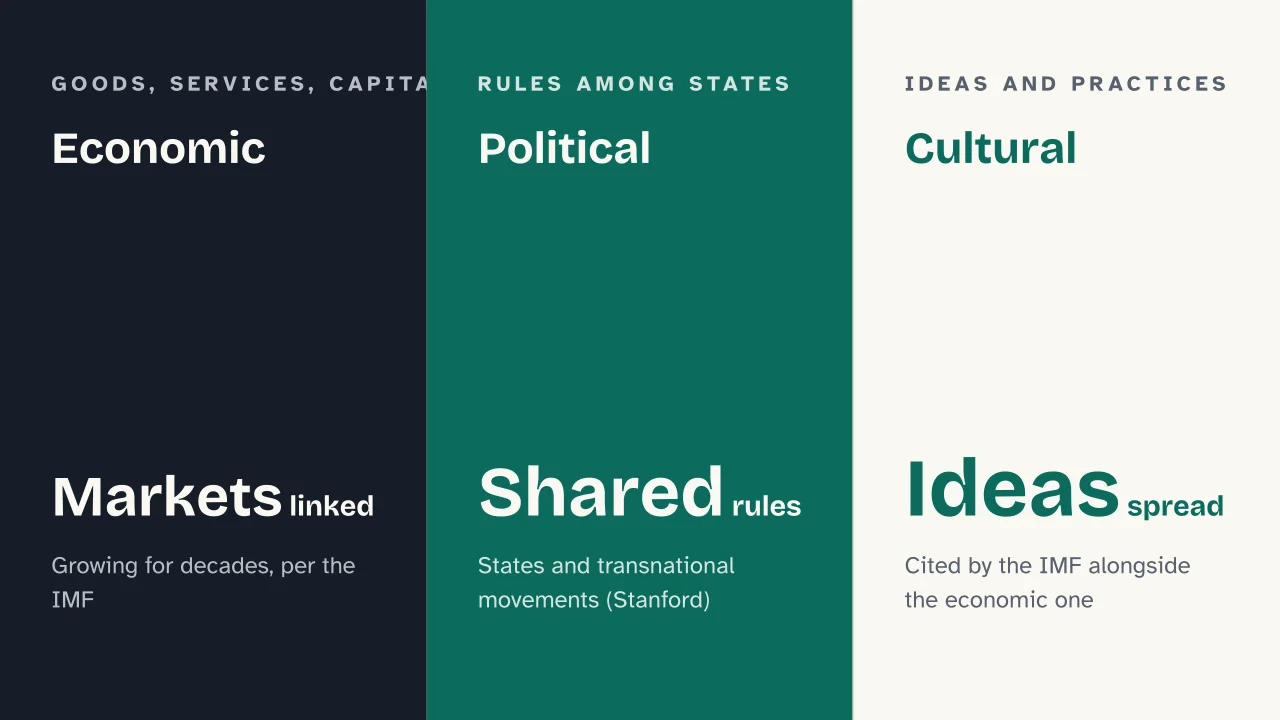
    Economic globalization

    The economic dimension is the best documented in the sources: it concerns the scale of the whole world economy, the level that macroeconomics studies, unlike microeconomics, which looks at individual firms or households. It covers trade in goods and services, capital flows and foreign direct investment, plus the movement of labor and knowledge between countries — the same elements the IMF lists in its definition, and the ones the 1980-2007 data series show growing steadily through the second wave of globalization.

    Political globalization

    The Stanford Encyclopedia of Philosophy describes a political dimension of globalization made up of two distinct strands. On one side, supranational forms of regulation and rulemaking, in which individual states choose to cooperate on shared rules: the European Union is the most institutionalized example of this kind of cooperation among states. On the other, transnational movements in which activists use fast communication technology to coordinate across borders. The same source also flags an open philosophical debate: democratic politics presupposes feelings of trust and belonging that remain uncommon at the supranational or global level, an argument used by those skeptical of world government. On the economic side, the Stanford Encyclopedia of Philosophy links the growing material inequality produced by economic globalization to rising domestic inequality even within wealthy democracies.

    Cultural globalization

    On the cultural dimension, the sources consulted offer less material than on the economic or political ones. The IMF names it explicitly, alongside the environmental dimension, as one of the “broader” dimensions of globalization that go beyond economics in the strict sense, without detailing which cultural practices or consumption patterns it involves. It’s fair to say, then, that globalization has a cultural side too, acknowledged by economic institutions themselves, more than to describe how it specifically works here.

    Slide deck

    Slides ready to download and make your own in PowerPoint or Google Slides, with speaker notes. Pick the Flash cut or the Full one.
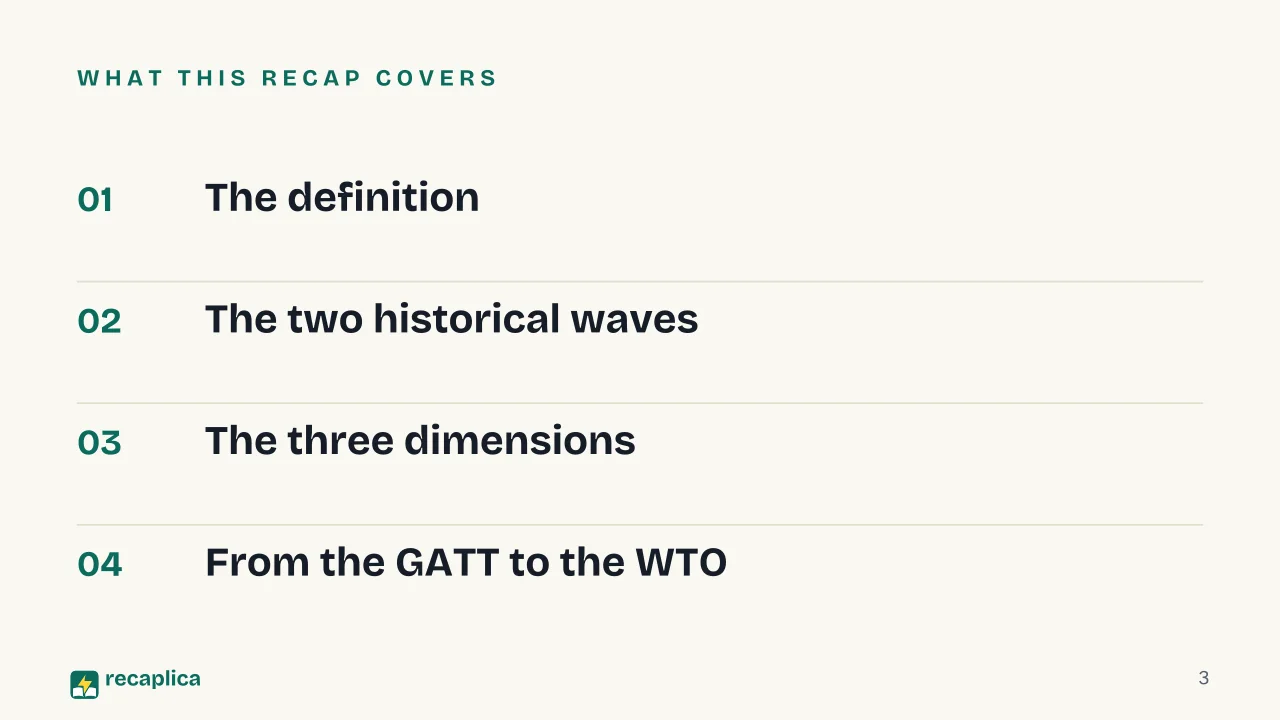
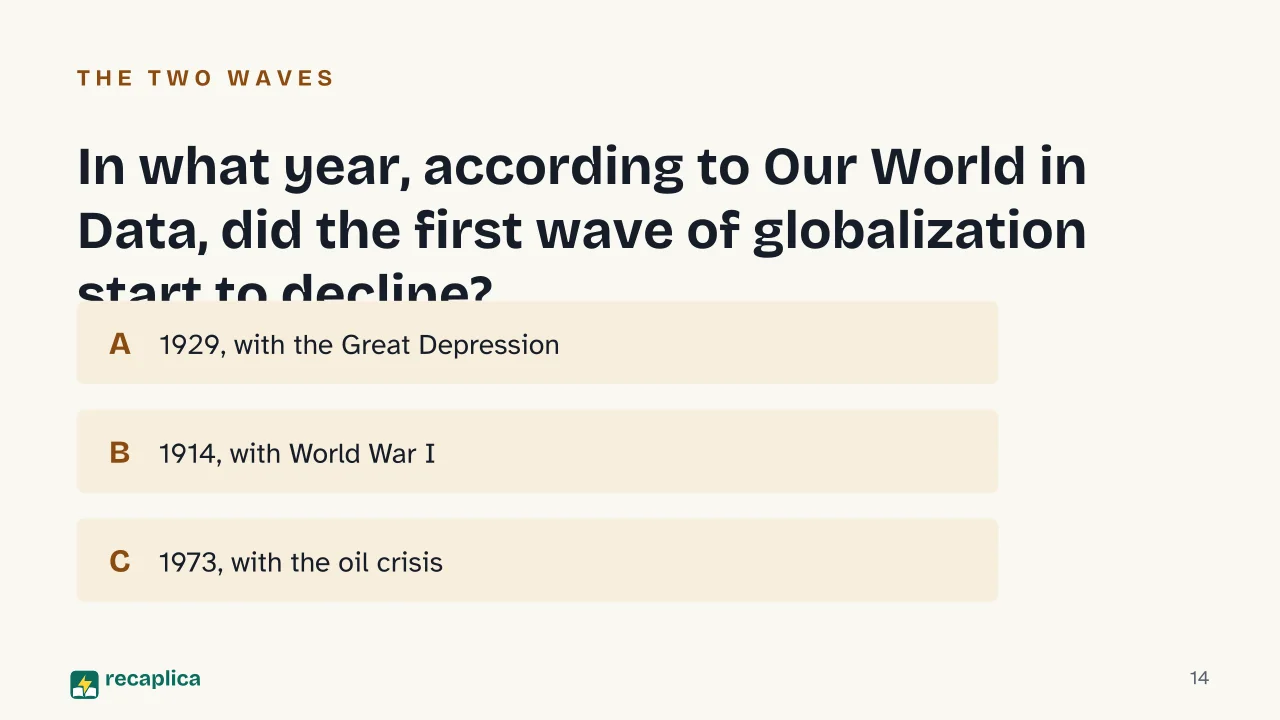
    Slide 1 of the presentation on Globalization: GlobalizationSlide 2 of the presentation on Globalization: Since when have the world's markets really been connected?Slide 3 of the presentation on Globalization: What this Recap coversSlide 4 of the presentation on Globalization: Chapter 01: The definitionSlide 5 of the presentation on Globalization: What drives globalization, per the IMF: Goods and services, Capital, Labor and knowledgeSlide 6 of the presentation on Globalization: Chapter 02: Two historical wavesSlide 7 of the presentation on Globalization: The two waves of globalizationSlide 8 of the presentation on Globalization: The first big leap in globalization arrived with railways and steamships, in the 19th century.Slide 9 of the presentation on Globalization: Chapter 03: The three dimensionsSlide 10 of the presentation on Globalization: Economic · Political · CulturalSlide 11 of the presentation on Globalization: Chapter 04: From the GATT to the WTOSlide 12 of the presentation on Globalization: From the GATT to the WTOSlide 13 of the presentation on Globalization: World trade, in numbersSlide 14 of the presentation on Globalization: In what year, according to Our World in Data, did the first wave of globalization start to decline?Slide 15 of the presentation on Globalization: The full Recap
    Flash10 slidesThe essential thread, to present in classFull15 slidesEvery chapter and the deeper detail

    Common myths

    • ✗ Myth Globalization is a product of the internet and the dot-com boom of the 1990s.

      ✓ Reality Our World in Data shows the first big leap happened a century earlier: between 1830 and 1900, intra-European trade climbed from 1% to 10% of GDP, driven by railways and steamships. Our World in Data places the start of the first globalization wave in the 19th century.

    • ✗ Myth Globalization is only about goods and capital moving between countries.

      ✓ Reality The IMF itself points to broader dimensions — cultural, political and environmental — beyond the economic one, and the Stanford Encyclopedia of Philosophy examines the political dimension in particular, covering supranational rulemaking among states and transnational activist movements that rely on communication technology.

    • ✗ Myth World trade has grown at the same steady pace, without ever slowing down.

      ✓ Reality Our World in Data traces growth in waves rather than a straight line: the first wave broke off when World War I began in 1914, as the decline of liberalism and the rise of nationalism caused international trade to collapse; a new wave, still running today, only picked up again after World War II.

    Mind map

    Drag the background to move around and the nodes to reposition them; use − and + to collapse and expand branches.
    Customize
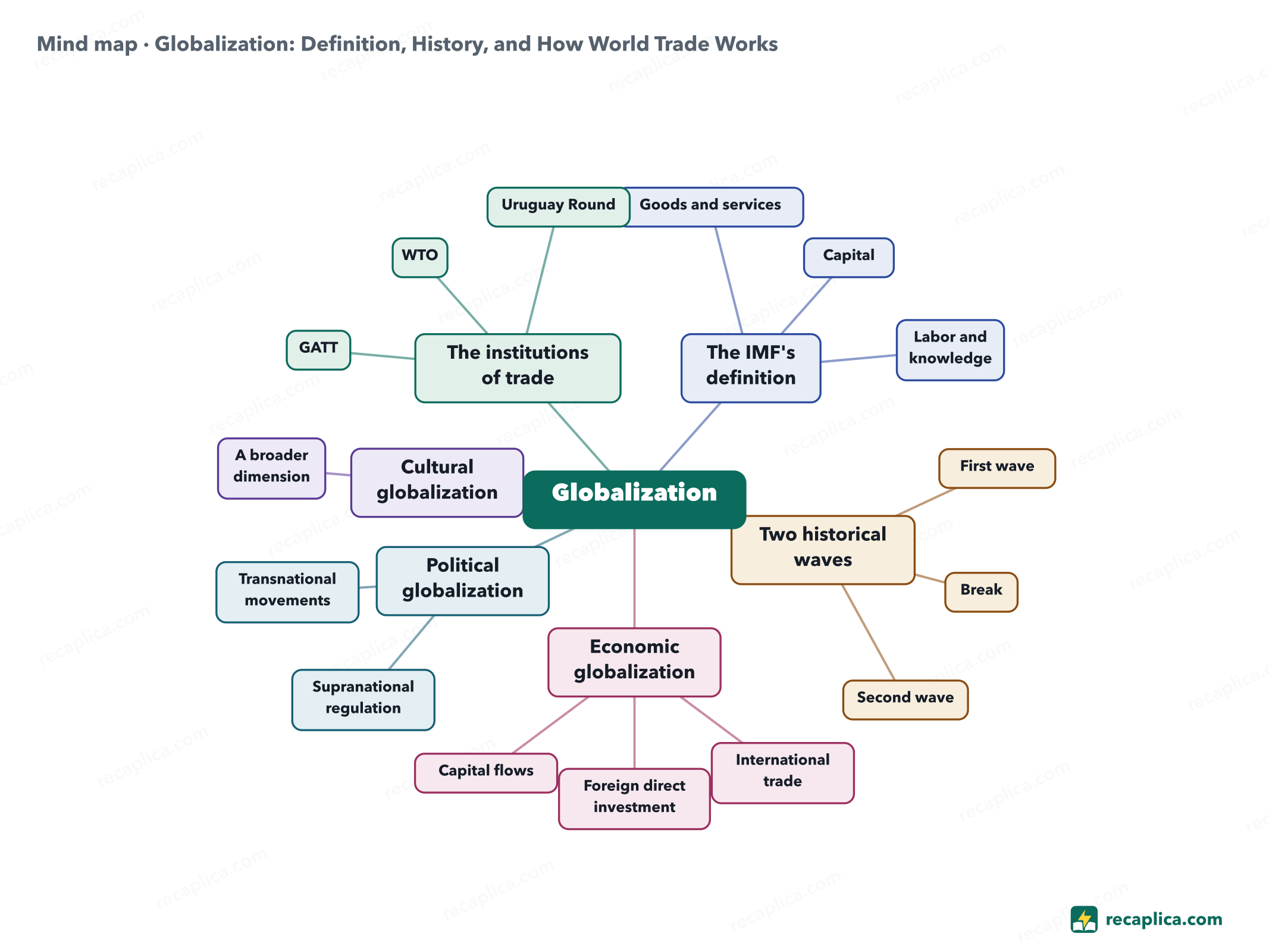
    Mind map: Globalization: Definition, History, and How World Trade Works
    • Globalization
      • The IMF's definition
        • Goods and services Cross national borders
        • Capital Investment and lending between countries
        • Labor and knowledge People and technology moving across borders
      • Two historical waves
        • First wave From the 1800s to 1914
        • Break 1914-1945, wars and nationalism
        • Second wave From 1945, still ongoing
      • Economic globalization
        • International trade
        • Foreign direct investment
        • Capital flows
      • Political globalization
        • Supranational regulation States cooperating on shared rules
        • Transnational movements Activists coordinating across borders
      • Cultural globalization
        • A broader dimension Named by the IMF alongside the economic one
      • The institutions of trade
        • GATT In force from 1948 to 1994
        • WTO Created on 1 January 1995
        • Uruguay Round 1986-1994, 123 countries, led to the WTO

    Quiz: test yourself

    Answer the questions to check what you have learned: you get instant feedback and a short explanation.

    Grade 0/10 0/5
    1 According to the IMF, what does economic globalization mainly involve?

    In the IMF's definition, the heart of globalization is economic integration, driven first of all by goods, services and capital moving across borders.

    2 When does Our World in Data place the start of the first globalization wave?

    Our World in Data places the start of the first wave in the 19th century; between 1830 and 1900, intra-European trade rose from 1% to 10% of GDP.

    3 True or false: according to Our World in Data, the start of World War I in 1914 broke off the first wave of globalization.

    Our World in Data ties the end of the first wave to the outbreak of World War I, when liberalism in retreat and nationalism on the rise brought international trade down.

    4 Which institution replaced the GATT on 1 January 1995, according to the WTO?

    On 1 January 1995 the WTO took over from the GATT; the WTO itself calls its founding the largest overhaul of international trade since World War II ended.

    5 According to Our World in Data, which country was the top source of imports for about 40% of the world's countries in 2024?

    Per Our World in Data, in 2024 about four countries in ten worldwide imported more from China than from any other country.

    Answers: 1-B · 2-B · 3-A · 4-B · 5-C

    Flashcards

    Tap the card to flip it and check whether you remember the answer, then move to the next one.

    1 / 8

    Explain it in your own words

    The ultimate test: if you can explain it in simple words, you've truly understood it. Write your explanation, then compare it with the Recap.

    Your explanation is saved only on this device.

    Globalization, as the International Monetary Fund defines it, is the world's economies growing more integrated: goods, services and capital crossing borders, along with labor and knowledge, plus broader political and cultural dimensions. It isn't a recent or a straight-line phenomenon: Our World in Data describes two major waves, the first starting in the 19th century and cut short by World War I in 1914, the second launched after World War II and still underway. World trade in goods and services reached $34.89 trillion in 2025, according to the World Trade Organization, while the map of trade flows has shifted: in 2024, China was the top import source for around four countries out of ten worldwide.

    Frequently asked questions

    What is globalization, in simple terms?

    It's the growing integration of the world's economies, the IMF explains, mainly through goods, services and capital moving across national borders; it also covers the movement of labor and knowledge, and it stretches to political and cultural dimensions as well.

    When did globalization start?

    Before 1800, international trade stayed below 10% of a global index, according to Our World in Data. The first real wave of globalization begins in the 19th century and breaks off with World War I in 1914; a second wave, still ongoing, restarts after World War II.

    What are the dimensions of globalization?

    The IMF names three beyond the economic one: political, cultural and environmental. The political dimension is examined further by the Stanford Encyclopedia of Philosophy, covering cooperation among states on supranational rules and transnational activist movements.

    What's the difference between the GATT and the WTO?

    Per the WTO, the GATT (General Agreement on Tariffs and Trade) provided the rules for most world trade from 1948 to 1994. The WTO was created on 1 January 1995, after the GATT's last and largest negotiating round, the Uruguay Round (1986-1994, 123 participating countries), and marked, in the WTO's telling, international trade's biggest reform since the Second World War.

    Why did world trade collapse between the two world wars?

    Our World in Data links the end of the first globalization wave to the start of World War I in 1914, when declining liberalism and rising nationalism drove international trade down; growth only resumed after World War II.

    Sources

    • Trade and Globalization — Our World in Data
    • Globalization: A Brief Overview — Issues Brief, International Monetary Fund
    • Globalization — Stanford Encyclopedia of Philosophy
    • The GATT years: from Havana to Marrakesh — World Trade Organization (WTO)
    • World Trade Statistics 2025 — World Trade Organization (WTO)

    Every Recap goes through an independent review before publication.

    Every evening, the day's new Recaps on our Telegram channel. Join the channel →

    Keep learning

    • Economics Sustainability: Definition, What It Means and the Three Pillars Sustainability, in the fuller phrase sustainable development, is development that covers the needs of the people living now while leaving future generations able to cover their own: that is how the United Nations defines it. The wording comes from Our Common Future, the report published in 1987 by the World Commission on Environment and Development, also called the Brundtland Commission. Treccani lists three interdependent factors behind the expression. The United Nations describe an integrated approach, where environmental concerns travel alongside economic development. Read the Recap →
    • Economics 2008 Financial Crisis: Timeline of How It Started and Spread The 2008 financial crisis began in the United States in the subprime mortgage market, when expanding credit to riskier borrowers and the practice of bundling those mortgages into securities collided with slowing home prices, according to the Federal Reserve. In spring 2008 the investment bank Bear Stearns was rescued with Federal Reserve support, but that September Lehman Brothers filed for bankruptcy and the insurer AIG had to be propped up by the government. Washington responded with TARP, a program Congress authorized for up to $700 billion, and with new bank-supervision rules in 2010. US GDP fell 4.3% and unemployment climbed to about 10%, while in Europe the shock turned, in the following years, into a public-finance crisis that the European Central Bank had to address with government bond purchases. Read the Recap →
    • Economics Fastest Growing Economies in the World: The Real GDP Growth Ranking, Explained According to the International Monetary Fund's projections for 2025, South Sudan tops the ranking for real GDP growth, followed by Guyana and Libya — small economies, or ones tied to a single resource, not the world's biggest ones. GDP growth rate measures, in percentage terms, how much a country's output expands each year, adjusted for inflation. Global real GDP grew 3.4% in 2024 according to the IMF, with emerging economies expanding at more than double the pace of advanced ones. A very high growth rate, though, can come from a rebound after a slump, an oil boom, or even an accounting quirk: on its own, it doesn't prove a stronger economy. Read the Recap →

    recaplica

    Clear in 30 seconds, yours in 10 minutes.

    Recaps Mind maps Request a Recap Telegram channel Mind map maker Our method About Privacy & cookies Legal notes & terms of use

    © 2026 Recaplica · A project by Curi S.r.l. — VAT IT05472000750

    Statistics, only if you say so

    To learn which Recaps help most we would use Google Analytics, with aggregate, anonymous data. It starts only with your OK, and you can change your mind anytime. Privacy policy