Skip to content
recaplica

    One moment: security check

    Cloudflare wants to make sure you're not a robot. Tick the box below and your search will continue on its own.

    IT
    recaplica Fastest Growing Economies in the World: The Real GDP Growth Ranking, Explained
    © 2026 Recaplica · recaplica.com — All rights reserved
    Home › Economics

    Fastest Growing Economies in the World: The Real GDP Growth Ranking, Explained

    By Recaplica Newsroom · Updated on October 1, 2026

    What to print

    Page numbers appear when printing with default margins.

    Slides

    Choose a cut

    Flash10 slidesThe essential thread, to present in classFull14 slidesEvery chapter and the deeper detail

    Both come with speaker notes.

    Telegram channel
    recaplica Clear in 30 seconds, yours in 10 minutes.
    In 30 seconds Key points Figures Deep dive Slides Myths Mind map Quiz Flashcards FAQ

    In 30 seconds quick read

    According to the International Monetary Fund's projections for 2025, South Sudan tops the ranking for real GDP growth, followed by Guyana and Libya — small economies, or ones tied to a single resource, not the world's biggest ones. GDP growth rate measures, in percentage terms, how much a country's output expands each year, adjusted for inflation. Global real GDP grew 3.4% in 2024 according to the IMF, with emerging economies expanding at more than double the pace of advanced ones. A very high growth rate, though, can come from a rebound after a slump, an oil boom, or even an accounting quirk: on its own, it doesn't prove a stronger economy.

    Key Points

    • In the IMF's 2025 projections, South Sudan tops the world ranking for real GDP growth, at an estimated 46.1%.
    • Real GDP growth is the annual percentage change in a country's output at constant prices; it measures speed, while absolute GDP measures size in dollars.
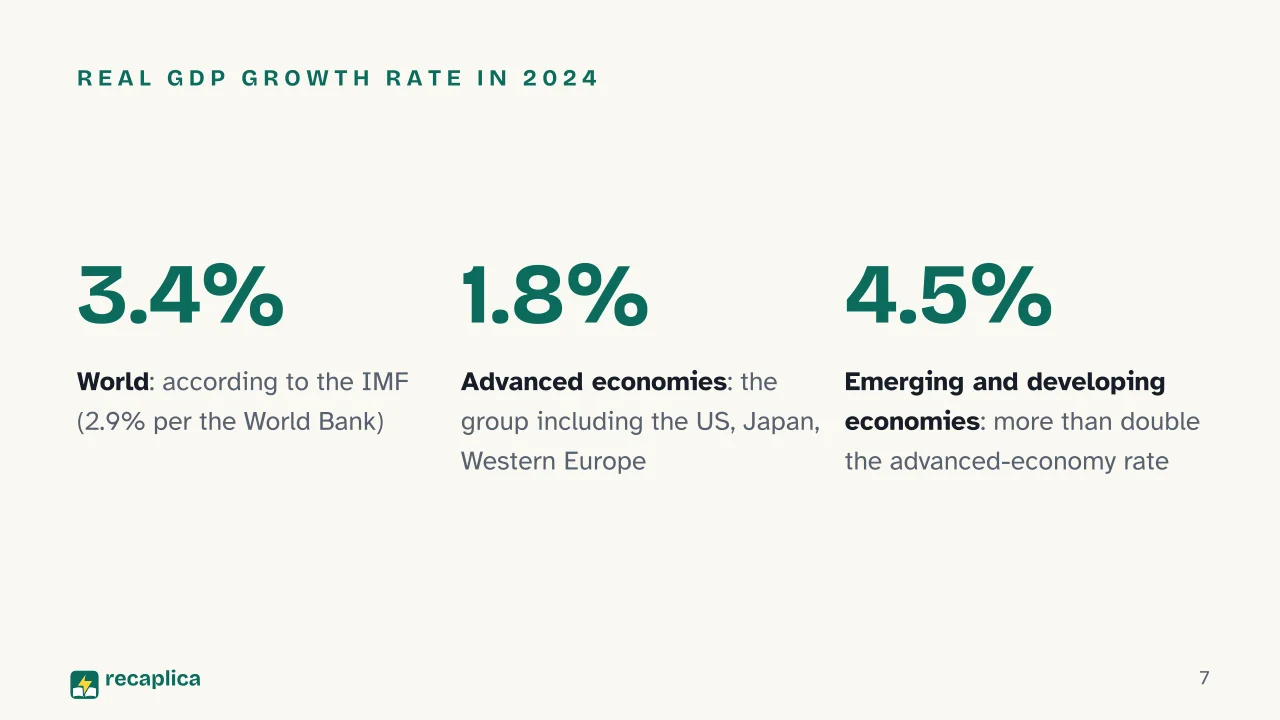
    • Global real GDP grew 3.4% in 2024 according to the IMF (2.9% per the World Bank); emerging economies grew 4.5%, more than double the rate of advanced economies (1.8%).
    • Guyana's growth is tied to its expanding oil output, which rose 860% between 2020 and 2025 according to Our World in Data.
    • Ireland's official GDP fell 5.5% in 2023 according to the Central Statistics Office, while GNI*, the indicator that strips out multinational profit effects, rose 5% that same year.
    • China grew 5% in 2024, well above the 3.4% global average, yet stays outside the top ten countries for projected 2025 growth rate.

    Key figures

    • 3.4% World real GDP growth rate in 2024 Source: IMF, World Economic Outlook Database, 2024
    • 46.1% IMF's projected 2025 real GDP growth for South Sudan (estimate, world's top spot) Source: IMF, World Economic Outlook Database, 2025 estimate
    • 43.8% Guyana's real GDP growth in 2024 Source: IMF and World Bank, 2024

    Deep Dive

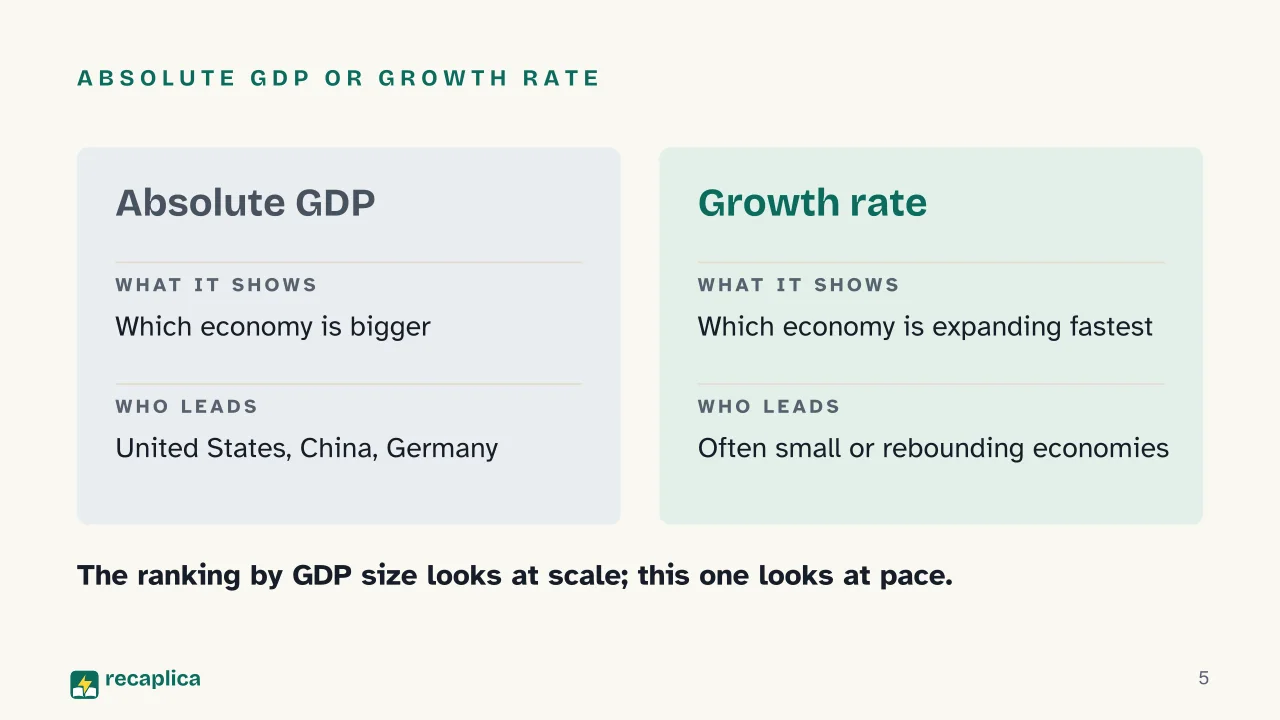
    Real GDP growth rate is a percentage change: how much a country’s output of goods and services grew from one year to the next, measured at constant prices. The International Monetary Fund tracks the indicator precisely so it can compare economies of very different sizes on the same footing, with inflation stripped out. It’s a different yardstick from GDP in absolute terms, the one behind Biggest Economies in the World: The Ranking by GDP, Explained: that ranking asks who produces the most overall, this one asks who’s moving fastest compared with itself a year earlier.

    According to the IMF, global real GDP grew 3.4% in 2024 (the World Bank, using its own methodology, puts the figure at 2.9%). Inside that average sit two very different speeds: advanced economies grew 1.8%, while the group the IMF labels “emerging market and developing economies” grew 4.5%, more than double. The countries topping the 2025 growth-rate ranking below — South Sudan, Guyana, Libya — all fall into that second, faster-moving group, and none of them rank among the world’s biggest economies by absolute GDP.

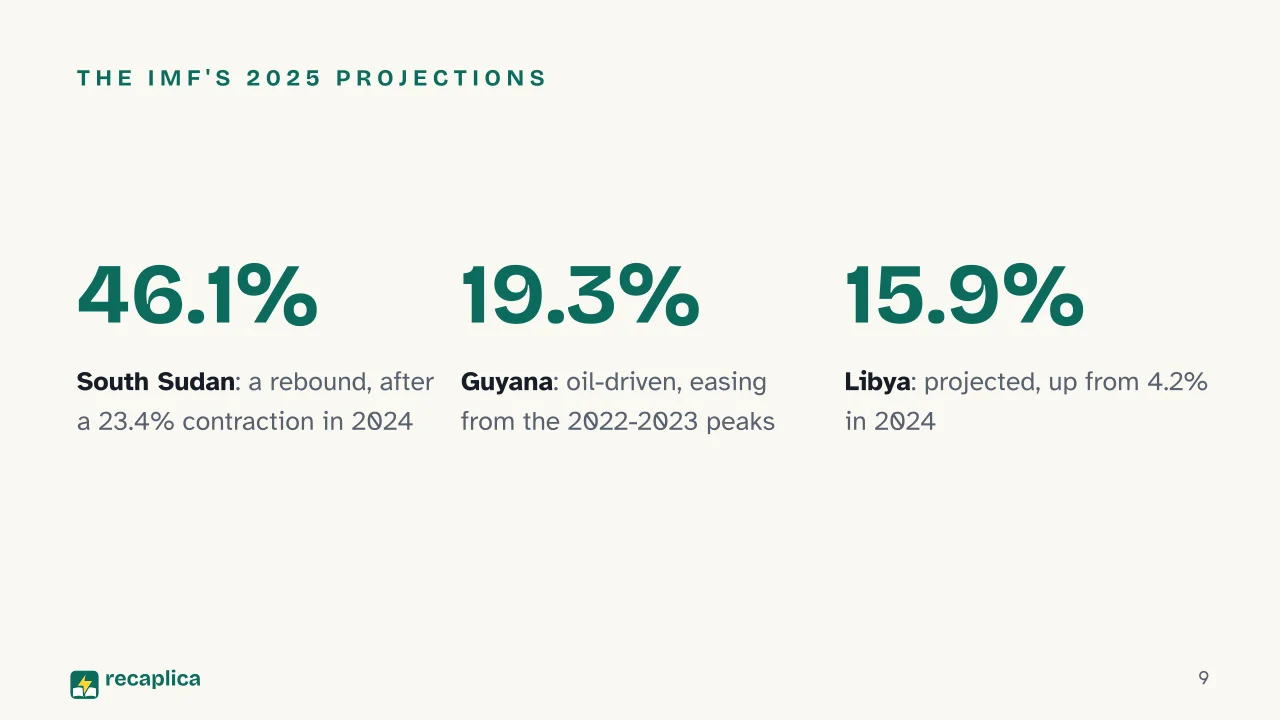
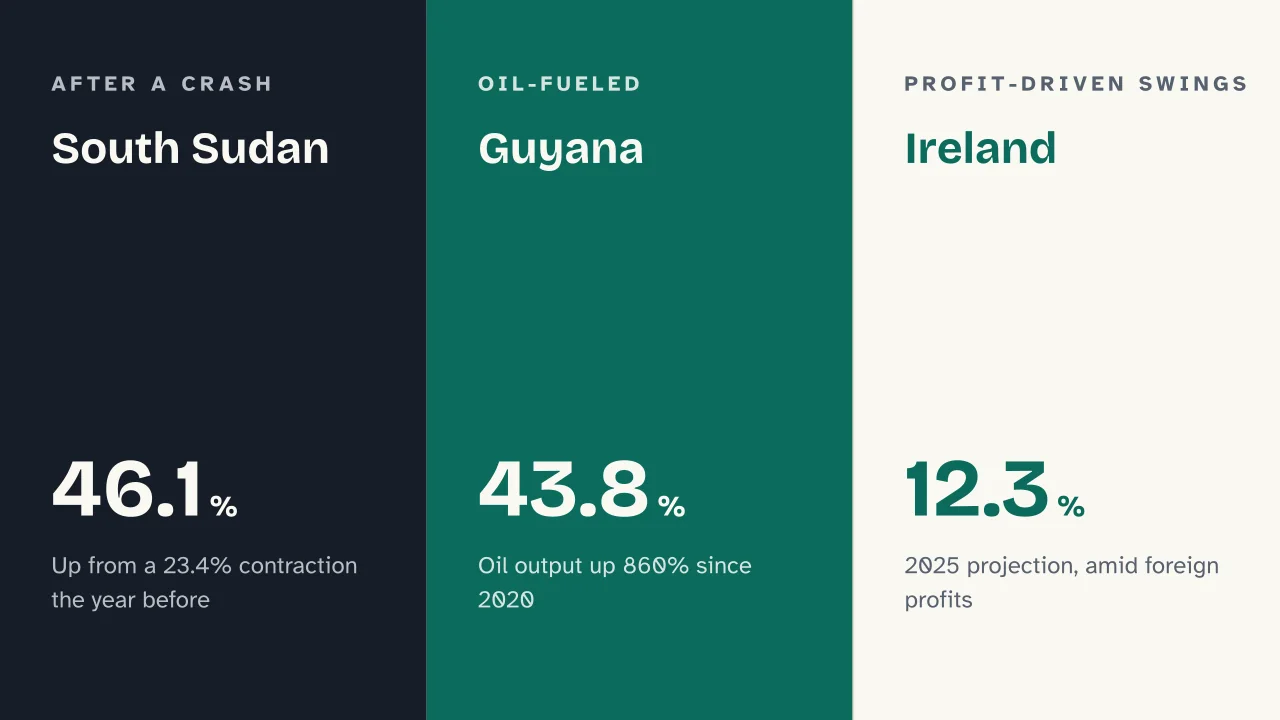
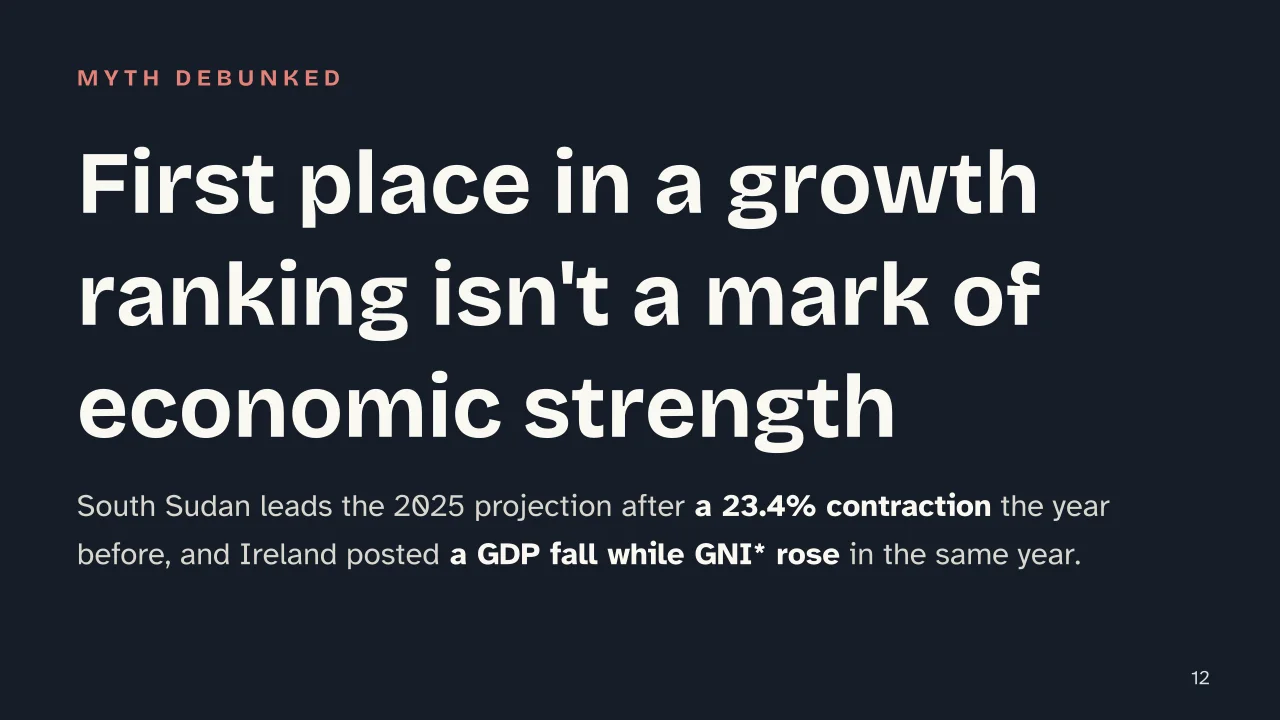
    That’s why the growth-rate ranking and the absolute-GDP ranking almost never line up. In the IMF’s 2025 projections, first place goes to South Sudan, at an estimated 46.1%. It’s a huge figure, but it has to be read against the year before: in 2024 South Sudan’s real GDP had contracted 23.4%. Most of the jump projected for 2025 is a rebound from a badly depressed base, not evidence of a stable boom.

    RankCountry2025 growth (IMF estimate)2024 growth
    1South Sudan46.1%-23.4%
    2Guyana19.3%43.8%
    3Libya15.9%4.2%
    4Ireland12.3%2.6%
    5Kyrgyzstan11.1%11.5%
    6Ethiopia9.2%8.1%
    7Taiwan8.7%5.3%
    8Tajikistan8.4%8.4%
    9Vietnam8%7%
    10Senegal7.9%6.1%

    The 2025 figures are IMF projections (World Economic Outlook Database); the 2024 figures are mostly final data.

    Guyana, in second place, tells a more straightforward story. The country’s real GDP grew 43.8% in 2024 according to the IMF, matching the World Bank’s series (43.8% in 2024, 33.8% in 2023, 63.3% in 2022). Oil production drove the numbers: Our World in Data puts the increase at 860% between 2020 and 2025, and before drilling began the country’s GDP per capita sat well below the world average — today it sits more than triple above it. Oil doesn’t guarantee growth on this scale as a rule: Guyana combined sizeable reserves with a recent start to production, and that specific combination is what the data can support.

    Practical example: Ireland shows how the same label, “GDP,” can tell opposite stories depending on how it’s read. According to Ireland’s Central Statistics Office (CSO), the country’s official GDP fell 5.5% in 2023, the same year GNI* — the alternative indicator the CSO calculates by excluding the effects of foreign multinationals — rose 5%. The CSO attributes the gap to a €48.5 billion drop in multinationals’ outbound profits compared with 2022: that year, official Irish GDP stood at €510.0 billion, GNI* at just €290.9 billion. That’s why the IMF projects a jump to 12.3% for Ireland in 2025, up from 2.6% in 2024: an economy with a heavy concentration of multinational tax residencies can swing wildly from one year to the next without living standards moving anywhere near as much.

    Large economies deserve the same scrutiny. China, the world’s second-biggest economy by absolute GDP, grew 5% in 2024, and the IMF projects another 5% for 2025, comfortably ahead of the 3.4% global average. Yet it doesn’t appear among the top ten in the growth-rate ranking: it carries enormous weight in absolute terms, less so once only pace is in view. India, the largest among the high-growth economies, posted 7.1% in 2024 with a 7.6% projection for 2025 — a high rate for an economy of its size, though still well short of the table’s top spots.

    Comparing these figures with other macroeconomic indicators helps put them in context: a closer look at Microeconomics vs Macroeconomics: What’s the Difference shows where GDP growth fits among the tools economists use to read an economy as a whole.

    Real GDP is calculated the way it is precisely to strip out the effect of rising prices, and the entry on Inflation: what it is, how it works and why prices rise walks through why.

    Anyone who wants to start from the basics can also read GDP: what it is, how it’s calculated and what it really tells us.

    Slide deck

    Slides ready to download and make your own in PowerPoint or Google Slides, with speaker notes. Pick the Flash cut or the Full one.
    Slide 1 of the presentation on Fastest Growing Economies in the World: The World's Fastest-Growing EconomiesSlide 2 of the presentation on Fastest Growing Economies in the World: Who's growing fastest?Slide 3 of the presentation on Fastest Growing Economies in the World: From definition to rankingSlide 4 of the presentation on Fastest Growing Economies in the World: Chapter 01: What the growth rate measuresSlide 5 of the presentation on Fastest Growing Economies in the World: Absolute GDP or growth rateSlide 6 of the presentation on Fastest Growing Economies in the World: Chapter 02: The global pictureSlide 7 of the presentation on Fastest Growing Economies in the World: Real GDP growth rate in 2024Slide 8 of the presentation on Fastest Growing Economies in the World: Chapter 03: The 2025 rankingSlide 9 of the presentation on Fastest Growing Economies in the World: The IMF's 2025 projectionsSlide 10 of the presentation on Fastest Growing Economies in the World: Chapter 04: Three stories, three driversSlide 11 of the presentation on Fastest Growing Economies in the World: South Sudan · Guyana · IrelandSlide 12 of the presentation on Fastest Growing Economies in the World: First place in a growth ranking isn't a mark of economic strengthSlide 13 of the presentation on Fastest Growing Economies in the World: According to the IMF's 2025 projections, which economy tops the world ranking for growth rate?Slide 14 of the presentation on Fastest Growing Economies in the World: Now, let's review
    Flash10 slidesThe essential thread, to present in classFull14 slidesEvery chapter and the deeper detail

    Common myths

    • ✗ Myth The fastest-growing economy is also the richest or the biggest one

      ✓ Reality In the IMF's 2025 projections, the top spots (South Sudan, Guyana, Libya, Ireland, Kyrgyzstan) belong to modest economies, several of them built around a single export. China, growing at 5% in 2024-2025, still sits outside the top ten by growth rate: it carries enormous weight in absolute terms, but it isn't among the fastest movers.

    • ✗ Myth A very high growth rate always signals a solid economic boom

      ✓ Reality South Sudan tops the 2025 projection after contracting 23.4% the year before, according to the IMF: the number mostly reflects a statistical rebound from a very low base. A high rate always needs to be read against what came before it.

    • ✗ Myth A country's growth rate for a given year is one fixed number everyone agrees on

      ✓ Reality For 2024, the IMF puts global real GDP growth at 3.4%, while the World Bank, using its own methodology and country sample, puts it at 2.9%. Neither institution got it wrong: they're two legitimate readings of the same year, and the gap between them is routine, not an error.

    Mind map

    Drag the background to move around and the nodes to reposition them; use − and + to collapse and expand branches.
    Customize
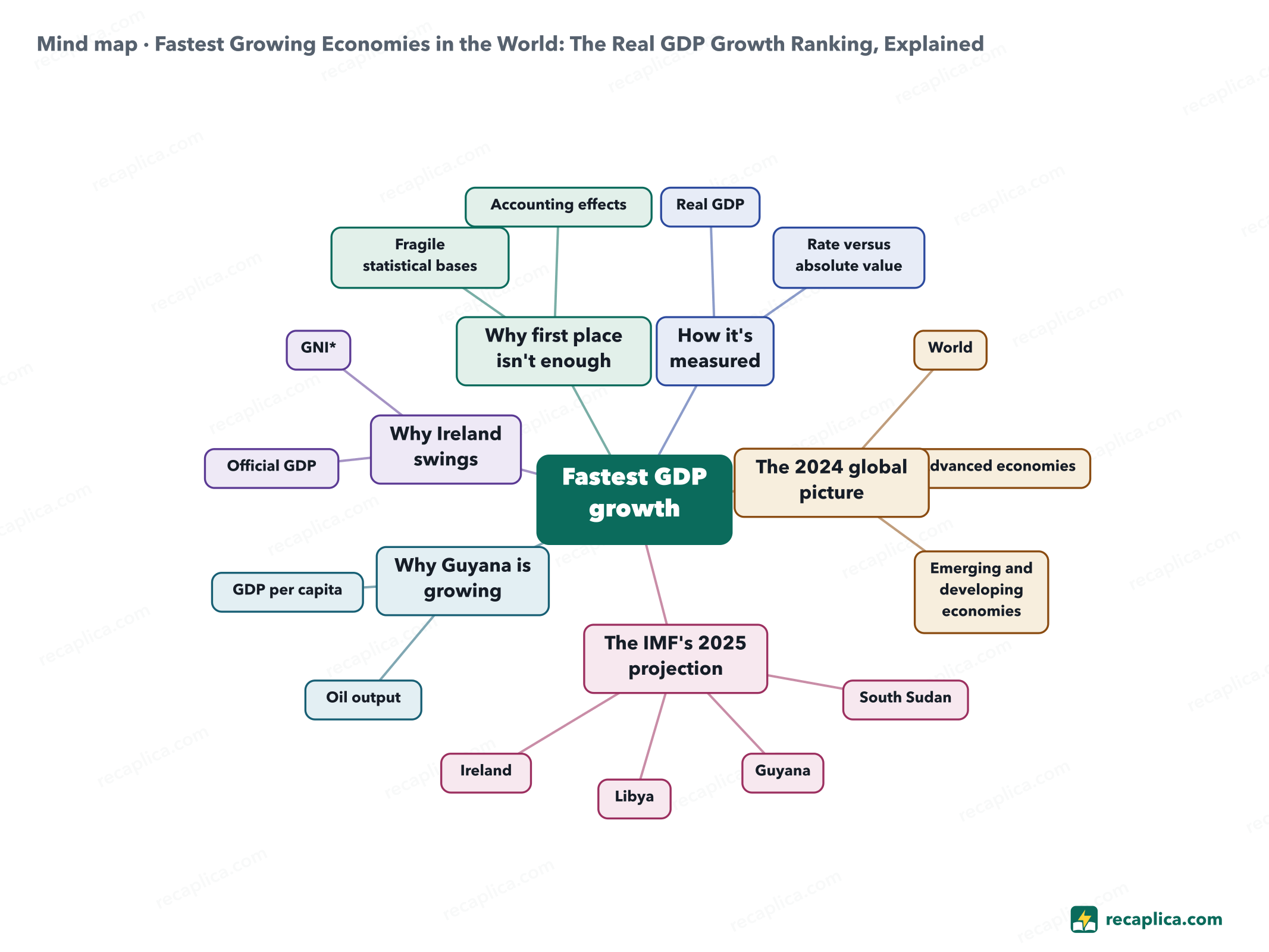
    Mind map: Fastest Growing Economies in the World: The Real GDP Growth Ranking, Explained
    • Fastest GDP growth
      • How it's measured A yearly percentage change
        • Real GDP Adjusted for inflation, at constant prices
        • Rate versus absolute value Two different rankings for the same economy
      • The 2024 global picture
        • World 3.4% per the IMF
        • Advanced economies 1.8%
        • Emerging and developing economies 4.5%, more than double the advanced rate
      • The IMF's 2025 projection
        • South Sudan 46.1% estimated, first place
        • Guyana 19.3% estimated
        • Libya 15.9% estimated
        • Ireland 12.3% estimated
      • Why Guyana is growing
        • Oil output Up 860% between 2020 and 2025
        • GDP per capita More than triple the world average
      • Why Ireland swings
        • Official GDP Tracks multinational profits
        • GNI* Strips them out, tells a different story
      • Why first place isn't enough
        • Fragile statistical bases A rebound isn't stable growth
        • Accounting effects A big number isn't always a big economy

    Quiz: test yourself

    Answer the questions to check what you have learned: you get instant feedback and a short explanation.

    Grade 0/10 0/5
    1 According to the IMF's definition, what does the real GDP growth rate measure?

    The IMF defines the indicator as real GDP growth: the annual percentage change at constant prices, meaning adjusted for inflation.

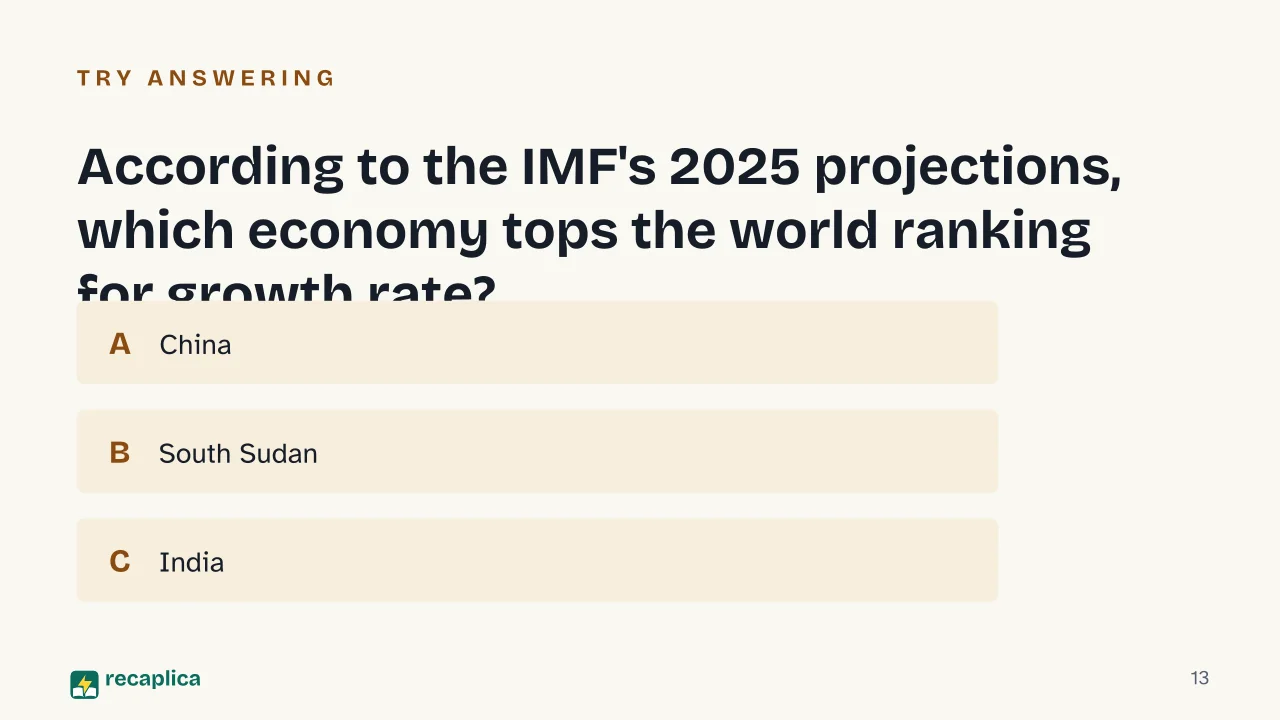
    2 According to the IMF's 2025 projections, which economy tops the world ranking for growth rate?

    The IMF projects 46.1% growth for South Sudan in 2025, the highest in the table — a figure that needs to be read alongside the 23.4% contraction the year before.

    3 Why is South Sudan's projected 2025 growth rate so high?

    South Sudan's real GDP contracted 23.4% in 2024: the growth projected for 2025 is largely a rebound from that very low base.

    4 True or false: in 2023, Ireland's GNI* rose while its official GDP fell.

    According to Ireland's Central Statistics Office, GDP fell 5.5% in 2023; that same year GNI*, which excludes foreign multinational profits, rose 5%.

    5 What was the world's real GDP growth rate in 2024, according to the IMF?

    The IMF puts world real GDP growth in 2024 at 3.4% (the World Bank puts it at 2.9%); emerging economies grew more than twice as fast as advanced ones.

    Answers: 1-A · 2-B · 3-A · 4-A · 5-B

    Flashcards

    Tap the card to flip it and check whether you remember the answer, then move to the next one.

    1 / 7

    Explain it in your own words

    The ultimate test: if you can explain it in simple words, you've truly understood it. Write your explanation, then compare it with the Recap.

    Your explanation is saved only on this device.

    According to the International Monetary Fund's projections for 2025, South Sudan tops the ranking for real GDP growth, followed by Guyana and Libya — small economies, or ones tied to a single resource, not the world's biggest ones. GDP growth rate measures, in percentage terms, how much a country's output expands each year, adjusted for inflation. Global real GDP grew 3.4% in 2024 according to the IMF, with emerging economies expanding at more than double the pace of advanced ones. A very high growth rate, though, can come from a rebound after a slump, an oil boom, or even an accounting quirk: on its own, it doesn't prove a stronger economy.

    Frequently asked questions

    What is the fastest-growing economy in the world?

    It depends on the year and the source. In the IMF's 2025 projections it's South Sudan (an estimated 46.1%), though that figure is largely a rebound from the previous year's slump. Looking at sustained GDP per capita growth over the decade to 2025, Our World in Data points to Guyana as the world's fastest-growing economy, driven by oil.

    Why does a small country grow faster than a giant like the United States or China?

    Because the growth rate is a percentage, and on a small economy even a modest rise in output turns into a large percentage jump. A huge economy, even when it expands far more in absolute terms, sits on such a vast base that matching the same percentage would require much bigger numbers.

    What's the difference between the ranking by absolute GDP and the one by growth rate?

    They measure two different things about the same phenomenon: the absolute-GDP ranking says which economy is bigger in a given year, the growth-rate ranking says which one is expanding fastest. The two lists almost never match — you can read the full comparison of countries by economic size in <a href="/en/economics/biggest-economies-in-the-world/">Biggest Economies in the World: The Ranking by GDP, Explained</a>.

    Does Ireland really grow at 12.3% a year?

    That's the IMF's projection for 2025, but Ireland's official figures are complicated by the weight of foreign multinationals: in 2023 official GDP fell 5.5% while GNI*, the indicator that excludes them, rose 5%. For Ireland, checking both numbers matters more than it does for most countries.

    Are the 2025 growth figures final data?

    For 2025 and 2026 the IMF publishes projections: they only become final figures once later editions of the World Economic Outlook update them. 2024 remains the last largely final year among those cited here.

    Sources

    • IMF DataMapper — World Economic Outlook Database (Real GDP growth, NGDP_RPCH)
    • World Bank Open Data — GDP growth (annual %)
    • Central Statistics Office of Ireland — Annual National Accounts 2023, Key Findings
    • Our World in Data — Guyana's oil-driven economy has had the largest GDP per capita growth in the world in recent years

    Every Recap goes through an independent review before publication.

    Every evening, the day's new Recaps on our Telegram channel. Join the channel →

    Keep learning

    • Economics Sustainability: Definition, What It Means and the Three Pillars Sustainability, in the fuller phrase sustainable development, is development that covers the needs of the people living now while leaving future generations able to cover their own: that is how the United Nations defines it. The wording comes from Our Common Future, the report published in 1987 by the World Commission on Environment and Development, also called the Brundtland Commission. Treccani lists three interdependent factors behind the expression. The United Nations describe an integrated approach, where environmental concerns travel alongside economic development. Read the Recap →
    • Economics 2008 Financial Crisis: Timeline of How It Started and Spread The 2008 financial crisis began in the United States in the subprime mortgage market, when expanding credit to riskier borrowers and the practice of bundling those mortgages into securities collided with slowing home prices, according to the Federal Reserve. In spring 2008 the investment bank Bear Stearns was rescued with Federal Reserve support, but that September Lehman Brothers filed for bankruptcy and the insurer AIG had to be propped up by the government. Washington responded with TARP, a program Congress authorized for up to $700 billion, and with new bank-supervision rules in 2010. US GDP fell 4.3% and unemployment climbed to about 10%, while in Europe the shock turned, in the following years, into a public-finance crisis that the European Central Bank had to address with government bond purchases. Read the Recap →
    • Economics Globalization: Definition, History, and How World Trade Works Globalization, as the International Monetary Fund defines it, is the world's economies growing more integrated: goods, services and capital crossing borders, along with labor and knowledge, plus broader political and cultural dimensions. It isn't a recent or a straight-line phenomenon: Our World in Data describes two major waves, the first starting in the 19th century and cut short by World War I in 1914, the second launched after World War II and still underway. World trade in goods and services reached $34.89 trillion in 2025, according to the World Trade Organization, while the map of trade flows has shifted: in 2024, China was the top import source for around four countries out of ten worldwide. Read the Recap →

    recaplica

    Clear in 30 seconds, yours in 10 minutes.

    Recaps Mind maps Request a Recap Telegram channel Mind map maker Our method About Privacy & cookies Legal notes & terms of use

    © 2026 Recaplica · A project by Curi S.r.l. — VAT IT05472000750

    Statistics, only if you say so

    To learn which Recaps help most we would use Google Analytics, with aggregate, anonymous data. It starts only with your OK, and you can change your mind anytime. Privacy policy