|
recaplica
How the European Union Works: Who Really Runs It | ||||||||||||||||||||||||
| © 2026 Recaplica · recaplica.com — All rights reserved | ||||||||||||||||||||||||
How the European Union Works: Who Really Runs ItWhat to print Page numbers appear when printing with default margins. SlidesChoose a cut Flash10 slidesThe essential thread, to present in classFull15 slidesEvery chapter and the deeper detailBoth come with speaker notes. In 30 seconds quick readThe European Union does not have one government; it runs on seven institutions with different jobs. The European Parliament, elected directly by citizens, and the Council of the European Union, where national ministers sit, jointly pass almost every EU law, but only after the European Commission has proposed it. The European Council, made up of heads of state and government, sets the broad political direction but never votes on legislation. The toughest calls at the Council of the EU go through qualified majority voting: at least 15 of the 27 member states have to say yes, and together they must represent 65% of the EU population. Key Points
Key figures
Deep DiveSeven institutions, not oneAccording to the EU’s official portal, the institutions with “distinct functions” that work together cover seven bodies: the European Parliament, the European Council, the Council of the European Union, the European Commission, the Court of Justice of the European Union, the European Central Bank and the European Court of Auditors. There is no single European government; each of these bodies has a different job. The Parliament “represents the citizens of EU countries and is directly elected by them,” according to the official description. The European Council brings together heads of state or government to set the overall political direction. The Council of the European Union instead represents national governments through sector ministers, who meet to adopt laws. The Commission represents the EU’s common interests and is its main executive body. The Court of Justice makes sure EU law is respected and interpreted correctly. The European Central Bank looks after price stability in the euro area. The European Court of Auditors works to improve financial management and transparency. Readers already familiar with how a national government works, say from the structure of the Italian Constitution, will find a different layout here: no single body concentrates lawmaking, execution and political direction the way a national government does. The European Council and the Council of the EU: the mix-up everyone makesThis is where confusion about the EU runs deepest, and journalists often slip up here too. The European Council brings together the heads of state or government of the 27 member countries. Official Council and EU sources are blunt about this: it “does not legislate,” but it “sets the EU’s overall political direction and priorities.” It has its own president, elected by European Council members through a qualified majority for a term of two and a half years, renewable once: Charles Michel, for instance, was re-elected for a second term running from 1 June 2022 to 30 November 2024. The Council of the European Union, often called simply “the Council,” is a different body altogether. It brings together the national ministers responsible for whatever is on the agenda: agriculture ministers when farming policy is discussed, environment ministers when it is environmental policy. Together with the Parliament, the Council of the EU adopts the vast majority of European laws. Its presidency is not fixed: it rotates among member states every six months.
Who proposes the laws: the Commission’s jobMost European laws start neither in the Parliament nor in the Council. They start at the European Commission, which its own official page describes as “responsible for the planning, preparation and proposal of new European legislation” — the so-called right of initiative. The Commission can act on its own initiative or respond to a request from the European Council, the Council of the European Union, the Parliament, or citizens through a successful European Citizens’ Initiative. Before a proposal is drafted, citizens, businesses, civil society and public authorities can weigh in during the consultation process. At the top of the Commission sits the College of Commissioners: 27 members, one per member state in the 2024-2029 term, appointed for five years. The Commission President assigns each Commissioner responsibility for a specific policy area, but decisions are taken collectively, under the principle of collegiality — no single Commissioner decides alone. The European Parliament: elected, not appointedThe European Parliament is the only EU institution elected directly by citizens. Since 1979, MEPs have been chosen by direct universal suffrage every five years, through electoral systems based on proportional representation in each member state. In the 2024-2029 term the Parliament has 720 members, fifteen more than the 705 of the 2019-2024 term. Seats per country follow the principle of degressive proportionality: an MEP from a larger country represents more people than an MEP from a smaller one. The Treaty on European Union sets the boundaries: no more than 750 representatives besides the President, a minimum of 6 seats per state, a maximum of 96.
MEPs do not sit by nationality but by political affinity, in groups. In the 2024-2029 term there are eight political groups; forming one requires at least 23 members from at least a quarter of member states, seven in this term, and no MEP can belong to more than one group. The Parliament holds three powers, by its own official description: a legislative one, exercised together with the Council of the EU; a budgetary one, since the Parliament and the Council must agree on the EU’s annual budget each year; and an oversight one, watching over the work of EU institutions, in particular the Commission, described as “the executive arm of the European Union.” A concrete example of that third power is the election of the Commission President, which requires the Parliament’s approval by an absolute majority — half of all members plus one. On 18 July 2024, Ursula von der Leyen was re-elected to a second five-year term with 401 votes in favour out of 719 MEPs present that day, 284 against and 22 blank or invalid ballots, against a required threshold of 360 votes. The vote was held by secret ballot. How a European law is actually madeThe typical sequence, according to official Council and Parliament sources, runs like this: the Commission proposes, the Parliament and the Council of the EU negotiate and amend the text over up to three readings, and finally adopt it together. The sources are explicit on the point: “the vast majority of EU laws, covering most policy areas, are negotiated and adopted jointly by the Council and the European Parliament, on the basis of a proposal of the European Commission.” This pattern, called the ordinary legislative procedure (formerly “codecision”), is one reason neither the Parliament nor the Council of the EU can impose a law on the other alone: both have to agree on a final text. Qualified majority voting: the vote that decidesNot every decision at the Council of the European Union carries the same weight. Under the standard procedure, and under the rules officially in force as of 2026, a qualified majority is reached when two conditions are met at once: at least 55% of member states vote in favour, meaning 15 of 27, and those states together represent at least 65% of the EU’s total population. Blocking a proposal takes at least four states voting against; with fewer than four, the qualified majority still counts as reached. When the Council votes on a proposal that does not come from the Commission or the High Representative, a higher bar applies, the reinforced qualified majority: at least 72% of states (at least 20 of 27) in favour, representing together at least 65% of the EU population.
The Court of Justice and the European Central BankNot every EU institution makes laws or policy. Some enforce the rules; others manage technical tools that touch the daily lives of hundreds of millions of people. The Court of Justice of the European Union exists to “ensure that EU law is followed and applied in the same way across the EU.” As of 2026 it is made up of 27 judges and 11 advocates general; each member state nominates its own judge, who must be independent and qualified for the highest judicial offices at home, or a recognised expert in EU law. A panel set up under Article 255 of the Treaty on the Functioning of the EU reviews candidates’ suitability before appointment. Judges serve renewable six-year terms. The Court of Justice of the European Union is actually made up of two distinct judicial bodies: the Court of Justice and the General Court. The European Central Bank has one stated primary aim: “to maintain price stability,” meaning to safeguard the value of the euro. According to the ECB, that goal is linked to broader EU objectives such as economic growth and job creation. Its functions include banking supervision, issuing banknotes, statistical collection and macroprudential oversight of financial stability, run through a governance structure that includes an Executive Board, a Governing Council, a General Council and a Supervisory Board. From six member states to twenty-sevenThe European Union grew out of a much smaller core. In 1951, six countries — Belgium, France, Germany, Italy, Luxembourg and the Netherlands — founded the European Coal and Steel Community; in 1957 the same six set up the European Economic Community and the European Atomic Energy Community through the Treaties of Rome. Enlargement followed in waves: Denmark, Ireland and the United Kingdom joined in 1973, bringing the total to nine; Greece became the tenth member in 1981; Spain and Portugal joined in 1986, taking the count to thirteen; Austria, Finland and Sweden joined in 1995, reaching fifteen; ten countries joined in 2004 (the Czech Republic, Estonia, Cyprus, Latvia, Lithuania, Hungary, Malta, Poland, Slovakia and Slovenia), taking the total to twenty-five; Bulgaria and Romania joined in 2007, reaching twenty-seven; Croatia joined in 2013, reaching twenty-eight. As of 2026 the Union has 27 member states, a number that also reflects the United Kingdom’s departure on 31 January 2020. Knowing who the member states are, and how much weight each carries in a vote, also helps when reading news and debates about European institutions: the tools described in the Recap on how to spot fake news come in handy exactly when the European Council and the Council of the EU get mixed up, or when a power that belongs to one institution gets attributed to another. Beyond Brussels: the EU’s international cooperationEU institutions do not operate in a diplomatic vacuum: member states remain actors with their own foreign policies, which the Union tries to coordinate without fully replacing them. In Italy, that coordination runs partly through the Ministry of Foreign Affairs and International Cooperation, which represents the country in European and international forums alongside its permanent representatives in Brussels. One of the clearest examples of the community method at work — a Commission proposal followed by negotiation between the Parliament and the Council — is the regulation of new technologies: the EU AI Act, Europe’s law on artificial intelligence, started as a Commission proposal and was then negotiated and amended by the Parliament and the Council of the EU following the same pattern described above. Slide deckSlides ready to download and make your own in PowerPoint or Google Slides, with speaker notes. Pick the Flash cut or the Full one.     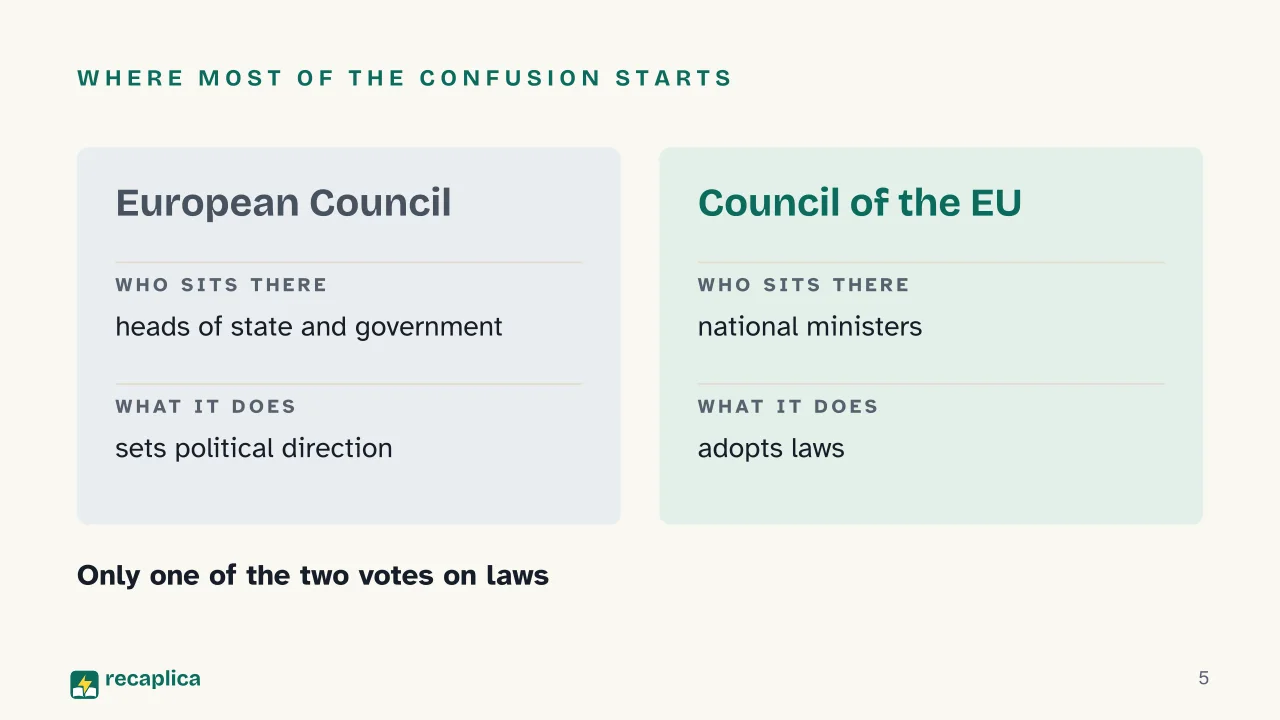 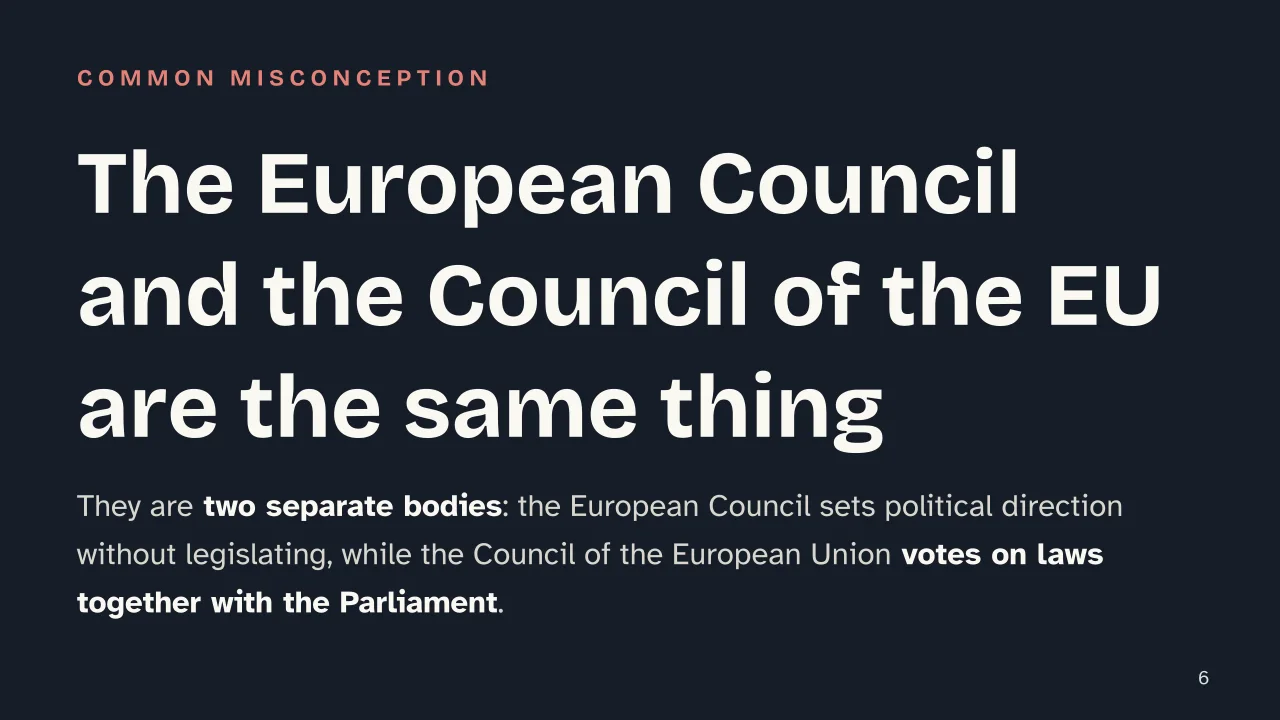  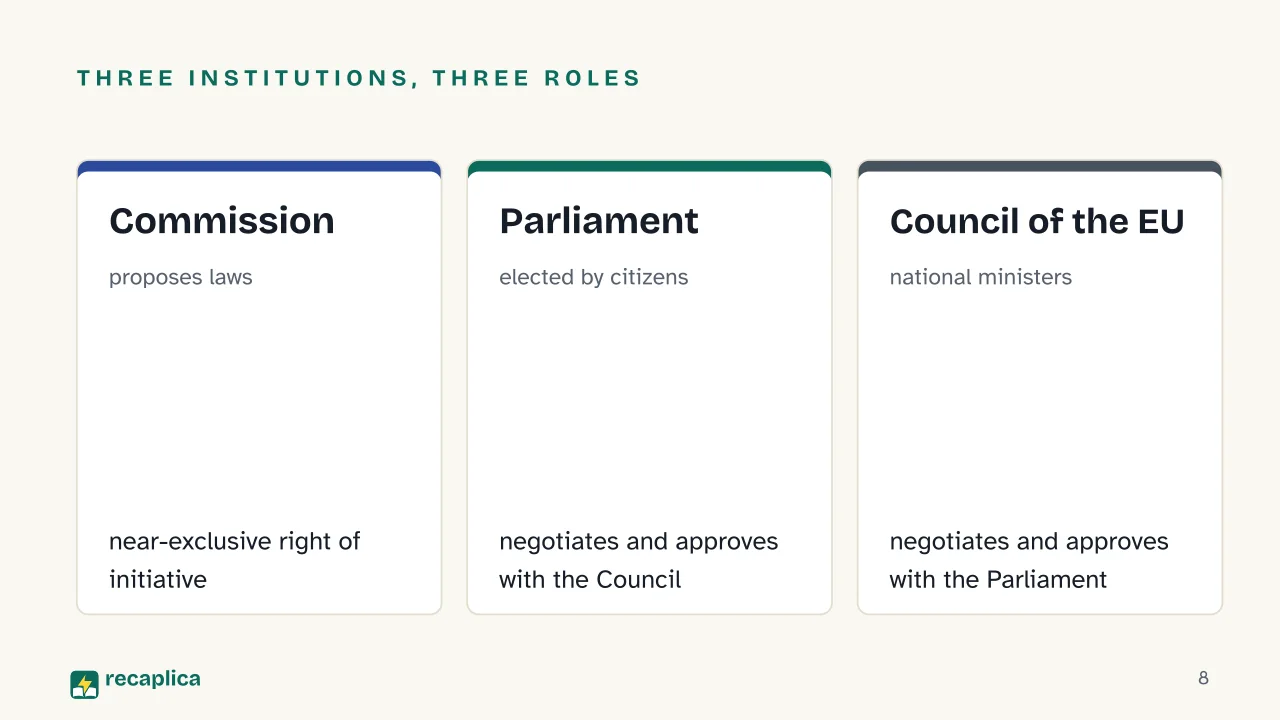 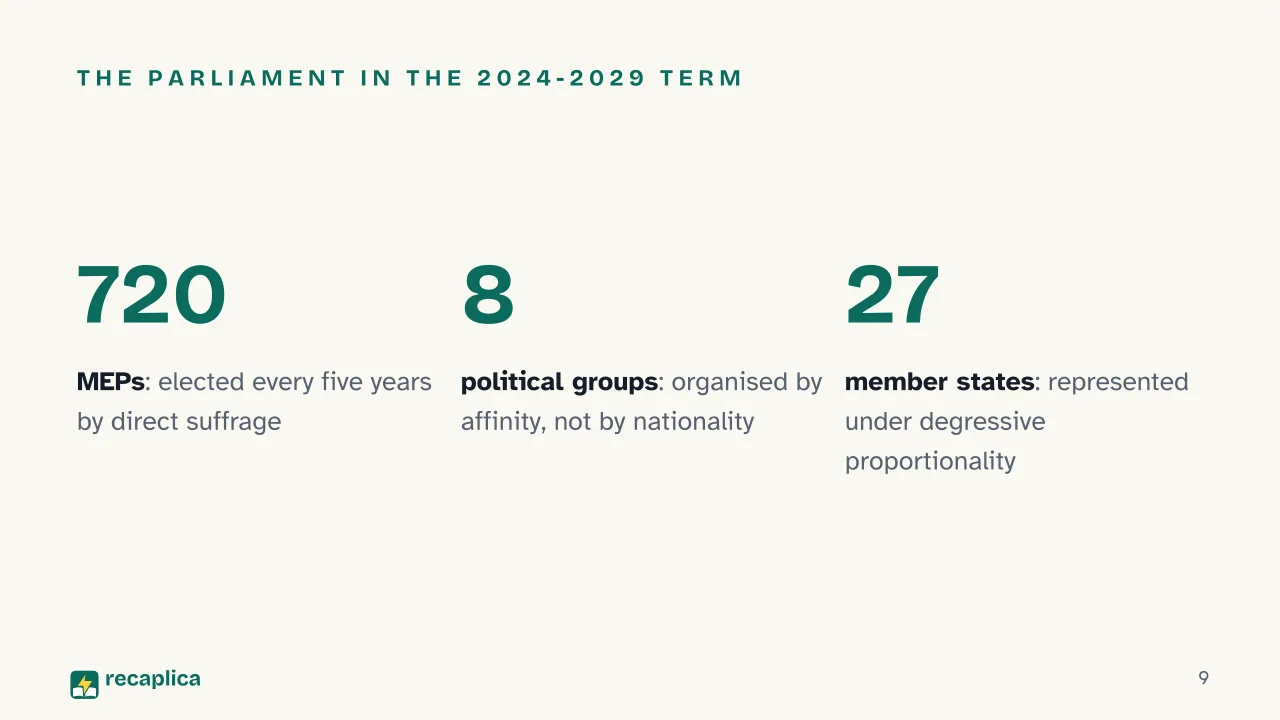  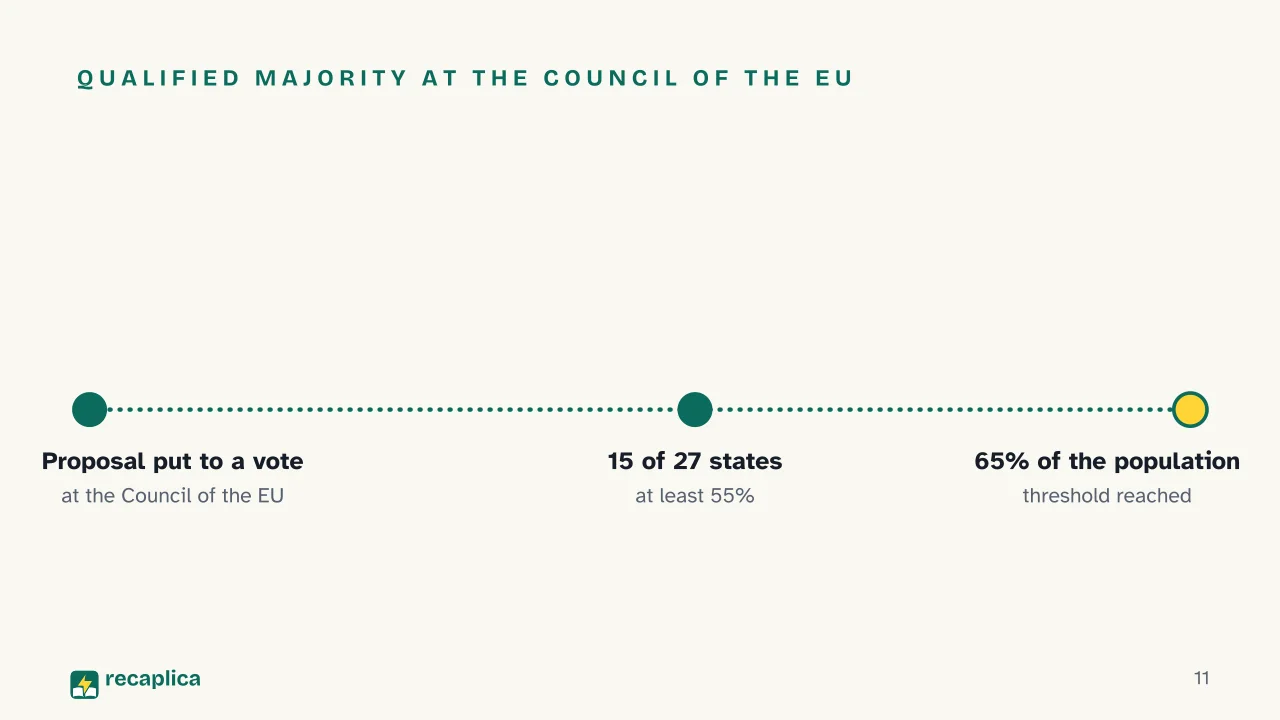  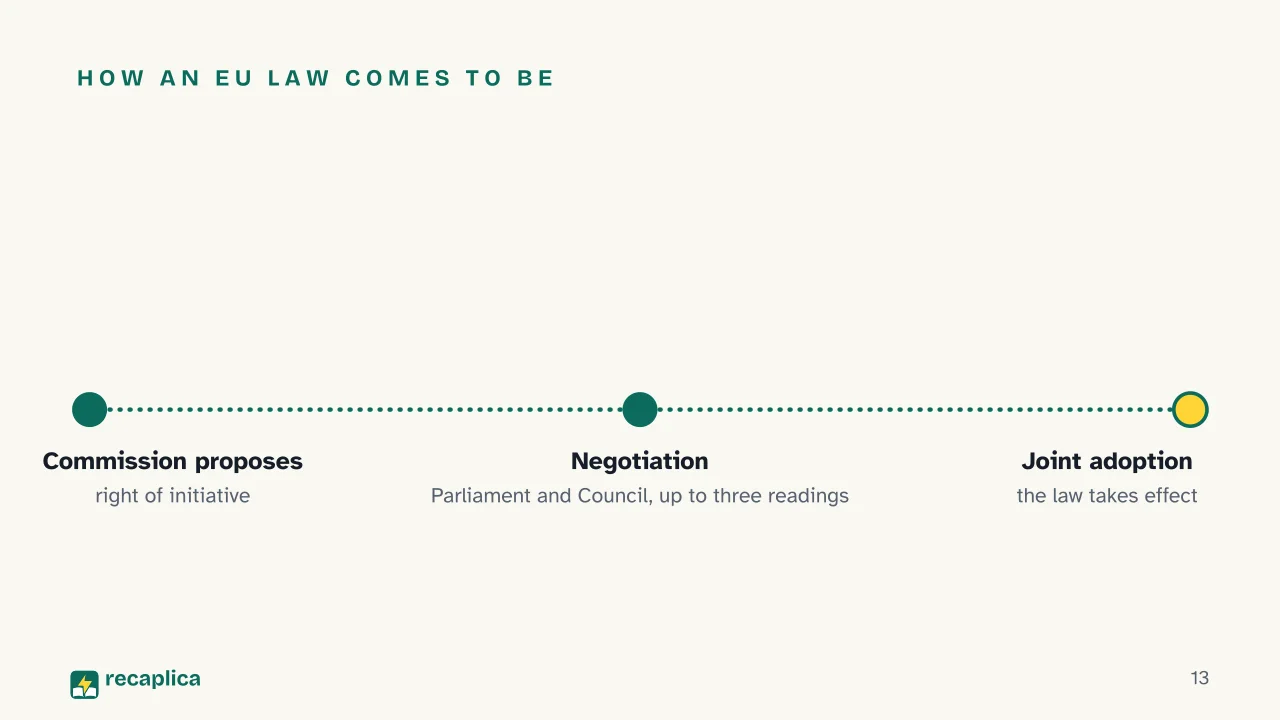   Common myths
Mind mapDrag the background to move around and the nodes to reposition them; use − and + to collapse and expand branches. 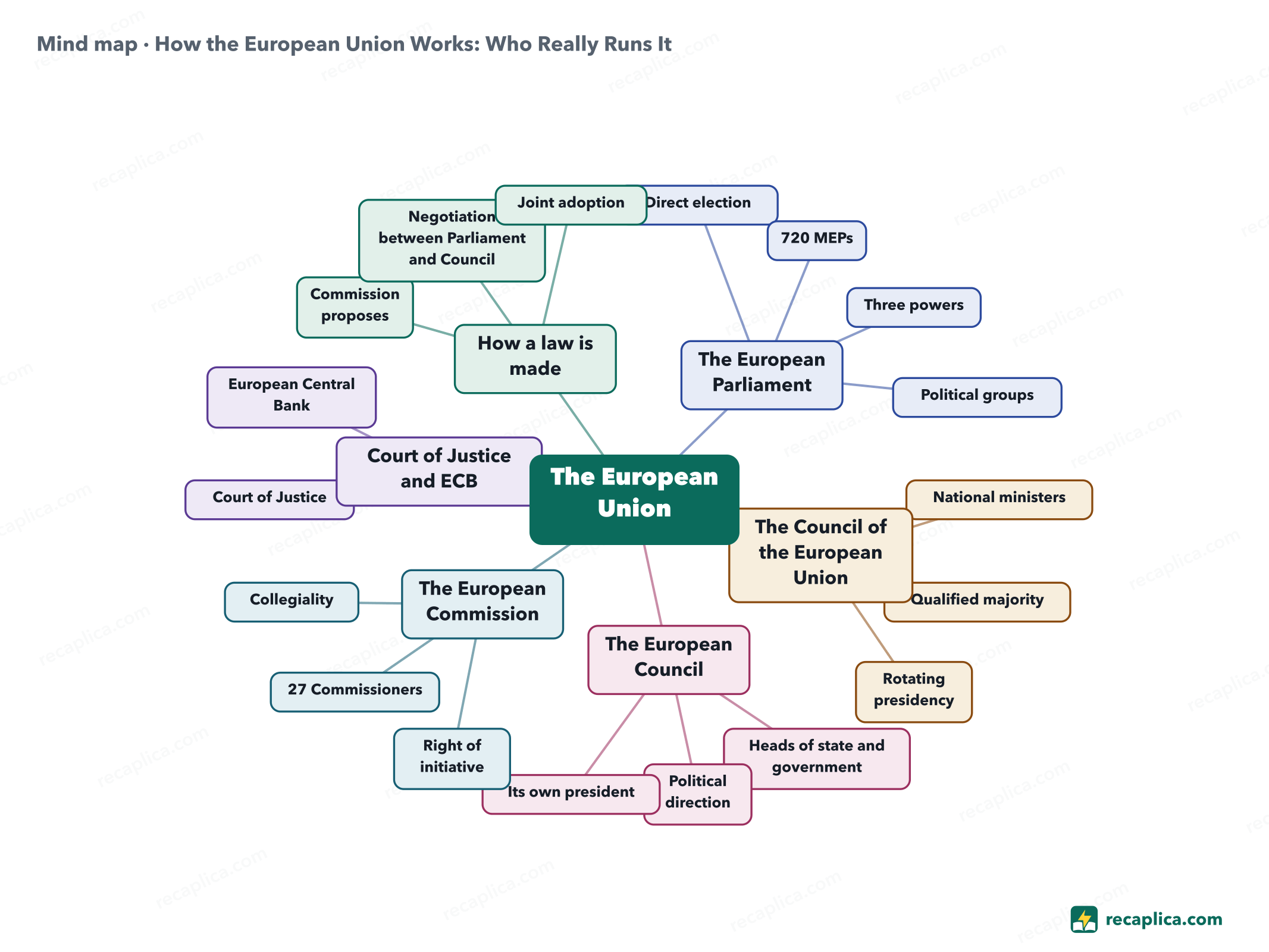
Quiz: test yourselfAnswer the questions to check what you have learned: you get instant feedback and a short explanation. Grade 0/10 0/5
FlashcardsTap the card to flip it and check whether you remember the answer, then move to the next one. 1 / 7 Explain it in your own wordsThe ultimate test: if you can explain it in simple words, you've truly understood it. Write your explanation, then compare it with the Recap. Your explanation is saved only on this device.
Frequently asked questionsHow is an EU law passed?The European Commission puts forward a proposal, after consulting citizens, businesses and other stakeholders. The Parliament and the Council of the European Union then negotiate it together, over up to three readings, amending it until they reach a joint agreement. Only then is the law adopted: neither institution can pass it alone. What is the difference between the European Council and the Council of the European Union?The European Council brings together the heads of state or government of the 27 countries and sets the EU's broad political priorities, without legislating. The Council of the European Union brings together national sector ministers instead — for example finance or environment ministers — and adopts actual legislation jointly with the Parliament. How does someone become President of the European Commission?The candidate needs an absolute majority of votes in the European Parliament, meaning half of all members plus one. On 18 July 2024, Ursula von der Leyen was re-elected to a second term with 401 votes in favour out of 719 MEPs present, against a required threshold of 360, in a secret ballot. Who sets monetary policy for the euro area?The European Central Bank, whose main task is keeping prices stable in the euro area. It also manages foreign reserves, banking supervision and payment system oversight, under the Treaty on the Functioning of the European Union and the Statute of the European System of Central Banks. How many countries belong to the European Union, and how did it get to that number?As of 2026 the European Union has 27 member states. The original core, in 1951, was six countries (Belgium, France, Germany, Italy, Luxembourg, the Netherlands); further countries joined in 1973, 1981, 1986, 1995, 2004, 2007 and 2013, with a single departure, the United Kingdom's. Every Recap goes through an independent review before publication. |