Skip to content
recaplica

    One moment: security check

    Cloudflare wants to make sure you're not a robot. Tick the box below and your search will continue on its own.

    IT
    recaplica Mercantilism: History, Examples, and Definition
    © 2026 Recaplica · recaplica.com — All rights reserved
    Home › Economics

    Mercantilism: History, Examples, and Definition

    By Recaplica Newsroom · Updated on September 24, 2026

    What to print

    Page numbers appear when printing with default margins.

    Slides

    Choose a cut

    Flash10 slidesThe essential thread, to present in classFull16 slidesEvery chapter and the deeper detail

    Both come with speaker notes.

    Telegram channel
    recaplica Clear in 30 seconds, yours in 10 minutes.
    In 30 seconds Key points Deep dive Slides Myths Mind map Quiz Flashcards FAQ

    In 30 seconds quick read

    Mercantilism was the dominant economic doctrine in Western Europe from the 16th to the 18th century: a state grew powerful by selling more abroad than it bought, building up reserves of gold and silver. Britannica Money describes it as "an economic practice by which governments used their economies to augment state power at the expense of other countries." Colonies had one job under this system: supply raw materials to the mother country and buy finished goods back from it, while at home tariffs and monopolies shielded domestic industry. The name itself came later, from the doctrine's most famous critic: Adam Smith made it current in The Wealth of Nations, published in 1776.

    Key Points

    • Britannica Money defines mercantilism as the practice by which states used their economies to increase their own power at the expense of rival countries; it dominated the Western world from the 16th to the 18th century.
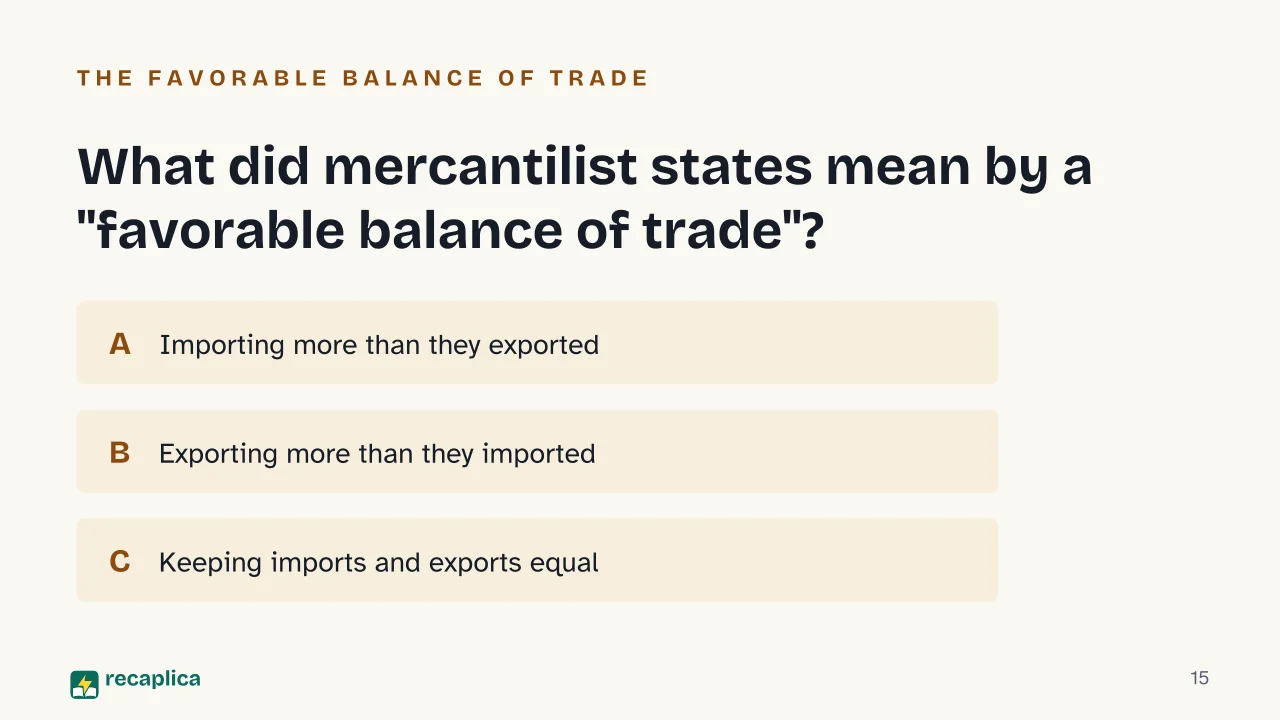
    • The goal was a favorable balance of trade, exporting more than a country imported, to build up gold and silver reserves: both Econlib and the OpenStax textbook describe this as the system's core aim.
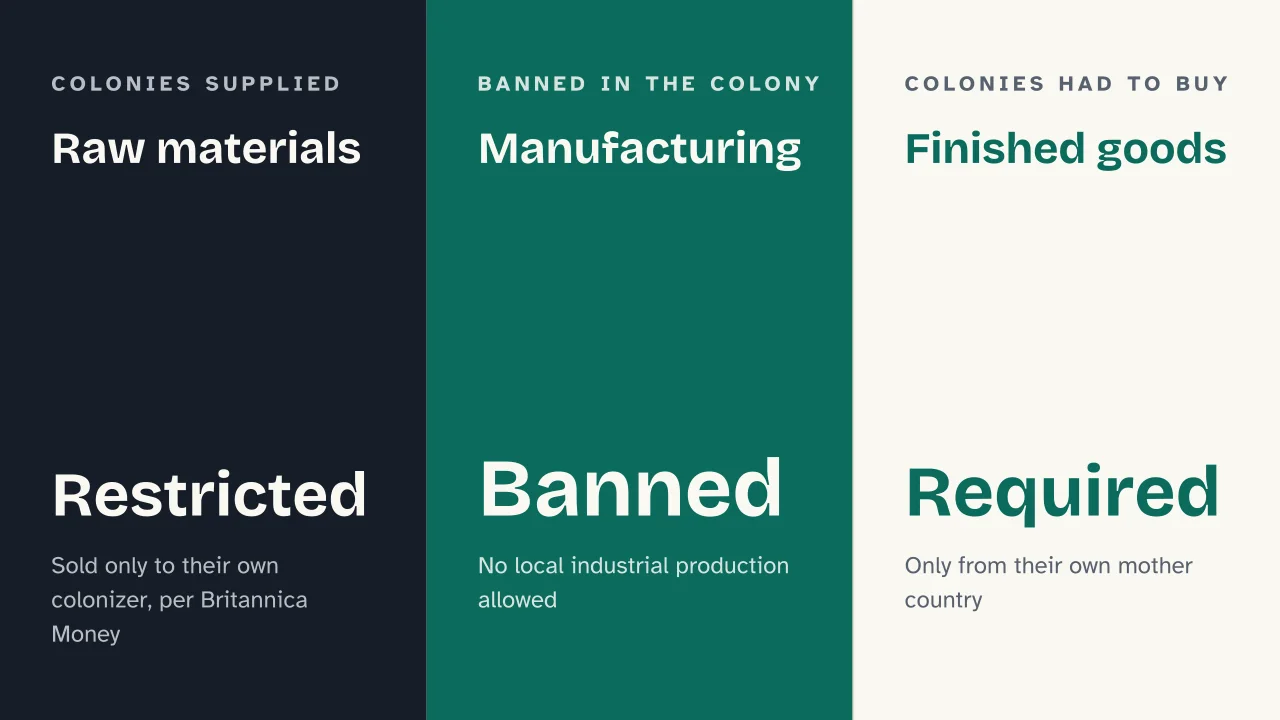
    • Under mercantilism, Britannica Money notes, colonies could sell raw materials only to their own colonizer and had to buy finished goods only from the mother country; local manufacturing was banned.
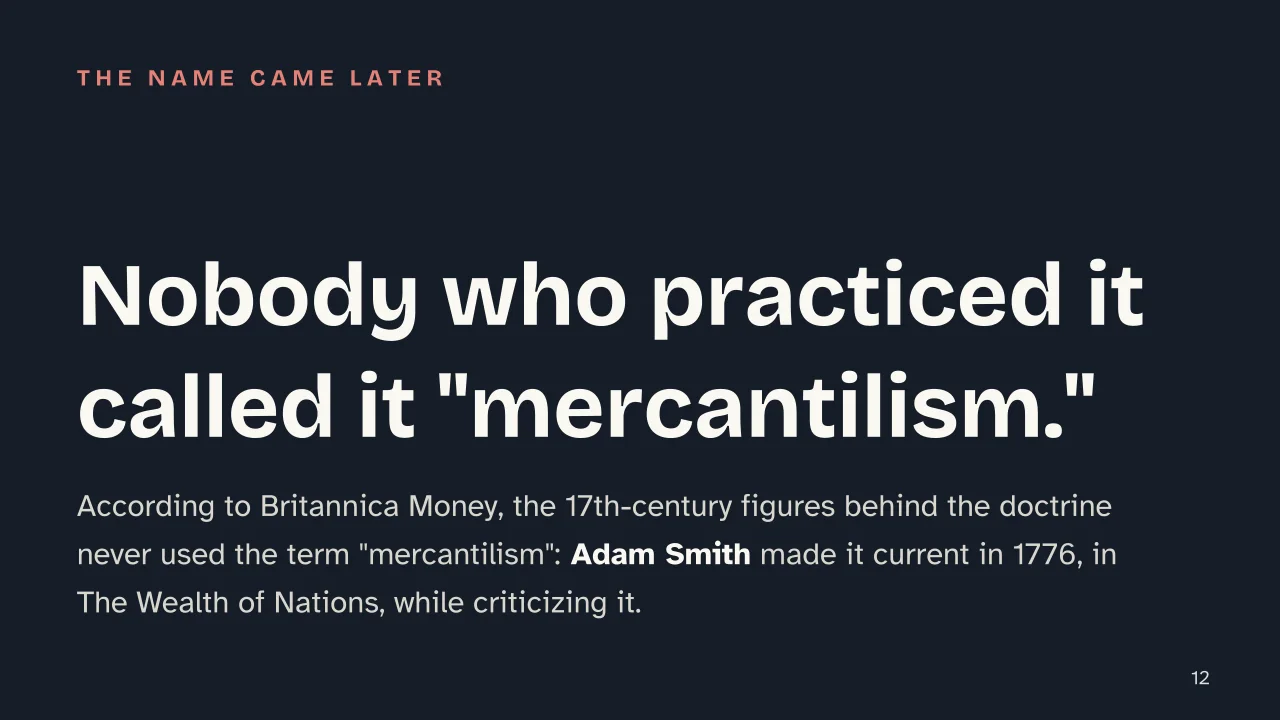
    • The word mercantilism was never used by its 17th-century practitioners, such as Thomas Mun, Jean-Baptiste Colbert, and Antonio Serra: Adam Smith gave the term currency in The Wealth of Nations, 1776 (Britannica Money).
    • According to Econlib, the hunt for precious metals also answered a practical need: armies and navies had become full-time professional forces that required hard currency reserves to maintain.
    • OpenStax describes the system's underlying premise as a zero-sum view: the world's wealth in gold and silver was treated as fixed, so one nation's gain was another's loss.

    Deep Dive

    A doctrine named by its critics

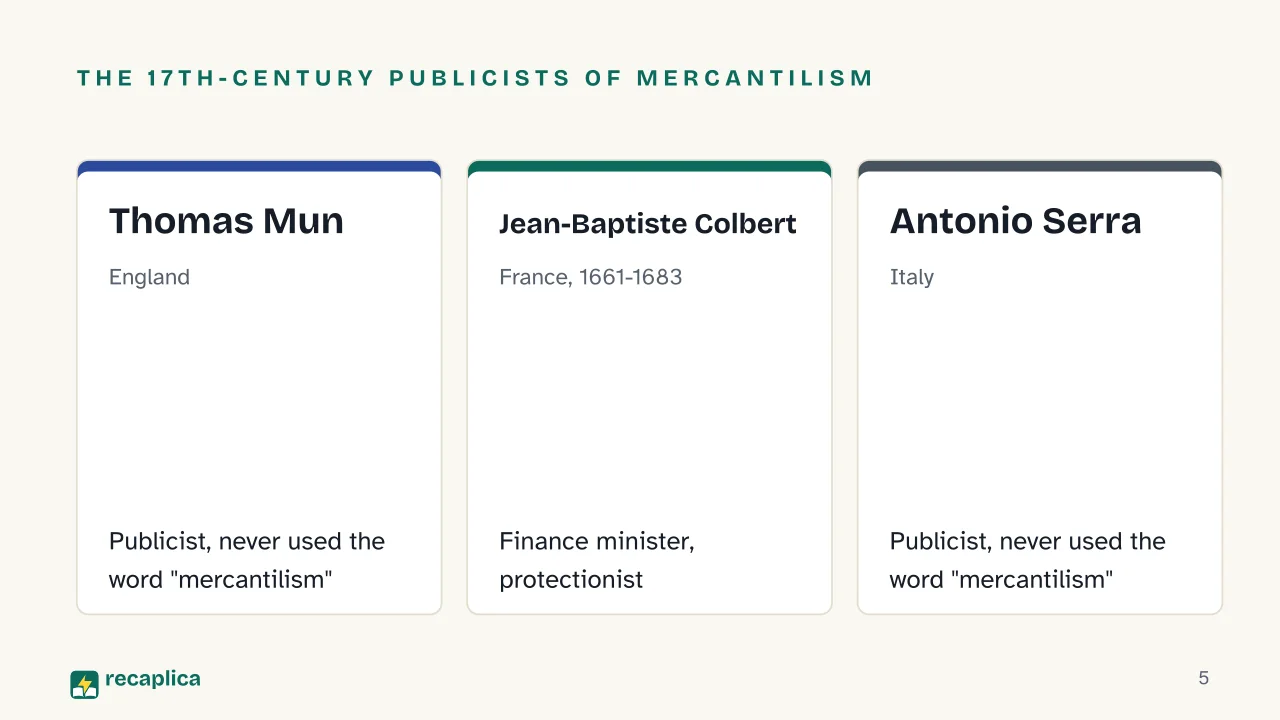
    In the 17th century, officials and writers such as the Englishman Thomas Mun, the Frenchman Jean-Baptiste Colbert, and the Italian Antonio Serra applied and described the economic policies we now call mercantilism. None of the three, however, ever used that word for their own work: according to Britannica Money, it was Adam Smith, in The Wealth of Nations of 1776, who gave the term currency, while criticizing its foundations. Mercantilism was the prevalent economic system in the Western world from the 16th to the 18th century, applied mainly in France, Spain, Portugal, Italy, and Britain, as well as Germany and the Netherlands — a period sometimes summarized as the history of mercantilism.

    The trade surplus, the shared goal

    The principle uniting these different practices was simple to state: a state had to sell more abroad than it bought. Econlib describes mercantilism as a form of economic nationalism, aimed at building a wealthy and powerful state: restricting imports and encouraging exports served to attract gold and silver and to support domestic employment. The same underlying idea served mercantilist states much as GDP serves today to measure the size of an economy: back then the yardstick was the reserve of precious metals, today it is the value of everything a country produces.

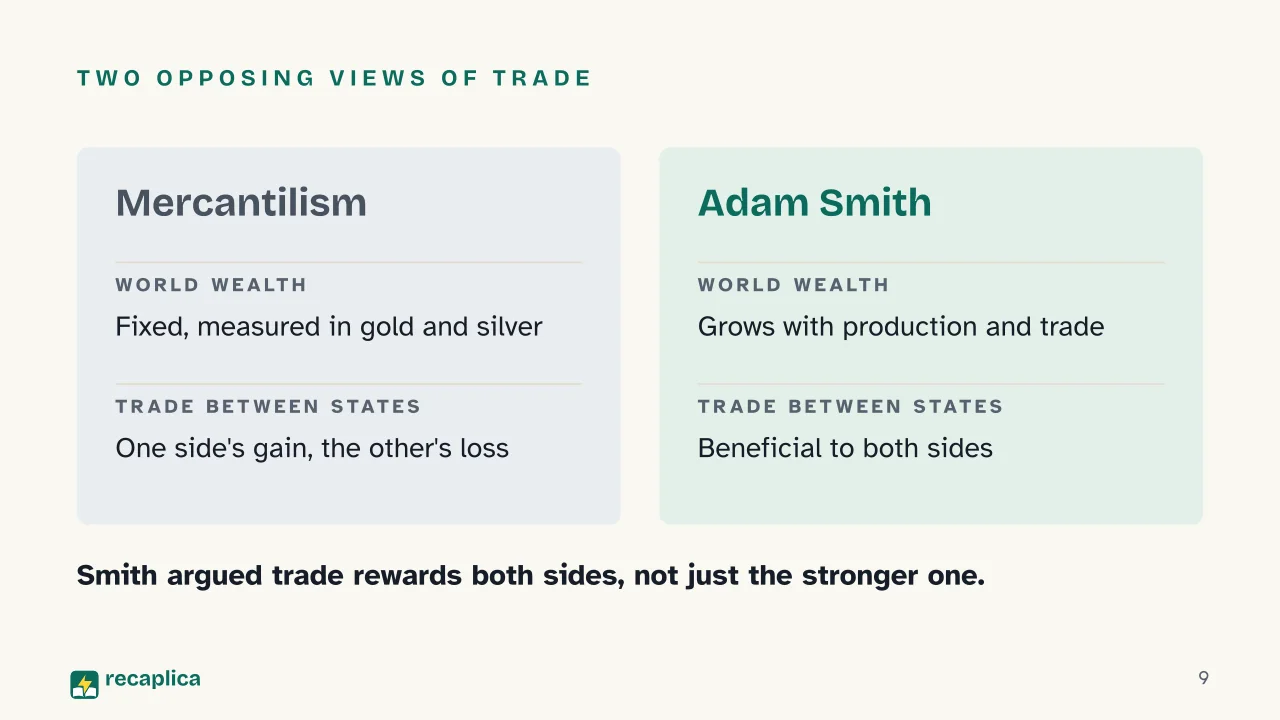
    OpenStax describes the conceptual premise behind this pursuit: the world’s wealth, measured in gold and silver, was treated as a finite quantity. One nation’s gain was therefore another’s loss, a zero-sum view that pushed every state to maximize exports and minimize imports, to the point of aiming to produce even farm goods at home.

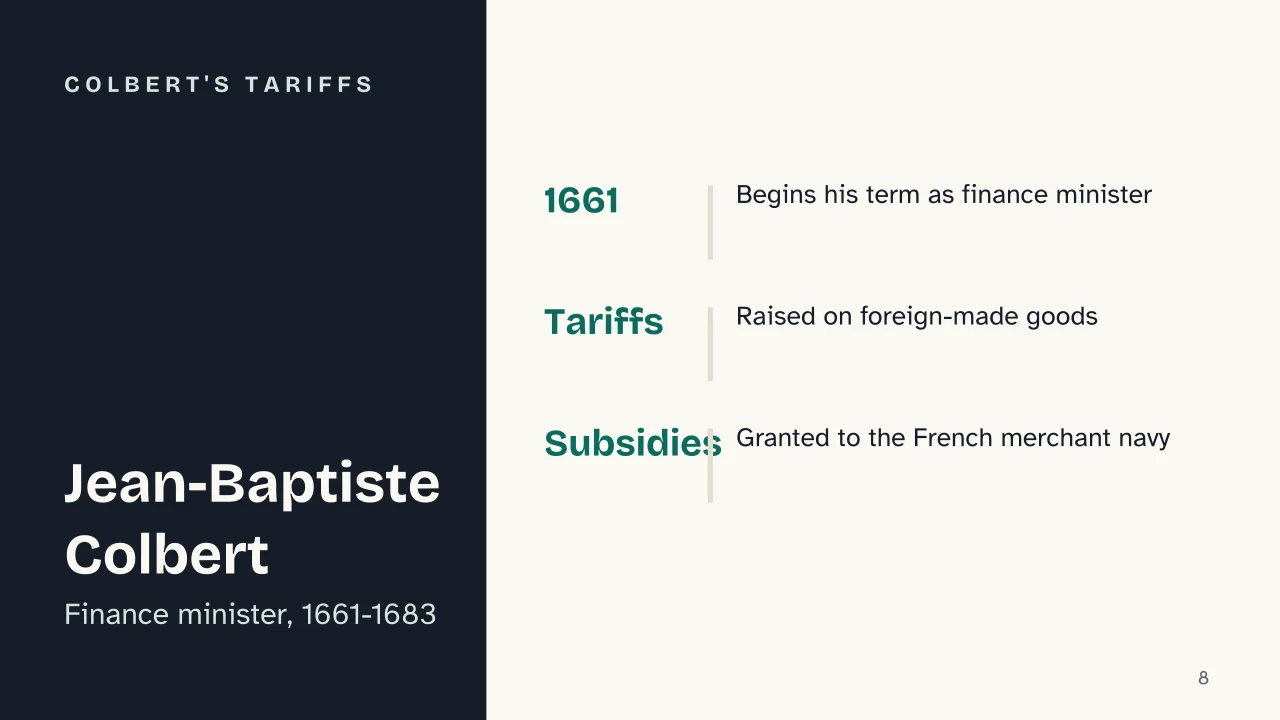
    Example: as French finance minister from 1661 to 1683, Jean-Baptiste Colbert applied mercantilism to the letter. He raised tariffs on foreign goods and banned the import of some products outright, while subsidizing the French merchant navy (Econlib, OpenStax).

    Laws that closed the ports

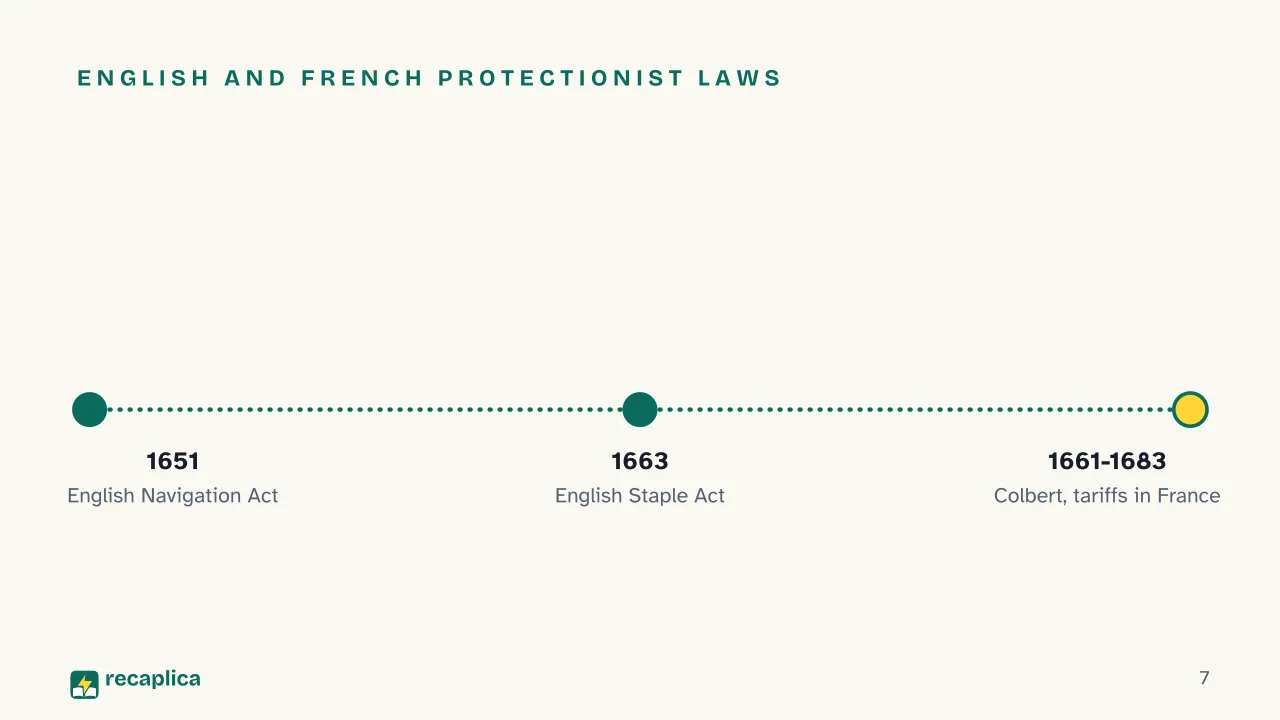
    Mercantilist protectionism also took the form of law. In England, Econlib cites the Navigation Act of 1651, which restricted foreign vessels, and the Staple Act of 1663, which required colonial exports to pass through English ports before reaching the rest of Europe. Rules like these did not concern foreign trade alone: they also shaped the relationship between a mother country and its colonies, the subject of the next section.

    Mercantilism in the colonies

    Under mercantilism, colonies had a defined economic job, not just political oversight from a distant capital. According to Britannica Money, they could sell their own raw materials only to their colonizers and had to buy finished goods only from their respective mother countries; local manufacturing was banned. OpenStax describes the same mechanism from the other side: colonies supplied raw materials for the mother country’s domestic consumption, sparing it the need to buy them elsewhere, and their populations were in turn a ready market for goods made at home.

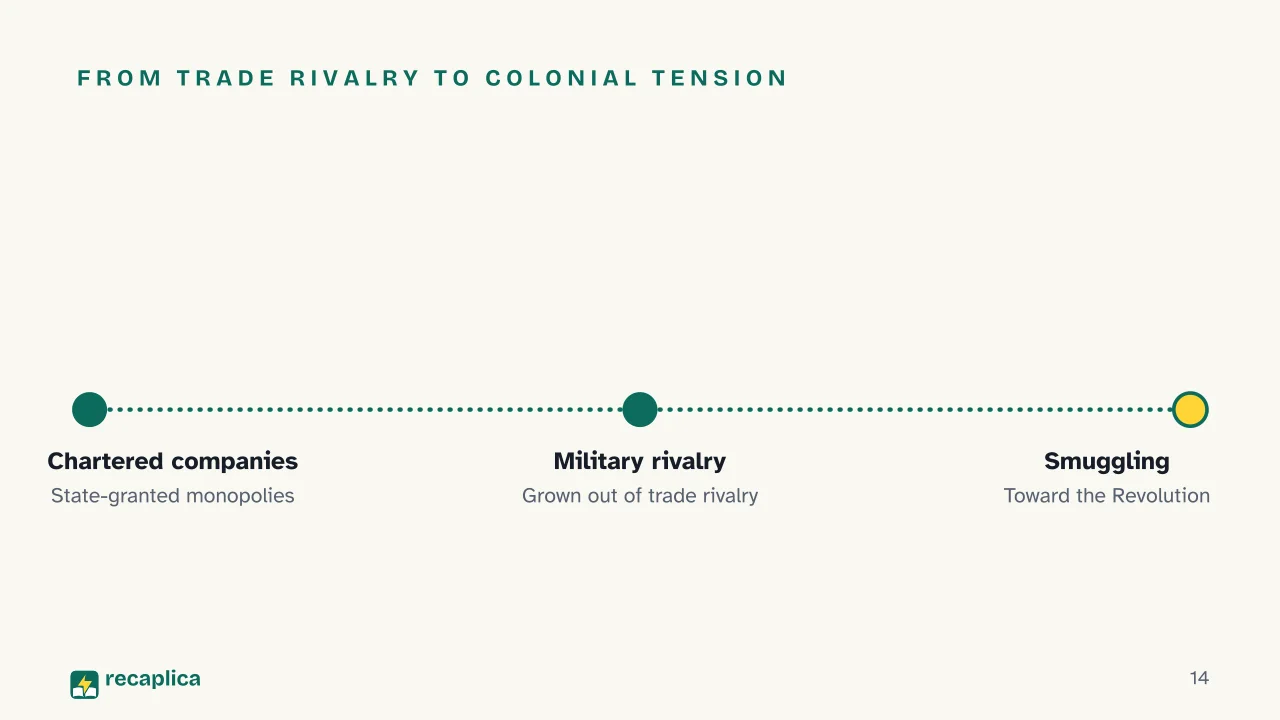
    This double constraint, Britannica Money explains, also produced monopoly trading companies and a commercial rivalry between European states that turned into military rivalry. Colonists, for their part, practiced widespread smuggling to get around those restrictions: among the tensions that followed, Britannica Money notes that mercantile restrictions were among the factors that contributed to the American Revolution.

    Why the state wanted gold: standing armies and navies

    Behind the hunt for precious metals was more than a simple desire to accumulate wealth. Econlib points to a concrete need: by the 17th and 18th centuries, armies and navies had become full-time professional forces, which had to be paid year-round, even outside periods of war. Hard currency reserves helped cover that expense, at a time when a state’s economy was also seen as the foundation of its military strength.

    Mercantilism and capitalism, compared

    Mercantilism reasoned at the level of the state, not of a single firm or household, the scale that macroeconomics still studies today, unlike microeconomics. The table below lists only the points the sources document directly.

    MercantilismAdam Smith and free trade
    World wealthA fixed quantity of gold and silver (OpenStax)Grows through production and exchange, not fixed
    Trade between statesOne side’s gain is the other’s loss (OpenStax)Beneficial to both sides, if free (Econlib)
    The state’s roleRegulates the economy with tariffs, bans, and monopolies (OpenStax)Opposes state monopolies and subsidies (Econlib)

    Adam Smith’s critique and the decline of mercantilism

    Among those who challenged the system were David Hume and Adam Smith. Econlib reports that Smith showed how trade, when freely initiated, benefits both parties, and that specialized production improves efficiency and growth. OpenStax adds that Smith opposed the monopolies and state subsidies that mercantilist practices relied on.

    Econlib describes the free-market doctrines that followed as a broad reaction against the imperialist policies of the era’s nation-states. That reaction opened the way to a different economic age, the Industrial Revolution, in which production and exchange, rather than gold reserves, became the measure of a country’s wealth.

    Slide deck

    Slides ready to download and make your own in PowerPoint or Google Slides, with speaker notes. Pick the Flash cut or the Full one.
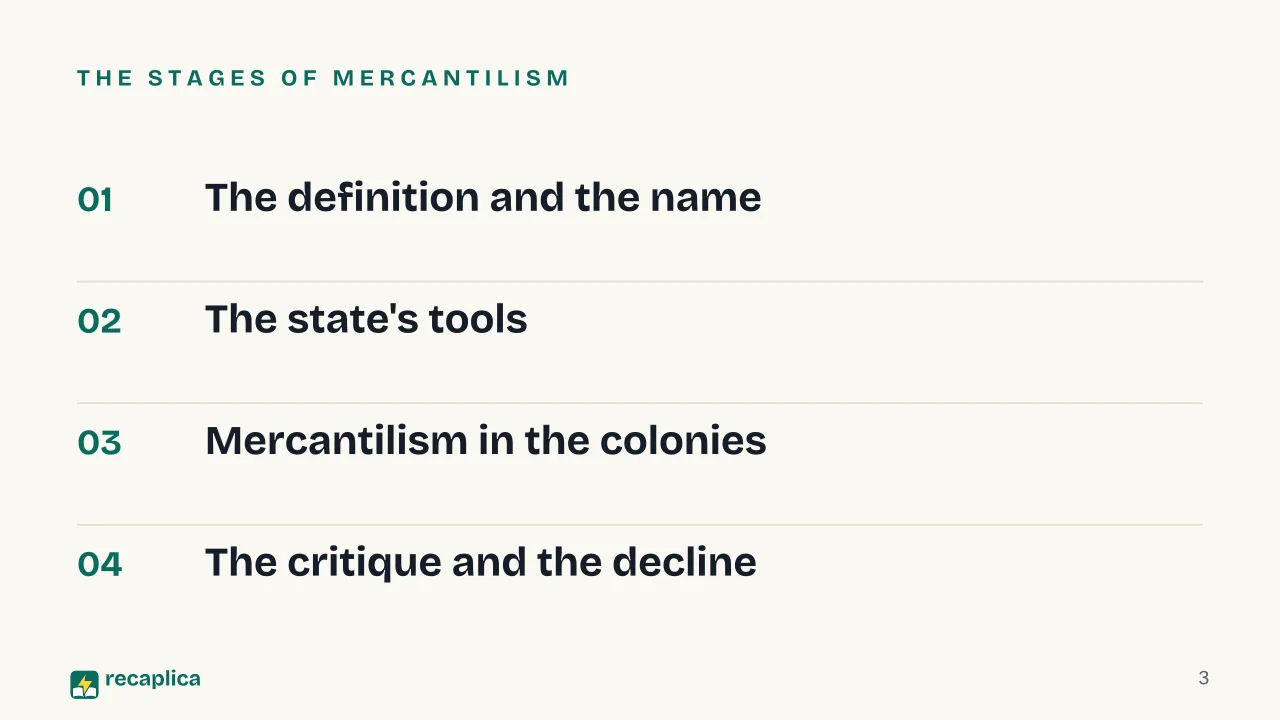
    Slide 1 of the presentation on Mercantilism: MercantilismSlide 2 of the presentation on Mercantilism: Why did a favorable balance of trade make a state stronger?Slide 3 of the presentation on Mercantilism: The stages of mercantilismSlide 4 of the presentation on Mercantilism: Chapter 01: The definition and the nameSlide 5 of the presentation on Mercantilism: The 17th-century publicists of mercantilism: Thomas Mun, Jean-Baptiste Colbert, Antonio SerraSlide 6 of the presentation on Mercantilism: Chapter 02: The state's toolsSlide 7 of the presentation on Mercantilism: English and French protectionist lawsSlide 8 of the presentation on Mercantilism: Colbert's tariffsSlide 9 of the presentation on Mercantilism: Two opposing views of tradeSlide 10 of the presentation on Mercantilism: Chapter 03: Mercantilism in the coloniesSlide 11 of the presentation on Mercantilism: Raw materials · Manufacturing · Finished goodsSlide 12 of the presentation on Mercantilism: Nobody who practiced it called it "mercantilism."Slide 13 of the presentation on Mercantilism: Chapter 04: The critique and the declineSlide 14 of the presentation on Mercantilism: From trade rivalry to colonial tensionSlide 15 of the presentation on Mercantilism: What did mercantilist states mean by a "favorable balance of trade"?Slide 16 of the presentation on Mercantilism: The full Recap
    Flash10 slidesThe essential thread, to present in classFull16 slidesEvery chapter and the deeper detail

    Common myths

    • ✗ Myth The term "mercantilism" was coined and used by its own supporters as the official name of their doctrine.

      ✓ Reality That is not the case: according to Britannica Money, publicists such as Thomas Mun, Jean-Baptiste Colbert, and Antonio Serra never used that word themselves. Adam Smith gave the term currency in 1776, in The Wealth of Nations.

    • ✗ Myth Hoarding gold and silver was a royal whim, with no real economic logic behind it.

      ✓ Reality Econlib links that pursuit to a practical need: by the 17th and 18th centuries, armies and navies had become full-time professional forces that had to be paid year-round. Hard currency reserves helped cover that expense, rather than satisfying a whim.

    • ✗ Myth Colonies, under mercantilism, were simply territories under political control, with no specific economic role.

      ✓ Reality They had a defined role, Britannica Money explains: selling raw materials only to their own colonizer and buying finished goods only from it, with local manufacturing banned. OpenStax adds that colonial populations also served as a ready market for goods made in the home country.

    Mind map

    Drag the background to move around and the nodes to reposition them; use − and + to collapse and expand branches.
    Customize
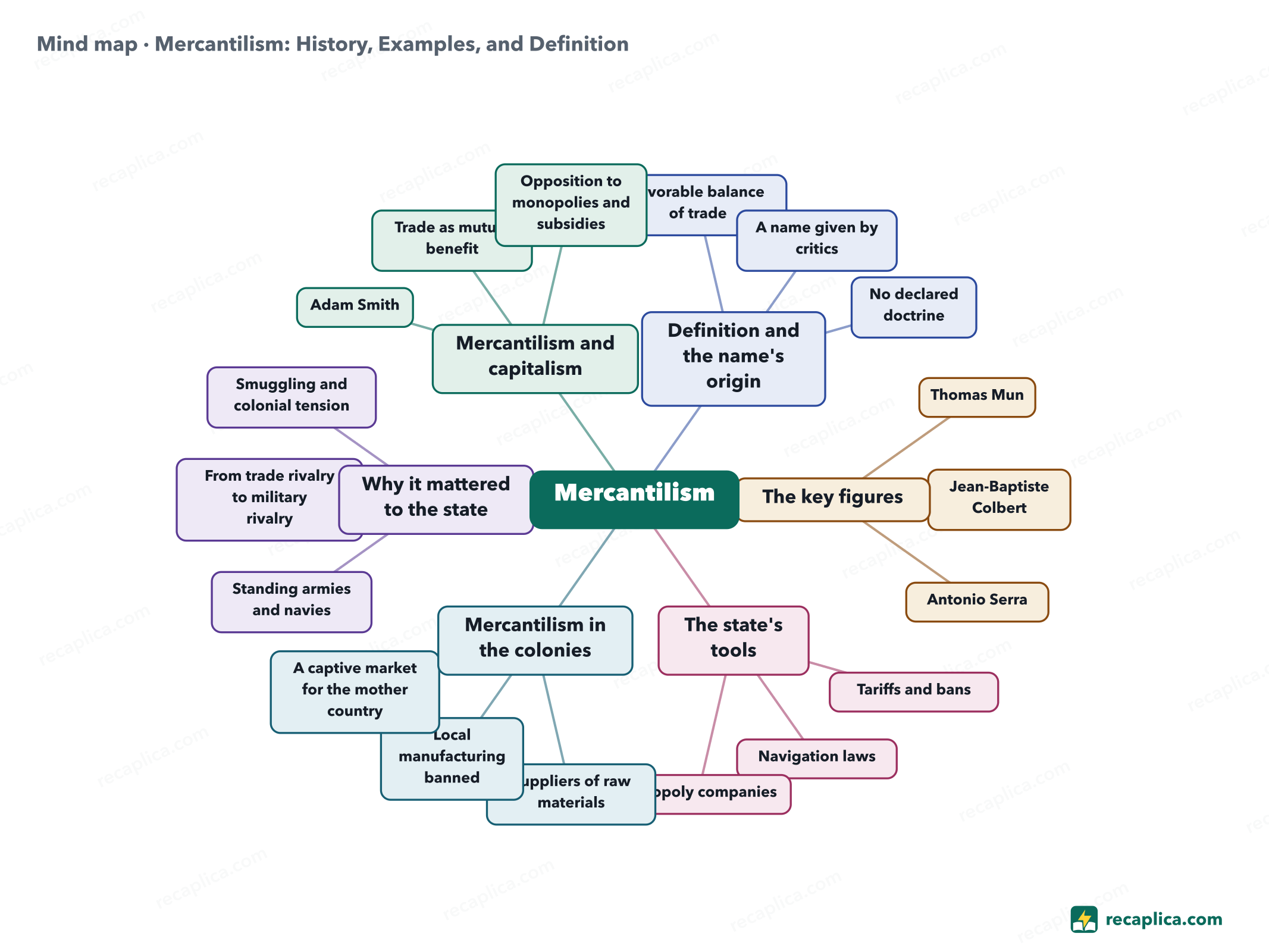
    Mind map: Mercantilism: History, Examples, and Definition
    • Mercantilism
      • Definition and the name's origin
        • Favorable balance of trade Exporting more than a country imports
        • A name given by critics Adam Smith made it current in 1776
        • No declared doctrine Its practitioners never used the term
      • The key figures
        • Thomas Mun English publicist, 17th century
        • Jean-Baptiste Colbert French finance minister, 1661-1683
        • Antonio Serra Italian publicist, 17th century
      • The state's tools
        • Tariffs and bans On foreign-made goods
        • Navigation laws Navigation Act 1651, Staple Act 1663
        • Monopoly companies State charters over foreign trade
      • Mercantilism in the colonies
        • Suppliers of raw materials
        • Local manufacturing banned
        • A captive market for the mother country
      • Why it mattered to the state
        • Standing armies and navies Professional forces paid year-round
        • From trade rivalry to military rivalry
        • Smuggling and colonial tension
      • Mercantilism and capitalism
        • Adam Smith The Wealth of Nations, 1776
        • Trade as mutual benefit
        • Opposition to monopolies and subsidies

    Quiz: test yourself

    Answer the questions to check what you have learned: you get instant feedback and a short explanation.

    Grade 0/10 0/5
    1 What did European states mean by a "favorable balance of trade" under mercantilism?

    Mercantilism aimed for a positive balance between exports and imports, in order to build up gold and silver reserves, as both Econlib and OpenStax explain.

    2 According to Britannica Money, who gave the term "mercantilism" its currency?

    Britannica Money notes that 17th-century publicists such as Mun, Colbert, and Serra never used the term themselves; Adam Smith made it current in The Wealth of Nations, 1776.

    3 True or false: under mercantilism, colonies could sell their raw materials to any foreign buyer.

    According to Britannica Money, colonies were required to sell raw materials only to their own colonizers and to buy finished goods only from the mother country; local manufacturing was banned.

    4 According to Econlib, what motivated mercantilist states to pursue gold and silver reserves?

    Econlib links the hunt for precious metals to the fact that armies and navies had become full-time professional forces, which required hard currency reserves to maintain.

    5 Which 1663 English law, cited by Econlib, required colonial exports to pass through English ports first?

    The Staple Act of 1663 required colonial exports to pass through English ports before reaching the rest of Europe, a trade-control mechanism cited by Econlib.

    Answers: 1-B · 2-C · 3-B · 4-B · 5-B

    Flashcards

    Tap the card to flip it and check whether you remember the answer, then move to the next one.

    1 / 7

    Explain it in your own words

    The ultimate test: if you can explain it in simple words, you've truly understood it. Write your explanation, then compare it with the Recap.

    Your explanation is saved only on this device.

    Mercantilism was the dominant economic doctrine in Western Europe from the 16th to the 18th century: a state grew powerful by selling more abroad than it bought, building up reserves of gold and silver. Britannica Money describes it as "an economic practice by which governments used their economies to augment state power at the expense of other countries." Colonies had one job under this system: supply raw materials to the mother country and buy finished goods back from it, while at home tariffs and monopolies shielded domestic industry. The name itself came later, from the doctrine's most famous critic: Adam Smith made it current in The Wealth of Nations, published in 1776.

    Frequently asked questions

    What is mercantilism in simple terms?

    It is the economic doctrine holding that a state grows rich by selling more abroad than it buys, in order to build up gold and silver reserves. It dominated Western Europe from the 16th to the 18th century, relying on tariffs, import bans, and a fixed economic role assigned to colonies.

    When was mercantilism widespread, and what is its history?

    Econlib and Britannica Money place it between the 16th and 18th centuries. The main countries that practiced it were France, Spain, Portugal, Italy, and Britain, along with Germany and the Netherlands.

    What role did colonies play under mercantilism?

    A tightly defined one, according to Britannica Money: colonies could sell raw materials only to their own colonizer and had to buy finished goods only from it, without developing their own manufacturing. OpenStax adds that colonial populations also served as a captive market for goods made in the home country.

    How does mercantilism differ from capitalism?

    OpenStax describes mercantilism as resting on a fixed, zero-sum view of wealth, where one state's gain was another's loss, with government regulating trade through tariffs and monopolies. Adam Smith argued the opposite, per Econlib and OpenStax, that voluntary trade benefits both sides and opposed the monopolies and subsidies mercantilism relied on.

    What are some examples of mercantilism in practice?

    Econlib and OpenStax point to Jean-Baptiste Colbert's France (1661-1683), which raised tariffs on foreign goods and banned some imports outright, and to England's Navigation Act (1651) and Staple Act (1663), which restricted foreign shipping and routed colonial exports through English ports.

    Sources

    • Mercantilism | Definition & Examples — Britannica Money
    • Mercantilism — Robert B. Ekelund Jr. and Robert D. Tollison, The Concise Encyclopedia of Economics (Econlib)
    • World History, Volume 2: from 1400, section 5.3 'The Mercantilist Economy' — OpenStax (Rice University)

    Every Recap goes through an independent review before publication.

    Every evening, the day's new Recaps on our Telegram channel. Join the channel →

    Keep learning

    • Economics Labor Market: How Supply, Demand and Unemployment Work The labor market is where businesses that need workers to produce goods and services meet the people willing to work for them. In the textbook model, that meeting sets wages and employment levels the way any other market would, but imperfect information, bargaining power and legal rules push the real market away from pure competition. Those gaps are where unemployment comes from, and economists split it into frictional, structural, cyclical and technological types depending on the cause. Official statistics, such as Italy's ISTAT, measure it against the labor force — people employed plus people actively looking for work — not the whole population. As of July 2026, Italy's unemployment rate stood at 5.8%, provisional, against 6.4% for the euro area. Read the Recap →
    • Economics Keynesianism explained: the theory born from the Great Depression Keynesianism is the body of economic thinking named after John Maynard Keynes, the British economist who in the 1930s offered a different way of reading a slump. The IMF notes that when the Great Depression hit, the economic theory of the day could neither explain the collapse nor say how to restart production and employment. Keynes put aggregate demand at the centre — the total spending of households, businesses and government — and argued that full employment is a special case rather than something markets deliver on their own. That is where the idea comes from that public spending can step in when private demand stalls. Keynesianism guided economic policy from the end of the Second World War until the 1970s, then lost ground. Read the Recap →
    • Economics CBDC: What Is a Central Bank Digital Currency and How Does It Work? A CBDC, or central bank digital currency, is digital money issued directly by a central bank rather than a private company. It is not a cryptocurrency: a CBDC carries the same backing as banknotes and coins, while an asset like Bitcoin or Ether has no institution standing behind it. The European Central Bank is building its own version, the digital euro, meant to sit alongside cash rather than replace it, with support for payments even without an internet connection. By 2024, more than nine in ten of the world's central banks were exploring a CBDC of some kind. Read the Recap →

    recaplica

    Clear in 30 seconds, yours in 10 minutes.

    Recaps Mind maps Request a Recap Telegram channel Mind map maker Our method About Privacy & cookies Legal notes & terms of use

    © 2026 Recaplica · A project by Curi S.r.l. — VAT IT05472000750

    Statistics, only if you say so

    To learn which Recaps help most we would use Google Analytics, with aggregate, anonymous data. It starts only with your OK, and you can change your mind anytime. Privacy policy