|
recaplica
2008 Financial Crisis: Timeline of How It Started and Spread | ||||||
| © 2026 Recaplica · recaplica.com — All rights reserved | ||||||
2008 Financial Crisis: Timeline of How It Started and SpreadWhat to print Page numbers appear when printing with default margins. SlidesChoose a cut Flash10 slidesThe essential thread, to present in classFull14 slidesEvery chapter and the deeper detailBoth come with speaker notes. In 30 seconds quick readThe 2008 financial crisis began in the United States in the subprime mortgage market, when expanding credit to riskier borrowers and the practice of bundling those mortgages into securities collided with slowing home prices, according to the Federal Reserve. In spring 2008 the investment bank Bear Stearns was rescued with Federal Reserve support, but that September Lehman Brothers filed for bankruptcy and the insurer AIG had to be propped up by the government. Washington responded with TARP, a program Congress authorized for up to $700 billion, and with new bank-supervision rules in 2010. US GDP fell 4.3% and unemployment climbed to about 10%, while in Europe the shock turned, in the following years, into a public-finance crisis that the European Central Bank had to address with government bond purchases. Key Points
Key figures
Deep DiveHow the Subprime Mortgage Bubble FormedIn the years leading up to the crisis, mortgage lenders in the United States started approving loans for subprime borrowers — people who would previously have struggled to qualify for a mortgage — according to a Federal Reserve essay on the subprime mortgage crisis. Those lenders did not keep the loans on their own books: they bundled them with others into securities, then sold those on to investors. This is the practice known as securitization, and most subprime mortgage funding ran through securities issued by private firms rather than public agencies.
Rising mortgage demand pushed home prices higher, especially where housing supply was tight. The mechanism seized up once that growth slowed: in April 2007, New Century Financial Corp, one of the largest US subprime lenders, filed for bankruptcy. Over the rest of that year, many securitized bonds and the derivatives built on them saw their ratings cut to high-risk territory, and a number of subprime lenders closed their doors. March 2008: The Bear Stearns RescueThe first major banking shock came about a year later. On March 13, 2008, the investment bank Bear Stearns warned the Federal Reserve it might run out of sufficient liquidity as soon as the next day. The Federal Reserve, which acts as the central bank of the United States, authorized a $12.9 billion emergency loan on March 14, backed by assets valued at $13.8 billion and channeled through JPMorgan Chase. On March 16, Bear Stearns agreed to merge with JPMorgan Chase. To complete the deal, the Federal Reserve Bank of New York provided about $29 billion to a special-purpose vehicle, Maiden Lane LLC, which took on roughly $30 billion of the bank’s troubled assets. September 2008: Lehman Brothers and the AIG RescueSix months after Bear Stearns, the crisis entered its most acute phase. Lehman Brothers formally filed for bankruptcy on September 15, 2008; on the eve of its collapse the bank still had $18.5 billion in outstanding loans from the Federal Reserve. The following day, September 16, the Federal Reserve Bank of New York extended credit to the insurer AIG, which held roughly $1 trillion in assets in mid-2008; in exchange for the rescue, the US Treasury received a 79.9% equity stake in AIG. After Lehman’s collapse, the Federal Reserve lent $28 billion through its primary dealer credit facility to contain the fallout across the rest of the system. In the following weeks, Citigroup and Bank of America also sought support from the Federal Reserve, the US Treasury and the FDIC. The Public Response: TARP and Dodd-FrankTo stabilize the system, the US Treasury launched the Troubled Asset Relief Program, or TARP: Congress authorized up to $700 billion, but the Treasury ended up spending a much smaller share. The program’s total actual cost, once the books closed, came to about $31.1 billion, driven largely by foreclosure-prevention programs. As of September 30, 2023, the Treasury had disbursed a total of $443.5 billion through the TARP programs and had recovered $425.5 billion, reaching $443.1 billion once an additional $17.5 billion in proceeds from AIG shares is included: as of that date every TARP investment program was closed.
In 2010, Congress also passed the Dodd-Frank Act, introducing new supervisory rules for large financial institutions. The Fallout on the Real Economy: GDP and JobsThe financial crisis translated into a deep recession in the real economy. From peak to trough, US GDP fell 4.3%, making 2007-2009 the deepest recession since World War II. The US unemployment rate more than doubled over the same period, rising from under 5% to about 10% — a direct hit to the American labor market. The recession lasted 18 months, the longest of the postwar US recessions. How the Global Economic Crisis Reached EuropeBy 2008 the world economy was already crisscrossed by capital and credit flows that ran past national borders, one face of globalization: that was part of why the shock from American mortgages was eventually felt in Europe too, even if with a lag of a few years. The euro area’s aggregate budget balance moved from a position close to balance in 2000 to a deficit of about 6% of GDP in 2010, according to the European Central Bank; pushed far enough, that same dynamic feeds a country’s public debt. From the middle of 2010, a vicious circle took hold between banks and public debt: banks held government bonds that were losing value, which in turn weakened their own balance sheets. The ECB intervened on several fronts. Between July 2009 and July 2010, the Eurosystem purchased €60 billion of covered bonds; in May 2010, faced with growing dysfunction in euro-area government bond markets, it launched the Securities Markets Programme to buy those bonds directly. On October 6, 2011, the ECB’s Governing Council decided on a second covered bond purchase program, worth €40 billion, to run from November 2011. On the rules side, the EU’s economic governance framework had failed to prevent or correct the unsustainable national policies that fed the imbalances behind the sovereign debt crisis, then ECB Vice-President Vítor Constâncio has acknowledged. On September 28, 2011, the European Parliament approved new legislation known as the “six-pack”: four measures to strengthen the Stability and Growth Pact and budget surveillance, plus two more to monitor and address macroeconomic imbalances among EU countries. Slide deckSlides ready to download and make your own in PowerPoint or Google Slides, with speaker notes. Pick the Flash cut or the Full one.     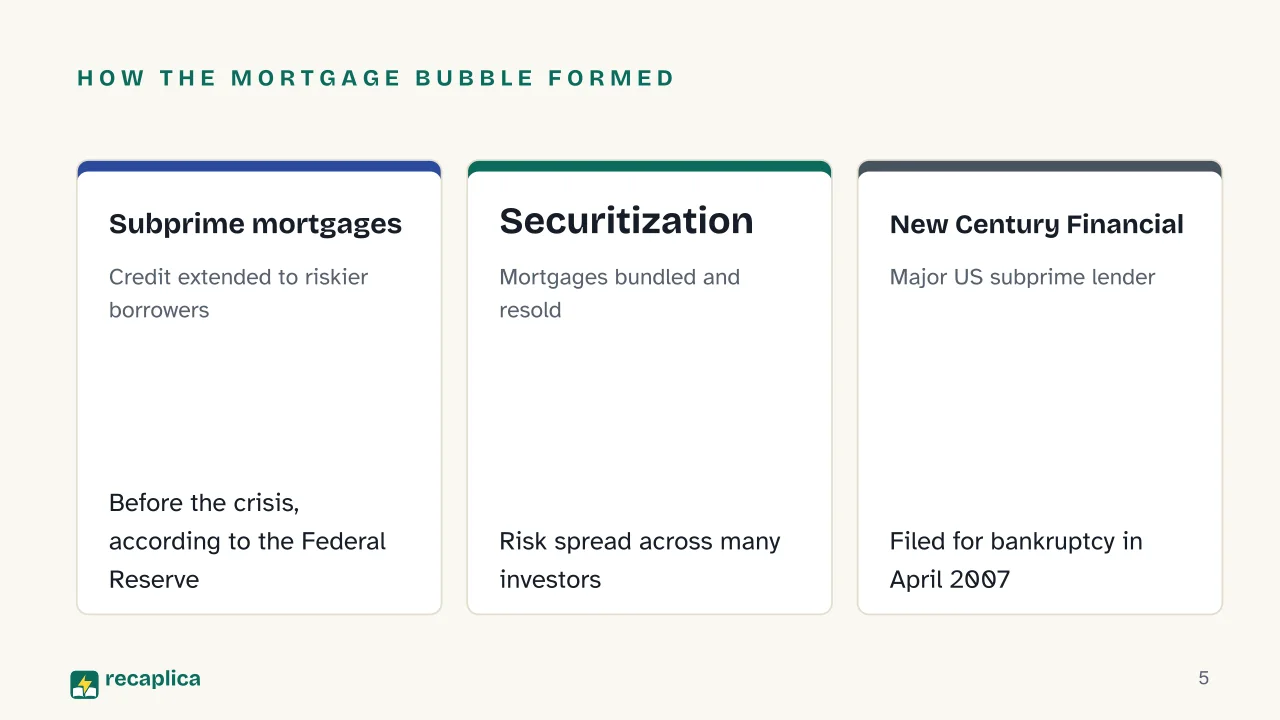  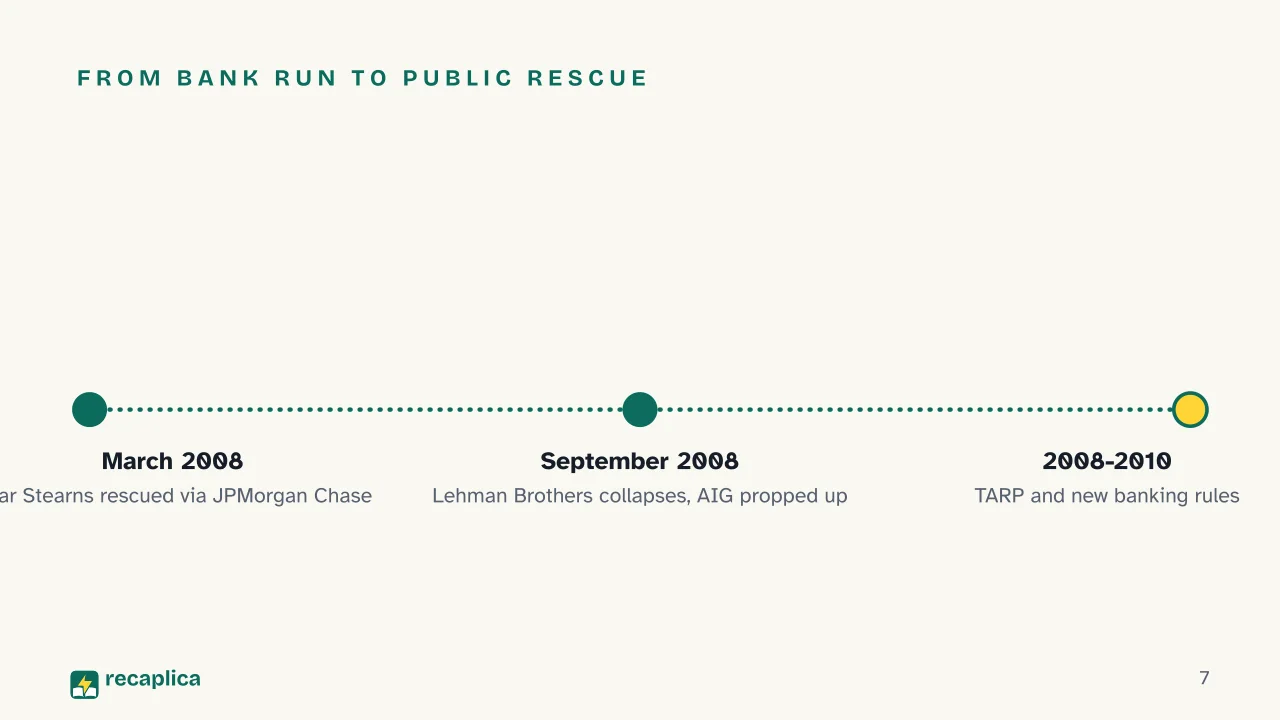  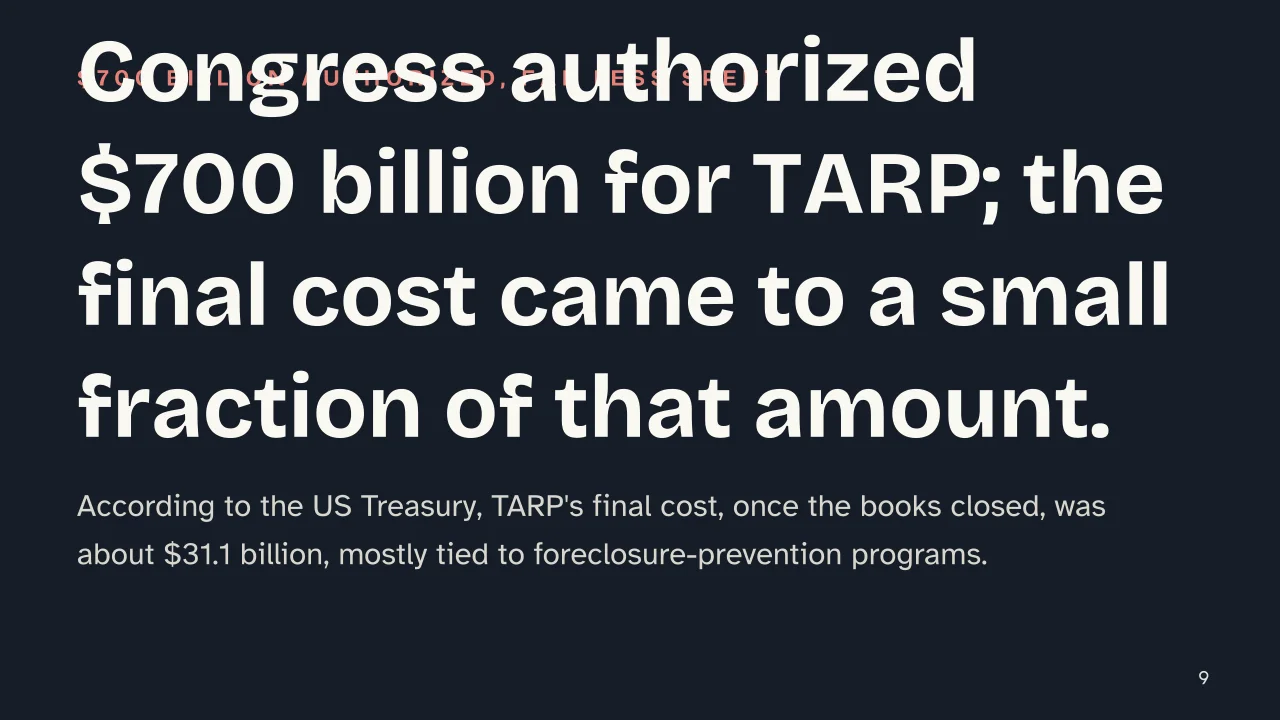  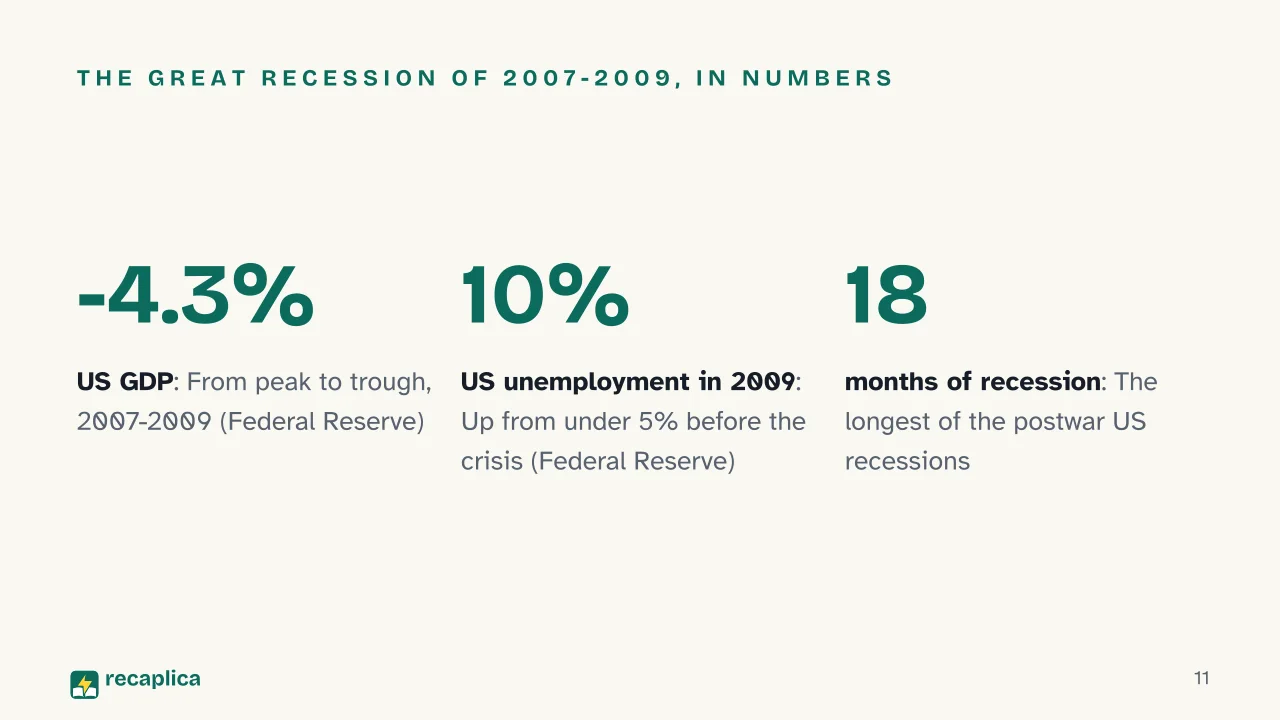 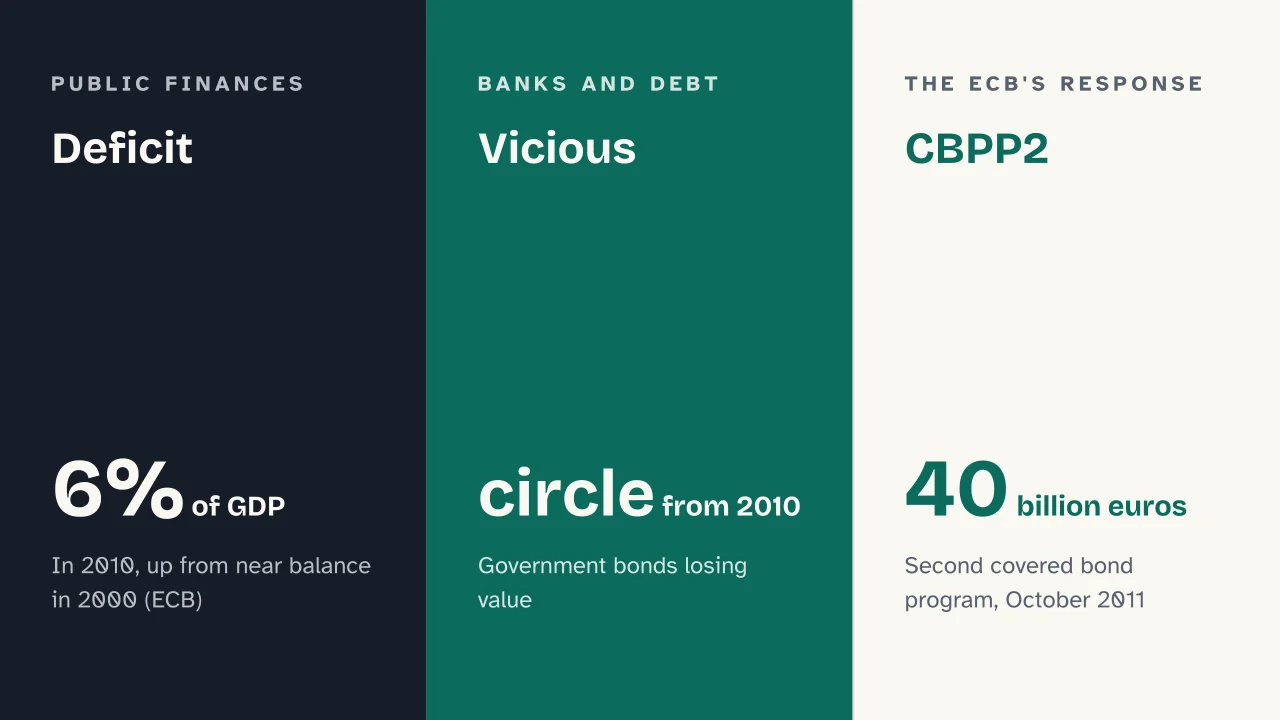 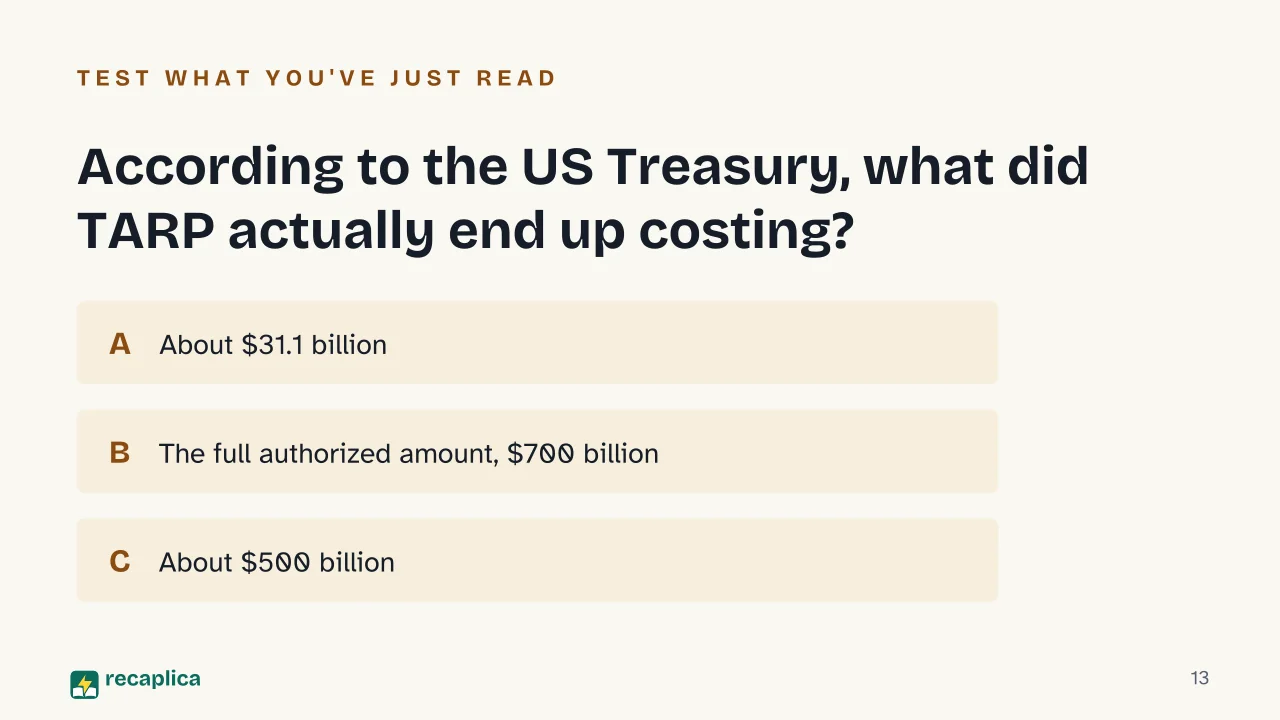  Common myths
Mind mapDrag the background to move around and the nodes to reposition them; use − and + to collapse and expand branches. 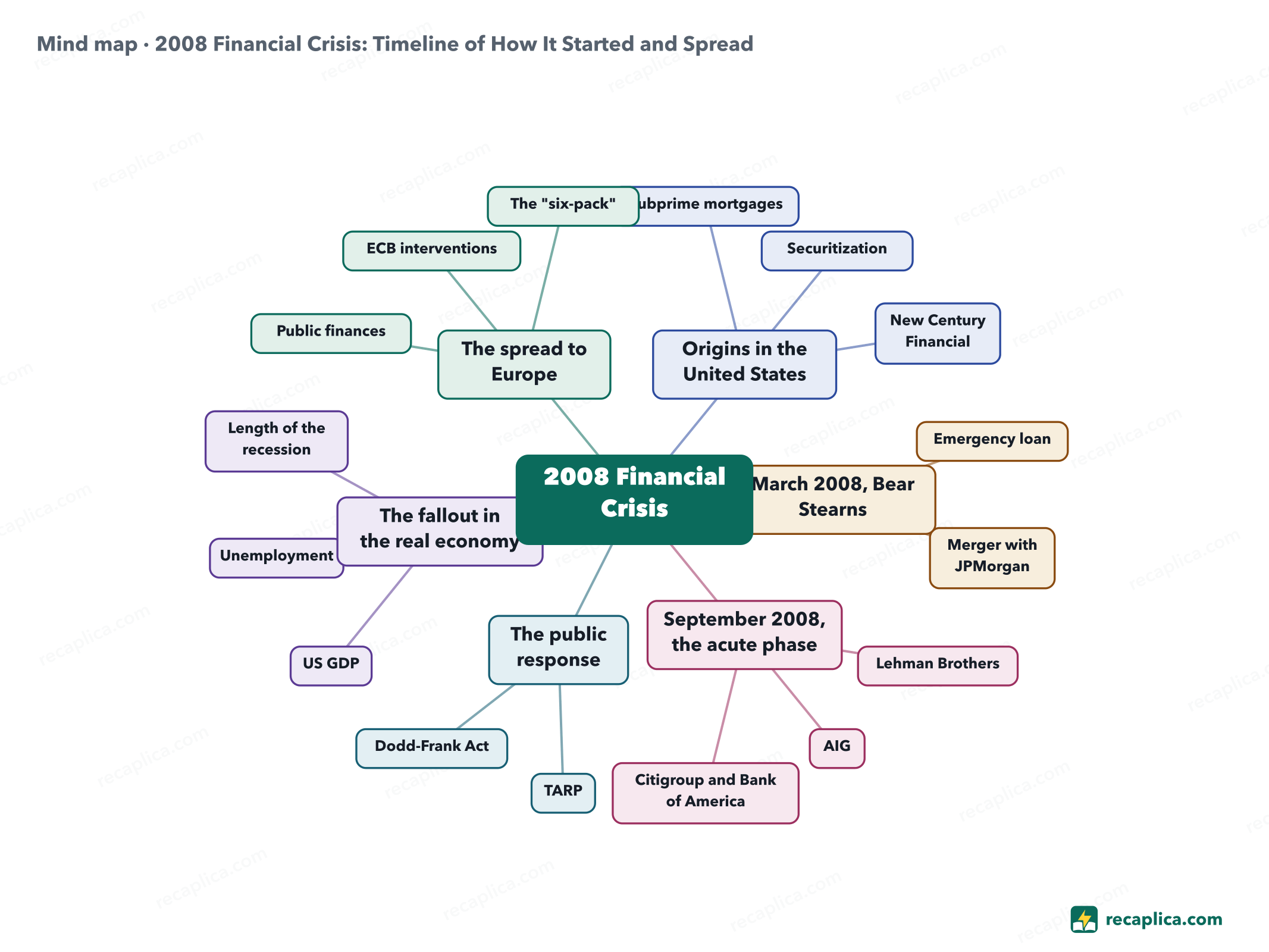
Quiz: test yourselfAnswer the questions to check what you have learned: you get instant feedback and a short explanation. Grade 0/10 0/5
FlashcardsTap the card to flip it and check whether you remember the answer, then move to the next one. 1 / 8 Explain it in your own wordsThe ultimate test: if you can explain it in simple words, you've truly understood it. Write your explanation, then compare it with the Recap. Your explanation is saved only on this device.
Frequently asked questionsWhat was the 2008 financial crisis?It was the financial crisis that hit the United States starting in the subprime mortgage market and that, between 2007 and 2009, produced, according to the Federal Reserve, the deepest recession since World War II, with GDP falling 4.3% and unemployment rising to about 10%. Why did so many subprime mortgages go bad?Because lenders had extended credit to riskier borrowers and funded new mortgages by bundling them into securities sold on to investors, according to the Federal Reserve. Once home prices stopped rising, the first subprime lenders, such as New Century Financial Corp in April 2007, began to fail. When did Lehman Brothers collapse, and what happened right after?Lehman Brothers filed for bankruptcy on September 15, 2008. The next day, the Federal Reserve Bank of New York stepped in to support AIG, which held roughly $1 trillion in assets in mid-2008; in the following weeks Citigroup and Bank of America also sought public support. What was TARP and what did it really cost?TARP (the Troubled Asset Relief Program) was the US federal program launched to stabilize the financial system. Congress authorized up to $700 billion, but according to the US Treasury the actual cost, once the books closed, was about $31.1 billion, mostly linked to foreclosure-prevention programs. How did the global economic crisis reach Europe?The European Central Bank places 2010 as the point at which the euro area's public finances, close to balanced a decade earlier, reached a deficit of about 6% of GDP; from that same year a vicious circle formed between banks, which held government bonds losing value, and public debt, and the ECB responded with bond purchases. Every Recap goes through an independent review before publication. |