|
recaplica
Sustainability: Definition, What It Means and the Three Pillars | ||||||||
| © 2026 Recaplica · recaplica.com — All rights reserved | ||||||||
Sustainability: Definition, What It Means and the Three PillarsWhat to print Page numbers appear when printing with default margins. SlidesChoose a cut Flash10 slidesThe essential thread, to present in classFull15 slidesEvery chapter and the deeper detailBoth come with speaker notes. In 30 seconds quick readSustainability, in the fuller phrase sustainable development, is development that covers the needs of the people living now while leaving future generations able to cover their own: that is how the United Nations defines it. The wording comes from Our Common Future, the report published in 1987 by the World Commission on Environment and Development, also called the Brundtland Commission. Treccani lists three interdependent factors behind the expression. The United Nations describe an integrated approach, where environmental concerns travel alongside economic development. Key Points
Key figures
Deep DiveThe word sustainable turns up on packaging and in company reports. It also has a written definition, dated 1987, and that definition talks about the economy and about poverty too. The sentence from 1987The World Commission on Environment and Development (WCED) was established in 1983, and it is also known as the Brundtland Commission. Four years later it published the report Our Common Future, and there the formula quoted ever since appears: development has to answer the needs of the present generation while leaving future generations able to answer needs of their own. The United Nations carry it on their public pages, and the Italian encyclopedia Treccani takes it up in the entry on the subject. The Brundtland Report asked for a strategy able to bring development and the environment together, and to describe that strategy it used the very term that later spread. Needs are the word at the centerThe decisive word is needs. The Brundtland Report puts it at the heart of the criterion and gives absolute priority to the essential needs of the poorest people on the planet, as the Environmental Ethics entry in the Stanford Encyclopedia of Philosophy reports. The definition carries a second piece as well: how much the environment can give now and in the future is not a fixed quantity, because it depends on the technology available and on the way society is organized. Readers curious about how needs of that kind get measured will find the criteria in the Recap on the poorest countries in the world, and the distinction drawn in the Recap on poverty, inequality and underdevelopment. The three factors Treccani holds togetherThe Treccani entry sets out three factors that depend on one another: care of the environment, the growth of the economy and the development of society. Treccani treats them as confirmed by the Johannesburg Conference of 2002. Interdependent means the three hold each other up.
Farming is one sector where these same three factors get a name of their own: sustainable agriculture, measured on concrete fronts such as soil, water, and biodiversity. In the energy sector the same criterion takes the shape of energy sustainability, measured on how much of the electricity and heat used comes from renewable sources. Environment and economy arrive togetherThe United Nations write that sustainable development calls for an integrated approach, one able to hold environmental concerns and economic development together. That knot was already there in 1987: for the Brundtland Report the most critical global environmental problems came mainly from poverty in the global South and from the way the North consumed and produced, on models the report judged impossible to keep up. The Stanford Encyclopedia of Philosophy reads in the report the same link between the environmental question and the question of development, set inside the inequality that separates the industrialized world from the rest of the planet. The setting in which that gap opened is the subject of the Recap on globalization. That integrated approach became a political commitment in 2015, when the UN adopted the Sustainable Development Goals, the 17 targets of the Agenda 2030. The 1987 criterion also touches social policy, described in the Recap on the welfare state, and the human consequences of a warming climate behind climate refugees. Slide deckSlides ready to download and make your own in PowerPoint or Google Slides, with speaker notes. Pick the Flash cut or the Full one.     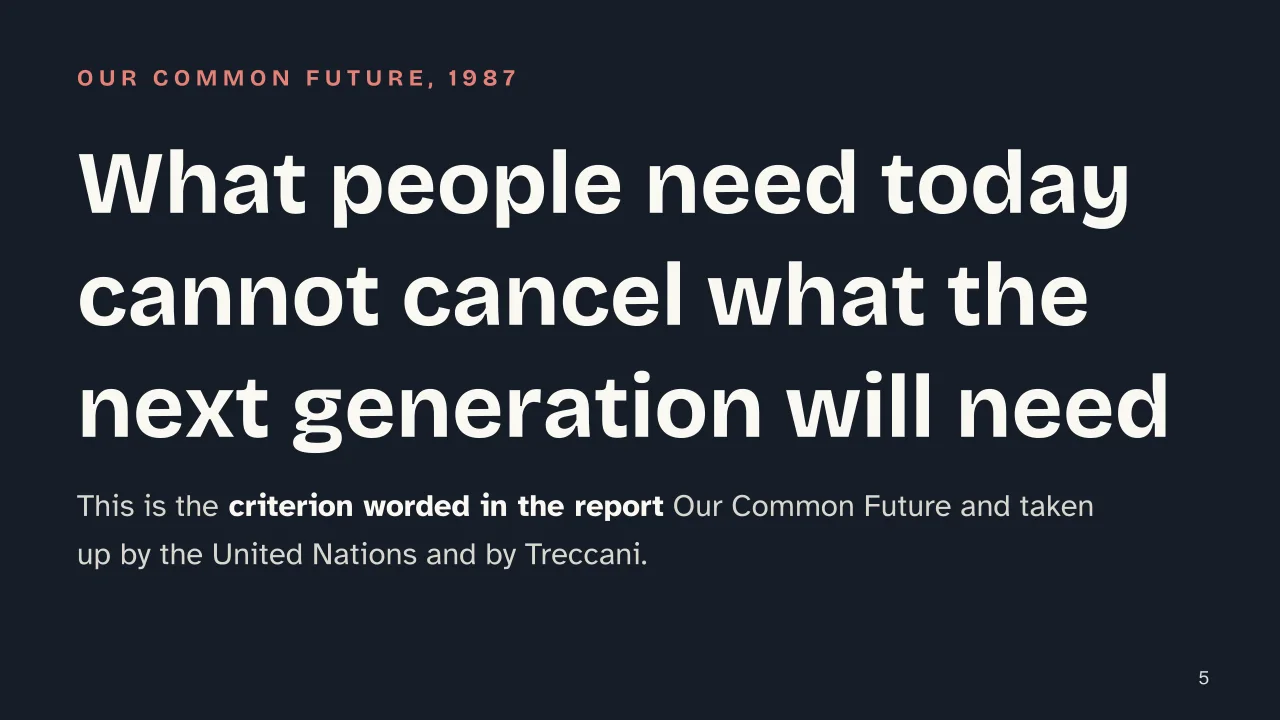 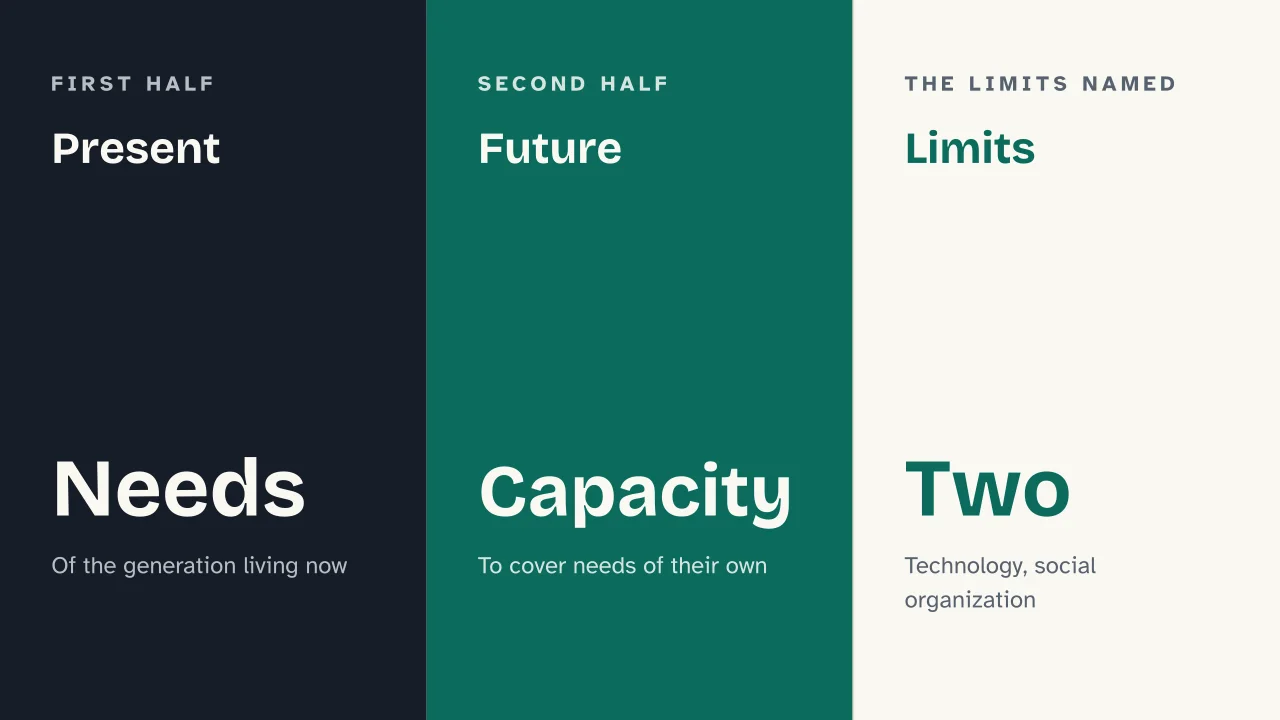  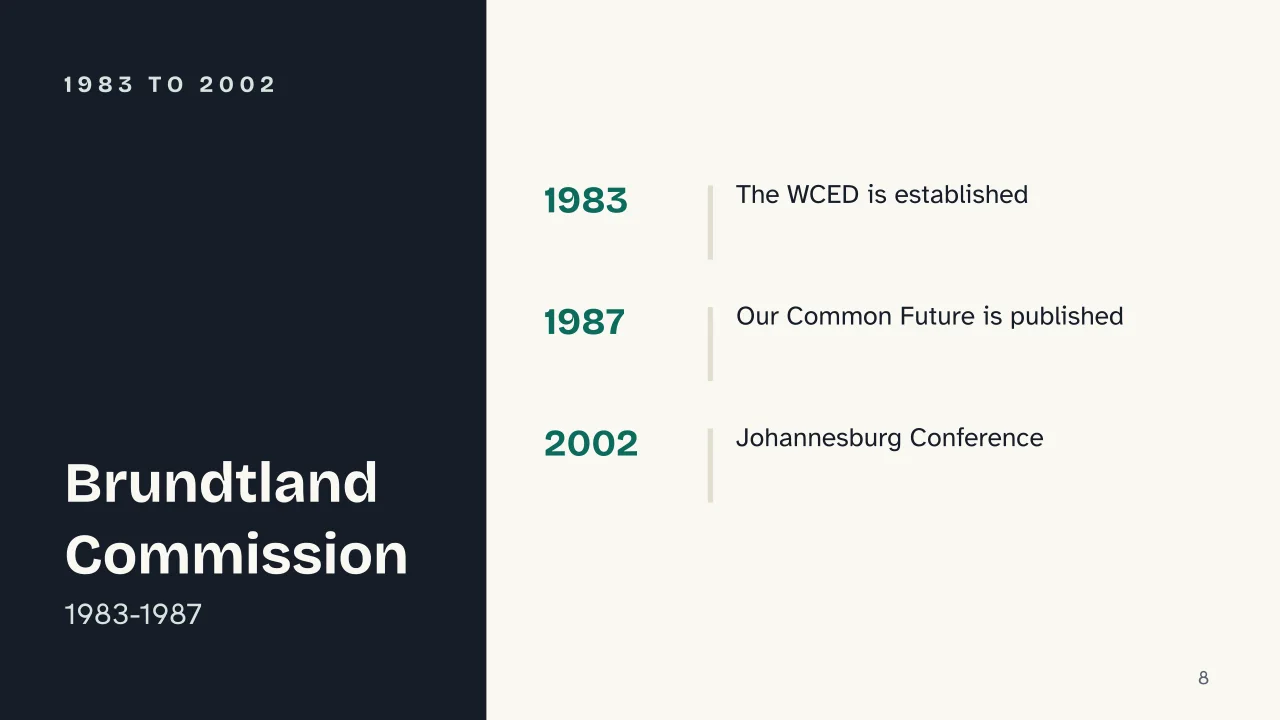  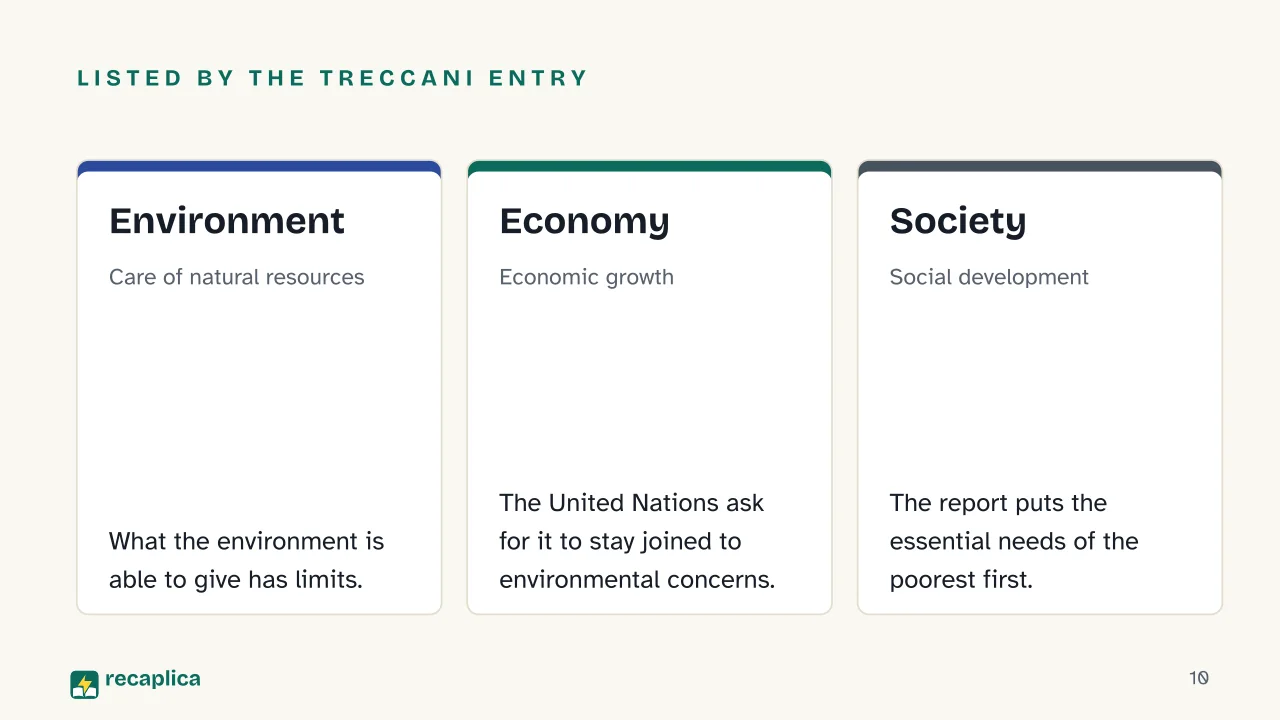   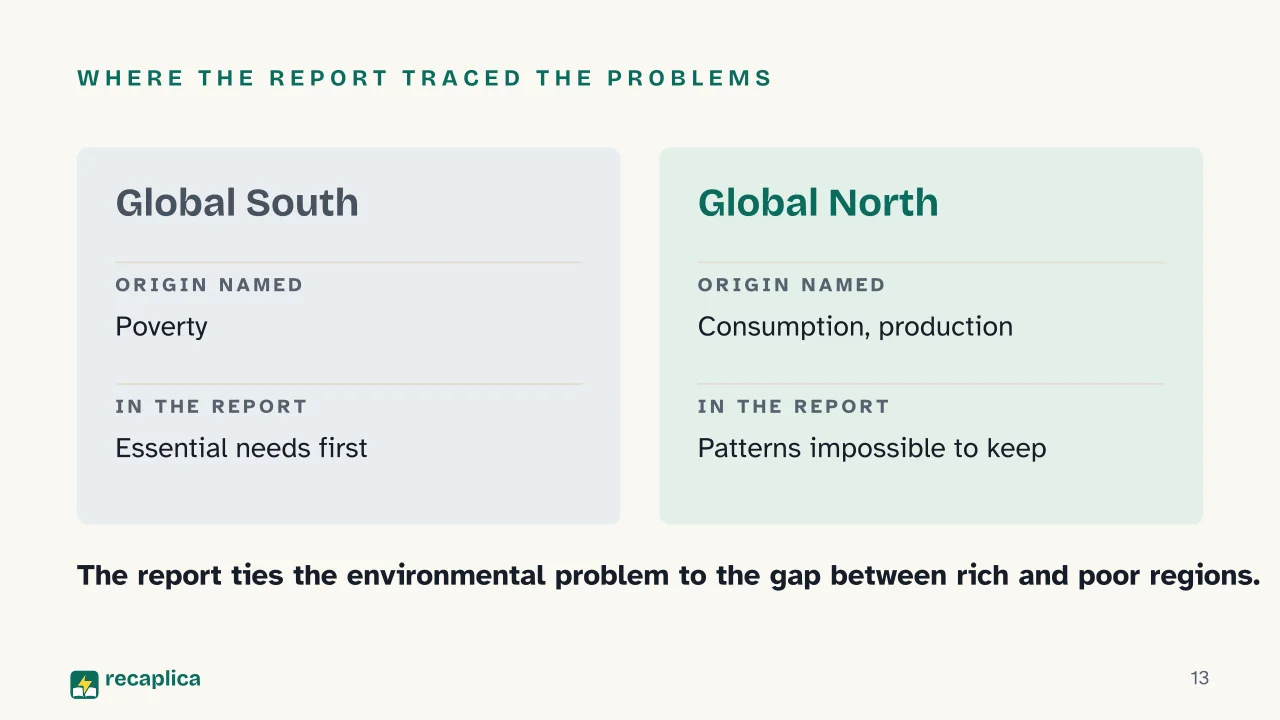 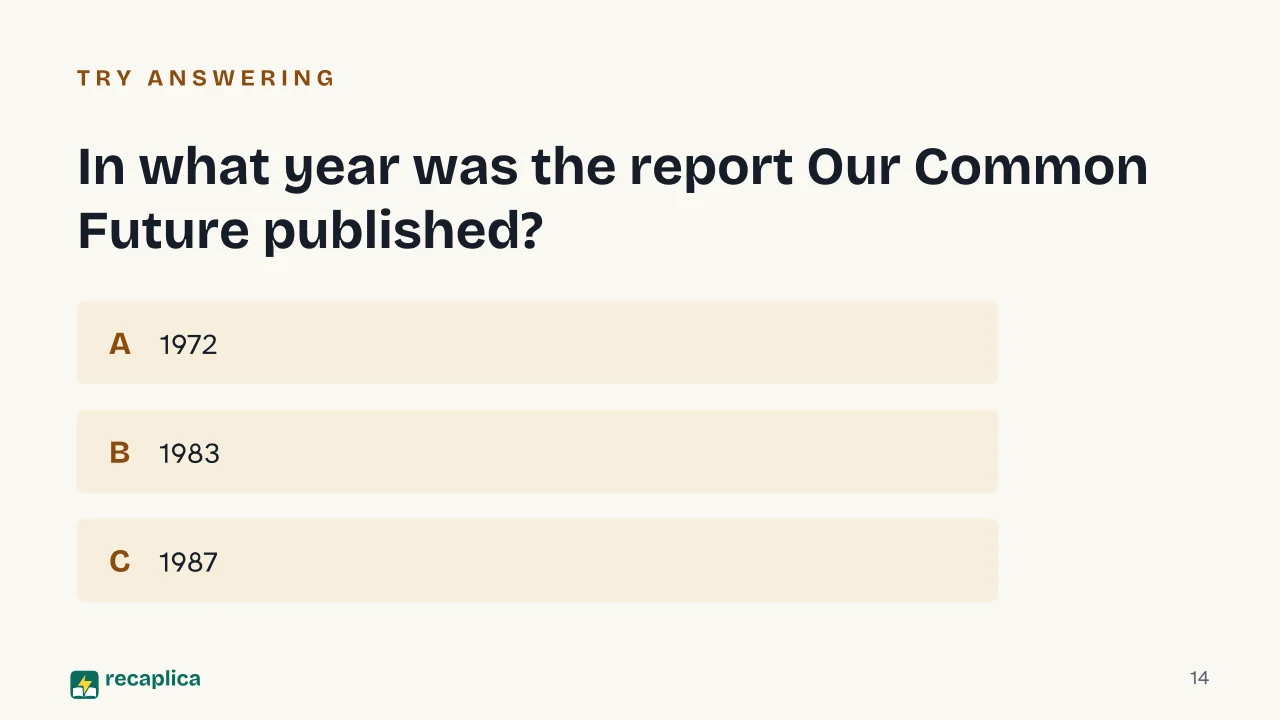  Common myths
Mind mapDrag the background to move around and the nodes to reposition them; use − and + to collapse and expand branches. 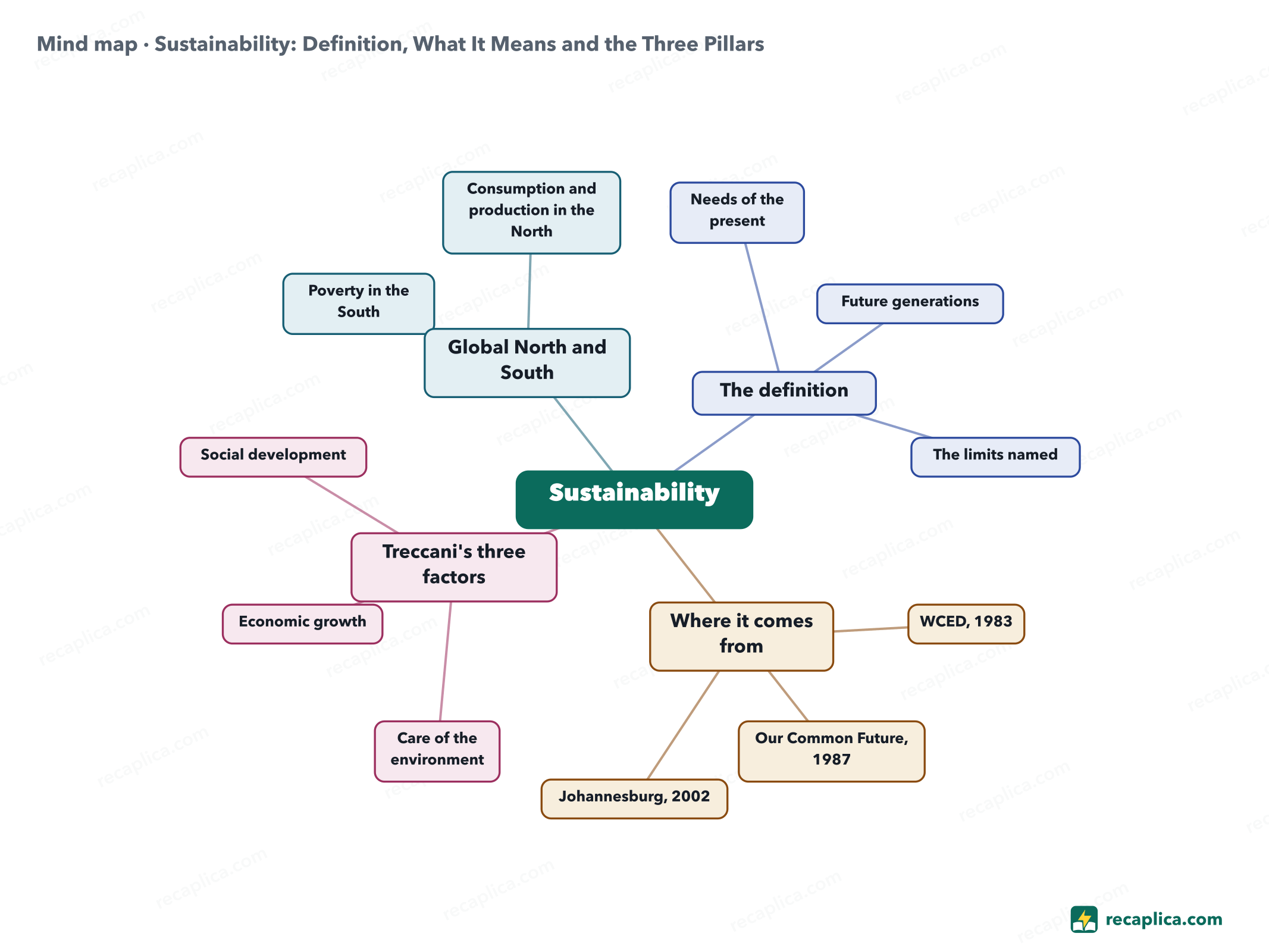
Quiz: test yourselfAnswer the questions to check what you have learned: you get instant feedback and a short explanation. Grade 0/10 0/5
FlashcardsTap the card to flip it and check whether you remember the answer, then move to the next one. 1 / 7 Explain it in your own wordsThe ultimate test: if you can explain it in simple words, you've truly understood it. Write your explanation, then compare it with the Recap. Your explanation is saved only on this device.
Frequently asked questionsWhat does sustainability really mean?It means development that answers the needs of the present generation while leaving the capacity of future generations to answer their own intact. The definition comes from the 1987 report Our Common Future, and the United Nations use it in this form, adding that it calls for an integrated approach between environmental concerns and economic development. Who wrote the definition of sustainable development?The WCED, that is the World Commission on Environment and Development, born in 1983 and known as the Brundtland Commission. The sentence appears in its 1987 report Our Common Future, which called for the environment and development to be brought into a single strategy. What are the three pillars of sustainability?The Treccani entry lists three interdependent factors, care of the environment, along with economic growth and social development, and treats them as confirmed by the Johannesburg Conference of 2002. Are sustainability and environmental sustainability the same thing?For the United Nations the criterion calls for an integrated approach, so the environmental dimension travels together with economic development and is one part of the picture. Treccani puts the growth of the economy and the progress of society alongside the environment. Every Recap goes through an independent review before publication. |