|
recaplica
Microeconomics vs Macroeconomics: What's the Difference | |||||||||||||||
| © 2026 Recaplica · recaplica.com — All rights reserved | |||||||||||||||
Microeconomics vs Macroeconomics: What's the DifferenceWhat to print Page numbers appear when printing with default margins. SlidesChoose a cut Flash10 slidesThe essential thread, to present in classFull14 slidesEvery chapter and the deeper detailBoth come with speaker notes. In 30 seconds quick readMicroeconomics and macroeconomics are two different lenses for looking at the economy. Microeconomics studies individual decision-makers, such as households and firms, and how prices form in a specific market. Macroeconomics studies the large aggregates that describe an entire country, such as national income, employment and the overall price level. The two fields did not emerge together: microeconomics traces back to the 1870s, while macroeconomics became a discipline of its own almost seventy years later. Knowing the difference makes it easier to follow an economics headline or a textbook chapter without mixing up the two levels. Key Points
Key figures
Deep DiveWhat microeconomics studiesAccording to Treccani, microeconomics is the branch of economic theory that deals with the behavior of individual economic agents: consumers and firms, both when they act on their own and when they interact with each other, typically through the market. Its field of view covers the allocation of goods among households, firms, individual industries and specific markets. In practical terms, microeconomics answers questions like: why does the price of a good rise when demand grows? How does a firm decide how much to produce? What happens to a market when a new competitor enters?
Microeconomics is traditionally traced back to Léon Walras, in the early 1870s. Treccani notes that before then, and for several decades afterward under the classical and neoclassical schools, economists’ attention remained focused on individual-level phenomena: what we now call the microeconomic view was, quite simply, the only view available. What macroeconomics studiesMacroeconomics, Treccani continues, is concerned with identifying the equilibrium values of the large aggregates: national income, overall employment, the general price level. Among the variables it analyzes are also aggregate demand (public and private consumption, investment, the trade balance), monetary and fiscal policy, unemployment and inflation. The historical reference point that encyclopedias cite for the birth of the discipline is the General Theory of Employment, Interest and Money, published by John Maynard Keynes in 1936. With that book, according to Treccani, the state took on “a decisive role” in supporting economic growth through public spending, an effect textbooks call the income multiplier: public spending generates an increase in national income that is more than proportional to the initial outlay. According to Treccani, this same moment also marks the birth of economic policy as its own scientific discipline, dedicated to studying the effects of state intervention. A Recap on inflation or one on GDP are, in this sense, direct examples of macroeconomic topics: they describe an entire country or currency area, not a single store or a single product. When the two disciplines splitAlmost seventy years separate the founding of microeconomics (early 1870s) from the birth of macroeconomics as a distinct discipline (1936). According to Treccani, the shift wasn’t sudden: it was specifically the Keynesian literature of the interwar years that gradually pushed the analysis of individual-level processes aside in favor of the large aggregates. Before Keynes, other economists, from Quesnay to Malthus, from Say to Marx, had already touched on topics we would now call macroeconomic, but without building a separate discipline around them, with its own name and its own method. Historically, microeconomics remains the one that took shape as an independent field of study first. Micro and macro economics: how they connect in practiceLarge macroeconomic quantities don’t exist in the abstract: Treccani says as much when it describes aggregates as sets built from countless individual quantities. National income is the sum of what millions of households and firms earn; overall employment is the sum of individual hires; inflation tracks how the prices of thousands of goods and services, set every day in individual markets, change on average. The link runs the other way too: a decision made at the macroeconomic level reshapes the choices of individual agents. When a central bank raises interest rates, a mortgage becomes more expensive: households put off buying a home, firms rethink an investment plan.
A recession, for instance, is a phenomenon observed at the macroeconomic level, a country’s GDP contracting for at least two consecutive quarters, but its causes and effects almost always run through microeconomic choices: firms cutting output, households trimming spending, a labor market hiring less. A recession, then, lines up both levels at once: individual stores and households on one side, a country’s GDP on the other. Slide deckSlides ready to download and make your own in PowerPoint or Google Slides, with speaker notes. Pick the Flash cut or the Full one.  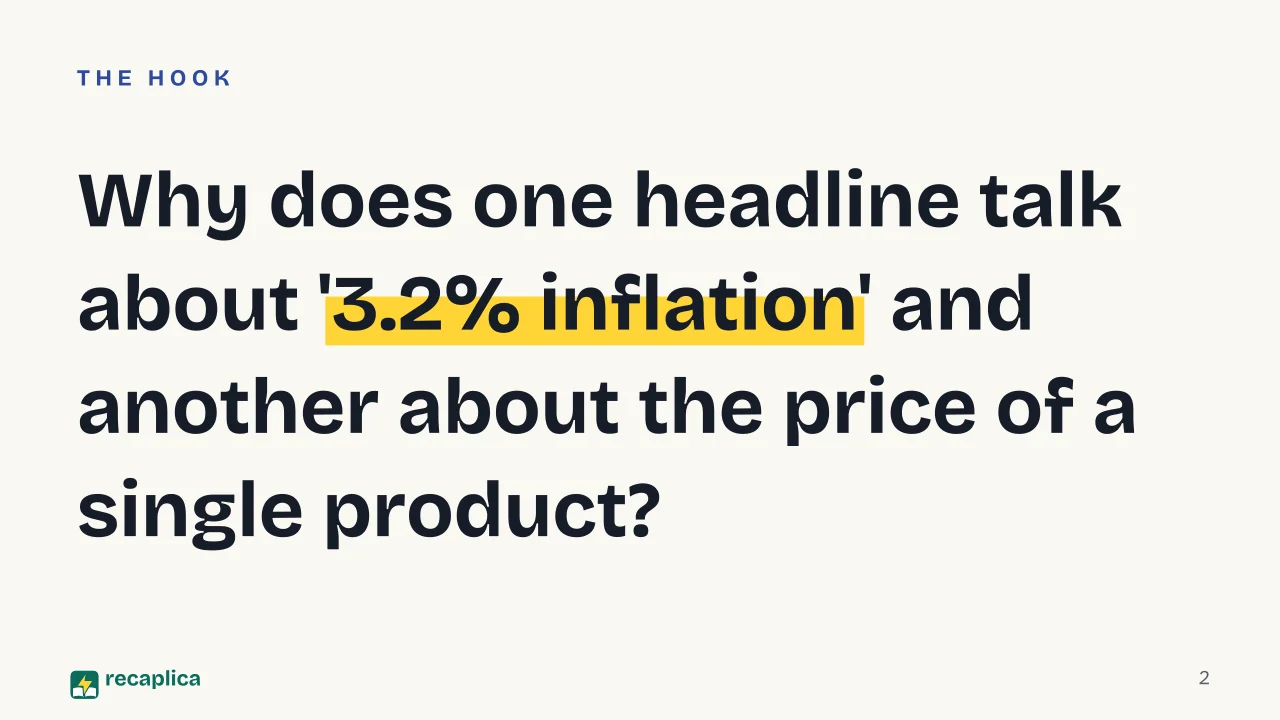 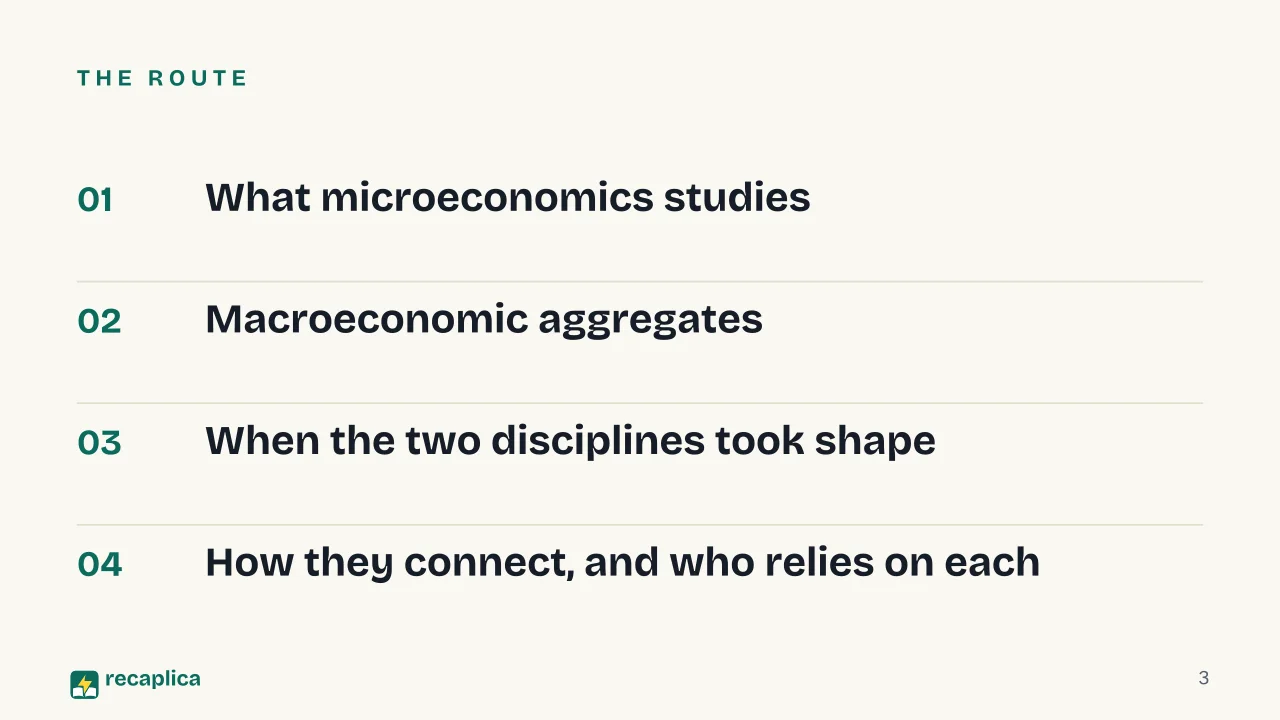   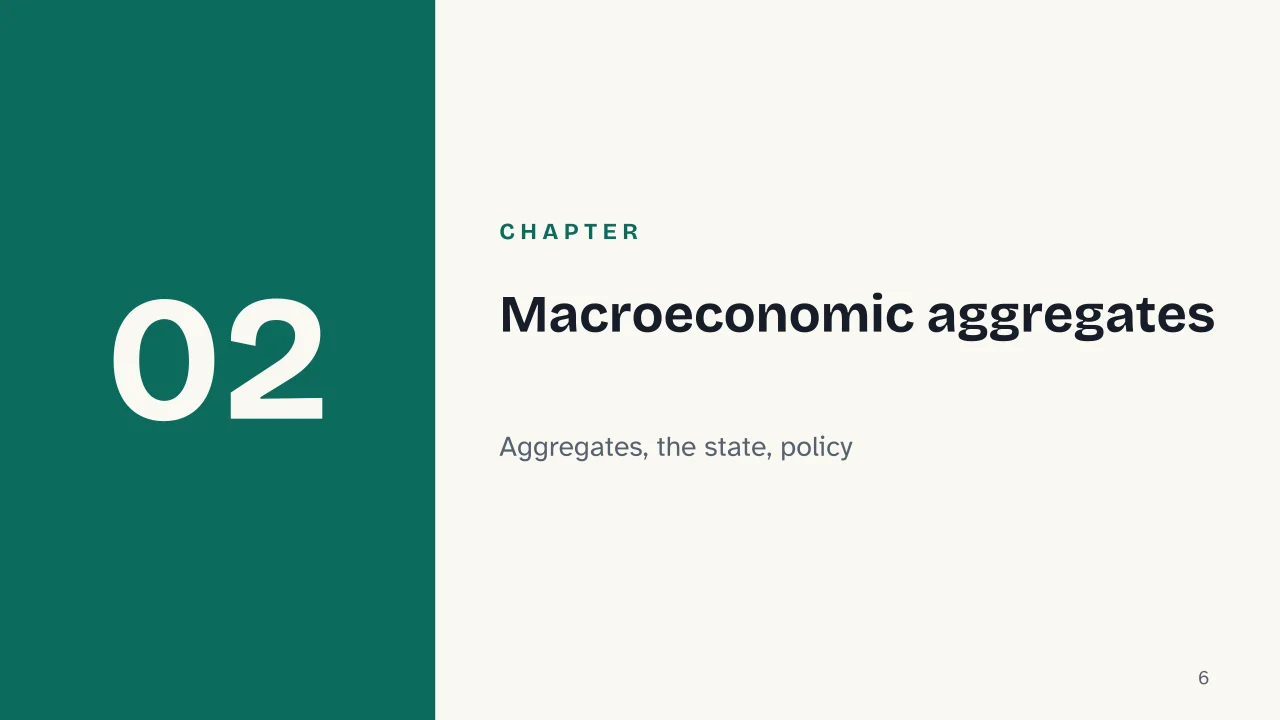 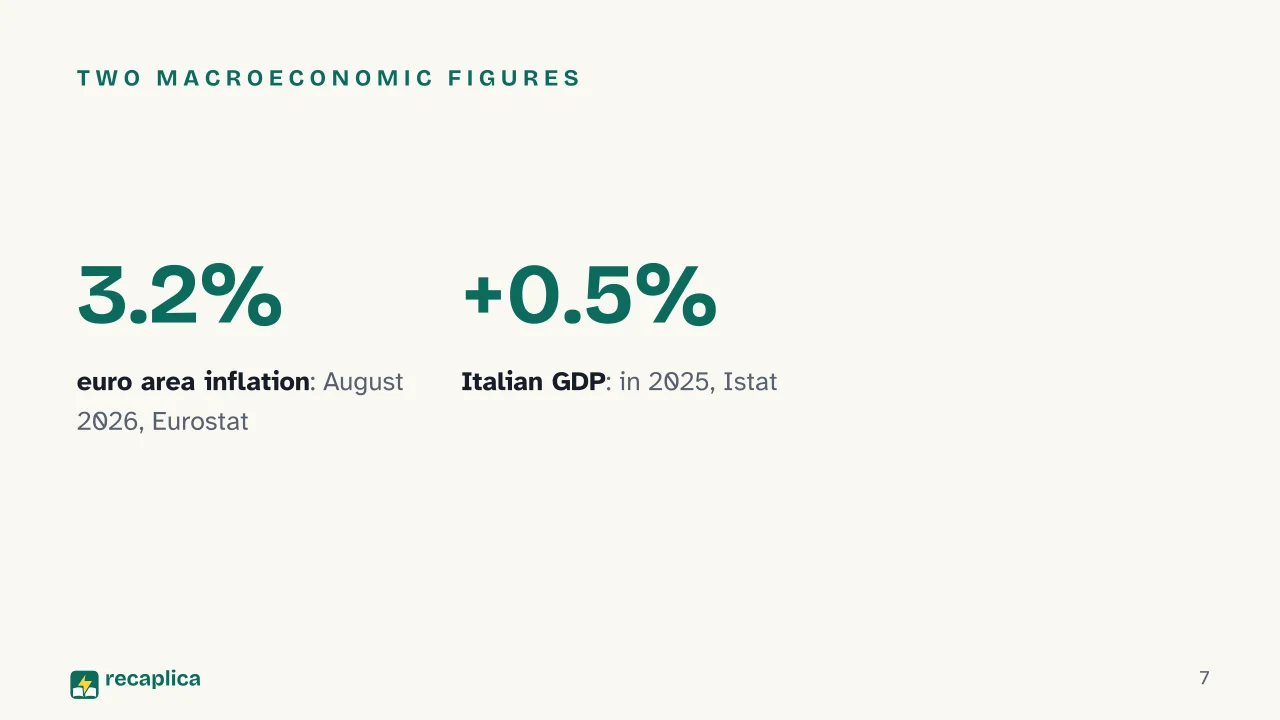  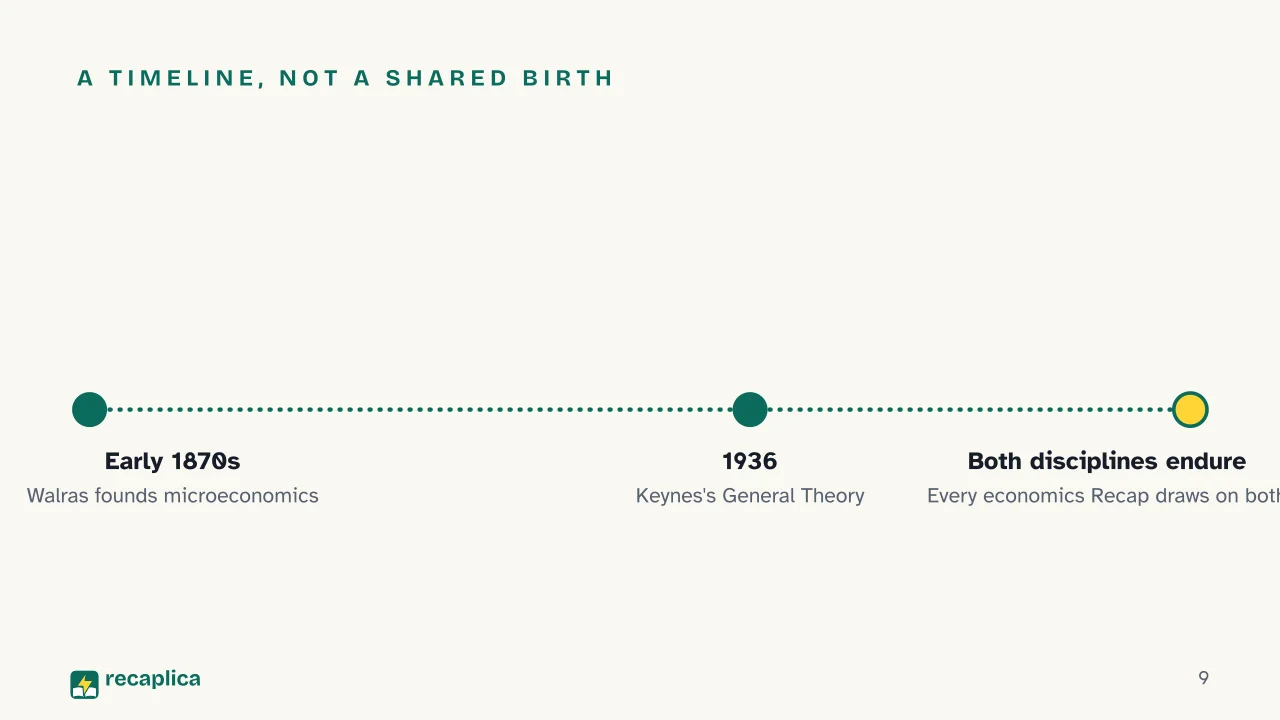  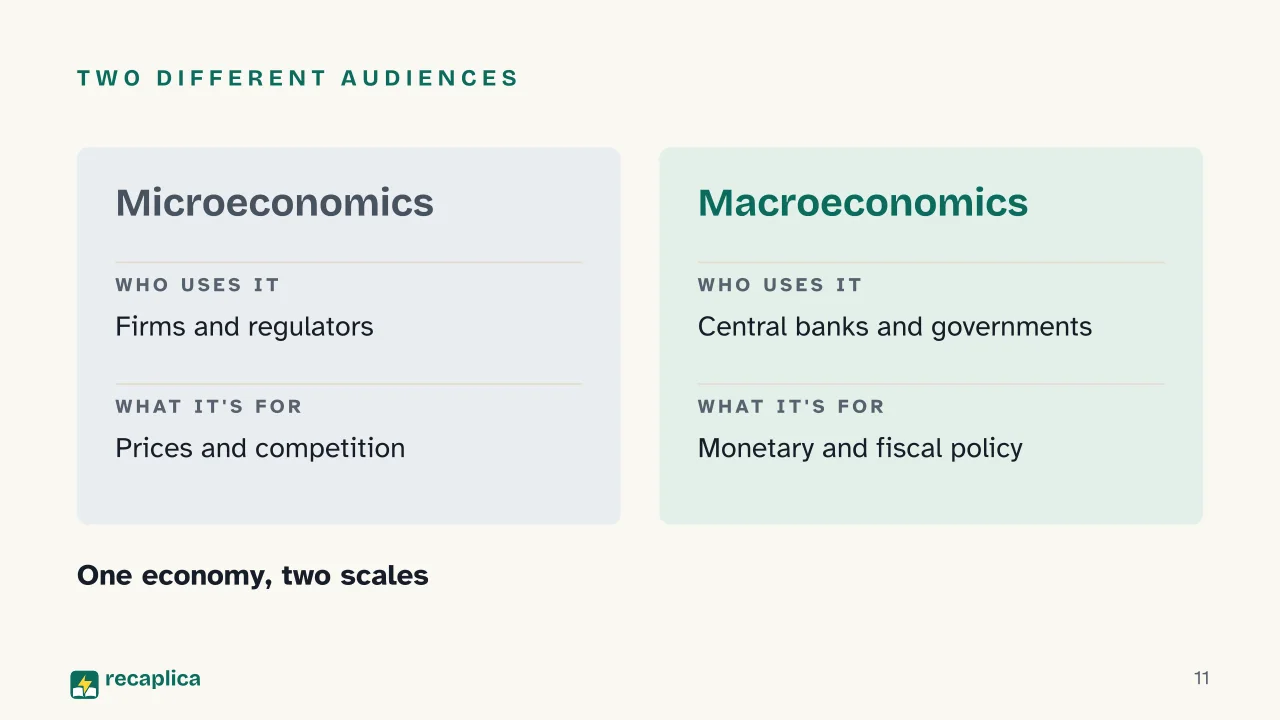  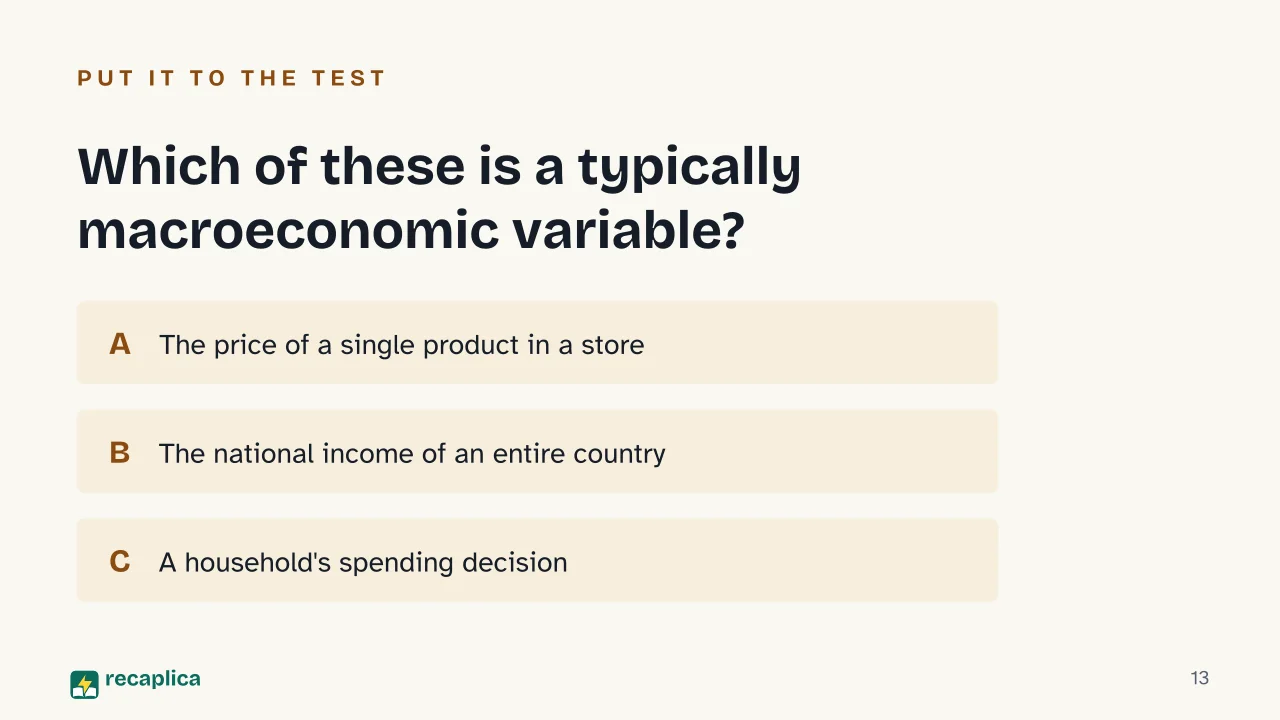  Common myths
Mind mapDrag the background to move around and the nodes to reposition them; use − and + to collapse and expand branches. 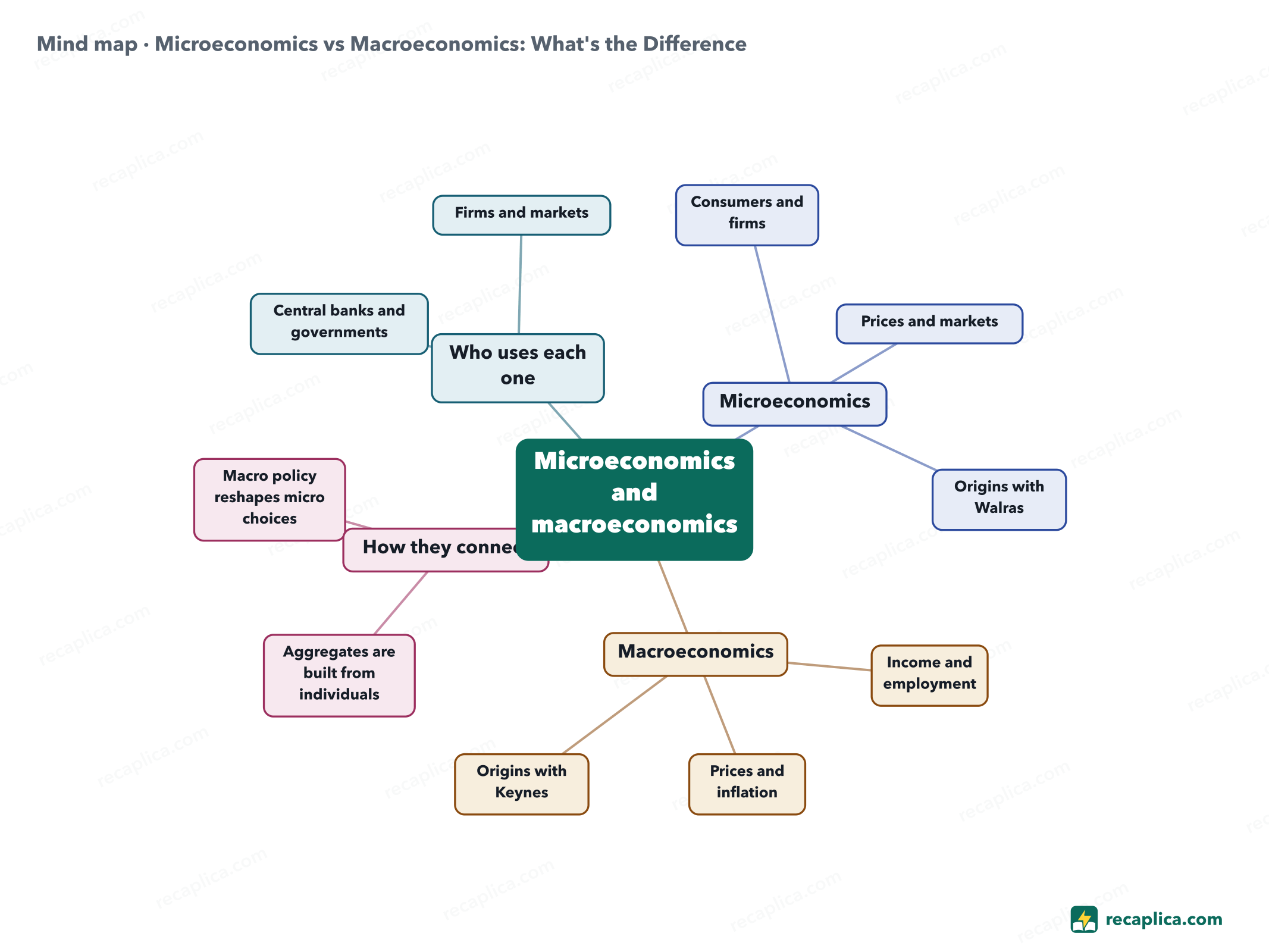
Quiz: test yourselfAnswer the questions to check what you have learned: you get instant feedback and a short explanation. Grade 0/10 0/5
FlashcardsTap the card to flip it and check whether you remember the answer, then move to the next one. 1 / 8 Explain it in your own wordsThe ultimate test: if you can explain it in simple words, you've truly understood it. Write your explanation, then compare it with the Recap. Your explanation is saved only on this device.
Frequently asked questionsWhat is the difference between microeconomics and macroeconomics?Microeconomics studies the behavior of individual economic agents (households, firms) and the markets for single goods; macroeconomics studies the large aggregates of the whole economy, such as national income, employment and the price level. What does macroeconomics mean, exactly?Macroeconomics is the branch of economics that studies the equilibrium of an entire economy's large aggregates: national income, overall employment, the general price level, aggregate demand, and the effects of monetary and fiscal policy. It looks at a country, or a currency area, as a whole rather than at a single market. Which came first, microeconomics or macroeconomics?Microeconomics: its foundation is traditionally traced to Léon Walras in the early 1870s. Macroeconomics became a separate discipline later, with Keynes's General Theory in 1936. Do micro economics and macro economics share any concepts?Yes. Both use concepts such as supply and demand, but applied at different scales: a single market in microeconomics, the whole economy in macroeconomics. Macro-level decisions, like interest rate changes, then reshape the micro-level choices of households and firms. Why does the distinction between microeconomics and macroeconomics matter in practice?It helps identify which level a statement belongs to: the price of a single product or its sales figures are microeconomic questions, while a country's inflation rate or GDP growth are macroeconomic ones, each with its own tools and its own main actors, firms on one side, central banks and governments on the other. Every Recap goes through an independent review before publication. |