Skip to content
recaplica

    One moment: security check

    Cloudflare wants to make sure you're not a robot. Tick the box below and your search will continue on its own.

    IT
    recaplica OSI Model: What It Is, the 7 Layers, and How It Compares to TCP/IP
    © 2026 Recaplica · recaplica.com — All rights reserved
    Home › Technology

    OSI Model: What It Is, the 7 Layers, and How It Compares to TCP/IP

    By Recaplica Newsroom · Updated on October 1, 2026

    What to print

    Page numbers appear when printing with default margins.

    Slides

    Choose a cut

    Flash10 slidesThe essential thread, to present in classFull16 slidesEvery chapter and the deeper detail

    Both come with speaker notes.

    Telegram channel
    recaplica Clear in 30 seconds, yours in 10 minutes.
    In 30 seconds Key points Deep dive Slides Myths Mind map Quiz Flashcards FAQ

    In 30 seconds quick read

    The OSI model, according to IBM, breaks network communication into seven abstract layers, from the physical cable up to the programs a user sees on screen. Real networks run on a leaner design instead, TCP/IP, defined in RFC 1122, which needs only four layers, Application, Transport, Internet, and Link. The two models don't line up layer for layer, Cisco Networking Academy notes that TCP/IP's Application layer alone covers what OSI splits into Session, Presentation, and Application. Knowing which layer a protocol like HTTP, TCP, or IPv4 belongs to helps pinpoint where a connection breaks when something goes wrong.

    Key Points

    • The OSI model breaks network communication into seven abstract layers, from Physical to Application, according to IBM.
    • The TCP/IP model, described in RFC 1122, has only four layers, Application, Transport, Internet, and Link, and is the one actually running networks.
    • OSI's Network layer maps to TCP/IP's Internet layer, according to Cisco Networking Academy, both route packets between different networks.
    • TCP/IP's Application layer groups OSI layers 5, 6, and 7, Session, Presentation, and Application.
    • Protocols such as HTTP, DNS, TCP, and IPv4 each sit at a specific layer in both models.
    • "OSI stack" is just another name for the same layered model.

    Deep Dive

    According to IBM, the OSI model (Open Systems Interconnection) is a conceptual model that organizes network communication into seven abstract layers, stacked one above the other, from the cable up to the program a user sees on screen. It isn’t software you install, and it isn’t a bundle of cables to wire up — it’s a way of thinking about the problem, built to separate the responsibilities of the people who design network hardware from the people who design network software. Readers of How the internet works: the journey of data from cable to page have already met pieces of this story without the name that ties them together.

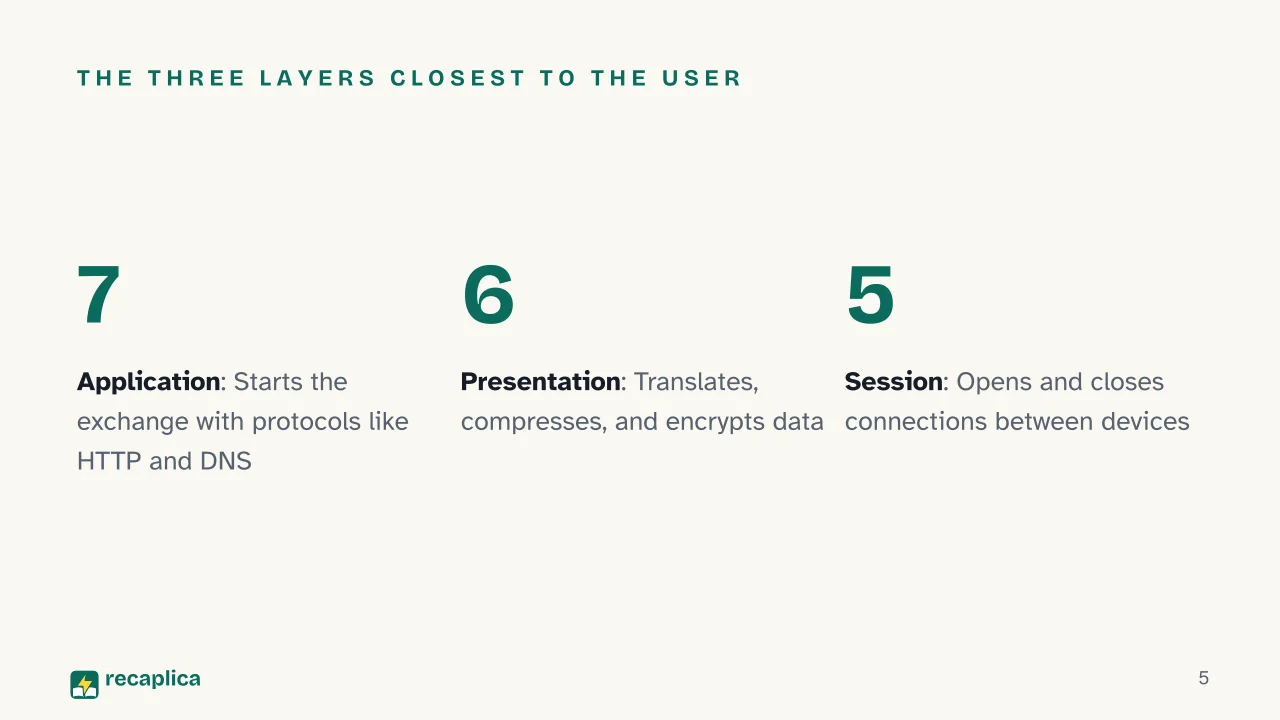
    The seven layers, read from top to bottom, are Application, Presentation, Session, Transport, Network, Data Link, and Physical, according to IBM. At the seventh, Application, live the protocols — HTTP among them — that turn network data into what a user sees when a browser requests a page. The sixth, Presentation, prepares that data by translating, compressing, and encrypting it before it reaches Application. The fifth, Session, opens and closes the connections between the two devices talking to each other.

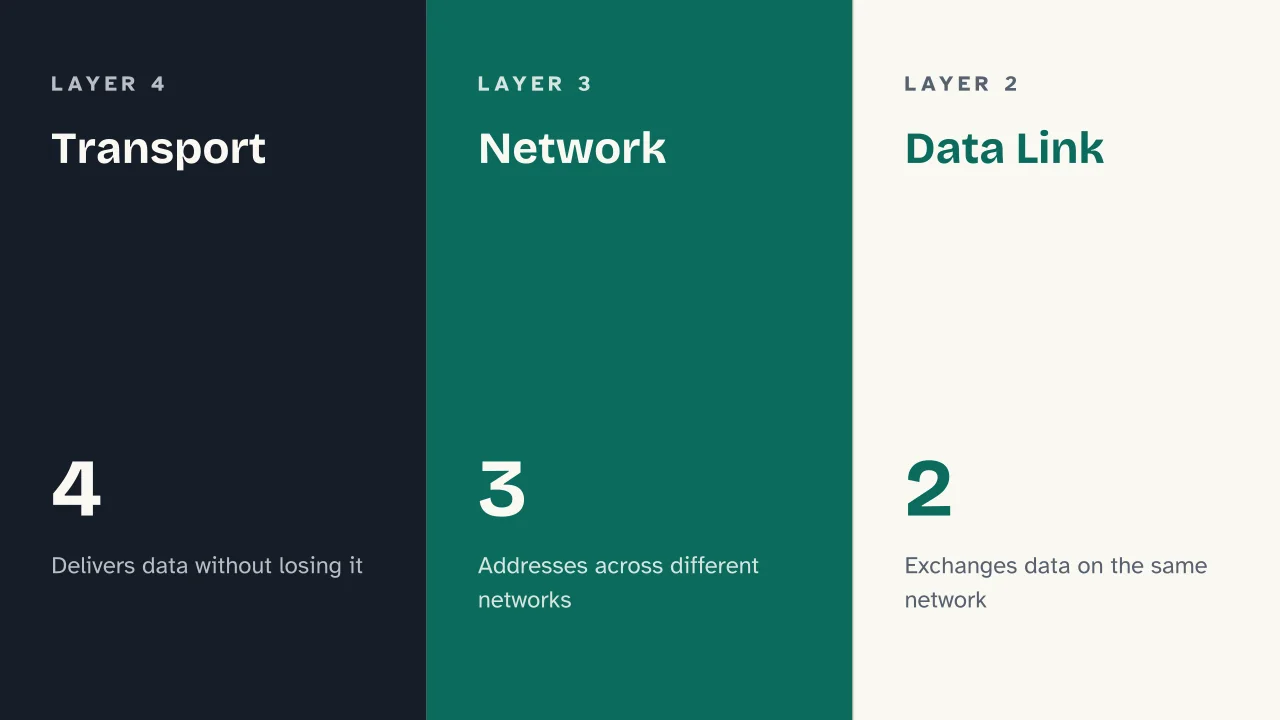
    Moving down the stack changes the kind of job each layer does. The Transport layer (4) delivers data end to end between two devices, checking that none of it is lost along the way. The Network layer (3) addresses and routes that data between devices sitting on different networks. The Data Link layer (2) instead handles the closer exchange, between two devices on the same network. At the base sits the Physical layer (1): the cables and routers that turn data into sequences of 1s and 0s, the same alphabet described in Binary Code: What It Is and How Computers Write Numbers.

    The OSI stack, another name for the same ladder

    “OSI stack” is another way people refer to this same model. The word stack describes layers piled one on top of the other.

    The TCP/IP model, the one networks actually run on

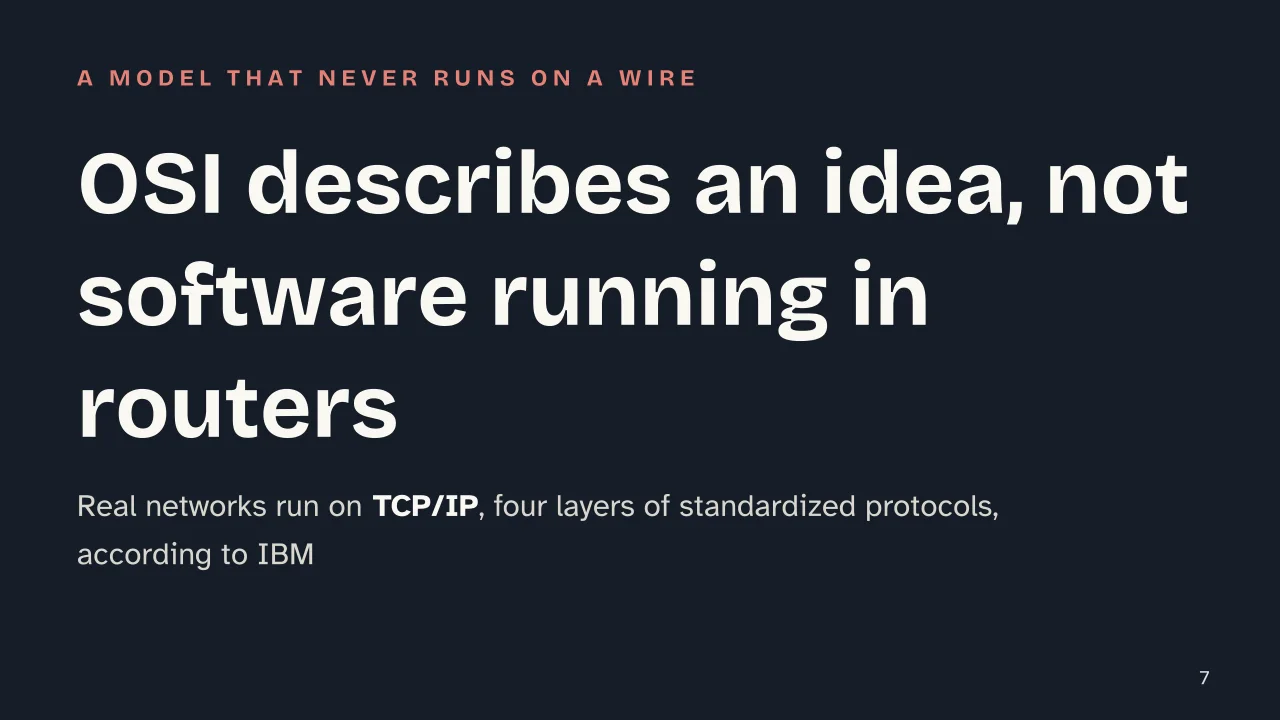
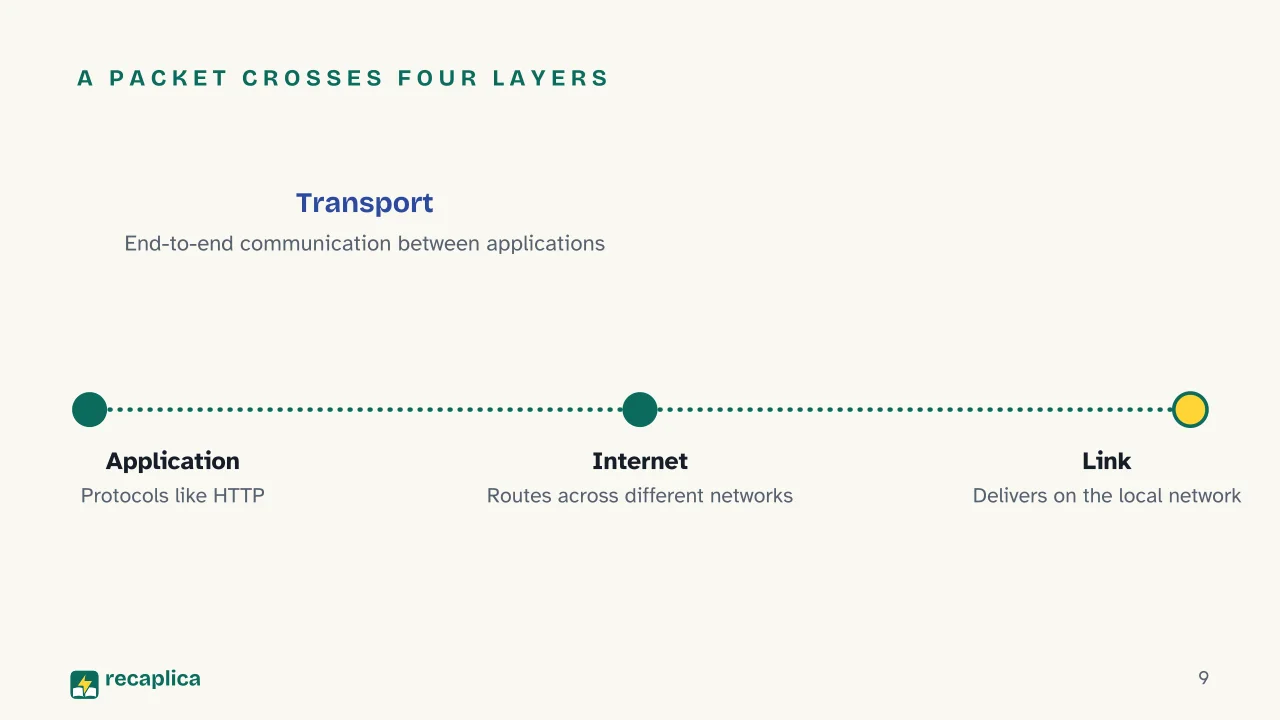
    Unlike the OSI model, TCP/IP relies on standardized protocols that are genuinely implemented in real networks, and it’s built from four layers instead of seven, according to IBM. RFC 1122, the IETF document that describes the requirements for Internet hosts, lists these four layers: Application, the top layer of the Internet protocol suite; Transport, which provides end-to-end communication services to applications; Internet, crossed by every transport protocol to move data from the source host to the destination host using the IP protocol; and the link layer, which a host must implement to communicate on the network it’s directly attached to. Cisco Networking Academy material describes the same four layers with different wording, useful for anyone who prefers another angle on the same facts: the Application layer represents data for the user and handles encoding and dialog control, the Transport layer supports communication between different devices on different networks, the Internet layer determines the best path across the network, and the Network Access layer controls the hardware devices and transmission media of the network.

    Where the two models meet

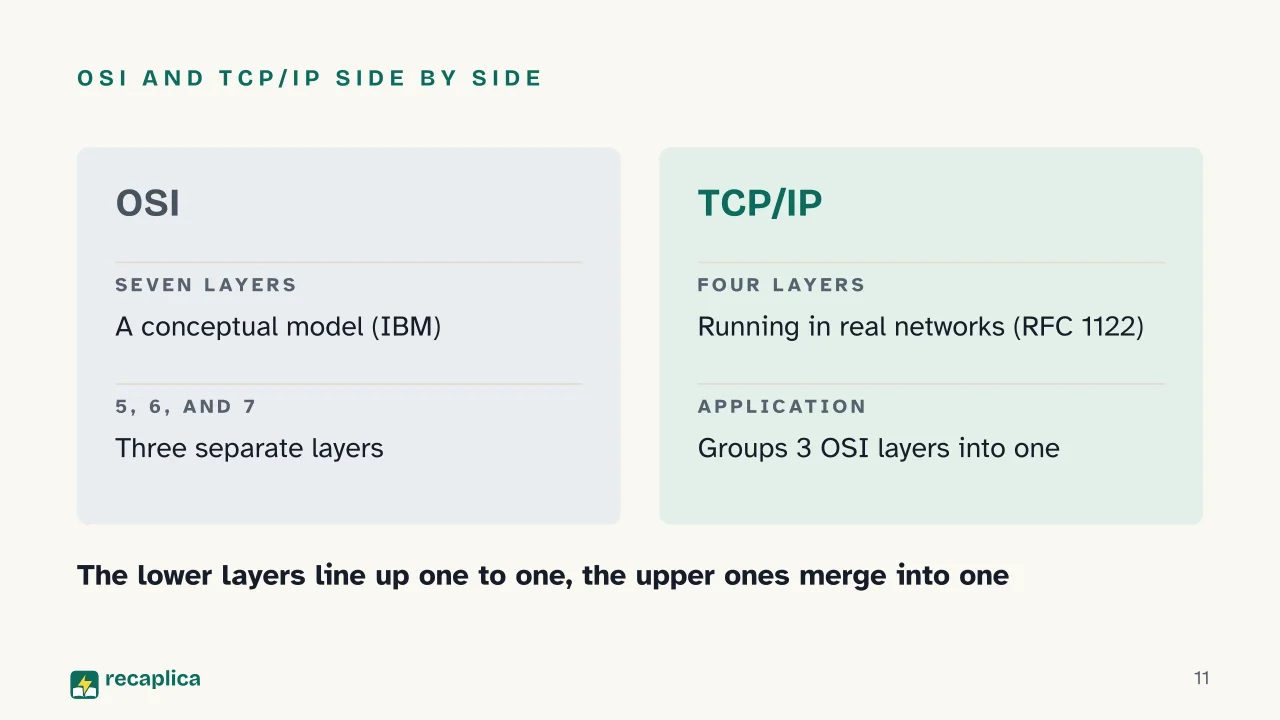
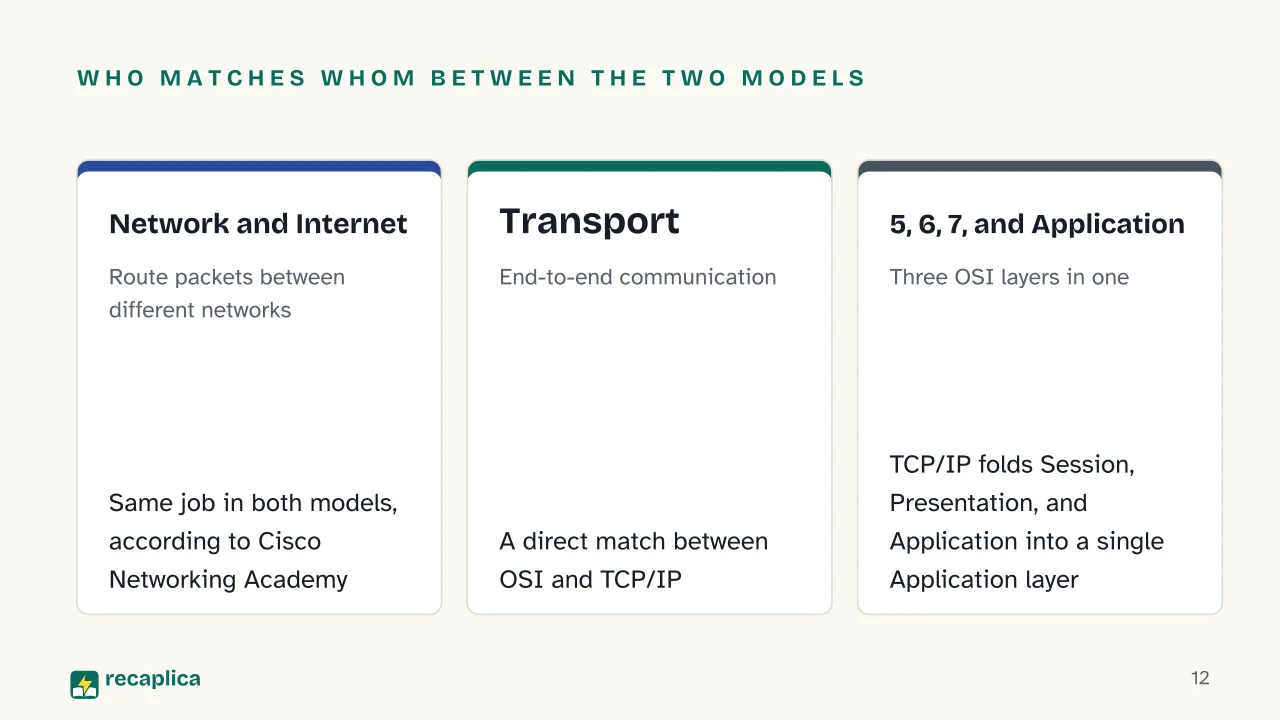
    Neither model is more “correct” than the other: they describe the same network communication at a different level of detail. According to Cisco Networking Academy, OSI’s Network layer (3) maps directly to TCP/IP’s Internet layer, and both are responsible for routing packets between different networks. In the same way, OSI’s Transport layer (4) maps to TCP/IP’s Transport layer.

    The match gets messier higher up the stack. TCP/IP’s Application layer alone groups OSI layers 5, 6, and 7 — Session, Presentation, and Application — which remain a useful reference for people building application software but have no separate counterpart in TCP/IP. At the bottom of the stack, OSI keeps Data Link and Physical apart, which is why it’s usually the model people reach for when discussing the lowest layers of a network, the same ground covered in History of Computers: A Timeline from Babbage to the Web.

    OSI layerTCP/IP layer
    Application (7), Presentation (6), Session (5)Application
    Transport (4)Transport
    Network (3)Internet
    Data Link (2), Physical (1)Link (Network Access)

    Protocols, layer by layer

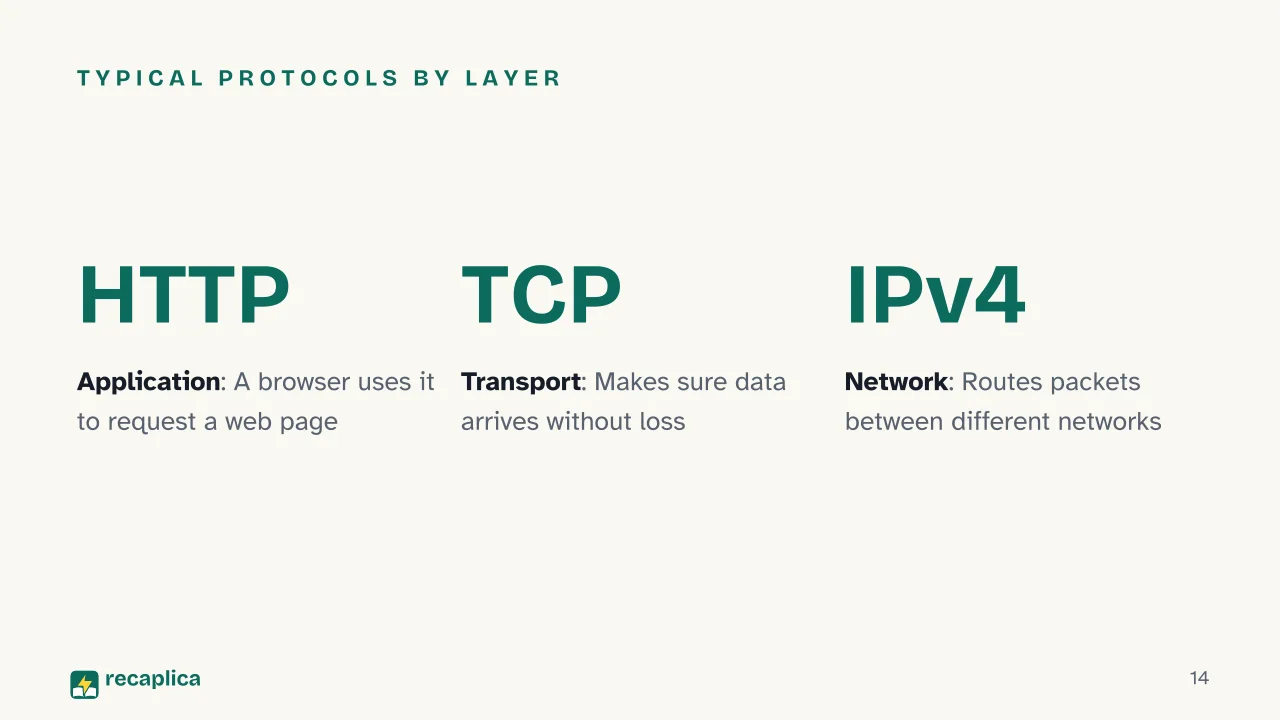
    Every layer has its own typical protocols. According to IBM, the Application layer runs HTTP, FTP, DNS, and SMTP; the Transport layer runs TCP and UDP; the Network layer runs IPv4 and IPv6; the Data Link layer runs Ethernet and ARP.

    Practical example: when a browser loads a web page, HTTP (Application layer in OSI, Application in TCP/IP) puts the request together; TCP (Transport layer in both models) breaks it into packets and tracks their delivery; IPv4 or IPv6 (Network layer in OSI, Internet in TCP/IP) find the path between networks; and finally Ethernet (Data Link layer in OSI, Link in TCP/IP) carries the data over the last stretch, from the network card to the cable or the Wi-Fi antenna.

    This breakdown into layers is what lets two computers running different hardware and software understand each other: each one speaks a different protocol at every layer, but the sequence of layers is shared, as also told in The History of the Internet: From ARPANET to the World Wide Web.

    Slide deck

    Slides ready to download and make your own in PowerPoint or Google Slides, with speaker notes. Pick the Flash cut or the Full one.
    Slide 1 of the presentation on OSI Model: The OSI ModelSlide 2 of the presentation on OSI Model: How does a browser load a page through cables, routers, and computers it has never met?Slide 3 of the presentation on OSI Model: In this RecapSlide 4 of the presentation on OSI Model: Chapter 01: The OSI modelSlide 5 of the presentation on OSI Model: The three layers closest to the userSlide 6 of the presentation on OSI Model: Transport · Network · Data LinkSlide 7 of the presentation on OSI Model: OSI describes an idea, not software running in routersSlide 8 of the presentation on OSI Model: Chapter 02: The TCP/IP modelSlide 9 of the presentation on OSI Model: A packet crosses four layersSlide 10 of the presentation on OSI Model: Chapter 03: Where they meetSlide 11 of the presentation on OSI Model: OSI and TCP/IP side by sideSlide 12 of the presentation on OSI Model: Who matches whom between the two models: Network and Internet, Transport, 5, 6, 7, and ApplicationSlide 13 of the presentation on OSI Model: Chapter 04: Protocols at workSlide 14 of the presentation on OSI Model: Typical protocols by layerSlide 15 of the presentation on OSI Model: How many layers does the TCP/IP model have, according to RFC 1122?Slide 16 of the presentation on OSI Model: Now, the recap
    Flash10 slidesThe essential thread, to present in classFull16 slidesEvery chapter and the deeper detail

    Common myths

    • ✗ Myth The OSI model and the TCP/IP model are the same thing under different names

      ✓ Reality People mix them up because both organize networking into layers, but they're distinct models: OSI counts seven, TCP/IP four, and according to Cisco Networking Academy TCP/IP's Application layer alone covers three separate OSI layers

    • ✗ Myth The seven OSI layers actually run inside routers and operating systems

      ✓ Reality According to IBM, OSI is a conceptual model used to reason about networking, while real networks run on TCP/IP, built on standardized protocols that are genuinely implemented

    • ✗ Myth OSI's Transport layer and Network layer do the same job

      ✓ Reality They have different jobs, according to IBM: the Network layer addresses and routes data between devices on different networks, while the Transport layer makes sure that data arrives end to end without loss

    Mind map

    Drag the background to move around and the nodes to reposition them; use − and + to collapse and expand branches.
    Customize
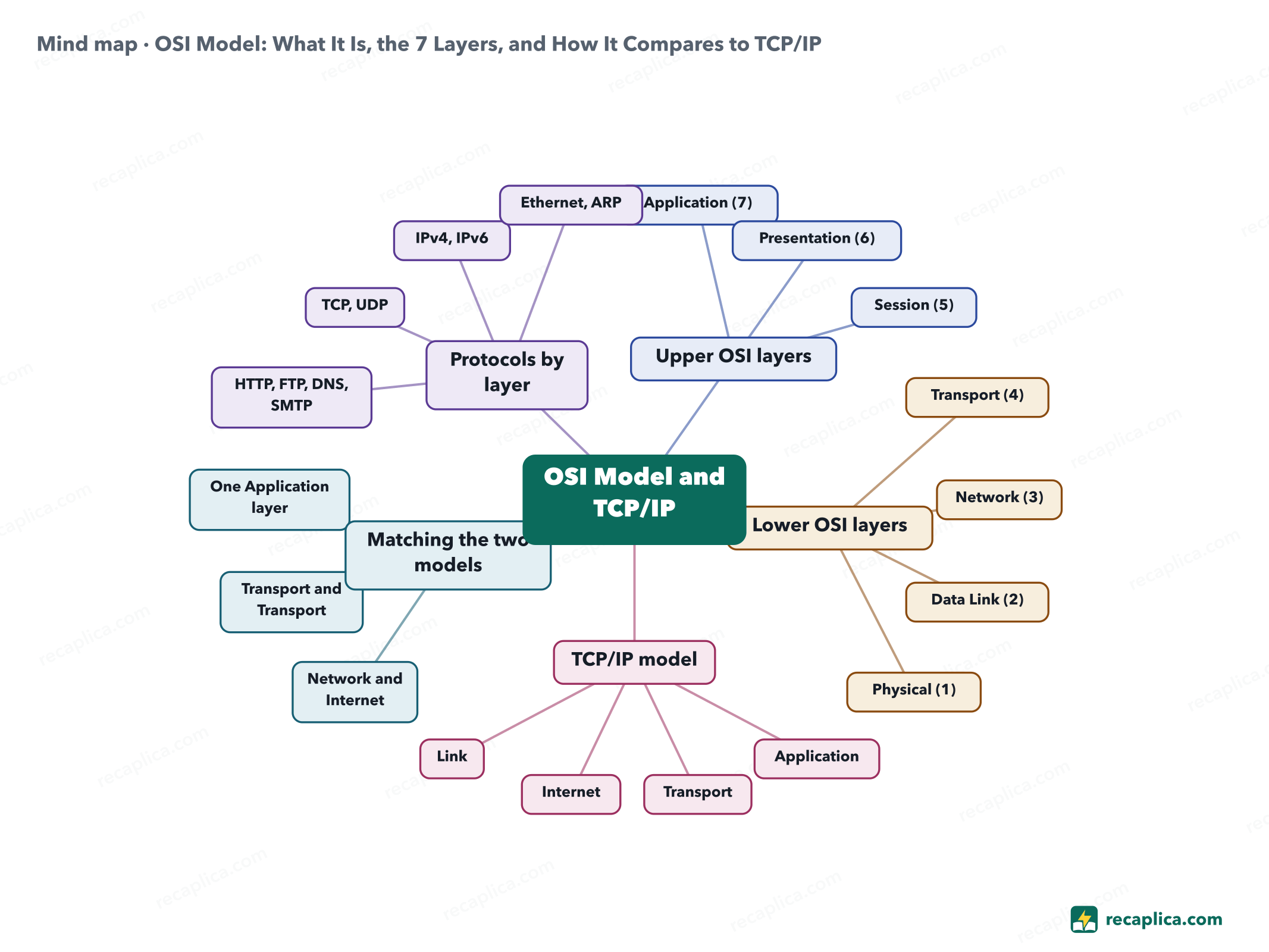
    Mind map: OSI Model: What It Is, the 7 Layers, and How It Compares to TCP/IP
    • OSI Model and TCP/IP
      • Upper OSI layers Application, Presentation, and Session
        • Application (7) Starts the exchange with protocols like HTTP and DNS
        • Presentation (6) Translates, compresses, and encrypts data
        • Session (5) Opens and closes connections between devices
      • Lower OSI layers
        • Transport (4) Delivers data end to end without loss
        • Network (3) Addresses and routes data between networks
        • Data Link (2) Exchanges data between devices on the same network
        • Physical (1) Cables and hardware that turn data into signals
      • TCP/IP model Four layers, according to RFC 1122
        • Application The top layer of the Internet protocol suite
        • Transport End-to-end communication services
        • Internet Uses IP to route data across networks
        • Link The protocol of the network the host connects to
      • Matching the two models
        • Network and Internet Same job, according to Cisco Networking Academy
        • Transport and Transport A direct match
        • One Application layer Groups OSI's Session, Presentation, and Application
      • Protocols by layer
        • HTTP, FTP, DNS, SMTP Application layer
        • TCP, UDP Transport layer
        • IPv4, IPv6 Network layer
        • Ethernet, ARP Data Link layer

    Quiz: test yourself

    Answer the questions to check what you have learned: you get instant feedback and a short explanation.

    Grade 0/10 0/5
    1 According to IBM, how many layers does the OSI model have?

    IBM describes the OSI model as breaking network communication into seven abstract layers.

    2 Which OSI layer handles addressing and routing data between different networks?

    According to IBM, the Network layer (3) handles addressing, routing, and forwarding data between devices on different networks.

    3 How many layers does the TCP/IP model described in RFC 1122 have?

    RFC 1122 and Cisco Networking Academy materials describe TCP/IP with four layers, Application, Transport, Internet, and Link.

    4 Which TCP/IP layer does OSI's Network layer correspond to, according to Cisco Networking Academy?

    Cisco Networking Academy states that OSI's Network layer (3) maps directly to TCP/IP's Internet layer.

    5 True or false: the OSI model is the one actually implemented in real networks, while TCP/IP remains purely theoretical.

    It's the opposite, according to IBM: the TCP/IP model relies on standardized protocols genuinely implemented in networks, while OSI remains a conceptual model.

    Answers: 1-B · 2-A · 3-B · 4-C · 5-B

    Flashcards

    Tap the card to flip it and check whether you remember the answer, then move to the next one.

    1 / 8

    Explain it in your own words

    The ultimate test: if you can explain it in simple words, you've truly understood it. Write your explanation, then compare it with the Recap.

    Your explanation is saved only on this device.

    The OSI model, according to IBM, breaks network communication into seven abstract layers, from the physical cable up to the programs a user sees on screen. Real networks run on a leaner design instead, TCP/IP, defined in RFC 1122, which needs only four layers, Application, Transport, Internet, and Link. The two models don't line up layer for layer, Cisco Networking Academy notes that TCP/IP's Application layer alone covers what OSI splits into Session, Presentation, and Application. Knowing which layer a protocol like HTTP, TCP, or IPv4 belongs to helps pinpoint where a connection breaks when something goes wrong.

    Frequently asked questions

    Is the OSI model actually used in networks?

    No. According to IBM, real networks run on the TCP/IP model, built on standardized protocols that are actually implemented, while OSI remains a conceptual model used to reason about network communication.

    How many layers does the TCP/IP model have?

    Four, according to RFC 1122, Application, Transport, Internet, and Link.

    What's the difference between OSI's Transport layer and Network layer?

    According to IBM, the Transport layer (4) delivers data end to end and makes sure none of it gets lost, while the Network layer (3) handles addressing, routing, and forwarding data between devices on different networks.

    What's the point of matching the OSI model to the TCP/IP model?

    It helps locate a network problem, because protocols like TCP or IPv4 perform the same job described by both the corresponding OSI layer and the corresponding TCP/IP layer, according to Cisco Networking Academy.

    What is the OSI stack?

    It's another name for the OSI model, the seven layers seen as a pile that data passes through every time it moves across a network.

    Sources

    • What Is the OSI Model? (IBM)
    • RFC 1122, Requirements for Internet Hosts (IETF/RFC Editor)
    • Network Communication Models (Cisco Press / Cisco Networking Academy)

    Every Recap goes through an independent review before publication.

    Every evening, the day's new Recaps on our Telegram channel. Join the channel →

    Keep learning

    • Technology Isometric Drawing: What It Is and How to Draw It Isometric drawing represents a three-dimensional object on a flat sheet without distorting its proportions along any of the three axes. The coordinate axes always meet at 120° angles, and the scale is identical along each one — hence the name, which comes from the Greek for equal measure. It is built either by starting from a vertical axis and drawing the other two tilted 120° apart, or by rotating the object roughly 45° and then about 35° relative to the viewer. It is the most common type of axonometric projection in technical drawing, and it also shows up in video games and pixel art. Read the Recap →
    • Technology Monometric Axonometric Projection: What It Is and How to Draw It Monometric axonometric projection is an oblique projection used in technical drawing to represent a three-dimensional object on a flat sheet. In the scheme most common in Italian school curricula, the vertical axis stays upright, while the other two axes are drawn at 30° and 60° from the horizontal, with a 120° angle between the x-axis and the vertical axis. What sets it apart from cavalier axonometric projection is that the object's measurements are transferred onto all three axes without any reduction, at true scale. In Italian technical-drawing vocabulary the name carries some genuine uncertainty: some sources treat it as a synonym for isometric projection, while other textbooks present it as a separate category. Read the Recap →
    • Technology Axonometric Projection: Definition and How to Draw It Axonometric projection is the descriptive-geometry method for drawing a three-dimensional object on a flat sheet in a single view. Unlike perspective, parallel lines stay parallel, so distances can be measured straight off the drawing. Several variants exist, isometric, trimetric, dimetric, oblique (cavalier), which change the angles between the axes and how each one shortens the measurements. The type most used in school technical drawing is isometric, with 120° angles between the axes, built from an isometric scale that carries the correct lengths onto the paper. Engineers and architects also rely on it to show the shape and structure of a building in one diagram. Read the Recap →

    recaplica

    Clear in 30 seconds, yours in 10 minutes.

    Recaps Mind maps Request a Recap Telegram channel Mind map maker Our method About Privacy & cookies Legal notes & terms of use

    © 2026 Recaplica · A project by Curi S.r.l. — VAT IT05472000750

    Statistics, only if you say so

    To learn which Recaps help most we would use Google Analytics, with aggregate, anonymous data. It starts only with your OK, and you can change your mind anytime. Privacy policy