|
recaplica
The History of the Internet: From ARPANET to the World Wide Web | ||||||||||||||||
| © 2026 Recaplica · recaplica.com — All rights reserved | ||||||||||||||||
The History of the Internet: From ARPANET to the World Wide WebWhat to print Page numbers appear when printing with default margins. SlidesChoose a cut Flash10 slidesThe essential thread, to present in classFull18 slidesEvery chapter and the deeper detailBoth come with speaker notes. In 30 seconds quick readThe internet began in the 1960s as a research project funded by the US military, meant to connect the computers of American universities. In September 1969 the first node of ARPANET, the network it all started from, went live; during the 1970s Vint Cerf and Robert Kahn designed TCP/IP, the protocols that let different networks understand each other, which became the single standard on January 1, 1983. In 1989 researcher Tim Berners-Lee proposed the World Wide Web at CERN, the service of linked pages that people often confuse with the internet itself, when it's really just one application running on top of it. In 2025, according to the ITU, about 6 billion people worldwide used the internet to communicate, learn, work and be entertained. Key Points
Key figures
Deep DiveThe name says it all: inter-net, between networks. Long before it became the pages we open in a browser, the internet was a university research experiment for years, then a set of shared technical rules, and only at the end the place where the Web lives. Following these three steps in order helps explain why they still get mixed up so often. A research project, not a single inventionIn 1962, J.C.R. Licklider, a researcher at MIT, put in writing, across a series of memos, the idea of a “Galactic Network”: a set of connected computers that would let anyone access data and programs from any point in the network. It was an idea, not yet a working network. The technical groundwork arrived soon after, from several directions at once. In July 1961, Leonard Kleinrock published the first theoretical basis for packet switching, the method that would let a message be split into many independent pieces instead of requiring a dedicated line. In 1965, Lawrence Roberts connected two distant computers, one in Massachusetts and one in California, over a low-speed dial-up telephone line, showing that different machines could work together at a distance. Around the same time, without either group knowing about the other, similar research on packet switching was also underway at RAND Corporation with Paul Baran and at the UK’s National Physical Laboratory with Donald Davies: the same idea took shape, among several parallel efforts, in more than one place. Roberts presented the plan for ARPANET in 1967. The project became reality in September 1969, when the company BBN installed the first Interface Message Processor at UCLA: Kleinrock’s lab became the network’s first node, with the Stanford Research Institute as the second node shortly after. By December 1970, a working group led by S. Crocker had completed the first shared host-to-host protocol, the Network Control Protocol (NCP): ARPANET’s computers finally had a common language. From linking two computers to a network of networks: TCP/IP is bornNCP worked well inside ARPANET, but it wasn’t designed to connect different networks to one another. Robert Kahn, who joined DARPA in 1972, took on the problem: what was needed was an “open” architecture, able to let networks built on different technologies talk to each other without any of them having to adapt to the rest. Kahn worked on the project together with Vint Cerf, and in September 1973 the two drafted the first version of the protocol, presented at a meeting of the International Network Working Group at the University of Sussex. In May 1974 they published the paper that first described TCP/IP. The protocol became a US defense standard as early as 1980, and January 1, 1983 brought the decisive moment, remembered as “flag day”: every ARPANET host switched, on the same day, from NCP to TCP/IP. By 1990, TCP/IP had displaced competing network protocols nearly everywhere in the world, and ARPANET itself, having served its purpose, was retired. From this point on, “the internet” stopped being the name of a single network and became what it still is: independent networks, university, corporate, government, that can talk to each other because they share the same set of technical rules.
Among the first applications to run on this infrastructure, file transfer and remote login, it was probably email that had the deepest impact, according to the Internet Society document cited as a source: for the first time, people far apart could exchange messages without a phone call or a letter, and that changed the way people collaborated at a distance. The World Wide Web: a service built on top of the internetThe Web arrived nearly twenty years after ARPANET’s first node, and it was born in one specific place: CERN, in Geneva. In March 1989, researcher Tim Berners-Lee submitted a proposal, “Information Management: A Proposal”, for linking CERN’s information — at the time scattered across incompatible systems — through hypertext. In May 1990 he presented a revised version, and in November 1990, together with colleague Robert Cailliau, he filed a formal project-management proposal titled “WorldWideWeb: Proposal for a HyperText Project”. By Christmas 1990, Berners-Lee had already defined the Web’s three technical pillars — HTML to write pages, HTTP to transfer them, and URLs to address them — and had written the first browser/editor and the first server software. The first website, hosted on a CERN NeXT computer at info.cern.ch, described the project itself. In March 1991 a simple, text-only browser reached users on CERN’s own computers, and on August 6, 1991, Berners-Lee announced the software on several internet newsgroups: from there, interest spread beyond the community of physicists. The turning point for its spread came on April 30, 1993, when CERN publicly declared the Web free of royalties, guaranteeing its status as an open standard that anyone could use and build on without paying licensing fees. By the end of that same year, more than 500 known web servers existed worldwide, even though Web traffic still accounted for only about 1% of all internet traffic: other services still carried most of the load in those years.
How it works: packets, addresses, namesUnderneath everything is still the idea of packet switching: every piece of information you send, a photo, a message, a page request, gets split into smaller packets, and each one carries the address of its destination. That address is the IP address, a sequence of numbers like 142.250.190.78; routers, as MDN Web Docs explains, read the address on each packet and forward it toward the next network, one hop at a time, following a routing algorithm that works out the best path each time. Inside a single local network, another layer of addresses, MAC addresses, normally assigned by the hardware manufacturer, lets a switch deliver packets to the right device, learning which connection each message arrived from. An ISP (Internet Service Provider) is the company that runs the routers able to connect your local network to other operators’ networks, all the way to any other network in the world. Nobody, though, memorizes number sequences like 142.250.190.78. That’s what the DNS is for: the system that translates human-readable names, like “google.com”, into the matching IP address.
One distinction is worth stressing, since it’s the one most often confused: the internet is not the Web. The internet is the network of networks just described, made of cables, routers and protocols; the Web is one of the services running on top of it, made of pages linked together and viewed with a browser over the HTTP protocol. Email, messaging and video streaming are other services that travel over the same infrastructure without going through the Web at all. Even pages built with server-side languages such as PHP remain, technically, part of the Web: they are programs that generate HTML pages to send to the browser over that same packet network. How many people use the internet worldwideEstimates vary depending on who calculates them and which period they cover, and the two main ones should always be cited separately. According to the ITU, the United Nations agency for telecommunications, about 6 billion people — 74% of the world’s population — used the internet in 2025, up from 5.8 billion in 2024; growth in 2025 ran at 3.3%, faster than the 2.9% recorded the year before. The gap remains wide: penetration reaches nearly 94% in high-income countries against 23% in low-income countries, and by region it ranges from 88-93% in the Commonwealth of Independent States, Europe and the Americas down to 36% in Africa. DataReportal, which publishes estimates using a different method, calculated that at the start of 2026 there were 6.04 billion internet users worldwide, or 73.2% of the population, an increase of 294 million people (+5.1%) over the previous twelve months; about 2.21 billion people remained offline. The two figures shouldn’t be added together or blended into one: they measure different periods with different methodologies, but they point to the same underlying trend — growth that slows down as it approaches the size of the world’s population. What the internet is used forEmail remains, according to the Internet Society document cited as a source, probably the service that changed remote collaboration the most, going back to ARPANET’s earliest years. From there, its uses have multiplied considerably. At the start of 2026, according to DataReportal, 5.66 billion user identities were active on social media worldwide (68.7% of the population), with the average person using close to 7 different platforms a month; 91.7% of online adults watch streaming television regularly, and streaming services now account for more than half of all TV viewing time worldwide. On the advertising side, global advertising spending in 2025 came to about $1.16 trillion (up 6.5% from the year before); digital channels accounted for 74.4% of that total. A more recent field, running on that very same infrastructure, is artificial intelligence platforms: more than 1 billion people use them every month according to DataReportal, with generative AI tools processing requests on remote servers reached through exactly the same packets, IP addresses and routers as any other service: what changes is the service running on top, not the transport underneath, the same transport that has connected every computer in the history of computers since TCP/IP existed. Still, there are the nearly two billion people the ITU estimates were offline in 2025: internet access is far from a given everywhere, and it remains closely tied to a country’s economic development. Slide deckSlides ready to download and make your own in PowerPoint or Google Slides, with speaker notes. Pick the Flash cut or the Full one.    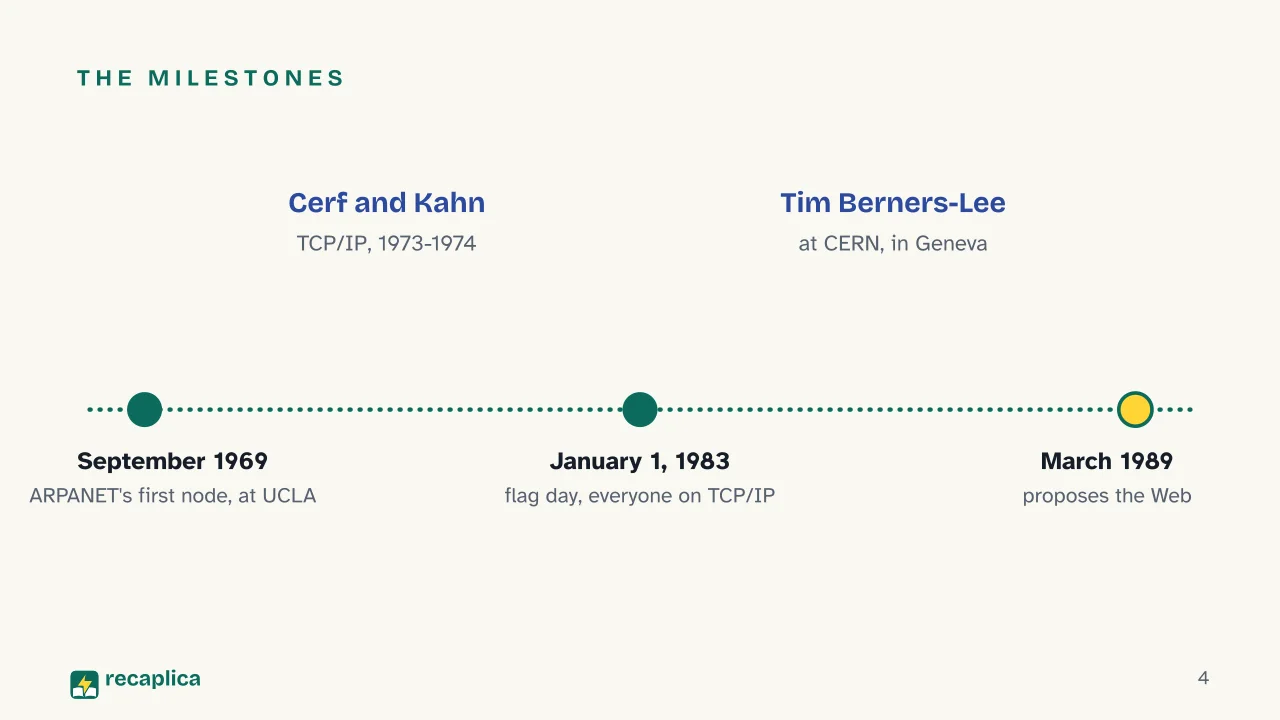  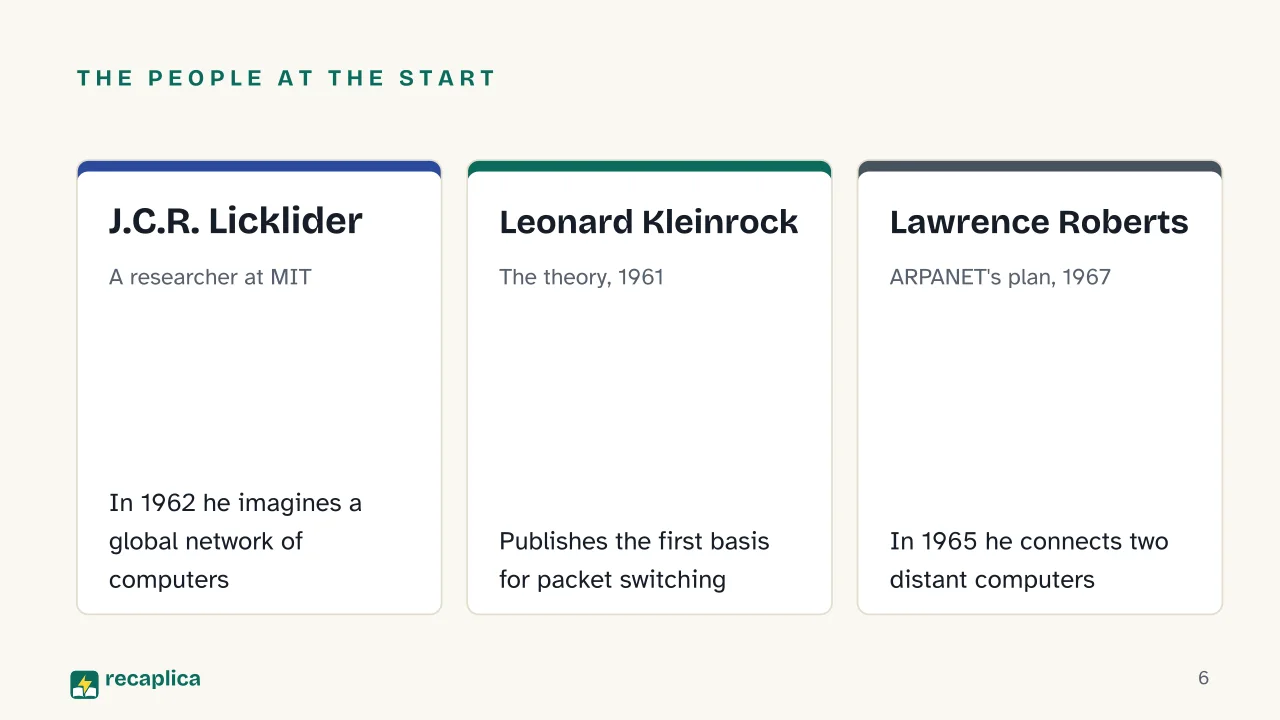 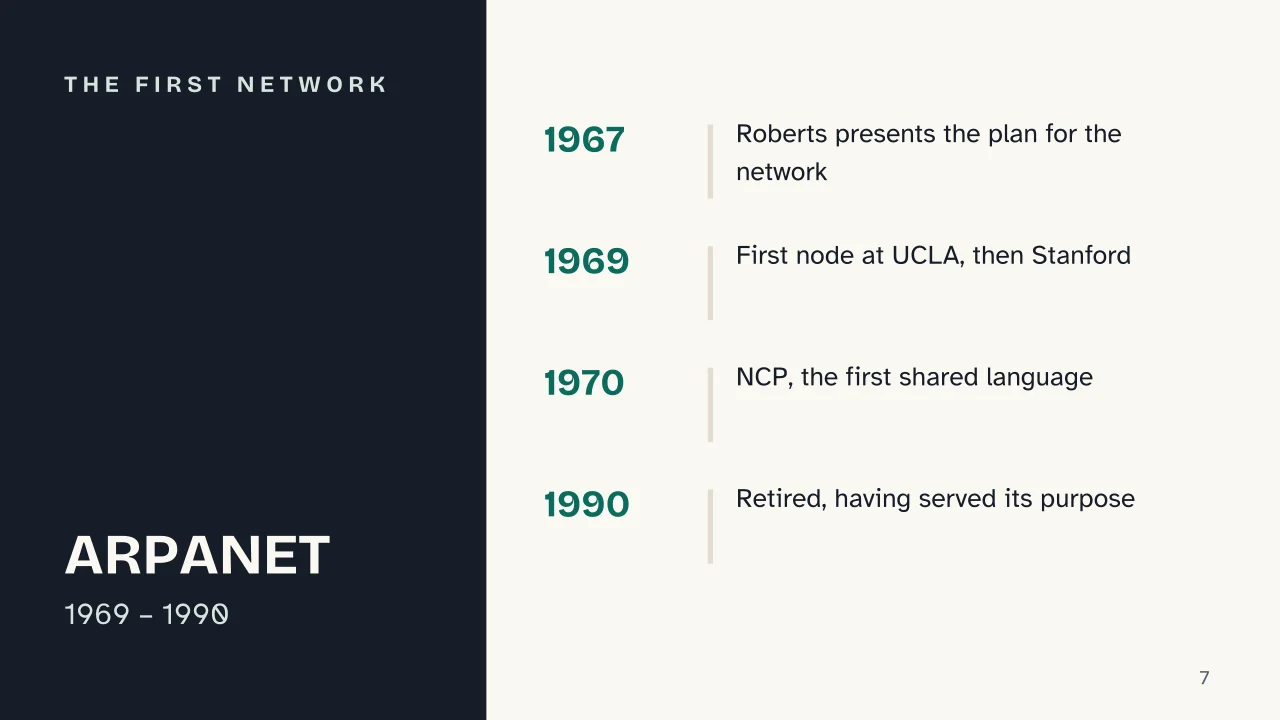  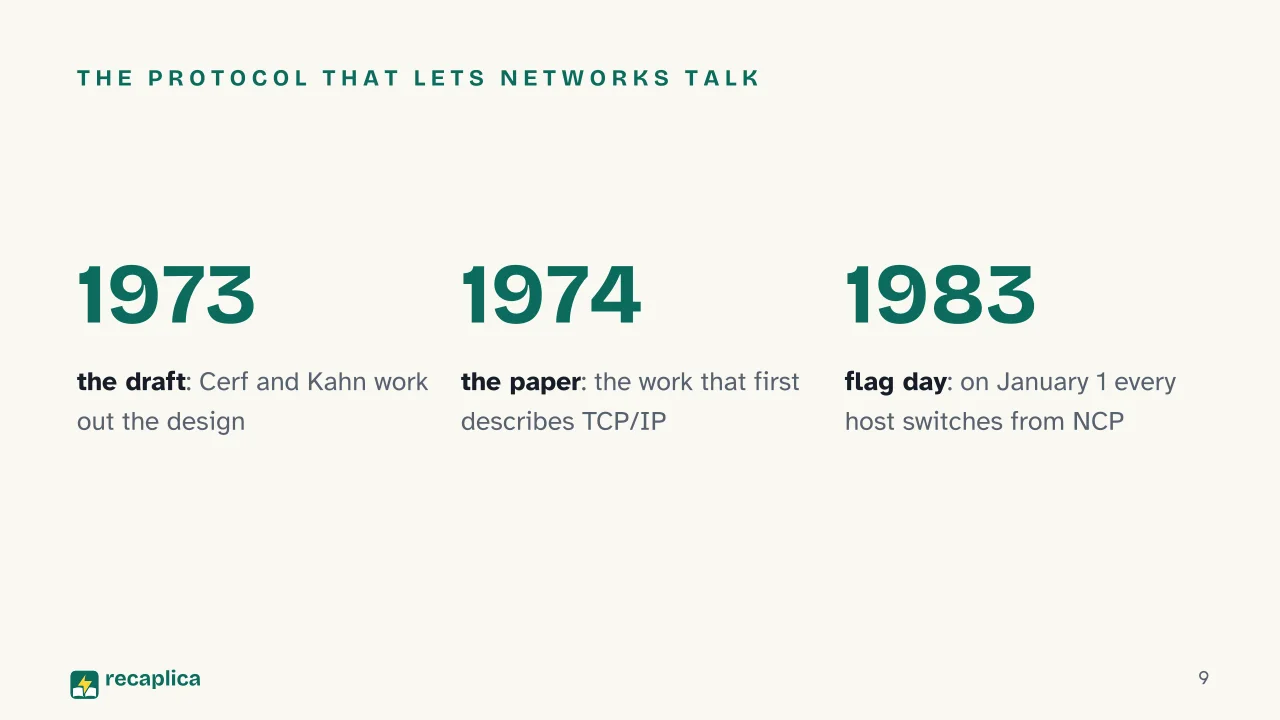  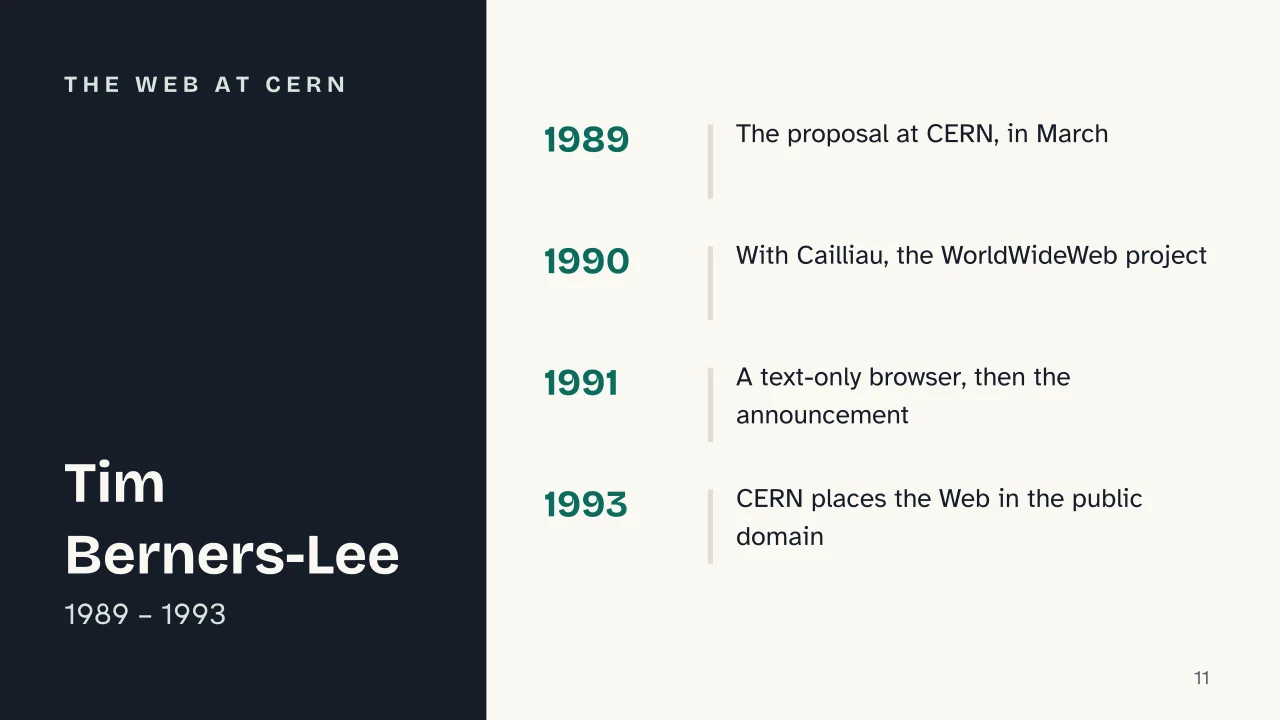 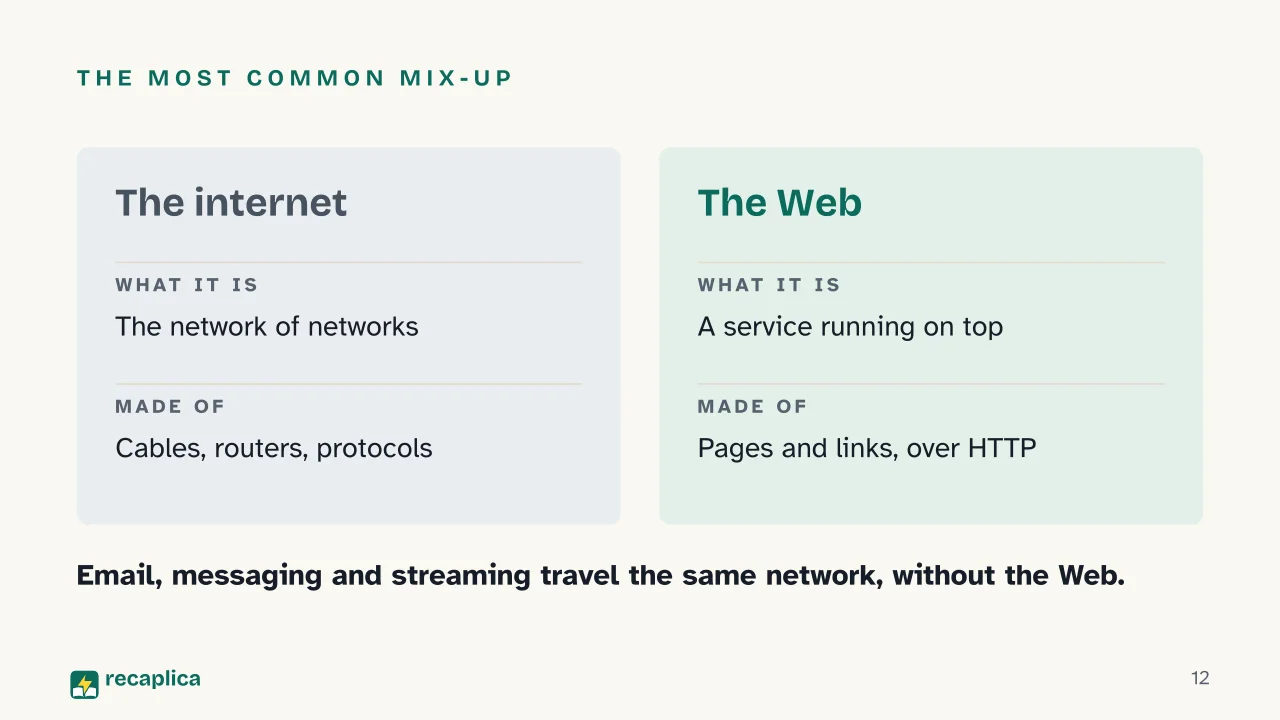 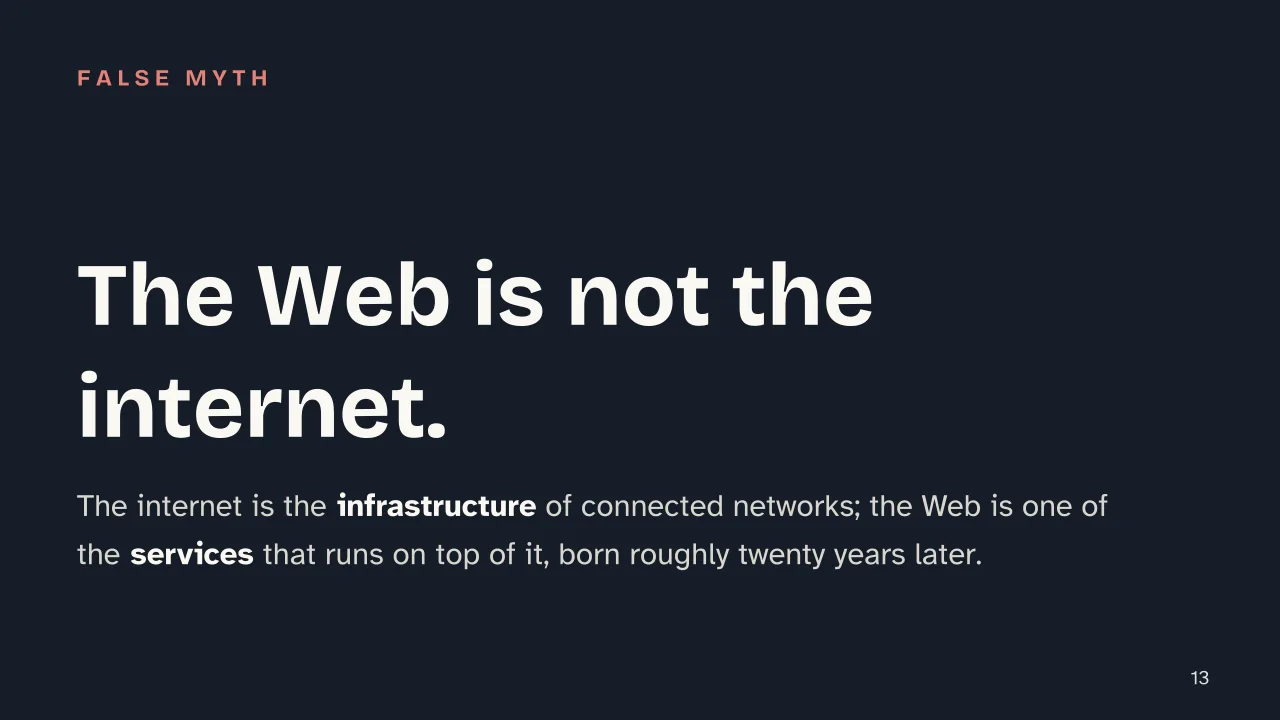   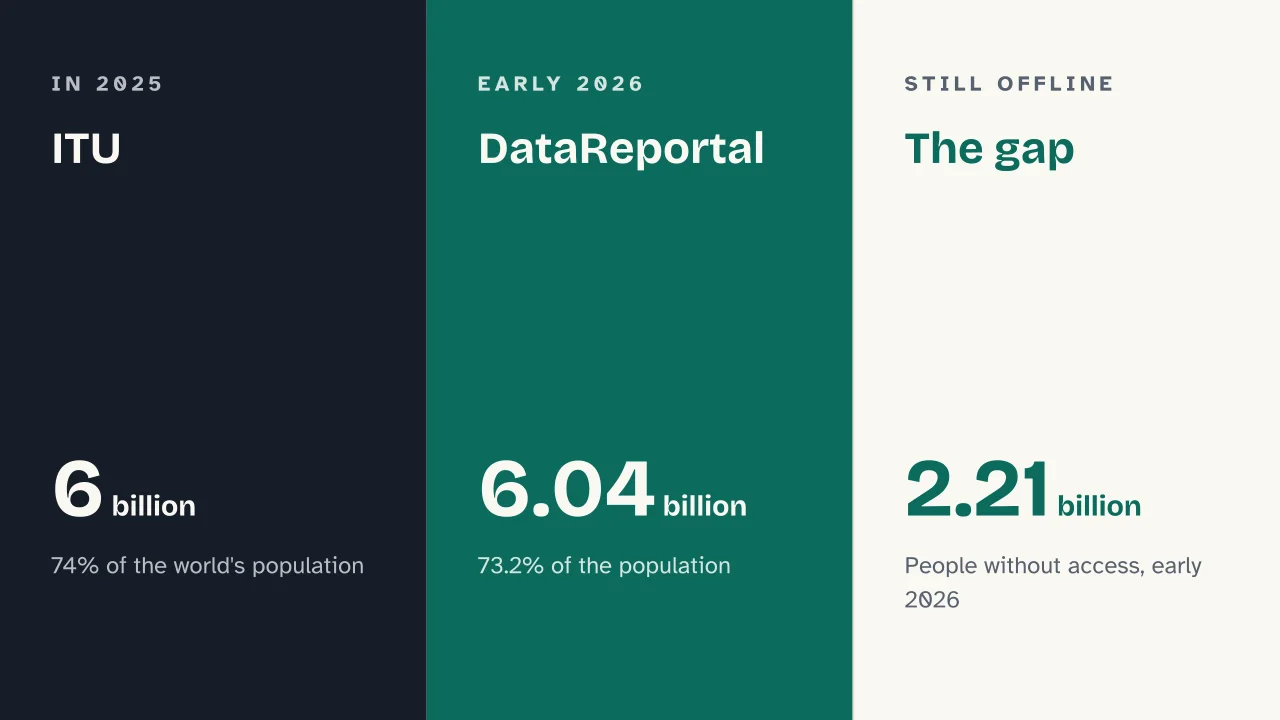   Common myths
Mind mapDrag the background to move around and the nodes to reposition them; use − and + to collapse and expand branches. 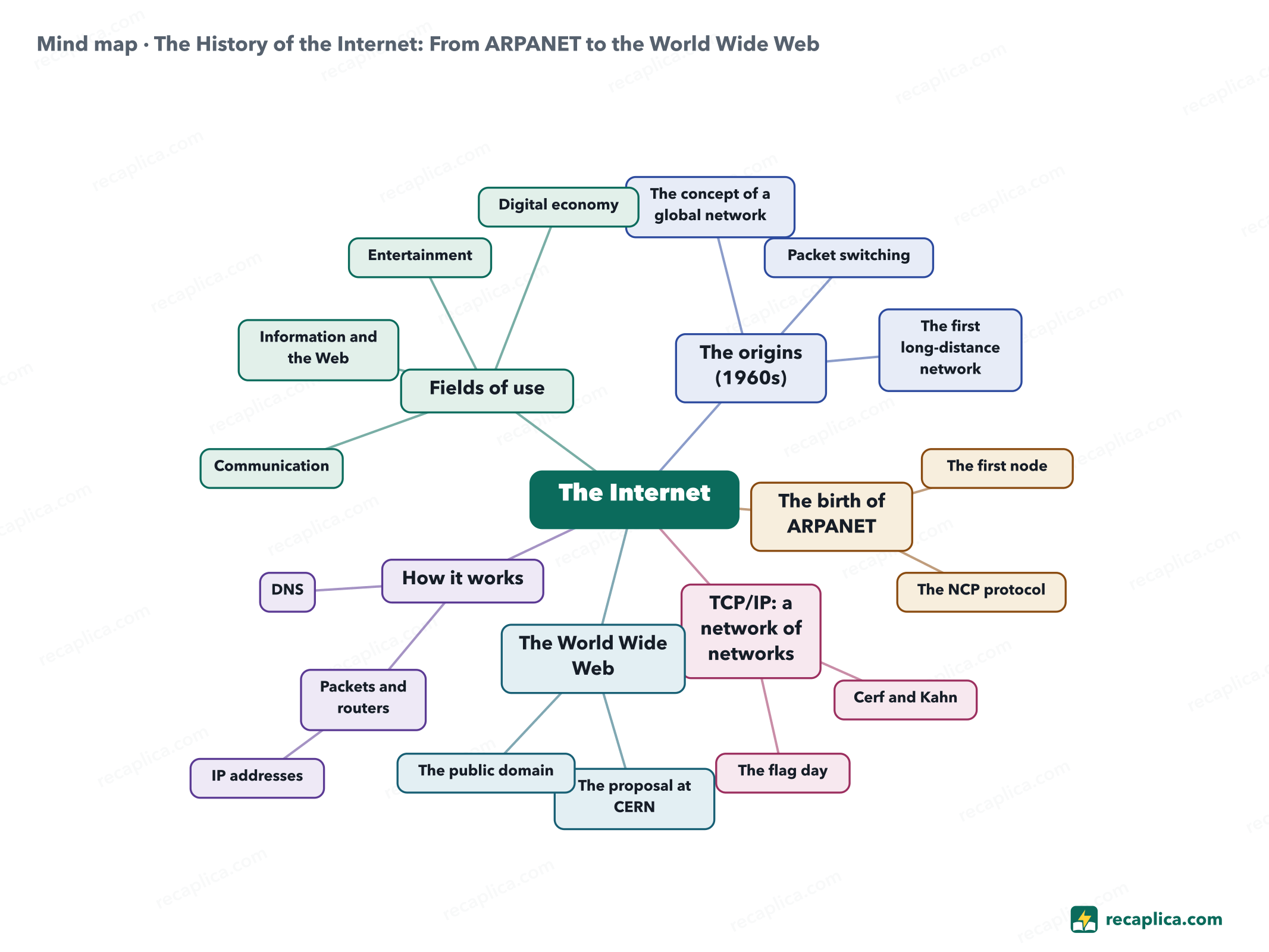
Quiz: test yourselfAnswer the questions to check what you have learned: you get instant feedback and a short explanation. Grade 0/10 0/5
FlashcardsTap the card to flip it and check whether you remember the answer, then move to the next one. 1 / 8 Explain it in your own wordsThe ultimate test: if you can explain it in simple words, you've truly understood it. Write your explanation, then compare it with the Recap. Your explanation is saved only on this device.
Frequently asked questionsWho invented the internet?No single person did. Among the decisive contributions are J.C.R. Licklider's ideas about a global network, Leonard Kleinrock's theory of packet switching, the long-distance network built by Lawrence Roberts, and TCP/IP, designed jointly by Vint Cerf and Robert Kahn. It's the result of collective work spanning more than a decade. What is the difference between the internet and the World Wide Web?The internet is the physical and logical network that connects computers worldwide; the Web is the set of pages linked together, viewed with a browser over the HTTP protocol, proposed by Tim Berners-Lee at CERN in 1989. The Web is one of the services that runs on top of the internet, alongside email and messaging. When was the internet invented?There's no single date. ARPANET's first node, the network the internet descends from, went live in September 1969; the modern internet is usually dated to the adoption of TCP/IP as the single standard on January 1, 1983, when ARPANET stopped using the older NCP protocol. What is the internet used for?To connect computers and people for a wide range of purposes, including communication (email, messaging, video calls), information (websites, search engines), entertainment (video and music streaming) and the digital economy (advertising, e-commerce, cloud services). At the start of 2026, according to DataReportal, more than 1 billion people worldwide also use generative artificial intelligence platforms every month. How many people worldwide use the internet?Estimates vary by period and calculation method. According to the ITU, about 6 billion people (74% of the world's population) used the internet in 2025. According to DataReportal, at the start of 2026 there were 6.04 billion users (73.2% of the population), with about 2.21 billion people still offline. Every Recap goes through an independent review before publication. |