|
recaplica
History of Computers: A Timeline from Babbage to the Web | ||||||||||||||||||||
| © 2026 Recaplica · recaplica.com — All rights reserved | ||||||||||||||||||||
History of Computers: A Timeline from Babbage to the WebWhat to print Page numbers appear when printing with default margins. SlidesChoose a cut Flash10 slidesThe essential thread, to present in classFull18 slidesEvery chapter and the deeper detailBoth come with speaker notes. In 30 seconds quick readThe history of computers begins with mechanical calculating machines designed in the nineteenth century and moves, within about a hundred years, through the first electronic calculators of the Second World War, the invention of the transistor, and the birth of the microprocessor, all the way to the personal computers of the 1980s and the arrival of the web. There is no single inventor and no single birthdate: each stage grew out of the work of different people, often in parallel, in different labs and different countries. The thread running through all of it is miniaturization, machines the size of entire rooms shrinking down to devices that fit on a desk, then in the palm of a hand. This Recap traces the main milestones, from Charles Babbage's hand calculations to Tim Berners-Lee's proposal at CERN in 1989. Key Points
Key figures
Deep DiveHand Calculations and the First Mechanical DesignsBefore a single electronic machine existed, calculation was human work, often long and repetitive. In 1821, Charles Babbage was checking calculation tables by hand alongside the astronomer John Herschel, tables riddled with errors, and is said to have let slip a line that became famous: “I wish to God these calculations had been executed by steam.” That frustration gave rise to the Difference Engine, a mechanical machine designed to compute polynomial functions automatically, with roughly 25,000 parts planned and an estimated weight of 4 tons. The British government funded the project with £17,500, a sum comparable to the cost of 22 steam locomotives at the time — a detail that places Babbage squarely within the Industrial Revolution, an era when steam power was already reshaping factories and transport. The project stalled in 1833 after a dispute with the master toolmaker building it, and the machine was never finished. Babbage didn’t stop there. In 1834 he conceived the Analytical Engine, a different and far more ambitious idea: not a machine dedicated to one kind of calculation, but a general-purpose programmable calculating machine. This is, in essence, the moment the concept of an algorithm applied to a real machine took shape: the same principle behind any algorithm, a sequence of instructions built to solve a problem regardless of the hardware running it. Ada Lovelace, who had met Babbage in 1833 at just 17, published in 1843 a translation of an article on the Analytical Engine accompanied by her own notes, three times longer than the original piece. Those notes contain the first published descriptions of a computer program, along with the insight that such a machine could manipulate not just numbers but symbols, letters, even musical notes. War Speeds Up ElectronicsFor a century, Babbage’s idea stayed more theoretical than practical. That changed sharply during the Second World War, when the need to compute ballistic firing tables quickly or crack coded messages pushed several countries to build electromechanical and electronic calculating machines in parallel, often with each team unaware of what the others were doing. In 1941, in Germany, Konrad Zuse completed the Z3: 2,300 relays, binary floating-point arithmetic, a 22-bit word. The Computer History Museum calls it “the world’s earliest digital computer,” even though the machine was destroyed in a bombing raid on Berlin as early as 1943. Around the same time, at Bletchley Park in England, Tommy Flowers’s team built the Colossus, which went operational in 1944 with 2,500 vacuum tubes and was used in the codebreaking work tied to Enigma, alongside the “Bombe” machines designed by Alan Turing and Harold Keen from 1941 onward — one of many episodes where computing technology is directly bound up with the events of World War II. In the United States, John Mauchly and J. Presper Eckert built ENIAC between 1943 and 1945 for the army, which needed to compute complex ballistic firing tables. Its existence stayed secret until February 15, 1946, when the New York Times broke the news to the public. It was a machine the size of an entire room, with nearly 18,000 vacuum tubes and a weight of 30 tons: more than 1,000 times faster than the electromechanical calculators that had come before it. Running it, though, was anything but simple: a tube failed roughly every one or two days, and the maintenance team learned to find and replace the faulty component in just 15 minutes. The project brought together, among others, physicist John Mauchly, engineer Harry Huskey, and programmers Frances Bilas and Betty Jean Jennings. It stayed in operation for about a decade, until a lightning-related fault took it down in 1955.
From Tubes to TransistorsVacuum tubes did the job, but they were bulky, fragile, and ran hot. On December 16, 1947, at Bell Telephone Laboratories, John Bardeen and Walter Brattain, working under William Shockley, managed for the first time to amplify an electrical signal with a small solid-state device: two thin gold contacts pressed onto a slab of high-purity germanium, able to amplify a signal up to 100 times. The name “transistor” was coined by engineer John Pierce; the public announcement came on June 30, 1948, at a press conference in New York, and in 1956 Bardeen, Brattain, and Shockley received the Nobel Prize in Physics for the invention. The shift from tubes to transistors was one of the key factors behind machines that were smaller, cheaper to build, and less prone to daily breakdowns. As early as November 1953, a British prototype, the Manchester TC, used 92 point-contact transistors; by 1958 the SAGE air-defense system, with 23 sites linked across the United States and Canada, still combined 55,000 tubes with 13,000 transistors, a sign of just how gradual, rather than instant, that transition really was. Minicomputers and Mainframes: Computers Enter the Business WorldIn the 1960s, the computer stopped being purely a military or academic project and started turning into a commercial product on a much larger scale. On April 7, 1964, IBM announced the System/360, a family of 5 compatible models and 40 peripherals, backed by a declared investment of $5 billion: within two years it was pulling in more than 1,000 orders a month. That same year, Digital Equipment Corporation launched the PDP-8 at $18,000, about a fifth the price of a System/360, opening up the minicomputer market, smaller and cheaper machines built for labs and technical offices rather than big corporate computing centers. In Italy, Olivetti put the Programma 101 on sale in 1965: 40,000 units were sold, ten of which went to NASA for the Apollo program.
The Microprocessor and the Birth of the Personal ComputerThe next leap came down to a single chip. In 1971, Federico Faggin, together with Ted Hoff and Stanley Mazor, developed the 4004 for Intel, born out of a contract with the Japanese company Busicom for a calculator: 2,250 transistors on a single chip, launched on November 15, 1971 for $60. It was the first complete commercial microprocessor, and within a few years it made it conceivable to build a computer small and cheap enough to sit on a desk at home. In January 1975, the cover of Popular Electronics featured the MITS Altair 8800, sold as a kit for $297: it was on that machine that Bill Gates and Paul Allen wrote a licensed BASIC interpreter, the episode that gave rise to Microsoft. The following year Steve Wozniak finished the Apple-1, and in 1977 the Apple II arrived, selling in the millions through 1993. In 1981 IBM launched its first Personal Computer, the Model 5150, with an Intel 8088 processor and the MS-DOS operating system, while in 1982 the Commodore 64 debuted at $595: according to the Computer History Museum, 22 million units were sold by 1993, and Guinness World Records has recognized it since 2006 as the best-selling single computer model in history. In February 1984, Apple unveiled the Macintosh with a commercial aired during the Super Bowl, a direct nod to “Big Brother” read as a jab at IBM’s grip on the market: it cost $2,500 and came with a mouse-driven graphical interface, an idea Xerox PARC had already shown off in 1974 with the Alto computer, never sold commercially but influential enough to shape both Apple and Microsoft directly. From Local Network to Global WebThe last major shift in this story is less about the machine itself and more about how machines got connected to one another. In March 1989, Tim Berners-Lee, working at CERN, wrote the first proposal for what would become the World Wide Web. In November 1990, together with systems engineer Robert Cailliau, he formally proposed it as a “hypertext” project called “WorldWideWeb,” where a network of linked documents could be browsed through programs called “browsers.” By the end of 1990, Berners-Lee already had a working server and browser running at CERN, hosted on a NeXT computer, the same company Steve Jobs founded after leaving Apple: that server, at info.cern.ch, was the first website in history. The software reached CERN colleagues in March 1991, and on August 6, 1991, an announcement on an internet newsgroup made the project accessible to the public outside CERN, the date commonly cited as the birth of the public web. In December 1991, the first server outside Europe went live at the Stanford Linear Accelerator Center in the United States. Perhaps the most decisive step came on April 30, 1993, when CERN made the World Wide Web’s source code freely available to anyone, royalty-free, a choice considered among the decisive factors in its worldwide spread. In May 1994 CERN hosted the first international conference on the web, and by the end of that same year there were already about 10,000 web servers worldwide and roughly 10 million users: the network of documents Berners-Lee had imagined at CERN was only just beginning to spread. Slide deckSlides ready to download and make your own in PowerPoint or Google Slides, with speaker notes. Pick the Flash cut or the Full one.     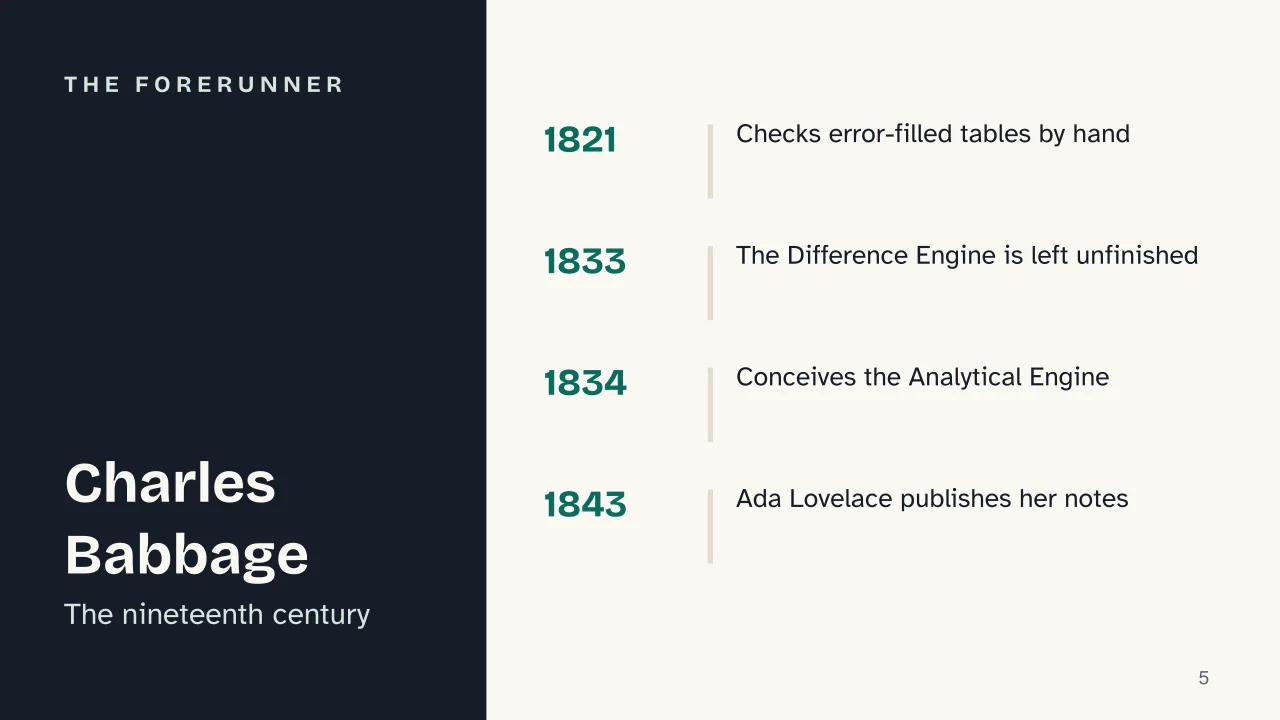  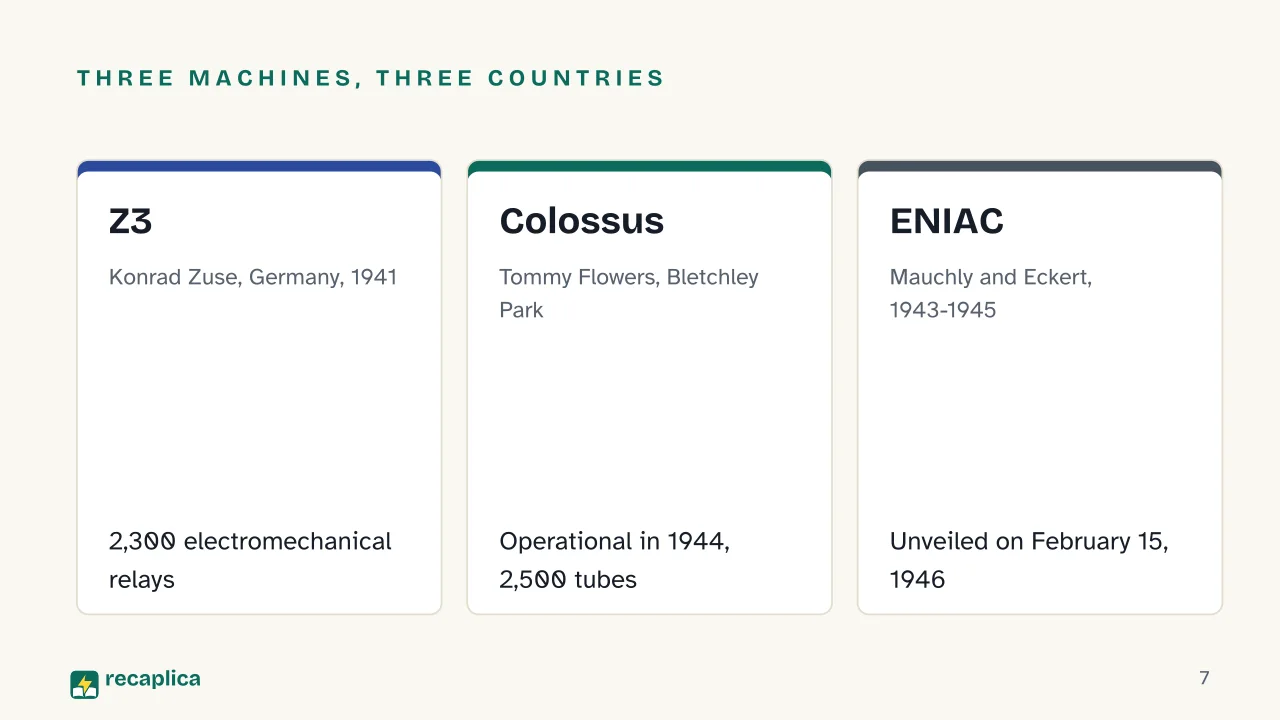 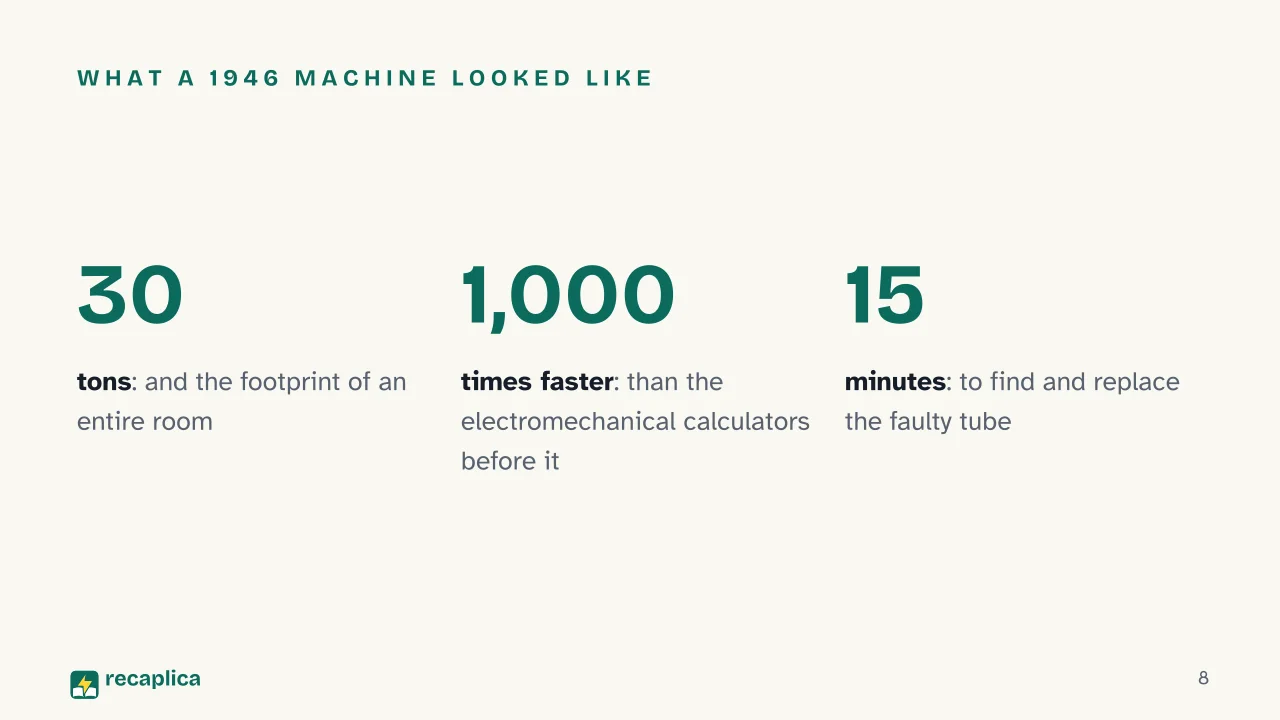 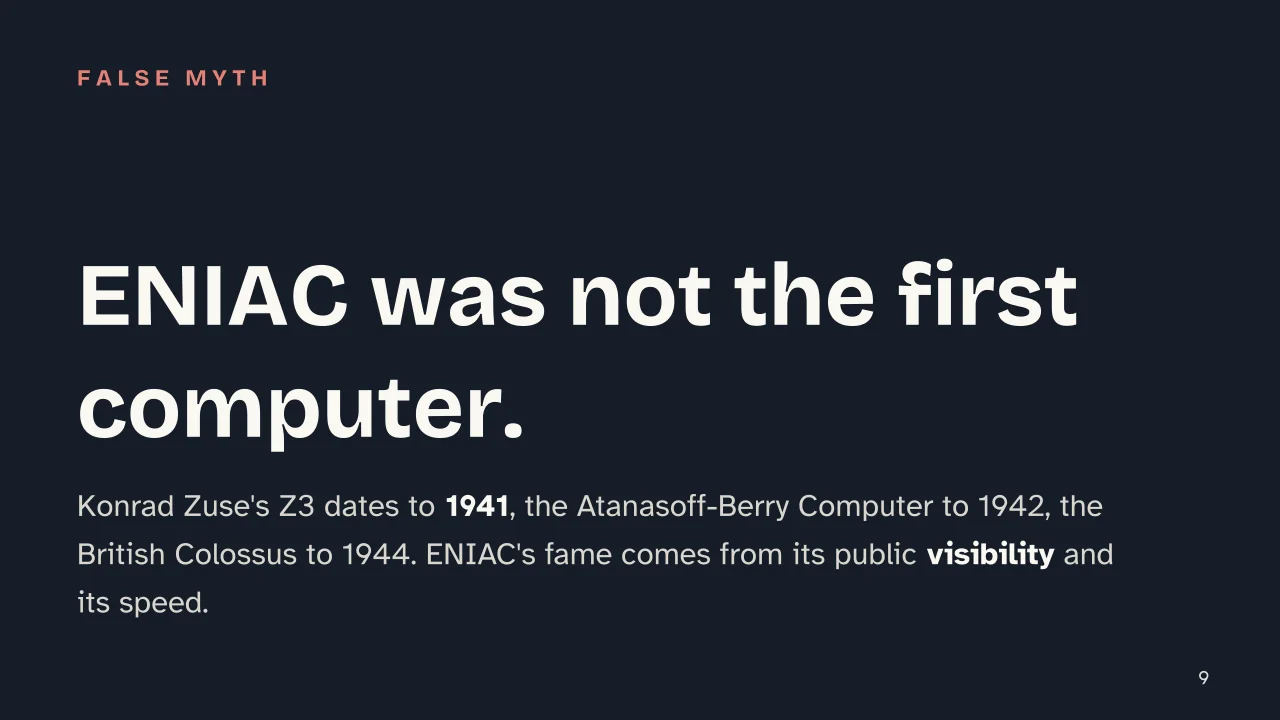  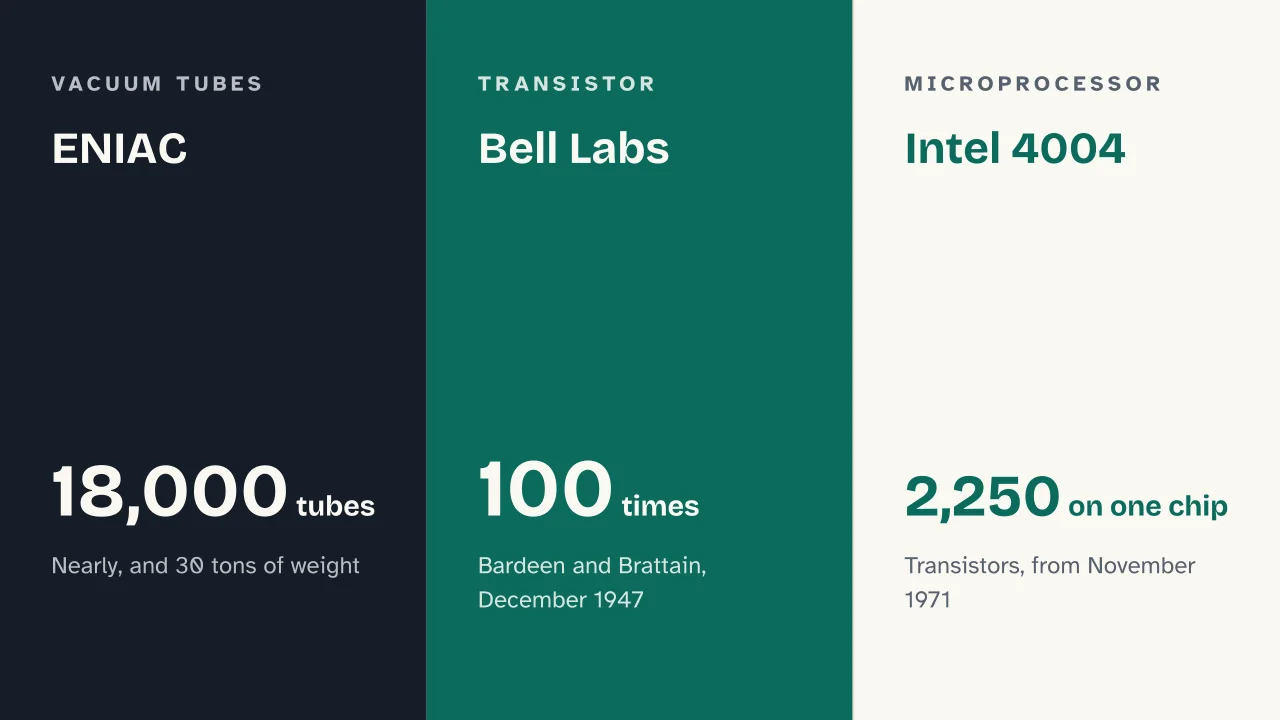 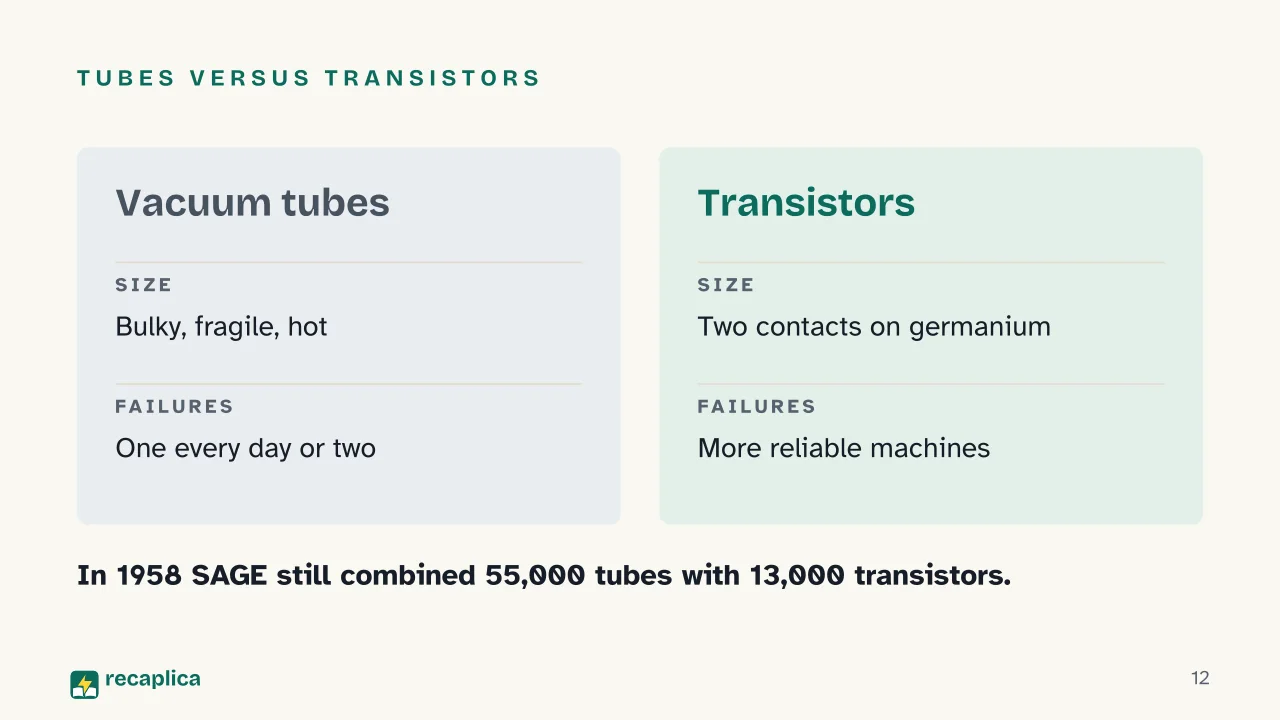  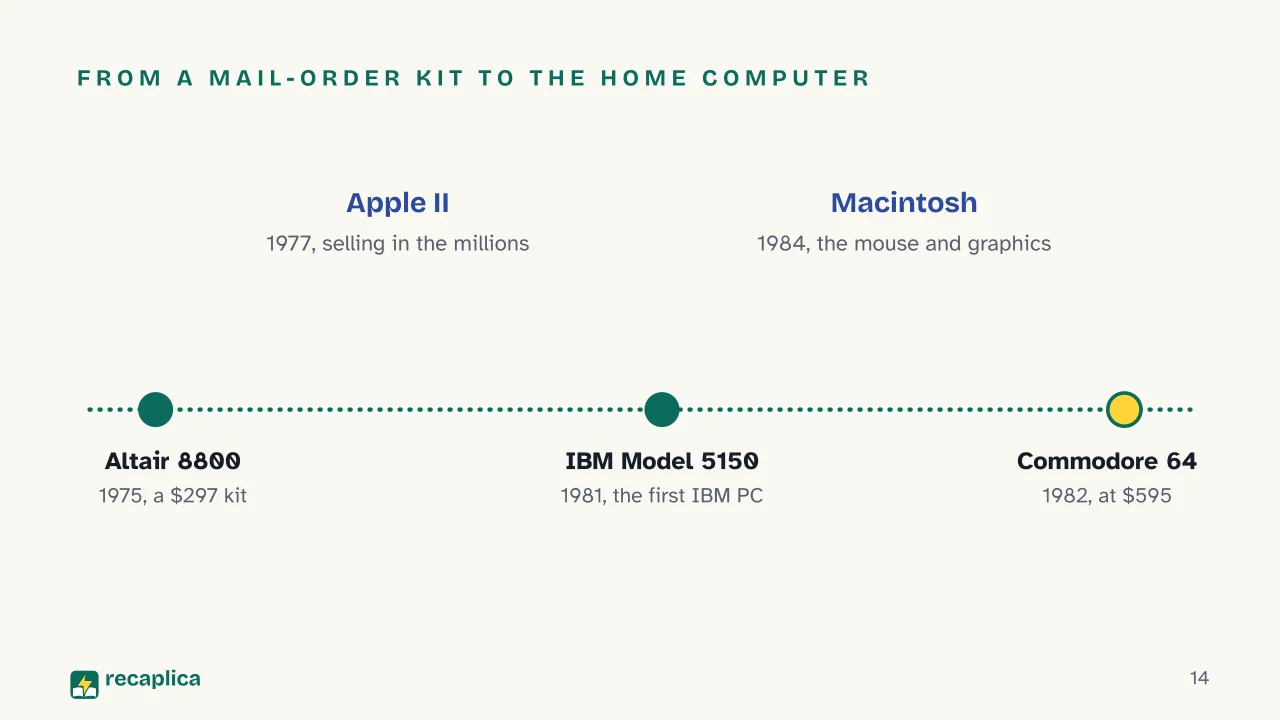 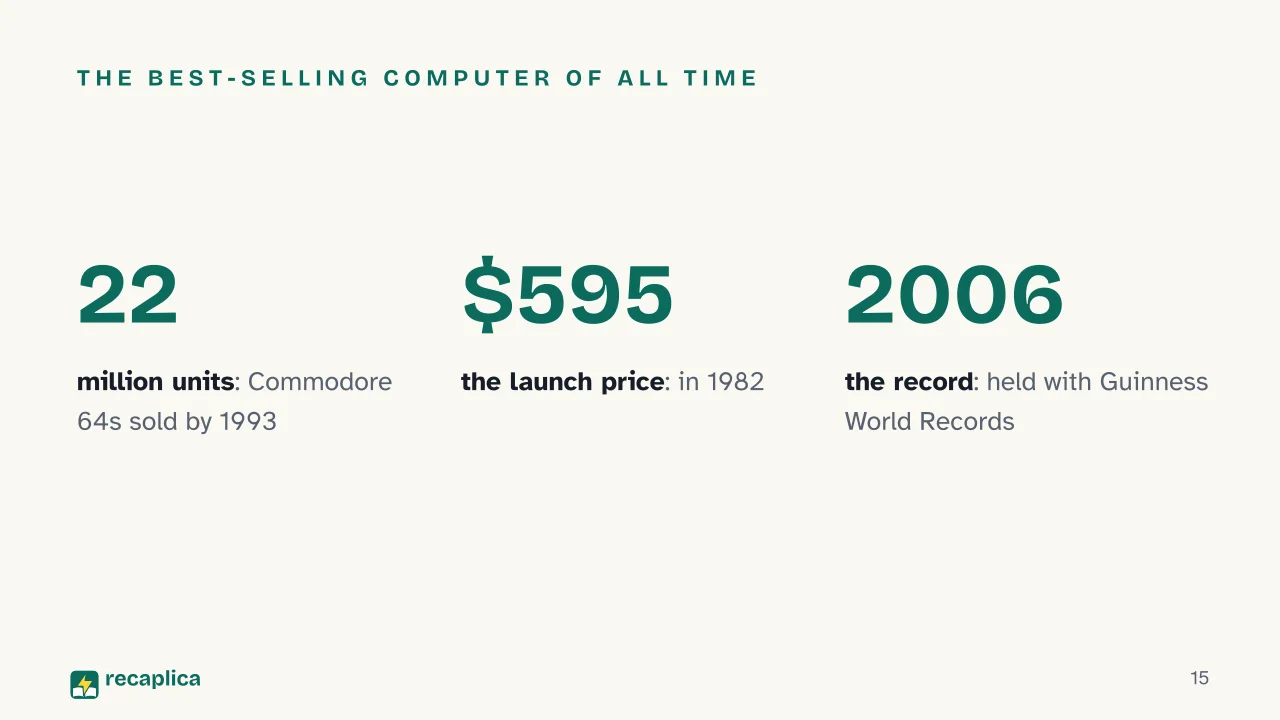 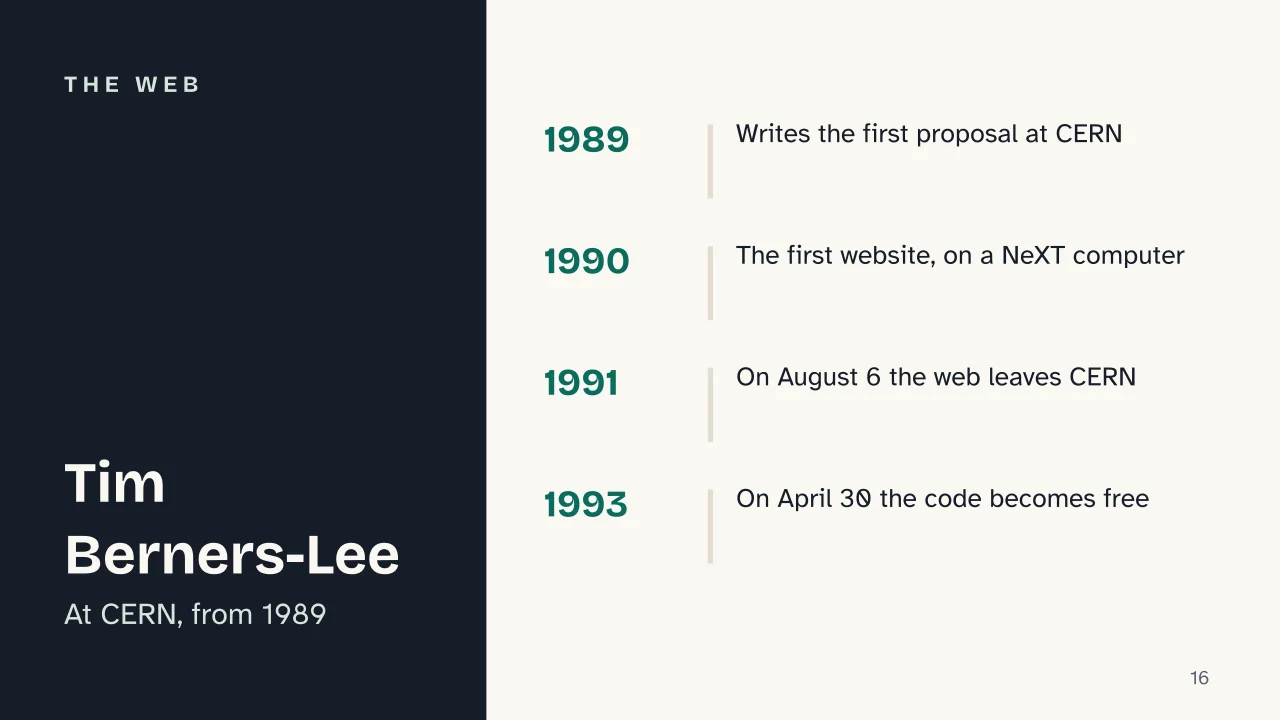 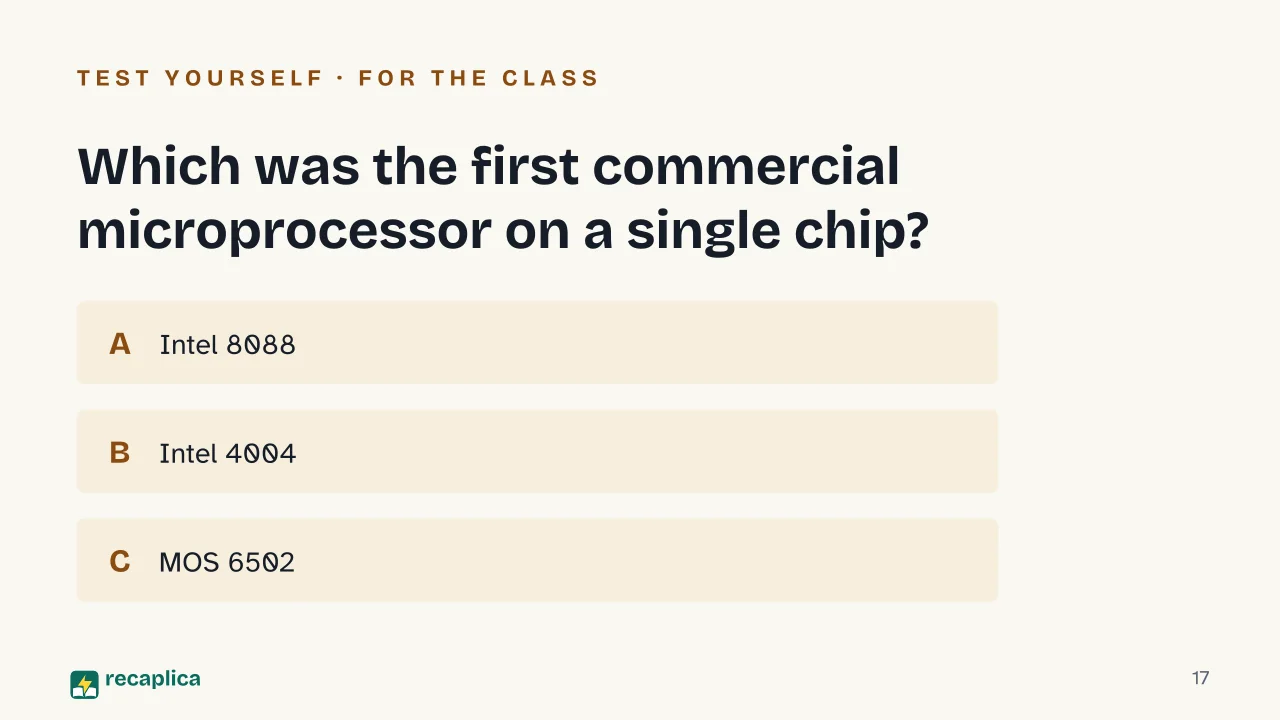  Common myths
Mind mapDrag the background to move around and the nodes to reposition them; use − and + to collapse and expand branches. 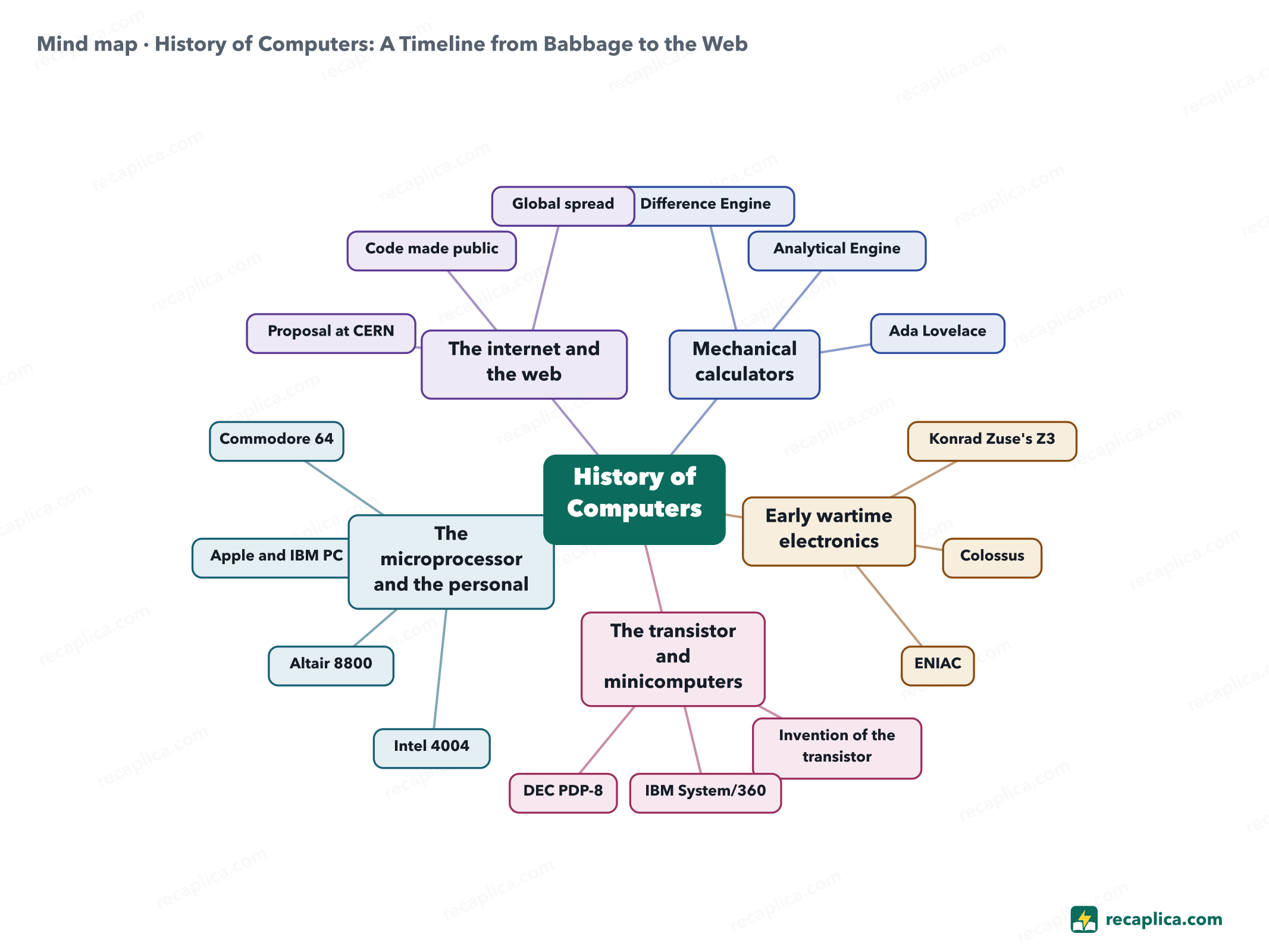
Quiz: test yourselfAnswer the questions to check what you have learned: you get instant feedback and a short explanation. Grade 0/10 0/5
FlashcardsTap the card to flip it and check whether you remember the answer, then move to the next one. 1 / 8 Explain it in your own wordsThe ultimate test: if you can explain it in simple words, you've truly understood it. Write your explanation, then compare it with the Recap. Your explanation is saved only on this device.
Frequently asked questionsWhat was the first computer in history?It depends on what counts as a "computer." Konrad Zuse's Z3, completed in 1941 with electromechanical relays, is described by the Computer History Museum as "the world's earliest digital computer," but Charles Babbage's Analytical Engine, conceived back in 1834, already introduced the idea of a programmable calculating machine, even though it was never completed. ENIAC, built in 1943-1946, remains the most famous because it was the first general-purpose electronic computer to become publicly known on a large scale. Who invented the computer?The computer is the result of many different people's work. Charles Babbage conceived the idea of a programmable calculating machine in the 1830s, Konrad Zuse built the first working digital calculator in 1941, John Mauchly and J. Presper Eckert built ENIAC in 1943-1945, and the transistor that made modern computers possible was invented in 1947 by John Bardeen and Walter Brattain at Bell Telephone Laboratories. Each stage built on the ones before it. When was the transistor invented, and why did it matter so much?On December 16, 1947, at Bell Telephone Laboratories, by John Bardeen and Walter Brattain. By replacing bulky, failure-prone vacuum tubes with a tiny solid-state device, the transistor was among the key factors that made it possible, over the following decades, to build cheaper, more compact computers, culminating in the microprocessor of the 1970s. When was the World Wide Web born?Tim Berners-Lee wrote the first proposal at CERN in March 1989. The first website in history went online at the end of 1990, but the date usually cited as the birth of the public web is August 6, 1991, when an announcement on an internet newsgroup made it accessible outside CERN. The decisive step for its spread came on April 30, 1993, when CERN made the source code free for anyone to use. What is the best-selling computer of all time?The Commodore 64, launched in 1982 for $595. According to the Computer History Museum, about 22 million units were sold by 1993; Guinness World Records has recognized it since 2006 as the all-time record for a single computer model. Every Recap goes through an independent review before publication. |