|
recaplica
How the internet works: the journey of data from cable to page | |||||||||||||||
| © 2026 Recaplica · recaplica.com — All rights reserved | |||||||||||||||
How the internet works: the journey of data from cable to pageWhat to print Page numbers appear when printing with default margins. SlidesChoose a cut Flash10 slidesThe essential thread, to present in classFull17 slidesEvery chapter and the deeper detailBoth come with speaker notes. In 30 seconds quick readThe internet is a network of networks: independent networks — homes, schools, companies, carriers — that can talk to each other because they agreed on the same rules, the protocols. Anything you send is broken into packets, each carrying the address of its destination, and routers bounce them from network to network until they arrive. DNS translates the names we remember into the numeric addresses machines actually use, and underneath it all run physical cables, most of them lying on the ocean floor. Key Points
Key figures
Deep DiveOne second, and the page is thereYou type an address, press Enter, and in under a second you are looking at a page that physically sits on the other side of the world. At least four distinct things happen in that second, and knowing them in order is the fastest way to understand everything else: your device finds out which number that name corresponds to, it opens a conversation with the machine at that number, the data is broken into packets that cross dozens of different networks, and the browser reassembles the pieces. Let’s take them one at a time. A network of networks, not a single networkThe internet is not one thing: it is the infrastructure that lets different networks — the one in your house, the one at your school, the one belonging to a Japanese carrier — talk to each other. The word says so: inter net, between networks. The piece that makes the connection possible is the router. As the MDN documentation explains, it is a specialised computer with a single job: look at the address written on a data packet and pass it to the next network, the one that brings it closer to its destination. No router knows the whole route; each one knows only the next step. Your carrier runs a lot of them, and connects in turn to other carriers: that is how data from your house reaches a server on the far side of the planet.
And where does it physically go? Not through the air. Traffic between continents runs inside optical fibres resting on the seabed: in early 2026 TeleGeography counts over 1.5 million kilometres of them in service, with more than 600 cables active or planned. Wi-Fi is only the last stretch, the one between your sofa and the router. Addresses: who you are, in numbersFor a packet to reach somewhere, that somewhere needs an address. This is
the IP address, and its definition sits in a technical document from
September 1981, RFC 791, which describes an address 32 bits long:
the four dot-separated numbers you have probably seen, something like
Thirty-two bits looked enormous in 1981. With billions of connected devices they no longer suffice, hence IPv6, defined in RFC 8200 in 2017: 128-bit addresses, designed, the specification says, to support a far greater number of addressable nodes and more levels of addressing hierarchy. The two versions have coexisted for years. One detail in RFC 791 surprises first-time readers: IP openly states that it does not provide a reliable communication service. No delivery acknowledgements, no error checking on the data itself. It delivers and hopes. This is not an oversight: IP does one job, routing, and leaves the rest to the machines at either end. DNS: from names to numbersNobody remembers numeric addresses, and indeed we do not use them. DNS
(Domain Name System) is the phone book that translates a name such as
The book is organised in levels, and at the top sit the root authorities: the DNS is configured with 13 of them, identified by the letters A to M. But they are not thirteen computers locked in a room: each letter stands for a cluster of servers scattered across dozens of countries, all answering at the same address. The organisations running them, as the IANA listing shows, have little in common with each other: NASA, the US Army, the University of Maryland, Europe’s RIPE NCC, ICANN, private companies such as Verisign. Packets: a message that travels in piecesHere comes the idea that changed telecommunications. In traditional telephony, talking to someone meant opening a dedicated circuit: a line reserved for the two of you for the whole call. The internet does the opposite. The message is split into packets, each self-contained, each carrying the destination address. The packets leave, cross different routers, may even follow different paths, and arrive when they arrive. It is a sturdy method: if a line goes down, later packets take another way without anyone having to place the call again. Which way is decided by routers applying a routing algorithm, a precise procedure that picks the next hop at every step. That leaves the earlier problem: if IP guarantees nothing, how does a photo
arrive intact? TCP handles it. Sitting above IP, it numbers packets on
departure, checks on arrival what is missing, requests the lost pieces and
puts everything back in order before handing the result to the
application. The pair is called TCP/IP and has an official birthday: RFC
801, from November 1981, set the goal of moving the whole ARPANET onto
these protocols by 1 January 1983, and the deadline held. Earlier
still, on 29 October 1969, two ARPANET computers exchanged the first
message ever sent over the network. It was meant to be the word login:
the “l” and the “o” got through, then the system crashed. The network’s
first message was, in effect,
The internet is not the webThis is the most widespread confusion of all, and four lines clear it up.
When an app uses a generative AI model or a machine learning service, the computation happens on remote servers reached over this same infrastructure: packets, routers, IP addresses. The service on top changes, the transport underneath does not. Why it holds upPut the pieces together and the founding choice becomes clear: keep the centre simple and dumb, and make the edges smart. Routers do not know what they are carrying and promise nothing; the machines at the ends check what arrived and ask again for what is missing. It sounds like a surrender. It is actually the reason why the same infrastructure that in 1969 connected two ARPANET computers now carries video calls, maps and streaming without ever having been rebuilt from scratch. Slide deckSlides ready to download and make your own in PowerPoint or Google Slides, with speaker notes. Pick the Flash cut or the Full one.     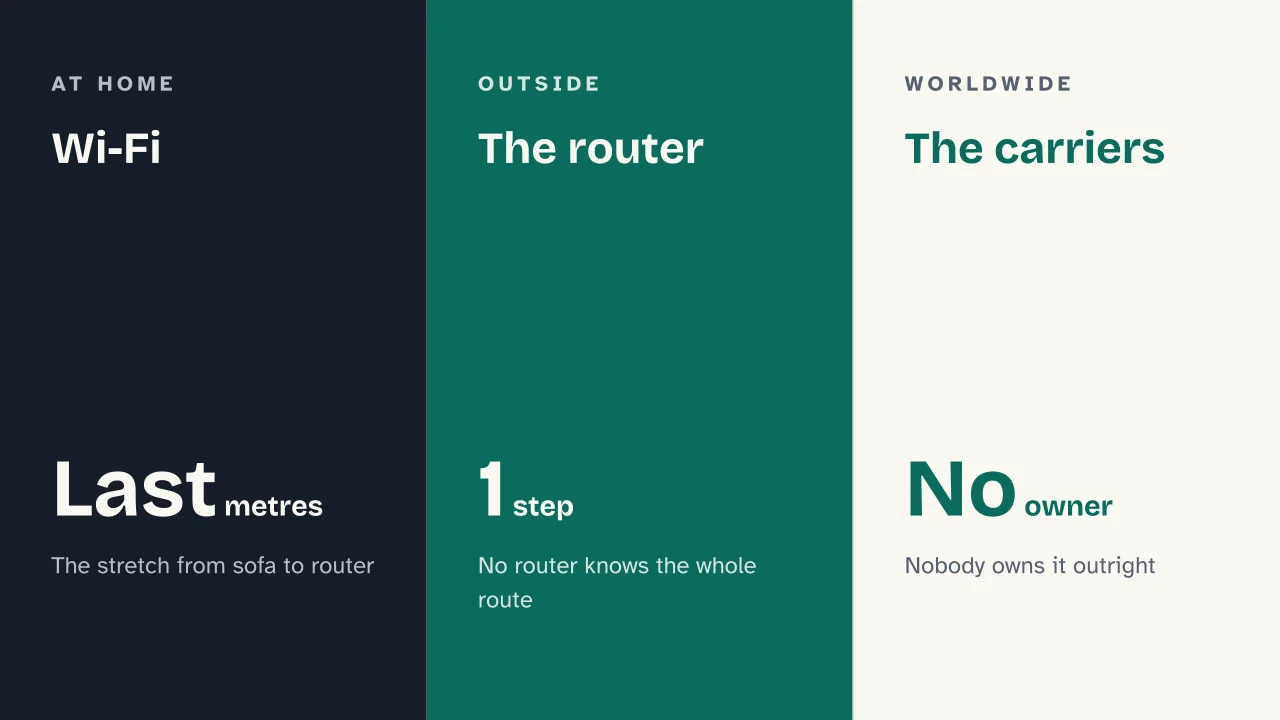   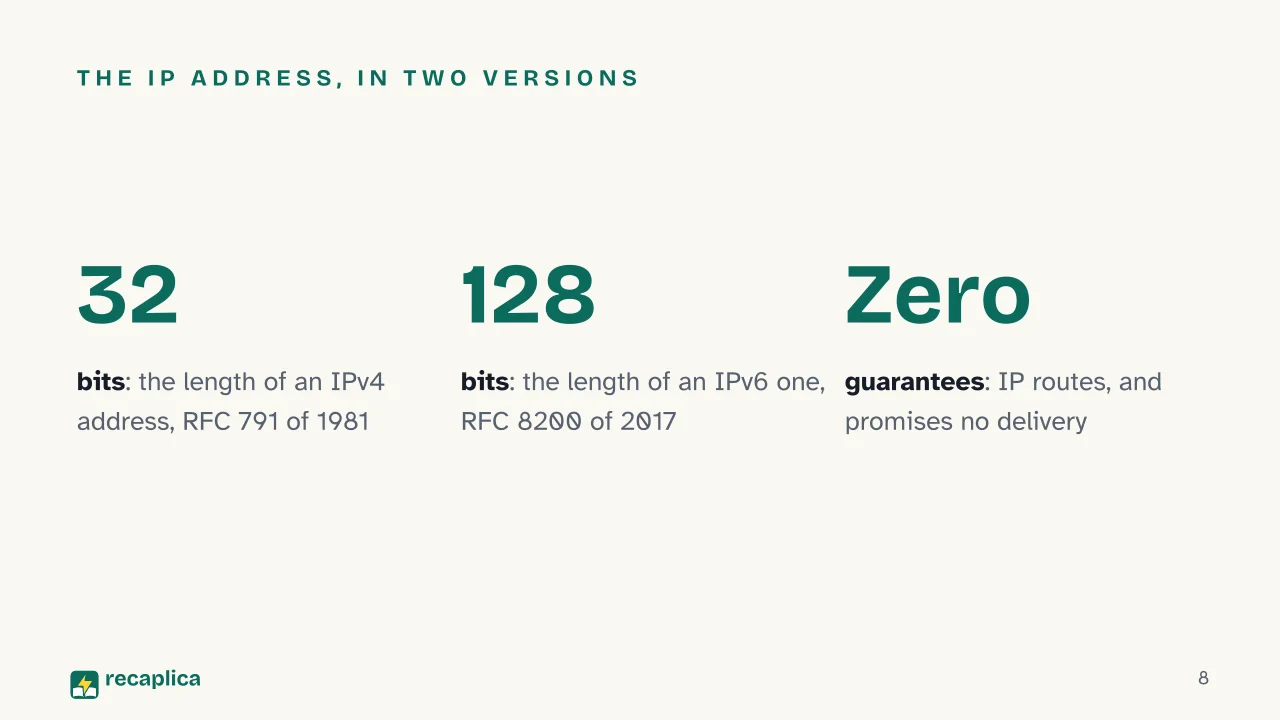 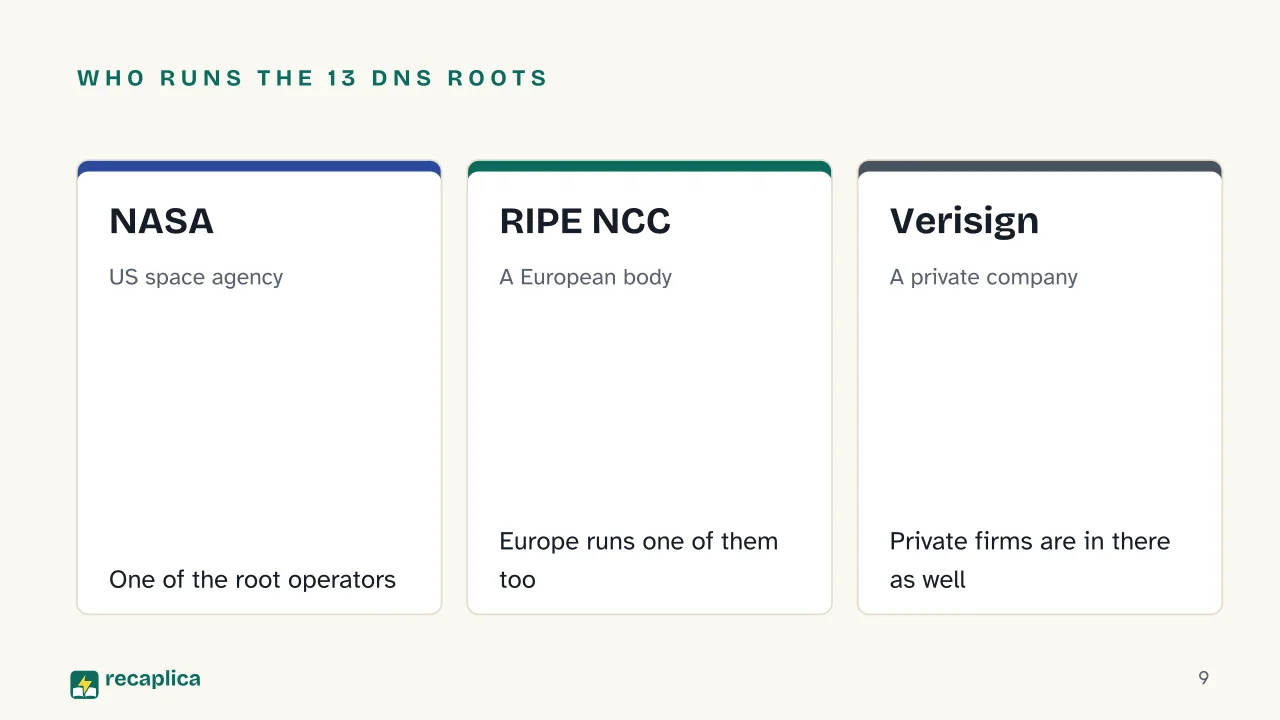  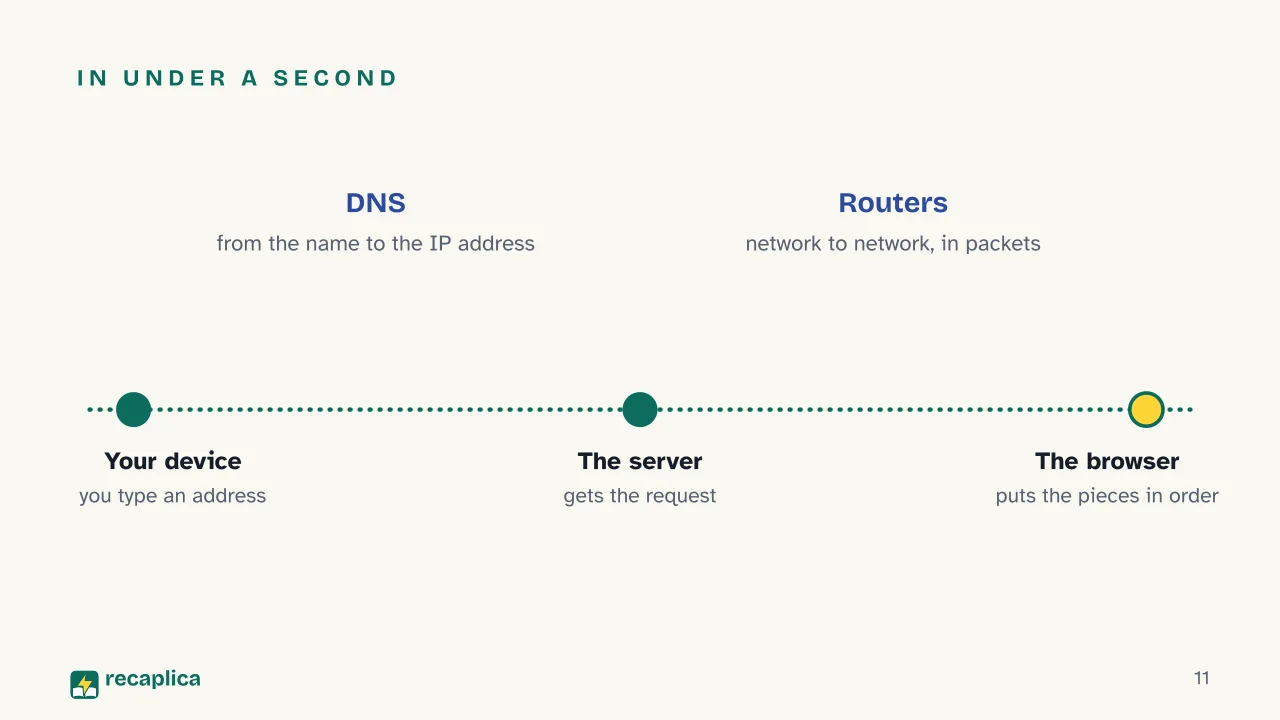 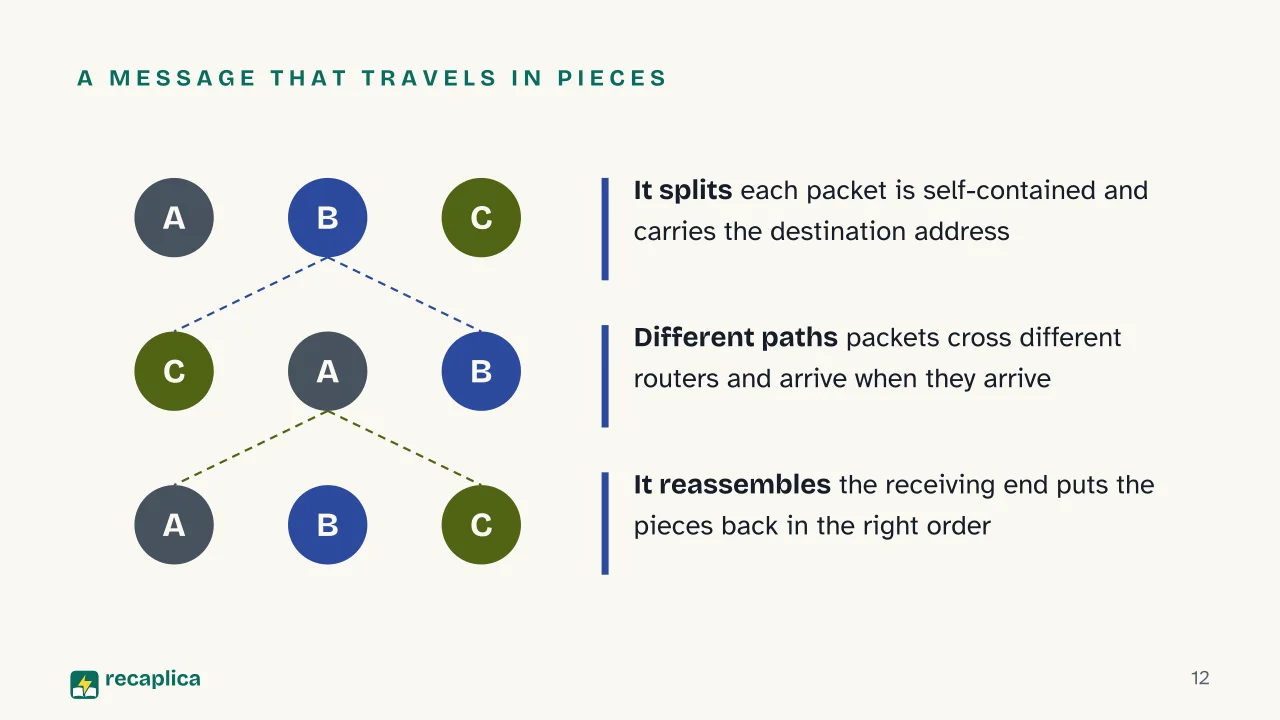 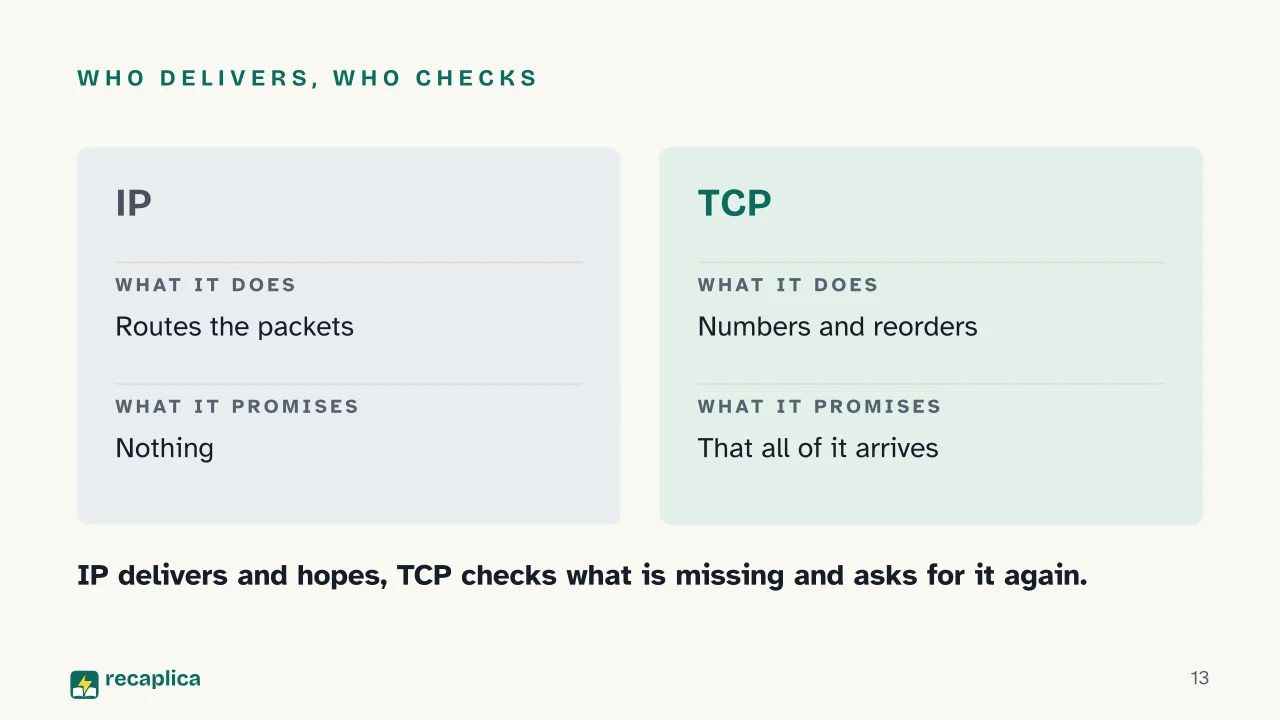  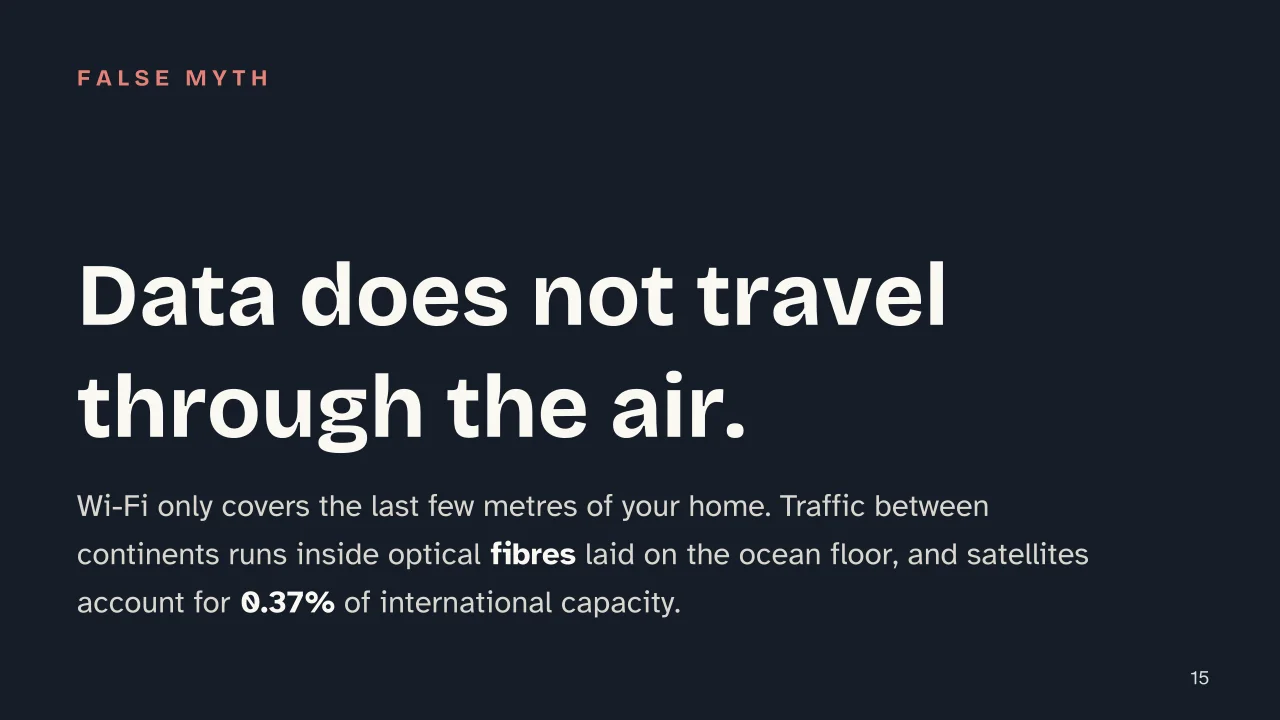 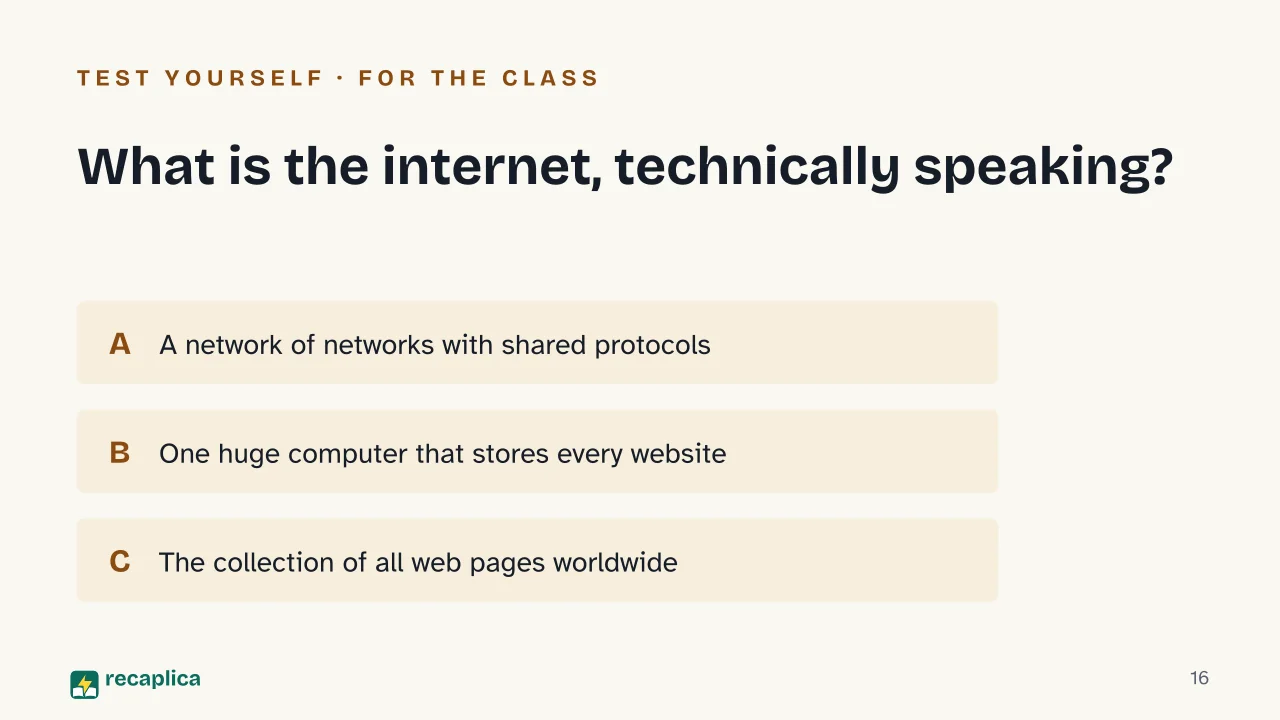  Common myths
Mind mapDrag the background to move around and the nodes to reposition them; use − and + to collapse and expand branches. 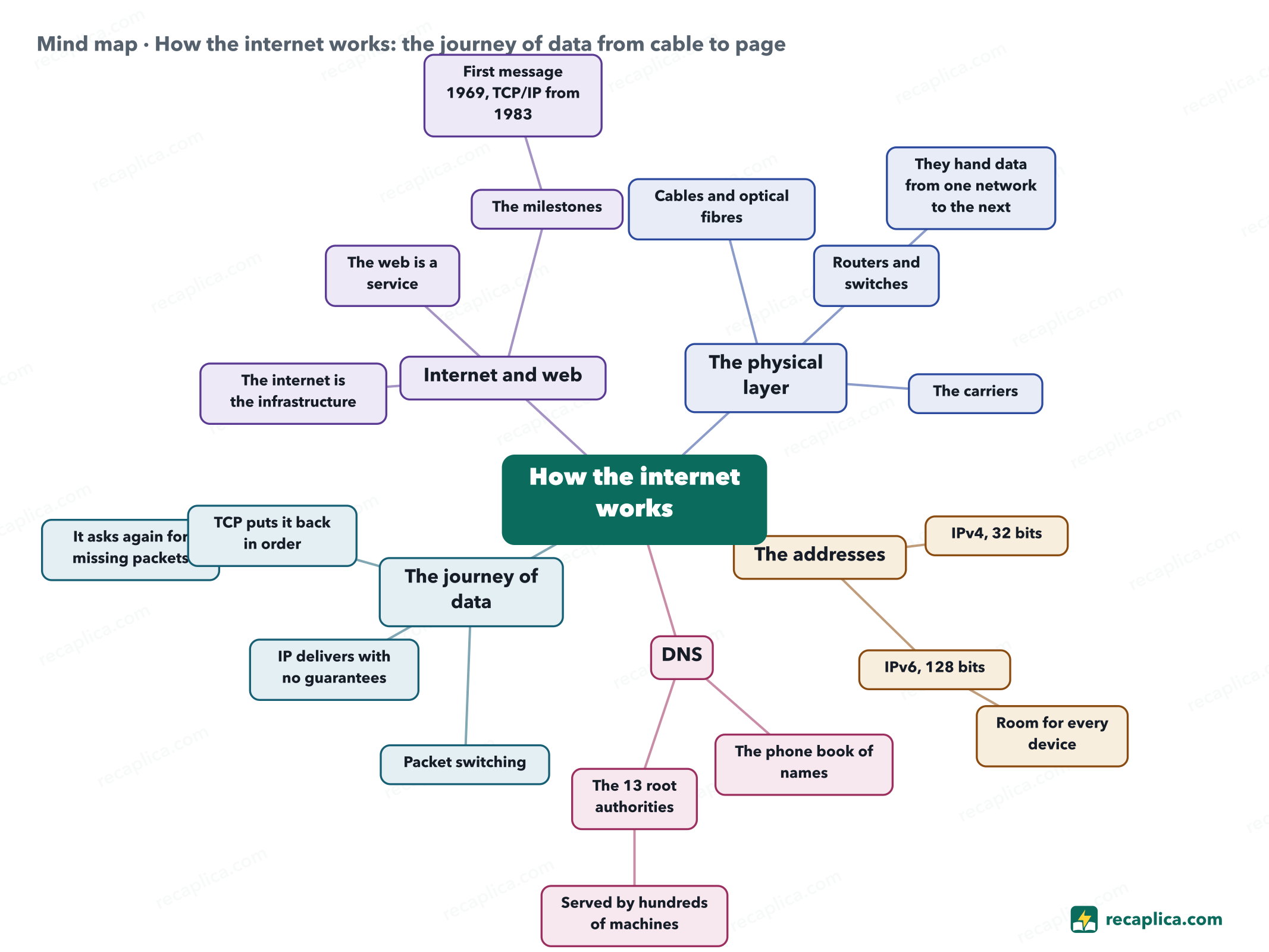
Quiz: test yourselfAnswer the questions to check what you have learned: you get instant feedback and a short explanation. Grade 0/10 0/5
FlashcardsTap the card to flip it and check whether you remember the answer, then move to the next one. 1 / 8 Explain it in your own wordsThe ultimate test: if you can explain it in simple words, you've truly understood it. Write your explanation, then compare it with the Recap. Your explanation is saved only on this device.
Frequently asked questionsWhat exactly happens when I type an address in my browser?Your device asks DNS for the numeric address matching the name, then opens a connection to that server and requests the page. The answer comes back split into packets that cross your provider's routers and those in between; the browser puts them back in order and draws the page. Usually in well under a second. What is the difference between the internet and the web?The internet is the physical and logical network connecting computers; the web is the set of pages and links you browse over the HTTP protocol. The web was born more than twenty years after the network that hosts it, and it is only one of its services: mail, messaging and streaming use others. Who is in charge of the internet?Nobody owns it outright. The networks belong to carriers, universities, companies and public bodies that choose to interconnect. Some coordination duties — domain names, address allocation, technical standards — sit with bodies such as ICANN, IANA and the IETF, which publish shared rules but do not run the traffic. What happens if a submarine cable breaks?Traffic is rerouted along other paths, which is why almost nobody notices: the International Cable Protection Committee counts roughly 200 faults a year on average. Real trouble starts when a region depends on very few cables and loses them together. Does my IP address reveal where I live?Not precisely. An IP address identifies a point on the network and allows a rough guess at region and provider, not your street address. Many providers also hand out addresses that change over time or are shared between several customers. Every Recap goes through an independent review before publication. |