|
recaplica
Human Cognition vs. AI: What the Science Really Shows | ||||||||||||||||||
| © 2026 Recaplica · recaplica.com — All rights reserved | ||||||||||||||||||
Human Cognition vs. AI: What the Science Really ShowsWhat to print Page numbers appear when printing with default margins. SlidesChoose a cut Flash10 slidesThe essential thread, to present in classFull18 slidesEvery chapter and the deeper detailBoth come with speaker notes. In 30 seconds quick readA human brain and a modern large language model (LLM) process information in profoundly different ways: people learn from a handful of examples by following structured principles, while LLMs absorb statistical patterns from enormous amounts of text. Models trained only on text lack direct experience of the physical world, and their reasoning can be far shakier than a human's when a question is only slightly reworded. Whether a system like this could ever be conscious is a question science still can't answer: as of 2026, the debate remains genuinely unresolved. Key Points
Key figures
Deep DiveTwo ways of processing the worldAsk an artificial intelligence system to write a passage or answer a question, and you’ll often get something fluent and convincing back. But “fluent” isn’t the same as “reasoning the way a human does”. Cognitive science studies mind and intelligence by drawing on philosophy, psychology, neuroscience, and computer science. It has spent years comparing how a human brain processes information with how the neural networks behind modern large language models (LLMs) do it. The surface similarities are real; the deeper ones remain, as of 2026, largely unverified. Learning from a little data, or from a mountain of itThe most cited difference concerns how language is acquired. An LLM builds its abilities by analyzing recurrence statistics across hundreds of billions of words of text. A child reaches comparable language competence with far less exposure, by applying what researchers call “structured principles”: learning isn’t just accumulation, but appears to be guided from the start by built-in constraints. In the literature this gap is known as the “poverty of the stimulus” — the linguistic signal available to a child is, proportionally, far thinner than the corpora a model trains on, yet it’s still enough. There’s also a difference in purpose. A person learns language by communicating actively: asking for things, expressing needs, adjusting based on how listeners react. An LLM, during training, is mostly a passive receiver of raw text, optimized to predict the next word. These are two different learning objectives, not just two different speeds of the same process.
Architectures at opposite ends of the spectrumBeyond “what” gets learned, “how” the learning system itself is built also differs radically. A 2026 study published in Communications Psychology compares the two architectures point by point:
As of 2026, the largest models reach scales ranging from billions to trillions of parameters, spread across tens or hundreds of layers — another area where a direct comparison with the human brain, which doesn’t run on “parameters” in the same sense, needs to be treated with caution. Anyone curious about how these networks are actually built can start with the basics of a neural network or the broader picture of machine learning. Where the models’ reasoning shows cracksTwo weak spots show up consistently in studies comparing language models with human cognition. The first is social pragmatics: models struggle to grasp the nuance of words whose meaning shifts depending on the social context in which they’re used. The second is physical common sense — the near-automatic intuitions a person has about weight, space, and everyday causality — which representations built purely from text capture with far less confidence. On top of that, there’s a subtler kind of fragility: a simple change in how a question is phrased, or the addition of an irrelevant detail, can cause a sharp drop in a model’s accuracy on a task it previously handled without trouble. The same holds for logic problems built on a pattern the model never saw during training, even when the structure is identical to exercises it had already solved correctly. Generalization, in these cases, stays partial. Research using magnetoencephalography to compare human brain responses with the internal representations of models while listening to stories suggests, however, that targeted training on these two fronts, social/emotional understanding and physical common sense, can bring model responses closer to human ones: the gap, in other words, doesn’t look unbridgeable in principle, but it does need specific work, not just more generic data. The still-open debate over consciousnessThen there’s the harder question: could a system like this be conscious, in some sense? A 2024 study proposes a framework for classifying theories of consciousness along two axes — whether consciousness depends on physical structure or on function, and whether it requires simple or complex phenomena — surveying positions as far apart as integrated information theory (which ties human consciousness to how interconnected information is within the brain) and higher-order thought theories (which hold that a thought merely needs to be directed at a first-order content, without itself being conscious). The authors’ conclusion is explicit: given the state of knowledge as of 2026, it’s premature to either affirm or rule out that an LLM could be conscious. As long as theories of consciousness aren’t empirically verifiable in a shared way, they argue, drawing conclusions in either direction would remain an unscientific exercise. One more factor complicates the picture further: LLMs are designed by people, trained on text written by people, and fine-tuned to reproduce distinctly human traits. Some researchers describe this as a “recursive loop of anthropomorphism”: the better a model imitates human expression, the harder it becomes to tell a genuine cognitive capacity of the machine apart from simple psychological projection by the person using it. It’s one more reason, among several, to treat both the enthusiasm and the dismissiveness around this topic with caution — and to keep separating, when talking about generative AI, what an algorithm is actually doing under the hood from what it merely looks like it’s doing to the person reading its output. Slide deckSlides ready to download and make your own in PowerPoint or Google Slides, with speaker notes. Pick the Flash cut or the Full one.     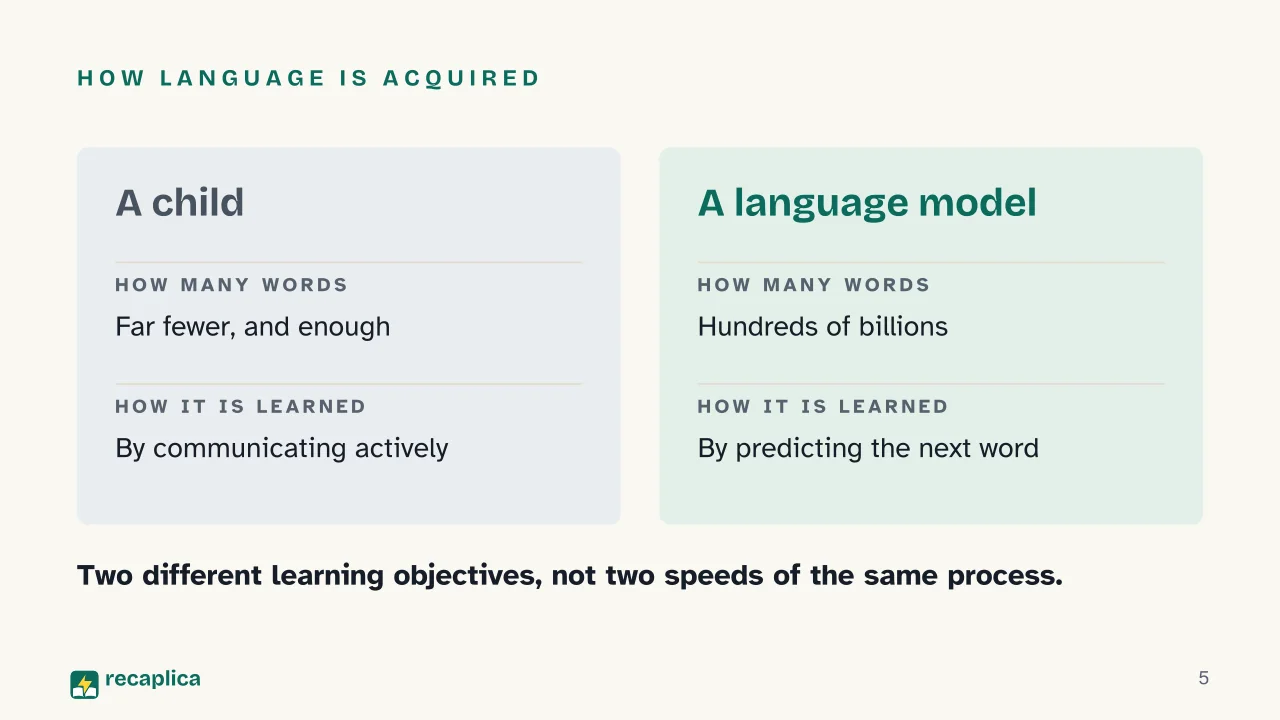   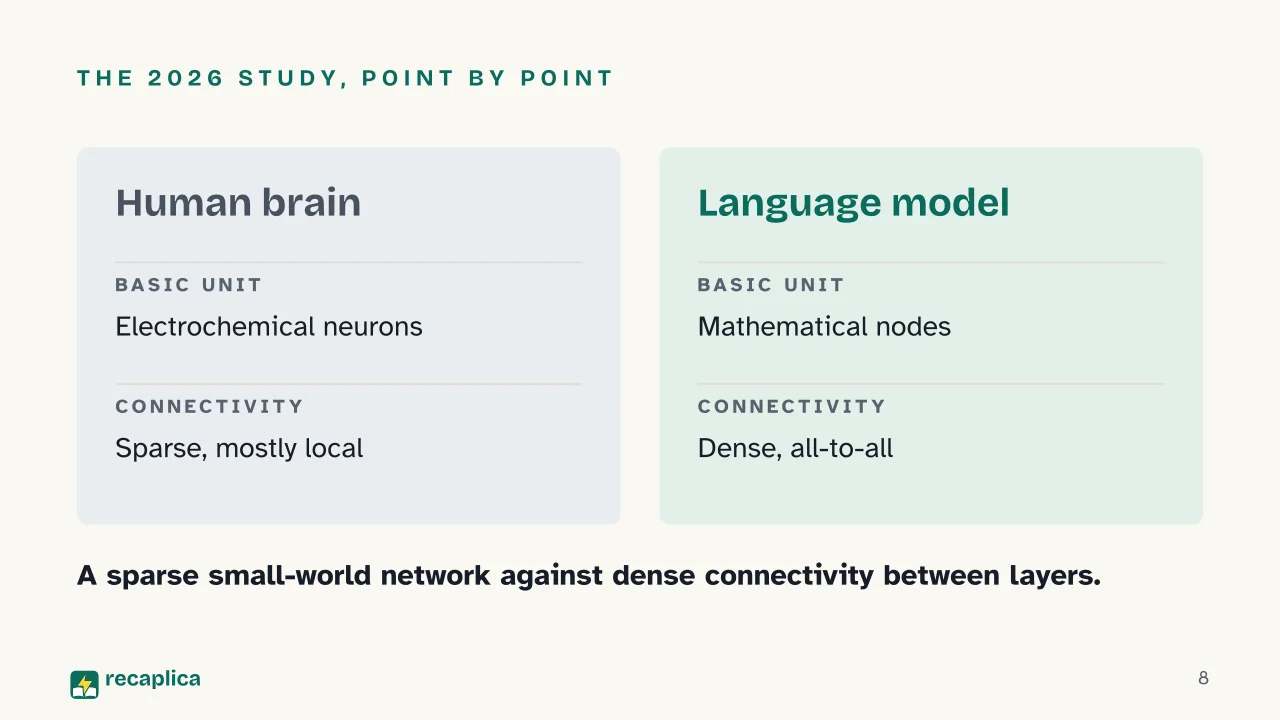 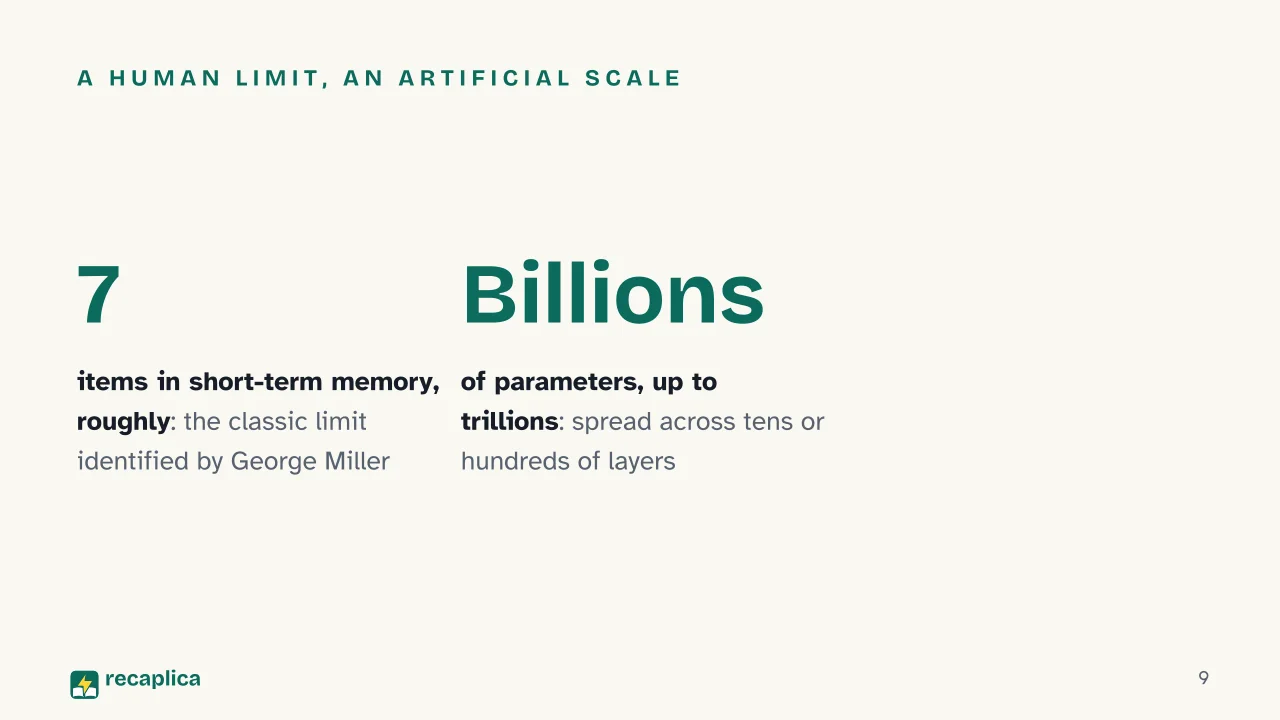  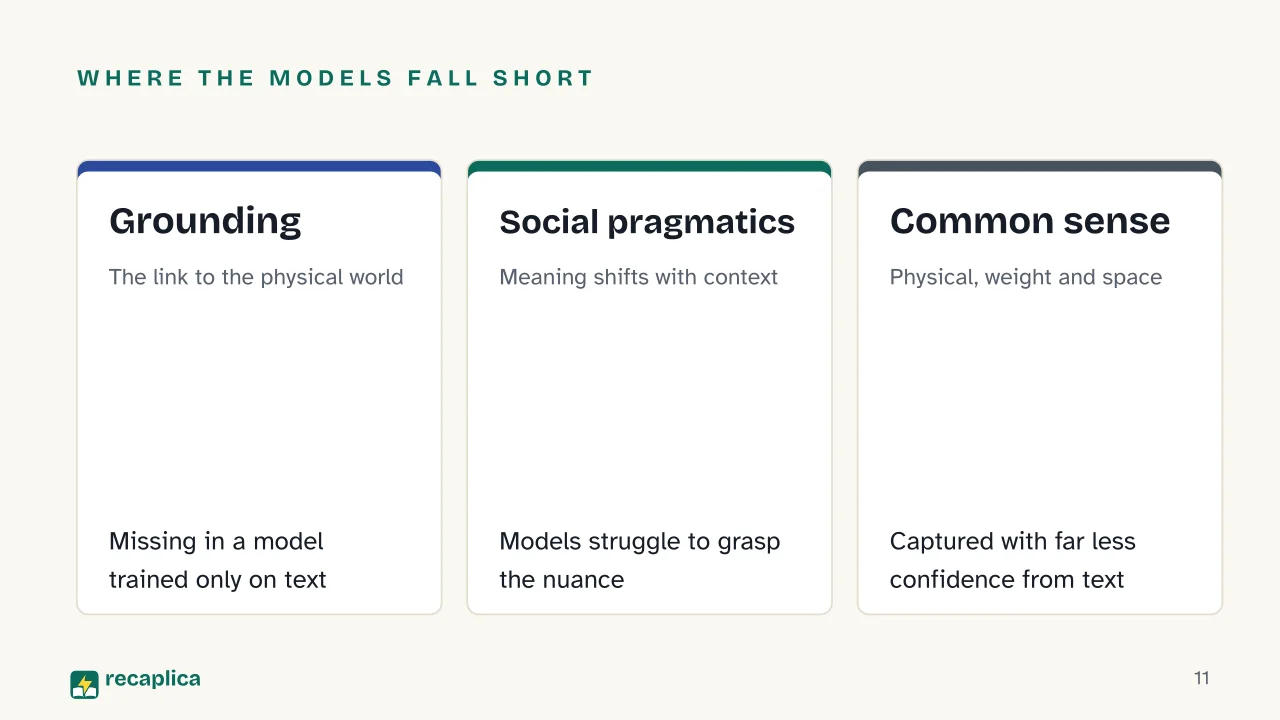 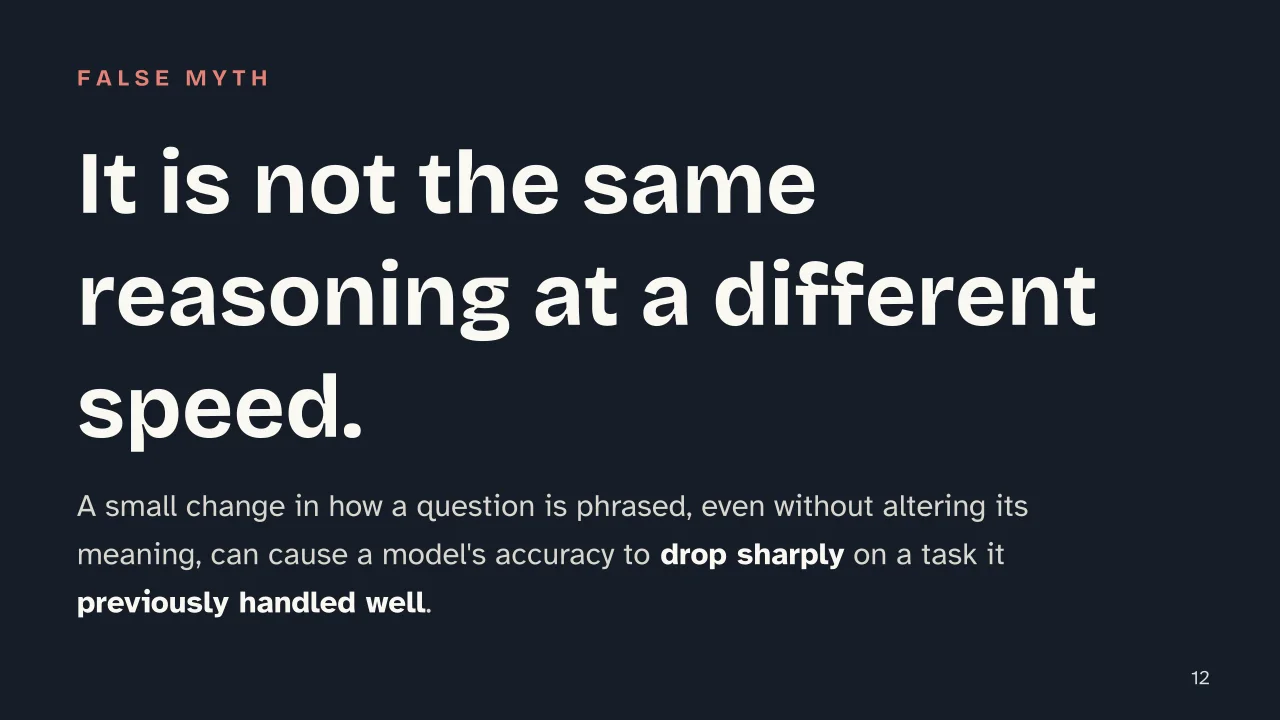  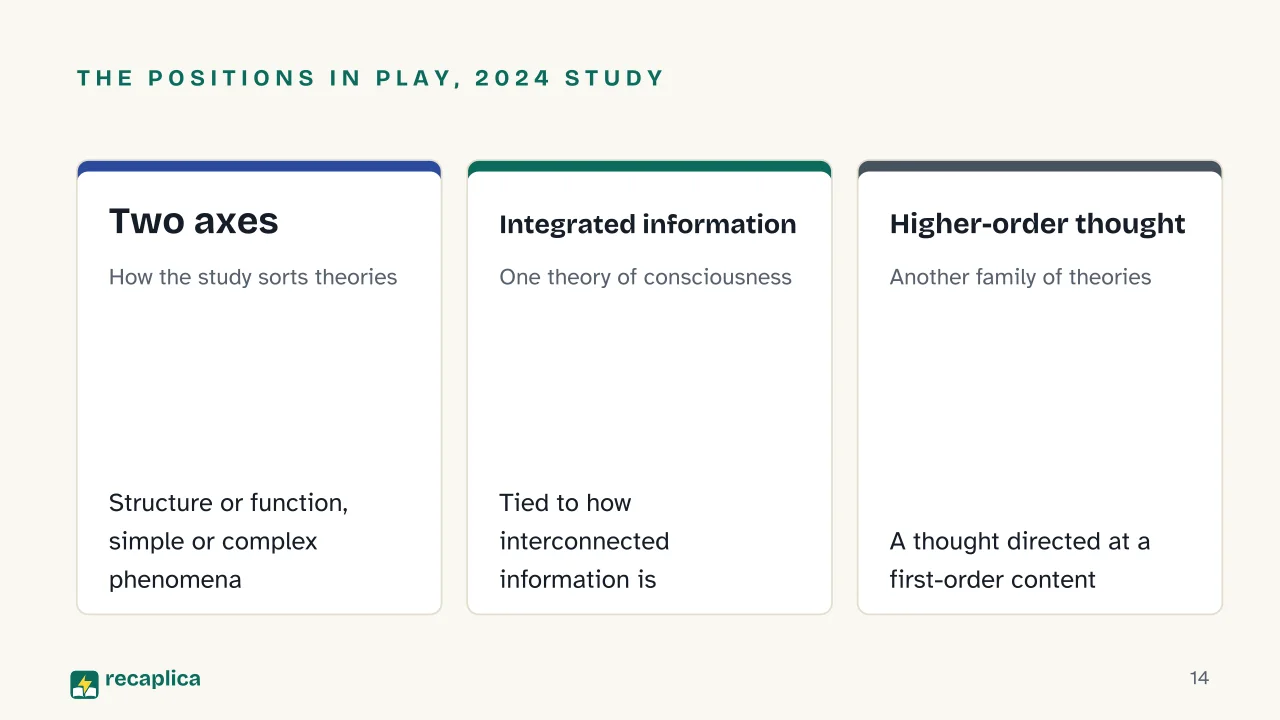  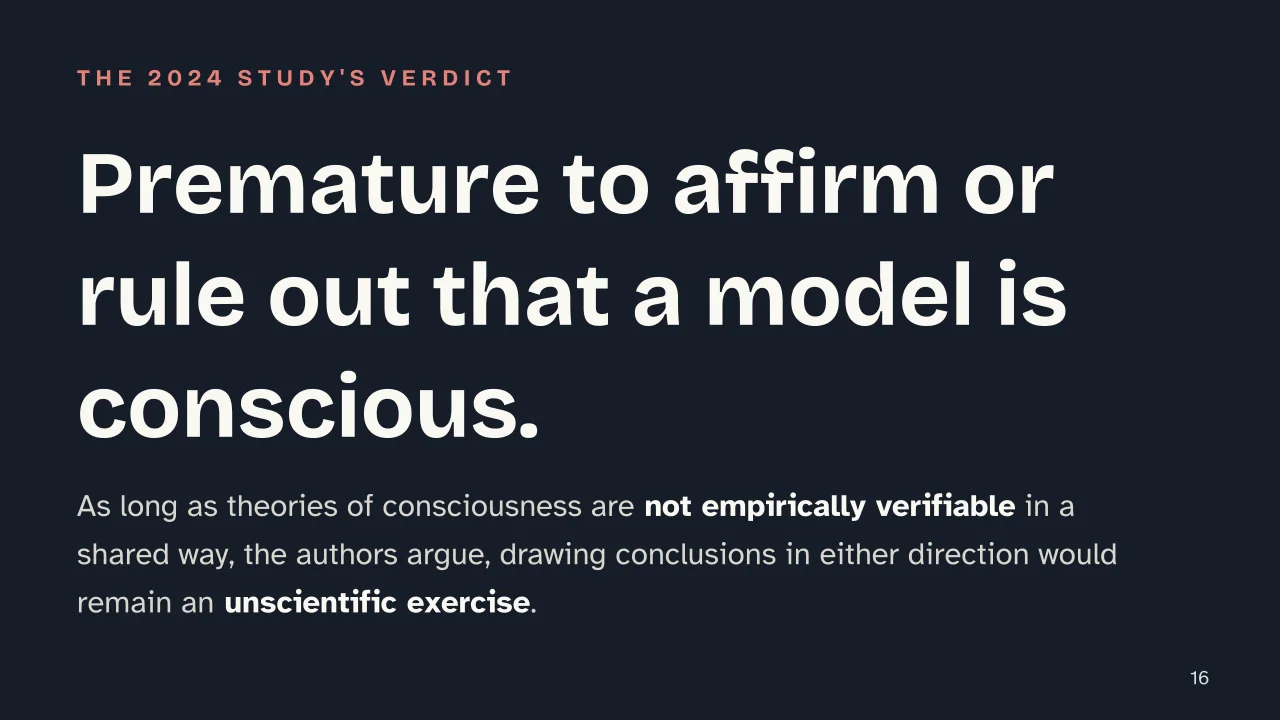   Common myths
Mind mapDrag the background to move around and the nodes to reposition them; use − and + to collapse and expand branches. 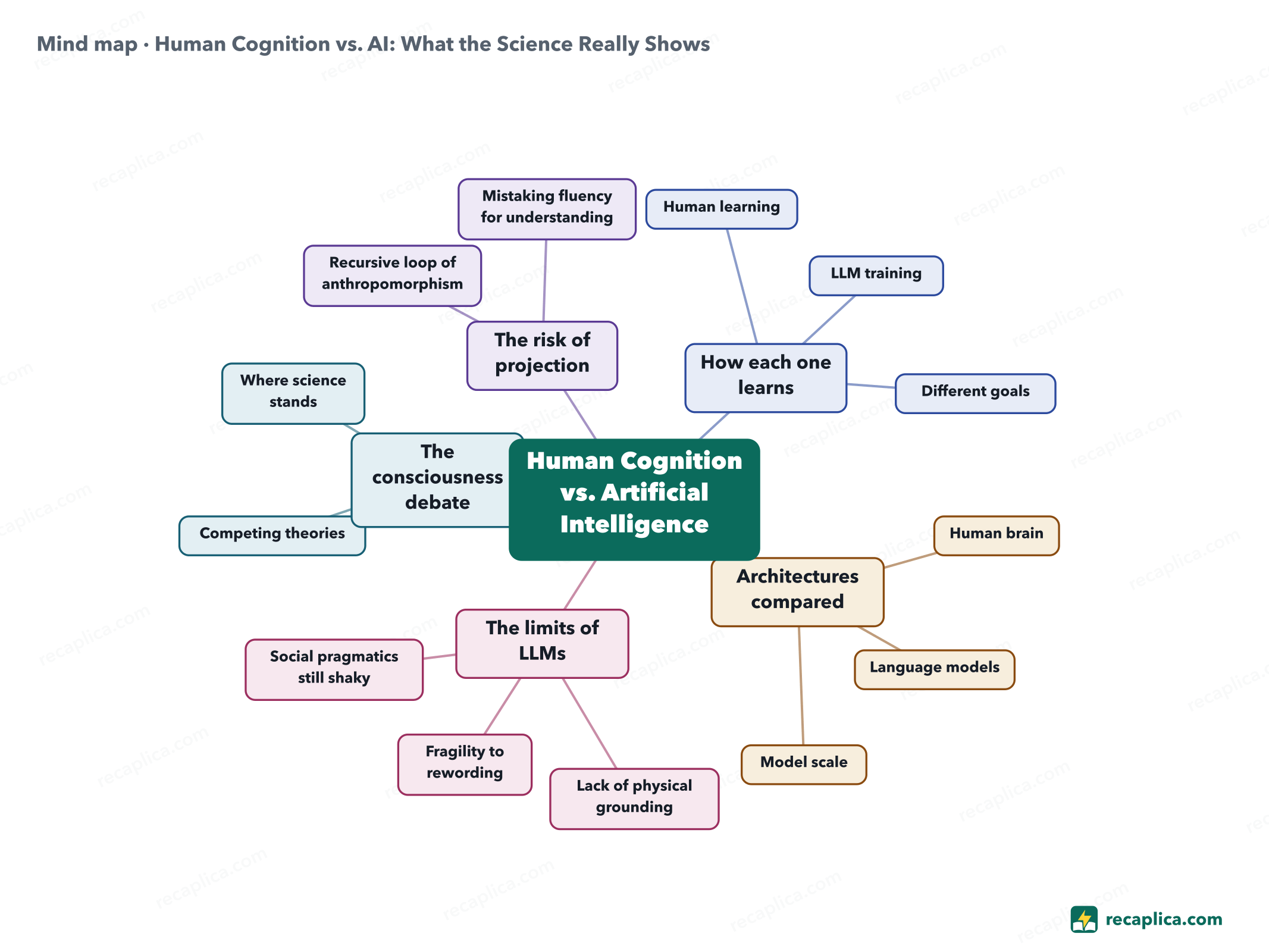
Quiz: test yourselfAnswer the questions to check what you have learned: you get instant feedback and a short explanation. Grade 0/10 0/5
FlashcardsTap the card to flip it and check whether you remember the answer, then move to the next one. 1 / 8 Explain it in your own wordsThe ultimate test: if you can explain it in simple words, you've truly understood it. Write your explanation, then compare it with the Recap. Your explanation is saved only on this device.
Frequently asked questionsDoes artificial intelligence think like a human being?According to research as of 2026, not in the same way: an LLM processes language as statistical prediction over large text corpora, while human cognition integrates perception, bodily experience, and active learning from small amounts of data. Some researchers propose treating LLM understanding as its own distinct form, rather than a simplified copy of human understanding. Can a chatbot be conscious?It's still an open question. A 2024 study concludes that, with the theoretical and experimental tools available as of 2026, it's premature to either affirm or rule it out: the leading theories of consciousness aren't yet verifiable in a scientifically shared way for artificial systems. Why does an AI sometimes get things wrong if I slightly change my question?Because its reasoning can be fragile to small changes in phrasing: a simple paraphrase or an irrelevant detail added to the prompt can cause accuracy to drop on a task the model previously handled well, a behavior quite different from how human reasoning typically responds. What does an AI lack that a human has had since early childhood?Mostly direct contact with the physical world. An LLM trained only on text has no perception, body, or action of its own: it lacks that 'grounding' and that physical common sense — intuitions about weight, space, everyday causality — that a human builds from infancy onward. Why does talking to an AI feel so natural?Because language models are trained on enormous amounts of human conversation and optimized to mimic the traits of human language. That makes the fluency of the output convincing, but it isn't on its own proof of understanding or consciousness equivalent to a human's. Every Recap goes through an independent review before publication. |