recaplica
Clear in 30 seconds, yours in 10 minutes.
In 30 seconds quick read
Generative AI is a technology that can create new content — text, images, audio, video, code — from a request written in natural language. It doesn't "copy" from an archive: it learned the patterns and rules of language by analyzing enormous amounts of data, and uses them to generate original answers, one word at a time.
Key Points
Generative means it creates new content, instead of just classifying or recognizing existing content.
At the core are large language models (LLMs), neural networks trained on enormous amounts of text.
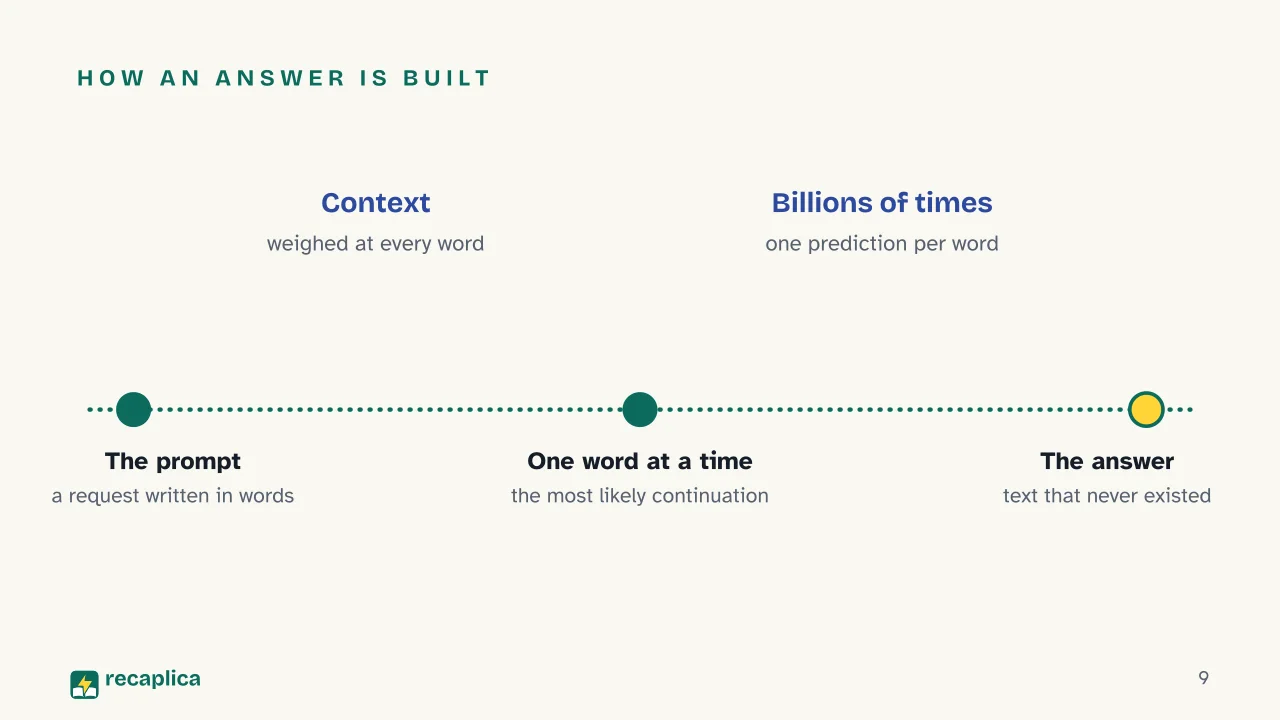
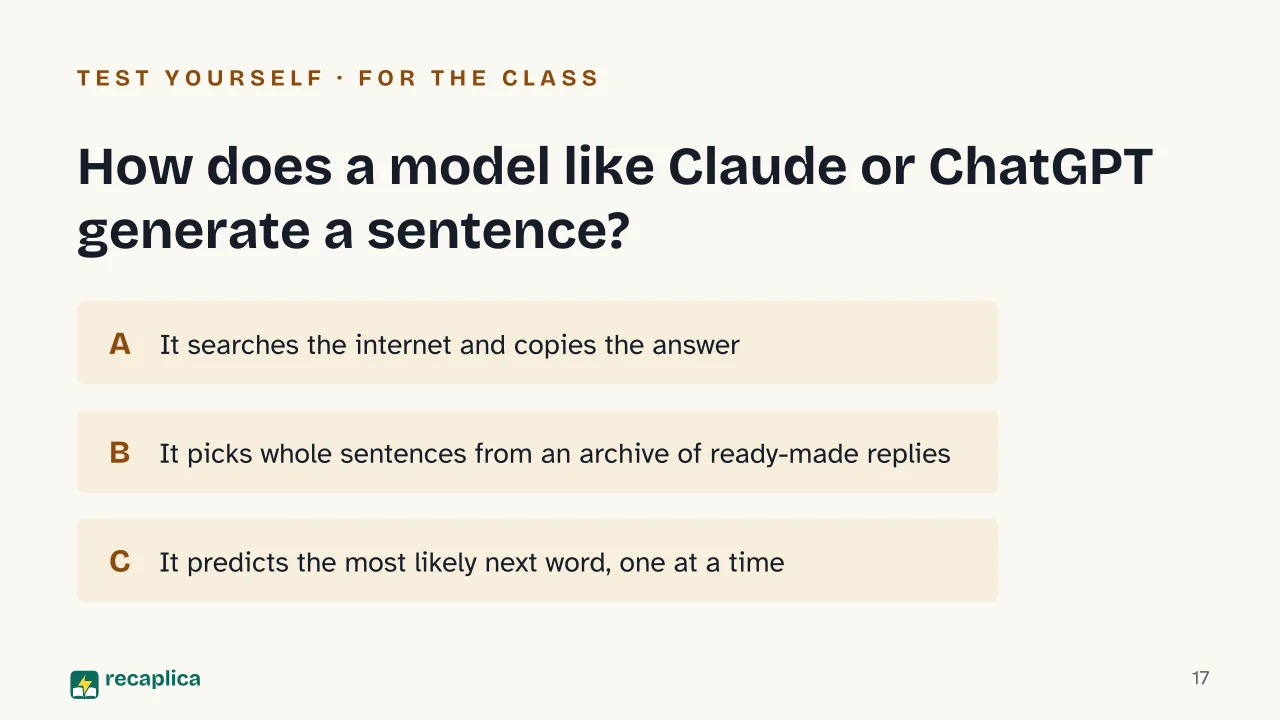
An LLM generates text by predicting the most likely next word, one at a time, billions of times.
The prompt is the request you write to the model: the clearer and richer in context, the better the result.
Models can be confidently wrong: so-called hallucinations are plausible but false answers — always verify.
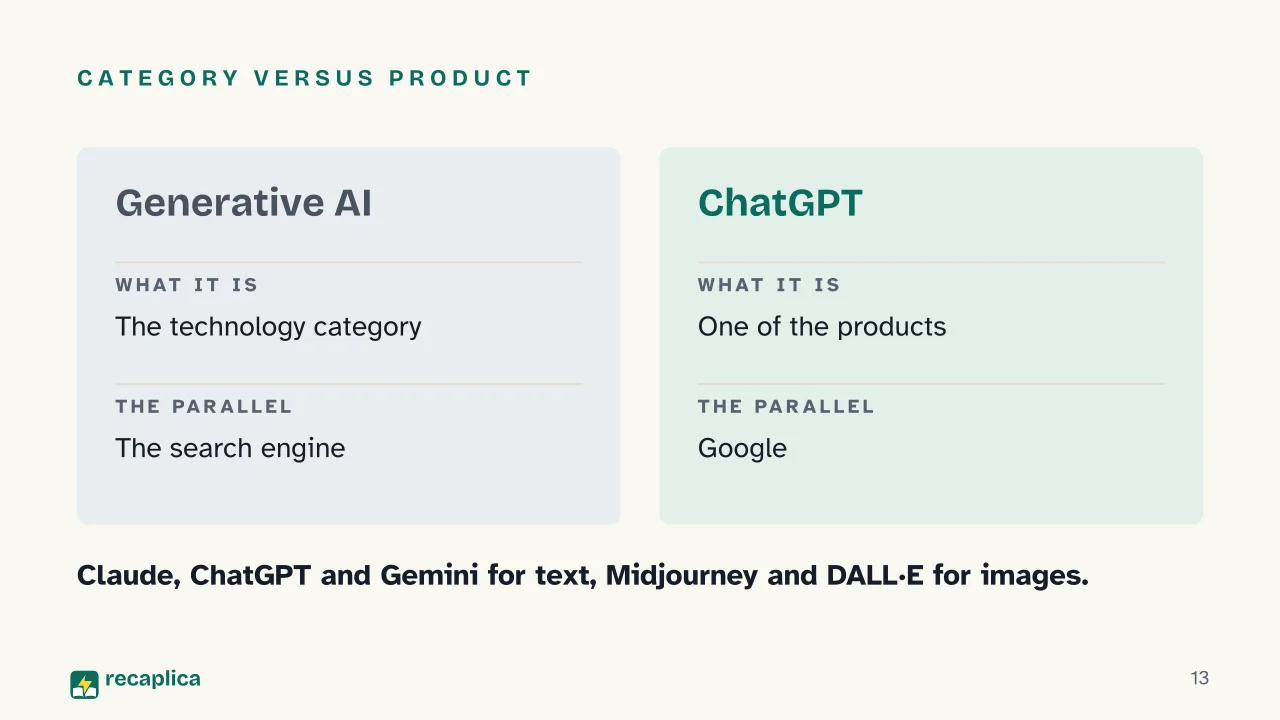
Well-known examples: Claude, ChatGPT and Gemini for text; Midjourney and DALL·E for images.
Key figures
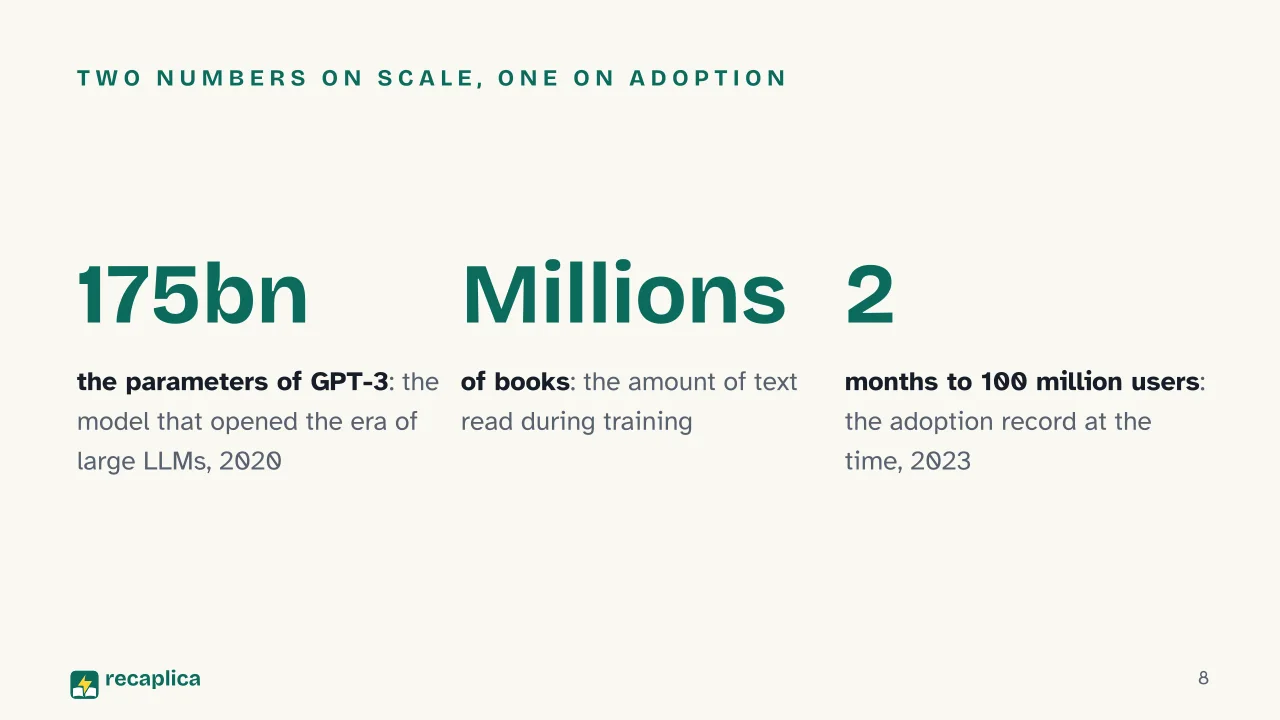
2 months the time ChatGPT took to reach 100 million users, an adoption record at the time Source: Reuters/UBS, 2023
175bn the parameters of GPT-3 (2020), the model that opened the era of large LLMs Source: arXiv, 2020
Deep Dive
A technology that creates, not just recognizes
For decades, artificial intelligence mostly did one thing: recognize.
Recognize a face in a photo, a spam email, a sentence spoken on the phone.
Generative AI flips the perspective: instead of analyzing existing content,
it creates new content.
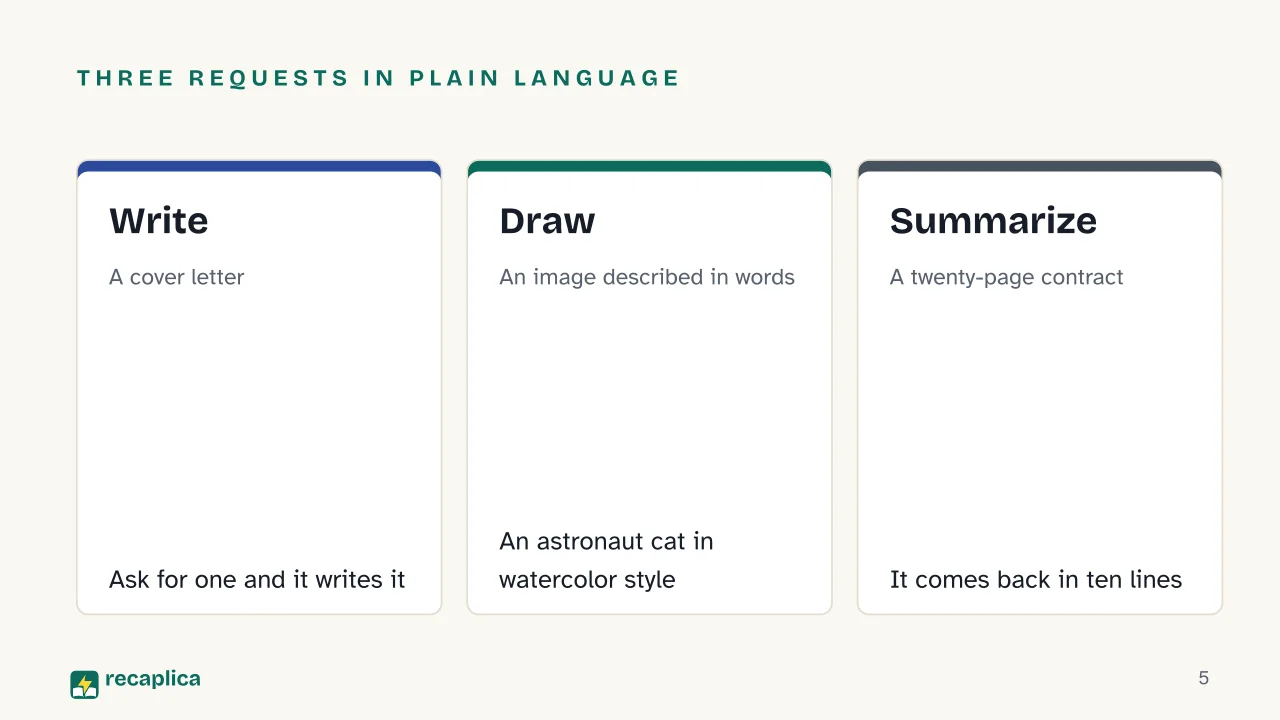
Ask it for a cover letter, and it writes one. Describe an image — “an
astronaut cat in watercolor style” — and it draws it. Paste in a
twenty-page contract, and it summarizes it in ten lines. All starting from
a simple request written in natural language: the prompt.
How it works: predicting the next word
Behind tools like Claude, ChatGPT or Gemini sits a large language model
(LLM): a neural network with billions of parameters, trained by reading an
amount of text comparable to millions of books.
The working principle is surprisingly simple to state: predict the next
word.
Practical example: when you read “the cat meows and the dog…”, your
brain instinctively completes it with “barks”. An LLM does the same
thing, but at an enormous scale: for every word it generates, it weighs
the entire context of the conversation and computes the most likely
continuation. Repeating that prediction billions of times, word after
word, it builds articulate, coherent, relevant answers.
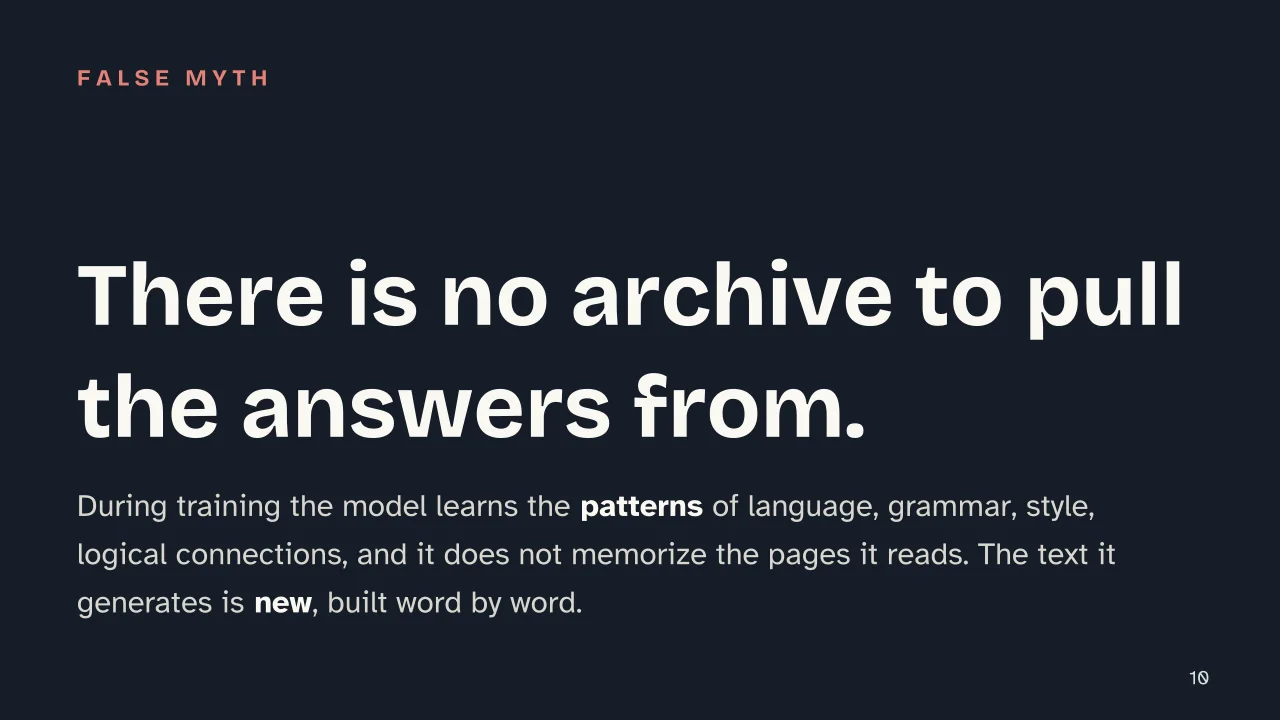
During training, the model doesn’t memorize the pages it reads the way a
database would: it learns patterns — grammar, style, logical
connections, recurring factual knowledge — and uses them to generate text
that never existed before.
What it can actually do
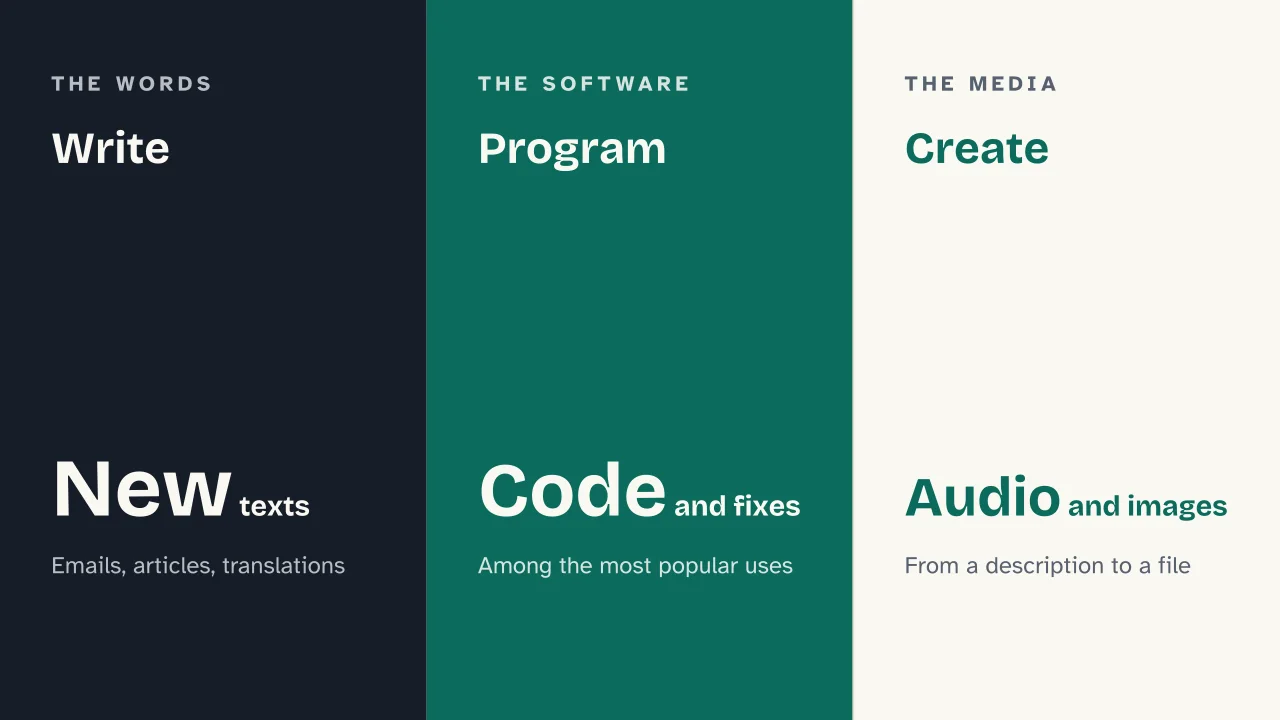
Generative AI is used every day to:
Write and rewrite: emails, articles, posts, translations, texts
adapted to different tones and audiences.
Summarize and explain: long documents condensed into key points,
complex concepts explained at different levels.
Code: generating and fixing software, today among the most popular
uses of all.
Create images, audio and video: from a text description to a
finished piece of media.
Brainstorm: propose ideas, alternatives and angles you hadn’t
considered.
The limits you need to know
The most important one has a curious name: hallucination. Because the
model always generates the most likely continuation and not necessarily
the true one, it sometimes produces invented information in a perfectly
confident tone: a wrong date, a quote that never existed, a made-up source.
Practical example: ask a model for the biography of a little-known
person and you may get plausible but inaccurate dates and events, mixed
with true facts. The text sounds right — and that’s exactly the risk.
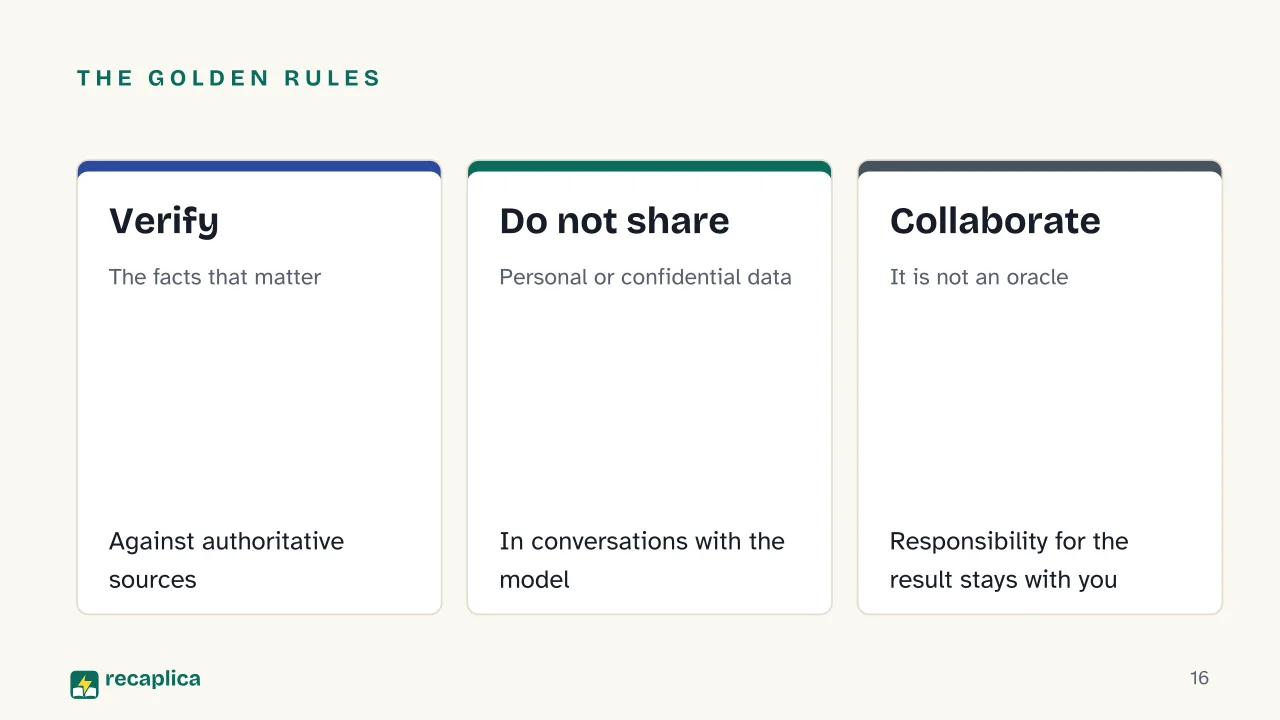
The golden rules for smart use:
Verify important factual claims against authoritative sources.
Don’t share personal or confidential data in conversations.
Use AI as a collaborator, not an oracle: responsibility for the
final result stays with you.
Why it’s a turning point
The point is not that machines “think” — they don’t, in the human sense.
The point is that for the first time anyone can delegate cognitive
tasks — writing, summarizing, translating, coding — to a tool that
answers in natural language, with no technical skills required. It is a
shift comparable to the arrival of the personal computer or the internet:
it doesn’t replace human intelligence, it multiplies its reach.
Slide deck
Slides ready to download and make your own in PowerPoint or Google Slides, with speaker notes. Pick the Flash cut or the Full one.
✗ Myth Generative AI copies and pastes content found on the internet.
✓ Reality During training the model learns statistical patterns of language — it doesn't memorize pages to serve back: the text it generates is new, built word by word.
✗ Myth AI understands what it says, like a person.
✓ Reality The model computes the most likely continuation of the text: it produces sensible answers without consciousness or human-style understanding. It's sophisticated statistics, not thought.
✗ Myth If AI wrote it, it must be correct.
✓ Reality Models can generate hallucinations: invented information phrased with confidence. Important claims must always be checked against authoritative sources.
Mind map
Drag the background to move around and the nodes to reposition them; use − and + to collapse and expand branches.
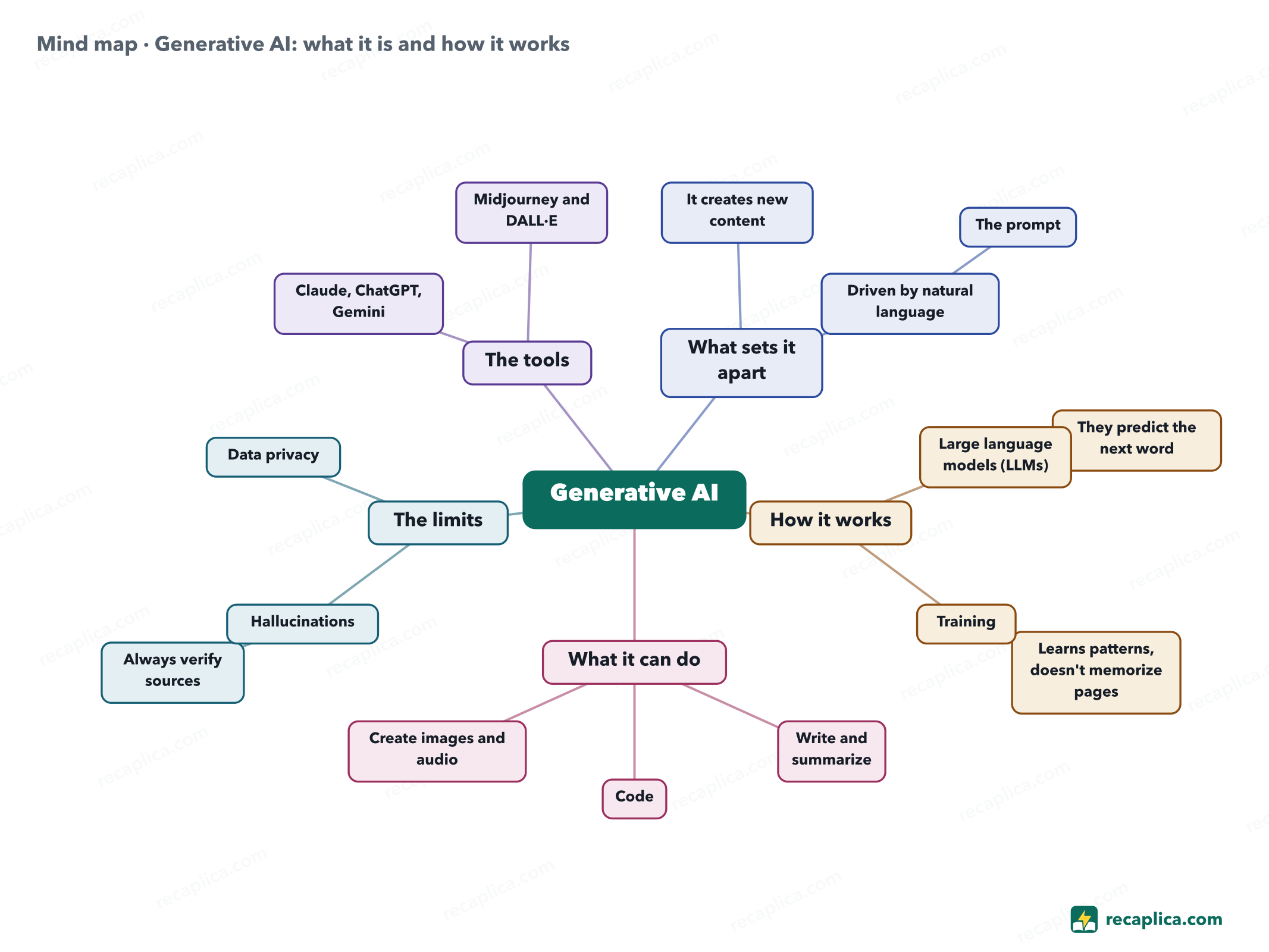
It creates new contentText, images, audio, video and code.
Driven by natural language
The prompt
How it works
Large language models (LLMs)Neural networks trained on enormous amounts of text.
They predict the next word
Training
Learns patterns, doesn't memorize pages
What it can do
Write and summarize
Code
Create images and audio
The limits
HallucinationsPlausible but false answers.
Always verify sources
Data privacy
The tools
Claude, ChatGPT, Gemini
Midjourney and DALL·E
Quiz: test yourself
Answer the questions to check what you have learned: you get instant feedback and a short explanation.
Grade0/100/5
Answers: 1-B · 2-C · 3-A · 4-A · 5-B
Flashcards
Tap the card to flip it and check whether you remember the answer, then move to the next one.
1 / 6
Explain it in your own words
The ultimate test: if you can explain it in simple words, you've truly understood it. Write your explanation, then compare it with the Recap.
Your explanation is saved only on this device.
Generative AI is a technology that can create new content — text, images, audio, video, code — from a request written in natural language. It doesn't "copy" from an archive: it learned the patterns and rules of language by analyzing enormous amounts of data, and uses them to generate original answers, one word at a time.
Frequently asked questions
Does generative AI copy content from the internet?
Not in the copy-paste sense: during training the model learns statistical patterns of language, it doesn't memorize pages to serve back. It generates new content, although the copyright debate around training data is still open.
What's the difference between generative AI and ChatGPT?
Generative AI is the technology category; ChatGPT is one of the products built on it, like Anthropic's Claude or Google's Gemini. It's the same difference as between 'search engine' and 'Google'.
Can I trust the answers of a generative AI?
Generally yes for creative tasks, summaries and explanations, but with a critical eye: models can generate errors known as hallucinations. For data, dates, figures and medical or legal matters, always check authoritative sources.
Will generative AI take people's jobs?
It will transform many professions more than eliminate them: it automates repetitive writing, summarizing and coding tasks, while new roles grow around supervision, verification and the strategic use of these tools.
Every Recap goes through an independent review before publication.
Statistics, only if you say so
To learn which Recaps help most we would use Google Analytics, with aggregate, anonymous data. It starts only with your OK, and you can change your mind anytime. Privacy policy