|
recaplica
What Is Pi? The Number That Never Ends | ||||||||||||||||||
| © 2026 Recaplica · recaplica.com — All rights reserved | ||||||||||||||||||
What Is Pi? The Number That Never EndsWhat to print Page numbers appear when printing with default margins. SlidesChoose a cut Flash10 slidesThe essential thread, to present in classFull16 slidesEvery chapter and the deeper detailBoth come with speaker notes. In 30 seconds quick readPi, written π, is the ratio between a circle's circumference and its diameter, about 3.14159. It isn't a rounding shortcut: it's an irrational number, proved in 1761 by Johann Heinrich Lambert, whose decimal digits never end and never settle into a repeating pattern. In 1882 Ferdinand von Lindemann went further, showing that π is also transcendental. As of November 23, 2025, mathematicians had calculated 314 trillion of its digits, even though the first ten cover almost every practical use, from drawing a circle to the orbits NASA calculates. Key Points
Key figures
Deep DiveA Ratio That Never ChangesPick any circle, as small as a coin or as wide as a running track. Divide the length of its circumference by its diameter, the straight line that cuts through the center from one side to the other. The result is always the same number, about 3.14159, whatever the size of the circle you started from. That number is called pi, written with the Greek letter π: according to Wolfram MathWorld, π is defined precisely as the ratio C/d between a circle’s circumference C and its diameter d. Those same digits, 3.14, give the date of Pi Day, the celebration held every March 14. The symbol everyone recognizes today is younger than the idea itself. The first person to use the single letter π for this ratio was the Welsh mathematician William Jones, in 1706, in his work Synopsis Palmariorum Matheseos, according to Wikipedia and MacTutor. The symbol then became the standard in the West through the first half of the 1700s, thanks to the work of Leonhard Euler. A Number No Fraction Can CaptureHere comes the less intuitive part, and it’s also the answer to why π’s digits never end: π is an irrational number. That means there is no pair of whole numbers that, written as a fraction, equals π exactly. The Swiss mathematician Johann Heinrich Lambert proved it in 1761, using a continued-fraction representation of the tangent function, according to Wolfram MathWorld and MacTutor (University of St Andrews); Legendre confirmed the result in 1794. Anyone studying trigonometry runs into the tangent in exactly that kind of proof, even though at school it’s mostly used for triangles. Being irrational has a direct consequence for the decimal digits: if π were a fraction, its digits after the decimal point would eventually settle into a repeating cycle, the way 1/3 = 0.333… or 1/7 do. Since it isn’t, according to NASA, π’s decimal digits are infinite and never follow a repeating pattern. It isn’t an isolated case in mathematics: the square root of 2 is also an irrational number, for a different reason but with the same consequence, infinite digits with no period. Beyond Irrational: A Transcendental NumberLambert closed one question but opened another: is π irrational yet still the solution of some equation built from numbers? In 1882 the German mathematician Ferdinand von Lindemann answered no. He proved that π is transcendental, meaning it isn’t the solution of any polynomial equation with rational coefficients, according to Wikipedia. The direct practical consequence for compass-and-straightedge drawing is that squaring the circle, constructing a square with the same area as a given circle using only a straightedge and compass, is impossible: a problem geometers had tried to solve for centuries, within the tradition of Euclidean geometry, turned out to be unsolvable because of the very nature of π. From Archimedes to Supercomputers
Long before computers, a polygon was enough. Around 250 BCE, Archimedes had already found a way to narrow down the value of π without knowing it exactly, centuries before Lambert and Lindemann. He drew a regular hexagon inside and outside a circle, then kept doubling the number of sides until he reached a 96-sided polygon: the inner polygon gives a value a little smaller than π, the outer one a little larger, and tightening the two polygons shrinks the margin of error. With this method Archimedes showed that 223/71 < π < 22/7, a result correct to the first two decimal digits, according to Wikipedia and Wolfram MathWorld. The same principle of bracketing a figure between two known measurements also shows up in the Pythagorean theorem, where a right triangle ties three lengths together with a fixed relationship.
With computers, Archimedes’ method has been replaced by much faster algorithms, but the underlying idea, closing in on a number that can never be written out in full, hasn’t changed. According to Wikipedia (“Chronology of computation of π”), Kevin O’Brien, Divyansh Jain and Brian Beeler pushed the calculation to 314 trillion decimal digits as of November 23, 2025, with the y-cruncher program, over 110 days of continuous computation. These figures matter more for testing hardware and algorithms than for doing new mathematics: for almost every real-world calculation, from school to engineering, a few dozen digits are enough. Scientists and engineers at NASA’s Jet Propulsion Laboratory regularly use π, with far fewer digits than the record, to study moons, planets, stars and other spherical bodies, and to calculate the orbits of satellites and spacecraft. Slide deckSlides ready to download and make your own in PowerPoint or Google Slides, with speaker notes. Pick the Flash cut or the Full one.   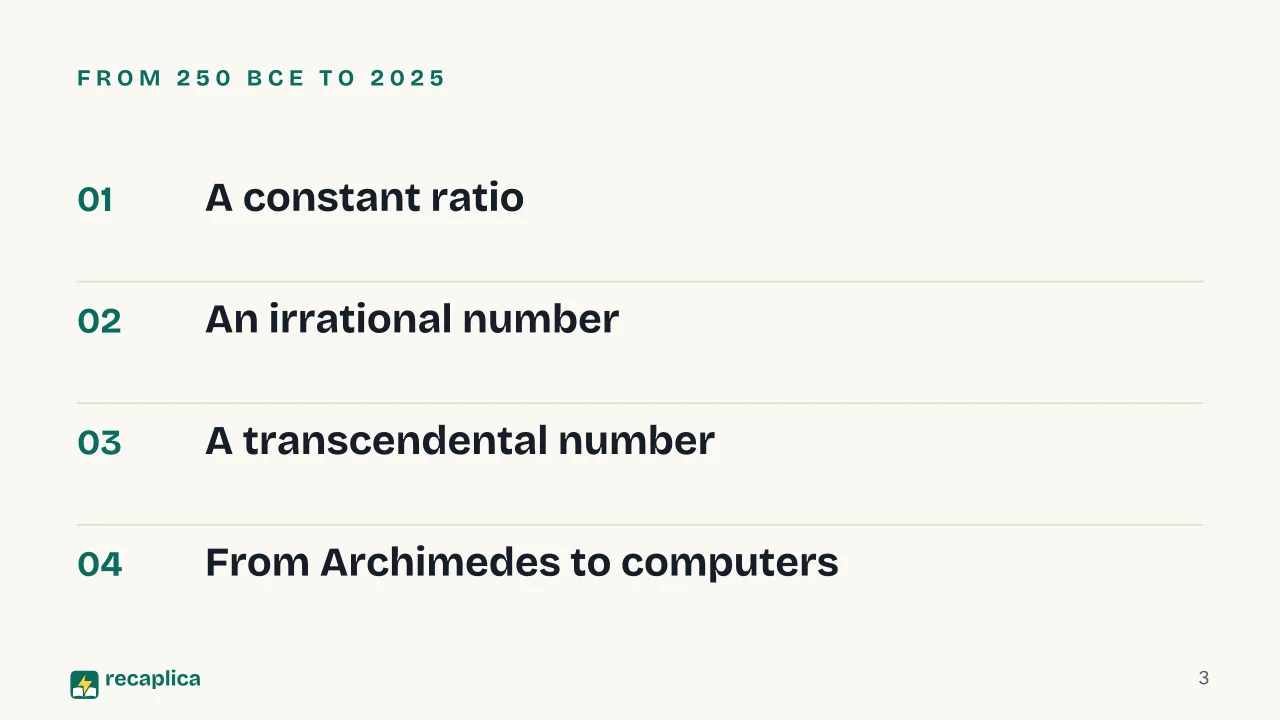  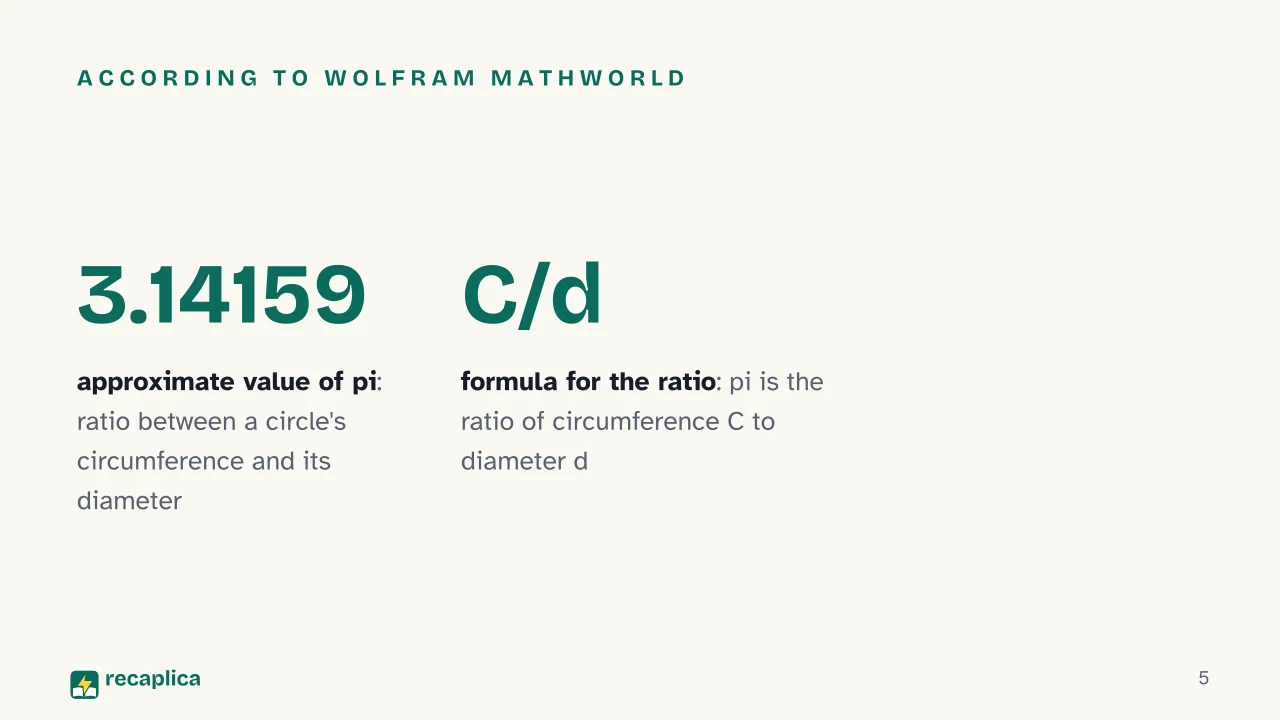  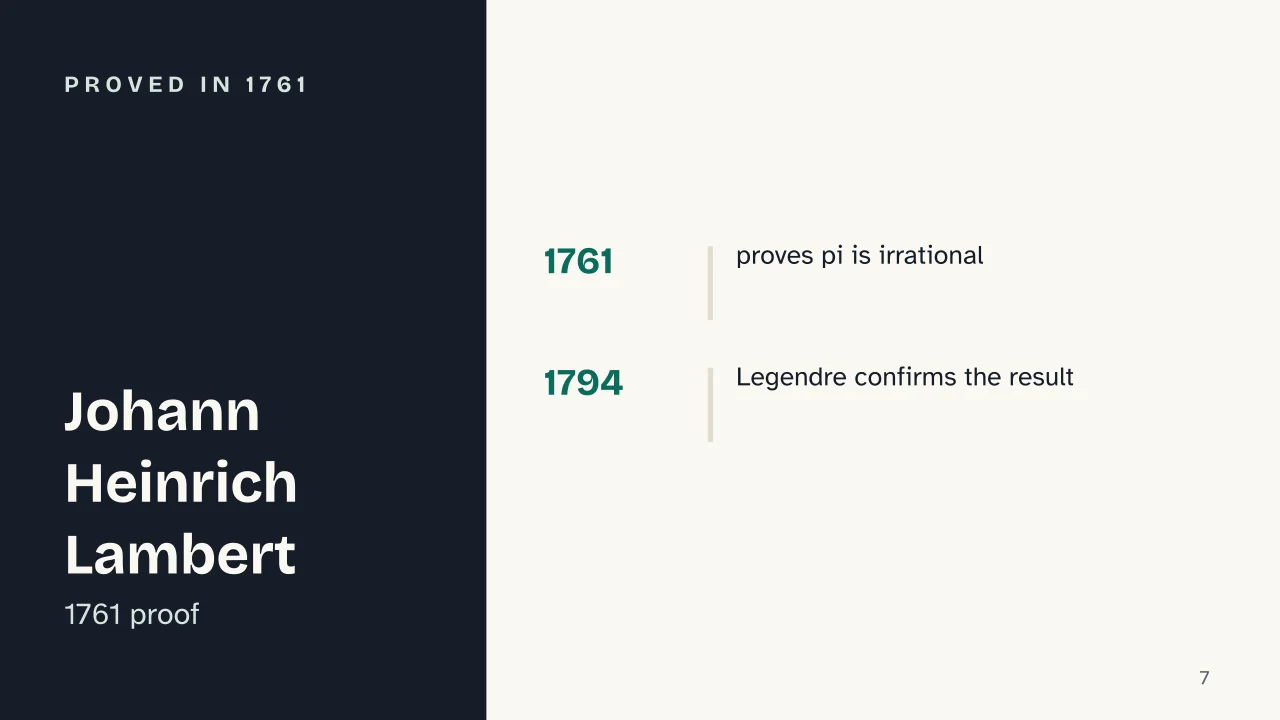 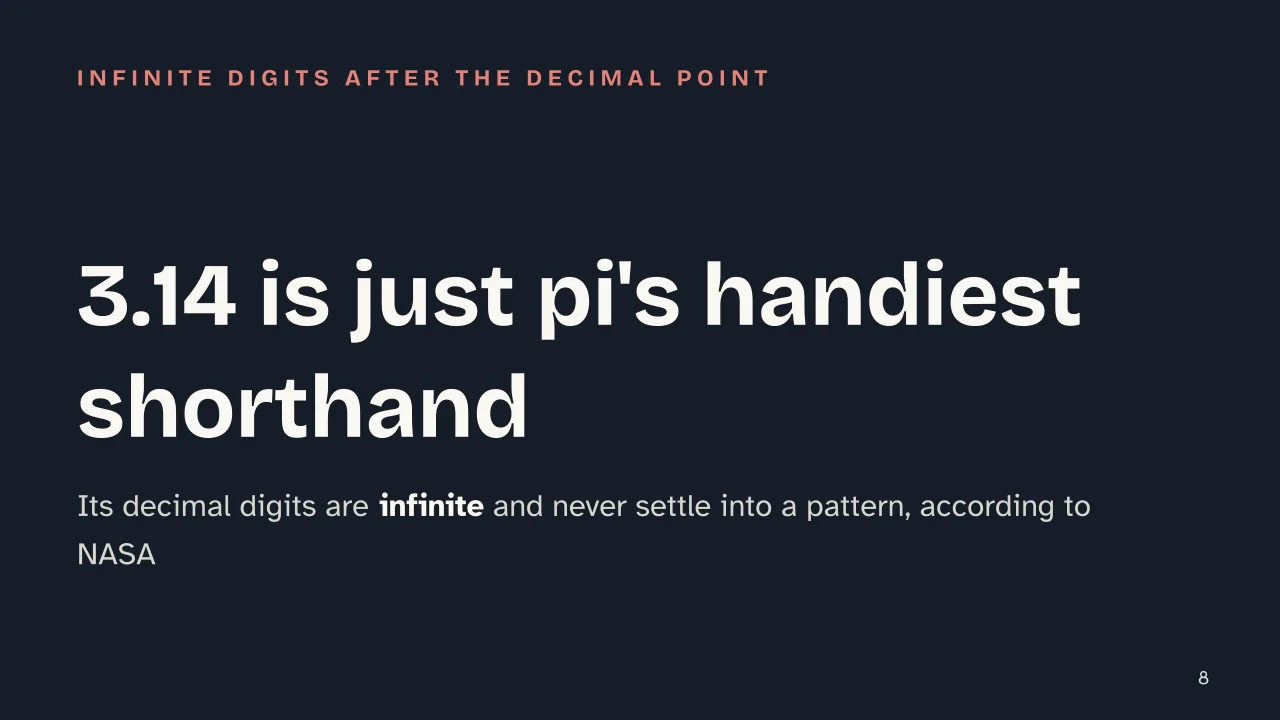  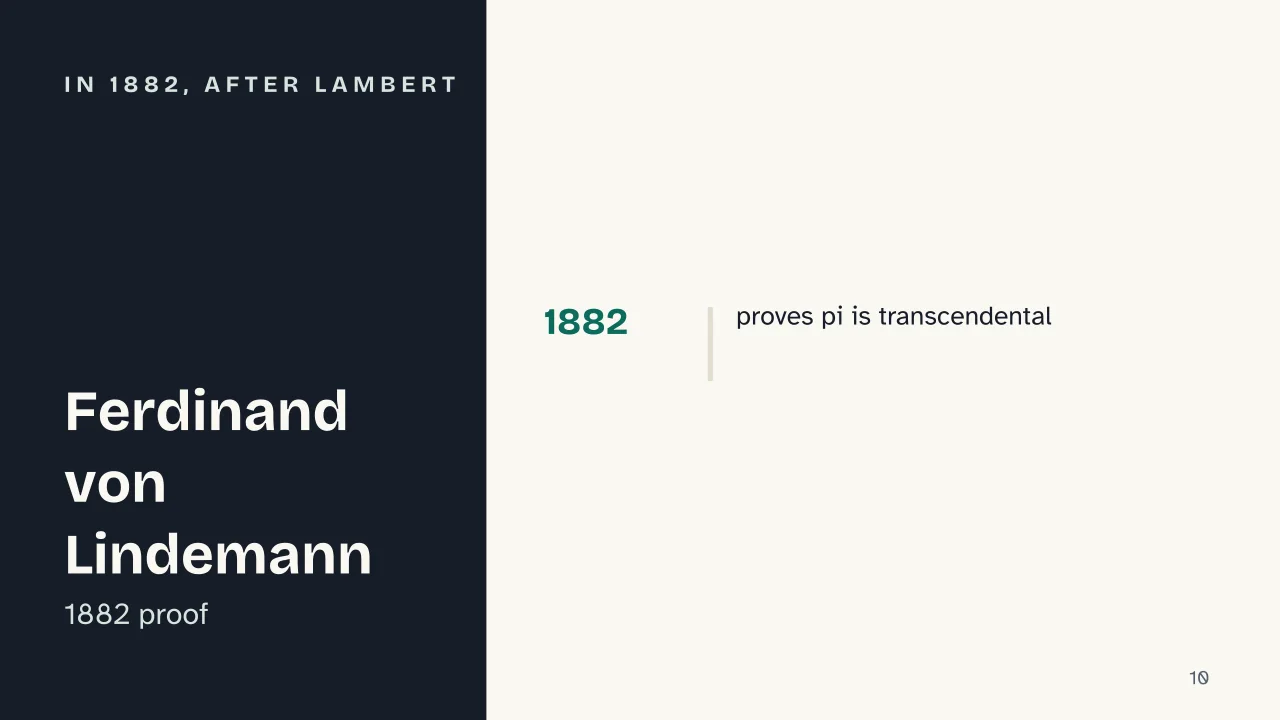  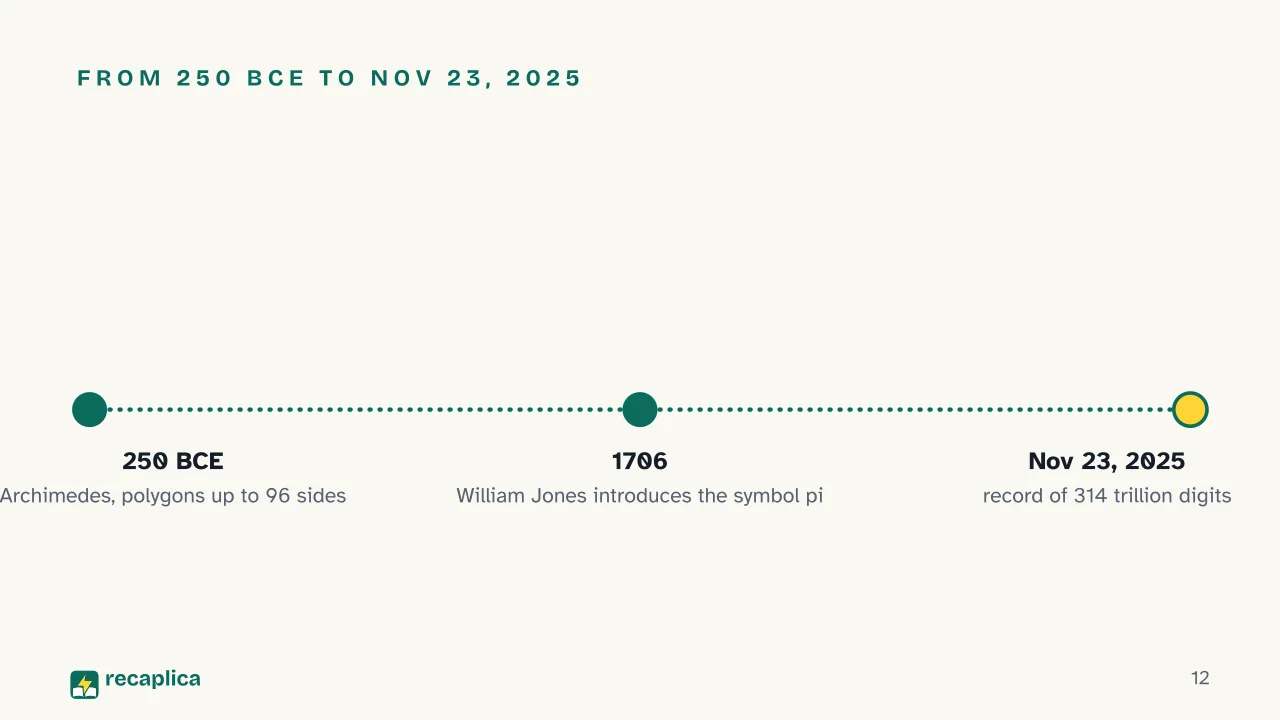 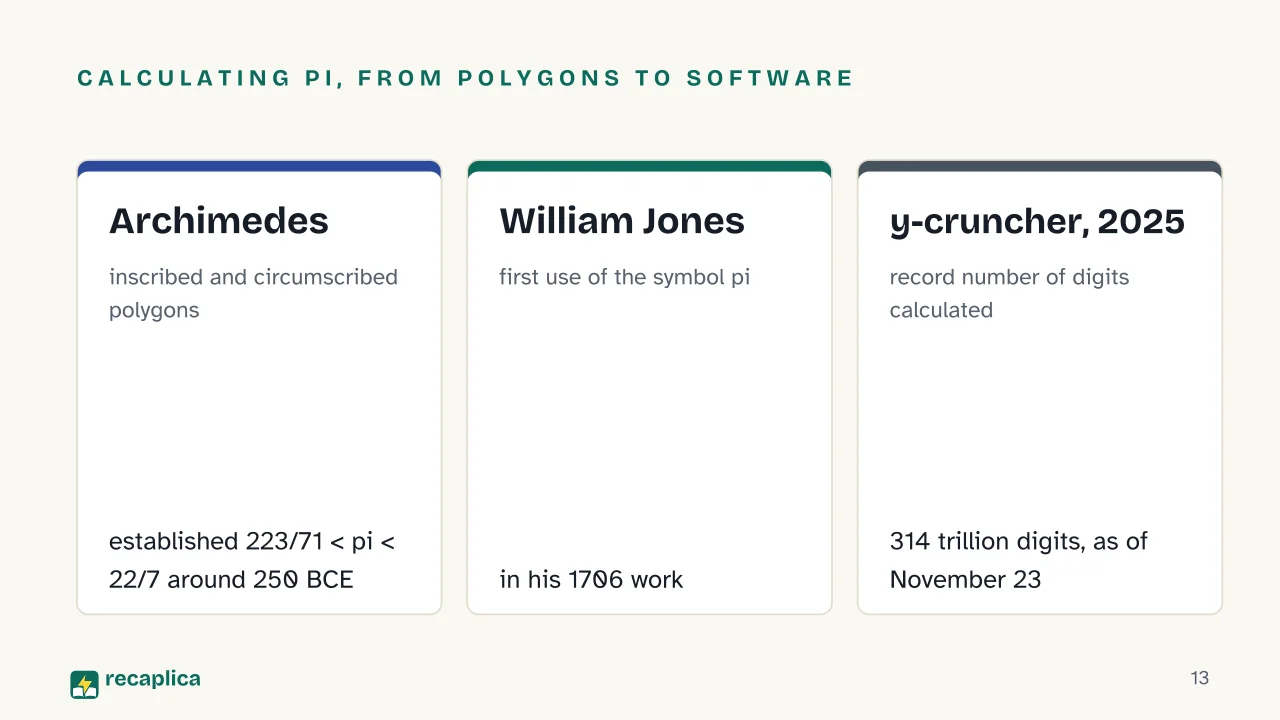 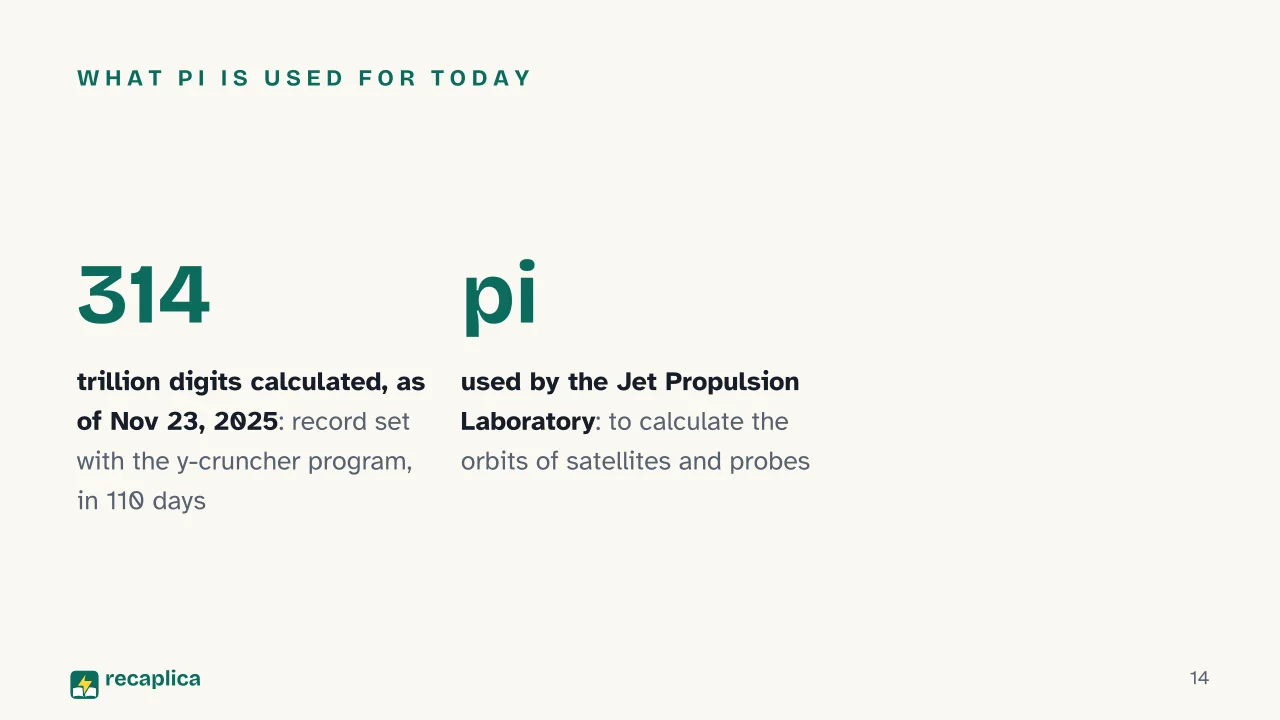 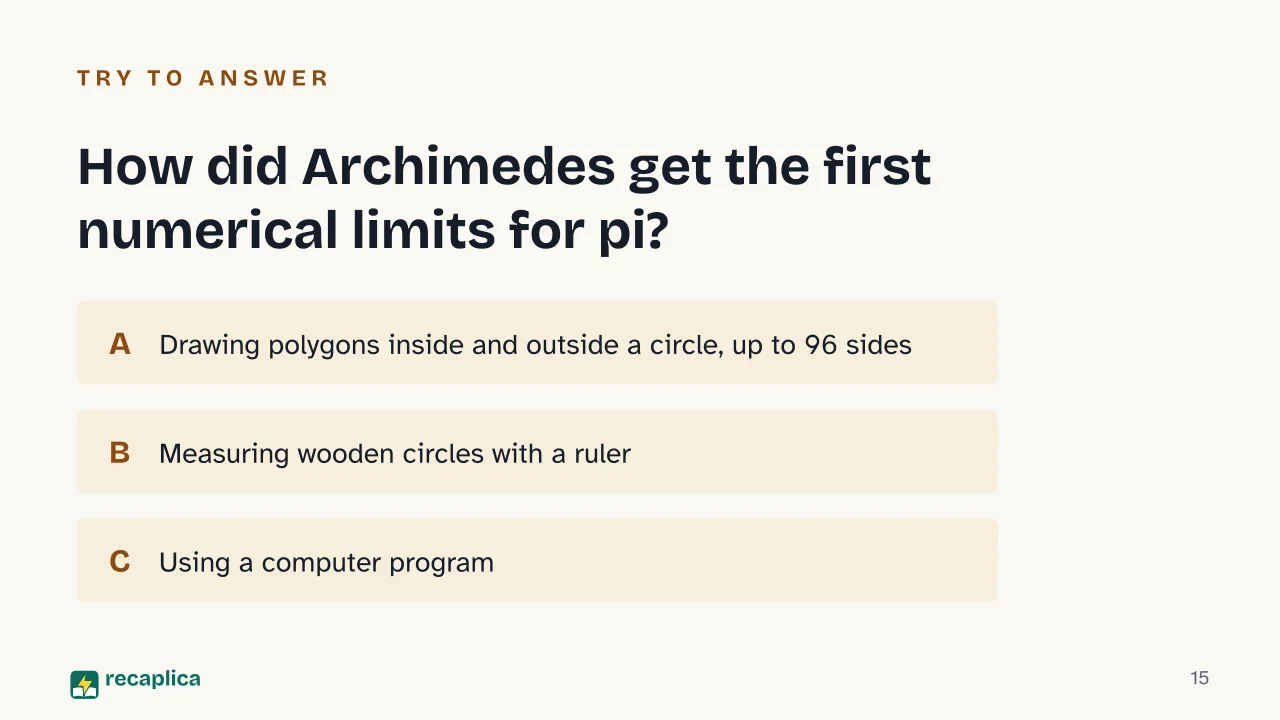  Common myths
Mind mapDrag the background to move around and the nodes to reposition them; use − and + to collapse and expand branches. 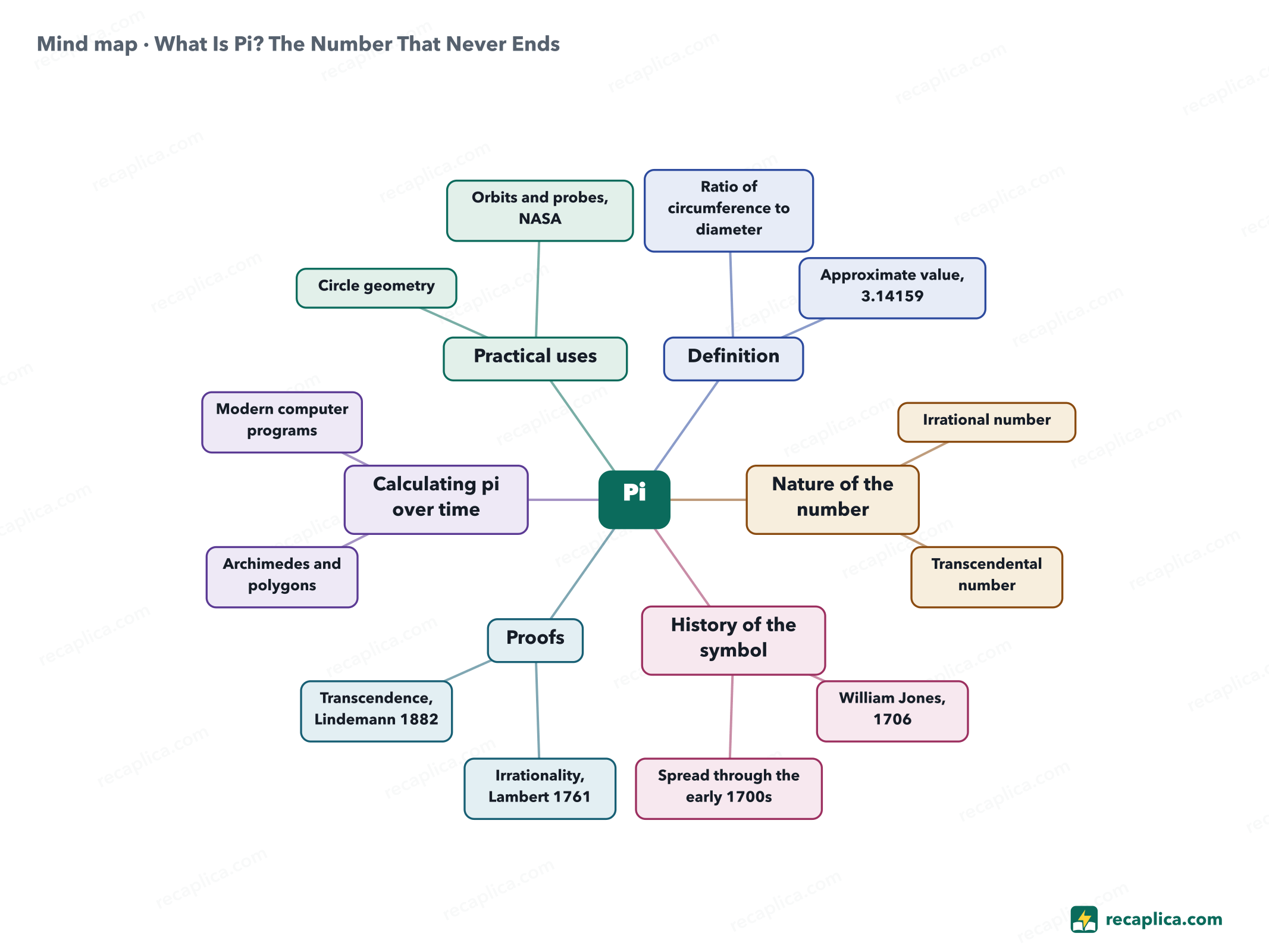
Quiz: test yourselfAnswer the questions to check what you have learned: you get instant feedback and a short explanation. Grade 0/10 0/5
FlashcardsTap the card to flip it and check whether you remember the answer, then move to the next one. 1 / 8 Explain it in your own wordsThe ultimate test: if you can explain it in simple words, you've truly understood it. Write your explanation, then compare it with the Recap. Your explanation is saved only on this device.
Frequently asked questionsHow many digits does pi have?Infinite: π is an irrational number, so its decimal digits go on forever without locking into a repeating cycle, as NASA explains. With computers, as of November 23, 2025, 314 trillion of them had been calculated, the record reached by Kevin O'Brien, Divyansh Jain and Brian Beeler with the y-cruncher program in 110 days. Is pi an irrational number, and why does that mean it never ends?Yes: no fraction of two whole numbers represents π exactly, a fact Johann Heinrich Lambert proved in 1761. Being irrational is why its decimal representation never becomes periodic, unlike a fraction such as 1/3. Is pi equal to 3.14?No, 3.14 is only a convenient approximation, and it's the origin of the date of Pi Day, March 14. The real value has infinite, non-repeating decimal digits, according to NASA. Who invented the symbol π?The Welsh mathematician William Jones used it first, in 1706; the symbol then spread through the first half of the 1700s thanks to Leonhard Euler, becoming the standard in the West. What is pi actually used for, beyond school?NASA's Jet Propulsion Laboratory relies on it constantly to study moons, planets and stars, and in the calculations that guide satellites and probes through space. Every Recap goes through an independent review before publication. |