|
recaplica
What Is Pi Day? Why It Falls on March 14 | ||||||||||
| © 2026 Recaplica · recaplica.com — All rights reserved | ||||||||||
What Is Pi Day? Why It Falls on March 14What to print Page numbers appear when printing with default margins. SlidesChoose a cut Flash10 slidesThe essential thread, to present in classFull15 slidesEvery chapter and the deeper detailBoth come with speaker notes. In 30 seconds quick readPi Day is a yearly observance on March 14, chosen because the US date format writes that day as 3/14, matching pi's first digits. Larry Shaw, a physicist at San Francisco's Exploratorium, came up with it in 1988 during a staff retreat at the museum. What started as a small party among coworkers grew into a public celebration with a parade, pie, and a 2009 resolution from the US Congress. Today it's mostly marked in schools and science museums, with digit-memorization contests and discounts at pizza and dessert shops. Key Points
Key figures
Deep DiveA date that’s also a numberOn March 14, in thousands of schools and science museums around the world, people celebrate Pi Day. The name rests on a calendar coincidence: in the United States, dates are written month first, so March 14 becomes 3/14 — the same as pi’s first digits, the constant behind every circle, covered in the Recap on what pi is. The idea isn’t old. According to Wikipedia, it started in 1988 during a staff retreat at San Francisco’s Exploratorium, a hands-on science museum. Larry Shaw, a physicist at the museum, was talking with a few colleagues, including Ron Hipschman, about mathematical constants, and noticed the link between the date and pi’s digits.
From a staff party to a public paradeThe first edition, in 1988, was small: just Exploratorium staff, a march around one of the museum’s circular spaces, and fruit pies afterward. The following year the celebration opened to all visitors, and it has repeated every year since, even through the museum’s moves to new buildings. The public version settled into a set routine: a parade at 1:59 p.m. (the digits that follow 3.14 in pi), with participants carrying signs showing one digit each, a gathering point called the “pi shrine,” fruit pie and pizza, and a round of “Happy Birthday” sung to Albert Einstein, which has become part of the Exploratorium’s yearly tradition. Larry Shaw never took credit for it. He liked to say he was just the one holding the pole. Recognition from the US CongressOn March 12, 2009, the US House of Representatives passed resolution H.Res. 224, recognizing March 14 as “National Pi Day.” According to the resolution’s text, the date is tied to pi’s approximation as 3.14; the document formally supports celebrating the day beyond US borders and encourages schools and teachers to build activities around the number it’s named for. It’s a non-binding resolution, though: it doesn’t close a single school or office, and it doesn’t require any state or teacher to observe it.
A holiday you can eatThe most common thread running through Pi Day is pie: “pie” sounds like the first syllable of “pi,” and that pun has shaped how the day gets marked everywhere. Eating, throwing, and giving away pie has become almost as much a part of the ritual as talking about the number behind the name. Anyone curious about the number itself, rather than the holiday, can find out why pi never ends in the Recap on irrational numbers: pi is one of those numbers that can’t be written as an exact fraction, which is why its decimal digits keep going without ever repeating. Slide deckSlides ready to download and make your own in PowerPoint or Google Slides, with speaker notes. Pick the Flash cut or the Full one.     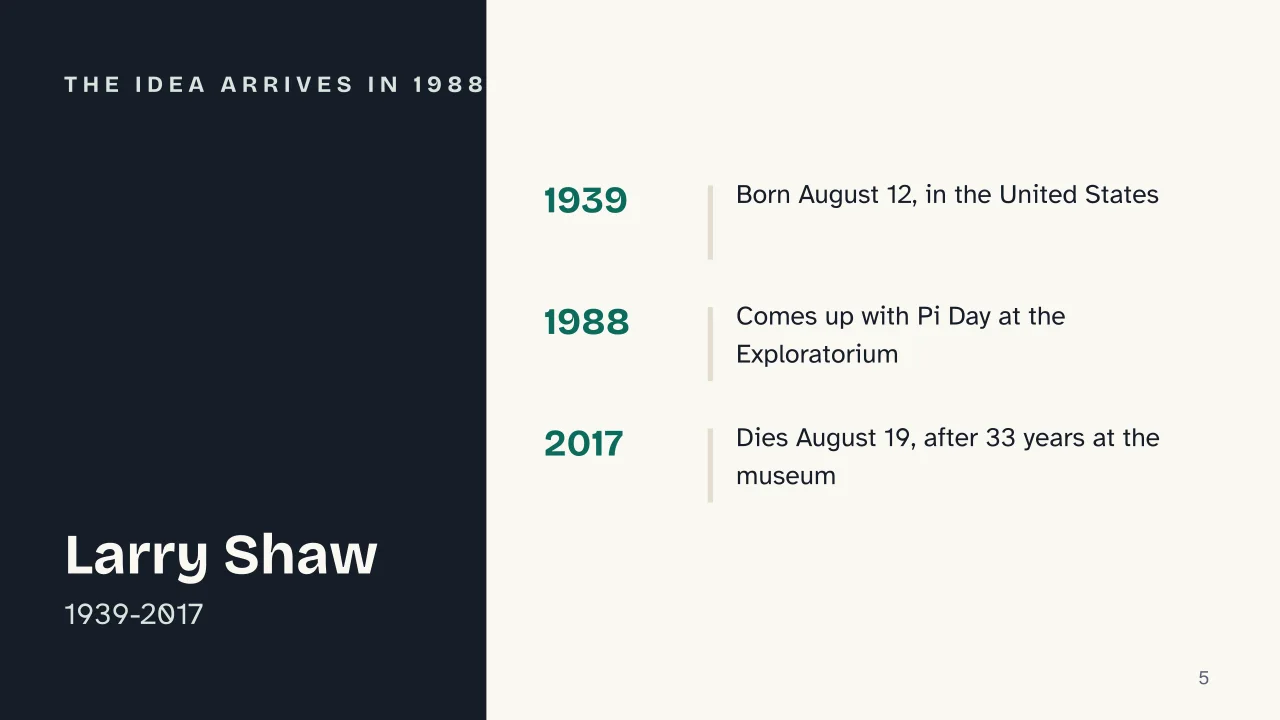 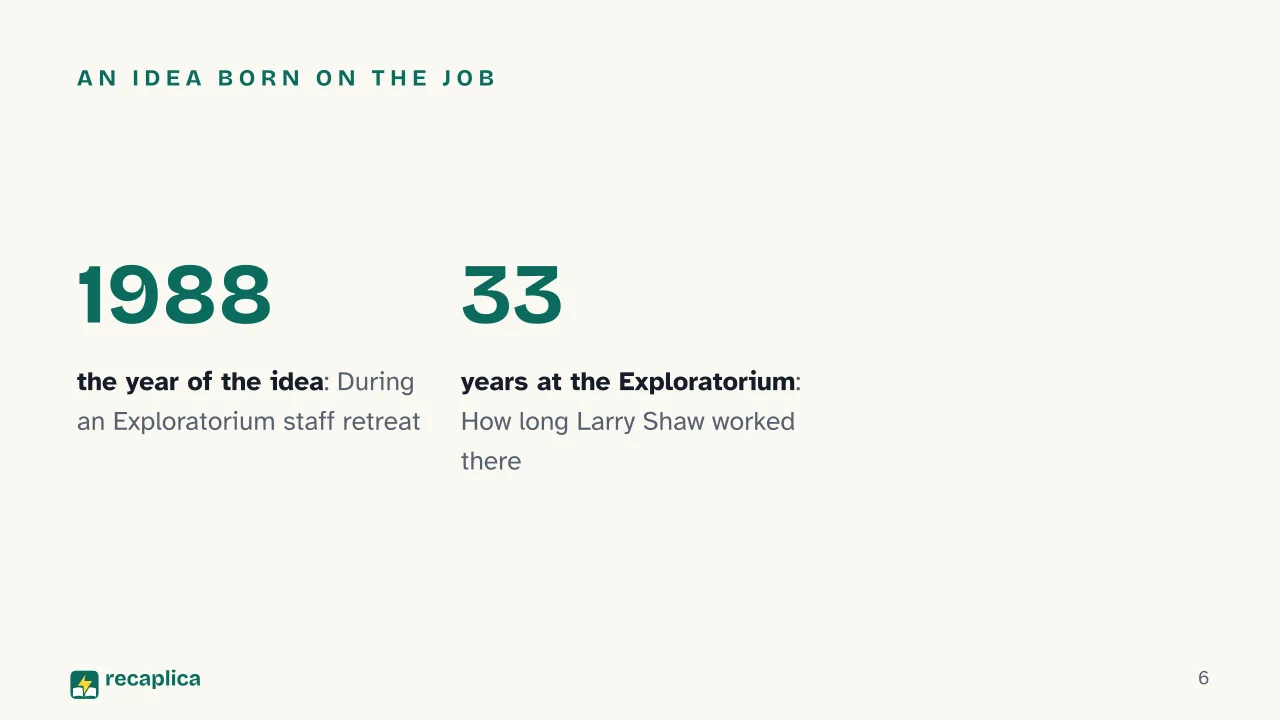  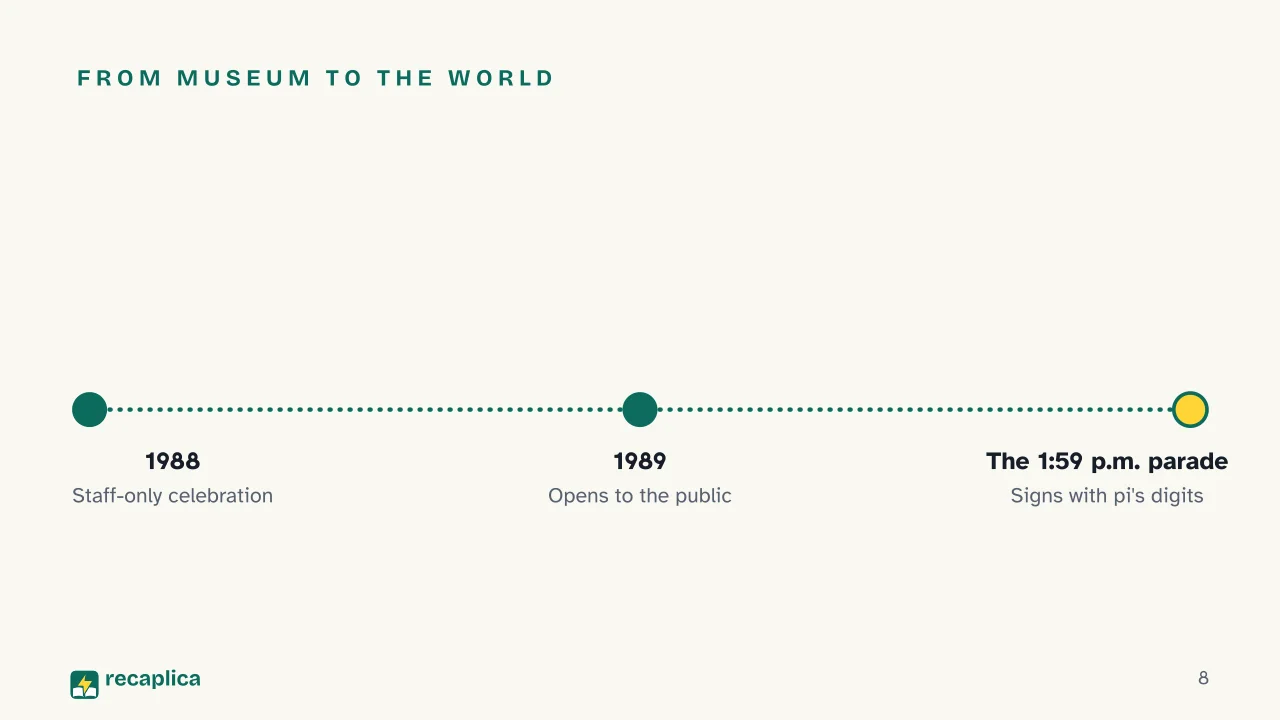 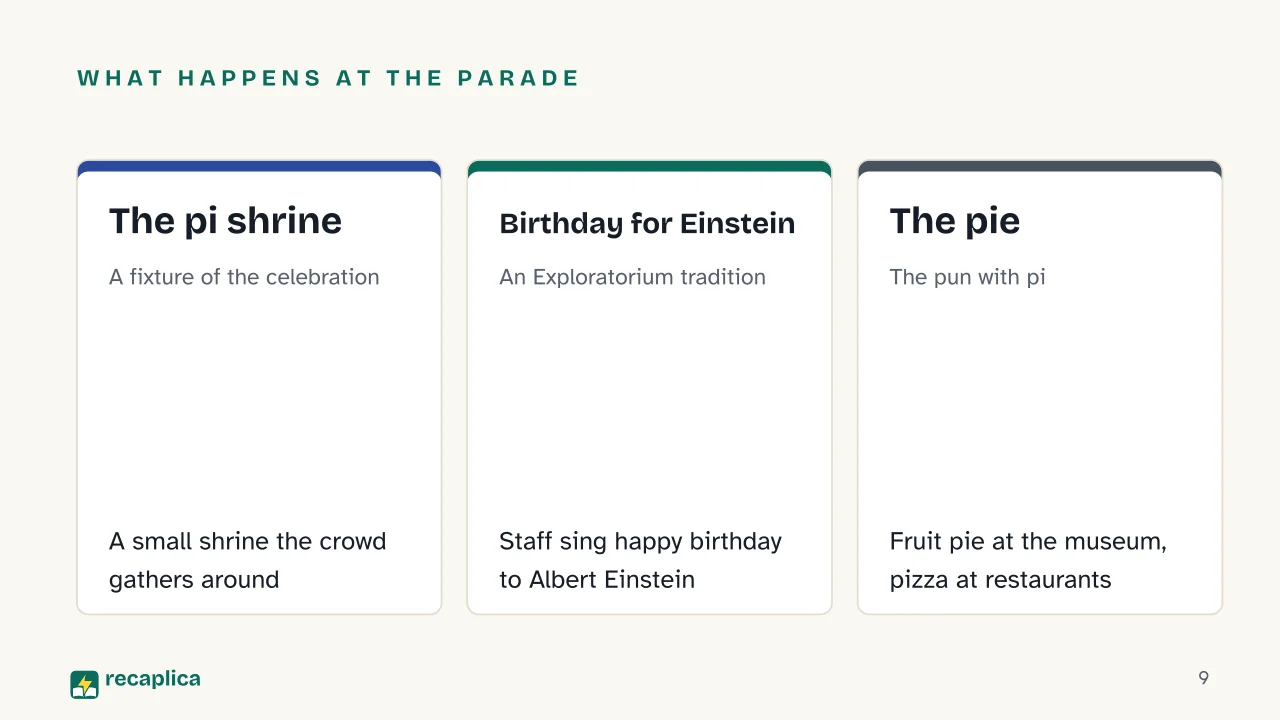  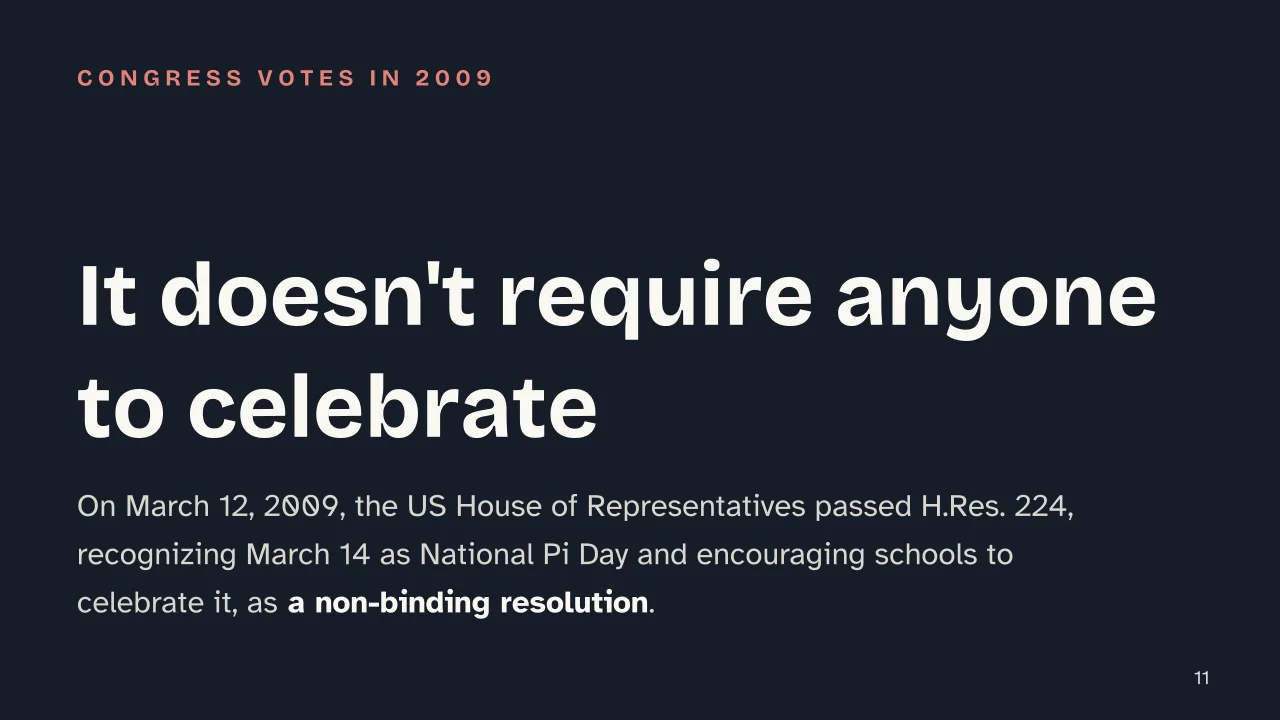   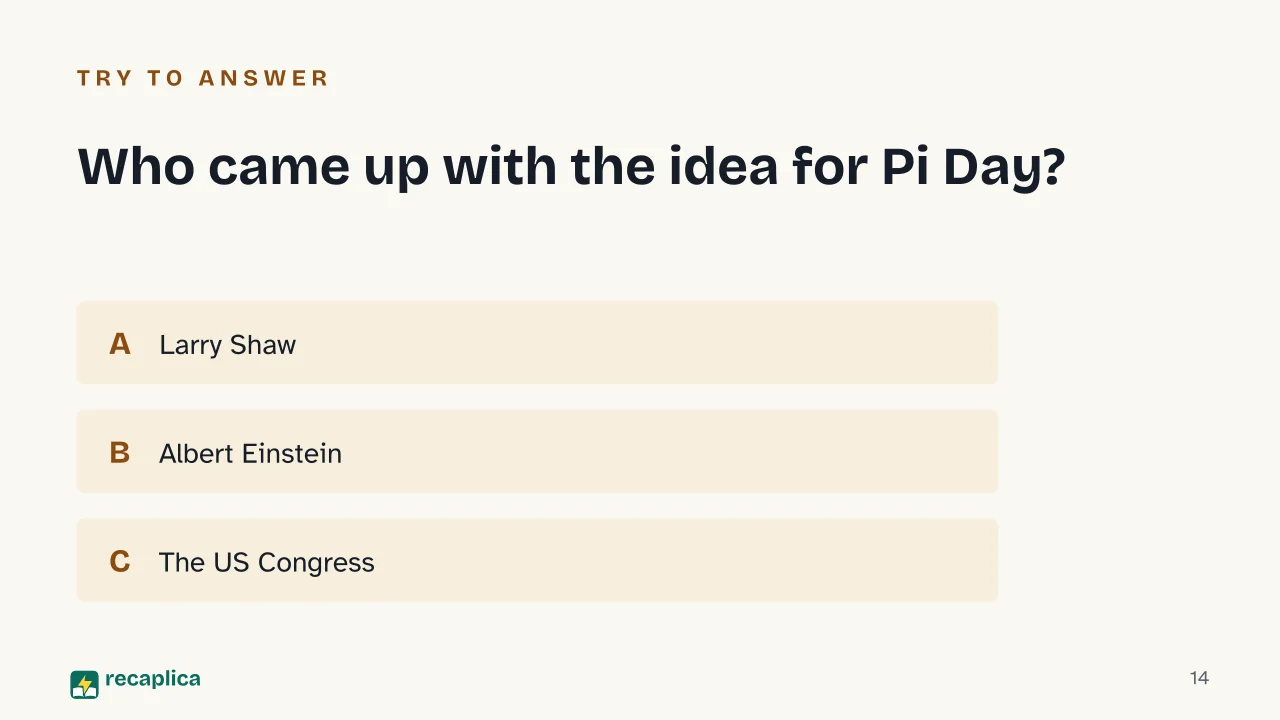  Common myths
Mind mapDrag the background to move around and the nodes to reposition them; use − and + to collapse and expand branches. 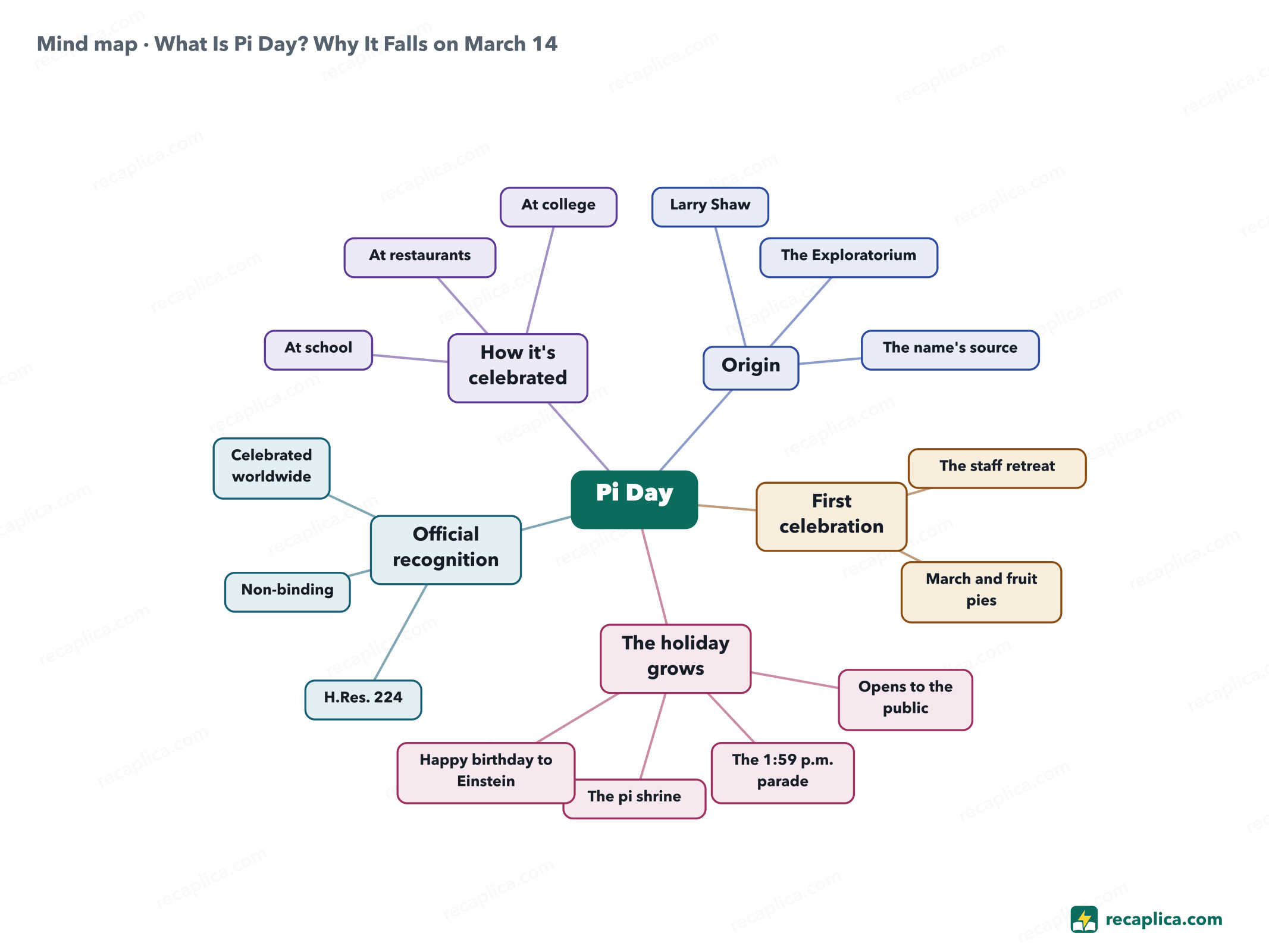
Quiz: test yourselfAnswer the questions to check what you have learned: you get instant feedback and a short explanation. Grade 0/10 0/5
FlashcardsTap the card to flip it and check whether you remember the answer, then move to the next one. 1 / 8 Explain it in your own wordsThe ultimate test: if you can explain it in simple words, you've truly understood it. Write your explanation, then compare it with the Recap. Your explanation is saved only on this device.
Frequently asked questionsIs Pi Day an official holiday worldwide?No. In the United States, a 2009 congressional resolution recognizes it, but it isn't binding; in the rest of the world it's an observance marked mostly by schools, museums, and enthusiasts, with no legal status. Who invented Pi Day and why?Larry Shaw, a physicist at San Francisco's Exploratorium, in 1988, during a staff retreat where colleagues were discussing mathematical constants: he connected pi's first digits to the date March 14, written 3/14 in the US format. What do people eat on Pi Day?Mostly pie, thanks to the pun between pi and pie. At the Exploratorium, staff eat fruit pies, and many pizza places and bakeries run discounts or giveaways on the day. Does Pi Day have anything to do with Albert Einstein?Only in passing: the Exploratorium celebration traditionally includes singing happy birthday to Albert Einstein, but the holiday itself comes from linking March 14 to pi's digits, not from a direct tie to him. How do schools celebrate Pi Day?Often with contests over who can recite the most decimal digits of pi from memory, along with other classroom activities about the number, as the 2009 US congressional resolution also encourages. Every Recap goes through an independent review before publication. |