|
recaplica
Irrational Numbers: What They Are and Why the Square Root of 2 Isn't a Fraction |
| © 2026 Recaplica · recaplica.com — All rights reserved |
Irrational Numbers: What They Are and Why the Square Root of 2 Isn't a FractionWhat to print Page numbers appear when printing with default margins. SlidesChoose a cut Flash10 slidesThe essential thread, to present in classFull15 slidesEvery chapter and the deeper detailBoth come with speaker notes. In 30 seconds quick readIrrational numbers are real numbers that cannot be written as a fraction: their decimal digits go on forever without ever settling into a repeating pattern. The first case ever found, in ancient Greece, was the square root of 2, the length of the diagonal of a square with sides of length 1. The proof that the square root of 2 isn't a fraction works by contradiction: it assumes the opposite and shows that assumption leads nowhere. Historians trace the discovery to the Pythagorean school as a group rather than to Pythagoras himself, since solid evidence for his personal role is thin. Key Points
Deep DiveThe numbers used at school for counting and measuring split into two families, and the difference is about how they can be written, not how big they are. According to Treccani, an irrational number is a real number that cannot be expressed as a fraction: its decimal form is infinite and never settles into a repeating pattern, while a rational number always has a decimal that is either finite or repeating. The square root of 2, the number that multiplied by itself gives 2, is the case through which this distinction first entered the history of mathematics. A fraction for every segment, or so it was thoughtIn ancient Greece, Treccani recounts, it was believed that any two line segments must have a ratio expressible as a fraction: all it took was finding a shared unit of measure, as small as needed, and counting how many times it fit into each of the two. The Pythagorean theorem ties a square’s side to its diagonal with a precise calculation: if the side measures 1, the diagonal measures the square root of 2. The trouble started when someone tried to find that shared unit between the side and the diagonal, and could not.
MacTutor, the history-of-mathematics website run by the University of St Andrews, calls this situation incommensurability: no single unit length exists of which both 1 and the square root of 2 are whole-number multiples. The proof, step by stepThe proof that the square root of 2 isn’t a fraction is a proof by contradiction, one of the basic tools of algebra. The starting point is the opposite claim: that the square root of 2 is rational, so it could be written as the ratio a/b of two whole numbers. Any common factor between a and b drops out through the Euclidean algorithm, leaving the fraction already in lowest terms — which means at least one of the two numbers has to be odd. Squaring the equation a/b = √2 gives a² = 2b². That means a² is an even number, since it’s twice another whole number; and if a² is even, a itself must be even too. Substituting a with twice a whole number and working through the calculation leads to the conclusion that b must also be even. At that point both a and b come out even — impossible, since a/b was supposed to be reduced to lowest terms with at least one odd number. The claim that the square root of 2 is rational has to be false. Who discovered it, and whenHere the sources turn cautious. MacTutor credits the discovery to the Pythagorean school as a whole, and considers it unlikely that it was Pythagoras’s own work. Little is known with certainty about when and under what circumstances it happened. The name most often mentioned in connection with this discovery is the Pythagorean Hippasus of Metapontum: a tradition holds that he was killed for revealing the secret of the square root of 2’s irrationality to outsiders, though the account survives mostly as folklore, resting on almost no documentary support. The historian Von Fritz put forward a separate hypothesis, never a settled fact: that the same Hippasus was also the first to prove a different number irrational, the golden ratio, uncovered through the proportions of the regular pentagon. Historians also suspect that the incommensurability of the square root of 2 was found before that other case, which would help explain why the mathematician Theodorus of Cyrene, some time later, began his own studies of square roots with 3 rather than with 2: that path had already been walked. Algebraic and transcendental numbersTreccani sorts irrational numbers into two families. Algebraic numbers include every square root √x of a number x greater than zero that isn’t a perfect square, such as the square root of 2, of 3, or of 5. Transcendental numbers are everything else, infinitely many of them too: among these, π and Euler’s number (e) matter enough to have earned their own symbol. For a map of every family of numbers, from the naturals to the reals, the general overview lives in Number Sets. Slide deckSlides ready to download and make your own in PowerPoint or Google Slides, with speaker notes. Pick the Flash cut or the Full one.     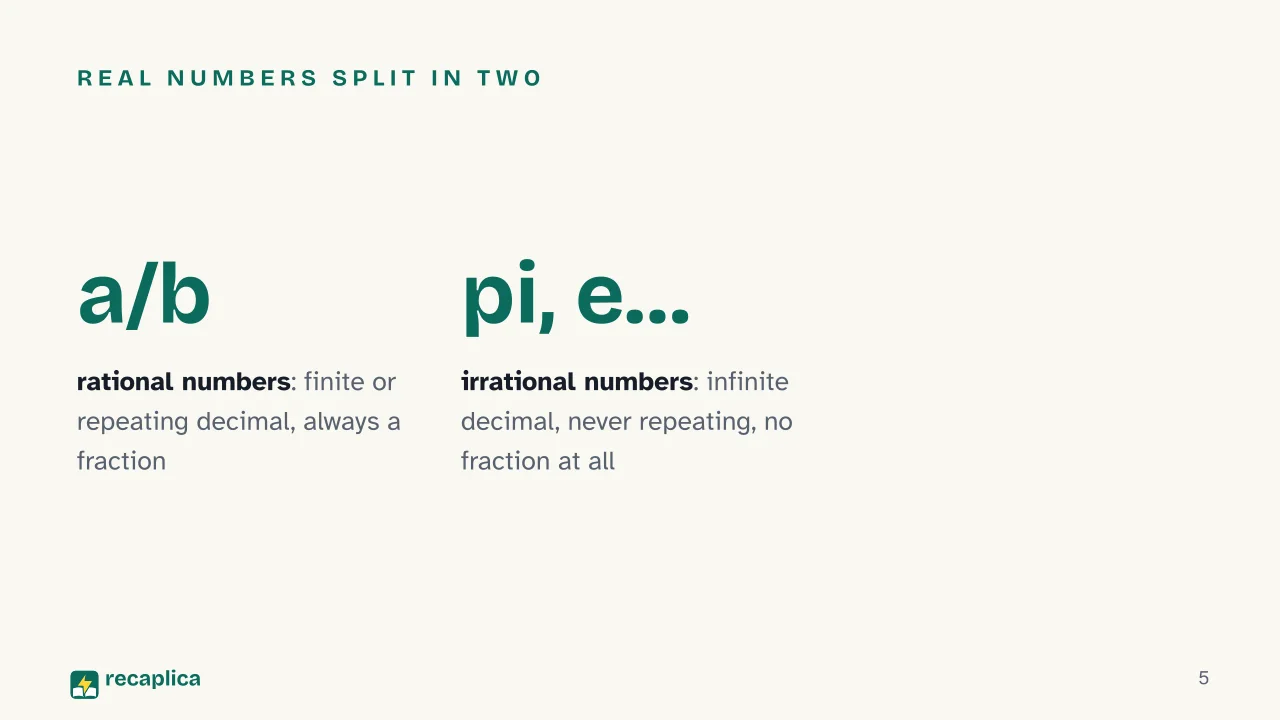  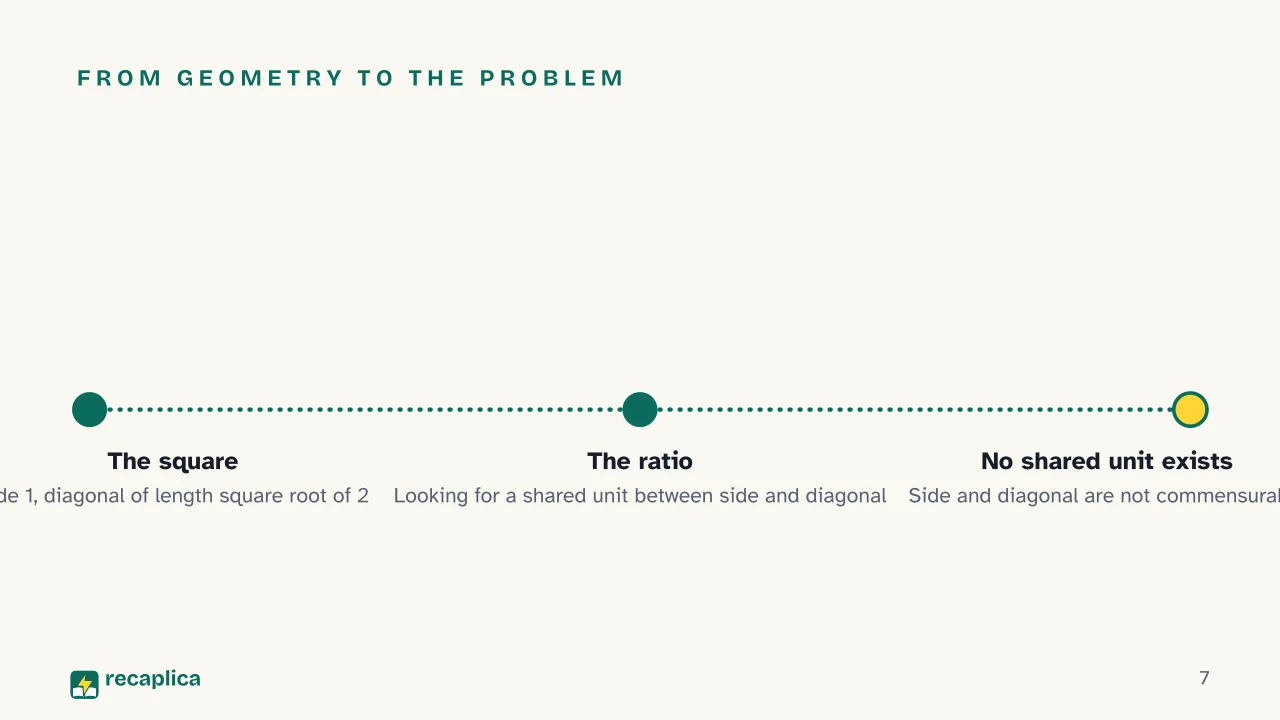  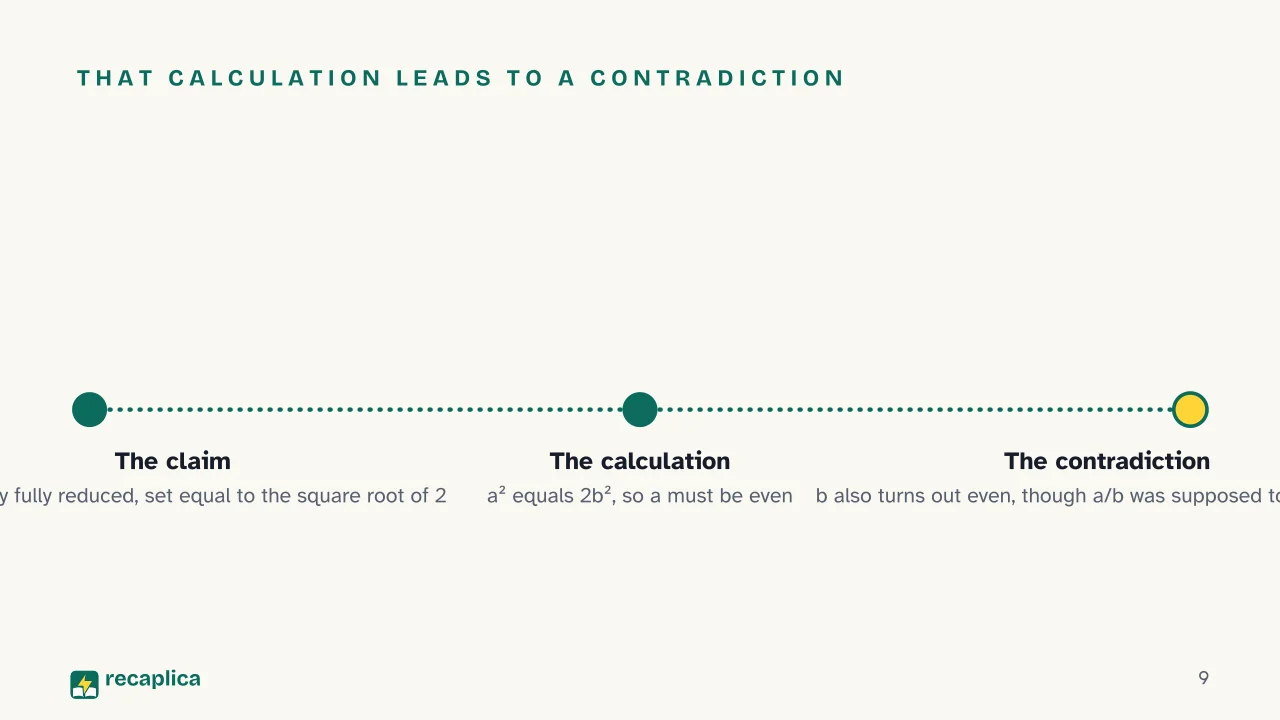 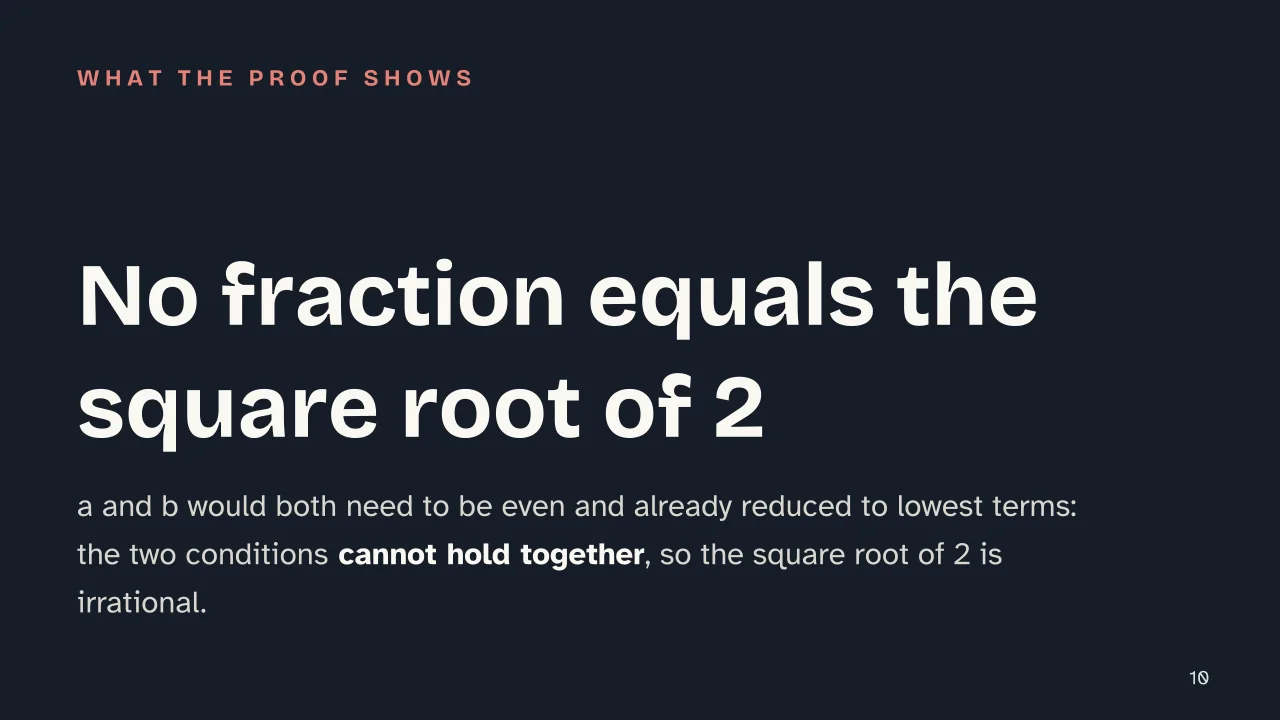  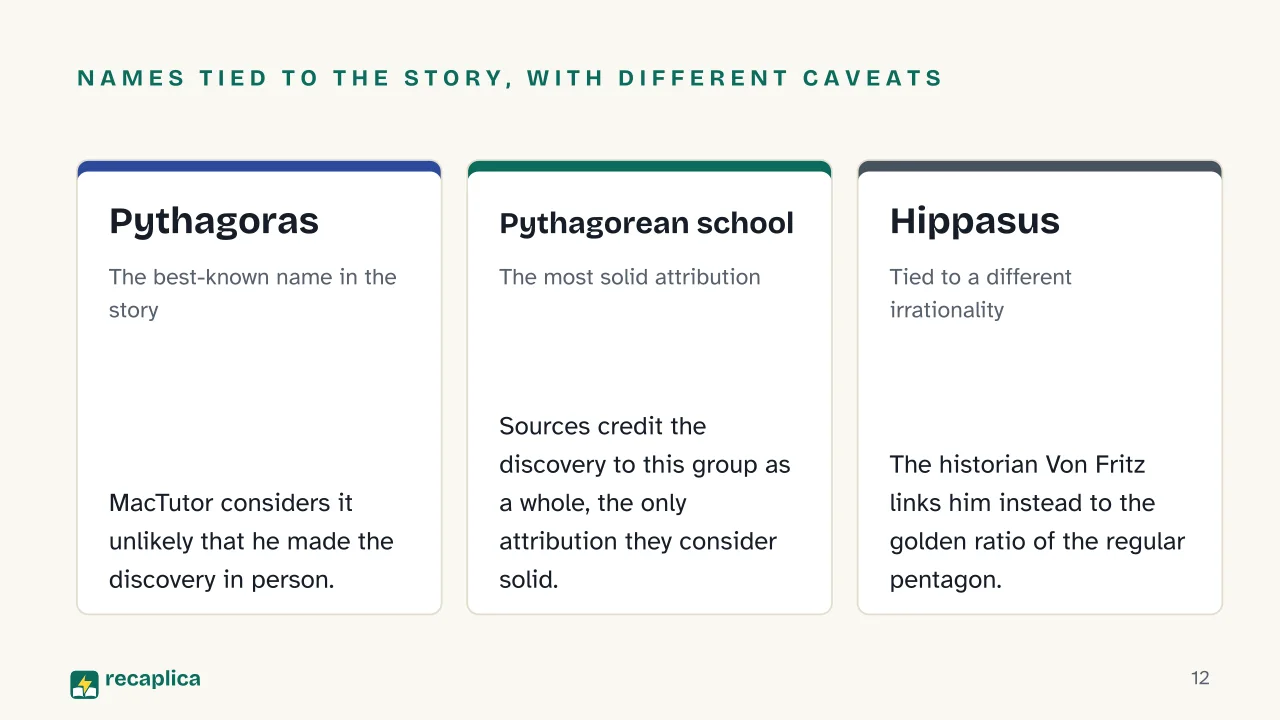 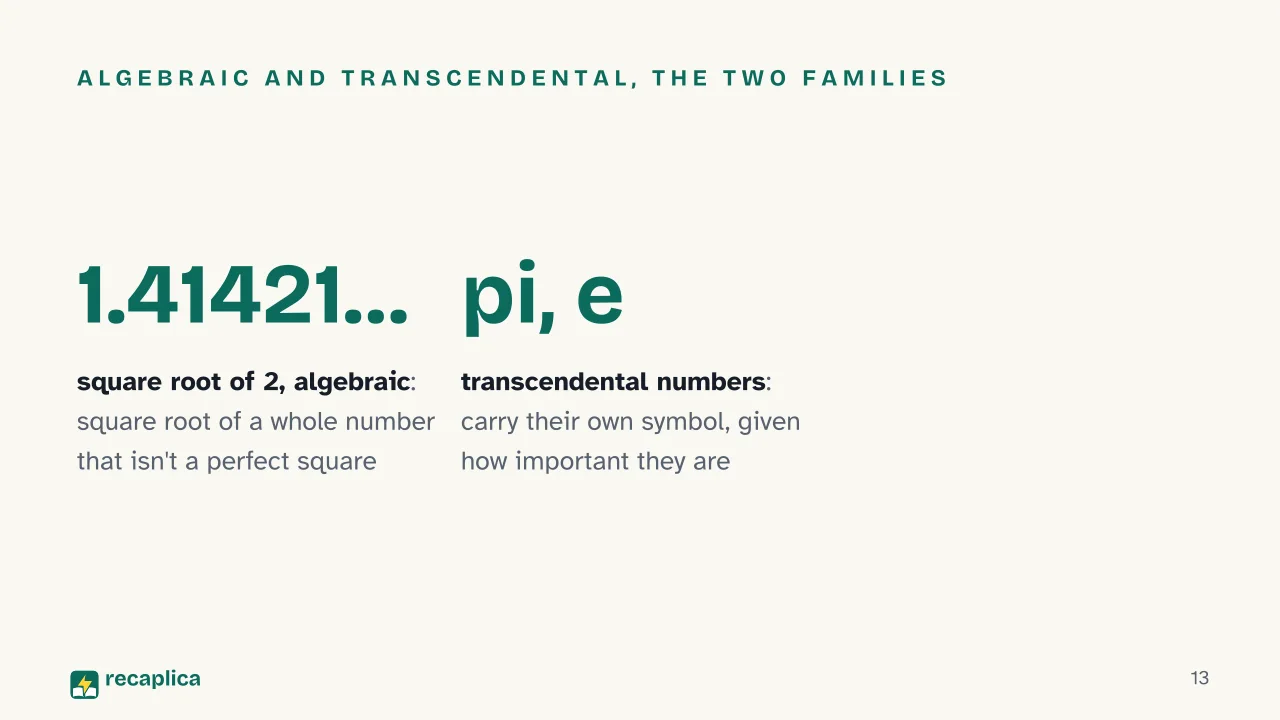 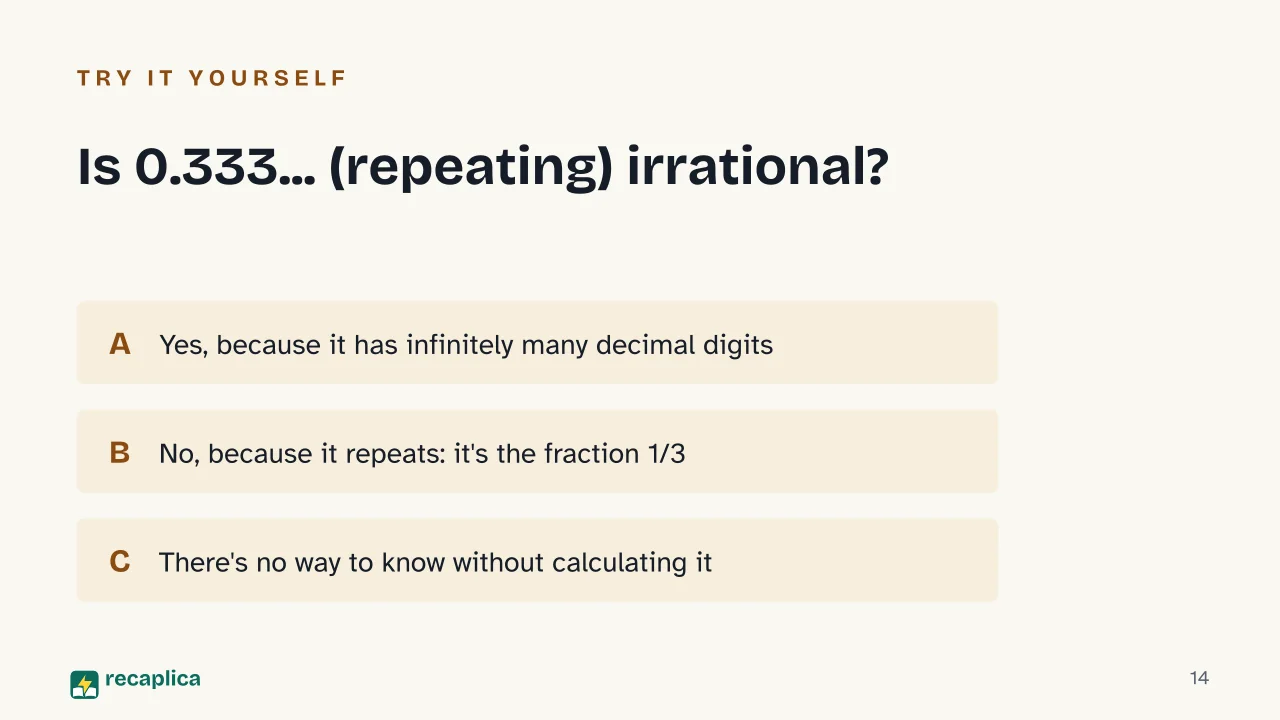  Common myths
Mind mapDrag the background to move around and the nodes to reposition them; use − and + to collapse and expand branches. 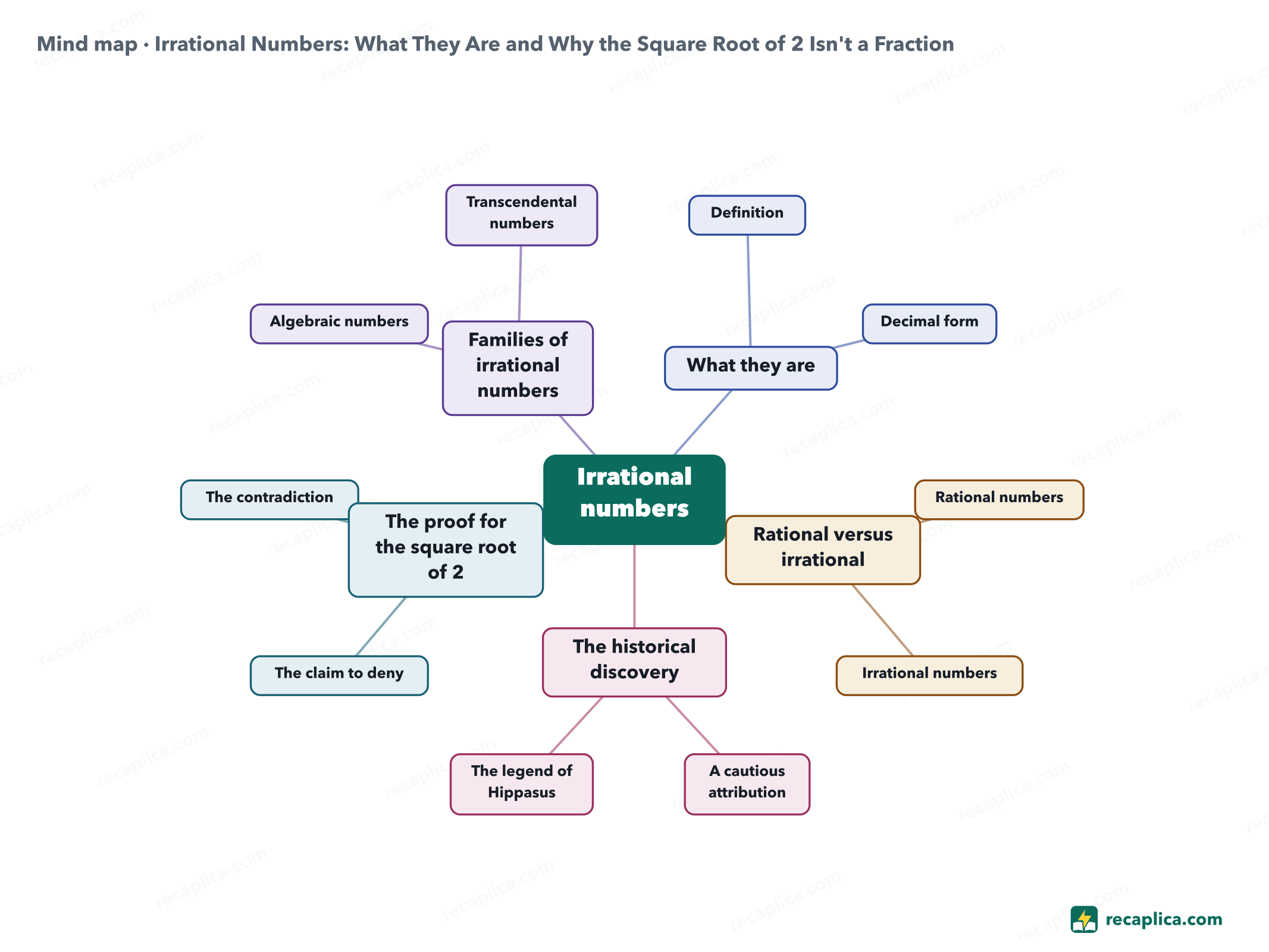
Quiz: test yourselfAnswer the questions to check what you have learned: you get instant feedback and a short explanation. Grade 0/10 0/5
FlashcardsTap the card to flip it and check whether you remember the answer, then move to the next one. 1 / 8 Explain it in your own wordsThe ultimate test: if you can explain it in simple words, you've truly understood it. Write your explanation, then compare it with the Recap. Your explanation is saved only on this device.
Frequently asked questionsIs 0.333... (repeating) an irrational number?No. It has infinitely many decimal digits, but they repeat: according to Treccani, that pattern makes it a rational number, expressible as the fraction 1/3. Why isn't the square root of 2 a fraction?Because, if it were rational, it would have to equal an already fully reduced fraction a/b with no common factors; the calculation instead shows that both a and b come out even, which is impossible for a fraction already reduced as far as it can go. That contradiction is the proof. Who discovered irrational numbers?It remains an open question: sources point to the Pythagorean school as a group, while a direct role for Pythagoras himself is considered unlikely, and the exact time and circumstances of the discovery are still unknown. What are examples of irrational numbers?The square root of 2, and more generally the square root of any positive whole number that isn't a perfect square; also π and Euler's number (e), both important enough to have their own symbol. Are 0, 3.14, and 1/3 rational or irrational?All three are rational. Zero can be written as 0/1, 3.14 is a terminating decimal equal to the fraction 314/100, and 1/3 equals the repeating decimal 0.333..., with digits that settle into a repeating pattern. None has the infinite, non-repeating decimal expansion that defines an irrational number; note that 3.14 is only a rounded stand-in for π, which actually is irrational. Every Recap goes through an independent review before publication. |